Funds face being pinched in a closing information gap; Watchdogs crack down on investment managers’ traditional edge

January 10, 2014 4:17 pm

Funds face being pinched in a closing information gap

By Brooke Masters in London

Watchdogs crack down on investment managers’ traditional edge

It is getting harder and harder to find an edge these days. Back in the day, fund managers achieved good results by cultivating company executives to get an early sniff of looming problems and successes. Then regulators cracked down on the practice of selective information sharing. The US passed regulation FD (for fair disclosure) in 2000 and the UK began enforcing rules requiring prompt disclosure of material information. The rise of the internet and high-frequency trading also cut down on information asymmetry and sped up market reaction to news when it occurred. Professionals are also finding that there are fewer inattentive punters to exploit. Institutional investors now hold more than 60 per cent of US shares, up from just 10 per cent in the 1970s; and the average holding period of UK shares has dropped from five years in the 1960s to well under a year now. Read more of this post

From Non-GAAP To Non-Sense: David Stockman Slams The “Earnings Ex-Items” Smoke-Screen

From Non-GAAP To Non-Sense: David Stockman Slams The “Earnings Ex-Items” Smoke-Screen

Tyler Durden on 01/11/2014 17:47 -0500

We noted on Thursday, when Alcoa reported, that “non-recurring, one-time” charges are anything but; indicating just how freely the company abuses the non-GAAP EPS definition, and how adding back charges has become ordinary course of business. But it’s not just Alcoa, and as David Stockman, author The Gret Deformation, notes Wall Street’s institutionalized fiddle of GAAP earnings made P/E multiples appear far lower than they actually are, and thereby helps perpetuate the myth that the market is “cheap.” Read more of this post

Forget BRICs & PIIGS; Meet The Fragile 5 Emerging Markets

Forget BRICs & PIIGS; Meet The Fragile 5 Emerging Markets

Tyler Durden on 01/09/2014 20:03 -0500

20140109_saxo

Despite an apparent belief among the US mainstream media that ‘taper’ is priced in, Saxo Capital Markets warns that Emerging Market countries with large current account deficits like Brazil, India, South Africa, Indonesia, and Turkey face increasing problems. As the following chart shows (and highlghted most recently by Brazil’s highest FX outflows since 2002!) could see their currencies weaken even further if the Fed’s taper plans result in a deterioration of global risk appetite. Think it will be different this time? Think again – Brazil just saw its largest outflows since 2002!!! Read more of this post

Ford is taking a calculated risk by abandoning the traditional welded steel construction in the F-150 and switching to aluminum to reduce weight

The F-150’s Aluminum Diet

By LINDSAY BROOKEJAN. 10, 2014

DETROIT — When Ford rolls out its redesigned F-150 pickup truck here on Monday morning to kick off two days of press previews for the 2014North American International Auto Show, the automaker will be making one of the boldest product gambles in its 111-year history. Read more of this post

Fed’s Lacker Admits “Asset Bubble” – Reluctant To Pop It

Fed’s Lacker Admits “Asset Bubble” – Reluctant To Pop It

Tyler Durden on 01/10/2014 09:56 -0500

While we have been told again and again that there are no asset bubbles – although th emost recent FOMC statement referenced concerns over small-cap mulitples and covenant-lite loan issuance – it seems the Fed’s Jeff Lacker just let slip some ugly truthfulness…Answering questions after a speech proclaiming growth ahead and rising inflation, he said: Read more of this post

Europe’s Prospects Looked Better in 1930s

Europe’s Prospects Looked Better in 1930s

Recent growth in the euro area has tracked the experience of much of Europe in the 1930s all too closely. Unless policies change, this stagnation is likely to persist. In some ways, the euro area’s prospects are more challenging than the parallel with the Great Depression suggests. If only things were as bad as in the 1930s — how’s that for a thought to put matters in perspective? Read more of this post

Dubai Plans to Crack Down on Home Flipping That Fed Bubble

Dubai Plans to Crack Down on Home Flipping That Fed Bubble

Dubai plans new rules to control speculation on properties sold before they’re built after home prices climbed by more than 30 percent last year, the head of the emirate’s Land Department said. Read more of this post

Dollar stores are now getting too expensive for many Americans

Dollar stores are now getting too expensive for many Americans

By Matt Phillips @MatthewPhillips January 10, 2014

For low-income Americans, even shopping at Family Dollar can feel like an uphill climb. Reuters/Jim Young

At first glance, the fortunes of American families have significantly improvement recently. Household net worth has rebounded back to roughly where it was before the financial crisis. Read more of this post

Pimco’s El-Erian: Do not bet on a broad emerging market recovery

January 8, 2014 6:00 am

Do not bet on a broad emerging market recovery

By Mohamed El-Erian

Valuations are more attractive but stock picking is important

One striking aspect of last year’s markets is the extent to which emerging marketassets underperformed those in advanced economies. As investors search for returns this year among some frothy asset markets, such unusual underperformance attracts even greater attention. Read more of this post

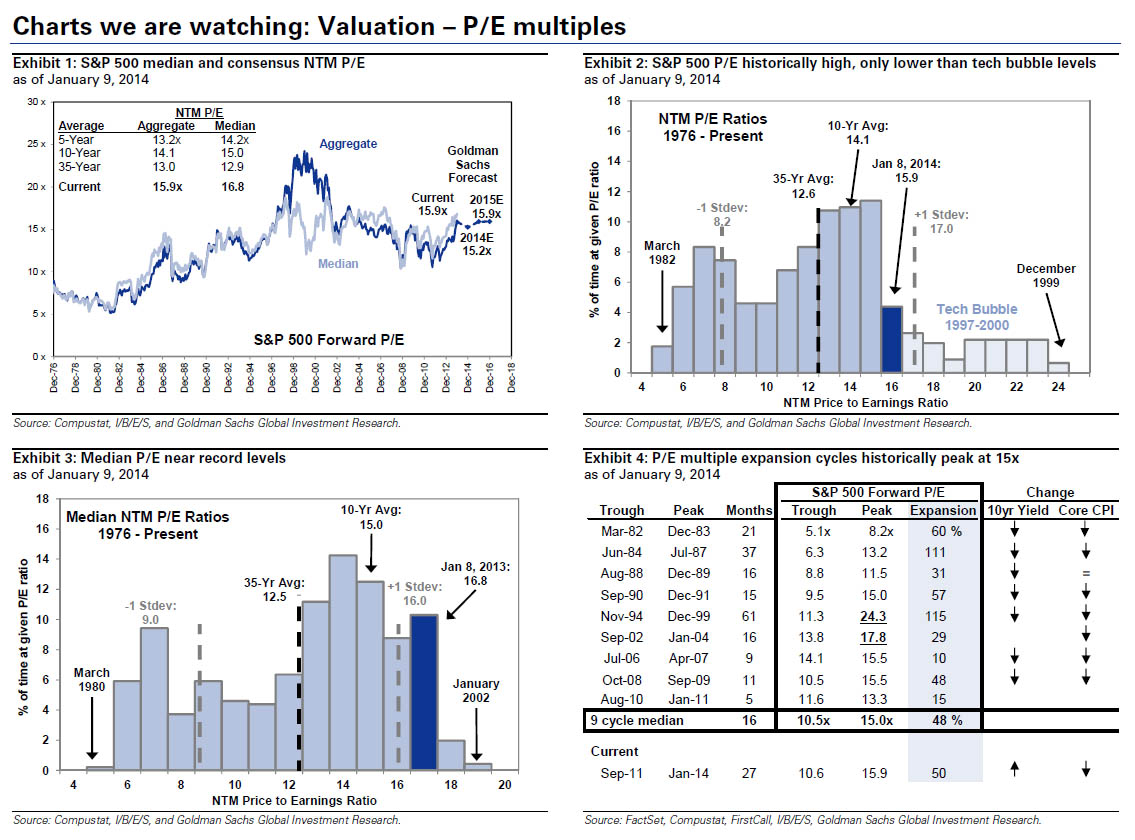
Did Goldman Just Kill The Music? – “The S&P500 Is Now Overvalued By Almost Any Measure”

Did Goldman Just Kill The Music? – “The S&P500 Is Now Overvalued By Almost Any Measure”

Tyler Durden on 01/11/2014 12:46 -0500

GS chart 1

“As long as the music is playing, you’ve got to get up and dance…. We’re still dancing.”

– Chuck Prince, July 2007

Late last night the music may have just skipped a major beat after Goldman released a Friday evening note that is perhaps the most bearish thing to come out of Goldman’s chief strategist David Kostin in over a year, (and who incidentally just repeated what we said most recently a week ago in “Stocks Are More Expensive Now Than At Their 2007 Peak“). To wit: Read more of this post

Cut Out the Wolves of Wall Street With ETFs

Cut Out the Wolves of Wall Street With ETFs

After watching “The Wolf of Wall Street,” the thought of investing though a financial middleman may seem as appealing as diving into the ocean right after seeing “Jaws.” Read more of this post

Covered Bond Shock Forces Denmark to Examine ‘Plan B’ for Banks

Covered Bond Shock Forces Denmark to Examine ‘Plan B’ for Banks

Denmark is mapping out a new battle plan to protect $555 billion in mortgage bonds after Europe’s bank regulator proposed rules that threaten to trigger a sell-off of the securities. Read more of this post

Challenging year forces Brazil to rethink growth strategies; Brazil: the end of an era as outflows hit 10-year high

January 9, 2014 8:10 pm

Challenging year forces Brazil to rethink growth strategies

By Samantha Pearson in São Paulo

Plastered across shop windows along São Paulo’s main Paulista Avenue this week is one word: ‘liquidação’ (sale). Stores in Brazil’s biggest city are offering discounts of up to 90 per cent as they frantically try to clear stock after the worst Christmas in a decade. Read more of this post

Central banks’ influence set to wane, despite rise in reserves

January 7, 2014 8:35 pm

Central banks’ influence set to wane, despite rise in reserves

By Delphine Strauss in London

Central banks rebuilt foreign currency reserves in the third quarter of 2013 but their influence in currency markets may decline as the US Federal Reserve scales back its exceptional stimulus. Read more of this post

Can Norwegian Air Shuttle Become the Cheapest Global Airline?

Can Norwegian Air Shuttle Become the Cheapest Global Airline?

By Devin Leonard January 09, 2014

feat_Bjorn03__01__300 03_feat_norwegianair_315

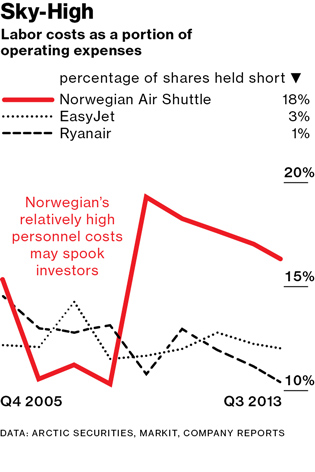
It’s snowing in Copenhagen as Norwegian Air Shuttle Flight DY7041 lifts off. There are nearly 300 passengers on board, most of them Norwegians, Swedes, and Danes eager to escape the gloom that engulfs their part of the world in late November. Today they will arrive in Florida faster than usual. This is the first direct flight from Scandinavia to Fort Lauderdale. And it’s a bargain: The tickets are a fraction of what larger airlines charge. Read more of this post

Can a Hungry World Say No to GM Crops and Still Have Food Security?

Can a Hungry World Say No to GM Crops and Still Have Food Security?

by Marc Van Montagu | Jan 7, 2014

The world is running low on food. Can we afford to reject GM crops out of hand?

Rice provides up to 80 percent of food calories for poor societies, but lacks micronutrients such as Vitamin A. Worldwide, every year, hundreds of thousands of children die due to a lack of Vitamin A and multiples thereof become permanently blind. Read more of this post

Buy $3 Trillion in Stocks. What Could Go Wrong?

Buy $3 Trillion in Stocks. What Could Go Wrong?

Of the five economic proposals Jesse Myerson lists in Rolling Stone, one stands out, though not in a positive sense: that the U.S. start a sovereign wealth fund. It’s a proposal that would prove problematic for capital markets, pose thorny conflicts of interest, and offer vast opportunities for cronyism and graft. Read more of this post

BlueCrest Builds a Hedge Fund Empire

BlueCrest Builds a Hedge Fund Empire

By Jesse Westbrook January 09, 2014

When hedge fund managers venture into new areas, they typically move gradually. Not Michael Platt, co-founder of BlueCrest Capital Management. To expand from fixed-income investing into stocks, he negotiated a $750 million loan from 16 banks in July, allowing his firm to hire at least 25 money managers and provide them with capital to start trading immediately, according to two people with knowledge of the loan who asked not to be identified because it isn’t public. “I can’t think of any other examples like this,” says Daniel Celeghin, a partner at Casey Quirk & Associates, which advises hedge funds on fundraising. “It’s just the nature of finance, where if you are big and successful, people want to do business with you.”

Read more of this post

Bitcoin Banned by Alibaba’s Taobao After China Tightens Rules

Bitcoin Banned by Alibaba’s Taobao After China Tightens Rules

Alibaba Group Holding Ltd., China’s largest e-commerce website, will ban the sale of Bitcoin and other virtual currencies after the country’s central bank tightened regulations in December. Read more of this post

Big carmakers: Kings of the road; Size is not everything for mass-market carmakers. But it helps

Big carmakers: Kings of the road; Size is not everything for mass-market carmakers. But it helps

Jan 11th 2014 | From the print edition

20140111_WBC124

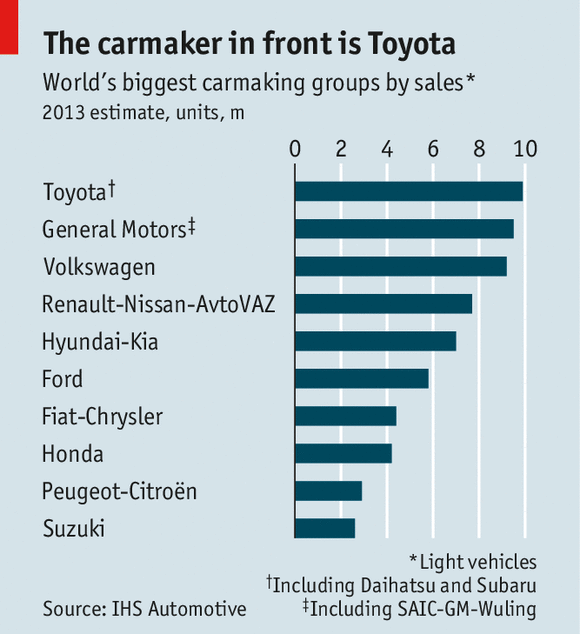
AS THE first estimates of worldwide car sales in 2013 come in, it is clear that Toyota, when its production is combined with that of its affiliates Daihatsu and Subaru, is on the brink of becoming the first member of the “10m club”. It will swiftly be followed by GM and Volkswagen (see chart), both of which are also enjoying continued growth, especially in the world’s largest car market, China. Makers of luxurious models with strong brands, such as BMW and Jaguar Land Rover, can do well selling relatively small volumes of cars for handsome profits. But despite rising sales in America and Britain, and the apparent end of a six-year downturn in continental Europe, life is getting tougher for a squeezed middle, selling mainly mass-market models at margins that are slim at best. Read more of this post

Banking rivalries: Risk on, risk off; Goldman Sachs is sticking to trading while Morgan Stanley bets on wealth management

January 9, 2014 7:51 pm

Banking rivalries: Risk on, risk off

By Tom Braithwaite

Goldman Sachs is sticking to trading while Morgan Stanley bets on wealth management

Only two pure Wall Street investment banks survived the financial crisis intact. One came to be viewed as so powerful that it had become a problem for society. The other was considered lucky simply to have made it. Read more of this post

Baltic Dry Index Collapses 35% – Worst Start To Year In 30 Years

Baltic Dry Index Collapses 35% – Worst Start To Year In 30 Years

Tyler Durden on 01/10/2014 09:11 -0500

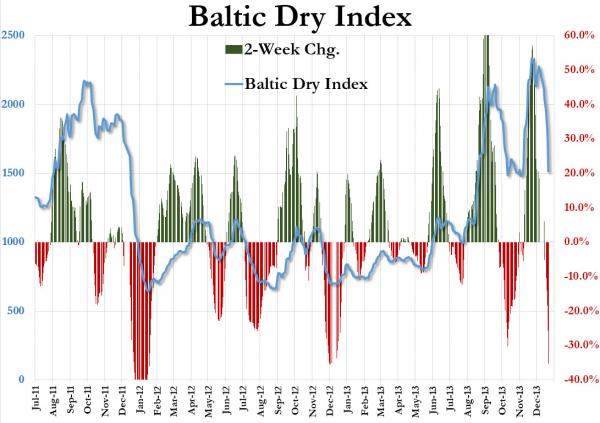
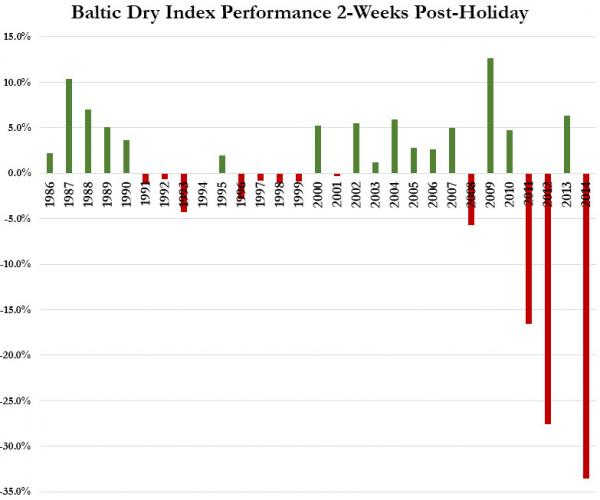
When this indicator of global trade rises, everything is rosy and reams of asset-gatherers and talking-heads wil quote it as indicative of how great the world is. When it drops – silence. There’s always an excuse – over- or under-capacity, too many ships, too few ships, etc. However, the last 2 weeks have seen a 35% collapse in the cost to ship bulk. There is a relative seasonal pattern over the holiday period – with shipping costs rising into the holiday and falling after but… this is the biggest drop from a Christmas Eve since at least 1984, 30 yearsSeems like the inventory stacking of Q4 had absolutely no follow-through whatsoever… All thepost-Thanksgiving exuberance has been eviscerated from the Baltic Dry Index… and some context – this is the worst post-holiday start to the year since at least 1984!!

20140109_BDIY2_0 20140109_BDIY1_0

Bailout Risk, Far Beyond the Banks; In the too-big-to-fail parade, what about a closer look at the asset management firms that oversee trillions of investor dollars?

Bailout Risk, Far Beyond the Banks

JAN. 11, 2014

By GRETCHEN MORGENSON

Everyone knows that the largest of our nation’s banks would be destined for a taxpayer bailout if they ran into trouble anytime soon. But which nonbank financial institutions — say, asset management companies offering hedge funds or mutual funds — might also pose too-big-to-fail risks because of their size and interconnections? Read more of this post

Ars deathwatch 2014: Companies on the edge of relevance; These five companies won’t die, but they may not escape 2014 in one piece

Ars deathwatch 2014: Companies on the edge of relevance

These five companies won’t die, but they may not escape 2014 in one piece.

by Sean Gallagher – Jan 4 2014, 9:30pm MPST

With all of the holiday cheer now behind us, it’s time to take stock of the year ahead. And while 2013 was a good year for the stock market and a somewhat better-than-recessionary year for the economy as a whole, the ravages of the past twelve months have placed a handful of technology-related companies at a crossroads—one that could lead to a miraculous recovery, an acquisition, or the sort of corporate undeath that turns them into intellectual property zombies that feed on other companies’ brains for survival. Read more of this post

An Advantage Vanishes for Money Funds; In a turnaround from decades past, money market bank deposits are paying more interest, on average, than money market mutual funds

An Advantage Vanishes for Money Funds

By ANNA BERNASEK

JAN. 11, 2014

When money market mutual funds were invented back in 1971, they offered something new. Investors could earn higher yields than on bank deposits, with nearly the same liquidity and safety. But that has changed. Currently, a money market deposit at Citibank pays about five times as much interest as an investment in the Fidelity Cash Reserves fund — though, in today’s low-rate environment, the yields are minuscule. Read more of this post

Accounting watchdogs are examining the role of RSA’s former auditor Deloitte in Ireland over the irregularities that left the FTSE 100 insurer with a £200m hole in its accounts

January 10, 2014 9:48 pm

Accounting watchdogs to look at RSA auditors

By Alistair Gray, Insurance Correspondent

Accounting watchdogs are examining the role of RSA’s former auditor Deloitte in Ireland over the irregularities that left the FTSE 100 insurer with a £200m hole in its accounts. Read more of this post

A new voice for investors to drive culture change; Shareholders can and must drive a real breakthrough in the pace of change towards better corporate cultures

A new voice for investors to drive culture change

Shareholders can and must drive a real breakthrough in the pace of change towards better corporate cultures.

By Helena Morrissey

7:09PM GMT 11 Jan 2014

Taking part in Barclays CEO Antony Jenkins’s guest-edited Today programme on New Year’s Eve, I was struck by just how far we are from reconciling the goals of corporate responsibility and profitability. Read more of this post

‘Low Beta Bubble’ is ‘On The Verge of Deflating’: BofA

January 6, 2014, 3:26 P.M. ET

‘Low Beta Bubble’ is ‘On The Verge of Deflating’: BofA

By Brendan Conway

BN-AZ610_BofAbe_P_20140106151330

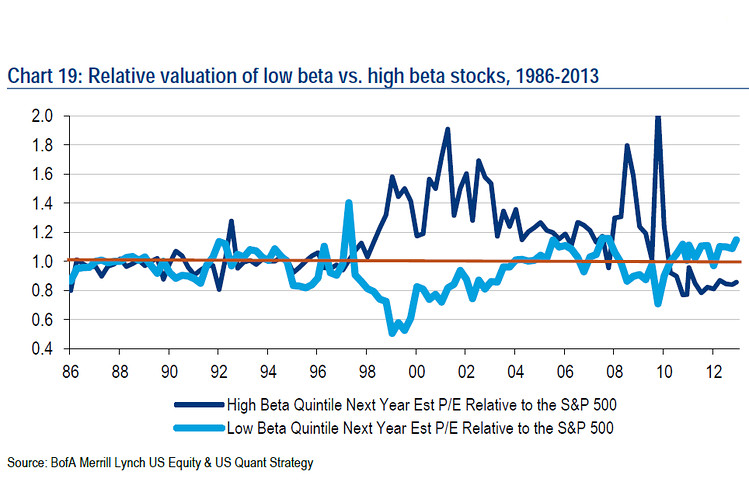
In investing, boring is often best. But there are cases where it isn’t — like when seemingly every investor wants staid and secure. Utility and telecom stocks showed it during 2013 when they sold off sharply due to investors’ interest-rate fears. The trend looks bigger than one bout of rate worries to Bank of America Merrill Lynch’s quantitative strategists. Read more of this post

Arrogance undoes the Turkish model; Erdogan’s high-handedness threatens country’s prosperity

January 8, 2014 6:33 pm

Arrogance undoes the Turkish model

Erdogan’s high-handedness threatens country’s prosperity

For much of the past decade, Recep Tayyip Erdogan, Turkey’s prime minister, has been hailed for the political and economic transformation he has wrought in his country. Since his moderate Islamist-rooted AK party came to power in 2002, Turkey has enjoyed political calm following years of unstable coalition governments. The Turkish economy has tripled in size in dollar terms, making it one of the world’s most dynamic emerging markets. When the Arab uprisings erupted in 2011, Turkey’s example of a democracy working in a Muslim majority state was lauded as a model for others in the region to follow. Read more of this post

New Year’s Greetings by Asian Patriarchs: Implications for Value Investors (Bamboo Innovator Insight)

Updates:

  • One of our recent new subscribers last month is a Singapore-based billionaire who’s a secretive low-profile super value investor with his own multi-billion family office and we have another European-based multi-billion family office signing up too.
  • The Bamboo Innovator also met up with one of our Institutional Subscribers over  Saturday at the Detecting Accounting Frauds Ahead of the Investment Curve workshop (our 6th run of the workshop series) and he commented that while he has been cautious on the macro front, he finds the investment philosophy, the thinking process and the stock ideas highlighted in the monthly reports to be carefully researched and useful for his professional and personal growth as a value investor in taking high-conviction bets of wide-moat business models with peace of mind in an uncertain macro environment.
  • We are grateful to have the support of our subscribers and readers, an unusual and exceptional group who are not traders seeking short-term momentum, get-rich-quick, syndicates-driven ideas. We are especially grateful to our initial subscribers including the astute private investors Mr K (whose investments in Malaysia’s wide-moat innovator DKSH is up nearly 200% since March 2013) and Mr W. This reminds the Bamboo Innovator of what Harvard’s Michael Porter remarked in a recent interview last month:

“The concern is that it seems like the vast majority of energy and effort in investing has become about other things. It’s about momentum. It’s about program trading to capitalize on tiny movements in share prices. It’s about locating your servers closer to the exchange so you can trade in and out a little faster. I’m all for price discovery and liquidity, but improvements here have diminishing returns for fundamental wealth creation. One investor’s gain is often another investor’s loss.. I believe that the fundamental purpose of investing is to deploy capital to productive uses in the real economy. It’s the ability of businesses to use capital well to meet needs at a profit and grow that creates all the wealth in society. Directing capital to companies that can use it productively to create economic value, and thus wealth, is ultimately the most profound benefit investors can have on society.”

With knowledge, we have a choice to invest in the hardworking Asian entrepreneurs and capital allocators who are serious in building a wide-moat business. And we are intrinsically motivated to keep the flames burning to highlight these exceptional innovators for our subscribers who are just as unique!

The following article is extracted from the Bamboo Innovator Insight weekly column blog related to the context and thought leadership behind the stock idea generation process of Asian wide-moat businesses that are featured in the monthly entitled The Moat Report Asia. Fellow value investors get to go behind the scene to learn thought-provoking timely insights on key macro and industry trends in Asia, as well as benefit from the occasional discussion of potential red flags, misgovernance or fraud-detection trails ahead of time to enhance the critical-thinking skill about the myriad pitfalls of investing in Asia at the microstructure- and firm-level.

Dear Friends and All,

New Year’s Greetings by Asian Patriarchs: Implications for Value Investors

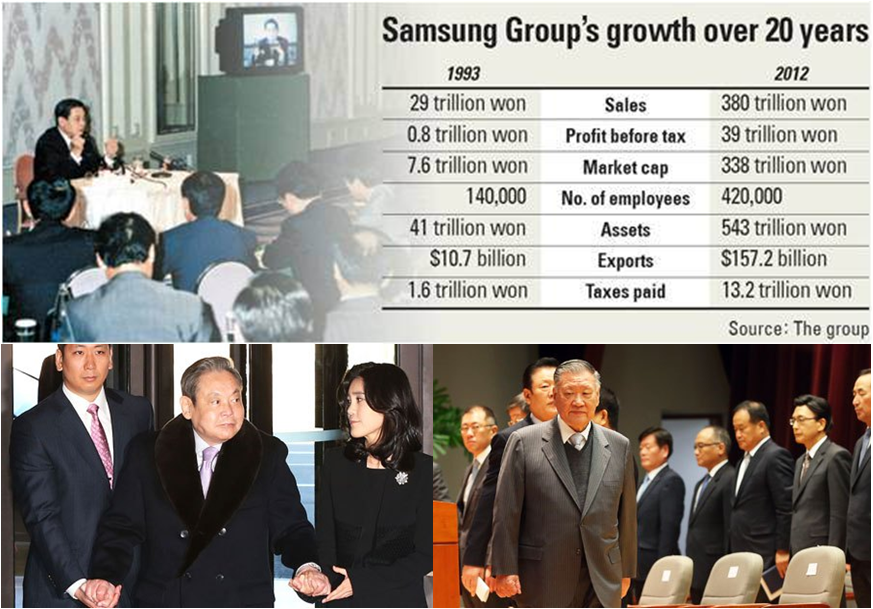
“Let us boldly throw away the business models and strategies of the past five and ten years,” said the 71-year-old Lee Kun-hee in a New Year message to Samsung Group’s 420,000 employees around the world. More than 60% of the profits of Samsung come from the flagship vehicle Samsung Electronics (005930 KS, MV $180bn), and 60% of Samsung Electronics’ profits come from mobile phones. “Let us move beyond our hardware-oriented processes and corporate culture. “Our leading businesses are constantly being challenged by competitors, while time is running out for our less dynamic businesses. It is therefore time to change once again. Economic slowdowns can present opportunities too. Let us see farther from a higher vantage point and create new technologies and markets. We must push ourselves to improve our business structure so that we can lead industry trends. We must innovate technologies that can help us compete in an uncertain future. And we must invest in systems to enhance our global management capabilities. As we move forward, we must resist complacency and thoughts of being good enough, as these will prevent us from becoming better. We should not be complacent and be armed again with a sense of crisis. We need to be a management that thrives on innovation, autonomy and creativity, that accepts challenge and is not afraid of failure. We must create an environment of ingenuity, where autonomy and creativity abound. There are social expectations on us. We will take another first step toward becoming an eternal, super first-class corporation that can’t be shaken by any obstacle. Once again, we will move strongly.” Like Nokia and Blackberry, Samsung was also disrupted by Apple but it managed to accomplish something the others did not — it bounced back, stronger than ever; to bend, and not break, like the bamboo.
New Year_Samsung

Top: On June 7, 1993, at an emergency executives meeting in Frankfurt, Germany, he told his assembled managers: “Change everything except your wife and children.” Bottom left: Samsung Electronics Chairman Lee Kun-hee walks into the Hotel Shilla in Seoul, holding hands with the hotel’s CEO and his daughter Boo-jin, to attend the 2014 New Year’s greeting ceremony; Bottom right: Hyundai Motor Group Chairman Chung Mong-koo walks into a hall to attend a New Year’s greeting ceremony at the group’s headquarters in Yangje-dong, Seoul.

“The economic condition is still difficult, especially with the strengthening of the won and the dragging out of the economic recovery,” said Koo Bon-moo, chairman of LG Group, as he asked each employee to be ready for the challenge of difficult times ahead. “We are in a crisis,” he said. “A leading firm could collapse due to a careless mistake.” LG Electronics (066570 KS, MV $10bn) has since lagged far behind Samsung Electronics. Hyundai Motor (005380 KS, MV $46bn) Chairman Chung Mong-koo, 75, also called for innovative approaches to tackle challenges. “The global economy has entered the era of low growth, which has led to a fiercer competition. Uncertainty has grown, due to technological conversions,” Chung said. “It is necessary to innovate the management system of global networks to obtain efficiency to cope with challenges.” Hyundai Group Chairwoman Hyun Jeong-eun said 2014 will be a turning point for the group. “We are in a time we can’t survive with old sales strategies, business models and management measures,” she said. “We should be reborn to carry out innovative strategies.” Hyundai Group has recently decided to sell all three of its financial affiliates – Hyundai Securities, Hyundai Savings Bank and Hyundai Asset Management – for $3.1 billion in a bid to avoid a liquidity crisis and lower its high debt ratio from nearly 500% to less than 300%. It also expects to raise $320 million by selling the Banyan Tree Hotel in Seoul which it acquired for $155 million in 2012. Hyundai Group is a conglomerate with businesses ranging from shipping and logistics to finance and machinery, but it does not include Hyundai Motor or Hyundai Heavy Industries (009540 KS, MV $18bn), which were spun off following the 1997/98 Asian Financial Crisis. Creditors have piled pressure on cash-strapped industrial conglomerates to accelerate restructuring, following a string of bankruptcies including STX, Tongyang and Woongjin.

The New Year message by these successful and crisis-aware Asian patriarchs and entrepreneurs has been sober. What are the implications for value investors? The increasing pace of business disruptive changes will accelerate the restructuring efforts of many Asian business groups to spin-off, divest, merge and acquire the different business parts to stay relevant and competitive, to make decisions and execute faster on business opportunities, and to aim for the highest valuation with an improved governance structure. Take for instance Korea’s internet giant NHN which announced the spin-off of its games division (Hangame, renamed NHN Entertainment) on 8 March 2013 from its search and mobile chatapp LINE business (Naver) with the actual split date on August 29. The rationale is for the separate entities to respond to challenges and opportunities more nimbly and quickly. Naver Corp (035420 KS, MV $21.8bn) is up 57% since the split as shown in the price chart, compared to a flat Kospi index over the same corresponding period. Understanding the company’s motivations for restructuring is critical to provide clues to the future values of new and existing entities.
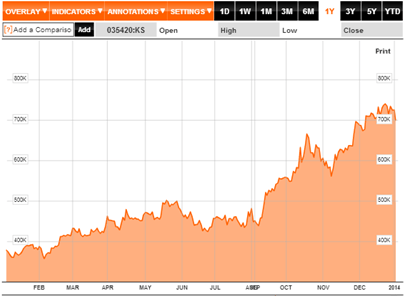
Naver

To read the exclusive article in full to find out more about how restructuring aimed at improving corporate governance will be a major investment theme in Korea and Asia in 2014, please visit:

New Year