The 18-year-old who sold his start-up to Yahoo for an estimated $30m talks to Jonathan Ford about the business of skim-reading and being a time-poor teenager

January 24, 2014 4:41 pm

Lunch with the FT: Nick D’Aloisio

By Jonathan Ford

The 18-year-old who sold his start-up to Yahoo for an estimated $30m talks to Jonathan Ford about the business of skim-reading and being a time-poor teenager

Iam sitting in a restaurant in south London listening to a teenager telling me why he doesn’t read newspapers.

“I read traditional media on Twitter,”Nick D’Aloisio

explains. “Like, I won’t go to FT.com and read off there, but if on Twitter someone shared an interesting FT thing, then I’ll read that.”

It is not that news is boring, he hastens to reassure me, perhaps noticing that I am wincing slightly. There just isn’t the time.

To illustrate the problem, D’Aloisio tells me how some time ago he took a subscription to the Economist, hoping to absorb the magazine’s content by downloading its weekly podcast: “I thought, I am going to try and be intelligent here by listening to the Economist every week.”

It didn’t work. “It’s five hours if you want to listen to everything,” he says, his eyes widening. D’Aloisio tried downloading the shorter summary and even listening to it in bed before going to sleep. In the end he dropped it. “I didn’t have time in the day. I just couldn’t interact with it.”

D’Aloisio does read deeply into things when they intrigue or excite him. When he picked up George Orwell, for instance, he decided he had to read everything that Orwell had ever written.

It’s the same story when he consumes media: “So if I am interested in tech and someone has done a scoop on some tech founder, I want to read every inch of that article and then I want more.” As for the rest, he has a simple solution: “I just skim-read.”

People talk about the “fire-hose” of information that has been unleashed by the internet, and how it is changing reading habits. D’Aloisio has thought about these shifts more deeply than most. The tousle-haired 18-year-old has spent the past few years devising software that aims to let you sip from the flow without being drenched with information.

Skim-reading isn’t just his preference; it is his business.

Last year, D’Aloisio came to public attention when at the age of 17 he sold his start-up, Summly, to Yahoo for an estimated $30m (of which he is thought to have raked in more than a third). With backing from a glittering array of investors, including the Chinese billionaire Li Ka-shing and the British comedian Stephen Fry, he designed a piece of software that compressed long slabs of text into a few summarising sentences.

Seen as a killer app in a world in which an increasing number of people surf the web on their mobile phones, Summly attracted huge interest and quickly gained about 1m users before being snapped up by the US internet giant. D’Aloisio now works for Yahooimproving Summly and developing new applications involving similar technology.

He communicates daily by Skype with his 10-strong team of software engineers, flying out to Silicon Valley to see them one week in every four. Earlier this month he was on stage with Yahoo’s chief executive, Marissa Mayer, at the Consumer Electronics Show in Las Vegas launching Yahoo News Digest, an app that gives users summaries of the latest top stories twice a day.

D’Aloisio believes summaries are a way to bring to new media one of the more satisfying attributes of the old. “It’s the ability to get to the end and then you’re done,” he says. This sense of “completion” has been lost in cyber space. “The problem with the internet is that you can never finish an infinite stream.”

. . .

Surveying his schedule, it is easy to see why D’Aloisio is always pressed for time. As well as work, he is in his final year at school. We meet at the Light House, a restaurant just around the corner from King’s College School, the public school he sporadically attends in Wimbledon where he is studying for A-levels in maths, further maths and philosophy.

Although on an extended “sabbatical” from full-time education, he has continued with his studies, working mainly in the evenings and going into school for occasional guidance. It helps, D’Aloisio says, that he is studying maths because it’s a subject in which he can tutor himself. “I’ll go into school to make sure that I am doing the right stuff or do a test; it’s fun.”

At home, he preserves a veneer of normality. He still goes on family holidays, wears school uniform whenever he pops into King’s, and has a girlfriend who pre-dates his business success.

It can sometimes seem an attenuated version of teenagerdom, D’Aloisio admits: “My girlfriend can be quite angry because I am never able to chill out for a day and just do nothing. There’s always a hundred things I am doing.”

And while skipping lessons must be every schoolboy’s dream, it has sometimes been disorientating. “One minute I’d be in this frame of mind: I’m missing out on school, I should be there. I’m very nervous. Then I’d think, this is an amazing opportunity, what am I thinking? I should run with it.”

He hasn’t touched the capital he received from the acquisition and pays most of his Yahoo salary into a savings account. It is not a high salary, he insists: “I mean, your pay is linked to experience. I am only 18 and this is my first job.” Anyway, he doesn’t need much money other than “to pay for dinner or whatever or get a cab somewhere”. Could he buy a Ferrari? “Not unless I save for multiple years.” Do his parents charge him rent? “They don’t – they should! I probably couldn’t afford it!”

We have been havering over our menus and the waitress finally descends, forcing us to take decisions. D’Aloisio opts for pumpkin soup to start while I go for a blue cheese, pear, walnut and beetroot salad. For the main course he chooses the belly pork while I have the pheasant. I offer him a glass of wine (D’Aloisio turned 18 last November) but he declines, preferring a Diet Coke. I have a glass of house Rioja.

Most of us would, I suspect, struggle with the discipline necessary to juggle the commitments D’Aloisio has taken on. But he has always been good at setting himself goals and (more impressively) sticking to them. Born in Australia, he moved to Britain at the age of seven. Academically gifted, he did well at school and won the top scholarship to King’s. By then he was a keen self-taught programmer.

The young D’Aloisio would devote himself to building apps during his school holidays – often staying up half the night to do so. “I would spend six weeks developing an app and launching it,” he recalls.

The waitress is waiting to take away our plates. My salad is long gone but D’Aloisio is still stirring his fast-cooling soup. I find myself unconsciously slipping into the role of parent: “Come on, finish your starter,” I chide.

Right from the beginning, D’Aloisio didn’t just want to build programs, he wanted to sell them. The first app he got Apple to market in its store made £79 on its launch day. “Yes, I thought, there’s definitely something in this. It gave me the appetite to do more. Each time I did a new app, I set myself a new task or a new challenge and it slowly developed.”

From simple games – an early effort was a treadmill for hands called “Finger Mill” – he moved on to more complex software. Before long he was playing around with summarisation technology – the germ of the time-saving idea that became Summly.

It was schoolwork that first led D’Aloisio to think there was a need for applications that could summarise text. “I had this experience when I was revising for exams,” he explains. “There is all this information on Google and Bing, but to find it you have to go in and out of the links on the results pages. It’s hard to determine what is relevant until you click through. That’s pretty inefficient, so I thought that if you could take the URL and show almost like a précis, it would give you a sense of whether you wanted to click on [the link].”

Building an app to do this was no simple task, however. D’Aloisio had to learn about natural language processing – how to break words down into “morphemes”, or their smallest comprehensible linguistic units, and then to write algorithms that categorised them in ways that teased out meaning.

His intellectual voracity helped him get to grips with some of the issues. “Language, algorithms, design and all that stuff, I have always loved learning – it’s my favourite thing,” he avers. But inquisitive nerdiness could only carry him so far. The first prototypes of Summly, then called Trimit, did not work well. It proved impossible to compress articles into mere tweets. And even when the summaries were expanded, they frequently did not make sense.

Pulling out his mobile phone, D’Aloisio shows me an early version of Trimit. He pastes in a story about last year’s financial crisis in Cyprus, which is basically about the banks shutting and people queueing at cashpoints. There is a paragraph low down – almost an aside – which quotes the Ministry of Defence saying there should be no effect on the British military bases on the island. But when the summary comes up, it’s gibberish. The software thinks it’s a story about the 3,000-strong British garrison.

How has it got the story back to front, I ask. “This was very primitive when I did it,” says D’Aloisio. “But basically it tries to evaluate a sentence on a number of different variants. Like the length of a sentence, what it contains, how many real nouns.” It turns out that the algorithm has simply sniffed out the sentence with the highest number of positive matches and made it the subject: “Cyprus, Ministry, Defence – that’s three proper nouns which is quite high for one sentence. It also contains the number 3,000, which is a statistic.”

Such glitches were only cleared up after the launch of Trimit in 2011 when, in spite of its shortcomings, the app attracted the interest of Horizon Ventures, an investment company owned by Li Ka-shing. A team from Hong Kong came to London, met D’Aloisio and his parents (“I had to tell them I couldn’t meet between 9 and 5 because I was at school”), and stumped up $300,000 in what D’Aloisio calls a “philanthropic decision”. All of a sudden, he was no longer a schoolboy programming from his bedroom; he was an entrepreneur backed by some of the shrewdest tech investors on the planet.

As I start my pheasant and D’Aloisio picks at his pork, I wonder how he coped with the switch. Horizon’s cash allowed him to hire some serious programming talent, including Inderjeet Mani, an artificial intelligence expert who is now head of R&D at Yahoo Labs. How easy was it to manage his new, much older, employees? “I wouldn’t ever be like ‘do this or that’,” he says, cautiously. “I didn’t have the guts and it would have been far too precocious.”

. . .

Instead of trying to dominate everything, D’Aloisio explains, he focused on one bit of the project: design. “That was the area I wanted to have full control over: the designers I worked with, the programmers I worked with.”

I now idolise polymaths, people like da Vinci … their genius lay in piecing things together

As for the rest, D’Aloisio quickly realised that he didn’t have to understand everything about the underlying technology. “I would try as long as possible to keep up with the team, but there would come a point when I didn’t understand the code, the AI thing or whatever. That was fine because I discovered that actually you don’t need to know everything, you just need to know enough.”

Rather like giving up the Economist podcast, this epiphany came as a sort of liberation. “The best thing is that I now idolise polymaths, people like da Vinci and Michelangelo,” he says. “They weren’t just engineers, they were artists and scientists, mathematicians and philosophers. They weren’t even experts in their own domain. Their genius lay in piecing things together.”

We are now on coffee and I ask D’Aloisio about his next moves. Summly’s success has, after all, left him with an unusual dilemma. Should he stay with Yahoo and pursue a tech career or revert to normal adolescence and go to university?

“I need more data,” he says. “I need to see what happens at Yahoo in the next 12 months in terms of what I am going to be working on. I also need to finalise what universities and why.”

But if he does take a degree, he says he would most like to read philosophy and politics. “I am more interested in political theory and the philosophy of that than anything else.” He doesn’t even rule out combining university with Yahoo. “I don’t regard the two as mutually exclusive,” he says.

In the meantime, there is no let up for D’Aloisio, not even in the school holidays. When I ask him if he plans to spend some time just chilling out over the break, he simply looks blank: “I wish. My God, I would love two weeks of nothing.”

Jonathan Ford is the FT’s chief leader writer

——————————————-

The Light House

75-77 Ridgway London SW19 4ST

Pumpkin, butter bean and ruby chard soup £5.75

Stichelton, walnut, pear and beetroot salad £7.50

Roast pheasant, red cabbage and turnip gratin £16.50

Roast pork belly, neeps and garlic greens £15.95

Still water x 2 £7.00

Rioja Montesc 2010 £8.00

Diet Coke £2.95

Latte £2.50

Filter coffee £2.25

Total (incl service) £76.95

Steve Jobs’ First Demonstration of the Mac, Unseen Since 1984, Is The ‘Stuff Of Tech-History Legend’

Steve Jobs’ First Demonstration of the Mac, Unseen Since 1984, Is The ‘Stuff Of Tech-History Legend’

CAROLINE MOSS 

JAN. 26, 2014, 8:50 AM 10,082

image003


It’s been 30 years since Steve Jobs unveiled Apple’s Mac, and Time has obtained never-before-seen footage of the entire 1984 presentation of the computer.

Time reports,

This presentation, at Apple’s annual shareholder meeting on January 24, is the stuff of tech-history legend. What’s not so well remembered: Jobs did it all twice, in less than a week. Six days after unveiling the Mac at the Flint Center on the De Anza College campus near the company’s headquarters in Cupertino, Calif., he performed his show all over again at the monthly general meeting of the Boston Computer Society. His host, Jonathan Rotenberg, was a 20-year-old student at Brown University who’d co-founded the BCS in 1977 at the age of 13.

Now, all 90 minutes of the presentation at BCS are available for the first time in their entirety since they were shot on January 30, 1984.

http://techland.time.com/2014/01/25/steve-jobs-mac/

The Little Guide to Your Well-Read Life Hardcover

The Little Guide to Your Well-Read Life Hardcover

by Steve Leveen  (Author)

image003

“Perfect for all of us who can never get enough time with good books. It not only urges us to indulge deeply and often, it shows us how.”-Myra Hart, professor, Harvard Business School

“Readers and want-to-be readers will be encouraged by the advice to read more, more widely and more systematically.”-Michael Keller, university librarian, Stanford University

“An ideal gift for both sporadic and relentless readers.”-James Mustich Jr., publisher of A Common Reader

“A worthy addition to even the most well-stocked personal library.”-Ross King, author of Michelangelo & The Pope’s Ceiling

Do not set out to live a well-read life but rather your well-read life. No one can be well-read using someone else’s reading list. Unless a book is good for you, you won’t connect with it and gain from it. Just as no one can tell you how to lead your life, no one can tell you what to read for your life.

How do readers find more time to read? In The Little Guide to Your Well-Read Life, Steve Leveen offers both inspiration and practical advice for bibliophiles on how to get more books in their life and more life from their books.

His recommendations are disarmingly refreshing, as when he advises when not to read a book and why not to feel guilty if you missed reading all those classics in school. He helps readers reorganize their bookshelves into a Library of Candidates that they actively build and a Living Library of books read with enthusiasm, and he emphasizes the value of creating a Bookography, or annotated list of your reading life. Separate chapters are devoted to the power of audio books and the merits of reading groups.

The author himself admits he came “late to the bookshelf,” making this charming little guide all the more convincing.

Editorial Reviews

From Publishers Weekly

Some people need self-help books on relationships, others need them for work. Leveen’s self-help book is for the person who needs help in becoming a reader, whose spirit is willing but whose flesh is weak. In a gentle, coaxing style, Leveen offers standard self-help advice: he counsels moderation. You don’t need to be a marathon reader to be well-read—no one can read everything; and you’re okay—even if a so-called classic doesn’t appeal to you. Call books beckoning to you “candidates for your attention,” rather than the more obligatory-sounding “reading list.” Leveen is against ad hoc reading decisions and in favor of lists—which will seem too bad to readers who know the joys of serendipity. He is an advocate of audiobooks, especially unabridged editions, and devotes an entire chapter to “Reading with Your Ears.” In the end, there’s probably nothing like reading a great book to make someone love reading—but perhaps Leveen’s gentle encouragement can help. (May 2) 
Copyright © Reed Business Information, a division of Reed Elsevier Inc. All rights reserved.

Review

A pleasant and mindful celebration of the art of reading that many will appreciate…recommended for all public libraries. — Library Journal March 15, 2005
A practical handbook…distilled into easy-to-digest prose. — The New York Times Book Review, July 10, 2005
All most people need to get started on what can be the truly mind-altering experience of reading. — thecelebritycafe.comOctober 14, 2005
For the person who needs help in becoming a reader, whose spirit is willing but whose flesh is weak. — PUBLISHERS WEEKLY – February 28, 2005
How to read more and like it? Steve Leveen’s delivery of the gourmet fast food of reading. — Christian Science Monitor, May 3, 2005
Just what the book lover with too little time needs to put his or her reading house in order. — Friends of Libraries USA Vol. 28, Issue 1 February 2005
Leveen proposes a strategy for falling, and staying, in “book love.” There’s no daunting recommended reading in Leveen’s “Little Guide.” — The Boston Globe, June 4, 2005
The Little Guide may just inspire you to dust off the tomes on your own shelf. — U.S. Airways Attache Magazine September 2005

The Other Kind of Inequality The decline of American social egalitarianism is more worrisome than differences in how much people earn

The Other Kind of Inequality

The decline of American social egalitarianism is more worrisome than differences in how much people earn.

MICKEY KAUS

Jan. 26, 2014 5:15 p.m. ET

The problem with the Democrats’ new war on inequality (“the defining challenge of our time,” says President Obama ) is that there are two kinds of growing inequality—and the Democrats are attacking the wrong one.

When I started writing about income inequality in the 1980s, I expected to make a reassuring argument that incomes weren’t growing unequal. That article couldn’t be written. An unceasing barrage of data described an income scale that was pulling apart like taffy. The rich were getting richer faster than anyone else. But even within skill levels or professions—including journalism—the stars were making big money and everyone else was stuck or in decline.

This pulling apart has continued for more than three decades, through Republican and Democratic presidencies, including Mr. Obama’s. It seems to be driven largely by deep tectonic forces within the economy: global trade, which has devalued the labor of unskilled Americans, and technology, which has replaced labor with machines while empowering (and rewarding) those with skills.

Harsh Truth No. 1: Democrats aren’t proposing anything that comes close to reversing this three-decade trend. They got nothin’, as the comedians say. Raising the minimum wage may be a good idea, but it affects a sliver of the labor market. It’s not going to stop the top 10% from taking home 50% of the nation’s income, or 51%. The same goes for extending unemployment compensation. Even the tax increases fought for by Mr. Obama are a blip. On paper they might cut the incomes of the very richest Americans by 6%—until the rich find ways to avoid them.

If Democrats are going to get voters to play along they should maybe give them at least an idea of what they propose to do and how it will achieve their goal—without toxic side effects. A better plan is to ask why we care about economic inequality anyway. If the poor and middle class were getting steadily richer, would it matter that the rich are getting richer much faster?

There’s some confusion among egalitarians on this score. Many argue that inequality per se hampers growth, though the academic support for this theory is soft. Others argue that it hampers mobility, though if skills are now more important to getting ahead that in itself will hamper mobility, whatever the level of inequality.

Harsh Truth No. 2: If it’s not enough for everyone to work hard—if you now have to be smart enough to learn—only some people will make that jump.

When we think honestly about why we really hate growing inequality, I suspect it won’t boil down to economics but to sentiments. No, we don’t want to “punish success”—the typical Democratic disclaimer. But we do want to make sure the rich don’t start feeling they’re better than the rest of us—a peril dramatized, most recently, in the “Wolf of Wall Street” and its seemingly endless scenes of humiliation and rank-pulling.

“Whether we come from poverty or wealth,” President Reagan said, “we are all equal in the eyes of God. But as Americans that is not enough. We must be equal in the eyes of each other.” Worry about this social equality lies at the root of our worry about economic equality.

Social equality—”equality of respect,” as economist Noah Smith puts it—is harder to measure than money inequality. But the good news is that if social equality is what we’re after, there may be ways to achieve it that don’t involve a doomed crusade to reverse the tides of purely economic inequality. As Reagan’s quote suggests, achieving a rough social equality in the midst of vivid economic contrast has been something America’s historically been good at, at least until recently.

We can, for example, honor the universal virtue of work by making it the prerequisite for government benefits wherever possible. There’s a reason Social Security checks are respectable and politically untouchable—unlike food stamps, they only go to Americans who’ve worked.

We can also pursue social equality directly, through institutions that mix people from all income levels together, under conditions of equal status—institutions like the draft, for example, or national service. Do we remember the 1950s as a halcyon egalitarian era because the rich weren’t rich—or because rich and poor had served together in World War II?

The draft isn’t coming back anytime soon. But the great social egalitarian hope—mine, anyway—was that Mr. Obama’s health plan might perform a similar function, offering the poor and middle class the same care, in the same hospitals, with the same doctors—and the same respect—that the affluent get (much as Medicare already does).

The tragedy is that the Democrats readily abandoned this goal. In order to save money and extend maximum coverage and subsidy to the maximum number of the uninsured, Democrats signed off on a system in which affluent Americans sign up for totally different medical networks than people who have less to spend, while the poorest get shunted to Medicaid and the richest bail completely into a private world of concierge medicine.

It’s not easy to imagine a modern medical system that would make Americans feel less like equals, even if they get subsidized. But it is still more likely that ObamaCare

can be changed so that the nation’s health-care system will reinforce social equality than that the tax-and-transfer system will produce economic equality.

Social egalitarians always will be tempted or bullied to abandon their real goal for a more concrete, economistic type of equality—the green-eyeshade fairness of “tax progressivity,” Gini coefficients and income quintiles. Democrats have already sacrificed their biggest recent legislative achievement—and best hope of preserving social equality—chasing after the shallow democracy of what is, after all, only money. They shouldn’t make that their template for the future.

Mr. Kaus is the author of “The End of Equality” (Basic Books, 1992). He blogs for The Daily Caller.

How Constraining Are Limits to Arbitrage? Evidence from a Recent Financial Innovation

How Constraining Are Limits to Arbitrage? Evidence from a Recent Financial Innovation

Alexander Ljungqvist, Wenlan Qian

NBER Working Paper No. 19834
Issued in January 2014
Limits to arbitrage play a central role in behavioral finance. They are thought to interfere with arbitrage processes so that security prices can deviate from true values for extended periods of time. We describe a recent financial innovation that allows limits to arbitrage to be sidestepped, and overvaluation thereby to be corrected, even in settings characterized by extreme costs of information discovery and severe short-sale constraints. We report evidence of shallow-pocketed “arbitrageurs” expending considerable resources to identify overvalued companies and profitably correcting overpricing. The innovation that allows the arbitrageurs to sidestep limits to arbitrage involves credibly revealing their information to the market, in an effort to induce long investors to sell so that prices fall. This simple but apparently effective way around the limits suggests that limits to arbitrage may not always be as constraining as sometimes assumed.

Asia Hedge Fund PCA Investments, Backed by China Sovereign Wealth Fund, Has Shut Down

Asia Hedge Fund PCA Investments Has Shut Down

China Sovereign-Wealth Fund Was Hedge Fund’s Only Major Outside Investor

MIA LAMAR

Updated Jan. 26, 2014 10:59 a.m. ET

A hedge fund with financial backing almost entirely from China’s giant sovereign-wealth fund closed down last week less than three years after it was launched, according to people familiar with the matter.

PCA Investments was formed in 2011 and attracted notice for the involvement of China Investment Corp., the country’s $575 billion sovereign-wealth fund, which is tasked with investing part of China’s vast foreign-exchange reserves. PCA had operations in both Hong Kong and Beijing.

The involvement of one of the world’s largest sovereign-wealth funds with a hedge fund startup with no record of performance was unusual. CIC is better known for investing in established funds.

People familiar with the fund said CIC was PCA’s only major outside investor, adding even more opaqueness to the privately run firm, which was estimated by these people to be managing more than $500 million.

PCA was founded by Hang Hu and former Merrill Lynch executive Wing Lau, who left the firm last year.

The reason for the fund’s closure wasn’t known. A call to PCA’s Hong Kong office wasn’t returned and CIC representatives didn’t respond to request for comment late Sunday.

The sovereign-wealth fund is going through management changes, with a new chairman, Ding Xuedong, appointed last year amid China’s leadership change and its president, Gao Xiqing, set to be succeeded by Executive Vice President Li Keping.

A website for PCA describes it as a “multiasset and multistrategy” investment firm running an Asiawide equities strategy, a global fixed-income strategy and a global macro strategy, the latter a catchall phrase for funds that try to predict and profit from global economic trends.

The closure goes against the current interest in Asian hedge funds, many of which are catching the eye of investors with strong performances. Average returns for funds last year investing in Asia excluding Japan beat peers in the U.S. and Europe for the second year running, rising 13% versus an 8% average return for the industry, according to data from industry tracker Eurekahedge.

Emerging market oil groups out of favour

January 26, 2014 11:01 pm

Emerging market oil groups out of favour

By Ed Crooks in New York

National oil companies from emerging economies have fallen out of favour on stock markets over the past year relative to western energy groups, as the North American shale revolution continues to attract investors.

Companies such as PetroChinaPetrobras of Brazil and Gazprom and Rosneft of Russia all suffered significant falls in their share prices in 2013, while Chevron andExxonMobil of the US, and Total, BP and Royal Dutch Shell from Europe all rose.

The combined market value of state-controlled national oil companies’ shares fell 15 per cent, while the value of the large western groups rose 9 per cent, according to IHS, the analysis group.

The figures mark a reversal from the prevailing trends of the 2000s, when it seemed that national oil companies, with greater access to resources and government support, would inevitably eclipse the western groups.

Daniel Trapp of IHS said: “With the national oil companies, investors are asking where their priorities lie. Are they with shareholders, or will they follow the government’s priorities?”

The boom in US shale oil and gas production has created an alternative for investors concerned about the risk in state-controlled companies.

Among the best-performing companies last year, according to an analysis published by IHS on Monday, were some of the largest producers of US shale oil: EOG ResourcesContinental Resources and Pioneer Natural Resources.

The markets have also rewarded companies such asOccidental Petroleum and Hess that are moving to cut back their global exposure and focus on North American production.

The largest western oil groups were slow to develop shale production and have been paying the price, with Shell and others forced to write down the value of their assets.

However, they have been acquiring skills that should leave them better placed to develop shale resources than their rivals from emerging economies, which are generally even further behind.

Concerns about increased supplies of US shale oil putting downward pressure on prices have been a particular issue for Petrobras, which is facing the challenge of developing Brazil’s difficult deep water oilfields, and concerns about political interference. Its shares fell 24 per cent last year.

Other companies that thrived in 2013 included the large oil services groups that have the skills and technology needed for shale oil and gas production, includingSchlumbergerHalliburton and Baker Hughes.

They were hit by overcapacity in the industry in 2011-12, but markets for oil services have now tightened.


ESPN’s Internet Rollout Tests Television Cash Cow; Sports Channel Seeks to Profit From Demand for Online Video Without Pushing Away Pay-TV Customers

ESPN’s Internet Rollout Tests Television Cash Cow

Sports Channel Seeks to Profit From Demand for Online Video Without Pushing Away Pay-TV Customers

SHALINI RAMACHANDRAN, AMOL SHARMA and MATTHEW FUTTERMAN

Jan. 26, 2014 11:02 p.m. ET

BRISTOL, Conn.—In the control room of ESPN’s headquarters, a row of screens shows video feeds going out to cable providers for each of its television channels. But a growing part of ESPN’s future lies across the room, where a similar setup tracks transmissions to the Internet.

On a recent Saturday, technicians were busy streaming several dozen games, some at the same time as they were on television and others that weren’t televised at all. Damon Phillips, in charge of the service, used a tablet computer to monitor how many people were watching online.

“I’m obsessed with this,” he said, pointing to the usage tally, which he starts checking at 5:30 a.m. while on his exercise bike. “I look at it all day long.”

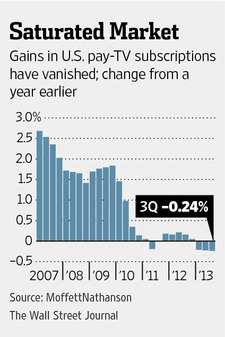
The app, called WatchESPN, is part of an aggressive push by ESPN into online services as pay television matures. ESPN pioneered sports TV on that medium and for three decades rode a steady rise in U.S. cable and satellite TV subscriptions. These now have leveled off and appear to be contracting. ESPN is at the forefront of the TV industry’s efforts to expand into Internet distribution.

image001-1

The company, which generates about 40% of majority owner Walt Disney Co.’s operating profits, sees the app as a way to cash in on growing demand for online video. But with its TV offerings still lucrative, ESPN is walking a fine line, trying to avoid doing anything that might encourage customers to drop their pay-TV subscriptions.

It is a challenge others in the business also are wrestling with. ESPN’s strategy is to allow only pay-television subscribers to stream games that air on ESPN TV channels.

The sports network has devised a complex business model. Although the app is delivered over the Internet, ESPN collects money for the app from pay-TV providers such as cable companies, which pay for the right to offer it to their customers. For ESPN, a second revenue stream comes from advertising on the app.

The WatchESPN app also includes a strictly online channel, called ESPN 3, that shows lower-profile sports such as rugby, polo and small-college athletics. For that, in most markets, users don’t need to be pay-TV subscribers.

The dual strategy results from years of experimentation and debate inside ESPN, and in the industry more broadly, over how to deal with the saturation of the pay-TV industry and thirst for online video. Time Warner Inc. TWX -2.04% ‘s HBO, for instance, has said it might offer a version of its HBO Go app to Internet users for a subscription fee, depending how the pay-TV industry evolves, though for now HBO plans to continue limiting access to subscribers who pay for the premium channel.

Most network owners, including ESPN, say the risk of cannibalizing their pay-TV businesses is too great to offer stand-alone online subscription services. It isn’t clear they could charge enough to be as profitable as deals with pay-TV providers. Revenue from mobile advertising, while growing, isn’t nearly enough to replace TV ad dollars. Media companies also would have to take on customer-service responsibilities now handled for them by cable and satellite companies.

Yet content providers face the reality of weakening pay-TV subscriptions. ESPN lost roughly 1.5 million subscribers between September 2011 and September 2013, according to Nielsen data provided by the company. Part was from dropped pay-TV subscriptions and part from downgrades to lower-cost packages not including ESPN. The company says the changes haven’t affected its TV ratings materially.

image002-1

ESPN President John Skipper calls the losses “marginal,” given that the sports network reaches into 98.4 million households. Still, he doesn’t dismiss the threat.

“Pressure on the system provides peril for ESPN,” Mr. Skipper said in an interview. “But ESPN, as long as the system doesn’t break up, is in fine position.” He said WatchESPN makes pay-TV subscriptions more valuable.

Several hurdles lie in ESPN’s online path. Professional sports leagues, which already collect huge sums for TV rights, see an opportunity in the next decade from selling their digital rights or offering games via their own streaming-video services. For ESPN, acquiring streaming rights is complicated and becoming more costly.

Pay-TV providers such as cable companies, for their part, are likely to push back as ESPN, which is already the most expensive cable-TV network, raises its prices to offer WatchESPN.

Limiting the online viewing of TV channels to pay-TV subscribers, a strategy also pursued by most other TV-channel owners, carries risks. Besides excluding customers who have “cut the cord,” it excludes “cord nevers”: sports fans, mostly younger, who have never subscribed to a cable or satellite service.

And if operators such as cable companies pass on to subscribers the fees ESPN charges them, the higher cost could prompt more to disconnect. Some pay-TV executives say rising prices are a major reason customers bow out.

Mr. Skipper, a 59-year-old former Spin magazine executive who took the helm of ESPN in 2012, acknowledged a “dissonance” between its instinct to disseminate its content as widely as possible and the usage restrictions designed to safeguard the core television business. “There’s no denying there’s a certain element of protection and defense,” he said.

image003-1

Though the company has internally considered a stand-alone broadband offering, “it’s not close yet.”

As for what ESPN’s endgame is, Mr. Skipper said the company plans a lot of online experimentation, but its priority is to protect pay-TV profits: “Our calculation right now is we’re going to ride this. We’re going to ride it as long as it makes sense.”

ESPN still has growth opportunities in TV, Mr. Skipper added, including a new college sports network it is launching this year with the Southeastern Conference and expansion in Latin America.

ESPN first tried online distribution in the early 2000s, well before most other networks. Leading the effort was Sean Bratches, who dealt with cable and satellite companies. Known for his vast cuff link collection and coordinated ties and pocket handkerchiefs, Mr. Bratches cut an unlikely figure for a technology innovator.

He came up with an unorthodox initial business model for ESPN: It would charge the providers of high-speed Internet service a per-subscriber fee to make sports available online to their customers.

The idea faced opposition internally from executives who wanted a more traditional Web approach of giving away content while making money on ads. Mr. Bratches argued that ESPN could extend to the Internet its cable model of earning money from both ads and subscriptions. He prevailed, and in 2001 ESPN launched its first broadband service.

It struggled to gain traction. Some Internet-service providers balked, not used to paying for content. ESPN executives blamed the rough start also on their website’s clunky design and lack of live events. To lift usage, they started putting online some games airing on their flagship TV channel.

But by 2010, when ESPN began a round of contract renewals with pay-TV distributors such as cable companies, the industry’s subscriber growth had slowed sharply. Both sides worried that making TV content available online could encourage more pay-TV subscribers to disconnect. In negotiations with Time Warner CableTWC -0.63% ESPN hashed out a deal to combat that with the limit on online access.

The result was the WatchESPN app. Its simple design, which grew out of a paper sketch by Mr. Skipper, allowed tablet and smartphone users to tap on-screen boxes to play ESPN channels. It launched on mobile devices in April 2011.

The earlier broadband service, by then named ESPN 3, could be accessed through the new app, but phased out televised games. It has charted a new course as a place for thousands of events that the company has the rights to but that don’t make it to TV, such as cricket and collegiate gymnastics. ESPN has enlisted some colleges to handle production of their own events, to expand offerings while keeping costs down.

Though ESPN 3 can be accessed without a pay-TV subscription in most markets, the company is careful not to market it as a product for cord cutters.

“We want to be conscientious that we don’t overplay our hand,” Mr. Bratches said in an interview at his New York office, stuffed with all manner of sports paraphernalia: books on Jerry West and Muhammad Ali, football helmets, a bowling pin, a punching bag and baseball bats.

The WatchESPN app has been downloaded 25 million times. Its viewership remains far below television’s. Some 26 million people watched college football’s national championship game Jan. 6 on television, but just 773,000 saw it online with WatchESPN.

Still, as ESPN has renewed deals with cable and satellite operators, it has cited the app as a justification for rate increases. Its flagship channel is already by far TV’s costliest, at $5.54 a month, according to market researcher SNL Kagan.

Access to the app raises the price. Time Warner Cable and Verizon Communications Inc.VZ -0.48%

‘s FiOS service, which offer the app to their subscribers, pay ESPN 19 cents more per subscriber each month than does Dish Network Corp. DISH -1.28% , which doesn’t support the app, according to papers from a court case involving ESPN and Dish last year. Dish is currently in negotiations with ESPN for a contract renewal.

DirecTV has balked so far at ESPN’s asking price for streaming video access, said a person familiar with the matter. However it is likely to negotiate for those rights when its contract with ESPN expires at the end of this year.

At ESPN, the broadband push has meant a cultural shift for a TV-centric company.

Getting software engineers to move to ESPN offices in the sleepy Connecticut town of Bristol wasn’t easy. A key hire last year was Ryan Spoon, an eBay Inc. alum and former venture capitalist, who has hired veterans of major Silicon Valley companies.

Now a team of ESPN engineers is developing algorithms to link online programming options to users’ tastes and affinity for certain teams, sports or cities. ESPN executives have taken product advice from the likes of Apple Inc. AAPL -1.82% Chief Executive Tim Cook, a fan of the Auburn Tigers, and Google Inc. GOOG -3.13% Chief Business Officer Nikesh Arora, a fan of cricket.

In ESPN’s control room, balloons on an overhead screen track how heavily WatchESPN is being used around the country, while analysts monitor bandwidth usage to make sure the video streams don’t hiccup en route to users.

Getting streaming rights can be problematic. ESPN has had the right to televise Monday Night Football since 2006 and struck a deal with the National Football League in 2010 that allowed streaming of the game to desktop, laptop and tablet computers. Yet ESPN can’t stream it to smartphones.

Mobile-phone rights to the Monday game weren’t on the table when ESPN last renewed its deal with the NFL. Verizon owns the streaming rights to Monday night, Sunday night and Thursday night NFL games, and has just agreed to a four-year contract extension that will also allow people to watch Sunday afternoon home-market games on mobile phones.

ESPN keeps having to pay leagues more. In the contract it negotiated with the NFL in 2011, the network agreed to pay an average of $1.9 billion a year, up 58% from before. And last year, ESPN and Major League Baseball reached an eight-year deal that, at $700 million a year, was double the earlier price. Streaming rights were a factor in the increase, said a person familiar with the matter.

ESPN is working on perfecting sales of ads for the app. It says it sold app ads to some 200 brands in 2013. But these haven’t been enough to fill every available ad break.

Partly that is because the technology to serve up ads into the app isn’t yet very advanced and can’t always find spots of the proper length to insert. When TV viewers see commercials, app users are sometimes shown filler material.

ESPN is talking to broadband providers about other Internet products, such as an ultra-high-definition version of its TV channels that would be offered only to people who upgrade to faster tiers of broadband.

“We innovate with the consumer in mind and with the philosophical default that we are going to adopt new things,” Mr. Skipper said. “We are not going to resist.”


The Surface and the Chromebook Offer Lessons on Innovation

January 24, 2014, 5:04 PM ET

The Surface and the Chromebook Offer Lessons on Innovation

By Steve Rosenbush

Deputy Editor

Well after their initial release, two devices—the Surface tablet and the Chromebook laptop—finally are gaining some traction in the market. Microsoft Corp.MSFT +2.08%’s Surface was a bright spot in the company’s latest earnings report, the WSJ’s Shira Ovide says. The Chromebook—a stripped-down laptop that is designed to be used over the Internet with Google Inc.GOOG -3.13%’s Chrome operating system and its cloud-based apps–is increasingly popular among schools, the WSJ’s Rolfe Winklerreports.

Neither product was an instant sensation, but that is exactly what makes them interesting. Conversations about innovation focus all too often on the iPads and iPhones of the world, the outliers that redefine markets and the way that people go about lives and their business. It’s great to understand the stories behind their success, but given that few successful products can match that arc—and that the ones that do tend to come about in a unique and unpredictable way—the Surface and the Chromebook may have more to teach us.  As Gartner Inc. analyst Tuong Nguyen says, “the process of progress in technology is often more evolutionary than revolutionary.”

As readers of CIO Journal are well aware, the Surface failed to live up to initial expectations in 2012. But as Ms. Ovide writes, “fresh versions of Surface went on sale in October, and Microsoft sharply discounted the first-generation Surface models. It looks like the one-two punch of new Surface models and cheap, older Surface models helped drive a surprisingly good showing from Microsoft’s hardware business.” Reviews of early Chromebooks, launched in 2011, determined that the devices suffered from basic flaws—they were under-powered and had poor screens, even given the price range of about $300. But prices have come down even more, and the quality steadily has improved.  “A Chromebook could soon become a truly viable notebook,” the Verge’s David Pierce wrote last year in a review of the Hewlett-Packard Co. Chromebook 14.

“We’re always listening to what our customers may need, and Chromebooks are always gaining new features based on that feedback,” a Google spokeswoman told the WSJ. That may seem obvious, but the fact is that businesses often don’t listen to their customers, and even if they do, then what? What do they do with all of that feedback and how do they use those insights to improve their products and bring them to market?

CIO Journal has focused on those questions for nearly two years now. As PwC principal Chris Curran wrote in a guest column back in 2012, many companies have the ability to generate or capture innovative ideas, but “a rare few have instilled the systemic organizational processes to harness those ideas and to repeat the process over and over again to sustain successful innovation.”

Innovation draws together a broad range of people and skills and flows organically from a company, from its culture, leadership and structure. As Mr. Curran notes, technology and IT leadership is a major factor in that success, which depends upon the collection, dissemination and analysis of data.

***

The innovation process should be segmented into phases and talent should be managed accordingly. Creativity fuels the idea generation phase of innovation and is necessary to identify potential breakthrough products and services. The second phase, idea exploration, employs more left-brained talent that is capable of sorting, prioritizing, and prototyping and testing ideas. Discriminating scrutiny is required to boost the odds that the innovation is aligned with business goals and has a chance of generating a return on investment. At the final stage, idea scaling, the art of innovation takes a back seat to the engineering. Corporations need to marshal the necessary resources along the innovation conveyor belt to mobilize, scrutinize, enhance, scale and implement inspired ideas.***

While it’s unlikely that this sort of prosaic work will yield the next iPhone or iPad, it may play a key role in helping save the next promising, but flawed , idea from failure. In the aggregate, those relatively minor successes are greater than the sum of their parts.

In Music, the Money Is Made Around the Edges; In Pre-Grammy Tradition, Executives Seek Ways to Boost Profits With Freebies, Interactive Videos

In Music, the Money Is Made Around the Edges

In Pre-Grammy Tradition, Executives Seek Ways to Boost Profits With Freebies, Interactive Videos

HANNAH KARP

Jan. 26, 2014 7:22 p.m. ET

LOS ANGELES—While much of the music industry was busy last week feting Grammy nominees, several dozen artist managers, technologists and record-label executives met for breakfast at a private club on the Sunset Strip to discuss a more urgent matter: how to make more money.

A pre-Grammy tradition that started several years ago known as the Big Bang Forum, the tech-focused discussion highlighted an uncomfortable reality: While Grammy wins and performances still boost record sales and exposure, the glory is increasingly muted as record sales make up a shrinking piece of most artists’ income.

The speakers included Tim Quirk, GoogleInc. GOOG -3.13% ‘s head of programming for music and digital-media store Google Play. Mr. Quirk talked candidly about Google’s long-term strategy to make a “profit center” by charging different consumers different prices for the same songs.

Yoni Bloch, founder of Israeli technology startup Interlude, showed why low-cost interactive music videos—such as recently released clips for Bob Dylan’s “Like a Rolling Stone” and Pharrell Williams’s “Happy”—garner far more advertising dollars than the traditional videos. Helping drive interest, fans can click on the videos to customize everything from the song lyrics to the instruments band members play.

SFX Entertainment Inc. SFXE +2.72% plans to make more money from social media than from selling tickets to the dozens of electronic-dance-music festival’s the promotion company has snapped up in recent years, said Chris Stephenson, SFX’s chief marketing officer.

“There’s a 5% to 10% margin on these events—that’s not what the business is. People are reliving that moment 365 days a year,” said Mr. Stephenson, noting that one of SFX’s festivals, Tomorrowland, was streamed live by 16.9 million people last year, and has been viewed 100 million times. The company plans to capitalize on that ongoing interest by corralling social-media followers onto a central platform where brands can advertise.

Google’s Mr. Quirk said his vision to make money in music involved catering to three different groups: fans looking for free tunes; fans willing to pay a small amount to rent or stream music from its subscription service, All Access; and superfans who will pay almost any price for a memento associated with their favorite act. As an example, he cited devotees of the rock band Kiss who want to be buried in a “Kiss coffin.”

The trick, Mr. Quirk said, is to market to all three groups at once. Albums, for example, should be presented as free apps, including access to some content but requiring eventual purchase for certain songs, features, or merchandise, he said.

Google Play’s early experiments have yielded mixed results, he said. A global promotion for the now defunct British punk pioneers The Clash in September—for which Google paid “a significant amount” to produce documentary interviews with the band’s four surviving members—did “not necessarily recoup” the video investment, he said, and only sold several hundred downloads in Belgium, for example. But the promotion, which also featured free Clash cover songs and $175 box sets, helped to significantly increase Google’s share of the music market, he said. Google doesn’t disclose its music sales.

“We have to get people used to buying stuff on Google,” Mr. Quirk said.

Among the other lessons Google has learned: It’s far easier to funnel fans from free to paid content on genre-specific sites than it is on a general-music home page. While the company struggled to get country-music fans to connect with general Google Play promotions, its country page has become its most lucrative.

Google also started eking out more revenue from its emerging artists page, “Antenna,” when it began offering a multi-artist sampler free of charge instead of focusing on one artist at a time.

“When it was single [artists] we could not get people to download these tracks—now the site has the best conversion rate,” he said. “Free is where you have to start, but free is not enough.”

Google is also gathering data on which types of fans are most likely to make purchases if given freebies. While track and album giveaways generally pay for themselves within a week, Mr. Quirk said, some generate far more sales than others.

A decade ago, as a member of the alternative rock band Wonderlick, Mr. Quirk said that to fund the completion of an album, the band ran a presale letting fans name their price and promising fans who paid more than the average that their names would be published in the CD liner notes. Fans paid an average of $32 an album, he said, with no one paying less than $5.

“So this [stuff] works, basically,” he said.


One in Three Audits Fail, PCAOB Chief Auditor Says

January 24, 2014, 3:12 PM ET

One in Three Audits Fail, PCAOB Chief Auditor Says

EMILY CHASAN

Senior Editor

More than one in three audits inspected by the U.S. government’s audit watchdog were so deficient the auditors shouldn’t have signed off, an official said this week.

While the Public Company Accounting Oversight Board inspects audits where is suspects problems, the high failure rate is raising questions about whether auditors are getting adequate training and oversight to provide high quality audits for investors.

“When we look at an audit, the rate of failure has been in a range of around 35 to 40%,” Martin Baumann, chief auditor of the Public Company Accounting Oversight Board said on Thursday in comments to a New York State Society of CPAs conference.  In those cases, the watchdog said it found that auditors did not have sufficient evidence to support their opinions.

That doesn’t necessarily mean the underlying corporate financial statements are incorrect, but the audit failures could start to undermine investor confidence, Mr. Baumann said. “Investors are relying on the audit,” he said.

The board is working on creating audit quality indicators so that firms could potentially measure their performance against a common standard in the future, Mr. Baumann said. It expects to issue a concept release on the indicators in the first quarter.

The PCAOB has found five common trouble spots for auditors: complex “fair value” measurements for hard-to-price financial instruments, management’s estimates, revenue recognition policies, internal controls, and relying too heavily on the use of data prepared by the company being audited.

“In many cases [auditors were] just taking the report that management prepared and using that as evidence without getting behind what that’s all about,” Mr. Baumann said.

The board’s inspections are the finding problems — at both large and small audit firms — stemmed from ineffective supervision, ineffective quality reviews and monitoring, a lack of professional skepticism, and inappropriate tone at the top of the audit firm.

“Most industries have some way in which they monitor the quality of their products,” Mr. Baumann said.


Italy launches big privatisation push

January 26, 2014 6:03 pm

Italy launches big privatisation push

By Guy Dinmore in Rome and Rachel Sanderson in Milan

Italy’s coalition government has embarked on what it calls its largest privatisation programme since the late 1990s with a plan to raise €12bn, but questions are already being raised over the value of state-owned companies to be put on the block and why only minority stakes are to be sold.

“We want to hurry up and take advantage of this market window,” Fabrizio Pagani, senior economic adviser to prime minister Enrico Letta, told the Financial Times on Sunday, confirming that the four sales would be made through initial public offerings.

Details of the privatisation programme were outlined after a cabinet meeting late on Friday, with Mr Letta saying proceeds would allow Italy to reduce its crippling public debt of over €2tn for the first time in six years.

The government intends to retain controlling stakes by selling 40 per cent of postal services operator Poste Italiane and 49 per cent of air traffic controller Enav.

Separately, Cassa Depositi e Prestiti (CDP), a Treasury-controlled funding vehicle which manages the postal savings deposits taken by Poste Italiane and also operates a strategic investment fund, plans to sell stakes in Fincantieri, Europe’s largest shipbuilding group, and Sace, an export credit agency.

Also to go are the government’s four per cent holding in energy group Eni; a 13 per cent stake inSTMicroelectronics, a semiconductor manufacturer which is partially owned by the French government; Grandi Stazioni which manages Italy’s largest railway stations, and CDP holdings in Snam and Terra, operators of the gas and electricity grids.

“This is the largest privatisation programme since the 1990s, when Italy prepared to enter the euro,” Mr Pagani said.

However the sell-off, pushed by the European Commission, depends on a period of political stability to see the legislation through parliament. Mr Letta’s nine-month-old coalition aims to stay in office until 2015 but has to navigate the danger of snap general elections this May if Matteo Renzi, leader of Mr Letta’s Democratic party and aspiring prime minister, fails to make progress with his agenda of sweeping institutional reforms.

The government’s intention to retain majorities in key companies, such as Poste Italiane, may help placate trade unions and leftwing parties but has raised questions over the validity of the process.

“When the government keeps control of the company and shares it with the unions, leaving an old bureaucrat to run the company, I don’t call this a privatisation,” commented Francesco Giavazzi, economics professor at Milan’s Bocconi university.

“It is a bit of a wishy washy process of privatisation as the state has said it only plans to sell minority stakes,” said a senior banker, saying sales of energy group Eni and utility Enel – not on the agenda – would be more appealing.

Bankers were also sceptical about the sale of Enav because of the parlous state of the Italian airline industry and political sensitivities.

Fabrizio Saccomanni, finance minister, said the 40 per cent stake in Poste Italiane could raise from €4bn to €4.8bn, while the partial sale of Enav could yield €1bn. The government has previously set a total target of €12bn for its privatisation programme.

The sale of Poste Italiane, which employs 144,000 workers, is the most controversial, with the government aiming for an IPO by as early as July. Leftwing trade unions have already voiced objections. Susanna Camusso, leader of the CGIL federation, has warned that past lessons taught that privatisations were “not the way to help the economy”.

The more moderate CISL union has welcomed the planned sale, which the government says will make shares available to employees and could leave unions with representation on the board. Mr Pagani said shares could be offered to workers at a discount “to get the support of employees and unions”.

Poste Italiane’s privatisation has been on the agenda of successive governments. The group reported a net profit of €1bn in 2012 on revenues of €24bn, with €19bn coming from its financial and insurance services. Massimo Sarmi, the chief executive, who is lobbying to keep his post after the sale, has said the group would be sold as a whole, rather than broken up.

Bankers remain sceptical that Poste Italiane will be ready to float this year, given its close relationship with the state. This was highlighted last year when, under pressure from the government, Mr Sarmi agreed to acquire a 19.5 per cent stake in Alitalia in a recapitalisation that saved the privately owned airline from bankruptcy.

Fincantieri is expected to be first off the block. Banks launched their pitches to manage the IPO last week. Mr Pagani said part of the proceeds would be reinvested in the shipbuilder while the CDP could make a special dividend to the Treasury that would also go towards debt reduction.


First HSBC Halts Large Withdrawals, Now Lloyds ATMs Stop Working; Furious Backlash Forces HSBC To Scrap Large Cash Withdrawal Limit

First HSBC Halts Large Withdrawals, Now Lloyds ATMs Stop Working

Tyler Durden on 01/26/2014 14:43 -0500

Update: things are back to normal – Lloyds will gladly accept your deposits again:

First HSBC bungles up an attempt at pseudo-capital controls by explaining that large cash withdrawals need a justification, and are limited in order “to protect our customers” (from what – their money?), which will likely result in even faster deposit withdrawals, and now another major UK bank – Lloyds/TSB – has admitted it are experiencing cash separation anxiety manifesting itself in ATMs failing to work and a difficult in paying using debit cards. Sky reports that customers of Lloyds and TSB, as well as those with Halifax, have reported difficulties paying for goods in shops and getting money out of ATMs.

All three banks are under the Lloyds Banking Group which said: “We are aware that some customers are unable to use their debit cards either to make purchases or to withdraw money from ATMs. “We are working hard to resolve this as swiftly as possible and apologise for any inconvenience caused.”

Further from SkyNews, TSB, which operates as a separate business within the group, issued a statement saying: “We are aware that some TSB customers are unable to use their debit cards either to make purchases or to withdraw money from ATMs. “This has impacted all Lloyds Banking Group brands. We are working hard to resolve this and unreservedly apologise for any inconvenience caused.”

TSB chief executive Paul Pester said in a tweet: “My apologies to TSB customers having problems with their cards. I’m working hard with my team now to try to fix the problems.”

Clients were not happy:

On the microblogging site, one TSB customer Nicky Kate said: “Really embarrassed to get my card declined while out shopping, never had any problems with lloyds then they changed my account.”

Hannah Smith: “I am a TSB customer with a Lloyds card still (like everyone else). And I’ve been embarrassed three times today re: card declined.”

Another customer Julia Abbott said: “Lloyds bank atm and card service down. 20 mins on hold to be told this. Nothing even on website. Shoddy lloyds. … shoddy.”

Helen Needham said: “#lloyds bank having problems with there card service… Can’t pay for anything or get money out!”

Another Twitter user wrote: “This problem is also affecting Halifax debit cards as I found out trying to pay for lunch with my wife!”

And Jane Lucy Jones tweeted Halifax, saying: “Why can’t I get any money out of any cashpoints, what is going on?

What is going on is known as a “glitch” for now, and perhaps as “preemptive planning” depending on who you ask. Sure, in a few months in may be called a bail-in (see Cyprus), but we will cross that bridge when we get to it.


Furious Backlash Forces HSBC To Scrap Large Cash Withdrawal Limit

Tyler Durden on 01/26/2014 13:23 -0500
Following the quiet update that HSBC had decided to withhold large cash withdrawals from some if its clients – demanding to know the purpose of the withdrawal before handing over the customers’ money – it appears the anger among the over 60 thousand readers who found out about HSBC’s implied capital shortfall just on this website, has forced HSBC’s hands.

The bank issued a statement (below) this morning defending their actions – it’s for your own good – but rescinding the decision – “following feedback, we are immediately updating guidance to our customer facing staff to reiterate that it is not mandatory for customers to provide documentary evidence for large cash withdrawals.” After all the last thing the bank, which over the past few years has been implicated in aiding an abetting terrorists and laundering pretty much anything, wants is an implied capital shortfall to become an all too explicit one.

Via HSBC – Statement On Large Cash Withdrawals

25 Jan 2014

As a responsible bank we ask our customers about the purpose of large cash withdrawals when they are unusual and out of keeping with the normal running of their account. Since last November, in some instances we may have also asked these customers to show us evidence of what the cash is required for. The reason being we have an obligation to protect our customers, and to minimise the opportunity for financial crime. Large cash transactions have inherent security issues and leave customers with very little protection should things go wrong, by asking customers the right questions, we can explore whether an alternative payment method might be safer and more convenient for them.

However, following feedback, we are immediately updating guidance to our customer facing staff to reiterate that it is not mandatory for customers to provide documentary evidence for large cash withdrawals, and on its own, failure to show evidence is not a reason to refuse a withdrawal. We apologise to any customer who has been given incorrect information and inconvenienced.

Indeed, as one HSBC customer exclaimed, “you shouldn’t have to explain to your bank why you want that money. It’s not theirs, it’s yours.”

Banish ‘inequality’ from the economist’s lexicon; True equality may not not even be possible in death – Mozart was buried in a paupers’ grave

January 23, 2014 12:58 pm

Banish ‘inequality’ from the economist’s lexicon

By Samuel Brittan

True equality may not not even be possible in death – Mozart was buried in a paupers’ grave

An American philosopher, CL Stevenson, coined the term “persuasive definition” for attempts to smuggle in contentious views in the guise of defining terms. An example would be defining democracy in terms of universal franchise. We now have a danger, not so much of persuasive definitions as of persuasive abstract nouns, the one most in vogue being “inequality”.

This has become a cliché subject in the social sciences. The assumption being smuggled in is that equality is a normal state of affairs, departures from which have to be justified.

In fact this type of discussion actually harms those whom it is intended to benefit. For once it is realised that true equality is possible only in the grave (and maybe not even there – Mozart was buried in a paupers’ cemetery) it is all too easy to divert attention from genuinely disturbing changes in the distribution of income and wealth.

Debating points against egalitarians are not hard to find. Whose income is meant to be equalised, the individual citizen or the family? Are those with limited capacity for satisfaction – whether for physical or psychological reasons – to be given more or less than the average?

Non-egalitarians used to make great play with sums purporting to show how little the average citizen – or even those at the bottom of the income and wealth distribution – would gain if the better-off were deprived of their excess earnings or wealth. This led to the charge that egalitarians were motivated by jealousy and envy. More positively it was said that “a rising tide lifts all boats”. An unemployed labourer in the west has access to all manner of services, from television to modern medical treatments, unavailable to King Edward VII.

This line of defence is no longer available. Some estimates suggest, for instance, that there has been no rise in average US real wages since 1970. In the UK there has been similar stagnation or worse. Even in relatively egalitarian Scandinavian countries there has been a squeeze on real earnings.

One can speculate forever on the forces behind these trends. One of the plausible candidates is the impact of new technology, which has put the squeeze on a mass of workers, white-collar as well as manual. But I doubt if this would have been enough without the impact of globalisation, which has brought billions of poorer workers from Asia into competition with their brethren in Europe and North America. Some academics say that there has been an increase in inequality inside certain countries offset by greater equality between them. But that is only to redescribe the problem.

More video

Many of the remedies advanced by the left would only make things worse. And the right are inclined to copy them. For instance, in Britain we have had the strange spectacle of a conservative chancellor, who is not on the progressive wing of his party, urging a rise in the minimum wage. A medical acquaintance of mine, with no pretensions to economic expertise, immediately saw through this ploy. If earnings rose, more tax would be gathered. Even if many of those immediately affected were below the tax threshold, an increase at the bottom might raise the whole earning structure in nominal terms and thus benefit the exchequer.

There was a time when rightwing academics were quick to point out that an increase in the cost of labour would put more people out of work. In any case, tackling the problem by pushing up wages would increase costs and make matters worse. This could be offset by devaluations. But what would then become of the inflation targets on which governments have set such store? And would real wages benefit? A devaluation is normally regarded as a way of cutting real wages by the back door.

Many of the other suggestions for easing the pressure on the mass of wage-earners belong to the list of worthy policies that have been espoused by most governments since the end of the second world war, if not even earlier. Some of them echo the less successful aspects of Franklin Roosevelt’s New Deal, an example being the rebuilding of union strength.

I would look at much simpler ideas. Inequality on most conventional measures would be reduced if tax thresholds affecting the poor were raised and selected social security benefits increased. Whether the cash for these changes should come from more taxes on the middle and upper ranges or be paid out of budget deficits ought to depend on the economic conjuncture, a simple piece of economics that George Osborne, UK chancellor, refuses to understand.

How far one can use fiscal measures to distribute income and wealth more evenly depends in part on the geographical scale of the action. A government of a small or medium-sized country acting on its own does risk losing entrepreneurs to foreign lands where taxes are lower; but the more countries act in concert the less likely these bolt-holes are to be used.


A Lawyer and Partner, and Also Bankrupt; For the last 40 years, all firms had to do was answer the phone from clients and lease more office space. That run is over

The rising economic pressures on non-equity law firm partners

BY KENNETH ANDERSON

January 25 at 3:10 pm

New York Times business page columnist James B. Stewart has a profile in today’s paper, “A Lawyer and Partner, And Also Bankrupt,” recounting how a Manhattan partner at the now-gone Dewey & LeBoeuf law firm, Gregory M. Owens, gradually slid into personal bankruptcy on December 31, 2013.  It’s a candid profile, filled with many personal details of an upper middle class professional in financial distress, on the one hand, and offering a dismaying assessment of the structural economic pressures on the highly compensated senior lawyers at many of the large New York and other big city law firms in the United States, on the other.  Although Owens filed for bankruptcy, he is in fact employed – no longer as an equity partner, however, but as a non-equity “service” partner, at White & Case. That’s the firm to which his mentor (the equity partner rainmaker who had brought about the M&A deals on which Owens had done much of the detailed, technical work) departed before Dewey & Leboeuf collapsed.

The article contains a lot of personal financial information – salary, alimony and child support, rent, etc.  I suppose one could spend a lot of time picking over the details and primly lecturing Owens on what he should have done differently, how he’s misspending his money, or why someone who made $356,000 in 2013 should scarcely be a pity project in the Times.  But that’s too vulture-ish for me, and I’m sure I’m not alone in thinking, “There, but for the grace of God …” — more so, in that though the article doesn’t exactly say, it’s hard not to think that financial and professional turmoil had something to do with the breakup of Owens’ marriage.

But Stewart wrote the column, presumably, and Owens revealed his personal and financial situation, in an effort to explain something that goes beyond one individual’s story — the article aims to illuminate structural economic issues that have emerged in the last few years in large-firm, high-end law practice.  These lawyer positions were long understood to be a haven in a heartless world for certain smart, technically skilled, professionals, once they achieved a certain level of seniority — but a haven  no longer.  Indiana University law professor William Henderson, who has certainly done as much as any academic to try and understand the business models of the legal profession and law schools, takes this as a cautionary tale of the many new uncertainties in big firm law practice compared to earlier decades:

“In almost any other context, $375,000 would be a lot of money,” said William Henderson, a professor at the Indiana University School of Law and a director of the Center on the Global Legal Profession. “But anyone who doesn’t have clients is in a precarious position. For the last 40 years, all firms had to do was answer the phone from clients and lease more office space. That run is over. The forest has been depleted, as we say, and firms are competing for market share. Law firms are in a period of consolidation and, initially, it’s going to take place at the service partner level. There’s too much capacity.” He added that law firm associates and summer associates had also suffered significant cuts, which has culled the ranks of future partners.

Professor Henderson goes on to talk in the article about the implications for law schools, which are seeing rapid fall-off in LSAT takers and applications to schools.  As he has said in many venues, the pressures on Big-Law business models are not cyclical and merely an overhang of the 2008 recession; the shifts are structural and the returns are simply not, and won’t be, what they were.  Although some would contest that big law firm practice is undergoing a genuinely structural shift, I think it is pretty widely accepted in the legal marketplace.  But significantly lower returns even to big firm, high end law practice eventually has to have an impact on law school business models, to the extent that they have priced themselves to students on the basis of certain expectations (themselves likely always unrealistic) about the returns to lawyers from legal education


A Lawyer and Partner, and Also Bankrupt

JAN. 24, 2014

By JAMES B. STEWART

Anyone who wonders why law school applications are plunging and there’s widespread malaise in many big law firms might consider the case of Gregory M. Owens.

The silver-haired, distinguished-looking Mr. Owens would seem the embodiment of a successful Wall Street lawyer. A graduate of Denison University and Vanderbilt Law School, Mr. Owens moved to New York City and was named a partner at the then old-line law firm of Dewey, Ballantine, Bushby, Palmer & Wood, and after a merger, at Dewey & LeBoeuf.

Today, Mr. Owens, 55, is a partner at an even more eminent global law firm, White & Case. A partnership there or any of the major firms collectively known as “Big Law” was long regarded as the brass ring of the profession, a virtual guarantee of lifelong prosperity and job security.

But on New Year’s Eve, Mr. Owens filed for personal bankruptcy.

According to his petition, he had $400 in his checking account and $400 in savings. He lives in a rental apartment at 151st Street and Broadway. He owns clothing he estimated was worth $900 and his only jewelry is a Concord watch, which he described as “broken.”

Mr. Owens is an extreme but vivid illustration of the economic factors roiling the legal profession, although his straits are in some ways unique to his personal situation.

The bulk of his potential liabilities stem from claims related to the collapse of Dewey & LeBoeuf, which filed for bankruptcy protection in 2012. Even stripping those away, his financial circumstances seem dire. Legal fees from a divorce depleted his savings and resulted in a settlement under which he pays his former wife a steep $10,517 a month in alimony and support for their 11-year-old son.

But in other ways, Mr. Owens’s situation is all too emblematic of pressures facing many partners at big law firms. After Dewey & LeBoeuf collapsed, Mr. Owens seemingly landed on his feet as a partner at White & Case. But he was a full equity partner at Dewey, Ballantine and Dewey & LeBoeuf. At White & Case, he was demoted to nonequity or “service” partner — a practice now so widespread it has a name, “de-equitization.”

Nonequity partners like Mr. Owens are not really partners, but employees, since they do not share the risks and rewards of the firm’s practice. Service partners typically have no clients they can claim as their own and depend on rainmakers to feed them. In Mr. Owens’s case, his mentor and protector has long been Morton A. Pierce, a noted mergers and acquisitions specialist and prodigious rainmaker whom Mr. Owens followed from the former Reid & Priest to Dewey, Ballantine to Dewey & LeBoeuf and then to White & Case.

“It’s sad to hear about this fellow, but he’s not alone in being in jeopardy,” said Thomas S. Clay, an expert on law firm management and a principal at the consulting firm Altman Weil, which advises many large law firms. “For the past 40 years, you could just be a partner in a firm, do good work, coast, keep your nose clean, and you’d have a very nice career. That’s gone.”

Mr. Clay noted that there was a looming glut of service partners at major firms. At the end of 2012, he said, 84 percent of the largest 200 law firms, as ranked by the trade publication American Lawyer, had a class of nonequity or service partners, 20 percent more than in 2000. And the number of nonequity partners has swelled because firms have been reluctant to confront the reality that, in many cases, “they’re not economically viable,” Mr. Clay said.

Scott A. Westfahl, professor of practice and director of executive education at Harvard Law School, agreed that service partners faced mounting pressures. “Service partners need a deep expertise that’s hard to find anywhere else,” he said. “Even then, when demand changes, and your specialty is no longer hot, you’re in trouble. There’s no job security.” He added that even full equity partners were feeling similar pressures as clients demanded more accountability. “Partners are being de-equitized,” he said, as Mr. Owens was. “That’s a trend.”

Mr. Owens specializes in financing and debt structuring in mergers and acquisitions, a relatively narrow expertise where demand rises and falls with the volume of merger and acquisition deals that his mentors generate. Former colleagues (none of whom would speak for attribution) uniformly described him as a highly competent lawyer in his specialty and, as several put it, “a lovely person” who relishes spending time with his son. But he does not seem to be the kind of alpha male — or female — who can generate revenue, bring in clients and are generally prized by large law firms.

At Dewey & LeBoeuf, Mr. Owens’s name was perennially among a group of partners who were not making enough revenue to cover their salaries and overhead, according to two former partners at the firm. But each time, the powerful Mr. Pierce, then the firm’s vice chairman, protected Mr. Owens, they said.

“He was very good at what he knew,” a former Dewey & LeBoeuf partner said. “But he wasn’t built to adapt. To make it as a law firm partner today, you have to periodically reinvent yourself.”

As partners were leaving Dewey & LeBoeuf in droves as it neared bankruptcy in 2012, Mr. Pierce went to White & Case. Mr. Owens followed, but this time as a salaried lawyer, not an equity partner, even though he has the title of partner.

A spokesman for White & Case said Mr. Owens and Mr. Pierce had no comment. Neither did the firm.

Mr. Owens has been well paid by most standards, but not compared with top partners at major firms, who make in the millions. (Mr. Pierce was guaranteed $8 million a year at Dewey & LeBoeuf.) When Mr. Owens first became a partner at Dewey, Ballantine, he made about $250,000, in line with other new partners. At Dewey & LeBoeuf, his income peaked at over $500,000 during the flush years before the financial crisis. In 2012, he made $351,000, and last year, while at White & Case, he made $356,500. He listed his current monthly income as $31,500, or $375,000 a year. And he has just over $1 million in retirement accounts that are protected from creditors in bankruptcy.

How far does $375,000 a year go in New York City? Strip out estimated income taxes ($7,500 a month), domestic support ($10,517), insurance ($2,311), a mandatory contribution to his retirement plan ($5,900), and routine expenses for rent ($2,460 a month) transportation ($550) and food ($650) and Mr. Owens estimated that he was running a small monthly deficit of $52, according to his bankruptcy petition. He has gone back to court to get some relief from his divorce settlement, so far without any success.

In his petition, Mr. Owens said he didn’t expect things to get any better in 2014.

And they could get worse. The most recent deal on White & Case’s website in which Mr. Owens played a role was the relatively modest $392 million acquisition of the women’s clothing retailer Talbots by Sycamore Partners, in which Mr. Owens (working with Mr. Pierce) represented Talbots. That deal was announced in May 2012. The White & Case spokesman did not provide any examples of more recent deals.

“In almost any other context, $375,000 would be a lot of money,” said William Henderson, a professor at the Indiana University School of Law and a director of the Center on the Global Legal Profession. “But anyone who doesn’t have clients is in a precarious position. For the last 40 years, all firms had to do was answer the phone from clients and lease more office space. That run is over. The forest has been depleted, as we say, and firms are competing for market share. Law firms are in a period of consolidation and, initially, it’s going to take place at the service partner level. There’s too much capacity.” He added that law firm associates and summer associates had also suffered significant cuts, which has culled the ranks of future partners.

All this “has had a huge effect on law school enrollment,” Professor Henderson said.

Mr. Clay, the consultant, said many firms had been slow to confront the reality that successful service partners were probably going to need to work more hours than rainmakers, not fewer, to justify their mid- to high-six-figure salaries. Many of them “seem to have felt they had a sinecure,” Mr. Clay said. “They’re well paid, didn’t have to work too hard, they had a nice office, prestige. It’s a nice life. That’s O.K., except it’s not the kind of professional life that will do much for a firm. These nonequity positions were never meant to be a safe place to rest and not work as hard as everyone else.”

And these lawyers may have to give up the pretense that they’re law firm partners. In his bankruptcy petition, Mr. Owens describes himself as a “contract attorney,” which has the virtue of candor.

“From a prestige standpoint, being called a partner is something that’s very important to people,” Mr. Westfahl observed. “Lawyers tend to be very competitive, and like all people, titles and status matter. But to the outside world, where people think all partners are equal, it’s deceptive. And inside the firm, everyone knows the real pecking order. When people see that partners are treated disparately, it causes unnecessary dissonance and personal frustration.”


Invention and Reinvention: The Evolution of San Diego’s Innovation Economy

Invention and Reinvention: The Evolution of San Diego’s Innovation Economy (Innovation and Technology in the World E) Paperback

image001-17

Formerly prosperous cities across the United States, struggling to keep up with an increasingly global economy and the continued decline of post-war industries like manufacturing, face the issue of how to adapt to today’s knowledge economy. In Invention and Reinvention, authors Mary Walshok and Abraham Shragge chronicle San Diego’s transformation from a small West Coast settlement to a booming military metropolis and then to a successful innovation hub. This instructive story of a second-tier city that transformed its core economic identity can serve as a rich case and a model for similar regions.
Stressing the role that cultural values and social dynamics played in its transition, the authors discern five distinct, recurring factors upon which San Diego capitalized at key junctures in its economic growth. San Diego—though not always a star city—has been able to repurpose its assets and realign its economic development strategies continuously in order to sustain prosperity. Chronicling over a century of adaptation, this book offers a lively and penetrating tale of how one city reinvented itself to meet the demands of today’s economy, lighting the way for others.

Editorial Reviews

Review

“Throughout my career in public office, I was conscious of the need for a good history about the dynamic south west corner of our state. Mary Walshok and Abe Shragge have captured a century and a half of San Diego history in a book that will ring true for anyone who has been engaged in its political and economic evolution over the last fifty years.”—Pete Wilson, Former California State Assemblyman, Mayor of San Diego, U.S. Senator, and Governor of California

“This is an important, pioneering book that contributes to our unique understanding of how one place, San Diego, has achieved what most places want: the capacity to evolve and meet the challenges of a constantly changing global economic environment. Walshok and Shragge help us understand why some places thrive while others wiither.”—David B. Audretsch, Indiana University and Author of The Entrepreneurial Society

“The San Diego region has long deserved a really comprehensive history of how its economy emerged from a primarily military and defense contracting town into one of the leading innovation regions in America. This book describes that journey and contains a number of insights that will be extremely useful to other regions that are trying to reinvent themselves.”—Richard Florida, Author of The Rise of the Creative Class, Director, Martin Prosperity Institute, University of Toronto and the Creative Class Group

“San Diego has a unique history in terms of its long relationship with the federal government, and especially the military, which this book captures superbly. Especially relevant is the discussion of the role that the research institutions on the Torrey Pines Mesa played in the transformation of the region’s economy. A wonderfully engaging book for anyone interested in trying to realize the social and economic benefits of basic research.”—Richard C. Atkinson, President Emeritus, University of California and Director, National Science Foundation 1977–1980

“Having been an early faculty member at the UCSD School of Medicine, a founder of Hybritech, and an investor in many of San Diego’s biotech companies, I am impressed with how well this book captures the dynamics shaping San Diego’s emergence as a world class science hub.”—Ivor Royston, Founding Managing Partner, Forward Ventures and Founder, Hybritech

About the Author

Mary Lindenstein Walshok is Associate Vice Chancellor of Public Programs, Dean of University Extension, and Adjunct Professor of Sociology at the University of California, San Diego. She is the author of Blue Collar WomenKnowledge Without BoundariesClosing America’s Job Gap, and co-editor of Creating Competitiveness. She is also a co-founder of CONNECT, a renowned innovation cluster development organization. Abraham J. Shragge received his Ph.D. in Modern United States History from the University of California, San Diego. He is a curator of the Veterans Museum and Memorial Center in Balboa Park and Coordinator of the San Diego Ex-Prisoners of War Oral History Project. Shragge is currently a Visiting Professor at the Korea Development Institute School of Public Policy and Management.

Why Samsung quietly cheers when Apple sells an iPhone

Why Samsung quietly cheers when Apple sells an iPhone

Eric Pfanner,New York Times | Jan 25, 2014, 02.12 PM IST

TOKYO: In the marketplace, Samsung Electronics and Apple battle for customers. In the courts, they fight over patents. Yet every time Apple sells an iPhone, Samsung quietly cheers, too.
In addition to being one of Apple’s main competitors, Samsung is one of its top suppliers. Samsung provides the application processor in the iPhone 5S – the brains of Apple’s flagship handset, and one of its most expensive components.
Because Samsung is not only the biggest maker of smartphones, but also a leading provider of parts to Apple and other gadget makers, company executives say they are confident that the electronics giant can work its way through a difficult period. On Friday, Samsung confirmed that it had sustained a sharp slowdown in sales growth and earnings in the fourth quarter of 2013 and warned that business conditions would remain challenging in the first half of this year. Apple’s sales have risen, and those gains have shored up Samsung by lifting the performance of its chipmaking business.
Samsung said that one-time factors were largely responsible for the fourth-quarter weakness. These included a special bonus totaling 800 billion won, or $740 million, that Samsung paid out to employees on the 20th anniversary of a management initiative to improve quality, as well as the effects of a surge in the strength of the South Korean currency, which Samsung pegged at 700 billion won.
“This kind of adjustment is normal for a high-growth industry,” said CW Chung, an analyst at Nomura, though he added that Samsung’s earnings could be “flattish” for the next two years.
Sales in the company’s mobile division fell 9% in the fourth quarter compared with the third quarter, it said, acknowledging that sales of high-endsmartphones had been weaker than expected. The premium segment, in which Samsung offers handsets like the Galaxy S4 and the Note 3, is the most lucrative part of the business, but analysts say it is increasingly saturated.
Samsung faces a renewed challenge from Apple, which introduced two new handsets – the iPhone 5S and a less expensive model, the 5C – in the second half of last year. Apple also recently reached agreements to distribute its phones via the largest mobile carriers in Japan and China.
While analysts said iPhone sales grew strongly after the latest models were introduced, with Apple regaining market share, Samsung’s chipmaking business shared the spoils. That unit posted a 7% quarter-on-quarter increase in sales, helped by “increased AP shipments for a competitor’s new product,” said Jee-Ho Baek, Samsung’s vice president of memory marketing, in a conference call with analysts. He was referring to application processors, and while he did not mention Apple by name, the allusion was clear.
Samsung’s mobile division provides about two-thirds of the company’s operating profit, but analysts expect that portion to decline in the coming years as the smartphone business matures. The chipmaking unit is expected to pick up some of the slack. That trend was already apparent in the fourth quarter, when the semiconductor division provided 24% of operating profit, up from 16% a year earlier.
Overall, Samsung posted net income of 7.3 trillion won, or $6.7 billion, up from 7.04 trillion won a year earlier but down from 8.24 trillion in the third quarter of 2013. Fourth-quarter sales of 59.28 trillion won were up from 56.06 trillion won a year earlier but flat compared with the third quarter of 2013. Operating profit, at 8.31 trillion won, was in line with a forecast issued two weeks ago.
The company said it expected weakness to persist in the first half of 2014, though it insisted that this was because of the “seasonality” of the technologyindustry, in which purchases are often deferred until later in the year.
While Samsung makes a wide range of consumer products other than phones, including televisions and home appliances, many of these have sluggish sales and low profit margins. Sales and earnings fell sharply in the display panel business.
Tablet computers are one area of promise, with sales and market share growing. Samsung executives said in the conference call that they were optimistic that new devices with larger screens would expand the tablet business further. The company also sees so-called wearable technology as a promising trend, though an early example, the Galaxy Gear smart watch, has gotten off to a slow start.
For now, that has left Samsung’s chipmaking arm to pick up most of the slack from the new softness in smartphones. Memory chips, which are recovering from a long price slump, are outperforming more complicated semiconductor devices like application processors. Samsung said memory chip sales had been bolstered in the fourth quarter by the introduction of new video game consoles like Sony’s PS4 and Microsoft’s Xbox One.
While Apple once bought other components, including screens, from Samsung, it has been moving to reduce its dependence on its South Korean rival. Still, Apple pays about $20 to $30 per phone for the iPhone application processors it buys from Samsung, estimated Sundeep Bajikar, an analyst at the brokerage firm Jefferies. That, he said, was about one-fifth of the overall parts bill for an iPhone.
Apple did not respond to a request for comment on reports that it planned to move production of application processors for its next generation of iPhones to the Taiwan Semiconductor Manufacturing Co. But Chung, the Nomura analyst, said he expected Apple to alternate contracts for application processors between Samsung and TSMC from now on.
There is a lot of business to go around. In 2013, Apple was the biggest buyer of semiconductors globally, spending $30.3 billion, according to IHS, a research firm. Samsung, which sources some of its chips internally, was in second place, spending $22.2 billion on outside semiconductor purchases, IHS said.
As chip technology improves more incrementally, Samsung is one of the few companies left with the financial wherewithal to make the investments needed for new generations of semiconductor equipment, analysts say. As a result, it could be in a strong position to gain business from other mobile phone makers, Bajikar said.
“Then Samsung will have greater control over the whole ecosystem,” he said. “The benefits of that could be enormous.”

Wisconsin’s Ice Caves Are Open For The First Time In Years, And They Look Incredible

Wisconsin’s Ice Caves Are Open For The First Time In Years, And They Look Incredible

CATIE LEARYMOTHER NATURE NETWORK
JAN. 24, 2014, 4:21 PM 7,403 3

image001-16 image004-4

stpaulgirl/Flickr

You can thank the polar vortex for this one.

After being off-limits for five consecutive winters for safety reasons, the stunning ice caves of the Apostle Islands National Seashore in Lake Superior are officially open for seasonal gawking.

The 21-island park located off the coast of the northern tip of Wisconsin is a well-known summer kayaking destination that attracts visitors with colorful, winding caves and rock formations that protrude and dip along the water line.

image002-8

stpaulgirl/Flickr

In the winter, the seashore takes on an entirely different quality. As frigid weather takes its toll on the Midwest, massive stalagmites and stalactites form along the islands’ striated geology. Inside the caves, lake water freezes into smooth, icy floors that are as clear as a sheet of glass.

Visitors can reach the caves by walking about a mile across the frozen surface of the lake — when the ice is thick enough, that is.

image003-7

stpaulgirl/Flickr

Park officials monitor the ice conditions carefully, and the last time the ice was thick enough to venture safely out onto the frozen lake was in 2009. Luckily, after the past several weeks of Arctic-like weather, Lake Superior is now iced over enough to allow safe passage from the mainland to the caves.

For up-to-date information on the condition of the ice, be sure to check out Sea Caves Watch, which provides real-time webcam images and weather forecast information.

Unable to visit the frosty sea caves this winter? Here’s a visual taste of what you’ll be missing.

image004-4

stpaulgirl/Flickr

image005-4

stpaulgirl/Flickr


stpaulgirl/Flickr

image006-4

image007-2

Famous Movie Quotes as Charts

image001-4

Battle of the Box: Dropbox Vs Box

BATTLE OF THE BOX

Ben Thompson

Monday, January 20, 2014 — Tweet this article

The problem with the old thin client model was the assumption that processing power was scarce. In fact, Moore’s Law and the rise of ARM has made the exact opposite the case – processing is abundant.

Data, on the other hand, is scarce – indeed, it is the scarcest resource in technology.

To be precise, I’m referring to personal data – my data, if you will – the opposite of “big data.” Were I to no longer have access to my various documents, pictures, emails, etc., I couldn’t simply walk into the store and pick up some more, and you couldn’t loan me yours. It’s precious, and it’s worthless, all at the same time.

Thus, over the last few years as the number of fat clients has multiplied – phones, tablets, along with traditional computers – the idea of a thin client with processing on the server seems positively quaint; however, in the context of our data, that is the exact model more and more of us are using: centralized data easily accessible to multiple “fat” devices distinguished by their user experience:

This is the niche Dropbox, which just raised $250 million at a $10 billion valuation, seeks to fill. In The Dropbox Opportunity, I argued that Dropbox’s business model gave them a key advantage vis–à–vis device/platform vendors like Apple:

Dropbox’s approach to my most important data is much more in line with the value I ascribe to that data: it’s available everywhere.

Not so for iCloud: data is available only on Apple devices, and it’s not exactly clear how to get it out…The only coherent strategy for Apple is a walled-garden of sorts that protects their vertical business model. A services-centric company like Dropbox, on the other hand, ought to pursue a horizontal strategy predicated on maximizing the number of interconnects with the layers above and below.

Today, though, I’m not so sure; Dropbox’s model makes sense theoretically, but it ignores the messy reality of actually making money. After all, notably absent from my piece on Business Models for 2014 was consumersoftware-as-a-service. I’m increasingly convinced that, outside of in-app game purchases, consumers are unwilling to spend money on intangible software. That is likely why Dropbox has spent much of the last year pivoting away from consumers to the enterprise.

There are multiple reasons why the latter is a more attractive target for all software-as-a-service companies, especially those focused on data:

Consumers need to be convinced of the value of their data – Despite the fact that data is precious and unique to each consumer, the vast majority of consumers don’t know or don’t care. Backblaze, the online storage company, found that only 10 percent of people backup regularly; I would imagine anyone reading this who has tried to convince friends and family to buy a $70 drive for Time Machine or similar is nodding wearily. While backup is not the primary use case for Dropbox, the broader point remains: before Dropbox can get a consumer to pay for their data service, said consumer needs to value data in the first place.

The situation is the exact opposite in the enterprise; data is what ties the entire operation together, and it’s difficult to imagine any company anywhere that is not intently concerned with its data even before you consider the various regulations around data safekeeping. It is much easier to sell something to someone who already knows they need what you have on offer.

Consumers have multiple free options – As I noted above, Dropbox’s horizontal orientation aligns their incentives with my need to have my data available anywhere. Most consumers, though, are much less likely to consider such intricacies when deciding where to put their data. Instead, convenience usually wins, and it’s more convenient to use iCloud, SkyDrive, or Google Drive on Apple devices, Microsoft devices, and Google devices respectively.

Enterprises, on the other hand, will never choose one of the free services offered by platform providers: the licensing terms are usually unacceptable, there is no guarantee of uptime, security is a significant concern, there is no top-down control, and there is no customization. Thus, while there may be competition on price within the enterprise space, that price will not be zero. It should be obvious that this makes monetization easier.

Consumers are hard to market to – Reaching the sort of scale to profit from consumers requires converting millions; if you consider how few consumers even know their data is important, and the fewer still that are willing to pay, that means the top of your consumer marketing funnel must be exponentially larger. This then requires a huge amount of money for advertising as well as an advertising message that is sufficiently broad and non-specific to appeal to your addressable market.

This is another stark difference with the enterprise, where most marketing is still done to a small group of individuals in the senior leadership of the company, particularly the CIO. Influencing just one person can result in many thousands of users; more importantly, the ability to actually sit down and have a conversation lets you more effectively tailor your message and sell your product.

For consumers, collaboration is an edge case – Most of the data that matters to consumers is for use by them alone; that’s part of what makes the data so valuable on an individual basis, but it also means collaboration and general sharing of files is only necessary every now and then. This reduces the perceived utility of Dropbox, making it even more difficult to monetize (particularly with the freemium option sufficing for any collaboration needs that do come up).

In contrast, what is an enterprise if not a collection of people and the data they jointly create and consume? Data belongs to the corporation, and by definition requires collaboration. Collaboration features, then, are a necessity, and the quality and ease-of-use of them is of primary importance. Any service that excels in this area is meeting a real need (and, as I just noted, the direct contact entailed with enterprise sales lets you explain these features clearly).

Building a platform for consumers is incredibly difficult – The natural evolution of a service like Dropbox – and one that justifies such a high valuation – is to be a platform on which other apps and services depend. The trouble with building consumer platforms is twofold:

The vast number of consumers necessitates a broad-based general-use platform, even as different consumers have specific use cases. The only way to overcome this is with massive developer support and mindshare

Many potential partners are not incentivized to support your platform. For example, the device makers may have a competing service; other partners, like say Gmail (for contacts), have different business models; still other partners may have your business-model but view the consumers dollar as a zero sum game given their general unwillingness to pay anything at all

While building platforms for the enterprise is no walk in the park, both of these challenges are reduced:

Because you are making specific sells to specific customers, you have more latitude to build custom solutions that directly meet consumer needs, which may only entail a few specific partners for a payoff of many thousands of licenses

Potential partners are, just like your competitors, paid offerings as well. This better aligns incentives. This is particular the case of other SaaS companies, which often still see a benefit in promoting SaaS in general, leading to win-win offerings that expand the pie for all. For example, Salesforce has made cloud promotion a central part of their pitch; this makes them more amenable to partnering with a storage cloud solution (as opposed to, say Gmail contacts)

Again, platforms are hard, but the incentives and obstacles in the enterprise are reduced; thus, the likelihood of seizing the potential upside is increased.

This is what is driving Dropbox’s pivot. Well, this plus the reality that Dropbox, according to the WSJ, only had revenues of ~$200 million last year, hardly enough to justify their 2011 Series B valuation of $4 billion, much less this weekend’s Series C valuation of $10 billion. To wit, over the last several months Dropbox has:

Poached execs from Salesforce, VMWare, and Google to lead enterprise sales

Hired an enterprise sales team en masse (take a look at Dropbox’s LinkedIn profiles; it’s hard to find a sales exec with tenure greater than six months)

Relaunched Dropbox for Teams, which offered basic group management options, as Dropbox for Business which allowed dual business and personal accounts and slightly more fine-grained administrator control

Waiting in the wings, though, is the company most often compared to Dropbox: Box. Aaron Levie figured out a full seven years ago that enterprise was a far more attractive market than consumer. From a profile in theMIT Technology Review:1

By 2007, Box’s user base had doubled 20 times over and annual revenue was around $1 million. But Levie felt uneasy. The price of hard disks was falling 50 percent every 12 to 18 months. As online storage became a commodity, what would stop Apple, Google, or Microsoft from giving it to customers free? He noticed that the customers who stuck around longest weren’t storing MP3s or JPEGs but Word, Excel, and PDF files. In other words, business customers. Moreover, their colleagues would follow their lead, generating a steady stream of new sign-ups. Levie decided to ditch the fickle consumer market and focus on serving enterprises, companies with thousands of employees, which would be willing to pay for a storage service tailored to their needs. He set about adding the capabilities required by large businesses: search, security, and the ability to create and delete accounts, manage file access, and grant permission to view, edit, or delete.

In other words, what we have here is one of the more interesting business experiments we’ve ever seen: is it better to have established a firm foundation in the top-down enterprise market that actually matters – i.e. Box – or to have built tremendous goodwill and customer loyalty with actual users – i.e. Dropbox?

Looking back at the five factors I identified above:

Box has focused on enterprises – who value data – a full six years longer than Dropbox. This means they have a much more full-fledged offering when it comes to features like user permissions, centralized control, etc.

Box has long been focused on paid accounts, not freemium

Box has an experienced sales team that has been an integral part of the company for years; Dropbox is catching up in sheer numbers, but not in cultural or product competency

Box has only ever been concerned with competing with paid options; Dropbox has a legacy freemium business to be concerned with

Box has spent years building up its platform capabilities; Dropbox has a nice hold on small scale developers but little else

On the other hand, Dropbox has a significant lead in registered users: 200 million (at last report) versus 20 million for Box, and many of those users are intensely loyal.

Box itself raised a new round of financing late last year – $100 million at a $2 billion valuation. The question, then, is if I had $10 million, would I prefer to invest in Dropbox or Box?

The decision is a close one:

At the most recent valuations, $10 million will get me 0.1% of DropBox, or 0.5% of Box.

Dropbox has a lot of retrofitting to do; in the consumer space, security and downtime concerns are of relatively less importance. You may lose customers, but they’re not very valuable on an individual basis. In enterprise, though, your uptime is usually guaranteed contractually, and data integrity is a precondition. I am very curious what this means for Dropbox’s reliance on Amazon S3 and shared files

I’ve previously argued that The Consumerization of IT is Overstated; consumer and enterprise products are increasingly similar, but business models aren’t – and business models matter

Thus, if I had the $10 million, I’d invest in Box. Unfortunately, I don’t, which gives me the luxury of sitting back and observing which matters more: consumer headway in a market where enterprise pays, or enterprise capability – and business model – with a smaller base.

May the battle begin.


25 American Classics Everyone Should Read At Least Once In Their Lifetime

25 American Classics Everyone Should Read At Least Once In Their Lifetime

MEGAN WILLETT

JAN. 24, 2014, 2:56 PM 154,844 14

Not all of us paid attention in high school English class, but that doesn’t mean the assigned books weren’t worth reading (or re-reading).

And maybe it’s finally time to enjoy “The Grapes of Wrath” and other classics, instead of just the CliffsNotes version.

Miriam Tuliao, assistant director of central collection development at the New York Public Library, helped us create a list of 25 American classics everyone should read.

From John Steinbeck’s masterpiece to Jack Kerouac’s “On The Road,” these 25 titles are worth your time (listed here in alphabetical order).

Do you think another book belongs on this list? Let us know in the comments.

“A Tree Grows in Brooklyn” by Betty Smith

A Tree Grows in Brooklyn” is the heartwarming coming-of-age story of the young and idealistic Francie Nolan as she grows up in the slums of Williamsburg during the early 20th century.

An avid reader and lover of penny candy, Francie is a sweet and lovable narrator who must also face the horrors of life — battling sexual assault, extreme loneliness, and lost love — in an effort to survive (and prosper) despite her environment.

Buy the book here »

“The Adventures of Huckleberry Finn” by Mark Twain

Considered to be one of the great American novels, “The Adventures of Huckleberry Finn” follows Huck Finn and his friend Tom Sawyer as they travel along the Mississippi River and through the 19th century antebellum South with a freed slave named Jim.

It was the first book written in vernacular English, and though it’s frequently challenged for use in the U.S. public school system’s curriculum due to racial stereotypes and frequent slurs, many modern academics argue the book is an attack on racism.

Buy the book here »

“Atlas Shrugged” by Ayn Rand

The lengthy “Atlas Shrugged” is set in a fictional dystopian United States where all the world’s movers and shakers have abandoned society, leaving the world and the remaining people in a state of flux.

No matter your opinion on the underlying concept of the book — that capitalism is goodness itself — Ayn Rand’s philosophical book is considered by many to be her magnum opus and one need not agree with her to appreciate it.

Buy the book here »

“The Awakening” by Kate Chopin

One of the most boundary-pushing and feminist novels of its era, Kate Chopin tells the story of a Louisiana housewife who loses herself in an extramarital affair and yearns for independence from her husband and children.

Originally thought too provocative by the 19th century critics who panned the book, Chopin’s realism, depiction of female sexuality and questioning of societal expectations in “The Awakening” is why it remains a moving novel to this day.

Buy the book here »

“The Collected Poems of Emily Dickinson” by Emily Dickinson

Emily Dickinson was a true master of the English language, but she went largely unrecognized during her own time due to her idiosyncratic punctuation, capitalization, and vocabulary.

Though an introvert and recluse, Dickinson had a profound understanding of the human condition, and was able to write with a knowledge that one would not expect from a woman who later in life refused to leave her room. Today, she is known as one of the greatest poets in history with a corpus of nearly 1,800 poems.

Buy a collection of her work here »

“The Color Purple” by Alice Walker

In this Pulitzer Prize- and National Book Award for Fiction-winner, Walker paints the horrifying yet realistic account of a young black woman named Celie who faces disturbing abuse — both physical, mental, and incestuous — at the hands of the men in her life.

The Color Purple” is set in the southern U.S. in the ’30s, and follows Celie as she learns how to survive and let go of the past after discovering that she is somebody worth loving.

Buy the book here »

“The Crucible” by Arthur Miller

From the same Pulitzer Prize-winning playwright who wrote “Death of a Salesman,” “The Crucible” is another of Arthur Miller’s plays about the Salem witch trials of the 17th century.

It hit the stage in 1953, and was thought to be an attack on Senator Joseph McCarthy for his anti-Communist fervor and “witch hunts” of Communists in 1950s America. And though not entirely accurate, the play remains a timeless story of how intolerance and hysteria can tear a community apart.

Buy the book here »

“Fahrenheit 451” by Ray Bradbury

Fahrenheit 451” is set in a dystopian future where literature (and all original thought) is on the brink of extinction.

Guy Montag is a fireman whose job is to burn printed books as well as the houses where they’re hidden. But when his wife commits suicide and a young neighbor who introduced him to reading disappears, Guy begins hoarding books in his own home.

Buy the book here »

“The Fall of the House of Usher and Other Tales” by Edgar Allan Poe

Suspense writing gets no better than with Edgar Allen Poe’s tome of Gothic tales, and the “House of Usher and Other Collected Works” is a testament to that.

From the “Tell-Tale Heart” to the Sherlock Holmes-esque “The Murders in the Rue Morgue,” Poe is a master at building to a story’s climax with palpable emotions — terror, love, sadness — that feel undeniably real to readers.

Buy the book here »

“The Grapes of Wrath” by John Steinbeck

Winner of the National Book Award, Pulitzer Prize, and Nobel Prize, John Steinbeck wrote “The Grapes of Wrath” during and about the Great Depression that seized America in the 1930s.

The story follows a family of poor tenant farmers as they’re driven away from their Oklahoma home, and journey through the Dust Bowl toward California. But all of their hopes for redemption are slowly wiped out as they battle hunger, lack of employment, and death.

Buy the book here »

“The House of Mirth” by Edith Wharton

Edith Wharton’s “The House of Mirth” tells the story of class hierarchies in America through Lily Bart, a woman who sabotages all her possible opportunities for a wealthy marriage in the hopes of marrying for love, but refuses to marry for love because she is unable to give up her love of money.

Through a series of rumors and gossip, Lily slowly loses the esteem of her social circle, until she dies poor and alone. It was a stark illustration of the Gilded Age Wharton knew so well, and it remains profoundly tragic.

Buy the book here »

“How the Other Half Lives” by Jacob Riis

New York’s 19th century industrial workers lived in squalid, cramped tenement buildings. So journalist Jacob A. Riis made it his mission to show the American upper- and middle-class the dangerous conditions the poor faced every day with graphic descriptions, sketches, statistics, and his photographs.

Not only did “How the Other Half Lives” inspire tangible change to the Lower East Side’s schools, sweatshops and buildings, but it was also the basis for future “muckraking” journalism.

Buy the book here »

“I Know Why the Caged Bird Sings” by Maya Angelou

Maya Angelou’s “I Know Why The Caged Bird Sings” is a powerful American classic that tells of her struggles growing up during the Great Depression, and the abuse she suffered.

The memoir follows Angelou during her youth as she survives soul-crushing racism, a brutal sexual assault, and finally her hard-won independence as she becomes a young woman. Her poetic prose continues to influence and inspire generations today.

Buy the book here »

“Incidents in the Life of a Slave Girl” by Harriet Jacobs

This slave narrative was an in-depth chronological account of Jacobs’s own life as a slave, documenting in particular the horrific sexual abuse that female slaves faced: rape, pressure to have sex at an early age, being forced to sell their children, and the relationship between female slaves and their mistresses.

Though “Incidents in the Life of a Slave Girl” went relatively unnoticed at the time of its publication due to the outbreak of the Civil War, it reemerged in the 1970s and ’80s as an important historical account on the sexualization and rape of female slaves.

Buy the book here »

“Invisible Man” by Ralph Ellison

Winner of the National Book Award for Fiction, “Invisible Man” is a masterpiece that explores what it means to be black in America, as it grapples with race relations and misguided activist groups in the United States.

The book follows the nameless narrator as he tries to escape racist stereotypes from both the white and black people whom he meets in an effort to find his true identity and make others see him how he sees himself.

Buy the book here »

“The Jungle” by Upton Sinclair

U.S. journalist Upton Sinclair wrote “The Jungle” to raise awareness for immigrants in America by making the squalor and harrowing working conditions of Chicago factory life incredibly vivid.

The book galvanized public opinion and led to a forced government investigation that eventually caused the passage of pure food laws. Today, it’s often referenced in response to poor working conditions and food safety laws.

Buy the book here »

“Leaves of Grass” by Walt Whitman

Leaves of Grass” is a poetry collection that Walt Whitman spent his entire life revising and re-writing until his death. There are many versions of the book, from a small compilation of twelve poems to the final (gigantic) collection of 400 poems.

But all collections showcase Whitman’s staple free-verse poetry, which explores themes such as what it means to be an American, while still remaining accessible to modern readers.

Buy his deathbed collection here »

“Maggie: A Girl of the Streets” by Stephen Crane

Stephen Crane published “Maggie: A Girl of the Streets” at his own expense, and at the time it was considered a major failure for the well-known novelist.

Today, it’s said to be one of the first examples of American realistic novels. It tells the story of Maggie, a pretty girl born into — and ultimately killed by — the New York City slums of the 19th century. Maggie’s tragic fate pays homage to the true grit of life inside the tenement buildings.

Buy the book here »

“On the Road” by Jack Kerouac

Jack Kerouac’s unforgettable descriptions and truly original writing style soar in this novel about a pair of friends traveling across America.

A defining work of the postwar “Beat” culture, “On The Road” is both a physical and spiritual journey of the narrator who tries to find meaning in his life through his friends, lovers, and adventures around the U.S.

Buy the book here »

“The Portrait of a Lady” by Henry James

When the beautiful Isabel Archer is brought from America to Europe by her wealthy Aunt Touchett, she is expected to find a suitable match. But the stubborn Isabel almost immediately turns down two eligible suitors in a desire for independence.

However, the American heiress soon finds herself the target of a con by two American expatriates, and must struggle with a loveless marriage, cruelty, and intrigue in one of Henry James’ finest novels, “The Portrait of a Lady.”

Buy the book here »

“The Things They Carried” by Tim O’Brien

The Things They Carried” is the critically acclaimed collection of related stories about a platoon of American soldiers fighting in the Vietnam War, based in part on O’Brien’s own experiences.

A short-story collection, memoir, and novel wrapped into one, O’Brien takes his readers to the front lines with him, whether it’s trying to escape to Canada to avoid the draft, watching a friend die, or being welcomed home by people who have become strangers.

Buy the book here »

“Their Eyes Were Watching God” by Zora Neale Hurston

Zora Neale Hurston is one of the preeminent U.S. writers of the 20th century. She was a major player in the Harlem renaissance, known for mastering beautiful imagery and local dialect in her work.

Their Eyes Were Watching God” is one of her best-known novels, following the life of Janie Crawford as she tries to discover herself through a series of marriages. The book is deeply moving as it confronts issues of female identity with the linguistic richness of 1930s Florida.

Buy the book here »

“To Kill a Mockingbird” by Harper Lee

To Kill a Mockingbird” is the Pulitzer Prize-winning story of local attorney Atticus Finch and his children Scout and Jem as they grow up in a community divided by — and defined by — racism.

Based on Harper Lee’s own hometown of Maycomb, Ala., Finch is asked to defend an African-American man accused of rape, which sends the small Southern town into a frenzy and launches Scout and Jem into the center of the conflict.

Buy the book here »

“Slaughterhouse-five” by Kurt Vonnegut

Billy Pilgrim is a man who has become unstuck in time after being abducted by aliens, specifically Tralfamadorians for their planet’s zoo. The book follows his capture, as well as his time as an American prisoner of war witnessing the firebombing of Dresden during World War II.

Slaughterhouse-five” is a comically-dark novel that combines both fantasy and realism, and is one of Vonnegut’s most masterful works.

Buy the book here »

“Walden” by Henry David Thoreau

Henry David Thoreau’s “Walden” is an American masterpiece that is one man’s autobiographical attempt to find simplicity, self-reliance, and peace through solitude and nature.

Filled with allegorical metaphors and complex, insightful paragraphs, “Walden” shows what can happen when we strip life of its luxuries and go back to the “savage delight” of the wilderness.

Seoul mulls bankruptcy system for local gov’ts

2014-01-26 11:00

Seoul mulls bankruptcy system for local gov’ts

South Korea is considering introducing a bankruptcy system for highly indebted local administrations to make them more responsible for fiscal soundness, the home affairs ministry said Sunday.
Under the envisioned system, local administrations may be declared bankrupt when they are unable to pay back matured debts for 30 days or more, according to the Ministry of Security and Public Administration.
“The ministry began a study on introducing a bankruptcy system so that local governments will take greater responsibility for their finances,” a ministry official said.
The planned system is designed to enable local governments saddled with debt to recover their financial health and normally provide administrative services, he added.
But it is still undecided whether the central government will declare bankruptcy for financially troubled municipalities or allow local administrations to apply for insolvency, the official said.
In his New Year’s press conference, Hwang Woo-year, the chief of the ruling Saenuri Party, said the party may weigh the introduction of such a system as part of efforts to make local governments more financially sound.
However, experts said the ministry’s plan may face strong opposition because it could undermine the autonomy of local governments, the backbone of home rule. (Yonhap)

Growth of foreign investors in S. Korean stock market slows to 10-yr low

2014-01-26 11:02

Growth of foreign investors in S. Korean stock market slows to 10-yr low

The rise in the number of foreign investors in South Korea’s stock market slowed to a 10-year low last year, the financial watchdog said Sunday.
According to the Financial Supervisory Service (FSS), the number of foreign investors in the local market came to 37,611 in 2013, up 5.4 percent from the previous year.
Such a rise marks a continuation of recent increases, but the lowest on-year gain since 2003.
Of all foreign investors here, 26.3 percent, or 9,904, were individual investors with foreign businesses and institutions making up the rest.
Despite a rise in the number of foreign investors, the amount of foreign investment dropped significantly, apparently reflecting the waning popularity of the local market to foreign investors.
Foreign investors purchased some 4.72 trillion won (US$4.37 billion) worth of listed shares in South Korea last year, down 73.2 percent from 17.63 trillion won in 2012, according to the FSS.
As of the end of last year, American investors and firms owned some 171.35 trillion won worth of listed shares here, accounting for 39.6 percent of the total owned by foreign investors.
British firms and investors followed with 42.46 trillion won worth of shares, making up 9.8 percent of the total owned by foreign investors.   (Yonhap)

Steven Rattner: The Myth of Industrial Rebound

The Myth of Industrial Rebound

JAN. 25, 2014

Steven Rattner

WITH metronomic regularity, gauzy accounts extol the return of manufacturing jobs to the United States.

One day, it’s Master Lock bringing combination lock fabrication back to Milwaukee from China. Another, it’s Element Electronics commencing assembly of television sets — a function long gone from the United States — in a factory near Detroit.

Breathless headlines in recent months about a “new industrial revolution” and“the promise of a ‘Made in America’ era” suggest it’s a renaissance. This week, when President Obama gives his State of the Union address, he will most likely yet again stress his plans to strengthen our manufacturing base.

But we need to get real about the so-called renaissance, which has in reality been a trickle of jobs, often dependent on huge public subsidies. Most important, in order to compete with China and other low-wage countries, these new jobs offer less in health care, pension and benefits than industrial workers historically received.

In an article in The Atlantic in 2012 about General Electric’s decision to open its first new assembly line in 55 years in Louisville, Ky., it was not until deep in the story that readers learned that the jobs were starting at just over $13.50 an hour. That’s less than $30,000 a year, hardly the middle-class life usually ascribed to manufacturing employment.

This disturbing trend is particularly pronounced in the automobile industry. When Volkswagen opened a plant in Chattanooga, Tenn., in 2011, the company was hailed for bringing around 2,000 fresh auto jobs to America. Little attention was paid to the fact that the beginning wage for assembly line workers was $14.50 per hour, about half of what traditional, unionized workers employed by General Motors or Ford received.

With benefits added in, those workers cost Volkswagen $27 per hour. Consider, though, that in Germany, the average autoworker earns $67 per hour. In effect, even factoring in future pay increases for the Chattanooga employees, Volkswagen has moved production from a high-wage country (Germany) to a low-wage country (the United States).

All told, wages for blue-collar automotive industry workers have dropped by 10 percent, after adjusting for inflation, since the recession ended in June 2009. By comparison, wages across manufacturing dropped by 2.4 percent during the same period, while earnings for Americans in equivalent private-sector jobs fell by “only” 0.5 percent. (To be fair, including benefits, compensation for manufacturing workers remains above that of service employees.)

These dispiriting wage trends are a central reason for the slow economic recovery; without sustained income growth, consumers can’t spend.

Low wages are not the only price that America pays for its manufacturing “renaissance.” Hefty subsidies from federal, state and local government agencies often are required. Tennessee provided an estimated $577 million for Volkswagen — $288,500 per position! To get 1,000 Airbus jobs, Alabama assembled a benefits package of $158 million.

Now Boeing has just used the threat of moving to a nonunion, low-wage state to win both a record subsidy package — $8.7 billion from Washington State — and labor concessions.

Over objections from their local leadership, union workers approved a new contract that would freeze pensions in favor of less generous 401(k) plans, reduce health care benefits and provide for raises totaling just 4 percent over the eight-year term. (Boeing’s stock price rose by over 80 percent last year.)

FOR all the hoopla, the United States has gained just 568,000 manufacturing positions since January 2010 — a small fraction of the nearly six million lost between 2000 and 2009. That’s a slower rate of recovery than for nonmanufacturing employment. “We find very little real evidence of a renaissance in U.S. manufacturing activity,” a recent Morgan Stanley report stated, echoing similar findings from Goldman Sachs.

If anything, the challenges to American manufacturing have grown, as less developed countries have become more adept. In Mexico, where each autoworker earned $7.80 per hour in 2012, auto industry officials say productivity is as high as in the United States, where total compensation costs were $45.34 per hour. No surprise then that in 2013, Mexican automobile production was 50 percent higher than seven years earlier, while output in the United States was at the same 2006 levels.

For the United States to remain competitive against countries like Mexico, productivity must continue to rise. But unlike past gains in productivity, these improvements in efficiency are not being passed along to workers.

And these necessary productivity gains often take the place of hiring more workers; the United States remains the world leader in agriculture while employing less than 2 percent of Americans.

Advanced manufacturing — a sector that many advocate as a path for the United States to remain relevant at making things — also involves a high degree of efficiency, meaning not as many hires and particularly, not as many of those old-fashioned, middle-class, assemble-a-thousand-pieces jobs.

Moreover, the lead that the United States has in some advanced manufacturing areas — notably aerospace — is being compromised by growing capabilities of workers elsewhere. Bombardier is now assembling Learjets in Mexico, and later this year Cessna will start delivering Citation XLS+ business jets that were put together in China.

Similarly, while America’s energy boom will provide an incentive for manufacturers to locate here, don’t count on cheap natural gas to fuel an employment boom. According to a 2009 study, only one-tenth of American manufacturing involved significant energy costs.

While we shouldn’t expect manufacturing to save our economy, we needn’t despair. Among other things, we need to get over the notion that service jobs are invariably inferior. The United States remains a world leader in service industries like education and medicine. Not only do these fields generate well-paying jobs, but they also help with our balance of trade: when foreigners come to America to be educated or treated, those services are tallied as exports.

Manufacturing has been an emotional American touchstone since George Washington wore a wool suit that had been woven in Hartford, Conn., to his first inauguration to illustrate the importance of making stuff at home. We do need to maintain an industrial presence, but perhaps not for the obvious reasons.

For one thing, companies often locate research and development facilities — stuffed with high-paying jobs — near their manufacturing facilities. In addition to jobs, R&D yields high-value intellectual property that spills over into still more innovation and employment. And not surprisingly, every manufacturing position requires an additional 4.6 service and supplier positions to support it.

The challenge for the United States is particularly acute because manufacturing now accounts for just 12 percent of our economy, down from a peak of 28 percent in 1953 and on a par with France and Britain as the least industrialized of major economies.

While keeping that share from dipping further should be a priority, we should be careful to avoid raising false hopes (like Mr. Obama’s unrealistic second-term goal of creating a million manufacturing jobs) and pursuing ill-conceived policies (such as special subsidies for manufacturing).

The president’s proposals — unveiled over the last several years — include the two most important elements of a sensible manufacturing strategy: more training focused on the skills needed by employers and increased spending on research and development.

The United States work force is simultaneously overqualified (15 percent of taxi drivers are college graduates) and underqualified (we rank in the bottom half of many comparisons of developed countries).

When Volkswagen arrived in Chattanooga, it found that not enough eager applicants had the requisite technical skills, so it established a German-style training system (including three-year apprenticeships) at the factory.

As for research and development, the fiscal tightening by the federal government has prevented more investment in this critical area, the exact opposite of what is required. At the same time, while subsidies to draw jobs have become a necessary evil, we should be rigorous about analyzing the value of these costs. And we must stop short of excessive meddling in the private sector, and particularly the notion of picking winners. (Think Solyndra or Fisker.)

Mr. Obama skirted this problem by proposing to create 45 “manufacturing innovation institutes,” which bring together companies, universities and government experts in a kind of laboratory setting to help develop advanced manufacturing strategies.

While these institutes are not going to turn the tide, they might help at the margin. But like the president’s other proposals, they have been largely ignored by Congress. (The White House managed to establish a pilot center in Youngstown, Ohio, and another is coming in Charlotte, N.C.)

Manufacturing would benefit from the same reforms that would help the broader economy: restructuring of our loophole-ridden corporate tax code, new policies to bring in skilled immigrants, added spending on infrastructure and, yes, more trade agreements to encourage foreign direct investment and help get closer to Mr. Obama’s seemingly unattainable goal of doubling our exports.

Those who see a brighter manufacturing picture for the United States argue that wages are rising more rapidly elsewhere, not just in China and Brazil but also in Japan, Germany and France. But just like the “feel good” stories, celebrating this fact ignores the reality that the flip side of wages’ rising faster elsewhere means they are rising more slowly here.

And that is the essence of our challenge: In a flattened world, there will always be another China.

What Drives Success? Culture pushes some groups to achieve. We can learn from them

What Drives Success?

By AMY CHUA and JED RUBENFELDJAN. 25, 2014

A SEEMINGLY un-American fact about America today is that for some groups, much more than others, upward mobility and the American dream are alive and well. It may be taboo to say it, but certain ethnic, religious and national-origin groups are doing strikingly better than Americans overall.

Indian-Americans earn almost double the national figure (roughly $90,000 per year in median household income versus $50,000). Iranian-, Lebanese- and Chinese-Americans are also top-earners. In the last 30 years, Mormons have become leaders of corporate America, holding top positions in many of America’s most recognizable companies. These facts don’t make some groups “better” than others, and material success cannot be equated with a well-lived life. But willful blindness to facts is never a good policy.

Jewish success is the most historically fraught and the most broad-based. Although Jews make up only about 2 percent of the United States’ adult population, they account for a third of the current Supreme Court; over two-thirds of Tony Award-winning lyricists and composers; and about a third of American Nobel laureates.

The most comforting explanation of these facts is that they are mere artifacts of class — rich parents passing on advantages to their children — or of immigrants arriving in this country with high skill and education levels. Important as these factors are, they explain only a small part of the picture.

Today’s wealthy Mormon businessmen often started from humble origins. Although India and China send the most immigrants to the United States through employment-based channels, almost half of all Indian immigrants and over half of Chinese immigrants do not enter the country under those criteria. Many are poor and poorly educated. Comprehensive data published by the Russell Sage Foundation in 2013 showed that the children of Chinese, Korean and Vietnamese immigrants experienced exceptional upward mobility regardless of their parents’ socioeconomic or educational background.

Take New York City’s selective public high schools like Stuyvesant and Bronx Science, which are major Ivy League feeders. For the 2013 school year, Stuyvesant High School offered admission, based solely on a standardized entrance exam, to nine black students, 24 Hispanics, 177 whites and 620 Asians. Among the Asians of Chinese origin, many are the children of restaurant workers and other working-class immigrants.

Merely stating the fact that certain groups do better than others — as measured by income, test scores and so on — is enough to provoke a firestorm in America today, and even charges of racism. The irony is that the facts actually debunk racial stereotypes.

There are some black and Hispanic groups in America that far outperform some white and Asian groups. Immigrants from many West Indian and African countries, such as Jamaica, Ghana, and Haiti, are climbing America’s higher education ladder, but perhaps the most prominent are Nigerians. Nigerians make up less than 1 percent of the black population in the United States, yet in 2013 nearly one-quarter of the black students at Harvard Business School were of Nigerian ancestry; over a fourth of Nigerian-Americans have a graduate or professional degree, as compared with only about 11 percent of whites.

Cuban-Americans in Miami rose in one generation from widespread penury to relative affluence. By 1990, United States-born Cuban children — whose parents had arrived as exiles, many with practically nothing — were twice as likely as non-Hispanic whites to earn over $50,000 a year. All three Hispanic United States senators are Cuban-Americans.

Meanwhile, some Asian-American groups — Cambodian- and Hmong-Americans, for example — are among the poorest in the country, as are some predominantly white communities in central Appalachia.

MOST fundamentally, groups rise and fall over time. The fortunes of WASP elites have been declining for decades. In 1960, second-generation Greek-Americans reportedly had the second-highest income of any census-tracked group. Group success in America often tends to dissipate after two generations. Thus while Asian-American kids overall had SAT scores 143 points above average in 2012 — including a 63-point edge over whites — a 2005 study of over 20,000 adolescents found that third-generation Asian-American students performed no better academically than white students.

The fact that groups rise and fall this way punctures the whole idea of “model minorities” or that groups succeed because of innate, biological differences. Rather, there are cultural forces at work.

It turns out that for all their diversity, the strikingly successful groups in America today share three traits that, together, propel success. The first is a superiority complex — a deep-seated belief in their exceptionality. The second appears to be the opposite — insecurity, a feeling that you or what you’ve done is not good enough. The third is impulse control.

Any individual, from any background, can have what we call this Triple Package of traits. But research shows that some groups are instilling them more frequently than others, and that they are enjoying greater success.

It’s odd to think of people feeling simultaneously superior and insecure. Yet it’s precisely this unstable combination that generates drive: a chip on the shoulder, a goading need to prove oneself. Add impulse control — the ability to resist temptation — and the result is people who systematically sacrifice present gratification in pursuit of future attainment.

Ironically, each element of the Triple Package violates a core tenet of contemporary American thinking.

We know that group superiority claims are specious and dangerous, yet every one of America’s most successful groups tells itself that it’s exceptional in a deep sense. Mormons believe they are “gods in embryo” placed on earth to lead the world to salvation; they see themselves, in the historian Claudia L. Bushman’s words, as “an island of morality in a sea of moral decay.” Middle East experts and many Iranians explicitly refer to a Persian “superiority complex.” At their first Passover Seders, most Jewish children hear that Jews are the “chosen” people; later they may be taught that Jews are a moral people, a people of law and intellect, a people of survivors.

That insecurity should be a lever of success is another anathema in American culture. Feelings of inadequacy are cause for concern or even therapy; parents deliberately instilling insecurity in their children is almost unthinkable. Yet insecurity runs deep in every one of America’s rising groups; and consciously or unconsciously, they tend to instill it in their children.

A central finding in a study of more than 5,000 immigrants’ children led by the sociologist Rubén G. Rumbaut was how frequently the kids felt “motivated to achieve” because of an acute sense of obligation to redeem their parents’ sacrifices. Numerous studies, including in-depth field work conducted by the Harvard sociologist Vivian S. Louie, reveal Chinese immigrant parents frequently imposing exorbitant academic expectations on their children (“Why only a 99?”), making them feel that “family honor” depends on their success.

By contrast, white American parents have been found to be more focused on building children’s social skills and self-esteem. There’s an ocean of difference between “You’re amazing. Mommy and Daddy never want you to worry about a thing” and “If you don’t do well at school, you’ll let down the family and end up a bum on the streets.” In a study of thousands of high school students, Asian-American students reported the lowest self-esteem of any racial group, even as they racked up the highest grades.

Moreover, being an outsider in a society — and America’s most successful groups are all outsiders in one way or another — is a source of insecurity in itself. Immigrants worry about whether they can survive in a strange land, often communicating a sense of life’s precariousness to their children. Hence the common credo: They can take away your home or business, but never your education, so study harder. Newcomers and religious minorities may face derision or hostility. Cubans fleeing to Miami after Fidel Castro’s takeover reported seeing signs reading “No dogs, no Cubans” on apartment buildings. During the 2012 election cycle, Mormons had to hear Mitt Romney’s clean-cut sons described as “creepy” in the media. In combination with a superiority complex, the feeling of being underestimated or scorned can be a powerful motivator.

Finally, impulse control runs against the grain of contemporary culture as well. Countless books and feel-good movies extol the virtue of living in the here and now, and people who control their impulses don’t live in the moment. The dominant culture is fearful of spoiling children’s happiness with excessive restraints or demands. By contrast, every one of America’s most successful groups takes a very different view of childhood, inculcating habits of discipline from a very early age — or at least they did so when they were on the rise.

In isolation, each of these three qualities would be insufficient. Alone, a superiority complex is a recipe for complacency; mere insecurity could be crippling; impulse control can produce asceticism. Only in combination do these qualities generate drive and what Tocqueville called the “longing to rise.”

Needless to say, high-achieving groups don’t instill these qualities in all their members. They don’t have to. A culture producing, say, four high achievers out of 10 would attain wildly disproportionate success if the surrounding average was one out of 20.

But this success comes at a price. Each of the three traits has its own pathologies. Impulse control can undercut the ability to experience beauty, tranquillity and spontaneous joy. Insecure people feel like they’re never good enough. “I grew up thinking that I would never, ever please my parents,” recalls the novelist Amy Tan. “It’s a horrible feeling.” Recent studies suggest that Asian-American youth have greater rates of stress (but, despite media reports to the contrary, lower rates of suicide).

A superiority complex can be even more invidious. Group supremacy claims have been a source of oppression, war and genocide throughout history. To be sure, a group superiority complex somehow feels less ugly when it’s used by an outsider minority as an armor against majority prejudices and hostility, but ethnic pride or religious zeal can turn all too easily into intolerance of its own.

Even when it functions relatively benignly as an engine of success, the combination of these three traits can still be imprisoning — precisely because of the kind of success it tends to promote. Individuals striving for material success can easily become too focused on prestige and money, too concerned with external measures of their own worth.

It’s not easy for minority groups in America to maintain a superiority complex. For most of its history, America did pretty much everything a country could to impose a narrative of inferiority on its nonwhite minorities and especially its black population. Over and over, African-Americans have fought back against this narrative, but its legacy persists.

Black America is of course no one thing: “not one or ten or ten thousand things,” as the poet and Yale professor Elizabeth Alexander has written. There are black families in the United States occupying every possible socioeconomic position. But Sean “Diddy” Combs — rapper, record producer and entrepreneur — undoubtedly spoke for many when he said: “If you study black history, it’s just so negative, you know. It’s just like, O.K., we were slaves, and then we were whipped and sprayed with water hoses, and the civil rights movement, and we’re American gangsters. I get motivated for us to be seen in our brilliance.”

Culture is never all-determining. Individuals can defy the most dominant culture and write their own scripts, as Mr. Combs himself did. They can create narratives of pride that reject the master narratives of their society, or turn those narratives around. In any given family, an unusually strong parent, grandparent or even teacher can instill in children every one of the three crucial traits. It’s just much harder when you have to do it on your own, when you can’t draw on the cultural resources of a broader community, when you don’t have role models or peer pressure on your side, and instead are bombarded daily with negative images of your group in the media.

But it would be ridiculous to suggest that the lack of an effective group superiority complex was the cause of disproportionate African-American poverty. The true causes barely require repeating: They include slavery, systematic discrimination, schools that fail to teach, employers who won’t promote, single motherhood and the fact that roughly a third of young black men in this country are in jail, awaiting trial or on probation or parole. Nor does the lack of a group superiority narrative prevent any given individual African-American from succeeding. It simply creates an additional psychological and cultural hurdle that America’s most successful groups don’t have to overcome.

At the same time, if members of a group learn not to trust the system, if they don’t think people like them can really make it, they will have little incentive to engage in impulse control. Researchers at the University of Rochester recently reran the famous marshmallow test with a new spin. Children initially subjected to a broken promise — adults promised them a new art set to play with, but never delivered — almost invariably “failed” the test (snatching the first marshmallow instead of waiting 15 minutes for a promised second). By contrast, when the adults followed through on their promise, most kids passed the test.

The same factors that cause poverty — discrimination, prejudice, shrinking opportunity — can sap from a group the cultural forces that propel success. Once that happens, poverty becomes more entrenched. In these circumstances, it takes much more grit, more drive and perhaps a more exceptional individual to break out.

Of course a person born with the proverbial silver spoon can grow up to be wealthy without hard work, insecurity or discipline (although to the extent a group passes on its wealth that way, it’s likely to be headed for decline). In a society with increasing class rigidity, parental wealth obviously contributes to the success of the next generation.

But one reason groups with the cultural package we’ve described have such an advantage in the United States today lies in the very same factors that are shrinking opportunity for so many of America’s poor. Disappearing blue-collar jobs and greater returns to increasingly competitive higher education give a tremendous edge to groups that disproportionately produce individuals driven, especially at a young age, to excel and to sacrifice present satisfactions for long-term gains.

THE good news is that it’s not some magic gene generating these groups’ disproportionate success. Nor is it some 5,000-year-old “education culture” that only they have access to. Instead their success is significantly propelled by three simple qualities open to anyone.

The way to develop this package of qualities — not that it’s easy, or that everyone would want to — is through grit. It requires turning the ability to work hard, to persevere and to overcome adversity into a source of personal superiority. This kind of superiority complex isn’t ethnically or religiously exclusive. It’s the pride a person takes in his own strength of will.

Consider the story of Sonia Sotomayor, who was born to struggling Puerto Rican parents. Her father was an alcoholic, she writes in her moving autobiography, “My Beloved World,” and her mother’s “way of coping was to avoid being at home” with him. But Justice Sotomayor, who gave herself painful insulin shots for diabetes starting around age 8, was “blessed” with a “stubborn perseverance.” Not originally a top student, she did “something very unusual” in fifth grade, approaching one of the smartest girls in the class to “ask her how to study.” Soon she was getting top marks, and a few years later she applied to Princeton — though her guidance counselor recommended “Catholic colleges.”

The point of this example is not, “See, it’s easy to climb out of poverty in America.” On the contrary, Justice Sotomayor’s story illustrates just how extraordinary a person has to be to overcome the odds stacked against her.

But research shows that perseverance and motivation can be taught, especially to young children. This supports those who, like the Nobel Prize-winning economist James J. Heckman, argue that education dollars for the underprivileged are best spent on early childhood intervention, beginning at preschool age, when kids are most formable.

The United States itself was born a Triple Package nation, with an outsize belief in its own exceptionality, a goading desire to prove itself to aristocratic Europe (Thomas Jefferson sent a giant moose carcass to Paris to prove that America’s animals were bigger than Europe’s) and a Puritan inheritance of impulse control.

But prosperity and power had their predictable effect, eroding the insecurity and self-restraint that led to them. By 2000, all that remained was our superiority complex, which by itself is mere swagger, fueling a culture of entitlement and instant gratification. Thus the trials of recent years — the unwon wars, the financial collapse, the rise of China — have, perversely, had a beneficial effect: the return of insecurity.

Those who talk of America’s “decline” miss this crucial point. America has always been at its best when it has had to overcome adversity and prove its mettle on the world stage. For better and worse, it has that opportunity again today.

Amy Chua and Jed Rubenfeld are professors at Yale Law School and the authors of the forthcoming book “The Triple Package: How Three Unlikely Traits Explain the Rise and Fall of Cultural Groups in America.”

Beijing’s Bad Air Would Be Step Up For Smoggy Delhi; India’s unusual mix of polluted air, poor sanitation and contaminated water may make the country among the most dangerous in the world for lungs

Beijing’s Bad Air Would Be Step Up For Smoggy Delhi

By GARDINER HARRIS

JAN. 25, 2014

NEW DELHI — In mid-January, air pollution in Beijing was so bad that the government issued urgent health warnings and closed four major highways, prompting the panicked buying of air filters and donning of face masks. But in New Delhi, where pea-soup smog created what was by some measurements even more dangerous air, there were few signs of alarm in the country’s boisterous news media, or on its effervescent Twittersphere.

Despite Beijing’s widespread reputation of having some of the most polluted air of any major city in the world, an examination of daily pollution figures collected from both cities suggests that New Delhi’s air is more laden with dangerous small particles of pollution, more often, than Beijing’s. Lately, a very bad air day in Beijing is about an average one in New Delhi.

The United States Embassy in Beijing sent out warnings in mid-January, when a measure of harmful fine particulate matter known as PM2.5 went above 500, in the upper reaches of the measurement scale, for the first time this year. This refers to particulate matter less than 2.5 micrometers in diameter, which is believed to pose the greatest health risk because it penetrates deeply into lungs.

But for the first three weeks of this year, New Delhi’s average daily peak reading of fine particulate matter from Punjabi Bagh, a monitor whose readings are often below those of other city and independent monitors, was 473, more than twice as high as the average of 227 in Beijing. By the time pollution breached 500 in Beijing for the first time on the night of Jan. 15, Delhi had already had eight such days. Indeed, only once in three weeks did New Delhi’s daily peak value of fine particles fall below 300, a level more than 12 times the exposure limit recommended by the World Health Organization.

“It’s always puzzled me that the focus is always on China and not India,” said Dr. Angel Hsu, director of the environmental performance measurement program at the Yale Center for Environmental Law and Policy. “China has realized that it can’t hide behind its usual opacity, whereas India gets no pressure to release better data. So there simply isn’t good public data on India like there is for China.”

Experts have long known that India’s air is among the worst in the world. A recent analysis by Yale researchers found that seven of the 10 countries with the worst air pollution exposures are in South Asia. And evidence is mounting that Indians pay a higher price for air pollution than almost anyone. A recent study showed that Indians have the world’s weakest lungs, with far less capacity than Chinese lungs. Researchers are beginning to suspect that India’s unusual mix of polluted air, poor sanitation and contaminated water may make the country among the most dangerous in the world for lungs.

India has the world’s highest death rate because of chronic respiratory diseases, and it has more deaths from asthma than any other nation, according to the World Health Organization. A recent study found that half of all visits to doctors in India are for respiratory problems, according to Sundeep Salvi, director of the Chest Research Foundation in Pune.

Clean Air Asia, an advocacy group, found that another common measure of pollution known as PM10, for particulate matter less than 10 micrometers in diameter, averaged 117 in Beijing in a six-month period in 2011. In New Delhi, the Center for Science and Environment used government data and found that an average measure of PM10 in 2011 was 281, nearly two-and-a-half times higher.

Perhaps most worrisome, Delhi’s peak daily fine particle pollution levels are 44 percent higher this year than they were last year, when they averaged 328 over the first three weeks of the year. Fine particle pollution has been strongly linked with premature death, heart attacks, strokes and heart failure. InOctober, the World Health Organization declared that it caused lung cancer.

The United States Embassy in Beijing posts on Twitter the readings of its air monitor, helping to spur awareness of the problem. The readings have more than 35,000 followers. The United States does not release similar readings from its New Delhi Embassy, saying the Indian government releases its own figures.

In China, concerns about air quality have transfixed many urban residents, and some government officials say curbing the pollution is a priority.

But in India, Delhi’s newly elected regional government did not mention air pollution among its 18 priorities, and India’s environment minister quit in December amid widespread criticism that she was delaying crucial industrial projects. Her replacement, the government’s petroleum minister, almost immediately approved several projects that could add considerably to pollution. India and China strenuously resisted pollution limits in global climate talks in Warsaw in November.

Frank Hammes, chief executive of IQAir, a Swiss-based maker of air filters, said his company’s sales were hundreds of times higher in China than in India.

“In China, people are extremely concerned about the air, especially around small children,” Mr. Hammes said. “Why there’s not the same concern in India is puzzling.”

In multiple interviews, Delhiites expressed a mixture of unawareness and despair about the city’s pollution levels. “I don’t think pollution is a major concern for Delhi,” said Akanksha Singh, a 20-year-old engineering student who lives on Delhi’s outskirts in Ghaziabad, adding that he felt that Delhi’s pollution problems were not nearly as bad as those of surrounding towns.

In 1998, India’s Supreme Court ordered that Delhi’s taxis, three-wheelers and buses be converted to compressed natural gas, but the resulting improvements in air quality were short-lived as cars flooded the roads. In the 1970s, Delhi had about 800,000 vehicles; now it has 7.5 million, with 1,400 more added daily.

“Now the air is far worse than it ever was,” said Anumita Roy Chowdhury, executive director of the Center for Science and Environment.

Indians’ relatively poor lung function has long been recognized, but researchers assumed for years that the difference was genetic.

Then a 2010 study found that the children of Indian immigrants who were born and raised in the United States had far better lung function than those born and raised in India.

“It’s not genetics; it’s mostly the environment,” said Dr. MyLinh Duong, an assistant professor of respirology at McMaster University in Hamilton, Ontario.

In a study published in October, Dr. Duong compared lung tests taken in 38,517 healthy nonsmokers from 17 countries who were matched by height, age and sex. Indians’ lung function was by far the lowest among those tested.

All of this has led some wealthy Indians to consider leaving.

Annat Jain, a private equity investor who returned to India in 2001 after spending 12 years in the United States, said his father died last year of heart failure worsened by breathing problems. Now his 4-year-old daughter must be given twice-daily breathing treatments.

“But whenever we leave the country, everyone goes back to breathing normally,” he said. “It’s something my wife and I talk about constantly.”

The Gadfly of Greenwich Real Estate; Amid dozens of unsold mega-mansions, a real estate agent sees a glut of greed

The Gadfly of Greenwich Real Estate

By LANDON THOMAS Jr.JAN. 25, 2014

As he drives his white pickup truck past the manors that crowd the hills and meadows along Round Hill Road in Greenwich, Conn. — a town that has long signified what it means to be rich in America — Christopher Fountain snorts.

One of the gaudy estates is owned by a hedge fund kingpin now residing in prison; others belong to a real estate investor just coming out of prison and an investment adviser who steered his clients and their billions to Bernard L. Madoff. Then, to cap it off, a guy in an 8,000-square-foot mansion is charged with crushing his wife’s skull in with a baseball bat.

This is “Rogues Hill Road,” or so Mr. Fountain has called this 3.5-mile stretch of asphalt. “All these aspirational schnooks came out here thinking that they had really made it,” said Mr. Fountain, a real estate broker, blogger and lifelong Greenwich resident. “But then the tide went out and what you are left with is a bunch of crooks.”

Believe it or not, Mr. Fountain actually makes a living brokering mega-mansion real estate deals to these so-called schnooks, among others.

And his blog, For What It’s Worth, has attracted a cult following among those he lampoons — the financial titans who can afford to plunk down $5 million or more on a house but who nonetheless seem to appreciate his scabrous take on Greenwich residents’ run-ins with the law, debt-fueled implosions or plain old bad taste.

Indeed, Mr. Fountain would seem to spend as much time selling schadenfreude as houses.

The essence of his complaint — that decades of easy money and ceaseless greed have created a glut of unsalable houses that will remain a blight on his hometown for many years — highlights one of the more curious anomalies of today’s explosion in asset prices.

Though the Federal Reserve’s policy of rock-bottom interest rates over the last few years has revived the value of many of the nation’s subdivisions and sent stocks soaring to historic highs, it has prompted only modest interest in the over-the-top Greenwich mansion, a classic emblem of quick riches.

Mr. Fountain likes to point to the prominent Greenwich characters in the public spotlight as part of the problem. Topping Mr. Fountain’s list of homeowners are Raj Rajaratnam, the hedge fund executive now serving an 11-year prison sentence on charges of insider trading, and Frederic A. Bourke Jr., co-founder of Dooney & Bourke, the high-end handbag accessories store, who has just been imprisoned for bribery and whose house is on the market for $13 million.

He also likes to skewer Walter Noel, a founder of Fairfield Greenwich, the investment firm that raised more than $8 billion for Mr. Madoff and subsequently became the target of investigations. Mr. Noel’s 175 Round Hill address is just across the road from Mr. Bourke’s home. The estate of Steven A. Cohen, whose hedge fund pleaded guilty to insider trading charges in November, is six miles east of Round Hill Road.

Mr. Fountain includes in his gallery plenty of lesser-known people pushed into bankruptcy after overreaching, borrowing millions to build 15,000-square-foot houses that no one wanted to buy.

Mr. Fountain’s contention that the legal and financial troubles bedeviling Greenwich big shots have contributed to this slump — a view that is hotly disputed by his more established competitors — is more anecdotal than scientific. Still, the numbers are stark.

According to Trulia, the real estate website, the average price per square foot of a four-bedroom house sold in Greenwich in the last three months was $442, down 40 percent from a year ago and 11 percent from 2009.

Mr. Fountain says that more than 43 houses are on the market for at least $10 million — many of them unsold for more than a year.

What will it take to sell them?

“My rule of thumb now is divide the asking price by two,” he said. “Although the owner’s ego always makes that very hard to do.”

Mr. Fountain began to vent on his blog about two years ago.

“I’m sure Greenwich attracted some nefarious characters back in the ’50s and ’60s, but the past decade has seen just a parade of sad sack crooks,” Mr. Fountain wrote in a cri de coeur about how the 100-acre pastures and graceful mansions of his youth had been replaced by garish castles squeezed onto four-acre lots.

This was especially true, he felt, of Round Hill Road. “The road, to me, represents all that is sordid in our modern business world, money-grubbing poseurs putting on airs, until the handcuffs are slapped on.”

It is tempting to dismiss this as an old-money lament from someone who missed out on the past decade’s asset boom. While Mr. Fountain’s father rode the train into Grand Central every morning to a Wall Street job at White Weld, a white-shoe investment firm that is now defunct, his own career path has been rockier.

After practicing law in Bangor, Me., Mr. Fountain returned to Greenwich, where he spent most of his time defending small investors suing big Wall Street banks over dubious investment advice. He quit his job in 2000 after publishing his first book, “The New Millionaire’s Handbook: A Guide to Contemporary Social Climbing.” But his writing career stalled, and in 2001 he beat a retreat to selling houses. At the age of 60, Mr. Fountain has had three careers over the last decade and now rents a modest farmhouse in North Stamford, Conn., about 10 miles from Round Hill Road.

Nevertheless, his outbursts over new-money excesses in Greenwich have struck a vein, attracting readers who, Mr. Fountain says, include not just bankers and local real estate mavens but also followers in Europe and Asia. Cliff Asness, the billionaire hedge fund manager, has commented on the blog, and Mr. Fountain’s taste for Greenwich gossip makes him all the more appealing.

“Fountain is great,” said a defense lawyer for a legally encumbered Greenwich resident who has come in for punishment on the blog. “He is really catnip for all of us.”

One investment banker who recently used Mr. Fountain to sell and buy a house appreciates his forthrightness.

“If he thinks the house you are trying to sell is worth $1 million and not $5 million he will tell you,” said the banker, who spoke on condition of anonymity because his firm did not permit him to speak to the press. “Plus, his blog is hilarious.”

Much of it consists of his rightward-leaning libertarian and politically incorrect rants in which he mercilessly sends up — in equal measure — what he sees as the big-government vanities of the Obama administration and the arrogance of those who think they have arrived just because they could secure a $10 million mortgage.

With his raspy growl of a voice, his pickup truck and his trusty bow and arrow, which he deploys when deer-hunting season rolls around, Mr. Fountain might be as close as Greenwich comes to a redneck. And even if it is all a bit of an act, the shtick — selling real estate requires self-promotion of one kind or another — has been great for his business.

“The hedgies love me — it’s amazing how successful you can be if you tell the truth,” he said. “Last year was great, but it really kicked off when I started going on about Walter Noel and Rogues Hill Road.”

Still, in the competitive Greenwich market, where 1,000 people out of a population of 61,000 are licensed to sell houses, there are those who wonder if Mr. Fountain’s footprint is as big as he contends. While the $20 million in sales that he and his business partner generated in 2012 put him in the top tier of the local broker pool — 2013 was a harder slog, he says — some rival agents say his presence was hardly felt in previous years.

They also reject his assertion that the market for big-ticket houses is in terminal decline.

“It really bothers me when he talks about the market like this because it is just not true,” said David Ogilvy, the longstanding dean of the mansion market in Greenwich, who also has suffered his share of pokes on the blog.

To prove his point, Mr. Ogilvy ticks off his firm’s sales in recent months: $13.4 million, $14.5 million, $24 million.

But other real estate agents say large houses often sell for far less than the asking price these days.

“This is still a buyer’s market,” said W. Harry Pool, a longtime investment banker turned real estate broker at Halstead Property in Greenwich. “If you want to sell your $10 million house, you really have to have the best $10 million house out there.”

When he is not hunched over a laptop or in pursuit of deer, Mr. Fountain spends most of his days cruising around town in his pickup.

“I mean this is insanity — it’s just a garish pile of bricks,” he growled in the fall, as he drove past yet another 10,000-square-foot, slightly worse for wear and quite empty house. Like so many of its ilk, the house had been slapped together in a few months by a highly leveraged speculator; unable to pull in the $9 million needed to clear his debts, he had to surrender it to the bank.

And who signed off on the mortgage? “Patriot Bank, of course,” Mr. Fountain said, spitting the words.

Of the many that have suffered a whipping from Mr. Fountain over the years, few have been subjected to as much sustained abuse as Patriot National Bank, the small regional lender that is based nearby, in Stamford, and bankrolled some of Greenwich’s most egregious mortgage disasters.

“Patriot was in a pretty bad place when we took over,” concurred Michael A. Carrazza, whose investment firm, Solaia Capital Advisors, rescued the bank in 2010 and restored it to good health. About one-third of the bank’s loan portfolio, he said, consisted of nonperforming loans belonging to those owning high-end houses in and around Greenwich. Many of the loans went to highflying Wall Street titans, but a surprising number were directed to other borrowers, like Jianhua Tsoi, an acupuncturist and aspiring artist, who borrowed $40 million to build at least five houses in and around Greenwich, few of which he was able to sell.

Another Patriot borrower was Dominick DeVito, a builder and renovator of big homes who, when he took up residence on Round Hill Road in 2005, had already served a term in prison for real estate fraud.

After a profitable run, he became overextended, borrowing $6 million from Patriot in 2006 to build and flip his most spectacular house yet.

When the market collapsed, Mr. DeVito’s bankers got cold feet, shut down his credit line and took possession of his nearly completed house. In 2009, he was sent to prison again on mortgage charges related to his earlier real estate activities in New York.

That Mr. DeVito — an Italian-American kid from the rougher side of Eastchester, N.Y., and with no college education — would end up on Greenwich’s most prestigious thoroughfare is in itself a bit of a curiosity.

“I mean I was a paint contractor,” said Mr. DeVito in an interview last year, as he took in the swimming pool, the rolling green hills and the white picket fence from the front porch of his house. “Now I am on Round Hill Road?”

Since his release from prison in early 2013, Mr. DeVito has jumped back into the real estate game with a vengeance — plying the back roads of Greenwich in search of unloved mansions that he might snap up, tear down and sell for a profit.

“I am done with the banks, though,” he said. Instead, he is looking to rich people in Greenwich to put up the cash, with profits to be split down the middle.

“I mean,” he said with one of his signature, flashing white grins, “it’s not rocket science, is it?”

For the Wall Street types, however, headline-grabbing failure is harder to brush off.

Consider Joseph F. Skowron III, known as Chip, whose $8 million house is on 16 Doubling Road, just a few miles east of Round Hill Road. A hedge fund investor, he was caught in 2011 doling out envelopes of cash in return for nonpublic stock tips and was sent to prison for five years. Once worth around $20 million, he left behind a wife, four small children and a garage once full of high-end sports cars.

Having already paid $7.7 million in fines to the United States government, Mr. Skowron was ordered last month to pay $24 million in past wages — beyond the $10 million he has already paid to his former employer, Morgan Stanley.

When a guy named Chip, with a dimple in his chin and a luxurious home on the edge of the local country club, commits and then admits to an egregious financial crime, the knives come out quickly.

“How warped can a guy get just to accumulate a 10-car collection of speedsters and a big Greenwich house,” wrote Mr. Fountain on his blog late last year, no doubt exaggerating the number of cars Mr. Skowron owns. “He now has plenty of time to ponder that question. Chump.”

Peter Tesei, the town’s first selectman, is quick to point out that a vast majority of Greenwich’s 61,000 residents are citizens in good standing. But even some of those have their pasts. And perhaps no one is better qualified to add a bit of heft to Mr. Fountain’s thesis than David A. Stockman, who was the budget whiz kid of the Reagan administration.

In his 712-page book, “The Great Deformation,” Mr. Stockman argues that the relentless money-printing of the Federal Reserve has created a pernicious cycle of greed and excess.

“This is just not sustainable — the bubbles are getting bigger and the busts are becoming more traumatic,” Mr. Stockman said. “And with each subsequent reflation the wealth and income is flowing into a smaller set of hands at the very tippy-top of the economic ladder.”

Mr. Stockman speaks from experience.

In the 1990s, he was a top executive at the private equity shop Blackstone and erected a 15,000-square-foot estate in the gated Greenwich community of Conyers Farm.

When the debt bubble burst in 2007, Mr. Stockman’s final private equity play — a car parts supplier — failed spectacularly. Federal prosecutors charged him with fraud but withdrew the case two years later.

In 2012, Mr. Stockman put his trophy home — with its 11 bathrooms, swimming pool and tennis court — on the market, asking $19.75 million.

Weak as the market was, the listing was removed — and Mr. Fountain is not surprised.

“For $9 million, it’s a nice little house,” he said. “But these types of houses don’t age well. There is just too much horse crap out there on the polo fields.”


The Danger in Bespoke Funds: Many offer lots of leverage on the way up, but also on the way down

SATURDAY, JANUARY 25, 2014

The Danger in Bespoke Funds

By BRENDAN CONWAY | MORE ARTICLES BY AUTHOR

Many offer lots of leverage on the way up, but also on the way down.

Call it the rise of the bespoke exchange-traded fund. These days, in a shift from general-interest ETFs, a large institutional investor can identify a hole in its portfolio, and presto, the investing public gets a brand-new specialized fund. But while these custom-crafted strategies might be a perfect fit for one investor, they could be a lousy fit for you.

A single buyer showed up for the lion’s share of several of last year’s biggest ETF launches: Ken Fisher’s Fisher Asset Management owns 97% of two recently christened Barclays exchange-traded notes. Similarly, the Arizona State Retirement System invested $100 million in each of four iShares “factor” ETFs—funds focused on one factor, such as value or momentum. Big, professional investors are more comfortable than ever owning ETFs, and fund makers love this because it helps them rake in the money, notes S&P Capital IQ analyst Todd Rosenbluth.

Complexity is one hallmark of these funds. Take Barclays’ $1.4 billion ETN+FI Enhanced Global High Yield ETN (ticker: FIGY), majority-owned by Fisher. It uses a complex formula for leveraged returns on 24 countries’ stocks. But the leverage varies over time, and there’s a screen to remove undesired stocks. “Our size and scope allow us to do this,” says a Fisher spokesman, citing the firm’s thesis on growth stocks and benefits like strong liquidity. If investors chase the ETN’s recent returns–the three-month rise is ahead of the MSCI EAFE index’s—they risk getting crushed by leverage in a selloff. But what hurts you might not hurt Fisher nearly as badly. The ETN is less than 3% of the firm’s assets under management. Individuals’ bets would probably be bigger, because their portfolios get unwieldy when allocations are too small. A Fisher spokesman cautions against comparisons, but adds that “there are certainly economic benefits to size in this area.”

The best-known custom-ETF craze followed a revamp of an existing strategy: the yen-hedged Japan fund. In 2012, firms including RiverFront Investment Group hatched the idea of tweaking the WisdomTree Japan Hedged Equity ETF (DXJ) in favor of yen-sensitive stocks, on the theory that they’d fare best in a monetary-policy shift. The plan was well timed: Exporters were enviably positioned for Abenomics. The yen plunged, Japanese stocks soared, and the ETF surged 42% in 2013. Assets under management ballooned to $13 billion.

Were there suddenly so many investors with nuanced views of Japan—or were they just jumping on the bandwagon? “Make sure you’re doing your homework,” cautions Chris Konstantinos, a RiverFront manager. Any selloff would be a double whammy for the ETF because investors would sell stocks and crowd into yen.

Are you more eager on Japan than RiverFront? The firm’s most aggressive strategy, a global growth portfolio, has a 12% Japan weighting. A more conservative strategy has 5.5%. If your exposure is bigger, you’re outbulling the bulls. “Japan is my highest-conviction idea,” says Konstantinos, “but we’re not putting all our eggs in that basket.” Also, RiverFront’s aggressive strategy uses 32 ETFs; its annual portfolio turnover is 75%. Most individual investors can’t be so tactical.

You might win for a while chasing the big guys’ returns, but it’s more likely you’ll churn—and you may well get burned. Chances are these highly specialized ETFs are a better, safer fit for someone else’s portfolio.


Agonizing Choices for Lives Saved by Miracle Drugs

Agonizing Choices for Lives Saved by Miracle Drugs

GEETA ANAND

Updated Jan. 24, 2014 10:33 p.m. ET

image001-12

Megan’s mother, Aileen, lifts her into bed from her wheelchair after school. Lexey Swall for The Wall Street Journal;Seven months ago, Megan Crowley made a gutsy decision: to undergo a radical surgery to straighten out her spine, which has been crippled by Pompe disease. Photo: Lexey Swall

PRINCETON, N.J.—Sixteen-year-old Megan Crowley lay facedown on an operating table last June as her surgeon tried to straighten her spine, badly contorted by a genetic disease that nearly killed her as a little girl.

The doctor had warned Megan that she stood a 5% chance of dying from the risky surgery, but she eagerly chose it anyway. Her 15-year-old brother Patrick, stricken with the same rare disease, refused the procedure and awaited news of her at home.

In the operating room, an alarm suddenly blared: Megan’s nerve signals had flatlined, suggesting paralysis. “Megan, wiggle your toes!” her surgeon, David Roye, recalls yelling, waking her from anesthesia. She tried, to no effect.

Megan’s and Patrick’s choices are the kind of agonizing ones now confronting a generation of Americans like them whom biotech breakthroughs have kept alive—but haven’t fully cured.

The two have Pompe disease, which progressively weakens muscles. Until about a decade ago, heart failure killed most babies with Pompe within a few years.

The siblings’ fate turned in a remarkable family drama: Their father saved their lives by helping develop a drug that restored their hearts, a story told through several Wall Street Journal articles since 2001.

But the drug couldn’t stop Pompe (pronounced pom-pay) from degrading Megan’s muscles. By her freshman year at Princeton High School, she needed a respirator and wheelchair. She couldn’t speak clearly or smile. Her spine bent about 100 degrees.

Dr. Roye offered a risky and painful way to help Megan sit up like other kids. “I would drill screws into your vertebrae,” he told her, “and put rods in to anchor them to your ilium,” or hip bone.

Children like Megan and Patrick, having survived once-fatal rare diseases, often must decide again and again as they grow older whether to endure interventions for their diseases’ complications.

These procedures can bring a better or longer life. They also can be excruciating and, even when successful, can leave the patient waiting for breakthroughs for disabilities that remain.

Some patients decide intervention just isn’t worth the agony. Patrick also lives on a respirator with a bent back, and his muscles continue to degrade. But he refuses operations.

“No!” he screams when asked in an interview if he would consider spinal surgery.

“It’s been hard for us sometimes, and we’ve struggled with it,” says their father, John Crowley, of their choices. “But we’ve learned to accept that what makes sense for each kid is different,” he says. “We realize the risk-benefit for Patrick.”

Thousands with other once-fatal rare diseases confront lifetimes of such risk-benefit decisions. Hundreds in the U.S. with Fabry disease, which leaves patients with severe heart and kidney problems, are alive thanks to a treatment developed in 2003. But they face decisions about surgery for continued complications.

So do patients who previously would have died of Hurler-Scheie Syndrome and Hunter Syndrome. New treatments have saved lives, but patients often remain disfigured and suffer spinal compression. They confront difficult decisions about whether to undergo procedures such as spinal-fusion surgery.

People with Gaucher disease, which causes crippling bone pain, can live longer and with fewer symptoms thanks to biotech drugs first developed in 1991. But for some, the disease continues to turn their bones brittle, forcing them to decide whether to undergo painful joint surgery.

“They face an ongoing series of new challenges and unknowns that we never envisioned when we developed these therapies,” says Priya Kishnani, chief of medical genetics at Duke University Medical Center. “They’re alive and they want us to help them decide when enough is enough. Who am I to judge?”

Roughly 1,000 people are on a Pompe drug in the U.S. and face many of the choices Megan and Patrick do.

Megan, who turned 17 last month, was diagnosed with Pompe at age 1 in 1998. Tests revealed her body made a defective version of an enzyme that digests sugars in muscle cells. Those sugars built up, disrupting cell function.

Doctors diagnosed Patrick with Pompe a few months later. Mr. Crowley and his wife, Aileen, are healthy. But both carry a mutation in the same gene, giving their children a 25% chance of developing Pompe. Their eldest son, John Jr., 19, doesn’t have it.

In 1998, there was no treatment for Pompe. When doctors told Mr. Crowley the children had few years to live, he quit his job as a drug-company executive and started a biotech firm to seek a treatment.

He succeeded. In 2003, Megan and Patrick, then 6 and 5, began receiving the medicine their dad helped develop. It kept their hearts from failing.

But Pompe continued to weaken other muscles. During early elementary school, they were strong enough to sit up. Their spines started to sag by age 9. They “puddled” into their wheelchairs, Dr. Roye says.

As Megan’s body bent, her left lung compressed at age 11, making it harder to breathe and speak. Patrick suffered similar symptoms.

The siblings faced their disabilities differently. Despite her spine’s collapse, Megan whizzed around school in her hot-pink electric wheelchair. “She wants people to know she’s there,” says her homeroom teacher, Julie Dunham. “She bedazzles with her spirit and personality and her desire to achieve.”

Patrick, more sensitive to curious staring, shunned crowds and social events, retreating to his bedroom to play videogames when he could.

As the pair’s spines curved more, the risk of fracture increased. In 2011, doctors suggested surgery.

The parents balked at putting them through a procedure that wasn’t vital to survival. Anesthesia is risky for a child on a ventilator, and one with a degenerative muscle disease often doesn’t recover strength lost in surgery.

Megan changed their minds. Mr. Crowley in 2012 returned from a trip to find her room redone in pink-and-black wallpaper. He says he asked if she wanted to live with such garish colors.

“It doesn’t matter,” she replied. “In a couple of years I’m outta here.”

“Where are you going?”

“College, of course.”

It sank in: Megan, who wasn’t supposed to live to elementary-school age, might go to college. Mr. Crowley says he envisioned her bent way over, wheeling to class on a far-off campus.

“They’re alive and they want us to help them decide when enough is enough. Who am I to judge?”

—Priya Kishnani, chief of medical genetics at Duke University Medical Center

“Nothing else makes her look deformed except for her spine,” he told his wife. “Maybe we should start thinking about the surgery.”

When Megan heard there was an operation that might let her sit straight, “it was like Everest,” says Andrew Condouris, her learning aide. “Once she knew it was there, she just had to do it.”

Patrick had the opposite reaction. “No, no, no, I’m good!” his parents say he shouted when asked if he would consider surgery.

In the summer of 2012, Megan’s parents took her to Dr. Roye, a specialist in straightening children’s spines at Columbia University Medical Center. He told Megan he thought he could achieve “about a 50% correction,” he says. “Think of the operation as giving you an internal brace to keep you from collapsing into your chair.”

Then, the warning: “There is a small chance you won’t survive the procedure.”

Megan didn’t speak as they drove home, turning up Katy Perry on her headphones, she says, to drown out emotions that swung from excitement at the prospect of sitting straight to terror about possibly dying.

In October, Megan wheeled to her dad as Sunday-night football played. “I’ve made my decision,” she told him.

Mr. Crowley says his stomach tightened. The possibility of losing her terrified him.

“I want to have my operation,” Megan told him.

“Why?”

“I don’t like the way I look and I don’t like the way I feel.”

It was the first he’d heard Megan complain about her appearance. That night in the kitchen, Megan laid out a schedule. She wanted her sweet-16 birthday party in December and her surgery the next June. She would recover for junior year.

As Megan’s birthday neared, she reserved the Westin Hotel ballroom and invited 200 guests. “This might also be my wedding,” Megan told her parents—in hopes, she says, that reminding them that marriage might not be in her future would persuade them to spend liberally.

On Dec. 15, 2012, in a bright-pink sequined dress, Megan wheeled into the ballroom to Lady Gaga’s “Born this Way.” She called guests forward as candles were lighted: friends, cousins, nurses, researchers who had treated her.

She called up her dad’s colleagues from Amicus Therapeutics, the firm he heads that develops Pompe drugs. “Thank you for all that you have done for so many and for the work you continue to do to make a better medicine for me and Patrick.”

Patrick gave a short speech, saying, “I love you, Megan.” When dancing started, he grew agitated, then tearful, as he did in loud places, his parents say. A nurse sped him home to his bedroom.

In the next months, as attention turned toward planning Megan’s surgery, her parents say they asked Patrick whether he wanted the procedure, looking to make him feel included.

The repartee became a family joke. A parent would say, “Patrick, do you want…,” and they would laugh as he shouted, “no!” before the parent could finish.

On June 18, Megan’s parents checked her into the hospital with three pink suitcases. In the first of two planned surgeries, Dr. Roye drove screws into several vertebrae and cut into some of the most deformed to reshape them. He drove six screws into her forehead to attach a carbon halo to later apply traction to stretch her back.

In her room after the eight-hour surgery, Megan was unrecognizable. Her face was swollen, and her arms and legs bruised from intravenous tubes. Her parents stayed up, administering painkillers.

Later, doctors attached 10-pound sandbags on pulleys to her halo to stretch her spine. She lay faceup in traction, stitches running down her back underneath her, for two agonizing weeks, her parents taking turns holding up an iPad showing movies.

During the second surgery, Dr. Roye anesthetized her and cut her back open again, attaching metal rods to her spine. He was pulling her spine straight when the nervous impulses stopped.

The warning alarm evoked a recurring nightmare for Dr. Roye, a dream in which he takes a child’s spine apart and can’t get it together again.

He ran through a checklist he wrote for crises. Temperature? Normal. Blood pressure? Normal. Screws? None had moved into her spinal canal.

But when he woke her, nerve signals didn’t appear. He had to undo whatever damage he’d done.

He began taking out the rods. With the last out, her impulses had returned.

When Megan woke again, she knew something was wrong. Her halo was still on. With a tube in her throat, she looked at her dad and then up at the halo, demanding an explanation with her eyes.

“Megan, you did great,” he told her. “Everything went well.”

The next evening, Mr. Crowley says he finally told her the surgery hadn’t gone well. If her spine wasn’t permanently damaged, she would need a third surgery.

“You lied to me, daddy,” she repeated, crying. “You told me all my life you’d never lie to me.”

Scans showed no damage, and Dr. Roye decided to try again. “No matter what, safety must be No. 1,” Mr. Crowley says he told Dr. Roye. “If we could just have her back the way she was, we’d be happy.”

On July 12, Megan was wheeled into the operating room. At 4 p.m., Dr. Roye reported the surgery was successful, straitening her spine enough so she could appear to be sitting up.

For Patrick, though, seeing Megan in the hospital “sealed the deal” against surgery, Mr. Crowley says. He was horrified to see her in traction, wounds oozing where screws held the halo. Patrick didn’t ask to visit again.

“He doesn’t like the way he looks,” Mr. Crowley says. “But knowing what Megan went through, there’s no way he would ever consider that surgery now.”

When Megan returned home after 32 days, she set a goal: By Sept. 7, she would recover enough to go wedding-dress shopping with her engaged cousin.

That day, in a black-leather skirt and high heels—sitting up straight—Megan wheeled into a Manhattan bridal store. Gowns and mirrors were everywhere. For the first time since surgery, Megan says, she forgot she was in pain.

School started two days later. During English, Megan’s back pain grew unbearable. She left the room to cry in the hallway. “Honey, let’s just go home,” her nurse said.

“No,” Megan replied, wheeling to the classroom.

“She’s like a typical teenager in many ways,” says Mr. Condouris, her aide. “But you also see an individual who is pushing herself out there—ambitious, driven, with a real sense of who she is and what she wants to do.”

Megan and Patrick probably face lifelong complications and will need constant nursing care unless new treatments can reverse the disease. Pompe experts say they don’t yet know what life expectancy is for patients on the new drug.

Mrs. Crowley says she finds it unbearably sad knowing how frustrated Patrick is by his inability to move. But she says they take comfort that he isn’t in pain most of the time and enjoys many daily activities.

Megan has lost most leg movement. Her bones are brittle. She can move her arms enough to type on her iPhone and operate her wheelchair but is likely to lose more strength unless new treatments are found.

Still, her father says, “she thinks there’s more therapies coming for her down the road, so there’s hope.”

In the fall, he took her to buy SAT-prep books. He asked: “Are you ready yet to go to Notre Dame?” his alma mater. Megan responded that socializing was her priority.

“Notre Dame doesn’t have sororities,” her mom told her later. Megan replied: “So maybe I’ll just have to go out there and start some.”

She asked Mrs. Crowley to look at her new school photos. In years past, she approached picture day with resignation, slumped so far that her shoulder was almost at head’s level.

This time, Megan says, she rolled to the photographer excitedly.

Mrs. Crowley looked at the photos. Megan still couldn’t smile, but otherwise looked like other kids, holding up her head. “They’re really nice,” she said.

“Order some more,” Megan said. “They’re awesome.”

甘露与净瓶的对话

甘露与净瓶的对话

《甘露与净瓶的对话》一书是吴若权从师圣严法师修行的笔记。

image001-11

在这本书中,你会看到下列问题的答案:

爱就像洋葱,层层剥开,瓣瓣分明,如何可以不流泪?

婚姻到了濒临破裂时,该放弃吗?“不离婚”有何新解?

节制给予,也是一种付出?如何用“减法”提升亲密关系?

禅修的目的,不是为了能够得到什么,为何要禅修呢?

何谓“看破”?“看破”的真正意义,其实是很积极的吗?

“闭关”,就像婚姻?笼中之心,如何海阔天空?

“放下”和“放弃”,有何不同?

囚禁,也是一种自由?“自由”和“随心所欲”,有什么不一样?

极乐世界的入口,到底在哪里?

积善”和“还债”,两者有何关联?

伴侣相处,如何“结缘”而不“结怨”?

看似成功、光鲜的吴若权,为什么要到忧郁症门诊就医?

圣严法师:我与若权面对面的接触,就是这次的访谈了。我们谈的内容,不会涉及什么高深的佛理,而是一般人在生活上、心理上乃至生理上,可能会遭遇的阻碍、困顿、矛盾等各式各样的难题……

面对烦恼的处理,我的基本立场是“正面的解读,逆向的思考”。正面的解读,就是遇到任何问题,不要一来就视为负面的阻力,而要看成是一种砥砺的助缘。逆向的思考,是遇到顺心的事,不沾沾自喜、不得意忘形;遭逢挫折与不如意事,不气馁,也不垂头丧气;只要观念一转变,就能柳暗花明。

我满欢喜这本书的出版,但愿本书能对我们的华人社会有一些帮助。

吴若权:

圣严法师说:“很多的人都说,这一生太苦了,希望此生过完了,不要再来世间,因为实在太苦。但是,菩萨不怕苦,菩萨一次一次地再来,他宁可吃苦,愿意向众生学习。”初次在现场听到圣严法师说的这句话,令我非常动容。夜晚在耳机里重听录音设备播出这句话,一遍又一遍,我流下泪来。

回顾自己的前半生;也展望自己的后半生。如果可能,今夜或许会是个界线。曾经吃过很多苦的我,以为修行是为了解脱;如今我才知道,生命的归宿,其实是自己初发的愿心。

3图书目录编辑

圣严法师序:转念之后,柳暗花明

自序:净瓶常注甘露水

第1讲 认识自我

我是谁,我要往哪里去?

当“倾听自己心声”和“接受别人忠告”之间有落差时,如何找到智慧的力量?

找到自己之后,如何放下自己?从“自我”到“无我”,该如何转化?

第1课 成长,是往内在去探索自己,而不是向外去需索感官的满足第2课 努力朝向最适合自己的路去发展,但也需要天时、地利、人和的因缘具足

第3课 从探索兴趣开始发展自我,找出最适合自己的方向

第4课 接受天生的限制,改进自己的缺点,也是一种自信

第5课 大鸭、小鸭,各有各的发展,经过努力与磨练,小鸭也有变成大鸭的可能

第6课 以发展自我为目的,就能把“吃苦”当作“进补”

第7课 立定志向之后,就要坚定信念,绝不退转

第8课 志向愈大,挫折和诱惑就相对地变小

第9课 承担责任,完成使命,并非好大喜功,而是要分享梦想

第10课 找到生命的导师,效法成功的典范

第11课 善用危机感激发自我的力量,突破环境的障碍

第12课 利他的练习,可以从无我开始

第2讲 爱与亲密关系

“爱自己”和“爱他人”有冲突时该怎么办?

有时候,刻意吝惜,“不给”对方,也是一种“付出”?

爱, 必须是对等的付出吗?

第13课 慈悲,是爱的最高层次,足以跨越人心的藩篱,及于一切众生

第14课 真正的慈悲,是不分对象、没有条件的

第15课 亲密关系之中若含有控制的成分,就可能伤害彼此的爱

第16课 即使是亲情,也必须进化;父母学会放手,亲子之间的爱才能长久

第17课 教养子女之前,父母应该先教养自己

第18课 要解决欠缺安全感的问题,不是仰赖更多的亲密关系;而是建立信任

第19课 婚姻中的伴侣关系,不是嫁鸡随鸡,而是要照顾对方一辈子,彼此守护

第20课 爱不一定要有相对的回馈;真正的爱是无条件的、平等的付出

第21课 要尽力和自己建立最亲密的关系,有自信就不会恐惧不安

第22课 学会慈悲,松开心中的防线,拆除心中的城墙,才能得到真正的解脱

第23课 唯有慈悲,才能解决因为爱而引起的冲突

第24课 “放下”心中的包袱;但永远不“放弃”心中的理想和责任

第25课 善用“爱的减法”,让亲密关系更欢喜自在

第26课 真正的“看破”,并非彻底失望;而是体认世事都是虚幻的,不再执着

第27课 勇于承担别人惠予的付出,将来才有分享出去的能力

第3讲 孤独

如何尽情享受独处,“孤独”而不“孤僻”?

修行的路一定是孤独的吗?孤独,有助于修行?

如何善用孤独的处境,面对更真实的自己,活得更幸福?

第28课 善用孤独的力量,是成就自我很重要的修行

第29课 必须妥善处理内心的孤独,才能转化成为正面的力量

第30课 像潜水般跃入最深沉的孤独里,才能浮现出最真实的自我

第31课 有心、有愿,就会有定力,不会被外在环境干扰

第32课 与世隔绝,让自己孤独,对修行来说是必要的

第33课 随着因缘的路途前行,自己就是最好的知音

第34课 遭遇人际关系的挫折,要检讨自己;但不要否定自己

第35课 倘若自己的想法很先进、很独到,就必须多沟通,让别人充分了解

第36课 权势的孤独,并非因为位居高处,而是不当行使权力

第37课 用行动的热情,融化内心的孤独

第38课 共修,既可以鼓励自己,也可以约束自己

第39课 用慈悲的心,相互包容,双方才能得到共修的好处

第40课 每个人的生命价值判断不同,应该彼此尊重

第41课 化“被动的孤独”为“主动的孤独”,就不会感觉孤独了第42课 帮助孩子化解孤独的感受,是父母应尽的责任

第43课 修行自己,并非只是独善其身,而是以苍生为念,利益众生

第4讲 欲望与恐惧

内心所最渴求的,其实正是最害怕失去的吗?

“想要”和“需要”之间有标准界线吗?还是因人而异?

情欲,是可以驯服或提升的吗?

第44课 智者畏苦,但能够深刻体认别人的苦,却是慈悲心的开始

第45课 “害怕”与“讨厌”是一线之隔;去除“傲慢”,才能面对恐惧,展现自信

第46课 傻人有傻福,聪明的人也有聪明的好处,只要自己尽了自己的力量,就不必恐惧

第47课 满足私利的欲望,叫做“私欲”;成就公众的利益,叫做“愿心”

第48课 只要是为公共利益,不为私人,就不会患得患失

第49课 愿心,是来生来世、永生永世,都要继续再做下去的坚持

第50课 转念的时机,跟年龄没有绝对关系;而是要视个别的人生际遇或智慧开发而定

第51课 愈早转念愈幸福,因为转念之前,追求私欲的路程很辛苦

第52课 发愿心,要有自知之明,量力而为,才不会力不从心

第53课 只有“舍”,没有“得”的欲望,才能够连“烦恼”都舍下

第54课 “想要”,如果超过“需要”;“消费”,就会变成“浪费”

第55课 人之所以高贵,是气质、是品格,而不是珠光宝气的价值

第56课 性冲动,可以用心理来克服,也可以用生活来调剂

第57课 为公众利益而修行,以“愿”心而得“愿”力;但是,发了愿心,还需要正确的方法

第58课 用宽大与坚强,消除竞争的恐惧,唤醒更大的愿心

第59课 拿自己的专长,去服务别人,就会产生“利他”的思考

第5讲 自由;自在

修行,就是为了解脱吗?

“自由”和“随心所欲”又有什么差别?

在肩负重大“责任”或“使命”时,还有可能觉得自由、自在吗?

第60课 为了积极实践目标而分分秒秒把自己捆绑,是愚痴的事

第61课 要学会放轻松,不要做超过自己能力范围的工作

第62课 自由和放荡不同。前者,有目标;后者,没有目标

第63课 自由,并非不受规范;此刻若不受规范,将来可能更不自由

第64课 适时向别人说“不”,才能保住“自由”;不要为了迎合别人的期待而扭曲自己

第65课 自由的真谛是:所做的一切,都是出于本身自愿的选择

第66课 因为有自知之明,面对诱惑时,才能解脱

第67课 要先能够放下自我中心,才能得到更多自由

第68课 觉悟,来自前世累积的善根,也要靠后天努力修行

第69课 即使,修行没有开悟,还是可以对别人有所帮助

第70课 修行的目的,就是为了得到解脱

第71课 自由,是不受束缚;自在,则是自己做主,没有阻碍

第72课 利益众生积极的作为,不会因为行动受限而无法发挥

第73课 在家修行,不应该忽略对家庭应尽的本分

第74课 修行要持之以恒,最好的方式就是回到初发心

第75课 遵守戒律,出于自己的选择,就不会觉得苦,反而是一种快乐的解脱

第76课 世界和平,就是追求全体的自由自在

第6讲 挫折与勇气

如何面对生命中的困境与意外?

“放下”和“放弃”,有什么不同?

“坚强”、“逞强”、“顽强”有什么差异?第77课 多读书,多向专家请益,可以促使因缘成熟

第78课 落实“四它”:面对它、接受它、处理它、放下它,要从勇气开始

第79课 不要用因果论,去解释过去已经发生的事

第80课 坚持,是用理性去评估,而不是用意气或情绪

第81课 最大的勇气是放下自我,因此而得到开悟

第82课 不论碰到多大的困境,都要有耐性,相信时间都可以将它改变

第83课 忏悔是非常重要的修行方法,也是修行必备的条件

第84课 如果不知道要对谁忏悔,就对佛忏悔

第85课 忏悔最主要的作用,在于自我反省,因为改过而得到成长

第86课 忏悔以后,除了悔过之外,还要弥补对别人造成的伤害

第87课 犯错的人,需要忏悔;受伤的人,需要宽恕

第88课 宽恕,也是一种勇气的表现

第89课 受害者是菩萨,用肉身的痛苦教育社会大众

第90课 学会宽恕,才能真正打开心结

第91课 勇气,并非外在的剽悍或刚强,而是内在的强韧与坚毅

第92课 真正的勇气,并非蛮力;而是精进不懈的力量

第7讲 生命的归宿

人死后,去了哪里?向往西方极乐世界,会不会也是另一种贪欲?

“积善”和“还债”,两者有何关联?如何“结缘”而不“结怨”?

人生苦短,但不如意事又十常八九,如何安顿自己的心?

第93课 不追问过去,不妄想未来,只需把握当下

第94课 信仰,并非靠外在印证;而是内心的感应

第95课 神秘经验,跟个人的修行及缘分有关

第96课 极乐,是从烦恼中得解脱。每个解脱的人,都有机会成佛

第97课 相信往生的亲人,会继续他下一段的旅程,是安顿自己对生死牵挂最好的方式

第98课 超渡亡魂,是为了在往生路上助他一臂之力

第99课 消极还债;积极还愿。自己得解脱,奉献给别人

第100课 若想不到对方的“恩”,就用“愿”来替代。“愿”的力量,比“恩”更大

第101课 有宗教信仰的人,内心比较安定、知足

第102课 宗教的入门,是身体力行的实践,在努力实践的过程中,就能体会修行的好处

第103课 当亲友往生时,学习洞见生死的微妙,对自己而言,也是一个重生的开始

第104课 有宗教信仰,对生命的归宿才会有落实感。生离死别,虽然痛苦,却可以渐渐解脱

第105课 从积极面对死亡的态度中,可以重新审视自己生命的意义与价值

第106课 体认生命很脆弱,才能学会珍惜及尊重

第107课 真正的吃苦是勇于接受挑战,获得成长,而不是自寻烦恼

第108课 菩萨不怕苦,一次一次地重返人间,向众生学习

4编辑推荐编辑

适合你读,也适合送给您关怀的人,共同细细品味:

出版七十几本畅销作品的吴若权,数月来每周两次亲自访谈圣严法师,并以第一人称纪录对谈内容精华,汇整成为充满智慧与法喜的修行笔记。 一位常以文字滋润读者,一位总以佛法抚慰众生,两位艺术家在此交会,互相倾听。当作家透露自己因为父丧而倾向忧郁时,法师也道出自己的父亲是自杀离世。作家提出人生中避不开的迷惘与未知,法师则以一种法喜充满的慈悲心来轻轻解惑。书中并以两人各自的生命故事来串联,读来亲切,亦具深度。

全书涵括七大智慧讲义,分别是:“认识自己”“爱与亲密关系”“孤独”“恐惧与欲望”“自由、自在”“挫折与勇气”“生命的归宿”,你将感受如沐春风的心灵洗礼,更能从中获得期待已久的开示与答案。


1作者简介编辑

吴若权,血型AB型,水瓶座。政治大学企管系毕业。现任多家企业营销顾问。他是各大书店排行榜上的常胜军,同时也是形象清新的热门媒体主持人及广告活动代言人。有着水瓶座的活跃聪明、企管人的敏锐精准,和创作者的细腻善感。浪漫与理性、认真与随性、柔软真心和诚恳热情,在他身上总能圆满调和,展现出精准细致的独特风采。吴若权认为:所谓的“正面思考”,并非认定人生只有阳光、没有阴暗,而是在阳光处尽情舒展身心,碰到阴暗时懂得安顿自己。比较重要的是:无论身处阳光里或阴暗中,不要忽略这一生的任务,不要忘记所为何来。生命的机缘,何其巧妙,吴若权适时得到圣严法师的首肯,接受对谈的请求,让他以提问的方式记录圣严法师的开示。这些疑问,有些是他本身碰到而无法解答的,有些则来自四周朋友的遭遇,其实就是每个人一生都会碰到的问题。现在,就邀请你一起进来聆听这一段故事,这一份奇缘。