“Thou shall have balls & not business ideas”; And 9 more commandments for startups from Indian entrepreneur, angel investor Vishal Gondal that will lead the “path to the promised land”

“Thou shall have balls & not business ideas”

By e27 Editorial Staff

And 9 more commandments for startups from Indian entrepreneur, angel investor Vishal Gondal that will lead the “path to the promised land”

Called ‘India’s King of Gaming’, Vishal Gondal is the Founder and CEO of India Games. He is considered among the among the top 25 powerful people in the Indian digital business. Erstwhile, he was the Managing Director of DisneyUTV Digital.

He has received no formal education in computers and is a commerce dropout.

Gondal shared his 10 commandments for startups as part of an initiative byNASSCOM’s 10000 Startups, an effort to support technology entrepreneurship in India. The programme aims at creating 10000 tech startups in India in the next 10 years. Gondal announced his commandments at Unpluggd – a flagship event ofNextBigwhat – a startup blog from India.

We present to you his commandments…

Thou shall have balls & not business plans
Ideas are dime a dozen. To be an entrepreneur you don’t need business plans but the courage and conviction to break through the initial challenges and bring your ideas to life.

Thou shall develop relationships & not transactions
Entrepreneurs should go out, meet people and invest in building long-term relationships. Those who can’t help you today may prove to be valuable tomorrow. Don’t be transactional about it; make lifelong friends!

Thou shall focus on real pain-points
India is the land of opportunity because it has tonnes of problems for entrepreneurs to solve. Instead of aping solutions from the West, we should look at solving local problems – something not many entrepreneurs are doing today.

Thou shall be among the top 2
It’s imperative that you be No. 1 or No. 2 nationally or internationally in your defined sector to ensure you create a larger market for yourself. There is no point in becoming the nth player in an already competitive marketplace which has established leaders.

Thou shall focus on 20 per cent
As an entrepreneur, you must focus on the 20% that gives you 80% impact. Entrepreneurs tend to waste their time and effort in a number of non-productive activities just to be everywhere. This should be avoided at all costs.

Thou shall avoid MBAs & spreadsheet makers
The education system is designed to train students to fill up competencies required to work in large organisations. Startups are meant to disrupt and are run by talking to people and constantly taking feedback from the ground. The mindset required to excel at a startup is very different from one that is required in a large company where there is time to invest in building year by year projections.

Thou shall celebrate failures & enjoy your journey
As an entrepreneur, you will have many moments of failure. Organisations where failing is not okay tend to become bureaucratic. As a startup, you should build a culture which celebrates failure and people have the independence to experiment and execute new ideas without worrying too much about failure.

Thou shall not want to sell
Don’t build your company with the intention to sell. You can’t build a great startup by dreaming about selling it someday. As an entrepreneur, your startup becomes the core of your life and you have to nurture it like your own baby.

Thou shall be fit
As an entrepreneur, one tends to put their health on the backseat but there is no point in building a billion-dollar company and having boiled vegetables with a IV attached to you. If you aren’t fit both, in mind and body, you cannot operate a company.

Thou shall win with… Passion
As a startup you will have a small set of people who won’t always have the best skills or resources at their disposal. In this case, the only thing you can motivate them with, is PASSION. As an entrepreneur you need to make your team believe that this is their chance to do something remarkable with their career!


Nanoparticles cause cancer cells to die and stop spreading

Nanoparticles cause cancer cells to die and stop spreading

BY AKSHAT RATHI 
ON JANUARY 23, 2014

More than nine in ten cancer-related deaths occur because of metastasis, the spread of cancer cells from a primary tumour to other parts of the body. While primary tumours can often be treated with radiation or surgery, the spread of cancer throughout the body limits treatment options. This, however, can change if work done by Michael King and his colleagues at Cornell University, delivers on its promises, because he has developed a way of hunting and killing metastatic cancer cells.

When diagnosed with cancer, the best news can be that the tumour is small and restricted to one area. Many treatments, including non-selective ones such as radiation therapy, can be used to get rid of such tumours. But if a tumour remains untreated for too long, it starts to spread. It may do so by invading nearby, healthy tissue or by entering the bloodstream. At that point, a doctor’s job becomes much more difficult.

Cancer is the unrestricted growth of normal cells, which occurs because mutations in normal cell cause it to bypass a key mechanism called apoptosis (or programmed cell death) that the body uses to clear old cells. However, since the 1990s, researchers have been studying a protein called TRAIL, which on binding to the cell can reactivate apoptosis. But so far, using TRAIL as a treatment of metastatic cancer hasn’t worked, because cancer cells suppress TRAIL receptors.

When attempting to develop a treatment for metastases, King faced two problems: targeting moving cancer cells and ensuring cell death could be activated once they were located. To handle both issues, he built fat-based nanoparticles that were one thousand times smaller than a human hair and attached two proteins to them. One is E-selectin, which selectively binds to white blood cells, and the other is TRAIL.

He chose to stick the nanoparticles to white blood cells because it would keep the body from excreting them easily. This means the nanoparticles, made from fat molecules, remain in the blood longer, and thus have a greater chance of bumping into freely moving cancer cells.

There is an added advantage. Red blood cells tend to travel in the centre of a blood vessel and white blood cells stick to the edges. This is because red blood cells are lower density and can be easily deformed to slide around obstacles. Cancer cells Have a similar density to white blood cells and remain close to the walls, too. As a result, these nanoparticles are more likely to bump into cancer cells and bind their TRAIL receptors.

image001

Leukocytes are WBCs and liposomes are nanoparticles. King/PNAS

King, with help from Chris Schaffer, also at Cornell University, tested these nanoparticles in mice. They first injected healthy mice with cancer cells, and then after a 30-minute delay injected the nanoparticles. These treated mice developed far fewer cancers, compared to a control group that did not receive the nanoparticles.

“Previous attempts have not succeeded, probably because they couldn’t get the response that was needed to reactivate apoptosis. With multiple TRAIL molecules attached on the nanoparticle, we are able to achieve this,” Schaffer said. The work has been published in the Proceedings of the National Academy of Sciences.

While these are exciting results, the research is at an early stage. Schaffer said that the next step would be to test mice that already have a primary tumour.

“While this is an exciting and novel strategy,” according to Sue Eccles, professor of experimental cancer therapeutics at London’s Institute of Cancer Research, “it would be important to show that cancer cells already resident in distant organs (the usual clinical reality) could be accessed and destroyed by this approach. Preventing cancer cells from getting out of the blood in the first place may only have limited clinical utility.”

But there is hope for cancers that spend a lot of time in blood circulation, such as blood, bone marrow and lymph nodes cancers. As Schaffer said, any attempt to control spreading of cancer is bound to help. It remains one of the most exciting areas of research and future cancer treatment.


[TechNode 2013 Year in Review]: A Year Not So Good, Not So Bad

[TechNode 2013 Year in Review]: A Year Not So Good, Not So Bad

By Ben Jiang on January 24, 2014

After a year that saw the burgeoning entrepreneurship cutting across China in 2011 and a following year that tasted the backlash in 2012 — painfully leads to the termination of venture capital spree in addition to the shutdown of innumerable failures, we are now at the end of 2013 and looking back at a year which is neither so good nor so bad for Chinese TMT industry.

IPO Window Reopens

I’ll start with the not so bad part. Just so you know, 2012 was a dud for both the startup and venture capital world with only two startups made it to the public market — YY(NASDAQ:YY) and VIPShop(NYSE:VIPS). The gloomy picture was mostly painted by the sustained worldwide economic downturn and worries over accounting fraud that dogged and derailed several China concept stocks over the past two years. Now in 2013 that picture – which apparently was put upside down — turned around and turned out to be a masterpiece. We have six companies, including 58(NYSE:WUBA), 500Wan(NYSE:WBAI), AutoHome(NYSE:ATHM), Lightinthebox(NYSE:LITB), SUNGYMobile(NASDAQ:GOMO) and Qunar(NASDAQ:QUNR), successfully pulled off long-awaited IPO.

image001-2


Breakthroughs that set for changes 

As IPO is just one of the many facets of a vivid and persuasive evidence to testify that 2013 isn’t a bad year, We also outlined below some breakthroughs that someday in the near future would have more material influence on Chinese economy with the power of Internet, new technology as well as political reform.

I think there is little argument that the groundbreaking set-up of China (Shanghai) Free Trade Zone topped the first place of the breakthrough candidates. Despite the fact that some optimists pointed out a parallel between this and the reform and open-up policy that leads China to what it’s achieved today, we are neither too optimistic nor will we play down its significance. While the trade zone indeed was created by aggressive (sort-of) reformers to spur changes in China, how’d it pan out remain to be seen. And, economic and political significance aside, at least hard-core Chinese gamers will applaud for the FTZ as the decade long ban on the sales of game consoles are lifted within this zone. High five? Ok never mind.

3G never really took off in China. In an effort to balance the inequities among Chinese carriers, MIIT did a little gimmick to issue WCDMA – advance technology, widely adopted by manufacturers, carriers worldwide – license to China Unicom the weakest one of the Chinese carrier trilogy while China Mobile the world’s largest carrier were obligated to build up the home-grown TD-SCDMA technology.The result is palpable, a small chunk of China Mobile users fled to either China Unicom or China Telecom (operates CDMA2000) for faster mobile Internet access, while the others stick around. Out of China’s 1.1 billion or so subscribers, 3G subscribers stand at a mere 234 million.

To solve the dilemma, MIIT finally granted 4G licenses to the carriers after a whole year of speculation and wait, hoping that the new standard could get people out of the 2G camp, while all the carriers are supposed to use the Beijing-backed TD-LTE technology, China Unicom and China Telecom were also seeking to apply for FDD-LTE license “as soon as practicable”.

China Mobile, which was muted by poorly-received TD-SCDMA, has already launched commercial 4G services with enthusiasm and wall-to-wall campaign in many cities with wider and more aggressive rollout in the coming years. Personally, some of my friends who sticked around already flipped the LTE switch on by getting an iPhone 5s. Speed? Bloody fast. Disadvantage? Poor coverage.

But it’s only getting better.

Interestingly, MIIT the bureaucratic slow mover and telecoms regulator of China caught everyone off guard by announcing a flurry of announcements in the final weeks of 2013. Well, good news always comes when least expected. MIIT also issued the highly speculated virtual network operator licenses to 11 Chinese companies (including Alibaba and JingDong) on December 26. Currently Chinese telecom market is dominated by the big three carriers, the introduction of virtual network operator is expected to bring some competition and efficiency to the market.
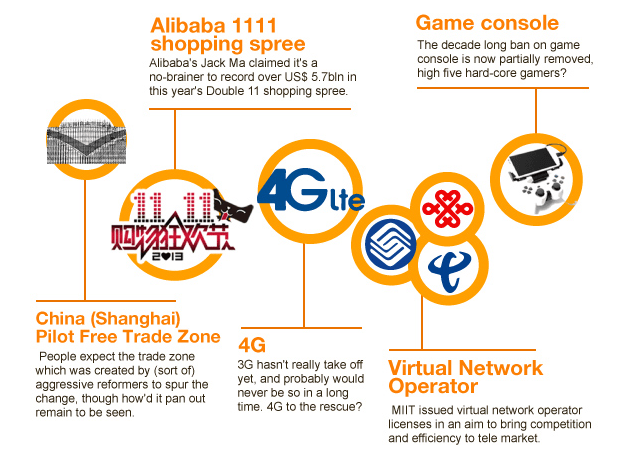
image002-1

Our readers would certainly be sure that mobile internet is now a mega trend in China: entrepreneurs are doing it, investors are checking on it, journalists are bragging about it. And a faster and more ubiquitous 4G services is expected to boost it to the next level and change Chinese people’s daily life in many ways.

Speaking of changing daily life, I guess the vigorous ecommerce empire pumped up by Alibaba deserves a vote. The company recored north of RMB 35 billion yuan (USD 5.7bln) in this year’s Double 11 shopping spree, breaking its own recored from last year. In comparison, America’s CyberMonday hit 2.29bln. Jack Ma, the legendary founder and chairman of the group later on divulged that the transaction volume was just a no-brainer, the company could easily crank it up to 100bln in the years to follow. Ambitious!

Numbers aside, we Chinese people who live here did felt the gradual and accelerated replacement of brick-and-mortar stores by virtual storefronts. What people used to say of anyone of Chna’s small commodity markets, where you could get almost anything, now they say of Taobao. The Chinese e-tailing platform provides everything ranging from clothing, food, electronics, cars, home decors to even improper items such as aircraft/island/human body parts, you name it, you find it.


2013 goes down as the most active for Internet M&A

As aforementioned are the breakthroughs emerged in the past year that’d be shaping up China towards a better direction, we also noted a maybe less profound but more practical change on the market that overrides the stereotype of Chinese Internet conglomerates. They DO know what M&A is.

Baidu grabbed 91 Wireless the largest Chinese app distribution platform from NetDragon, the whopping 1.9bln dowry made the deal the largest acquisition in Chinese Internet industry. It also gave Baidu access to a fast-growing and lucrative mobile Internet market. 91 Wireless manages 91 Assistant and HiMarket, tow of the leading app distribution service in China through which over 10 billion apps have been downloaded.

As Baidu is catching up on mobile front, Tencent and Sogou are coveting Baidu’s search business when they forged an alliance that saw Tencent bought 36.5% of Sogou with US& 448mln and packed Soso into Sogou.The new company would operate under the Sogou brand. Actually, from appearance nothing seems to have changed after the merger, Baidu 360 and Sogou ranked top 3 in terms of market share. Same old same old. But please be sure that the new Sogou is determined to take down 360 to become the second largest player.

And right after the merger, Sogou CEO Wang Xiaochuan said that some users of its Sogou Internet Browser running 360 Safe Guard complained about having the browser removed without their consent. The finger-pointing suggested that Qihoo was compromising Sogou on purpose, which came as no surprise given the company’s failed attempt in bidding for Sogou and its past repeated involvements in this kind of practice to rival against competitors.

A new acronym BAT was coined this year to represent Baidu/Alibaba and Tencent, three of the largest Chinese Internet companies with across-the-board services, as Baidu and Tencent both made fruitful deals in many areas this year, the one who is at a genuine spree should be Alibaba.

image003-1

The ecommerce giant treated itself with a little bit of something in almost every sectors: from Xiami (online music),  Zhong An (internet finance), Weibo (social media), AutoNavi (mobile map), Meituan (O2O, daily deal)UMeng (data analysis), Kanbox (cloud storage), LBE (mobile security), DDMap (O2O, e-coupon), Kuaidi (O2O, taxi hail app), Quiexy (overseas investment, app search service), ShopRunner (ditto, ecommerce) and Fanatics (ditto, sports retailer). Looks like Alibaba was trying to dip its toes into everywhere.

To wrap up, 2013 is a year that destined to go down as the most active for Internet M&A wave with Baidu, Alibaba and Tencent as the major drivers.


Xiaomi becomes a cult

Now let’s move on to the company of the Year. I personally haven’t tried anyone of those sensational popular Xiaomi phones, but my stubborn and ignorance did nothing to diminish Xiaomi’s status as a new cult here. According to Lei Jun, founder and CEO of the Chinese handset manufacturer founded three years ago, the company sold 18.7mln Xiaomi phones in 2013, up 160% from last year, while its revenue reached US$ 5.22 billion. The company was valued at over US$ 10bln in its latest round of financing compared to Nokia’s US$ 7.17bln sale to Microsoft. Besides, Xiaomi managed to nab Hugo Barra, a highly regarded Android team exec from Google, right in the middle of last year to steer its global expansion effort.

Good sales, wide prevalence, upbeat valuation and international effort all propelled the up-and-coming mobile vendor into our Company of the Year category.


Lei Jun, starts a business at 40

Since Xiaomi made it to the Company of the Year, the man behind it naturally emerged on top of our choices for People of the Year, and we thought Lei Jun, the founder and CEO of Xiaomi, well deserves it for a threefold reason:firstly, he made Xiaomi a huge success; secondly, he made Xiaomi a huge success; thirdly, he made Xiaomi a huge success.

In his late 30s, Mr. Lei already made his name for being a successful Jack of all trades and quite a figure in China Internet industry: as a professional manager, at him helm Kingsoft the Chinese software slash online game developer launched initial public offering; as an angel investor, his portfolios scattered around everywhere with YY landed an IPO last year; as a tech billionaire and happily married father of two, he basically had way more than what the world would expect from a middle-aged man.

Yet he didn’t feel completely fulfilled. He yearned to create a world-class company, a dream planted deeply in his heart in his early years.

The day he turned 40, he invited some friends over to a teahouse, and blew their mind by telling them he’d start a new business to make smartphone, he believed there was huge untapped potential in this area. Regardless of concerns over funding difficulty, failure among other things, he got started anyway. Now three years after, Mr. Lei’s Xiaomi not only took firm grip on its home turf, but also would expand its geographic footprints to overseas market such as Singapore soon.

Given Mr. Lei’s diligence, audaciousness and vision, we tapped him as this year’s People of the Year.

Now after all the sweet talks, it’s time to shed light on some tough realities. Just like the two sides of a coin, the past year wasn’t so bad, nor was it that good.

2013 is a lost year in terms of creativity and innovation. While people are applauding that BATs didn’t follow through on their copy-and-kill startups practice this year and generously offer them with big check instead, the unspoken fact is that M&A has replaced innovations. Now the big names couldn’t care less about curating mind-blowing new ideas that being challenged by big chances of failure despite a slight hope of becoming successful and transforming people’s life in some ways. They just went out with _strategic_ shopping and then arranged the acquiree like they’re the pieces in a chess match. All that matters is to gain the upper hand of your rivals and for that matter some pieces are doomed to be given up, the ultimate goal is to deliver checkmate.

While we couldn’t bank on the top-down innovation initiative, the bottom-up one also failed to work. The more popular Xiaomi became, the more sales-sensitive the company was. Xiaomi shipped its latest update to its handset with the launch of Xiaomi 3 and received mixed comments. Albeit a larger screen, battery that last longer, faster CPU and better camera,there’s no significant raise in price. This is one of the characteristics that made it successful – to offer high performance smartphone at relatively low price. However, some did find the iteration cycle of stacking up hardwares become more dull and less fun.

In all fairness, Xiaomi certainly isn’t the epitome of lack for creativity, the big guys are doing much much worse. Take Baidu the Chinese counterpart of Google for instance, at the company’s annual conference, it unveiled a new solution dubbed Light App to tap into mobile area. Since Light app basically is the rebranding of the web app solution once highly promoted by the search giant, what are we expecting for next year? Lighter App or Super Light App? Its pricey but worthwhile acquisition of 91 would do better to give it a quicker and easier access to mobile world.

Some might argue mentioning the smartwatch or smart router wave, aren’t those innovative enough? Listen, let’s don’t jump to conclusion so fast before you lay your hands on a smart watch, as for router, you mean a router with built-in features to block the pre-roll from online video sites? Not so much. There might be something coming out from them in the years to come, but not interesting enough for the time being.

For better or worse, 2013 is now a bygone and just like what Alfred Tennyson said, it’s not wiser to weep a lost, we might as well “trim our sails and let old bygones be” and to create a brave new tech world in 2014.

 

HK property agents were warned they face stiff punishment if they use their own money to pay developers in the hope of being allotted a chance to buy homes at popular projects

Agents warned on paying for shot at homes
Friday, January 24, 2014
Property agents were warned yesterday they face stiff punishment if they use their own money to pay developers in the hope of being allotted a chance to buy homes at popular projects.

Fines of up to HK$300,000 and licenses suspended or revoked were cited by Vivien Chan, chairwoman of the watchdog Estate Agents Authority.

“The authority is highly concerned about agents offering financing for homebuyers,” she said, noting there are clear guidelines that ban such action.

Agents are said to be drawn into such dealings when developers announce oversubscription figures at projects, hoping to boost sales.

Potential buyers have to register and provide cashiers’ cheques to a developer, which is how developers can gauge responses to a project.

Chan said the worry about this becoming a problem means more undercover checkers are being sent to watch agents, though only three violations of the money rule are suspected at this time.

The warnings on payments came as the authority revealed it had received a total of 494 complaints last year, with 44 of them from the primary market.

But that compared with 547 received in 2012.

It is also a fact that the number of agent licenses has been falling – it lately stood at 35,900 – since April last year.

The trend has reflected a lackluster market for homes, indicated clearly yesterday when a 1,600-square-foot unit at Harbourfront Landmark in Hung Hom sold for HK$32 million after the asking price had been reduced by HK$3 million.

And a survey by online property platform GoHome, which had 2,575 respondents, showed around one-third of local people interested in buying a home in the first half this year are being tempted by developers’ discounts and rebates.

Still, 86 percent of respondents also said that homes were still too expensive, while 38 percent believed prices will fall.

It was also noted that more than half of the respondents claimed they would consider buying property in Singapore, Malaysia or Thailand.


HK hospitals suffering from bad debts, with more than half the culprits being non-residents

Hospitals suffering from bad debts
Hilary Wong
Friday, January 24, 2014
The Hospital Authority says it has incurred bad debts totaling HK$49 million, with more than half the culprits being non-residents.

It said in its annual report that absconding pregnant woman from the mainland alone were responsible for HK$10 million of this amount.

Secretary for Health Ko Wing-man said he is greatly concerned as the number of bad debts has increased sharply from the previous year.

“We took stringent measures to prevent bad debts, including deposits by non-local patients,” he said.

Ko admitted it will be hard to recover the money if the patients had left Hong Kong as this will require additional resources.

“The deposit system is used when patients are referred to a hospital,” he said.

“But if a pregnant women arrives at the accident and emergency ward we have to provide medical services on humanitarian grounds and charge the patient later.”

He said the government and the authority will work together on prevention measures and he asked the public to understand the difficulties encountered on this issue.

Meanwhile, Ko said there are two peak periods of seasonal influenza, at the end of a calendar year and again in spring.

He said the Centre for Health Protection has been monitoring the incidence rate of influenza by examining samples from clinics or hospitals and collecting information about the patients who had upper respiratory infection symptoms similar to influenza.

Ko said the number of influenza cases this year is higher than the previous two years. He said since the outbreak of H1N1 in 2009, it had became one of the main viruses found in seasonal flu, accounting for 40 percent of all tested samples.

“With the flu season peaking in March and April we need to prepare to face any pressure to the medical system.”

Ko said despite the low death rate, flu can cause complications. “We still need to carefully monitor the situation so no conclusion can be made now.”

Charles Lee Yeh-kwong, the first chairman of Hong Kong Exchanges and Clearing (0388) became the chairman the Academy of Chinese Studies after stepping down from the top of the financial pyramid

Pivotal pioneer
Ling Wang
Monday, January 20, 2014

image001
Charles Lee Yeh-kwong, the first chairman of Hong Kong Exchanges and Clearing (0388) became the chairman the Academy of Chinese Studies after stepping down from the top of the financial pyramid.

Lee now endeavors to promote Chinese culture.

Last year marked the 20th anniversary of the first mainland enterprise listing in Hong Kong, and indeed, it was Lee, 77, who had pioneered the watershed event.

Mainland firms now account for more than half of Hong Kong’s total HK$24 trillion market capitalization.

In addition to bringing H shares to Hong Kong, Lee has been credited with being a prime mover in pushing through the merger of the city’s stock and futures exchange.

He also encouraged many of the territory’s biggest companies, including major developers to go public, as chairman of the Mandatory Provident Fund Schemes Authority.

Born in Shanghai in 1936 during the Sino-Japanese war, Lee moved to Hong Kong with his family in 1949, attended Wah Yan College, then studied accounting before going Britain to qualify as a lawyer.

Returning from London, he took various roles, including politician, solicitor, administrator, reformer, academic and charity worker. Now, he prefers people to call him a “messenger of culture”.

Mr Lee told Sing Tao Daily, The Standard’s sister paper, he likes the saying from The Analects of Confucius: “While wealth is covetable for a gentleman as well, he takes it in its natural course.”

Recalling the global financial crisis in 2008, He added: “So long as it comes to humans, things are not easy to control because humans are greedy by nature.” Therefore, edification brought by culture education was important.he lays blame on greed of Wall Street elites. “That was a grave lesson. But with days gone, people seem to forget the pain as Wall Street’s greed comes back again,” Lee said. “Governments want to correct the situation, but how?”

He paraphrased a story circulated in Pingyao, Shanxi Province, from where he has just returned.

The city was the financial center during the Ming and Qing dynasties. In the transition period between dynasties, the currency of the former dynasty depreciated sharply.

An owner of a private bank took pity on civilians who lost almost half of their life savings through currency depreciation, and deciding to exchange their currency with real gold prices.

“He suffered a great loss, of course, but it is a good example of doing business with morality,” Lee said.

He believes such good Chinese history is a treasure that deserves deeper exploration. The Academy of Chinese Studies is a non-profit organization established by renowned scholars in 1998. Lee is dedicated to promoting the website “Splendid Chinese civilization” (http://hk.chiculture.net).

The website has been running for more than 15 years, but has never had a high profile.

However, it has attracted a lot of overseas visitors, and the academy is translating the content into English. “You will be completely wrong if you think it’s an easy job,” Lee said.

“An article tens of thousand of words long needs more than one translator, but too many hands might spoil the coherence.” Despite the challenges, he would never give up. He believes that people should persist with meaningful things.

“It is a pity when you are capable, yet do nothing. When you are capable, then turn impossible into possible.”

In the past three decades, he has had numerous public roles. He feels sorry for the younger generation who show little enthusiasm for public service.

“The older generation felt they wanted to give something back to society when they tasted success. But the younger generation seems to think in a different way. They lack enthusiasm.”

There were lots of reasons for this, and politics was only one of them .

Asked if he would go back into public service, Lee said: “Opportunities should be left to the younger generation.”

But his public gowns have not disappeared for good.

He now heads the Hong Kong- Taiwan Economic and Cultural Cooperation and Promotion Council, and has been appointed as pro-chancellor. He has also been busy fund-raising for the Journalism Education Foundation to help it build a museum in Central.

As it gets harder for the government to find talent, Lee quoted a metaphor as food for thought.

“Man always complains it is hard to look for a girlfriend. For sure, it will be difficult when you require both beauty and brains. Sometimes you should lower the standards.”

He disagrees with those who criticize the young, saying: “Years ago, only one percent of people were admitted to university. Now over 60 percent attend colleges and universities, and one percent are as excellent as their predecessors.”

Although he was born in Shanghai and raised in Hong Kong, Lee’s family originated from Chiu Chow. He and another Chiu Chow tycoon, chairman of Cheung Kong (Holdings) Li Ka-shing have a close friendship.

He helped Cheung Kong to list in 1972 and held a role of director in all Cheung Kong-related companies. Last year, he became independent non- executive director of Cheung Kong and Hutchison Whampoa on a promise made 16 years ago.

“I joined the Executive Council in 1997, so I had to quit all the positions in listed companies. He [Li Ka-shing] said it was good to serve society, but when you finish the job in Exco, please come back to help me,” he said.

Li Ka-shing commented on current affairs and business issues in an interview conducted by mainland media last November. Asked how he sees his old friend’s remarks, Lee laughed and said, “Of course I cannot tell you.”

At 77, Lee still has lots of energy. He walks quickly, and still visits the office of Woo Kwan Lee & Lo law firm, which he co-founded in 1973. He is also a regular at a coffee shop in The Landmark..

Asked his opinion on Occupy Central, he said: “It’s OK to express ideas, but you have to adhere to the law.”

He likes scuba diving. His endurance of staying under the water would put many young divers to shame.

“People say diving is dangerous, but actually its the safest to stay under water. If I am under water when a tsunami hits, I would not feel it.”

Company chiefs in Hong Kong are earning as much as HK$31 million a year – but the city’s top and senior executives are still getting far less than their counterparts in Singapore and Japan

HK, Singapore CEOs tell a tale of two salary scales
Eddie Luk
Friday, January 24, 2014
Company chiefs in Hong Kong are earning as much as HK$31 million a year – but the city’s top and senior executives are still getting far less than their counterparts in Singapore and Japan.

The Hay Group found that salaries and year-end bonuses of CEOs in large listed companies in Hong Kong ranged from HK$13.63 million to HK$31.3 million a year.

But this is 34 percent less than that pulled in by top executives in Singapore.

And another survey showed that even senior executives in Hong Kong get 14 percent less than their counterparts in Singapore.

That’s according to Towers Watson, a professional services firm, which compared the salaries of senior executives in business corporations in Asian economies that also included Vietnam, Indonesia and others.

Based on the Hay Group survey, CEOs in banking, finance, telecoms and “consumer discretionary” industries are generally highly paid, taking home as much as HK$31.3 million a year.

Those in the financial/ banking and communication/ telecom sectors are paid HK$28.03 million and HK$20.68 million, respectively.

CEOs in the industrial sector are paid around HK$13.63 million a year.

On average, the salary of CEOs in the top 25 percent was HK$22.17 million a year.

The middle 50 percent took home HK$10.62 million and the bottom 25 percent got HK$4.82 million. Hay Group Hong Kong general manager Thomas Higgins said: “Changes in total CEO remuneration value is not always obviously linked to performance.”

Chinese University economics professor Terence Chong Tai-leung said: “As the retail industry is booming, particularly for firms selling watches, handbags and cosmetic products, they are willing to pay high salaries for the best CEOs.”

“In Singapore, firms are willing to offer extremely high salaries to lure talented people.”

Centaline Human Resources Consultants managing director Alexa Chow Yee-Ping agreed with Chong, saying that in recent years Singapore’s economic development has been stronger than Hong Kong’s.

India’s Decade of Decay; Manmohan Singh’s decade of disastrous leadership has been characterized by weakness and decay. India will suffer the consequences for years to come

India’s Decade of Decay

01-24 18:01 Caijing

Manmohan Singh’s decade of disastrous leadership has been characterized by weakness and decay. India will suffer the consequences for years to come.

By Jaswant Singh

NEW DELHI – Indian Prime Minister Manmohan Singh, who has been in office since 2004, recently held what was only the second press conference of his current five-year term, which is rapidly approaching an inglorious end. Betraying his yearning for approval, Singh told the assembled journalists that he hoped that history would judge his tenure more kindly than his political adversaries do.

That outcome seems unlikely, at best. On the contrary, Singh’s once-great Congress party is now at a political impasse, from which it can escape only if it frees itself from its destructive dynastic leadership. After more than a half-century in government – much of India’s modern life as an independent country – the era of Congress dominance appears to be over.

Perhaps the clearest indication of the party’s decline occurred in December, when it suffered crushing defeats in four key state-assembly elections. In Rajasthan, Congress won only 21 seats, while India’s second-largest political force, the Bharatiya Janata Party (BJP), won 162. This represents a massive shift from the 2008 election, when Congress gained 96 seats, compared to the BJP’s 78.

Likewise, in Delhi, Congress was reduced to just eight of 70 seats after 15 years in power, with even Sheila Dikshit, Delhi’s longest-serving Chief Minister, losing her seat to a political newcomer. Only in the small northeastern state of Mizoram did Congress retain its majority.

This was an unprecedented rout – and does not bode well for Congress in the upcoming national elections. To see why – and to determine whether the party can stem its own decay – requires understanding what has happened since Congress regained national leadership from the BJP-led National Democratic Alliance in 2004.

As the largest party, Congress became the hub of the newly established United Progressive Alliance (UPA). But, in a surprise move, the party’s leader, Sonia Gandhi, declined to become Prime Minister, naming Singh – an academic and civil servant, with no electoral experience – as the UPA’s choice. After nearly 40 days of melodrama, Singh was finally sworn in, though he had not won voter support directly in any constituency.

This unnatural arrangement instantly earned acid comments. As one observer astutely remarked, “Where there is authority, there is no ability; but where there is some ability, there is no authority.” Despite Singh’s academic abilities, his potential as India’s top politician was severely limited. Over time, it became apparent that Singh’s government was worse than ineffective; it was doomed to fail, because Singh’s strengths lie in serving as an obedient and capable subordinate, not as an agenda-setting leader who acts decisively.

Consider his role in managing India’s economic transformation when he was the country’s finance minister in the early 1990’s – an effort that his supporters have often cited as an example of his vision and ability. Last year, former External Affairs Minister Natwar Singh disclosed that it was actually then-Prime Minister Narasimha Rao, a shrewd and experienced Congress veteran, who pushed India’s economic reform and restructuring. Singh, reluctant to do what was needed, would have achieved very little had Rao not provided a platform – and the needed political support – to pursue the government’s agenda. Early on, there were intimations that Singh should neither be underestimated as a political manipulator, nor overestimated as an effective economic manager.

But Singh’s ineptitude as a leader was already apparent before the revelation of Rao’s role. Not only has economic reform come to a virtual standstill since he took office, but he has also acquiesced to all of Gandhi’s demands, legitimate or otherwise.

As a result, governance, and thus the economy, has been deteriorating. India has been taken hostage by an extra-constitutional body composed of NGOs, brought together under the National Advisory Council, which is chaired by Gandhi. With the cabinet having become superfluous, the NAC’s decrees – including half-baked ideas inspired by the European welfare state – became policy.

As a result, Singh has presided over a sharp economic slowdown and soaring prices, especially for food. Meanwhile, political scandals, financial scams, and other criminal activities have proliferated under Congress rule since 2004. The UPA regime has effectively looted the country, and rampant corruption and a lack of accountability have decimated its leading party’s credibility.

Through all of this, the supposedly economically literate Singh was little more than a silent spectator, offering only denials of responsibility or trite remarks from the perspective of a political outsider. And, while the damage that he has caused to Congress is for the party to solve, the damage that his aloofness has caused to the institution of Prime Minister is a problem for all Indians.

Manmohan Singh’s decade of disastrous leadership has been characterized by weakness and decay. India will suffer the consequences for years to come. Far from vindicating him, historians will know exactly whom to blame.

Jaswant Singh, a former Indian finance minister, foreign minister, and defense minister, is the author of Jinnah: India – Partition – Independence and India at Risk: Mistakes, Misconceptions and Misadventures of Security Policy.

Tesla makes electric debut in China market despite hurdles

Tesla makes electric debut in China market despite hurdles

Xinhua

2014-01-25

US electric vehicle maker Tesla made its debut in China this week amid applause over its lower-than-expected price tag, but consumers are still concerned about issues such as battery charging.

The company plans to have showrooms and maintenance centers open in more major cities in east China this year as part of its outreach to consumers in the world’s largest auto market, Veronica Wu, Tesla’s vice president, told Xinhua on Friday.

She also said CEO Elon Musk wants to double Tesla’s auto production this year and sees China as a key driver of its global auto sales growth.

Despite these ambitions, its efforts to build a strong presence in China face many hurdles.

Wu said pre-orders of its Model S in China have been dynamic in the past few months, but prospective car buyers in China are still resistant to the idea of driving a purely electric vehicle, mostly out of concern that it is hard to find places to recharge the car.

At Tesla’s Beijing showroom — the first and so far only one in mainland China — Xinhua reporters found customers gathering around the company’s popular Model S, with some venturing inside to try driving an electric vehicle.

A sales representative at the showroom said people who check out the Model S come with a broad range of questions, but the most frequently asked is where to charge the car, especially when running long-distance trips.

Tesla has said it will build free-to-use charging stations along expressways linking Beijing and Shanghai. The Model S can run up to 500 km after an hour of charging at one of these stations.

The insufficient infrastructure will likely hold back Tesla’s sales and expansion in China. But Wu expressed confidence in the Chinese government’s commitment to advancing its green initiatives. “Based on our contacts with officials in central and local governments, we find that authorities are very open to discussions about sustainable solutions to problems posed by growing automobile ownership,” she said.

Wu labels Tesla’s commitment to the Chinese market “unprecedented” compared with many multinational firms such as Apple and Motorola that she has previously worked for.

Tesla marked its entry to the highly competitive Chinese auto market with an online announcement on Thursday that the price of its Model S constitutes only its original price in the United States and unavoidable taxes and shipping costs.

Yet competitive pricing alone does not promise strong sales in China. A host of big Chinese cities have moved to cap the growth of automobile ownership to alleviate traffic congestion and air pollution.

Authorities have been encouraging purchases of hybrid and electric cars by granting more quotas and subsidies for buyers, but Tesla has yet to make the official list of cars eligible for such preferential policies.

Wu said Tesla is in talks with relevant government departments over this issue, recognizing that Tesla’s inclusion on the list would make its cars much more attractive to Chinese consumers.

She said the company has grand vision for its China business, even though its current China-based team of less than 30 people is building from scratch.

Wu also said she felt encouragement from the fact that China has seen “leapfrog development across many industries in the past” as an unsatisfactory status quo in many sectors has led to faster adoption of the latest technologies.

Kingston Chang, Tesla’s general manager in China, also added, “Though we sell cars, we are more of a tech company and we are in a business consistent with China’s goal of developing more sustainably. This means huge opportunities for us going forward.”


Taiwan topped the global rankings in patent activity and was ranked as the 10th most innovative nation in the world and the fourth most innovative in Asia

Taiwan tops global patent rankings

CNA

2014-01-25

Taiwan topped the global rankings in patent activity and was ranked as the 10th most innovative nation in the world and the fourth most innovative in Asia, according to the Global Innovation Rankings released by Bloomberg on Thursday.

According to Bloomberg, the patent activity category looked at resident patent filings per million residents and per US$1 million of research and development spent, as well as patents granted as a share of the world’s total.

In addition to patent activity, Taiwan finished second in high-tech density and tertiary efficiency in the Bloomberg innovation rankings.

The high-tech density category calculated the number of hi-tech publicly listed companies as a percentage of all listed companies. The United States came in first.

The tertiary efficiency category, measuring the number of secondary graduates enrolled in post-secondary institutions and the percentage of the labor force with tertiary degrees, in which Canada was ranked first, also looked at the annual number of science and engineering graduates as a share of the labor force and as a percentage of all tertiary graduates.

In addition to the three categories, the Bloomberg global innovation rankings weighed four other factors: R&D density, productivity, researcher concentration, and manufacturing capability.

The rankings evaluated more than 200 countries and regions based on the seven factors.

South Korea came in first in the overall innovation rankings but did not lead in any of the seven categories, according to Bloomberg.

Sweden was ranked the second most innovative nation in the world ahead of the United States, Japan, Germany, Denmark, Singapore, Switzerland, Finland and Taiwan.

China finished 25th in the overall innovation ranking but placed first in manufacturing capability, which measured manufacturing value as a percentage of a country’s gross domestic product and as a share of the world’s total value-added manufacturing.

South Korea came in second in the manufacturing capability category, according to the rankings.

Pharmas face closure if they fail to meet Beijing’s new regulations; Most drug makers who passed the new regulation are now facing idle capacity because their capacity had been enhanced to meet standards

Pharmas face closure if they fail to meet Beijing’s new regulations

Staff Reporter

2014-01-23

Drug manufacturers in China that have not passed new regulations under the Good Manufacturing Practice for Pharmaceutical Products (GMP) will face closure until they pass the verification process devised by the new GMP regulations, according to the China Food and Drug Administration.

Chinese pharmaceuticals can be divided into two categories — sterile medical products and non-sterile medical products.

The administration stated that all the sterile drugs manufactured by existing drug manufacturers had to meet the requirements of the new version of GMP before the end of 2013.

As of Dec. 31, 2013, the number of sterile drug producers was pegged at 1,319, with 796 passing the new GMP regulation and 523 trying to meet the new requirements or waiting to be merged with other companies.

The administration stated that those who have not met the requirements of the new GMP regulation could continue operating after they pass, but those who fail to pass the exam would be closed or merged, according to the Shanghai-based Economic Observer.

Most drug makers who passed the new regulation are now facing idle capacity because their capacity had been enhanced to meet standards, said a worker at China Shineway Pharmaceutical Group.

For drug producers, trying to meet the new GMP regulation is exerting mounting pressure as a result of idle capacity, bank loans, development for new drugs and capital flow.

Non-sterile medical products, on the other hand, have to meet the requirements of the new GMP by the end of 2015, said the report.

As of Oct. 2013, only 778 out of the total 3,839 non-sterile drug manufacturers passed the verification process.

An official at the China Association of Pharmaceutical Commerce said that at least 1,000 non-sterile medical producers have to be shut down or merged with other firms after the deadline passes in 2015.

Market observers are of the view that China’s pharmaceutical industry should be controlled by large pharmaceutical firms, which could help enhance quality, improve competitiveness and internationalization.

266 SMEs debut on China’s New Third Board

266 SMEs debut on China’s New Third Board

Xinhua

2014-01-25

A total of 266 small and medium enterprises (SMEs) started to be traded on the New Third Board on Friday, marking a considerable expansion for China’s over-the-counter (OTC) market after the board was officially established one year ago.

The move, bringing the number of companies listed on the New Third Board to 621, represents China’s efforts to encourage the development of SMEs against the current economic downward pressure.

The New Third Board, or National Equities Exchange and Quotation (NEEQ) system, serves as a national share transfer system for SMEs to transfer shares and raise funds.

Of all the debuting companies, which come from 28 provinces across the country, over 75% are engaged in innovative hi-tech sectors, covering high-end manufacturing, information transmission, software, research and development, technological solutions and cultural services.

23% of the companies have capital stock between 5 million yuan and 10 million yuan (US$820,000-$1.65 million), while enterprises with 10 million to 20 million yuan (US$1.65 million-$3.3 million) take up 24%.

Companies with capital stock of 20 million yuan to 50 million yuan (US$3.3 million-$8.26 million) and of above 50 million yuan account for 34% and 19%, respectively, of the total.

Half of the enterprises posted revenue of over 50 million yuan (US$8.26 million) in 2013 and a quarter reported 100-million-yuan (US$16.5 million) revenue with net profits surpassing 10 million yuan (US$1.65 million).

Confronted with a potential slowdown in economic growth, widespread industrial overcapacity and weakening investment increases, China’s economy is increasingly reliant on SMEs to generate growth.

Currently, such enterprises contribute 50% of national tax revenue, 60% of GDP, 80% of employment and 74% of technological innovation, the China Securities Journal reported on Friday.

However, SMEs in China still struggle with financing, regardless of whether they are trying direct or indirect ways of raising money, and are encumbered by intrinsic factors such as high risks for start-ups, lack of information and an opaque financial condition.

Prompted by the situation, the New Third Board was initiated in 2006 as an experimental platform to facilitate financing for China’s non-listed small and promising high-tech enterprises in Beijing’s Zhongguancun Science Park. Companies nationwide are now allowed to file applications.

The present system was officially established on Jan. 16, 2013 after years of trials in cities including Shanghai, Wuhan and Tianjin.

It complements the existing main board, the SME board and the ChiNext board, being seen as an easier financing channel with low costs, simple listing procedures and a short application period for start-up firms unqualified to be listed on major exchanges.

The State Council, China’s Cabinet, released policy measures in June 2013 to support adjustment and upgrading of the country’s economic structure, putting great emphasis on the OTC market in a bid to set up a multi-layered capital market.

Data from Straight Flush, a securities information service provider, showed that 355 enterprises listed on the New Third Board completed 60 issuance projects in 2013, raising over 1 billion yuan (US$165 million) and with aggregate market value surging 64.55% year on year.

Xie Geng, general manager of the NEEQ, revealed that the new transaction platform for the board is scheduled to begin operating in May while a system for market makers could also be expected in August.

Yang Xiaojia, chairman of the board of the NEEQ, promised to expand cooperation with commercial banks and other financial institutes and build a connecting mechanism for the Third Board and other exchanges markets as well as regional markets.

A guideline for supervision over mergers and acquisitions of non-listed companies is being drafted and will be released as soon as perfected, said the China Securities Regulatory Commission on Thursday via its account with Sina Weibo, the Twitter-like microblogging service.

China overtakes Japan for highest rate of death from overwork

China overtakes Japan for highest rate of death from overwork

Liang Shih-huang and Staff Reporter

2014-01-25

China has surpassed Japan to become the country that posts the highest rate of deaths caused by excessive work, with one Chinese website noting that the problem is acutest in the manufacturing sector.

According to some media reports, around 600,000 people or over 1,600 persons a day die as a result of overwork in China every year.

The manufacturing sector has seen the highest number of such deaths, reported iheima, a website offering consulting services to entrepreneurs, followed by PR, media, e-commerce, start-ups, finance, communication, internet, gaming and courier services.

“The invincible Chinese workers produce cheap, quality goods for the world, but pay the high price of health and lives,” iheima said, citing the example of Taiwan-based contract manufacturer Foxconn Group, which produces consumer electronics at its plants in China.

The website also cited the example of a 24-year-old employee at advertising agency Ogilvy & Mather’s Beijing office, who died suddenly in May last year after working overtime for a month.

However, such sudden deaths are excluded from accident insurance policies in China and have resulted in several disputes, the Chinese-language Beijing Business Today reported.

As a result, CIGNA and CMC Life Insurance Co recently launched the country’s first insurance policy that covers sudden death, although industry insiders pointed out certain existing life insurance policies also covered such deaths.

35% of top brands’ toxic childrenswear made in China

35% of top brands’ toxic childrenswear made in China

Staff Reporter

2014-01-25

A report released recently by Greenpeace claiming that the childrenswear lines of renowned international brands contain toxic chemical residues has caused a stir among Chinese consumers.

The clothes of twelve brands, including Burberry, Adidas, Nike, H&M, Primark, Puma, Li Ning, Disney, American Apparel, C&A, GAP, and Uniqlo, were found to have contained toxic ingredients, such as nonylphenol ethoxylates (NPEs) and phthalates, according to the report. The finding is based on samples of 82 items of childrens’ clothing purchased by the organization in 25 countries and areas during May-June of 2013, with production sites including China, Bangladesh, India, Indonesia, Italy, Mexico, the Philippines, Thailand, Tunisia, Turkey, Vietnam, and the US. “The problem may lie in the lining and the dyeing process,” remarked Xiao Danlai, vice secretary general of the Hubei Textile Industry Association.

Twenty nine, 35%, of the toxic samples came from China, which is the world’s largest textile producer, consuming 42% of textile chemicals worldwide.

The report points out that 50 of the 82 samples contain NPE ranging from 1.1-17,000 micrograms per 1.000 grams, higher than the allowed maximum of 1 microgram per 1,000 grams. Three samples had NPE residues exceeding 1,000 micrograms per 1,000 grams, including a Disney skirt, with 3,900 micrograms per 1,000 grams, C&A footwear, with 2,000 micrograms per 1,000 grams, and an American Apparel babywear garment, with 2,000 micrograms per 1,000 grams. A Burberry T shirt also contains 780 micrograms per 1,000 grams.

NPE is a chemical widely used in the textile production. When NPE is discharged into the environment, it can turn into nonylphenol (NP), an even more toxic environmental pollutant, which can disrupt the endocrine system of animals.

The report urges governments and enterprises to manage chemical ingredients throughout their life cycle, starting from the sources, by formulating complete policies and regulations.

Investors Offer Hospitals a Market Injection; Public hospitals in China’s cities are attracting investors willing to confront ‘Himalayan’ challenges

01.23.2014 17:24

Investors Offer Hospitals a Market Injection

Public hospitals in China’s cities are attracting investors willing to confront ‘Himalayan’ challenges

By staff reporters Yu Ning, He Chunmei, Li Xuena, Zhou Qun, Li Yan, Luo Jieqi and Ren Bo

(Beijing) — Sick patients waiting in long lines at China’s public hospitals have at least one advantage over the local government officials who run these overcrowded facilities.

Seeing a doctor, eventually, is pretty much assured for patients with patience. But for all their hard work a public hospital’s government managers may never see a profit: Simply breaking even after paying the bills is usually as good as it gets.

Which is one reason why local governments and the nation’s health care industry players have been carefully reviewing guidelines issued in October by the State Council, China’s cabinet, designed to encourage fresh investment in the nation’s more than 10,000 public hospitals.

The guidelines complement previous policy directives introduced by Beijing in recent years that encouraged a more market-oriented approach to managing the big, mainly urban hospital networks at the heart of the nation’s health care system.

“This policy is very attractive,” said Wei Xin, CEO of Sinocapistar Investment Holding Group Co. Ltd., a privately owned investment firm. “Private investors will soon carve up the public hospitals pie that’s being offered.”

Indeed, Wei said his firm is launching a special fund for investors interested in putting money into public hospital takeover projects. Others potential hospital investors include pharmaceutical companies, venture capital firms and even foreign investors.

The central government’s initiative has already spurred success stories as well as failures. Both outcomes have been experienced by the state-owned drug company China Resources Pharmaceutical Group Ltd. (CRP), for example, which first set its investment sights on hospitals in Yunnan, a province in the southwest, and Guangdong, in the south, in 2010. CRP is a subsidiary of the state conglomerate China Resources Group.

In the Yunnan capital of Kunming, CRP paid the city government 700 million yuan for a 66 percent stake in Kunming Children’s Hospital, the city’s main pediatrics facility and one of eight public hospitals in town.

On the failure side, the company in 2013 was forced to abandon a year-long effort to buy Gaozhou City Hospital, a public facility in the Guangdong city of the same name. The deal fell through because of what officials called resistance from special interests at the hospital.

A subtext to CRP’s tale of two city hospitals is that local governments, the traditional owner-operators of these bustling health centers, have the power to make or break an investor’s plan. Indeed, some say local governments stand as the biggest barriers to the kind of public hospital reform advocated by the central government.

Powerful city governments are particularly formidable. For that reason, the health sector does not expect outside investors to try vying for big public hospitals in big cities, such as Beijing and Shanghai, anytime soon.

However, smaller cities and communities with hospitals that are struggling financially are expected to welcome new investors. Some already have: In addition to Kunming Children’s, hospitals have gotten new owners in the cities of Wuhan, in the central province of Hubei, and Xuzhou, in coastal Jiangsu.

Willing investors can be found because buying a major or a controlling stake in a public hospital, which can include valuable medical staffers and urban real estate, is seen as a cost-effective way to break into the business. Public hospitals, although rarely profitable, are usually well-equipped and staffed by skilled doctors. Thus, buying a hospital is considered more investment-effective than trying to build a new hospital from scratch.

Himalayan Challenge

How did CRP successfully scale the local government barrier in Kunming? By winning support from the highest echelons, said company CEO Zhang Haipeng.

“It was only possible because the mayor led and the (Communist) Party secretary advocated the project,” Zhang said. “Investing in public hospitals is like climbing the Himalayas.”

CRP, whose parent started out as a trade mediator between Hong Kong and the mainland, has close ties with government agencies nationwide. This political network gave it a head start in its bid for the Kunming hospital.

In the course of negotiations with CRP, Zhang explained, Kunming’s then- arty secretary, Qiu He, agreed to let outside investors buy shares in up to three public hospitals, including Kunming Children’s.

For a local government official, Zhang said, Qiu’s outlook was especially progressive because he was willing to let CRP, as a new investor, acquire a majority stake and manage the hospital.

A CRP investment team had been looking for exactly that kind of opportunity. But while researching potential investment targets across the country, Zhang said, the team generally found government officials reluctant to allow private management of a local hospital.


Value is created by doing; Make mistakes of ambition and not mistakes of sloth. Develop the strength to do bold things, not the strength to suffer

Value is created by doing

Sam Altman

Jan 17, 2014

Value is created by doing.

It’s easy to forget this.  A lot of stuff feels like work—commenting on HN, tweeting, reading about other companies’ funding rounds, grabbing coffee, etc [1]—is not actually work.  (If you count that as work, think really hard about the value you’re creating in your job.)  These activities can be worthwhile in small doses—it’s important to network and meet interesting people to stay in the flow of ideas—but they are not by themselves how new wealth gets created.

Value gets created when a company does things like build widgets and sell them to customers.  As a rough guideline, it’s good to stay in roles where you’re close to the doing.

Of course you have to do the right things.  Writing software no one wants does not create value—that’s called a class project.  So it’s critical to figure out the right thing to work on, and strategy is far more valuable than a lot of pivot-happy companies would have you believe.  But strategy alone has no value—value gets captured by execution.

It’s easier to sit around and talk about building a startup than it is to actually start a startup.  And it’s fun to talk about.  But over time, the difference between fun and fulfilling becomes clear.  Doing things is really hard—it’s why, for example, you can generally tell people what you’re working on without NDAs, and most patents never matter.  The value, and the difficulty, comes from execution.

There are good tricks for keeping yourself honest here.  When I was running a company, I used to make a list of everything I got done at the end of the day.  It was remarkable how I could feel like I had a really busy day and realize that night I got nothing done.  Similarly, I could have a day that felt only somewhat busy, but accomplish 3 or 4 major things.

Err on the side of doing too much of the sort of work that matters and blowing off all the rest, or as Machiavelli said:

Make mistakes of ambition and not mistakes of sloth.  Develop the strength to do bold things, not the strength to suffer.

You build what you measure—if you measure your productivity by the number of meetings you have in a day, you will have a lot of meetings.  If you measure yourself by revenue growth or number of investments closed or something like that, you will probably have fewer meetings.

Another example of not-quite-work is every night in San Francisco, there are dinner parties where people get together and talk about the future.  It’s always fun and usually not very contentious—most people agree we need to go to space, for example.  But at the end of it, everyone goes home and works on something else.

If you believe that going to space is the most important project for humanity, then work on it.  If you can’t figure out how to raise hundreds of millions of dollars, go work for SpaceX (joining a great company is a much better plan than starting a mediocre one).  If enterprise software is what you really love, then work on that. [2]

If you’re reading this and feeling unproductive, there’s a silver lining.  You can just close the browser window.  The good news is that it’s easy to course-correct, and it feels great. [1] I count blogging as a marginal use of time, but the reason I started is because I realized it was important to be good at writing, I was bad at it, and the only way I was going to improve was with lots of practice.  And sometimes I meet really interesting founders because of something I wrote.

[2] This isn’t meant as any sort of relative value judgment; if what you want to do is build an enterprise software company, then you should do that.  The problem comes when what you really want to do is build rockets.  A lot of people feel like they first should do something to make money and then do what they care about (or first work at a company for awhile before starting a company they really want to start).  While you of course should take care of your family before anything else, you should try to work on what you really care about.  You can usually find a way.  The danger is that life is short and you only get to work on a small number of companies over the course of a career—it’s worth trying to make them count.


The Cult of Overwork

THE CULT OF OVERWORK

by James SurowieckiJANUARY 27, 2014

image001

For decades, junior bankers and Wall Street firms had an unspoken pact: in exchange for reasonably high-paying jobs and a shot at obscene wealth, young analysts agreed to work fifteen hours a day, and forgo anything resembling a normal life. But things may be changing. Last October, Goldman Sachs told its junior investment-banking analysts not to work on Saturdays, and it has said that all analysts, on average, should be working no more than seventy to seventy-five hours a week. A couple of weeks ago, Bank of America Merrill Lynch said that analysts are expected to have four weekend days off a month. And, last week, Credit Suisse told its analysts that they should not be in the office on Saturdays.

These changes may sound small, but, in the context of the Street, they’re positively radical. Alexandra Michel, a former Goldman associate who is now on the faculty at the University of Pennsylvania, published a nine-year study of two big investment banks and found that people spent up to a hundred and twenty hours a week on the job. In the pre-cell-phone, pre-e-mail days, it was possible for people to find respite when they left the office. But, as David Solomon, the global co-head of investment banking at Goldman, told me, “Today, technology means that we’re all available 24/7. And, because everyone demands instant gratification and instant connectivity, there are no boundaries, no breaks.”

Cry me a river, you might say. But what happened on Wall Street is just an extreme version of what’s happened to so-called knowledge workers in general. Thirty years ago, the best-paid workers in the U.S. were much less likely to work long days than low-paid workers were. By 2006, the best paid were twice as likely to work long hours as the poorly paid, and the trend seems to be accelerating. A 2008 Harvard Business School survey of a thousand professionals found that ninety-four per cent worked fifty hours or more a week, and almost half worked in excess of sixty-five hours a week. Overwork has become a credential of prosperity.

The perplexing thing about the cult of overwork is that, as we’ve known for a while, long hours diminish both productivity and quality. Among industrial workers, overtime raises the rate of mistakes and safety mishaps; likewise, for knowledge workers fatigue and sleep-deprivation make it hard to perform at a high cognitive level. As Solomon put it, past a certain point overworked people become “less efficient and less effective.” And the effects are cumulative. The bankers Michel studied started to break down in their fourth year on the job. They suffered from depression, anxiety, and immune-system problems, and performance reviews showed that their creativity and judgment declined.

If the benefits of working fewer hours are this clear, why has it been so hard for businesses to embrace the idea? Simple economics certainly plays a role: in some cases, such as law firms that bill by the hour, the system can reward you for working longer, not smarter. And even if a person pulling all-nighters is less productive than a well-rested substitute would be, it’s still cheaper to pay one person to work a hundred hours a week than two people to work fifty hours apiece. (In the case of medicine, residents work long hours not just because it’s good training but also because they’re a cheap source of labor.) On top of this, the productivity of most knowledge workers is much harder to quantify than that of, say, an assembly-line worker. So, as Bob Pozen, a former president of Fidelity Management and the author of “Extreme Productivity,” a book on slashing work hours, told me, “Time becomes an easy metric to measure how productive someone is, even though it doesn’t have any necessary connection to what they achieve.”

Habit, too, is powerful: things are done a certain way because that’s how they’ve been done before, and because that’s the way the people in charge were trained. When new regulations limited medical residents’ working hours to eighty a week, many doctors complained of declining standards and mollycoddling, and said that it would have a disastrous effect on training, even though residents in Europe work many fewer hours, without harming the quality of medical care. “I went through it, so you should” is a difficult impulse to resist.

To make these new policies stick, then, banks have to change not just rules but expectations. Indeed, as Michel told me, “it isn’t really external rules that force bankers to work the way they do. It’s an entire cultural system.” She cites the example of a consulting firm that mandated that people stay out of the office on weekends, only to discover that they were working secretly from home. In a culture that venerates overwork, people internalize crazy hours as the norm. As the anthropologist Karen Ho writes in her book “Liquidated,” “On Wall Street, hard work is always overwork.” Grinding out hundred-hour weeks for years helps bankers think of themselves as tougher and more dedicated than everyone else. And working fifteen hours a day doesn’t just demonstrate your commitment to a company; it also reinforces that commitment. Over time, the simple fact that you work so much becomes proof that the job is worthwhile, and being in the office day and night becomes a kind of permanent initiation ritual. The challenge for Wall Street is: can it still get bankers to run with the pack if it stops treating them like dogs? ♦

Read more: http://www.newyorker.com/talk/financial/2014/01/27/140127ta_talk_surowiecki?printable=true&currentPage=all#ixzz2rQSrI44K

Magnum, a Hong Kong nightclub launching its IPO, explains how a nightclub works, the popularity of the Jagerbomb and that, sometimes, people drink while dancing

With This Initial Public Offering, There’s a Lot to Drink In

Hong Kong Stock Pitch Explains Scene: Jagerbombs Sell Big; Club Hopping Poses a Risk

ISABELLA STEGER

Updated Jan. 21, 2014 10:58 p.m. ET

image001

Gold toilet at Magnum Club in Hong Kong Isabella Steger/The Wall Street Journal

When a company is going public, it is important that prospective investors understand its business.

Magnum, a Hong Kong nightclub, is launching an initial public offering on Thursday, and its prospectus explains the following: how a nightclub works, the popularity of the Jagerbomb and that, sometimes, people drink while dancing.

“Clubbing is a popular night time activity which has evolved from the discotheques of the 1970s into a modern form of social gathering with lively music, elaborate lighting and a dance floor, supplemented by both alcoholic and non-alcoholic beverages,” the IPO-prospectus overview begins.

And it describes the scene: “The aura and atmosphere of the modern clubbing scene is filled with images of people moving in unison to the beat of synthesised remixed dance and electronic music spun out by a DJ perched upon an elevated stage.”

Late on a Saturday night, the line to get into the Magnum Club can sometimes stretch down the block. As busy as Magnum gets, far more people want to buy into the company’s IPO than to dance amid its flashing walls and use its diamanté-encrusted toilets.

Investors placed orders for over 3,000 times the number of shares available in the HK$126 million ($16 million) IPO, making it one of the hottest stock offerings in the city’s history. The prospective buyers are betting that the stock of the nightclub chain will skyrocket when it starts trading on Thursday.

As with any coveted IPO, brokers give their best customers the first crack at the shares so they can earn quick profits if the stock pops when trading starts. In Hong Kong, that would include an army of mom and pop stock traders, many of whom spend their days hanging around brokerage offices and some who have likely gone to bed before Magnum gets hopping.

“Lots of my clients want to get their hands on Magnum’s shares,” said Arthur Lui, senior sales manager at Prudential Brokerage.

Peter Wong, 38 years old, works at a brokerage and visits the Magnum club twice a week. “I would actually be interested in the IPO, but it’s very hard to get into,” he said as he poured from a HK$5000 ($645) bottle of Belvedere vodka Saturday night at Magnum.

But he wouldn’t stay for the long haul. “I would dump the shares quickly,” Mr. Wong said. One reason: “People are fickle and will just move on to whatever the hottest new club is.”

The prospectus acknowledges that patrons might not hang around all night. “There has been a trend of ‘club-hopping’ developing in Hong Kong in recent years which means customers have the tendency to visit multiple clubs in one night,” the document continues. “Customers may choose a Club based on their mood on a particular evening.”

The IPO is tiny by most standards. The club’s owner, Magnum Entertainment Group Holdings Ltd., runs three nightclubs within blocks of one another in Lan Kwai Fong, a densely packed, occasionally rowdy neighborhood of bars and restaurants just up the hill from Central, Hong Kong’s main business district.

Magnum tries to differentiate its three clubs: Magnum, Beijing Club and Billion Club. The Billion Club boasts life-size bronze bulls on its outdoor terrace and Magnum has a crystal-studded DJ booth. Billion and Magnum have diamanté-decorated toilets. Proceeds raised from the IPO will go to opening another club, Zentral, this year.

The nightclub company and its bankers and lawyers wouldn’t talk ahead of the IPO.

Magnum topped the record set by Milan Station Holdings Ltd. 1150.HK +2.17% ‘s IPO in 2011, when investors placed orders for more than 2,000 times the number of shares available. Milan Station occupies a unique niche in brand-obsessed Hong Kong, selling secondhand designer handbags for prices ranging from a few hundred to a few thousand dollars. Hong Kong’s individual investors typically flock to small IPOs like these, looking to make a quick buck by selling the shares once the company starts trading.

Magnum makes most of its money selling drinks, “generally known as alcoholic beverage served by glass and prepared by bartenders mixing different alcohol and ingredients,” according to the prospectus.

The drinking habits of Magnum’s patrons have changed recently. According to the IPO prospectus, Magnum’s clients have widely divergent and rapidly changing tastes. The club’s highest-grossing drink is Moët & Chandon Magnum Champagne.

But the most popular is the Jagerbomb, typically defined as a shot of Jagermeister—a German liqueur made from 56 herbs, roots and spices that tastes heavily of anise—dropped into a glass of beer or energy drink. The Jagerbomb overtook a Smirnoff vodka that was the most popular drink for the previous three fiscal years, according to the prospectus.

Magnum’s IPO is getting an unlikely boost. While Hong Kong residents aren’t known to be big drinkers, the prospectus gives credit for the company’s growth to a 50% surge in expatriate professionals in Hong Kong after the financial crisis.

“It is believed that this leads the Hong Kong alcohol consumption and night entertainment scene closer to the consumption patterns observed in western countries,” the document says.


Craig Winkler’s Xero shares now worth $745m as stock breaks $40 barrier

Caitlin Fitzsimmons Online editor

Craig Winkler’s Xero shares now worth $745m as stock breaks $40 barrier

Published 16 January 2014 12:33, Updated 16 January 2014 12:35

image001

Craig Winkler returned to the BRW Rich 200 in 2013 thanks to his Xero investment. James Davies

The extraordinary rise of shares in accounting software start-up Xero has already made hundreds of millions of dollars for early investor Craig Winkler and it shows no signs of slowing down.

The New Zealand-based company opened on the Australian Securities Exchange at $40.30 on Thursday morning, after rising nearly 8 per cent the previous day.

This is an 18 per cent rise since 6 November last year when it closed at $34.20. The stock listed on the ASX just a year before, on 8 November 2012, at an opening price of $4.50. It was already listed on the New Zealand Stock Exchange and maintains a dual listing.

The share price gives it a market capitalisation greater than many other businesses, including SEEK and Qantas, and is despite the fact that the company is not yet profitable.

Xero reported a net loss of $16 million for the six months ended 30 September but revenue is growing strongly and is now more than $30 million. The company, described by Credit Suisse as the “Apple of accounting”, offers a cloud-based accounting solution to the small business market and its customer base is global.

Winkler paid $15 million for his initial stake in Xero in 2009 after selling out of rival accounting software company MYOB, which he founded.

He sold some shares early on but remains the second largest shareholder in Xero behind the Kiwi chief executive Rod Drury.

Winkler returned to the BRWRich 200 in 2013 in 178th place, with a fortune estimated at $275 million, $200 million of that from the value of Xero shares.

Based on the Thursday opening price of $40.30, his stake is now worth a staggering $745 million.

On Wednesday Xero appointed Victoria Crone, who previously worked at Telecom New Zealand and Chorus, as managing director in New Zealand, effective April.

The statement to the ASX also revealed the company had recruited 90 staff in the past three months and now had headcount over 600 but is still looking to hire more software developers.

Smiggle kids stationery retailer expands to UK; large shopping centre landlords are keen to have Smiggle as a tenant because there is little risk of sales leaking away to the internet

Smiggle kids stationery retailer expands to UK

Published 22 January 2014 12:00, Updated 23 January 2014 11:48

Simon Evans

The Smiggle chain’s bright colours and cheap and cheerful stationery have proven a hit with Australia’s nine-year-old girls and boys. Now Mark McInnes is hoping youngsters in Britain will have the same appetite for Smiggle’s rucksacks, pencil cases, lunch boxes, drink bottles and erasers.

The former boss of department store chain David Jones, who has been chief executive for almost three years at ­Premier Retail (the retail business owned by billionaire and BRW rich lister Solomon Lew’s listed Premier Investments ­vehicle), believes Smiggle can be a ­global champion.

He’s about to find out if Smiggle, which has 124 stores in Australia, can become a serious player in the $2.4 billion British market. The first Smiggle store is set to open on February 20 in Britain in Westfield Stratford City, the giant shopping centre which opened in 2011 and is adjacent to London’s Olympic Village.

McInnes, Smiggle group general manager John Cheston and the Premier Investments board are aiming to have 200 Smiggle stores operating in Britain within five years. This will make the British Smiggle business much larger than the Australian operations, which are rapidly approaching saturation point with 124 stores.

Smiggle also has 17 stores in Singapore after first entering that market two and a half years ago, and that business is tracking solidly. Mr McInnes thinks Smiggle has the right stuff to become a highly pro­fitable global brand as it attempts to muscle in on Britain.

“We’re not competing with the Zaras of the world. There aren’t many global companies that can talk about their ­target market being nine-year-old girls and boys.”

Smiggle’s biggest competitor is the private equity-owned Paperchase, which has about 100 stores in Britain and much larger store footprints of about 200 to 250 square metres. Paperchase has 70 per cent of its range focused on adult stationery. Another competitor is WH Smith, a newsagent, bookseller and stationery group.

Cheston says large shopping centre landlords are keen to have Smiggle as a tenant because there is little risk of sales leaking away to the internet. The average transaction size of Smiggle customers is about $20 each visit, as children shop with a parent and younger teenagers make purchases of fashionable stationery with their pocket money. Smiggle has a small internet presence but makes most of its sales in stores.

The former Just Group paid $29 million for Smiggle in 2008 when it was just 20 stores and sales revenue has risen from $19 million to more than $90 million. Premier Investments bought Just Group for $800 million in late 2008.


Will the 2nd Great Machine Age be a frightening jobless dystopia?

Will the 2nd Great Machine Age be a frightening jobless dystopia?

Machines have been displacing jobs for years and the rate is accelerating

By Ambrose Evans-Pritchard

12:11PM GMT 25 Jan 2014

Thanks to lightning-speed advances in hi-tech, humanity (or part of it) is close to achieving its dream of prosperity without toil. We are already starting glimpse the awful consequences. As Voltaire said, work is the triple tonic for needs, vice, and boredom.

A Davos vote split 51:49 on whether “technological innovation” will keep displacing jobs – and at an accelerating rate – leaving us with a deformed world where hundreds of millions are left on the unemployment scrap-heap (205m so far).

The waters have been so muddied by the global financial crisis – and the 1930s response to it in some quarters – that it is hard to separate the chronic job wastage caused by “robots” (to use a metaphor) from the temporary effects of scarce global demand.

Phillip Jennings, head of the UNI global labour federation, said it would be a “miscarriage of justice” to blame the 32 million job losses since the Lehman-EMU crisis on the iPad or the driverless car.

“You can’t put technology in the dock for 50pc youth unemployment in Greece or Spain. I blame the EU Troika. It was the economic and political decisions taken that have led to the collapse of jobs. In Greece it has gone beyond depression into a humanitarian crisis,” he said at theWorld Economic Forum.

He said some $2 trillion of corporate cash is on the sidelines in the US, $700bn in the UK, and another $2 trillion in the rest of the world. “There is an investors strike. This is a problem of demand in our economies, they are comatose,” he said.

This has a kernel of truth. The current policy settings are pushing the global savings rate to a record 25.5pc of GDP, creating a chronic surfeit of capital over labour. It is a Marxian world.

You can blame this on the “savings glut” in Asia and Northern Europe, or Chinese industrial policy, or regressive tax systems, or labour arbitrage that lets multinationals play off cheap labour in the East against the West, or growing inequality on the GINI index (all linked). As Mr Jennings says, “the social contract has been ruptured.” I would go further. We risk losing social/liberal democracy altogether.

And yet, there is a deeper story. Larry Summers, the former US Treasury Secretary, told the same panel that the post-Lehman jobless spike is of course due to a failure to take “economics seriously” – though he mercifully spared us the names of his “avatars of austerity”, the guilty men. We know who they are. It is a crisis caused by lack of global aggregate demand.

But he also said machines have been displacing jobs for almost half a century. The proportion of those aged 25-54 (the relevant cohort) that is not working in the US has tripled since 1965. This cannot be blamed on globalisation alone. “It predates meaningful trade with China. It is a long-term trend and it is accelerating.”

For those tempted by cry Luddism, hold your thought. This is nothing like the switch from agricultural revolution to the first machine age. The new displaced cannot migrate into textiles mills and great manufacturing hubs on the 19th Century. Labour-saving technology is now sweeping all sectors, including services. “The challenge is that much more immense now,” he said.

A single professor can teach 150,000 students the same academic course through digital lessons. While it still takes the irreplaceable creativity of human beings to play a Haydn Quartet, the same disc can be sold to millions, he said.

This is not a counsel of utter despair. Governments can rewrite the rule book, though that is a tall order in our global race to the bottom, with footloose capital. As Mr Summers says, the abuses did not self-correct even in the late 19th Century and early 20th Century. “It required a Gladstone, a Bismarck, a Roosevelt to make it work,” he said.

Prof Erik Brynjolfsson, a tech guru at MIT, said tax policies can change the game. Some 80pc of US taxation is now on labour. But how do you shift this burden to wealth taxes in a world of open capital flows and competing national tax jurisdictions? (Protectionism perhaps, but I wash my mouth out with soap for even muttering it)

Nor will the emerging economies escape this curse. Indeed, they are in the “bulls eye”, said Prof Brynjolfsson.

Apple’s new Mac Pro will be made in Austin, Texas. Robots have rendered the labour cost irrelevant. The BRICS and mini-BRICS can longer under cut on price.

“Wages don’t matter any longer. Off-shoring was just a way station.” We are back to reshoring, but without jobs. Welcome to our brave new world


If You’re Not Helping People Develop, You’re Not Management Material

If You’re Not Helping People Develop, You’re Not Management Material

by Monique Valcour  |   10:00 AM January 23, 2014

Skilled managers have never been more critical to the success of firms than they are today.  Not because employees can’t function without direction, but because managers play a vital role in talent management. Gone are the comprehensive career management systems and expectations of long-term employment that once functioned as the glue in the employer-employee contract.  In their place, the manager-employee dyad is the new building block of learning and development in firms.

Good managers attract candidates, drive performance, engagement and retention, and play a key role in maximizing employees’ contribution to the firm. Poor managers, by contrast, are a drag on all of the above.  They cost your firm a ton of money in turnover costs and missed opportunities for employee contribution, and they do more damage than you realize.

Job seekers from entry-level to executive are more concerned with opportunities for learning and development than any other aspect of a prospective job.  This makes perfect sense, since continuous learning is a key strategy for crafting a sustainable career.  The vast majority (some sources say as much as 90%) of learning and development takes place not in formal training programs, but rather on the job—through new challenges and developmental assignments, developmental feedback, conversations and mentoring.  Thus, employees’ direct managers are often their most important developers.  Consequently, job candidates’ top criterion is to work with people they respect and can learn from. From the candidate’s viewpoint, his or her prospective boss is the single most important individual in the firm.

Managers also have a big impact on turnover and retention. The number one reason employees quit their jobs is because of a poor quality relationship with their direct manager.  No one wants to work for a boss who doesn’t take an interest in their development, doesn’t help them deepen their skills and learn new ones, and doesn’t validate their contributions. This isn’t what departing employees tell HR during their exit interviews, of course.  After all, who wants to burn a bridge to a previous employer? Instead, they say they’re leaving because of a better opportunity elsewhere.  And so what happens is that organizations remain in the dark regarding how much damage their inept managers are doing.

Regardless of what else you expect from your managers, facilitating employee learning and development should be a non-negotiable competency.  Google’s famous people analytics team examined data from thousands of employee surveys and performance reviews to find out which behaviors characterize its most effective managers.  Coaching topped a list that also included helping with career development.  Research by Gallup has yielded similar results.  Work groups in which employees report that their supervisor (or someone else at work) cares about them as a person, talks to them about their career progress, encourages their development, and provides opportunities to learn and grow have lower turnover, higher sales growth, better productivity, and better customer loyalty than work groups in which employees report that these developmental elements are scarce.

Remember the Peter Principle?  The phrase refers to a process in which employees receive promotions as a reward for being competent in their current jobs, and they continue to rise through an organization’s ranks until they reach a level at which they are incompetent.  The predictable consequence of this pattern is that over time, an organization becomes heavily staffed by managers who are bad at their jobs.  Your organization cannot afford to let this happen.

Becoming a great developer of employees requires managers to expand their focus from “How can I get excellent performance out of my team members?” to “How can I get excellent performance out of my team members while helping them grow?”  Savvy managers know that doing well on the second part of the last question helps to answer the first.

The best managers ask, “How can we harness employee strengths, interests and passions to create greater value for the firm?”  Systematically linking organizational performance and individual development goals in the search for learning opportunities and better ways to work is a hallmark of organizations where sustainable careers flourish. And this is not a question managers try to answer by themselves; instead, they discuss it regularly with their team members.

Here are several steps you can take to stimulate learning and development:

Share detailed information with your team about current operations across the firm.  Be transparent about the firm’s challenges and direction, including such things as changing customer expectations, new vendor relationships, early-stage strategic plans, and top leaders’ thinking regarding the potential impact of industry trends and economic conditions. Invite their questions, thinking and suggestions on these issues as well.

Support the development of internal social networks that span functions and divisions in order to give employees broader understanding of the organization and help them spot opportunities to learn and to add value.

Instead of a once-annual conversation about career goals at the time of the annual performance review, have frequent short conversations throughout the year regarding employees’ career goals and interests, which may not be self-evident. Regular career conversations help employees to refine their goals. With better understanding of their learning goals, you and your employees are in a better position to spot developmental opportunities.

When planning your team’s work, ask employees to identify both how they can contribute and what they would like to learn. This gives employees the primary responsibility for clarifying what they want to learn and for proposing ways to incorporate on-the-job learning. It also helps to avoid having employees volunteer to perform only the tasks that they are already highly skilled at.

Ask employees to report back periodically to you and fellow team members on what they have been learning and how they are using new skills and knowledge.

Keep in mind that in addition to helping employees develop and pursue meaningful learning goals, regular career conversations also help to mark progress in development. And they serve as a reminder of the organization’s commitment to employee learning, which in turn strengthens employee commitment.


The Secret to Lean Innovation Is Making Learning a Priority

The Secret to Lean Innovation Is Making Learning a Priority

by Tom Agan  |   12:00 PM January 23, 2014

Lean innovation is being embraced by everyone — from the smallest start-ups to the largest global organizations. But in most cases, it’s still falling well short of its full potential because it either lacks or fails to tightly integrate with the mechanisms needed to systematically capture lessons learned and share them outside the team. And that’s where the money is in innovation.

Lean innovation embraces a philosophy of not letting perfection get in the way of progress. It leverages the Pareto principle that 20% of a product’s features (what’s distilled down into the minimal viable product) will most likely deliver 80% of the benefits sought by customers.

As an approach, lean innovation lends itself especially well to corporate cultures, often engineering ones and others strongly focused on process-improvement programs such as Six Sigma. Its straightforward, step-by-step methodology makes it relatively easy to explain and to implement:

Identify the minimal viable product.

Develop a version rapidly and test it with customers, ideally in a real-world competitive situation.

Repeat the process until the core product is competitive or pivot to explore a new approach.

Lean innovation stands in stark contrast to conventional approaches to product development in which teams expend enormous effort trying to create a perfected, many-featured product over an extended period without sufficient in-market customer feedback. The resulting new products are often too expensive, too complicated, too different from what customers want, and too late to market.

But an exclusively process-driven view of lean innovation obscures the underlying reason for its power. And without a deeper understanding, we limit our ability to fully benefit from its potential.

When I worked at Nielsen, I led a study of innovation best practices in the consumer-packaged-goods (CPG) industry with companies like Procter & Gamble and Kraft that revealed why top-performing companies average 600 times more revenue from their new products than the lowest performers. The research tied variations in new product revenue at almost 30 global companies to differences in processes, culture, organizational structure, senior executive leadership roles, and investment.

One of the key findings was that learning has far and away the single greatest impact on revenue from new products. And creating a better environment for learning is what lean innovation does so well. Its focus on the most important product attributes and rapid cycling of trial and error — ideally in the real-life competitive environment — accumulates critical knowledge at a rapid clip.

In other words, lean innovation is not a better innovation process; rather it’s a more efficient learning process. And by combining the lean perspective with innovation research from CPG companies, we can vastly improve the effectiveness of the lean innovation approach. Here is what the research tells us:

Companies with mandatory formal debriefs of both success and failure following new product launches average about 100% more revenue from new products in comparison to companies that don’t formally debrief.

When debriefs are led by an outside third party, the revenue increases substantially more.

And when the learnings are captured in a knowledge management system, revenue jumps again.

Companies that apply these learnings to creating, continuously improving, and strictly following decision-making criteria for the evaluation of potential new products average about 130% more revenue from new products.

Success can skyrocket by simply adding the above steps to a lean innovation process.

But this research also points to a cautionary note regarding lean innovation. Given that lean innovation teams move so quickly, the learnings are less likely to be captured than in traditional, slower approaches to product development. Secondly, given that lean innovation teams often exist in parallel with conventional product development teams, valuable learnings from lean teams are not always transferred to the development side.

We need to think of lean innovation as a process that drives more efficient learning. But to maximize success, lean innovation must be married to practices that effectively capture these rich lessons and make them readily available to everyone within the organization.


Five Questions Every Leader Should Ask About Organizational Design

Five Questions Every Leader Should Ask About Organizational Design

by John Beeson  |   11:00 AM January 23, 2014

A few years ago Dave Ulrich, a management thought leader from the University of Michigan, made a comment I found both insightful and profound: “Every leader needs to have a model of organization design.” Typically a graphic depiction of the organizational components to be addressed in a redesign (for example, McKinsey’s 7S model, which includes strategy, structure, systems, staff, skills, and so on), every consultant and his brother flogs an organization design model. Dave didn’t advocate any particular design model, just one the leader knows how to employ and one flexible enough to be applied to the range of organizational situations a leader faces in the course of a career.

Once upon a time, “organization design” meant bringing in a slew of consultants to oversee a large-scale organizational restructuring, most often intended to take out big chunks of cost during an economic downturn. Although that kind of redesign is still required periodically, leaders today are more typically confronted with the challenge of how to find cost efficiencies in certain parts of their organization to invest in other parts of the organization that drive growth. As a result, organization design is no longer just a big bang event. Rather it’s an on-going nipping and tucking of organizational resources to achieve both growth and efficiency at multiple levels: the company overall, the operating group level, and even within functional groups like human resources and information technology. So leaders at many different levels need to get in on the act.

If, as Dave suggests, there isn’t any ideal design model, then how does one choose an approach to designing an organization that is robust enough to address the dual goals of achieving efficiency and investing in growth at multiple levels of the organization?

The fundamental task of organization design is, as it always has been, helping a leader move from defining strategy to putting in place an organization that enables the strategy to be executed predictably. An effective organization design model guides a manager in answering five fundamental questions in a thoughtful and well-integrated way.

What is the business’s value proposition and it sources of competitive advantage? Business strategies are lofty, typically long-term oriented, and often aspirational. By contrast a compelling value proposition describes succinctly how the company will compete successfully against its competition—and implies the critical activities around which the organization should be designed. Are you competing on the basis of on-going product or technological innovation? Through low-cost sourcing and manufacturing?  By creating highly customized solutions for target customers? A clear, straightforward answer to this question provides a foundation on which you can design an organization.

Which organizational activities directly deliver on that value proposition—and, by contrast, which activities can the company afford to perform in a way equivalent to competition? When faced with an organization design challenge, many managers rush to grab a cocktail napkin—long the instrument of choice for reorganizing—and sketch out a high-level diagram of boxes and reporting relationships. In doing so, they implicitly accept the way organizational resources and costs are currently deployed and miss opportunities for more creative, effective design. A better course is devoting time to considering what organizational functions truly bring the value proposition to life. As Kreig Smith, founder of design consultancy AlignOrg Solutions, has pointed out, not all work is created equal. Certain activities are crucial to delivering on the value proposition. As a result, they should be owned by the company and given the greatest possible resources.

Conversely, there are functions and activities where an extra dollar of investment doesn’t help the company win in the marketplace. What’s important is to realize that both sets of activities vary with a company’s business strategy. For example, new product development may be the lifeblood of a consumer products company—and thus need to be cultivated and resourced carefully—while in a low-cost producer, or fast follower company, product development may be only a nice-to-have activity. “Get the wash out the door” activities, that is, those where being at par with competition is sufficient, are candidates for cost reduction whether by centralization, automation, outsourcing, or a shared service approach.

Which organization structure should we choose, and how do we overcome its inherent downsides? Many leaders fall in love with the organization structure they’re most familiar with, whether it’s organized according to function, geographic location, customer segment, or through a matrix. In the process they neglect to appreciate the pros and inherent cons of the structure and thus fail to take steps to mitigate the downsides. While a structure organized around customer groups is great for getting close to them and catering to their needs, for instance, it can be costly, and over time interest in product innovation may wane. What’s more, organization structures by definition create boundaries between one part of the organization and others. A successful organization design therefore, as Jay Galbraith of the Center for Effective Organizations pointed out years ago, includes linking or integrating mechanisms, such as an account management function to coordinate activities—creative, design, brand management, and so forth—on behalf of the client within an advertising agency.

What type of leadership and culture are required to achieve the value proposition? For all the table pounding that managers do about culture change, few fully consider the type of leadership and culture required to put a new organization design into gear. Clearly, a low-cost producer strategy demands a ruthless focus on controlling costs while a customer-focused organization needs to encourage deep customer knowledge and internal coordination aimed at creating customer-specific products and services. When a company adopts a significantly different organization design, a critical part of the implementation process needs to include putting in place leaders who lead in a way consistent with the new value proposition and who will take steps to strengthen corresponding cultural norms. For example, when a company moves from an efficiency-based strategy to a customer-focused one, members of the leadership team need to introduce a new reward system to promote a do-whatever-it-takes mentality in responding to customer needs throughout the organization.

Which organizational practices are required to reinforce the organizational intent? Many managers introduce a new strategy and organization structure and declare victory—often at their peril. The reason that cultures are so difficult to change is that cultural values are deeply woven into the policies and practices that govern how people work. As a result, when leaders launch a significantly new organization design, it’s imperative that they revise such practices — how performance objectives are set, the metrics and scorecards that signal success or failure, the type of people to be recruited, and how they are trained. Otherwise, they’ll put in place a shiny new organization structure — but find that people are behaving exactly as they did under the old regime.

As organization structures have become more fluid and organic, organization design is no longer the purview of a handful of senior executives supported by high-priced consultants. Leaders at many levels of the organization are increasingly called on to reallocate organizational resources and redesign their organizations to support more frequent shifts in company strategy. As a result, they need to have a trusty organization design model in their wallets—and know how to use it.


Does Your Company Make You a Better Person?

Does Your Company Make You a Better Person?

by Robert Kegan, Lisa Lahey and Andy Fleming  |   8:00 AM January 22, 2014

When we hear people talk about struggling to maintain work-life balance, our hearts sink a little. As one executive in a high-performing company we have studied explained, “If work and life are separate things—if work is what keeps you from living—then we’ve got a serious problem.” In our research on what we call Deliberately Developmental Organizations—or “DDOs” for short—we have identified successful organizations that regard this trade-off as a false one. What if we saw work as an essential context for personal growth? And what if employees’ continuous development were assumed to be the critical ingredient for a company’s success?

The companies we call DDOs are, in fact, built around the simple but radical conviction that the organization can prosper only if its culture is designed from the ground up to enable ongoing development for all of its people. That is, a company can’t meet ever-greater business aspirations unless its people are constantly growing through doing their work.

What’s it like to work inside such a company? Imagine showing up to work each day knowing that in addition to working on projects, problems, and products, you are constantly working on yourself.  Any meeting may be a context in which you are asked to keep making progress on overcoming your own blindspots—ways you are prone to get in your own way and unwittingly limit your own effectiveness at work.

Whether you are someone who avoids confrontation, hides your inadequacies to avoid being found out, often acts before thinking things through, gets overly aggressive when your ideas are criticized, or are prone to any number of other forms of counterproductive thinking and behavior, you and your colleagues can expect to be working on identifying and overcoming these patterns as part of doing your job well. Together, in meetings, one-on-one sessions, and just during the course of your everyday work, you will also be seeking to get to the root causes of these patterns and continually devising different ways of doing things and seeing what happens as a result.

In a DDO, the root causes almost always are about people’s interior lives—about unwarranted and unexamined assumptions and habitual ways of behaving. And no executive or leader (no matter how senior) is immune from the same analytic process. When it comes to ongoing development, rankdoesn’t have its usual privileges.

In the ordinary organization, every person is doing a second job no one is paying them to perform—covering their weaknesses and inadequacies, managing others’ good impression of them, and preserving a position that would feel more precarious if people didn’t always see them at their best. In a DDO, this is considered the single biggest waste of resources in organizational life.

Imagine if you worked in a place where your inadequacies were presumed not to be shameful but were instead potential assets for continuing growth, where business challenges were new opportunities to test out whether you could take a more effective approach to solving a problem, where no matter how effective you were at your job, you could keep stretching yourself to even greater levels of capability.

Imagine if you worked in a place where the definition of a “good fit” between the person and the job is “she does not yet have all the necessary capabilities to perform the role at a high level, but we will help her to develop them, and when she does she will have outgrown this job, and we will need to find her another.”

An implication of our work for companies that aspire to be high-performing cultures is summed up in this question:  Would you continue to consign the development of your people (and, inevitably, onlya fraction of your people) to one-off training programs, executive coaches, high-potential programs, and the like if you could make your organization’s very operations the curriculum and your company the most compelling possible classroom in your sector?

Being part of such an organization is not always easy, but the environment created by a focus on development in the workplace that is universal (across all ranks and functions in the organization) and continuous (and therefore habitual) unleashes some surprising qualities: compassion alongside tough-minded introspection and organizational solidarity that comes from collective work at self-improvement.  This creates a different kind of vitality at work: a work and life integrated rather than balanced against each other.

With thanks to our research team members, Matt Miller and Inna Markus, who contributed to this piece and to the forthcoming HBR article, “Making Business Personal” (April 2014).  


NYSE Euronext Files to Allow ‘Nontransparent’ ETFs to List, Trade; Mutual funds look to gain ETF foothold

NYSE Euronext Files to Allow ‘Nontransparent’ ETFs to List, Trade

ETFs Would Be Listed on NYSE Euronext’s Arca Trading Platform

MURRAY COLEMAN

Updated Jan. 23, 2014 6:07 p.m. ET

Exchange-traded fund managers got a boost to their efforts to capture a bigger part of the $7 trillion market for stock mutual funds.

The operator of the New York Stock Exchange filed a request with the Securities and Exchange Commission on Thursday to adopt a new rule that would permit “nontransparent” ETFs to list and trade on its platform.

The ETFs would be listed on the Arca trading platform of the NYSE Euronext, a unit ofIntercontinentalExchange Group Inc. ICE -1.22%

ETF sponsors currently must report securities held in each portfolio on a daily basis. Officials at NYSE Euronext, the exchange’s parent, are now asking for permission to trade ETFs that only have to report quarterly, much like traditional mutual funds, according to a copy of the filing on the exchange’s website. An NYSE official confirmed to The Wall Street Journal that the request was sent to the SEC.

“We’re finally seeing some real momentum in the move to gain regulatory approval for nontransparent ETFs,” said Kathleen Moriarty, an ETF pioneer who is now an attorney at Katten Muchin Rosenman LLP in New York. She was on the team that developed theSPDR S&P 500 ETFSPY5.LN -1.56% the first exchange-traded fund, which launched in 1993.

Developers of nontransparent ETFs say they are getting more feedback lately from regulators after seeing their proposals sit on the SEC’s shelf for years. But Ms. Moriarty said that shouldn’t be taken as a signal of a warming by the SEC to such proposals.

“What it really shows is that they’re finally getting around to considering these proposals, not that they’re leaning in any particular direction,” she said. More rounds of comments between regulators and ETF sponsors could stretch out for more than a year, she predicted. Also, advancement of any proposal would need to go before the public. Processing of such comments could take even more time, she noted.

“Nontransparent ETFs still face an uphill battle,” she said.

Regulators have been busy dealing with ETFs that use derivatives and leverage, said Dave Nadig, chief investment officer at San Francisco-based market researcher IndexUniverse. “They’re fearful of products that investors can’t see what’s inside, especially if they trade throughout the day,” he said.

But that hasn’t been the big holdup for the SEC addressing nontransparent ETFs, according to Mr. Nadig. “Developers of these new proposals are fighting more of a culture of risk aversion,” he said. “The SEC hasn’t been open to much in the way of ETF innovation for years. We’re finally starting to see a thawing in that type of an attitude.”

Much of any debate over relaxation of current reporting guidelines will probably focus on “window dressing” of portfolios, according to Mr. Nadig. The practice involves managers who are trying to boost their performance numbers at quarter’s end by unloading underperformers beforehand. “It’s the oldest game in town, and although nobody knows how widespread it is, the SEC is going to have to be concerned about potentially opening the ETF marketplace to that type of influence,” he said.

The NYSE’s request comes a day after Precidian Investments, of Bedminster, N.J., filed the first proposed prospectus detailing how such ETFs might work. The document lays out guidelines for three proposed U.S. stock portfolios—one covering large caps, another investing in domestic mid caps and the last taking a multi-cap approach. The funds would use a custodian and a blind trust to help shield key information about holdings until the end of each quarter.

The NYSE filing describes ETFs much in the same manner as Precidian’s system. Rival exchange operator Nasdaq OMX Group Inc. NDAQ -2.84% has also been working with other fund sponsors interested in bringing to market nontransparent ETFs, those familiar with the situation have told The Wall Street Journal. They expect a request laying out trading rules for a different set of nontransparent ETFs to be filed sometime in the first quarter, perhaps in coming weeks.

Other industry leaders have also filed with the SEC to move in the same direction, although those plans haven’t reached the stages of submitting a formal prospectus or definite trading rules, according to analysts. Those include BlackRock Inc., BLK -3.95%State Street Corp. STT -4.45% , Eaton Vance EV -3.25% and T. Rowe Price.TROW -3.18%

Separately on Thursday, a unit of Eaton Vance Corp. updated an earlier request to launch its version of a nontransparent ETF. The proposal seeks to come to market with a hybrid it is calling exchange-traded managed funds. Managers of such ETMFs wouldn’t be required to publicize positions being initiated or increased until the trades had settled. Since larger funds typically make such moves in stages, an investor might not see those positions for weeks.


Last updated: December 9, 2013 6:26 pm

Mutual funds look to gain ETF foothold

By Arash Massoudi and Tracy Alloway in New York

“To know your enemy, you must become your enemy” is an oft-quoted dictum for military and corporate strategists.

Mutual funds providers trying to grab a slice of the fast-expanding market for exchange-traded products are taking the tactic to heart.

image001

Exchange traded funds (ETFs) have challenged the mutual funds industry and grown into a $2tn asset class by offering investors cheaper products that trade like stocks but passively track indices or other baskets of securities.

Initially sceptical that ETFs would gain traction with investors, asset managers are now working to gain a foothold in the market by creating their own specialised version of the products.

So-called “actively managed ETFs” do not track an index, allowing the basket of securities underlying the funds to change in real time and give investment managers control over the portfolio’s trading strategy, just like a mutual fund.

To date some 68 of the products exist, holding more than $14bn worth of assets, but many believe the market for actively managed ETFs could grow to be worth more than $100bn over the next five years – if regulators agree to one crucial tweak.

“For the most part, the traditional mutual fund industry has watched from the sidelines and they can’t afford to miss this next wave in the ETF market,” says Stuart Thomas, principal at Precidian Investments, which creates ETFs.

The challenge is creating actively managed ETFs that protect a mutual fund provider from having its “secret sauce”, or daily trading strategies, exploited by other traders who now know what assets its managers are buying or selling.

While mutual funds are required to disclose their holdings every quarter, ETFs publish their holdings daily because they need a variety of banks and brokers to make markets in the underlying stocks and create the ETF shares.

At the same time, the ETFs will need to function like traditional versions of the product by closely tracking the value of the underlying basket of goods in real time.

“Compared to mutual fund sales there’s a bigger ecosystem supporting the sales of ETFs,” says Deborah Fuhr, founding partner at consultancy ETFGI. “A lot more people are talking about them and monitoring what’s happening in the space.”

Guggenheim Partners, Eaton Vance, T Rowe Price and Precidian have put forward proposals in recent years to create so-called “non-transparent actively managed ETFs”, which would preserve the anonymity of their trading strategies.

If successful, the effort will allow mutual fund providers to challenge large asset managers such as BlackRock, State Street and Vanguard who have carved out dominant positions in ETFs and also submitted proposals to regulators for non-transparent, actively managed ETFs.

Asset managers have made their case for non-transparent, actively managed ETFs in recent phone calls with the US Securities and Exchange Commission, according to people familiar with the matter.

For would-be issuers who have been trying for more than five years to convince regulators to approve the new products, the detailed discussions are being viewed as a potential turning point in their long-running battle to win the SEC’s blessing.

Kathleen Moriarty, a partner and ETF specialist at law firm Katten Muchin Rosenman, says: “The regulators want to know, if you are not going to tell the arbitrageurs what is in the portfolio, what you are going to give them to let them perform the hedging function.”

Arbitrageurs, known as “authorised participants”, or APs, are essential to building the funds since they create and redeem the ETF shares, usually in exchange for baskets of the underlying securities from the ETF sponsor. APs typically sign on to support ETFs because they believe they can profit by arbitraging small differences between the price of the fund’s shares and the underlying securities being tracked.

In most of these non-transparent active ETFs, proxy portfolios are designed to replicate the performance of the real holdings while disguising the ETF’s actual holdings.

Mr Thomas, at Precidian, says he believes regulators will ultimately approve some of these new ETFs despite the potential murkiness of the proxy portfolios: “The industry realises that an ETF structure brings technological and structural efficiencies, which bring advantages to the manager and the investor.”

But even if mutual fund sponsors are able to convince regulators, there are still questions over whether the products will work properly and simultaneously be embraced by investors.

Says Ms Fuhr: “Until it really happens and is out there and is really being used, that’s when we’ll see whether there are any potential issues that might come to light.”


Meet the Cabal That Wants to Terminate Your Cable Box

Meet the Cabal That Wants to Terminate Your Cable Box

By Victor Luckerson @VLuckJan. 24, 20142 Comments

Intel’s grand aspirations to launch a disruptive pay-TV service are dead, but the dream of a modern, more competitive television experience lives on. A cadre of big-name tech companies (and at least one startup) are quietly trying to broker deals with television networks in order to launch cable-like TV subscription packages that are delivered via the Internet. Such services could upend the $100 billion industry with improved user interfaces, tighter integration with digital services like Netflix and increased competition in local markets. Though all these companies have had their pay-TV plans reported on in the past, 2014 could finally be the year a newcomer breaks through. Here’s a breakdown of the primary contenders:

Aereo

The Plan: With Aereo customers can live-stream broadcast networks to their televisions, phones or tablets via the Internet and utilize a cloud-based DVR  to save at least 20 hours of content for later viewing. The $8-per-month service works by storing a farm of dime-sized antennas that are each assigned to individual customers, who can then tune them to the appropriate channel and stream content. The service is mostly for channels that send over-the-air broadcast signals that the antennae can pick up, but Aereo also carries Bloomberg TV and could make deals with other cable channels in the future.

Will it Work? That’s for the Supreme Court to decide. The court will hear an appeal brought by CBS, NBC and other major broadcast networks against Aereo that claims that the startup is essentially stealing their content by selling it to consumers without paying them retransmission fees. The lower courts have sided with Aereo, and a definite victory for the startup in the Supreme Court case would fundamentally change the relationship between broadcast networks and pay-TV operators.

Sony

The Plan: At this year’s Consumer Electronics Show Sony announced that it was launching a cloud-based TV service that would include live programming, on-demand viewing and DVR capabilities. Individual user profiles and a recommendation engine are also planned. Last year Sony reportedly reached a deal with Viacom to carry popular channels like MTV and Comedy Central on the service.

Will It Work? Sony hopes to appeal to its built-in fanbase by selling the service to people who own PlayStation game consoles and other Sony devices. Negotiating a deal with a huge player like Viacom also bodes well. However, the company just posted its first annual profit in five years in 2013, so it’s not exactly flush with cash to cut aggressive deals with TV networks. If a Sony service does launch, its channel bundles may look very similar to those currently offered by cable and satellite operators.

Verizon

The Plan: This week Verizon announced plans to purchase OnCue, the Intel-developed pay-TV service that the chipmaker abandoned after a new CEO threw cold water on the project. OnCue automatically saves three days’ worth of live content for easy viewing later, and utilizes a camera to recognize who’s watching television and serve them up personalized content. Verizon, which already has a small pay-TV service called FiOS, will likely use OnCue to more seamlessly stream content to mobile devices and expand FiOS’s footprint into more markets.

Will It Work? Verizon reportedly paid about $200 million for OnCue, so they’re definitely looking to put the technology to good use. The company also has more than 100 million wireless subscribers to whom they can offer bundles of television and cell service. And they already have relationships with the TV networks thanks to FiOS. But as an already active player in the pay-TV space, they’re unlikely to have the same disruptive tendencies as a startup like Aereo.

Amazon

The Plan: The online retail giant is reportedly in talks with television studios to license their content for a new pay-TV service that would stream live content, according to The Wall Street Journal. The service would be an extension of the Netflix-like streaming service and digital video rental store that Amazon already operates. It would likely integrate with the set-top-box that Amazon is reportedly prepping also.

Will it Work? Amazon has denied that they are planning a pay-TV service. But the company has shown itself willing to lose large amounts of money to elbow its way into other sectors (it spent an estimated $1 billion on its streaming service alone in 2013). The company might offer cheaper TV packages in hopes of enticing customers to buy more products from Amazon’s retail store.

Apple

The Plan: Apple has been trying to finagle its way into the TV industry since Steve Jobs was the CEO but hasn’t yet hit upon a winning formula. Reports last year indicated that the company was in talks with television studios to license content, but with a unique twist: Apple Apple would allow viewers to skip commercials, then compensate media companies for the lost ad revenue.

Will it Work? Apple has never commented much directly on its TV plans (beyond the Roku-like Apple TV device). However, the company is facing increasing pressure from Wall Street to launch another disruptive device like the iPhone or the iPad, despite continuing to rake in massive profits each quarter. A bold push into television might be just the thing to jumpstart the company’s stock price.

Google

The PlanGoogle has reportedly been mulling a pay-TV service for years. The company has plenty of experience broadcasting video content through YouTube, where it is currently experimenting with premium channels and live streams of sporting events.

Will It Work? Google has deep pockets, and the company is already edging its way into the living with Chromecast, a $35 device that allows users to stream content from computers and mobile devices to television screens. If the company couples Chromecast with a pay-TV service that people can easily control with their smartphones or tablets, they may hit on a formula that entices people to switch from clunky set-top-boxes and remote controls.

The Choreography of Design, Treasure Hunts, and Hot Dogs That Have Made Costco So Successful; The Designer of Over 500 Costco Warehouses on What Makes the Brand Such a Trustworthy Business

THE CHOREOGRAPHY OF DESIGN, TREASURE HUNTS, AND HOT DOGS THAT HAVE MADE COSTCO SO SUCCESSFUL

THE DESIGNER OF OVER 500 COSTCO WAREHOUSES ON WHAT MAKES THE BRAND SUCH A TRUSTWORTHY BUSINESS.

BY STAN LAEGREID

Costco, the sixth largest retailer in the world, succeeds because of its adeptness in breaking the rules of retail common sense. Costco has no advertising for non-members, though contained in a vacuous space, they offer no signage, then when you check out they do not bag your purchase. On top of that, the Costco store contains a mere 3,600 SKUs. Supermarkets offer around 25,000 and a typical Walmart can tally 142,000 SKUs under its roof. At Costco, if you want ketchup, you get just one choice, not 12. And all this comes with a membership fee; the shopper has to pay to even enter the store. But it works, and here’s why:

PANORAMIC STORE PLANNING

After transcending those barriers to entry, once you walk through Costco’s doors, the store is clearly set before you. It’s a carefully choreographed movement. The store–a three-acre, 148,000 square foot warehouse–at first glance appears overwhelming. The store layout however, offers a panoramic view of each of its shopping districts.

In comparison, Ikea stores create a circuitous but forcefully maneuvered “yellow brick road.” You survey each Ikea district only at your point of arrival there, whereas at Costco, the consumer can visually survey the entire store at its entrance, taking in the racetrack retail plan that will lead them past each of the Costco shopping districts they have already visually anticipated.

Upon entry, the Costco visitor is met by the “luxe” offerings of televisions, computers, and electronics. Add the unexpected but exotic offerings: a Cartier watch or a Prada handbag, or, on at least one occasion, an original Picasso. They may be for sale at a much reduced price, but likely for only a fleeting moment.

As the customer continues along, the racetrack infield features home, seasonal, and lifestyle selections on low-profile racks that allow for open sight lines across any point of the store. Beyond, floor-to-ceiling racks of hard goods ring the outside of the racetrack while fresh food is found at the racetrack’s far end. The very outside of the track is home to practical staples, including toilet paper, whose location requires consumers to pass many impulse buys.

PERISHABILITY TRIGGERS THE HUNT

Another element of Costco’s magic is the constant, storewide rotation of target staples–such as light bulbs, detergent, and paper towels–referred to as “triggers.” The shopper must search storewide for triggers, which, again, exposes them to a greater number of products. This is a “treasure hunt” in Costco’s parlance.

THE ENSUING SENSE OF URGENCY TO IMPULSE BUY IS STEMMED BY THE FEAR THAT THE ITEM MIGHT BE GONE IF YOU WAIT TO RECONSIDER.

Costco rotates upward of 25% of its hard-goods and its products inside the racetrack as triggers. The result is that, of the 3,600 items for sale, a full 1,000 may be offered only for that particular moment and may not be available upon a future shopping visit. In fashion retail, Zara has mastered this version of perishability, which creates a high turnover of unique and current offerings that, when sold out, are replaced by a new set of fashion looks or unique new offerings. The ensuing sense of urgency to impulse buy is stemmed by the fear that the item might be gone if you wait to reconsider.

A DANCE THAT DEFIES CRITICS

This choreography has resulted in astounding, perennial success: Last June, the Seattle Times ranked Costco as the 10th best company in the Northwest, placing it ahead of Amazon.com, Microsoft, Nordstrom, and Nike. The Times acknowledged that this kind of ranking is relative, but the recognition is still impressive. To qualify the retailer’s success further, we can look at rankings by specific factors, which offer more concrete comparisons.

In this case, it actually produces an even more staggering result: Costco is the fourth largest retailer in the country, and this year it’s No. 22 in the Fortune 500. The Costco private label, Kirkland Signature, is one of the most successful brands in the industry. Jim Sinegal, Costco cofounder and former CEO, just won the National Retail Federation’s Gold Medal Award for 2014, that organization’s highest honor. Since its inception, the company has never posted a negative same-store sales result, and Costco averages among the highest sales figures per sale in the industry.

Despite this success, greed has not overtaken its operation. Costco engenders loyalty among both its employees and members with a strategy that looks out for both. For its members, Costco religiously limits its mark-ups to a maximum of 15%, straining its profit margin compared to the average mark-up of 25% for supermarkets and in excess of 50% for department stores.

For its employees, a full-time hourly Costco worker with customary raises can make upward of $40,000 annually after three to four years. With an average pay approaching twice the minimum wage, Costco also offers health care for upward of 90% of its employees. That results in one of the lowest turnover rates in the industry.

image001A Costco store, located in Chicago.Photo courtesy of Brian Fritz

FRUGALITY BEGETS SUSTAINABILITY

Costco thrives on a sense of simplicity and sustainability. The store recycles packaging boxes for customers to use instead of bags, and displays are often just stacks of pallets from the loading dock. Costco also recycles tires and grease, and each warehouse uses around 150 individual skylights to provide a majority of the store’s illumination through natural lighting. Customers are unaware of many sustainable strategies, such as advanced heat recovery from the refrigeration system, or the increased introduction of solar panels. These efforts to maximize efficiency, from operations to store design and production, help Costco scale worldwide and still offer the benefits to its customers and employees.

CURATE MY KETCHUP

Costco also serves as a commodity editor that we can trust. There is a sentiment in shopping psychology that we as consumers suffer from a burden of choice and resultant overload anxiety. More than ever, we rely on social editors–people in whom we have faith or institutions whose values we identify with–to make simple decisions for us. Shoppers can freeze at the sight of an entire corridor of breakfast cereals, but Costco pre-selects and makes only one or two offerings. While Costco’s motivation may be efficiency, it ends up offering the customer simplicity and less stress, increasingly valued commodities.

INNOCENCE BELIES STRATEGY

After the checkout, the food court offers–in this case very similar to Ikea–a hot dog at $1.50, the same price since 1985. It’s again indicative of the company’s concerted effort, if not culture, to provide ever more value for its members while holding prices steady–or reducing them. It creates a situation where even the most determined single-item hunter shopper will be persuaded into many additional purchases. This carefully orchestrated layout of temptation and choreography results in an unexpected shopping spree that makes Costco a genius at seducing and catering to its customers at the same time. All this contained in a seemingly innocent warehouse.

Stan Laegreid, AIA, is senior principal of MulvannyG2 Architecture, Bellevue, WA, which has designed nearly every of Costco’s 648 warehouses and counting, worldwide, since the retailer opened for business in 1983.


Asian demand fuels Triotech’s growth in amusement park, attractions business

Asian demand fuels Triotech’s growth in amusement park, attractions business

Quentin Casey | January 8, 2014 | Last Updated: Jan 20 1:06 PM ET
image001

Ernest Yale’s story is familiar. In his youth, he spent hours tinkering with the computers at his school and reprogramming Atari games. So founding a business that made arcade games in 1999 was a natural progression. Montreal-based Triotech, soon found it was unable to compete on price with giants such as Sega, so it pivoted to creating original technology. Today, the company makes “interactive attractions” using large screens, 3D animation, moving seats, lasers, and wind machines, to make traditional amusement park attractions more interactive. Triotech is producing a major attraction for Canada’s Wonderland called Wonder Mountain’s Guardian, which features a digital dragon and lasers that visitors will fire at animated characters. Growth has been happening quickly, particularly in Asia where a growing middle class is clamouring for entertainment. As well, the 100-person company is using revenue-sharing partnerships with its clients to expand faster. Mr. Yale, chief executive of Triotech, recently discussed his company’s growth strategy with Quentin Casey. The following is an edited transcript of their conversation.

Q You’re headed off to Asia. Is the trip business-related?

A I travel about six months a year. On this trip I’m technically on vacation, but we’re in the attraction business so we always visit amusement parks. Even when I’m on vacation I go to every amusement park and I try the rides. There’s a thin line between work and play in my line of business. Actually, most people I know think I don’t work.

Q You have installations in more than 40 countries. Can you give me a sense of your recent growth?

A In the past four years, we’ve grown by an average 20% to 25%. We’ve been doing very well because we offer a new type of attraction — something interactive. When times are hard, people are looking for something that’s new and different to attract customers. We’re also in new markets like China.

Q You’ve opened a small office in Beijing. Does Asia represent the biggest market for further growth?

A Yes. It’s a bit of an expensive product for the Chinese market, but we’re seeing a lot of triple-A theme parks being built in China. They want to replicate the Disneys and Universal Studios of the world, so they’re buying foreign rides, including ours.

Q You’re trying to push your technology into bigger amusement parks. How will your project at Canada’s Wonderland aid that effort?

A Canada’s Wonderland is owned by Cedar Fair, a U.S. company. They own 11 amusement parks in North America. We’re targeting all their parks. Same thing in China. We’ve been working with theme park companies including the OCT Group and Happy Valley. If you do one ride, and it’s successful, then the park operators want to replicate that ride in a lot of their parks. That is our strategy.

Q You’ve also started partnering on revenue-sharing deals. Why?

A Our customers have been very successful with our attractions. A lot of them had a return on investment in less than a year. We’re partners in about 20 attractions, including one in the West Edmonton Mall. One of our goals is to establish these attractions all over the world, and have local partners manage them. It’s an important focus for the future.

Q Why is that important?

A It ensures long-term, steady revenue every month. And it’s actually much more profitable than manufacturing a product. Our operations division accounts for less than 10% of revenue. Eventually, it could drive the majority of our revenue. Just imagine you have 50 or 100 locations and they generate revenue every month. Every time someone steps on a ride we get a portion of that revenue. And some countries have 12-month seasons. In Singapore, for example, there’s no winter. Imagine the revenue.

Q Have you made any mistakes in growing the company?

A We’ve made a lot. For instance, we wanted to become a co-owner at some venues but we lacked expertise in operations. We initially placed some of our locations in far away places. We learned that we have to partner with someone who is local. In the U.S. we have local partners now. They know the market, and they know how to advertise there. We made a few mistakes. But we’re a small company so we’re able to turn it around quickly.

Q What’s your prediction for future growth?

A Last year was a record year. It was our best so far — by far. This year will be even bigger based on the contracts we have already. I see an acceleration of our growth in 2015 and 2016 — more than 25% a year. A lot of amusement parks are looking for something new. That’s where interactive attractions come in. It’s a virgin market.

New ETF Of ‘Old’ Firms An Odd Bird; NYCC ETF fund holds U.S.-listed companies with at least 100 years of operating history

New ETF Of ‘Old’ Firms An Odd Bird

By Scott Burley

January 23, 2014

There’s something to be said for tradition. The latest hot IPO might be exciting, but you could be buying into a fad that won’t last. Facebook, less than a decade old, might already be past its prime, and Twitter has yet to turn a profit.

Better to buy stable companies with long histories of proven performance.

That’s the pitch for the PowerShares NYSE Century Portfolio (NYCC), which launched Jan. 15. The fund holds U.S.-listed companies with at least 100 years of operating history. The holdings list is full of names your great-grandparents might have recognized: Coca-Cola (founded 1886), Ford Motor (1903), US Steel (1901), Campbell Soup (1869) and AT&T (1885).

NYCC’s premise makes intuitive sense. If a company has survived the ravages and pitfalls of the last century—the Great Depression, wars, stagflation, bubbles, crises and vast economic, technological and social change—then surely one can count on it to stick around for another 100 years.

Or maybe it’s a dinosaur that’s seen better days. Is Sears (1893) a safe bet for the next decade, let alone the next century? What about the New York Times (1851)? J.C. Penney (1902)?

In fact, the fund uses a rather loose set of criteria in determining the age of a company, one that safety-seeking investors might not be comfortable with. The holdings list is littered with firms that have declared bankruptcy at some point in the past 100 years. That’s right, a Chapter 11 reorganization doesn’t automatically disqualify a company from membership in the fund’s index.

To take a recent example: Auto parts supplier Dana Corp. (founded 1904) declared Chapter 11 in 2006, canceling its stock and wiping out equity holders in the process. The company emerged from bankruptcy in 2008 and is held by NYCC today. Dana survives—but pre-2006 shareholders lost their entire investments.

There are other concerns. NYCC doesn’t add new holdings based on any measure of fundamental or technical strength. Rather, it picks up new constituents whenever they cross that arbitrary 100-year mark.

In the recent past, this would have led to some unfortunate timing. Both General Motors and lender CIT Group were founded in 1908, meaning that they would have been added to the fund (had it existed) at its annual rebalance at the end of 2008. Both went bankrupt just months later. Both companies, now reorganized and trading newly issued shares, are held by NYCC today.

But wait, it gets weirder. The fund holds Berkshire Hathaway. No problem there—Berkshire is a conglomerate of boring, stable businesses. Berkshire has a long track record of success under the leadership of Warren Buffett. It’s a stock-picker’s stock. But Buffett isn’t a centenarian, so what qualifies the company for membership in a century portfolio?

Buffett has controlled Berkshire since 1964, when it was a New England-based textile manufacturer. The company was created by the 1955 merger of Berkshire Fine Spinning Associates and Hathaway Manufacturing Co.

But NYCC’s methodology looks back further than that, taking into account the history of all predecessor firms. Hathaway Manufacturing traces its lineage back to 1888, meaning Berkshire easily meets the requirements for membership.

But does any of this matter? Berkshire sold off or shut down the last pieces of its textile business almost 30 years ago.

Investors buy the company today to get a stake in Warren Buffett’s investing empire, not Horatio Hathaway’s cotton mill. (Coincidentally, Hathaway’s old mill was demolished on Jan. 14, 2014, the day before NYCC launched. There’s a metaphor in this somewhere.)

Berkshire Hathaway isn’t the only company to make it into NYCC’s portfolio on a technicality.

The new fund holds a stake in private equity firm KKR, of 1980s leveraged buyout fame. Compared with some of the other companies in the fund, KKR is quite young indeed—it was founded as a private partnership in 1976, and only went public in 2009. Private equity as an industry, strictly speaking, didn’t exist until the 1940s. So what’s it doing in the PowerShares NYSE Century Portfolio?

In 2013, KKR acquired industrial machinery producer Gardner Denver, descendent of the Gardner Governor Co., founded 1859.

But here’s the catch: Buying KKR won’t get you equity in Gardner Denver; that belongs to the pension funds and other institutional investors that have contributed to KKR’s private equity capital. KKR makes its money on management fees, and might turn a profit on the deal—or not—regardless of Gardner Denver’s performance.

It’s hard to imagine a more tenuous connection to the past.

NYCC’s strategy is odd, no doubt. But is it bad?

Not necessarily. The fund is well diversified, with almost 400 names. Effectively, it’s a U.S. total market portfolio with a distinct value tilt, as there aren’t too many companies still in a growth phase after 100 years.

Technology and health care are underrepresented, for obvious reasons, with most of the balance going to industrials, utilities, materials and financials.

Also, equal weighting of the constituents tilts the fund toward mid- and small-caps.

There are worse choices out there. But there are better, cheaper ones too.

With a 0.50 percent expense ratio—$50 for each $10,000 invested—NYCC would have been a bargain among mutual funds not too long ago. But with the advent of efficient, index-based ETFs with single-digit price tags and broad exposure, it may simply be out of date.