Does the Small-Cap Premium Exist? It is unreliable at best.

Does the Small-Cap Premium Exist?

It is unreliable at best.

By Alex Bryan | 01-22-14 | 06:00 AM | Email Article

It is intuitive to presume that small-cap stocks should outperform their large-cap counterparts over the long run. After all, small caps do tend to have more limited financial resources, weaker competitive advantages (if any), and lower profitability than large caps. They also tend to be more volatile and have less analyst coverage–which may increase the risk of mispricing. An efficient market should compensate investors for accepting greater non-diversifiable risk with higher expected returns. Consistent with this view, United States small-cap stocks historically have outpaced their large-cap counterparts over the long term. Rolf Banz from the University of Chicago first published this finding in 1981, and it served as the foundation for Dimensional Fund Advisors’ first equity fund when the firm was founded later that year. However, since the early 1980s, the small-cap premium has diminished despite outperformance during the past decade. Even if the premium still exists, it is unreliable at best. Investors should not count on a small-cap tilt as a way to boost long-term performance.

From 1927 through 1981, U.S. small-cap stocks outperformed large caps by 3.1% annualized, according to the Fama-French “Small Minus Big” factor. But this performance was uneven. In fact, much of this premium was concentrated in the month of January (Keim, Horowitz, and Easterday). This uneven performance suggests that the market is not offering a consistent risk premium for small-cap stocks. It’s also hard to argue that small caps are riskier at the beginning of the year. As an alternative explanation, some researchers have suggested that small caps may experience greater tax-loss selling in December because they include a disproportionate number of stocks that have declined in value (Crain). In January, when this selling pressure subsides, small caps are poised for greater gains, or so the argument goes. However, arbitrage should eliminate this effect, at least in the more liquid stocks. Small caps’ inconsistent performance edge over time further undermines the view that they offer a reliable risk premium. As the chart below illustrates, they have underperformed their large-cap counterparts for decade-long spans, such as during the 1950s and 1980s. That’s a long time to wait.

image001-7
Source: French Data Library.

In the periods when small caps did outperform large caps, the illiquid micro-cap stocks included in the group drove a significant portion of the performance gap (Horowitz, Fama, and French). This suggests that the small-cap premium may actually be compensation for liquidity risk. A few studies have presented direct evidence that liquidity risk helped explain the small-cap premium (Amihud and Liu). But small-cap stocks are more liquid than they used to be, partially because the proliferation of small-cap funds has made these securities more accessible. That may explain why the U.S. small-cap premium declined to 1.02% annualized from 1982 through November 2013. During that time period, this premium was not statistically significant, meaning that it may not really exist. Investors may have a tough time capturing what’s left of the small-cap premium because most small-cap stock funds invest in fairly liquid securities. For instance, from its inception in December 1978 through 2013, the Russell 2000 Index generated a nearly identical annualized return (12.1%) as the Russell 1000 and S&P 500 Indexes (12%).

There is also no evidence of a small-cap premium in many foreign markets during the past two decades. Small-cap stocks actually underperformed their large-cap counterparts in Europe, Japan, and Asia ex-Japan, from July 1990 through November 2013, based on the Fama-French “Small Minus Big” factor. This illustrates that small market capitalization is not a reliable source of higher expected returns, even over long horizons.

Valuation Matters
Valuations ultimately determine the long-term performance of small caps relative to larger stocks. In January 2004, the stocks in the Russell 2000 Index were trading at a lower price/forward earnings multiple (16.9) than those in the Russell 1000 Index (18.6). They subsequently generated higher returns over the next decade. However, these stocks are now trading at a premium (19.7 times forward earnings) to those in the Russell 1000 Index (16.2). Consequently, they are less likely to outperform going forward. Differences in expected growth rates can influence the valuation gap between large- and small-cap stocks.

In some cases, lofty growth expectations can work against small-cap stocks. Small-cap growth stocks have actually underperformed their large-cap counterparts over the long term, as illustrated in the table below. These stocks resemble lottery tickets. Some will offer big payoffs, but most won’t. On average, investors overpay for these stocks, leading to mediocre returns. However, small-value stocks have a better record relative to their large-cap counterparts. The value premium historically has been greatest among small-cap stocks. Consequently, a small-cap value fund may offer investors a better chance of boosting returns over the long run than a broad small-cap fund. Within this category, Gold-rated  DFA US Small Cap Value(DFSVX) (0.52% expense ratio) and  Vanguard Small-Cap Value ETF (VBR) (0.10% expense ratio) might be worth considering.

image003-6

But All Is Not Lost
Even if a broad portfolio of small-cap stocks won’t reliably outperform large-cap stocks, it still can offer good diversification benefits, particularly in the international arena. Small-cap stocks tend to be more highly leveraged to the domestic economy than large-cap stocks. As a result, foreign small-cap stocks tend to have lower correlations with U.S. stocks than their large-cap counterparts. For example, during the past decade, the MSCI ACWI ex USA Index was 0.89 correlated with the Russell 1000 Index, while the corresponding figure for the MSCI ACWI ex USA Small Cap Index was slightly lower at 0.85.  Vanguard FTSE All-World ex-US Small-Cap ETF(VSS) (0.25% expense ratio) offers low-cost exposure to foreign small-cap stocks from 46 developed and emerging markets.

Investors still may be able to capture an illiquidity premium from micro-cap stocks. However, index funds are poor vehicles to get exposure to these stocks because they usually screen out the most illiquid securities, which may offer higher expected returns than more-liquid stocks. Index funds may also incur high market-impact costs of trading when they rebalance, because they often have to pay a premium to obtain the necessary liquidity to quickly execute trades. (Samuel Lee’s article “Micro-Cap ETFs: Still Bad” in the March 2013 Morningstar ETFInvestor newsletter explains these challenges in more depth.)

 DFA US Micro Cap (DFSCX) (0.52% expense ratio) offers a better model. It provides broad exposure to U.S. micro-cap stocks, which DFA defines as the smallest 5% of the market by market capitalization. Yet, because it does not track an index, the fund is not forced to trade when doing so would not be cost-effective. The fund’s traders often act as liquidity providers in thinly traded stocks–buying when the herd is selling or selling to satisfy demand–which allows them to obtain better transaction prices. Consequently, this fund offers investors a cost-efficient way to harness an illiquidity premium.

1) Amihud, Yakov. 2002. “Illiquidity and Stock Returns: Cross-Section and Time-Series Effects.” Journal of Financial Markets, vol. 5, no.1 (January): 31-56.

2) Banz, Rolf W. 1981. “The Relationship Between Return and Market Value of Common Stocks.” Journal of Financial Economics, vol. 9, no. 1 (March): 3-18.

3) Crain, Michael A. 2011. “A Literature Review of the Size Effect.” SSRN Working Papershttp://papers.ssrn.com/sol3/papers.cfm?abstract_id=1710076

4) Easterday, Kathryn E., Sen, Pradyot K. and Stephan, Jens A. 2009. “The Persistence of the small Firm/January Effect: Is It Consistent With Investors’ Learning and Arbitrage Efforts?” The Quarterly Review of Economics and Finance, vol. 49, no. 3 (August): 1172-1193.

5) Fama, Eugene F. and French, Kenneth R. 2008. “Dissecting Anomalies.” The Journal of Finance, vol. 63, no. 4: 1653-1678.

6) Horowitz, Joel L., Loughran, Tim and Savin, N. E. 2000. “The Disappearing Size Effect.” Research in Economics, vol. 54, no. 1: 83-100.

7) Keim, Donald B. 1983. “Size-Related Anomalies and Stock Return Seasonality: Further Empirical Evidence.” Journal of Financial Economics, vol. 12, no. 1 (June): 13-32.

8) Liu, Weimin. 2006. “A Liquidity-Augmented Capital Asset Pricing Model.” Journal of Financial Economics, vol. 82, no. 3 (December): 631-671.


About That Morningstar Cover Jinx

About That Morningstar Cover Jinx

By John Rekenthaler | 01-23-14 | 08:45 AM | Email Article

Black Cats and Broken Mirrors
All right, I confess: I cheated with the headline. There’s no longer the sense among industry watchers that Morningstar’s Fund Manager of the Year Award serves as a jinx. This year, I’ve only seen one such article–a blog in U.S. News & World Reportcalled “The Curse of the Morningstar Top Fund Manager”–and even that was a head fake, as the article ended up being more about investor behavior than about the performance of FMOY funds.

But it’s a good excuse to run the numbers.

For all funds with managers who won an FMOY Award since the honor was first given in 1998, I compared the fund’s future Morningstar Risk-Adjusted Return against that of the category average.* The time periods were the following: one year, three years, five years, and 10 years.

 * If the manager ran more than one fund, I chose the largest, most visible fund, rather than double count that manager’s award. 

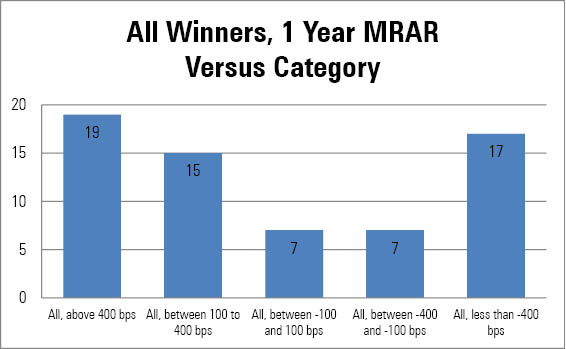
Below are the following one-year results, sorted into five buckets: 1) the fund’s MRAR was at least 4 percentage points per year higher than the category average; 2) the fund’s MRAR was between 1 and 4 percentage points higher; 3) the fund’s MRAR was between 1 percentage point lower and 1 percentage point higher; 4) the fund’s MRAR was between 4 percentage points lower and 1 percentage point lower; and 5) the fund’s MRAR was more than 4 percentage points lower.

(The cutoffs for the buckets are entirely arbitrary, but choosing different cutoffs does not change the analysis. As always, this analysis is from the perspective of the ongoing investor, so it does not include front-end sales charges but it does include all components of annual expenses.)

image001-4
  – source: Morningstar Analysts

In the year after the managers won, the FMOY Award funds regressed toward the mean, as one would expect. Overall, though, their performance remained modestly above average, as they were 34 funds making the top two quintiles and 24 funds landing in the bottom two quintiles. At the extremes, four funds out of the 57 in the sample had MRARs of greater than 8%, and five had MRARs of less than negative 8%.

While risk-adjusted performance is the best way to score success, per standard academic theory, it’s worth checking to see if total returns tell a different story. They do not, as shown by the chart below:

image002-4
  – source: Morningstar Analysts

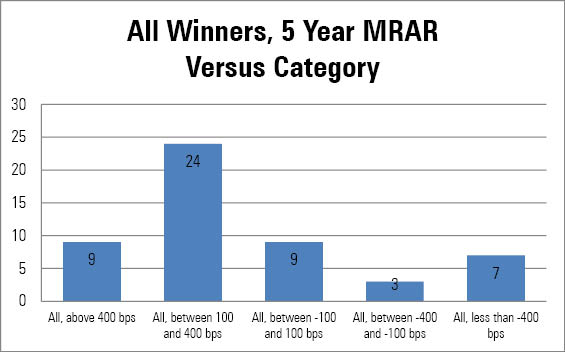
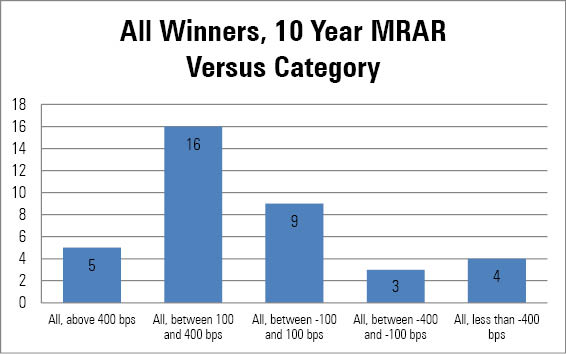
Extending past one year, the numbers sharply improve. Winners (that is, funds landing in the top two quintiles) outnumber losers (funds in the bottom two quintiles) by an almost 2:1 margin for three years and by 3:1 for the five- and 10-year periods.

image003-3
  – source: Morningstar Analysts

image004-3

  – source: Morningstar Analysts


image005-3

  – source: Morningstar Analysts

This looks to be a straightforward tale. There’s little short-term information in an FMOY Award. Winners perform slightly better than randomly over the next 12 months. Over longer time periods, however, there is a good deal of information. This makes sense as, despite its name, the FMOY Award is something of a career achievement, given to a successful manager who happens to have had a particularly good year.

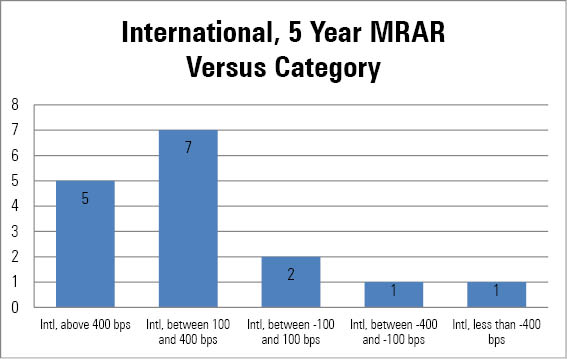
The effect holds for all three asset classes that receive the award–Domestic Stock, International Stock, and Fixed Income. (Yes, the Domestic Stock group is responsible for the modest one-year success. But I suspect that is luck; I see no reason why Morningstar’s Fund Research team has the ability to identify one-year winners with U.S. stock funds but not elsewhere.)

For example, the five-year results by asset class:

image006-3
  – source: Morningstar Analysts

image007-1
  – source: Morningstar Analysts

image008-1
  – source: Morningstar Analysts

I suspect that whispers of the curse will persist, as by chance three or four FMOY winners each decade figure to post a bottom-decile return the following year, thereby giving periodic opportunity for new anecdotes. There’s nothing to the general claim of a jinx, though, not as far as I can see.

Note: Morningstar’s Kailin Liu and I have each previously written on this topic, using a similar approach and arriving at broadly similar conclusions. Those articles are hereand here.

John Rekenthaler has been researching the fund industry since 1988. He is now a columnist for Morningstar.com and a member of Morningstar’s investment research department. John is quick to point out that while Morningstar typically agrees with the views of the Rekenthaler Report, his views are his own.

John Rekenthaler is Vice President of Research for Morningstar.


Novartis CEO Joseph Jimenez: Rethinking Pharmaceutical Business Models

JOSEPH JIMENEZ

Joseph Jimenez is CEO of Novartis.

JAN 23, 2014

Rethinking Pharmaceutical Business Models

ZURICH – The world’s health needs are changing dramatically. Demographic trends, shifting patterns of disease, and strained public funding are placing new burdens on health-care systems. For developed and developing countries alike, the new demands cannot be met if health care continues to operate in the same way. What is required are new business models that spread risks, take a broader view of health, and address the needs of the world’s poorest people.

Demographic changes will present significant challenges for countries’ long-term health planning. By 2050, the number of people worldwide who are 60 or older will exceed the number of children under 15. Moreover, an additional three billion people will join the global middle class over the next two decades, altering the types of health issues that countries will face, and the way health care is financed.

At the same time, non-communicable diseases, such as cancer, heart disease, and diabetes, are rising, while previously deadly conditions, such as HIV/AIDS, are now more treatable and have been deemed chronic diseases.

Keeping up with these changes would be difficult in the best of times. But a stagnant global economy is straining health-care budgets to the breaking point. Governments, insurers, and other health-care payers are becoming ever more concerned about getting value for money. In response, pharmaceutical companies and policymakers are looking for innovative ways to reduce these pressures, not just by developing new drugs, but also by rethinking how the industry operates.

My company, for one, has tested three business models that have shown encouraging results. One involves risk sharing, in which the user pays for the drug only if his treatment turns out to be successful. If it is not, the pharmaceutical company refunds the cost. We have used risk-sharing programs in Germany, where we cooperate with two major payers on the pricing for Aclasta, an osteoporosis treatment. If a patient suffers a bone fracture after treatment (signifying that the drug has not worked), Novartis repays the cost.

The payer benefits from this system, because risk sharing minimizes the cost of failure. The pharmaceutical firm gains as well, because the effective guarantee underpins public confidence in its products.

The risk-sharing model has limitations, though. Some payers find that the system is too complex, especially when trying to define a successful outcome, and that they must wait too long for refunds. Nevertheless, risk sharing is a good starting point from which to develop a fairer and more efficient business model – and one that can be refined or simplified over time.

A second business model brings patients, payers, and health-care professionals together to provide an integrated program to complement treatment for a specific illness. In Brazil, for example, our Vale Mais Saúde program uses this approach to treat chronic obstructive pulmonary disease (COPD), a potentially fatal lung condition forecast to be the world’s third biggest killer by 2030.

In addition to providing Onbrez Breezhaler, a daily treatment to improve lung function in COPD patients, the program provides a comprehensive treatment package covering all symptoms. Patients can receive discounted flu vaccines, nicotine replacement therapies, help in enrolling in pulmonary rehabilitation sessions, and health information sent to their homes. These interventions alleviate symptoms, prevent other illnesses from exacerbating them, and help patients continue their normal daily activities.

But it is in the poorest countries with the least developed health-care systems and weakest infrastructure that new business models are needed the most. In the past, corporate philanthropy has gone some way to help, but such an approach is neither sustainable nor scalable. If companies are to make a significant difference, they must find ways to work with existing health-care systems over the long term.

One way to do this is through social ventures. For example, our Arogya Parivar (or “Healthy Family”) program reaches millions of India’s poorest citizens. It is organized around four principles: awareness, acceptability, availability, and adaptability.

Arogya Parivar raises general public awareness of health issues by training educators to teach disease prevention and treatment in villages, helping some 2.5 million rural inhabitants in 2012 alone. The program reaches more than 45,000 local doctors through a network of 90 medical distributors, ensuring that medicines are available in 28,000 of India’s remotest pharmacies. To ensure affordability, especially to those on a daily wage, we sell smaller, over-the-counter doses. The program is also flexible, adapting medicines, packaging, and training according to the different health and cultural needs of India’s diverse communities.

These three examples demonstrate that, with innovative thinking, we can meet the world’s changing health needs. Pharmaceutical companies are doing what they can – but they need help. Most important, governments, payers, and physicians must come together to test, support, and roll out the best and most cost-effective ideas. Only then can we improve the health of all people, rich and poor alike, regardless of where they live.

The Elders of Organic Farming; two dozen pioneers of sustainable agriculture from the United States and Canada shared decades’ worth of stories, secrets and anxieties

The Elders of Organic Farming

By CAROL POGASHJAN. 24, 2014

BIG SUR, Calif. — Among the sleek guests who meditate and do Downward Facing Dog here at the Esalen Institute, the farmers appeared to be out of place. They wore baggy jeans, suspenders and work boots and had long ago let their hair go gray.

For nearly a week, two dozen organic farmers from the United States and Canada shared decades’ worth of stories, secrets and anxieties, and during breaks they shared the clothing-optional baths.

The agrarian elders, as they were called, were invited to Esalen because the organizers of the event wanted to document what these rock stars of the sustainable food movement knew and to discuss an overriding concern: How will they be able to retire and how will they pass their knowledge to the next generation?

Michael Ableman, a farmer and one of the event’s organizers, said the concerns were part of a much larger issue, a “national emergency,” in his words. Farmers are aging. The average age of the American farmer is 57, and the fastest-growing age group for farmers is 65 and over, according to the Census Bureau.

During their meetings, some of the farmers worried that their children would not want to continue their businesses and that they might have to sell their homes and land to retire.

Esalen is the birthplace of the human potential movement and a stunningly beautiful spiritual retreat overlooking the Pacific Ocean. When they were not in conference, the farmers wandered among floating monarch butterflies through Esalen’s farm and garden, rich with Calypso cilantro, tatsoi and flamboyant orange marigolds.

But the institute also holds conferences on major world and national issues. Mr. Ableman and Eliot Coleman, a Maine farmer, organized the intimate conference. Mr. Ableman, the author of “Fields of Plenty,” is writing a book about the gathering. Deborah Garcia, the widow of Jerry Garcia of the Grateful Dead and a filmmaker whose previous films include “The Future of Food” and “The Symphony of the Soil,” is making a documentary.

While the farmers here were proud of their anti-establishment beginnings, their movement has since gone mainstream, and organic farming has grown tremendously. Sales of organic food in the United States reached $31.5 billion in 2012, compared with $1 billion in 1990, according to the Organic Trade Association.

So the grandfathers and grandmothers of organic farming should be joyous, but they are not. Their principles of local, seasonal fruits and vegetables have been replaced in many cases by year-round clamshelled tomatoes for Walmart, Target and other stores. Some of today’s organic farmers have thousands of acres of single crops, which are flown to supermarket shelves, where they are sold at lower prices than many small organic farmers can afford to sell their produce.

Generally, the farmers at Esalen have less acreage and sell dozens or hundreds of varieties of fruits and vegetables at local farmers’ markets, to upscale restaurants and through so-called community-supported agriculture. C.S.A.’s, as these arrangements are known, consist of consumers who pay before the harvest for weekly deliveries of seasonal fruits and vegetables.

The sustainable agriculture these farmers practice goes beyond farming without synthetic fertilizer and pesticides. They adhere to a broader political and ecological ethos that includes attention to wildlife, soil, education and community. For most of them, the bottom line has never been their bottom line.

Many have done well, though not all organic farms succeed in the same way.

Some farmers operate a “debit card” C.S.A.; members make annual payments and buy at a discount only what they want. Jake Guest, who farms 70 acres in Norwich, Vt., said customers told him, “It’s like we’re getting free food.”

Stephen and Gloria Decater of Live Power Community Farm in Mendocino County, Calif., whose six Belgian draft horses help till the soil, operate “a participatory C.S.A.” with 200 households whose members split operating costs for the season and share the harvest with weekly baskets of organic food.

The proliferation of farmers’ markets has been a boon. Betsy Hitt sells her cut flowers, fruits and vegetables at one of 12 Saturday markets within 70 miles of her farm in Graham, N.C. Nash Huber, who farms in Washington State, sells his produce at seven farmers’ markets.

Some farmers have farm stands, some of which bring in $1 million or more annually. Another has a farmer’s cafe.

Farming an acre and a half of land in Harborside, Me., Mr. Coleman grosses $150,000, netting $30,000 annually. Tom Willey, with his wife, Denesse, grosses $2.8 million in direct food sales in the San Joaquin Valley. A few have had rough patches. But even they wax romantic about their love affair with the land.

“We went out of our way to give everything to the earth, and the earth gives back to us,” said Jack Lazor, who started his organic dairy farm in the 1970s. The earth doesn’t always give cash, though. He dropped his health insurance in 2008, because, he said, “We couldn’t afford it.”

All of the farmers were rebels. “We were told it was impossible to grow food without chemicals and pesticides,” said Mr. Coleman, who farms year-round, aided by his invention, a greenhouse on wheels.

They had few mentors or books to guide them. They went to schools like Tufts, Dartmouth, Cornell and the University of California. Some dropped out, protested the Vietnam War, occupied buildings or went to jail. They smoked marijuana and started communes.

“Every one of us broke the law,” said Frank Morton, 57, an Oregon seed farmer, with perverse pride.

When he was younger, Bob Cannard, 61, sprayed DDT and malathion, he said, and he passed out “many times” while working for his nurseryman father. Now Mr. Cannard lets weeds grow in harmony with his crops and is the main herb and vegetable grower for Chez Panisse in Berkeley, a temple of organic cuisine.

Mr. Ableman climbed out the window of his parents’ house when he was 16 and ran away. He was soon managing a 100-acre orchard, and then a 12-acre farm in Southern California, which grossed close to a million dollars. He now farms on Salt Spring Island, British Columbia, and travels to Vancouver to oversee urban farms he developed for people coping with addiction and mental illness. They are paid to work the land, and they sell their food to 30 restaurants and at six farmers’ markets.

Amigo Bob Cantisano’s dreadlocks dangle below his knees; he is tie-dyed down to his socks. Mr. Cantisano, 63, is the only one of the group at Esalen who has regular contact with industrial organic farmers. Some of them are Republicans in cowboy hats, he said, but they overlook his nonconformist appearance. He consults with companies like Sun-Maid, Sunkist and Earthbound Farm on how to improve yields and practice better sustainable agriculture.

Mr. Morton, who sells seeds through his Wild Garden Seed catalog, discovered at age 6 that food could be free but digging was hard. As a teenager, he said he “came to the realization that seed was the key to wealth and independence.”

Some related their marketing tips. Mr. Coleman, who sells his produce to 10 restaurants, said the endive variety called Bianca Riccia da Taglio would not sell until he renamed it. “Within two weeks, every lobster salad was sitting on a bed of golden frisée,” he said.

When farmers changed the name of Mandarin Cross tomatoes to tangerine tomatoes, sales soared. A farmer who had trouble selling her misshapen potatoes labeled them “Ugly Potatoes” and cut the price. They sold.

And many came looking for answers to the conundrum of retirement. Some have put their farms in land trusts; others said they tried to negotiate similar deals but failed. Like other family farmers around the country, some are finding that their children do not want to carry on their work.

Dru Rivers of Full Belly Farms in the Capay Valley in California was one of the few farmers whose children had returned to the farm, with their own ideas. A son is doing farm weddings and dinners. A daughter is operating a summer camp and running farm tours. In true hippie style, Ms. Rivers said: “I don’t want to die with one thing to my name. I want to give it all away. We have to do that to regenerate.” So she will give the farm to her children.

Norbert Kungl, 58, who farms in Nova Scotia, is concerned about the future of his land, which he says produces enough income for only one family. “I can’t find a cushion,” he said. “What options do I have other than selling to the highest bidder, which I do not want to do? These are questions that I have no answer for.”

Mr. Willey, 65, said he called a family meeting with his three children. “We made clear to them we have a very profitable business,” he said, but none were interested in carrying it on.

He understands why. “Farmers often work seven days a week and as many hours a day as the sun is up,” he said. “Young people looking into agriculture are not willing to make that drastic a sacrifice.”

Mr. Huber, who owns 25 acres and farms more than 600 acres on the north Olympic Peninsula in Washington State, said, “I think we’re looking at models that don’t work anymore.”

“I’m 72. I love what I do,” he said. “Obviously, I can’t keep doing it.” But young people “don’t have the financial resources to make it happen,” he said, with land in his area going for $26,000 an acre. “And they don’t have the knowledge, yet.”


The accuracy of equity research: Consistently wrong; Bear market or bull, analysts give bad advice

The accuracy of equity research: Consistently wrong; Bear market or bull, analysts give bad advice

Jan 18th 2014 | From the print edition

IT IS no secret that equity analysts at banks do not always give the best investment advice. In 2001 Eliot Spitzer, the attorney-general of New York state, exposed their habit of heaping praise on undeserving firms with which their colleagues hoped to do business. Some had advised clients to buy stocks they had referred to in private as “junk”, “crap” and “shit”.

But it is hard to talk up dud firms when markets are falling, and anyway, there is little business to be won at such times. So it might have been reasonable to assume that analysts’ recommendations are better in bearish markets than bullish ones. New research, alas, suggests this is not so: the advice analysts give in bad times seems to be even worse than the boosterism they peddle in good.*

Roger Loh of Singapore Management University and René Stulz of Ohio State University looked at analysts’ forecasts of profits and the buy or sell recommendations they issued for the period 1983-2011. Their predictions, it turned out, were less reliable in falling markets than in rising ones, even after making allowances for increased volatility in such times. Analysts’ forecasts of profits for the next quarter were out by 46% more during periods of financial crisis than at other times, for instance.

The drop in accuracy may be linked to cuts in research budgets. During downturns banks spend less on research. For instance, in the most recent crisis budgets were cut by around 40%, according to Neil Scarth at Frost Consulting, largely by replacing more experienced (and more expensive) analysts with younger, greener ones. The fear of being fired may also befuddle rather than focus minds.

Ironically enough, Messrs Loh and Stulz also found that investors pay more attention to analysts’ opinions when times are tough. Normally only one change in ten in analysts’ stock recommendations moves the price of the share in question. But the proportion increases to one in seven in falling markets, even though there are more changes during market routs. Just as drivers value maps more when it is foggy, investors pay more heed to research during periods of increased uncertainty, reckons Mr Stulz. Unfortunately for them, that is also when their maps are most likely to be wrong.

*Roger Loh and René Stulz, “Is sell-side research more valuable in bad times?”


Buy-in barons: Buy-out firms like selling to each other, much to their investors’ annoyance

Buy-in barons: Buy-out firms like selling to each other, much to their investors’ annoyance

Jan 18th 2014 | From the print edition

IN THE popular imagination, private-equity moguls unearth their targets by scouring obscure corners of the business world for corporate diamonds-in-the-rough. They buff such firms up and sell them for a fortune a few years later. The truth is rather more prosaic: often the buy-out barons merely take over companies owned by their private-equity rivals. Once a rarity, these “pass-the-parcel” deals have become common. In 2013 they represented nearly half the deals in Europe by value, according to Preqin, a data provider. Investors are grumbling that this defeats the point of private equity.

Reasons abound for the rise of “secondaries”, as the industry prefers to call such deals. For one thing, finding fresh corporate meat is hard. Taking listed companies private is tricky, since shareholders have enjoyed bumper returns of late and valuations are high. Conglomerates, which used to hive off unloved divisions to private equity, are flush with cash, which they started to stockpile as soon as the economy soured in 2008. At least in Europe, they remain wary of big mergers and acquisitions, which typically involve selling off expendable appendages to the likes of Blackstone or Carlyle. At the same time, private-equity groups have plenty of companies to sell, notably the firms they bought in the run-up to 2008, the industry’s apogee. Five years on, investors are clamouring for a payout, leaving private-equity funds eager to offload their stock.

Private-equity firms are not just forced sellers, they are also forced buyers. Funds globally have nearly $400 billion of cash on hand, about a third of it in Europe. Not spending the full amount is tantamount to failure: better to do a so-so second-hand deal than none at all. Some buy-out firms were left with slimmed-down teams in the aftermath of the crisis, meaning they are hesitant to commit scarce staff to take on a complex corporate spin-off. Secondary deals are easier: many of the due-diligence papers can be dusted off from the previous sale. The bankers who supplied the financing for the deal the first time round are often on hand for a repeat. Whereas a primary deal can take months or years of preparatory work, a secondary one can be set up in weeks if needed. Tertiaries are easier still.

Investors who back private-equity firms—typically pension funds, endowments and the like—are less than happy with the rise of secondaries. They offer much less scope for operational improvements, the main way in which private-equity firms purport to create value. Worse, the same institutions have sometimes invested in both the fund doing the buying and the one doing the selling. Strip away the financial montages, and they are in essence buying firms from themselves, with hefty transaction costs, including a 20% cut of the profit (if any) to the managers of the divesting fund.

Buy-out executives point to a host of profitable secondaries, as well as to studies that show that such deals are no less lucrative than other takeovers. Pets at Home, a purveyor of dog toys which three private-equity funds have chewed over in a decade, will deliver a handsome return for KKR if a proposed flotation goes ahead this year, for instance.

Many private-equiteers worry, however, about earning a reputation as repeat buyers, particularly in Europe. Joe Baratta, head of private equity at Blackstone, a buy-out titan, recently said it was “not a sign of health” that three-quarters of big deals in the region were secondaries. Things might change as the economy recovers, says Dwight Poler of Bain Capital, a rival buy-out firm: multinationals might regain an appetite for divestments, selling out of mature markets to focus on growth in emerging economies, say. Until then, more investors will discover the dubious pleasures of back-to-back buy-outs.


Which country gets the most out of international commerce?

Which country gets the most out of international commerce?

Jan 18th 2014 | WASHINGTON, DC | From the print edition

image001

“CHINA is now No 1 in trade”, proclaimed the front-page headline of China Daily USA, the American edition of an official Chinese newspaper, which is showcased in vending machines across America’s capital. The paper, published around the world, is one of the $2.21 trillion-worth of Chinese exports that helped make the headline true—or mostly true.

China’s international trade in goods did indeed lead the world in 2013. Its combined imports and exports amounted to almost $4.2 trillion, exceeding America’s for the first time (the exact size of its lead will not be known until America reports its full-year figures next month).

But goods are not the only things that countries trade. Alongside China Daily’s triumphant front-page story was an article about “PANDA!”, a Las Vegas show performed by the China National Acrobatic Troupe, which chronicles the quest of a heroic panda to liberate a peacock princess from a demon vulture. Such cultural exports are part of the international trade in services, which is of growing significance to global commerce. If trade in services is added to trade in physical goods, China remains number two (see chart).

China’s exports and imports are voluminous partly because its economy is so big. Relative to the size of its GDP, China’s trade is below the world average. Its exports and imports were equivalent to almost 53% of GDP in 2012, whereas the ratio of global trade to world GDP was over 63%.

Relative to the size of its population, China’s trade is also modest. It amounted to just $3,200 per inhabitant in 2012, ranking only 99th in the world. But China has over 1.34 billion people. Any economic magnitude, when divided by a number that size, looks rather less impressive. Populous, spacious economies are often quite closed: America’s ratio of trade to GDP is, for example, only a little above 30%. Brazil’s is about 26%. Indeed, Arvind Subramanian of the Peterson Institute reckons that China’s trade is almost 70% greater than one would expect given the modesty of its income and the vastness of its territory and population.

By the same token, measures of trade per person flatter small countries, like Luxembourg or Singapore. Some of the countries that rank highest by this measure are tiny emirates blessed with oil or gas. Their exports are lucrative, but not terribly sophisticated.

Ricardo Hausmann of Harvard University and his colleagues have devised an alternative measure of the sophistication of a country’s exports. To score highly, a country’s exports have to be both varied and esoteric (meaning sold by only a few countries). Using Mr Hausmann’s method, Saurabh Mishra and Nikola Spatafora of the World Bank have ranked countries according to the sophistication of their exports in 2012. Out of 181 countries, China ranks 39th. But that is a higher ranking than one would expect given its modest level of development. Controlling for its income per person, China ranks 10th.

Some sceptics of China’s trade point out that many of its seemingly sophisticated exports include valuable imported components. According to the World Trade Organisation and the OECD, China itself adds only 67% of the value of its exports; America adds 89%. Indeed, if you count only the value that a country adds to its exports, then America’s export figures are about the same as China’s.

But such a calculation would miss the point. Measures of international trade are not trying to capture the value a country adds to its economy through its international dealings. They are instead trying to capture a country’s integration with the rest of the world. The benefits of this integration mostly lie not with exports, but with imports. Countries export what they must to import what they want.

Which economy gets the most out of its imports? The biggest importer is America; the biggest per person, Hong Kong. But the country that gets the most bang for its import buck is possibly Norway. According to the IMF’s calculations, its currency, the krone, is now 83% overvalued—more than any other currency. As a consequence Norway’s money has far more purchasing power when spent on internationally traded goods, selling at world prices, than it does when spent on its own goods at home. Contrary to what China Daily declared this week, it is arguable that Norway is “now No 1 in trade”.


Archimedes would blush: Regulators go easy on Europe’s overstretched banks

Regulators go easy on Europe’s overstretched banks

Jan 18th 2014 | From the print edition

image001

“IT WAS always the French and the Germans,” grumbles a senior financial regulator, blaming counterparts from those two countries for undermining international efforts to increase capital ratios for banks. Every time the Basel committee, a grouping of the world’s bank supervisors, neared agreement on a higher standard, he says, a phone call from the Chancellery in Berlin or the Trésor in Paris would send everyone back to the table.

Similar phone calls almost certainly inspired the committee’s decision on January 12th to water down a proposed new “leverage ratio” for banks. It had originally suggested obliging banks to hold equity (the loss-absorbing capital put up by investors) of at least 3% of assets. In theory, that standard will still apply. But the committee came up with various revisions to how the ratio is to be calculated, in effect making it less exacting.

The new rule will allow banks to offset some derivatives against one another and to exclude some assets from the calculation altogether, thus making their exposure seem smaller. Analysts at Barclays characterised it as a “substantial loosening”. Citibank called it “significant regulatory forbearance”. Shares in big European banks such as Barclays and Deutsche Bank surged to their highest level in nearly three years on the news.

Leverage ratios have their critics—even outside overleveraged banks. They contend that leverage is a crude and antiquated measure of risk compared with the practice of weighting assets by the likelihood of making losses on them, and calculating the required cushion of equity accordingly. The chances of losing money on a German government bond, the argument runs, are much smaller than they are on a car loan; but a simple leverage ratio makes no distinction between the two. As a result, leverage ratios might actually encourage banks to buy riskier assets, in the hope of increasing returns to shareholders. Officials at Germany’s central bank, for instance, have argued that a binding leverage ratio “punishes low-risk business models, and it favours high-risk businesses.”

Bankers also claim that tough leverage requirements risk stemming the flow of credit to the economy, as banks shrink their balance-sheets to comply. BNP Paribas, a French bank, says this would particularly disadvantage European banks because they do not tend to sell on as many of their home loans as American ones.

The full extent of the new change is difficult to gauge, partly because there is still some uncertainty surrounding the rules. Yet a rough calculation suggests that they have been loosened just enough to allow most big European banks to pass the 3% test. Without the committee’s help as many as three-quarters of Europe’s big banks might have failed the test (see chart).

A detailed analysis by Kian Abouhossein of J.P. Morgan Cazenove, an investment bank, suggests that under the old rules big European banks may have had to raise as much as €70 billion ($95 billion) to get their leverage ratios to 3.5%, which is far enough above the minimum for comfort. Yet the new rules alone may improve big European banks’ leverage ratios by 0.2-0.5 percentage points compared with the previous ones, he reckons—enough for most to avoid raising new capital.

That does not mean banks will be able to shrug off the new leverage ratio entirely. Simon Samuels, an analyst at Barclays, expects it will prompt some European investment banks to reconsider their strategies. Some may have to cut lines of business and reduce their assets. That hints at the potency the measure could have had, if the regulators had allowed it.


The weather report: Economists are getting to grips with the impact of climate change

The weather report: Economists are getting to grips with the impact of climate change

Jan 18th 2014 | From the print edition

THE “polar vortex” that brought freezing weather to North America chipped roughly $3 billion off American output in a week. It was a reminder that extreme weather has economic consequences even in the richest countries and that climate change—which may usher in even wilder fluctuations—is likely to have a big economic impact. A recent burst of studies look at how large it may be, adding useful detail to the initial efforts, such as the Stern review of 2010. The results suggest that climate change may be having an effect already; that the weather influences economies through a surprisingly wide range of channels; but that calculating the long-run effects of climate change is harder than estimating the short-run impact of weather.

The link between more heat and more poverty is robust. Tropical countries are poorer. In a review of the literature, Melissa Dell of Harvard University, Benjamin Jones of Northwestern University and Benjamin Olken of the Massachusetts Institute of Technology find that, for each 1°C rise in the average temperature of a country, its GDP per head is 8.5% lower. Another study of poor countries alone showed that being 1°C warmer in any given year reduces income per head by 1.4%. These findings would not have surprised Montesquieu, who in 1748 argued that hot climates were inimical to the material conditions of the good life.

But it does not follow that if global temperatures were to rise by 1°C because of climate change, then world output would be 8.5% lower than it would otherwise have been. Perhaps the correlation between heat and poverty might exist because of some third factor (for example, the presence of malaria). If it were possible to change that factor (ie, eradicate the disease), temperature might cease to matter. Recently, tropical regions from southern China to Rwanda have been among the world’s most economically successful.

However, a correlation also exists between heat and growth, suggesting a longer-run effect. Despite some successes, tropical countries grew by 0.9 percentage points a year more slowly than the global average in 1965-90. In a sample of 28 Caribbean countries national output fell by 2.5% for each 1°C of warming. Again, this does not prove that high temperatures were to blame. But the correlation is strong enough to make it worth investigating whether the weather itself might be dragging down countries’ growth rates directly. The new literature suggests several ways in which it might do that.

First, natural disasters still wreak a lot of damage. One study reckons cyclones pushed down the world’s annual GDP growth by 1.3 points in 1970-2008. (Poor countries suffer disproportionately because they are more vulnerable to such disasters.) So if global warming were associated with more extreme weather, it would lower growth.

Next, higher temperatures and worse droughts tend to reduce farm yields. This hurts poor and middle-income countries most because agriculture has a bigger share in their GDP. To take one case, a decline in rainfall of one standard deviation cuts Brazilian farm incomes by 4%. But the agricultural effect of changing weather varies a lot. There seems to be a threshold of 29°-32°C below which rising temperatures can be beneficial; above it they are sharply harmful. With some crops, rising night-time temperatures do more damage than rising noontime ones. Farmers also adapt to higher temperatures by planting new crops or by emigrating to cities. So the impact of rising temperatures on farming is heterogeneous and hard to measure.

It is often assumed that the economic effects of climate change will be confined mainly to poor countries. That may be wrong. A study of time-use surveys and temperatures in the United States found that when temperatures reach 100°F (38°C), the labour supply in farming, forestry, construction and utilities falls by an hour a day, compared with what happens at 76-80°F. These are outdoor activities, which may explain why workers fail to show up. But a study of call centres also showed that each 1°C rise between 22°C and 29°C cut labour productivity by 1.8%. And in car factories in America, a week of outside temperatures above 90°F reduced output by 8%. Perhaps the heat disrupts the supply chain—or perhaps air conditioners fail to work properly.

Lastly, the weather influences basic conditions of life and hence factors of production. In America each additional day above 32°C raises the annual age-adjusted mortality rate by 0.1% relative to a temperate day (10-15°C). In India the rate increases by almost 0.8%. Heatwaves cause early deaths (especially of mothers and infants) and, by affecting the harvest, damage nutrition. This in turn has long-lasting effects on the economy.

Uncertain, with a chance of sub-optimal equilibrium

Almost all these correlations derive from weather data from the past five or ten years. But drawing conclusions about climate change—which takes place over hundreds of years—is perilous. Even more than with farming, the impact of climate change will be “non-linear”: changes may be modest up to a point, then turn dramatic. Meanwhile, people can adapt in important ways to changing conditions. This makes simple extrapolation nonsense.

But the new literature is a start. It shows how information in models of climate impact—recently described as “completely made up”—can be improved. It shows the multiple channels that economists of the climate must heed. It suggests that climate change is not something that will affect only poor countries, or hit rich ones only in the distant future. And—who knows—it may one day show how public policy, now so ineffective, might stem the emissions that are causing the mess in the first place.

Sources

“What do we learn from the weather?”, by Melissa Dell, Benjamin Jones and Benjamin Olken. Journal of Economic Literature, forthcoming.

Informing climate adaptation”, by Carolyn Kousky. Energy Economics   

Quantifying the influence of climate on human conflict”, by Solomon Hsiang, Marshall Burke and Edward Miguel

Envirodevonomics” by Michael Greenstone and Kelsey Jack. MIT Working Paper series   


Value of countries’ listed firms matched to companies with equivalent market cap

image001

Investors love the promise of high returns from emerging-market equities, but there are not many of them to buy. Especially if you exclude stakes held by governments, the market capitalisation of bourses beyond the rich world is tiny. Just how tiny is apparent from the map below: in many emerging markets, the value of all the freely traded shares of firms that feature in the local MSCI share index (which typically tracks 85% of local listings) is equivalent to a single Western firm. Thus all the shares available in India are worth roughly the same as Nestlé; Egypt’s are equal to Burger King. This suggests that emerging economies need deeper, more liquid markets-and investors need more perspective.

How Wall Street can make a good investment bad

How Wall Street can make a good investment bad

John Waggoner, USA TODAY7 a.m. EST January 18, 2014

Can Wall Street make index funds, a good investment, into a bad one? Sure.

Index funds are a low-cost way to get exposure to stocks

Their main advantage: Low cost

Don’t buy high-cost, highly specialized, or ultra-risky index funds

If you try really hard, you can make any good thing bad, and that’s exactly what Wall Street has done to some index funds. How bad? Very bad. Let’s take a look at the worst index funds.

First: Index funds really are good things. They give you a slice of a diversified portfolio of stocks at an exceptionally low price — as little as $5 per $10,000 invested, in the case of the Admiral shares of the Vanguard 500 Index fund. The average stock fund, in contrast, will charge you $120 year, according to Lipper, which tracks the funds.

How do you make a good thing bad? Three ways:

Charge a lot for it. The overriding advantage of an index fund is its low cost. It’s hard enough for a fund manager to beat the Standard & Poor’s 500 stock index. Beating the S&P 500 by more than 1.2% year after year makes Sisyphus’ job look easy.

The most expensive S&P 500 index fund: Rydex S&P 500 H shares, which charges 1.57% in annual fees. Not surprisingly, it is also the worst-performing S&P 500 index fund the past five years. While the average S&P 500 index fund turned $10,000 into $22,494 the past five years, Rydex S&P 500 H shares turned $10,000 into $21,137 — a $1,357 difference.

Specialize it. When you invest in a broad-based index, you get the volatility of the stock market. But when you invest in a specialized index, you more volatility. In general, the specialization you get, the greater the volatility. For example, the worst 12 months for the S&P 500 the past two decades has been a 44.8% loss the 12 months ended February 2009. The financial sector clocked a 70.7% loss the same period.

The more specialized you get, the greater your chance of loss. It should be no wonder, then, that one of the worst-performing funds the past five years has been an index fund: The United States Natural Gas fund, down 88.94% the past five years.

Leverage it, specialize it, and charge a lot for it. Leverage, in the financial world, means using futures and options to supercharge returns — both up and down. Direxion Financial Bear 3X shares takes an index of financial services stocks and leverages it by 300%. Unfortunately, it bets against the index, which has risen smartly the past three years. The fund has lost 99.7% of its value the past five years. Put more graphically, it has turned $10,000 into $30. The charge for that service? About 0.95% a year.

Why do bad index funds happen to good people? Sometimes, as in the case of Rydex S&P 500 H shares, it’s because they’re sold the fund by an adviser. Other times, it’s because they are lured by the prospect of huge returns. Had you invested in the PowerShares NASDAQ Internet Portfolio five years ago, for example, you would have gained 408.6%.

But your best bet is to avoid temptation and look for the lowest-cost, most broadly diversified index fund you can find for a core holding. Three suggestions:

• Vanguard Total Stock Market, which tracks the performance of the entire stock market. The investor class shares charge 0.17% a year in expenses; the Admiral shares charge just 0.05% a year. The fund has gained 57% the past three years.

• Fidelity Spartan International Index Fund, which tracks the performance of large-company foreign stocks. The fund charges just 0.27% a year in expenses, and has gained 27% the past three years.

• Vanguard Total World Stock, which invests in an index that tracks both U.S. and foreign stock performance. The fund charges 0.35% a year and has gained 33% the past three years.


The Sad Truth About Hedge Funds

The Sad Truth About Hedge Funds

By Larry Swedroe

January 22, 2014

No matter how you slice it, hedge funds seem like a rip-off, Swedroe says.

There are many well-documented problems with investing in hedge funds, and it’s hard to know where to start in pointing them out.

Among them are: lack of liquidity; lack of transparency; loss of control over the asset allocation and thus risk of the portfolio; non-normal distribution of returns (they exhibit excess kurtosis and negative skewness); and they have a high risk of dying (12.3 percent per year from 1994 through 2008).

Also, many invest in highly risky assets—creating problems when comparing with appropriate benchmarks—and returns have not been commensurate with the risks. They also tend to be highly tax inefficient, and their risks tend not to combine well with the risks of equities.

Not least, there’s no evidence of persistence in performance beyond the randomly expected, and their compensation structure creates agency risk, which is to say the incentives between the managers and investors are not aligned, which can lead to excessive risk taking.

And there are well-known biases in the data. Each of the following contributes significantly to a overstating of the actual returns earned by investors.

Self-reporting bias occurs because poorly performing funds are less likely to report.

Backfill bias occurs when funds with good performance during their incubation periods are added to databases.

Liquidation, or delisting, bias occurs when funds that become defunct fail to report their last returns.

Survivorship bias occurs when poorly performing funds disappear from the database of “live” funds.

Philippe Jorion and Christopher Schwarz, authors of the study “The Delisting Bias in Hedge Fund Databases,” which appears in the winter 2014 edition of the Journal of Alternative Investments, used information from three hedge fund databases with about 10,000 pairs of hedge funds to provide direct estimates of the amount of delisting bias.

The most famous example of a hedge fund that terminated its reporting because of serious negative performance is Long Term Capital Management. The managers of that fund managed to lose 92 percent of the invested capital from October 1997 through October 1998, and did not report that loss to public databases.

The authors note that while the delisting bias is impossible to assess from the information in one database only—they found funds delisted in one database often continue to report returns to another—they were able to build an estimate of the delisting bias. Following is a summary of their conclusions:

12.3 percent of funds delist per year, on average.

The delisting bias is greater for smaller funds solely due to their higher death rate, which goes from 20.2 percent for small funds to 5.5 percent for large funds.

The average omitted delisting loss is approximately 3.5 percent per fund, and 5 percent of omitted delisting losses are greater than 35 percent.

By tracking the typical performance of a fund that disappears in one database in others, they estimated a lower bound for the delisting bias of 0.35 percent per year across all funds, live and dead.

0.35 percent is only a lower bound because it ignores situations where the fund manager decides to stop reporting to all databases.

They inferred an upper bound for this delisting bias of approximately 1 percent a year.

The performance of hedge fund indices should be adjusted downward by about 0.5 percent a year to account for the delisting bias. This is still an estimate because it relies on self-reporting.Jorion and Schwarz note that the bias can help explain the systematic differences between the performance of the average hedge fund and that implied by funds of funds—once the extra fees of funds of funds are accounted for. Funds of funds cannot backfill the performance of their underlying funds, nor can they hide the performance of funds that perform poorly or fail. Avoiding the bias makes the funds-of-funds data more reliable.

With this information in mind, let’s take a look at the performance of hedge funds. In 2013, the HFRX Global Hedge Fund Index earned 6.7 percent. The table below shows the returns for various equity and fixed-income indices.

Benchmark Index 2013 Return (%)
Domestic Indexes
S&P 500 32.4
MSCI US Small Cap 1750 (gross dividends) 39.1
MSCI US Prime Market Value (gross dividends) 31.9
MSCI US Small Cap Value (gross dividends) 33.7
Dow Jones Select REIT 1.2
International Indexes
MSCI EAFE (net dividends) 22.8
MSCI EAFE Small Cap (net dividends) 29.3
MSCI EAFE Small Value (net dividends) 31.6
MSCI EAFE Value (net dividends) 23.0
MSCI Emerging Markets (net dividends) -2.6
Fixed Income
Merrill Lynch One-Year Treasury Note 0.3
Five-Year Treasury Notes -1.1
20-Year Treasury Bonds -1.14


The HFRX Global Hedge Fund Indexunderperformed all but two (U.S. REITs and Emerging Markets) of the major equity asset classes. An all-equity portfolio with 50 percent international/50 percent domestic, equally weighted within those broad categories, would have returned 24.2 percent. Also, a 60 percent equity/40 percent bond portfolio with those weights for the equity allocation would have returned 14.6 percent using one-year Treasurys, 14.1 percent using five-year Treasurys and 10.0 percent using long-term Treasurys.

Given the freedom to move across asset classes that hedge funds tout as their big advantage, one would think “advantage” would show up.

Over the long term, the evidence is even worse. For the 10-year period from 2004-2013, the HFRX Index returned 1.0 percent per year, underperforming every single equity and bond asset class. The table below shows the returns of the various indexes:

Annualized Returns 2004-2013

Domestic Indexes Return (%)
S&P 500 7.4
MSCI US Small Cap 1750 (gross dividends) 10.4
MSCI US Prime Market Value (gross dividends) 7.4
MSCI US Small Cap Value (gross dividends) 9.4
Dow Jones Select REIT 8.2
International Indexes
MSCI EAFE (net dividends) 6.9
MSCI EAFE Small Cap (net dividends) 9.5
MSCI EAFE Small Value (net dividends) 10.1
MSCI EAFE Value (net dividends) 6.8
MSCI Emerging Markets (net dividends) 11.2
Fixed Income
Merrill Lynch One-Year Treasury Note 2.1
Five-Year Treasury Notes 4.3
20-Year Treasury Bonds 6.1


Perhaps even more shocking is that over this period, the only year that the HFRX index outperformed the S&P 500 was 2008. Even worse, compared with a balanced portfolio of 60 percent S&P 500 Index/40 percent Barclay’s Government/Credit Bond Index, it underperformed every single year.

For the 10-year period, an all-equity portfolio with 50 percent international/50 percent domestic, equally weighted within those broad categories, would have returned 9.2 percent per year. And a 60 percent equity/40 percent bond portfolio with those weights for the equity allocation would have returned 7.1 percent per year using one-year Treasurys, 8.2 percent per year using five-year Treasurys, and 9.4 percent per year using long-term Treasurys.

The poor performance of the industry raises the question, Why is so much capital invested in hedge funds? One explanation is that it’s the triumph of hope, hype and marketing over wisdom and experience.

I also believe that the behavioral explanation of the desire to be a member of a special club explains the large amount of capital investment in hedge funds. Meir Statman, a leader in the field of behavioral finance, explains: “Investments are like jobs, and their benefits extend beyond money. Investments express parts of our identity, whether that of a trader, a gold accumulator, or a fan of hedge funds… We may not admit it, and we many not even know it, but our actions show that we are willing to pay money for the investment game. This is money we pay in trading commissions, mutual fund fees, and software that promises to tell us where the stock market is headed.”

Statman goes on to explain that some invest in hedge funds for the same reasons they buy a Rolex or carry a Gucci bag with an oversized logo—they are expressions of status, being available only to the wealthy.

He also explains that hedge funds offer what he called the expressive benefits of status and sophistication, and the emotional benefits of pride and respect. He cites the cases of investors who complain when hedge funds lower their minimums.

Those expressive benefits explain both why Bernard Madoff was so successful and why high net worth individuals continue to invest in hedge funds despite their lousy performance—they are ego-driven investments, with demand fueled by the desire to be a “member of the club.”

With that in mind, investors in hedge funds would be well served to consider the following from another leader in the field of human behavior, Groucho Marx: “I don’t care to belong to any club that will have me as a member.”


Larry Swedroe is director of Research for the BAM Alliance, which is part of St. Louis-based Buckingham Asset Management.

How to Read A Book

How to Read A Book

“Marking a book is literally an experience of your differences or agreements
with the author. It is the highest respect you can pay him.”
— Edgar Allen Poe

You already know how to read. I bet you were taught how in elementary school.

But do you know how to read well?

If you’re like most people, you probably haven’t given much thought to how you read.

Are you reading for information or understanding?

While great for exercising your memory, the regurgitation of facts without understanding gains you nothing. A lot of people, however, confuse insightful understanding with the ability to regurgitate information. They think that knowledge of something means understanding.

A good heuristic: Anything easily digested is reading for information.

Consider the newspaper, are you truly learning anything new? Do you consider the writer your superior when it comes to knowledge in the subject? Odds are probably not. That means you’re reading for information.

There’s nothing wrong with that; it’s how most people read. But you’re not really learning anything new. It’s not going to give you an edge or make you better at your job.

Learning something insightful is harder, you have to read something clearly above your current level. You need to find writers who are more knowledgeable on a particular subject than yourself. It’s also how you get smarter.

Reading for understanding means narrowing the gap between reader and writer.

The four levels of reading

Mortimer Adler literally wrote the the book on reading.

His book, How to Read a Book, identifies four levels of reading:

Elementary

Inspectional

Analytical

Syntopical

The goal of reading determines how you read.

Reading the latest Danielle Steel novel is not the same as reading Plato. If you’re reading for entertainment or information, you’re going to read a lot differently (and likely different material) than reading to increase understanding. While many people are proficient in reading for information and entertainment, few improve their ability to read for knowledge.

Before we can improve our reading skills, we need to understand the differences in the reading levels. They are thought of as levels because you can’t move to a higher level without a firm understanding of the previous one — they are cumulative.

1. Elementary Reading
This is the level of reading taught in our elementary schools.

2. Inspectional Reading
We’ve been taught that skimming and superficial reading are bad for understanding. That is not necessarily the case. Using these tools effectively can increase understanding. Inspectional reading allows us to look at the authors blueprint and evaluate the merits of a deeper reading experience.

There are two types of inspectional reading:

Systematic skimming
This is meant to be a quick check of the book by (1) reading the preface; (2) studying the table of contents; (3) checking the index; and (4) reading the inside jacket. This should give you sufficient knowledge to understand the chapters in the book pivotal to the authors argument. Dip in here and there, but never with more than a paragraph or two. Skimming helps you reach to a decision point: Does this book deserve more of my time and attention? If not you put it down.

Superficial reading
This is when you just read. Don’t ponder the argument, don’t look things up, don’t write in the margins. If you don’t understand something, move on. What you gain from this quick read will help you later when you go back and put more effort into reading. You now come to another decision point. Now that you have a better understanding of the books contents and its structure, do you want to understand it?

Inspectional reading gives you the gist of things. Sometimes that’s all we want or need. Too often however people stop here.

3. Analytical Reading

Francis Bacon once remarked “some books are to be tasted, others to be swallowed, and some few to be chewed and digested.” Think of analytical reading as chewing and digesting.

Analytical reading is a thorough reading. If inspectional reading is the best you can do quickly, this is the best reading you can do given unlimited time. At this point you start to engage your mind and dig into the work required to understand what’s being said.

There are rules to analytical reading

Classify the book according to kind and subject matter.

State what the whole book is about with the utmost brevity.

Enumerate its major parts in their order and relation, and outline these parts as you have outlined the whole.

Define the problem or problems the author is trying to solve.

You’ll probably notice that while those sound pretty easy, they involve a lot of work. Luckily the inspectional reading you’ve already done has primed you for this.

When you’ve done this you will understand the book but you might not understand the broader subject. To do that you need to use comparative reading to synthesize knowledge from several books on the same subject.

4. Syntopical Reading

This is also known as comparative reading and it represents the most demanding and difficult reading of all. Syntopical Reading involves reading many books on the same subject and comparing and contrasting the ideas.

This task is undertaken by identifying relevant passages, translating the terminology, framing and ordering questions we need answered, defining the issues and having a conversation with the responses.

The goal is not to achieve an overall understanding of any particular book, but rather to determine how to make the books useful to you.

This is all about you and filling in your gaps.

There are five steps to syntopical reading:

Finding the Relevant Passages
You need to find the right books and then the passages that are most relevant to filling your needs. So the first step is an inspectional reading of all the works that you have identified as relevant.

Bringing the Author to Terms
In analytical reading you must identify the key words and how they are used by the author. This is fairly straightforward.

The process becomes more complicated now as each author has probably used different terms and concepts to frame their argument. Now the onus is on you to establish the terms. Rather than using the authors language, you must use your own.

In short this is an exercise in translation and synthesis.

Getting the Questions Clear
Rather than focus on the problems the author is trying to solve, you need to focus on the questions you want answered. Just as we must establish our own terminology, so too must we establish our own propositions by shedding light on our problems to which the authors provide answers.

It’s important to frame the questions in such a way that all or most of the authors can be interpreted as providing answers. Sometimes we might not get an answer to our questions because they might not have been seen as questions by the authors.

Defining the Issues
If you’ve asked a clear question to which there is multiple answers then an issue has been defined. Opposing answers, now translated into your terms, must be ordered in relation to one another. Understanding multiple perspectives within an issue helps you form an intelligent opinion.

Analyzing the Discussion
It’s presumptions to expect we’ll find a single unchallenged truth to any of our questions. Our answer is the conflict of opposing answers. The value is within the discussion you have with these authors. You can now have an informed opinion.

Become a Demanding Reader

Reading is all about asking the right questions in the right order and seeking answers.

There are four main questions you need to ask of every book:

What is this book about?

What is being said in detail and how?

Is this book true in whole or in part?

What of it?

If all of this sounds like hard work, you’re right. Most people won’t do it. That’s what sets you apart.


Hesitate! Quick decision-making might seem bold, but the agony of indecision is your brain’s way of making a better choice

Hesitate! Quick decision-making might seem bold, but the agony of indecision is your brain’s way of making a better choice

by Steve Fleming 2,500 words

Steve Fleming is a cognitive neuroscientist. He is a postdoctoral fellow at New York University and a blogger at The Elusive Self.

In the autumn of 2007, the then prime minister of the UK, Gordon Brown, was riding on a wave of popularity. He had just taken the reins from Tony Blair, adroitly dealt with a series of national crises (terrorist plots, foot and mouth disease, floods) and was preparing to go to the country for a new mandate for his government. But then a decision to postpone the election tarred him with a reputation for dithering and his authority began to crumble. The lasting impression was not one of astute politicking — it was of a man plagued by indecision.

Whether lingering too long over the menu at a restaurant, or abrupt U-turns by politicians, flip-flopping does not have a good reputation. By contrast, quick, decisive responses are associated with competency: they command respect. Acting on gut feelings without agonising over alternative courses of action has been given scientific credibility by popular books such as Malcolm Gladwell’s Blink (2005), in which the author tries to convince us of ‘a simple fact: decisions made very quickly can be every bit as good as decisions made cautiously and deliberately’. But what if the allure of decisiveness were leading us astray? What if flip-flopping were adaptive and useful in certain scenarios, shepherding us away from decisions that the devotees ofBlink might end up regretting? Might a little indecision actually be a useful thing?

Let’s begin by casting a critical eye over our need for decision-making speed. It has been known for many years that the subjective ease with which we process information — termed ‘fluency’ by psychologists — affects how much we like or value things. For example, people judge fluent statements as more truthful, and easy-to-see objects as more attractive. This effect has consequences that extend beyond the lab: the psychologists Adam Alter and Daniel Oppenheimer, of the Stern School of Business in New York and the Anderson School of Management in Los Angeles respectively, found that if it a company name is easy to pronounce, it tends to have a higher stock price, all else being equal. The interpretation is that fluent processing of information leads people implicitly to attach more value to the company.

Fluency not only affects our perceptions of value; it also changes how we feel about our decisions. For example, if stimuli are made brighter during a memory test people feel more confident in their answers despite them being no more likely to be correct. In a study I conducted in 2009 with the psychologists Dorit Wenke and Patrick Haggard at University College London, we asked whether making actions more fluent also altered people’s sense of control over their decisions. We didn’t want to obviously signal that we were manipulating fluency, so we inserted a very briefly flashed arrow before the target appeared. In a separate experiment we confirmed that participants were not able to detect this arrow consciously. However, it still biased their decisions, slowing them down if the arrow was opposite in direction to their eventual choice, and speeding them up if it was in the same direction. We found that people felt more control over these faster, fluent decisions, even though they were unaware of the inserted arrow.

Fluent decisions, therefore, are associated with feelings of confidence, control, being in the zone. Mihaly Csikszentmihalyi, professor of psychology and management at Claremont GraduateUniversity in California, has termed this the feeling of ‘flow’. For highly practised tasks, fluency and accuracy go hand in hand: a pianist might report feelings of flow when performing a piece that has been internalised after years of practice. But in novel situations, might our fondness for fluency actually hurt us?

To answer this question we need to digress a little. At the end of the Second World War, engineers were working to improve the sensitivity of radar detectors. The team drafted a working paper combining some new maths and statistics about the scattering of the target, the power of the pulse, and so on. They had no way of knowing at the time, but the theory they were sketching — signal detection theory, or SDT — would have a huge impact on modern psychology. By the 1960s, psychologists had become interested in applying the engineers’ theory to understand human detection — in effect, treating each person like a mini radar detector, and applying exactly the same equations to understand their performance.

Despite the grand name, SDT is deceptively simple. When applied to psychology, it tells us that decisions are noisy. Take the task of choosing the brighter of two patches on a screen. If the task is made difficult enough, then sometimes you will say patch ‘A’ when in fact the correct answer is ‘B’. On each ‘trial’ of our experiment, the brightness of each patch leads to firing of neurons in your visual cortex, a region of the brain dedicated to seeing. Because the eye and the brain form a noisy system — the firing is not exactly the same for each repetition of the stimulus — different levels of activity are probabilistic. When a stimulus is brighter, the cortex tends to fire more than when it is dimmer. But on some trials a dim patch will give rise to a high firing rate, due to random noise in the system. The crucial point is this: you have access to the outside world only via the firing of your visual cortical neurons. If the signal in cortex is high, it will seem as though that stimulus has higher contrast, even if this decision turns out to be incorrect. Your brain has no way of knowing otherwise.

But it turns out the brain has a trick up its sleeve when dealing with noisy samples of information, a trick foreshadowed by the British mathematician Alan Turing while in charge of wartime code-breaking efforts at the secret Bletchley Park complex. Each morning, the code-breakers would try new settings of the German Enigma machine in attempts to decode intercepted messages. The problem was how long to keep trying a particular pair of ciphers before discarding it and trying another. Turing showed that by accumulating multiple samples of information over time, the code-breakers could increase their confidence in a particular setting being correct.

Remarkably, the brain appears to use a similar scheme of evidence accumulation to deal with difficult decisions. We now know that, instead of relying on a one-off signal from the visual cortex, other areas of the brain, such as the parietal cortex, integrate several samples of information over hundreds of milliseconds before reaching a decision. Furthermore, this family of evidence accumulation models does a very good job at predicting the complex relationships between people’s response times, error rates and confidence in simple tasks such as the A/B decision above.

Putting these findings together, we learn that there is a benefit from being slow. When faced with a novel scenario, one that hasn’t been encountered before, Turing’s equations tell us that slower decisions are more accurate and less susceptible to noise. In psychology, this is known as the ‘speed-accuracy trade-off’ and is one of the most robust findings in the past 100 years or so of decision research. Recent research has begun to uncover a specific neural basis for setting this trade-off. Connections between the cortex and a region of the brain known as the subthalamic nucleus control the extent to which an individual will slow down his or her decisions when faced with a difficult choice. The implication is that this circuit acts like a temporary brake, extending decision time to allow more evidence to accumulate, and better decisions to be made.

We don’t yet know whether these insights apply to the weighing of more abstract information, such as decisions about restaurants or holiday destinations. But there are hints that a signal detection-like model might explain these choices too. Daniel McFadden, a Nobel Prize-winning economist at the University of California, Berkeley, proposed an influential theory of choice in the 1970s directly inspired by signal detection theory. The core idea is that the values we assign to choice options are themselves subject to random fluctuations. These fluctuations then lead to different choices from moment to moment.

The agonising feeling of conflict between two options is not necessarily a bad thing: it is the brain’s way of slowing things down

In a recent study, researchers at the California Institute of Technology (CalTech) looked for signs of this accumulation of value while undergraduates chose between snack items, such as chips or cookies. During each decision, two items were presented on either side of a computer screen, and the students’ eye movements were recorded. Despite decisions being made within a couple of seconds, the pattern of eye movements belied subtle aspects of the decision process. When the decision was difficult — when the items were equally appealing — the eyes switched back and forth between the items more often than when the decision was easy. How much we flip between decision items, therefore, reveals the accumulation of evidence for decision-making.

In the evidence accumulation framework, indecision has a surprisingly simple interpretation. ‘Activity’ vacillates between two options over a particular time period — milliseconds for sensory A/B decisions, but perhaps minutes or even days for important decisions such as buying a car. Crucially, however, this neural flip-flopping is not something to be avoided. Instead, flip-flopping is an overt behavioural sign of the brain’s weighing of evidence for and against a decision. Anecdotal evidence suggests we are not alone in showing overt signs of indecisiveness. In a pioneering experiment, J David Smith, professor of psychology at the University of Buffalo in New York, trained a dolphin named Natua to press one of two levers depending on whether a sound was low- or high-pitched. After Natua could perform the task on cue, Smith introduced ambiguous tones. Natua vacillated between the two levers, swimming towards one and then the other, as if he was uncertain which one to press.

Some researchers have interpreted these signs of indecision as indicating that the dolphin has awareness of its own uncertainty during the decision. This could be the case, but it does not have to be — it could be that swimming from one option to the other is the dolphin equivalent of humans moving their eyes between options in the CalTech study. Either way, evidence accumulation models tell us that indecision is not a bad thing — the brain is slowing things down for a reason.

The speed-accuracy trade-off indicates that there can be negative consequences from being too decisive. Quicker decisions are often associated with more errors and greater potential for regret further down the line. If we are forced to make a decision quickly, evidence accumulation might not have finished before the decision is executed. By the time our muscles are contracting and we are pressing the ‘send’ button on a rash email, we might have accumulated additional evidence to suggest that this is not a good idea. Such gradual realisation of regret is writ large in Ian McEwan’s novel Atonement (2001) in which one of the characters, Robbie, is ‘seized by horror and absolute certainty’ that the letter he has just sent to his sweetheart is not the one he intended, with consequences that ripple through the rest of his story.

The implication is that sometimes our actions decouple from our intentions, revealing an intimate connection between evidence accumulation, indecision and error correction. Experiments support our intuitions about this: in a simple A/B decision, within only tens of milliseconds after the wrong button is pressed, the muscles controlling the correct response begin to contract in order to rectify the error. For rash emailers, this response even has a modern corrective: Gmail users are now able to set up a 30-second grace period in which to ‘undo’ a previously sent message. In other words, a response can be made, or an email sent, before our decision circuitry has appropriately weighed up all the evidence. Yet only a short time later, when enough evidence has been accumulated, we might become aware of something we should have said or done, the l’esprit de l’escalier of the neurosciences.

Consistent with this idea, a recent study by the neuroscientists Lucie Charles and Stanislas Dehaene at the Neurospin Centre in Paris showed that when subjects make errors under time pressure, a neural signature of the response that was intended but not actually executedcan be identified. Part of your brain seems to know what you should have done, even if the decision was executed too quickly, and too imperfectly, for the right action to have been made. In contrast, when given enough time to operate, intention and action work together in reasonable harmony, minimising the chances of a subsequent change of mind or regret.

Indecision is an inevitable feature of the neural mechanisms that underpin decision-making. With the right experimental set-up, we can observe the vacillations produced by this system in people’s behaviour. Cortico-basal ganglia circuits set the trade-off between speed and accuracy, and exquisitely sensitive mechanisms detect and correct errors even after decisions have been made. Yet decisiveness holds a subjective allure, perhaps because of the illusion of fluency, control and confidence it creates.

How should we reconcile the benefits of accumulating evidence with the costs of feeling disfluent? For simple decisions that take only a few seconds to make — from whether to reply to an email now or later, or which salad to have for lunch — there are some clear guidelines. First, decision-making tends to become more accurate if given a little extra time to operate. We should allow some indecision into our lives. Second, the agonising feeling of conflict between two options is not necessarily a bad thing: it is the brain’s way of slowing things down to allow a good decision to be made. Third, we should not ignore or suppress a change of mind after the fact — it is our brain’s way of using all the available information to correct inevitable errors in a time-limited process.

For important real-world decisions, however, the picture is certainly more complicated. The neuroscience of decision-making is in its infancy. Humans are endowed with the ability to simulate the future, and to use language to weigh up pros and cons — we can argue with ourselves and bounce ideas off others — all of which make such decisions very complex. But consider that important decisions are often the most difficult because they induce a state of indecision. (Charles Darwin even made a list of the pros and cons when deciding whether to marry, eventually deciding the pros outweighed the cons.) In these cases, our current understanding of the delicate balance of decision circuitry suggests we shouldn’t just blink and go with our gut instinct. In Habit (1890), the American philosopher William James said: ‘There is no more miserable human being than one in whom nothing is habitual but indecision.’ Yet enduring a little bracing indecision might be just what we need to navigate a busy, confusing world of choices.


What 16 Successful People Read In The Morning

What 16 Successful People Read In The Morning

ALISON GRISWOLD AND MAX NISEN JAN. 24, 2014, 8:00 AM 116,214 5

Staying informed is a constant struggle for most of us, let alone people with high-profile, high-pressure jobs. There’s usually not time to leisurely read a favorite paper over coffee.

Yet catching up on news is an important part of what’s often a very early morning for many of the world’s most successful people.

Now we would like everyone to read Business Insider in the morning (or the afternoon), but it turns out some very important people have their own favorite sources of news.

Warren Buffett starts his days with an assortment of national and local news.

The billionaire investor tells CNBC he reads the Wall Street Journal, the Financial Times, the New York Times, USA Today, the Omaha World-Herald, and the American Banker in the mornings. That’s a hefty list to get through.

David Cush reads five newspapers and listens to sports radio on a bike at the gym.

The Virgin America CEO told the AP that he wakes up at 4:15 a.m. on the West Coast to send emails and call people on the East Coast. Then he heads to the gym, hops on an exercise bike, listens to Dallas sports radio, and reads his daily papers, which include the New York Times, Wall Street Journal, USA Today, San Francisco Chronicle, and Financial Times.

Bill Gates reads the national papers and gets a daily news digest.

Bill Gates

The Microsoft co-founder gets a daily news digest with a wide array of topics, and he gets alerts for stories on Berkshire Hathaway, where he sits on the board of directors. Gates also reads the Wall Street Journal, the New York Times, and the Economist cover-to-cover, according to an interview with Fox Business.

Dave Girouard reads the New York Times and Wall Street Journal on his Nexus 7, and mixes in some Winston Churchill.

Girouard, CEO of Upstart and former president of Google Enterprise, told Business Insider that he’s a big fan of Winston Churchill’s speeches. He’s currently reading “Never Give In! The Best of Winston Churchill’s Speeches.” For news, he scrolls through the New York Times and Wall Street Journal.

David Heinemeier Hansson flicks through tech blogs.

The Danish programmer and creator of the programming language Ruby on Rails consumes a tech-filled fare each morning. He tells Business Insider that his daily round consists of Reddit, Hacker News, Engadget, the Economist, Boing Boing, and Twitter.

Jeffrey Immelt reads his papers in a very particular fashion.

“I typically read the Wall Street Journal, from the center section out,” the General Electric CEO told Fast Company. “Then I’ll go to the Financial Times and scan the FTIndex and the second section. I’ll read the New York Times business page and throw the rest away. I look at USA Today, the sports section first, business page second, and life third. I’ll turn to Page Six of the New York Post and then a little bit on business.”

Charlie Munger is devoted to the Economist.

When Fox Business asked the Berkshire Hathaway vice-chairman and right-hand man to Warren Buffett what he likes to read in the morning, Munger kept it simple. “The Economist,” he said.

Gavin Newsom starts with Politico’s Playbook email, and then reads each of California’s major papers.

The California Lieutenant Governor told The Wire that he starts by rotating through the morning shows at 7 a.m., then moves to his iPad to read Playbook, the Sacramento Bee, the San Francisco Chronicle, and the Los Angeles Times. Finally, he moves on to the news app Flipboard, through which he checks sites like Mashable and AllThingsD.

Barack Obama reads the national papers, a blog or two, and some magazines.

The President of the United States told Rolling Stone he begins his day with the New York Times, the Wall Street Journal, and the Washington Post. He’s a devoted reader of the Times’ columnists, and also likes Andrew Sullivan, the New Yorker, and The Atlantic.

Jonah Peretti pulls out the business or sports section from the New York Times for the subway ride; his wife keeps the rest.

The Buzzfeed founder and CEO wakes up around 8:30 a.m. and heads into the office with the sports or business section of the New York Times, he tells The Wire. He also takes New York magazine; subscriptions to the New Yorker and Economist fell by the wayside after he had twins.

Still, like many younger leaders, the principle way he discovers information is through Twitter and Facebook.

Steve Reinemund reads the Dallas Morning News and several national dailies.

The former PepsiCo CEO gets up promptly at 5:30 a.m. and heads downstairs with a stack of newspapers, Starwinar.com reports. He goes through the New York Times, the Wall Street Journal, and the Financial Times, as well as the Dallas Morning News.

Howard Schultz has kept his morning reading routine intact for 25 years.

In 2006, the Starbucks CEO told CNNMoney that he gets up between 5 and 5:30 a.m., makes coffee, and then picks up three newspapers: the Seattle Times, the Wall Street Journal, and the New York Times. The habit must work, because he’s stuck with it for more than two decades.

Nate Silver checks Twitter, Memeorandum, and Real Clear Politics pre-coffee in election years.

The FiveThirtyEight editor-in-chief shared his election-year reading habits with The Wire.

He starts with Twitter, Memeorandum, and Real Clear Politics before his coffee. He might hit the snooze button if nothing is breaking. Later come blogs like The Atlantic, Marginal Revolution, and Andrew Sullivan.

Shepard Smith works on TV, but relies on the websites of the New York Post and New York Times.

The Fox News host tells AdWeek that he starts his day with the websites of The New York Post or New York Times. After that comes The Daily Beast, SportsGrid, and sometimes Buzzfeed. Then comes sites relevant to whatever is being covered that day, including lots of local newspapers.

It’s a constant struggle to keep from being overwhelmed, he says. “If media were food, I would be obese,” Smith says.

Chuck Todd catches up with at least one major newspaper from each state on Twitter.

Todd, NBC’s Chief White House Correspondent, is up between 4:30 and 5 every morning, he tells AdWeek, and after catching up with dispatches and email updates, goes on Twitter to catch major news stories from local newspapers.

Twitter is the 21st century wire,” Todd says. “I remember the first time I got access to the [Associated Press] 50-state wire in 1992, and at that time, there was nothing like it. Now Twitter is the same way. I’ve made my own powerful, worldwide newswire on politics and international affairs.”

He also reads the New York Times, Washington Post, USA Today, Wall Street Journal, and Financial Times on his iPad.

Gary Whitehill supplements the Wall Street Journal with dozens of RSS feeds.

Sixty-three, to be precise. The Huffington Post reports that Whitehill, the founder of Entrepreneur Week, spends the first part of his day reading 40 pages in whatever his current book is, scanning through 63 RSS feeds, and perusing the Wall Street Journal.

CHART OF THE DAY: The Emerging Market Currency Bloodbath

CHART OF THE DAY: The Emerging Market Currency Bloodbath

SAM RO

JAN. 24, 2014, 8:14 AM 3,201

em

Global markets are getting rocked and traders are pointing their fingers at the emerging markets.

“Emerging Market weakness is widespread and after a long period of resilience is starting to impact credit markets,” said Morgan Stanley’s Rashique Rahman.

And there doesn’t appear to be one sudden event to blame.

“There is no single proximate cause, in our view, rather the cumulative impact of a number of events has led to a deterioration in risk sentiment,” added Rahman. “Growing concern over China’s macro trajectory and uncertainty over credit risk in China’s trust and wealth management products are probably the main drivers, but contributing factors to the spillover into other markets include Turkey’s ongoing currency volatility and political concerns, weakness of Ukrainian credit markets and the ARS devaluation.”

Rahman offered this five-day bar chart of the major emerging market currencies agains the U.S. dollar and the euro.

To the far right is the Argentine peso (ARS), which fell over 13% against the dollar on Thursday.

A Simple Checklist For Making Better Decisions

A Simple Checklist For Making Better Decisions

GRETCHEN RUBINLINKEDIN

JAN. 24, 2014, 5:26 PM 5,014

We all have to make decisions about how to spend our precious time, energy, and money.

Because of my happiness project, I now explicitly ask myself, “Will this decision make me happier?”

I consider:

1. Is this decision likely to strengthen my relationships with other people? Strong relationships with other people are a keythe key—to happiness, so decisions that help me build or strengthen ties are likely to boost my happiness. Yes, it’s a hassle and an expense to go to my college reunion, but it’s likely to have a big happiness pay-off.

2. Will this decision provide me with novelty and challenge? Novelty and challenge make me happier—but they also make me feel insecure, intimidated, frustrated, and stupid. To get past that hurdle, I remind myself that in the end, I usually get a big shot of happiness. When I considered adding video to my site, I reminded myself that the process of mastering the process would likely make me happier. And it has.

3. What is the opportunity cost of this decision? (“Opportunity cost” describes that fact that doing one thing means foregoing alternatives.) Energy, time, and money are limited. Even if a decision would bring happiness, if it means that I have to give up the opportunity to do many other happiness-boosting activities, it may not be worth it. I could dedicate many hours to learning about classical music, and in the end, I might enjoy classical music more, but that activity would crowd out too many other things that I want to do more. Like read children’s literature.

4. Does this decision help me obey my personal commandment to Be Gretchen? I want to shape my life to reflect my temperament, interests, and values. I ask myself: Am I making this decision to “Be Gretchen,” or because I want to impress other people, pretend that I’m different from the person I actually am, or deny a truth about myself?

5. When I consider a particular course of action, do I feel energized or drained? In Happier at Home, I write about how I conquered my fear of driving. I dreaded doing this, but I was also energized by the thought of tackling this nagging worry.

6. How happy are the people who have made that particular decision? In Daniel Gilbert’s book Stumbling on Happiness, he argues that the most effective way to judge whether a particular course of action will make you happy in the future is to ask people who are following that course of action right now if they’re happy, and assume that you’ll feel the same way. Going on a family trip to Disney World. Getting a hamster. Learning to use Pinterest. Working as a paralegal. Volunteering. In evaluating the likely consequences of a decision, other people’s experiences of happiness—or lack thereof—can be very instructive for me.

7. I remind myself to “Choose the bigger life.” People will make different decisions about what the “bigger life” would be, but when I ask myself that question, it always helps me see the right answer, for myself.


October 27, 2008

Paradoxes of Happinesss: the sadness of a Happiness Project.

I think everyone could benefit from a happiness project.

But there’s also a sad side to a happiness project, which comes directly from the first and most important of my Twelve Commandments: “Be Gretchen.”

Many of the things that have brought me happiness since I started my Happiness Project came directly from my attempt to do a better job of “Being Gretchen.” This blog. My children’s literature book group. My Boy Castaways of Black Lake Island project.

But being Gretchen, and accepting my true likes and dislikes, also means that I have to face the fact that I will never visit a jazz club at midnight, or hang out in artists’ studios, or jet off to Paris for the weekend, or pack up to go fly-fishing on a spring dawn. I won’t be admired for my chic wardrobe or be appointed to a high government office. I love fortune cookies and refuse to try foie gras.

Now, you might think – “Well, okay, but why does that make you sad? You don’t want to visit a jazz club at midnight anyway, so why does it make you sad to know that you don’t want to do that? If you wanted to, of course you could.”

It makes me sad for two reasons. First, it makes me sad to realize my limitations. The world offers so much!–and I am too small to appreciate it. The joke in law school was: “The curse of Yale Law School is to try to die with your options open.” Which means — at some point, you have to pursue one option, which means foreclosing other options, and to try to avoid that is crazy. Similarly, to be Gretchen means to let go of all the things that I am not — to acknowledge what I don’t encompass.

But it also makes me sad because, in many ways, I wish I were different. One of my Secrets of Adulthood is “You can choose what you do, but you can’t choose what you like to do.” I have a lot of notions about what I wish I liked to do, of the subjects and occupations that I wish interested me. But it doesn’t matter what I wish I were like. I am Gretchen.

Once I realized this, I saw that this problem is quite more widespread. A person wants to teach high school, but wishes he wanted to be a banker. Or vice versa. A person has a service heart but doesn’t want to put it to use. Someone wants to be a stay-at-home mother but wishes she wanted to work; another person wants to work but wishes she wanted to be a stay-at-home mother. And it’s possible — in fact quite easy — to construct a life quite unrelated to our nature.

People judge us; we judge ourselves.

And the Happiness Project makes me sad for another reason. Just as I must “Be Gretchen” and accept myself, strengths and weaknesses both, I must also accept everyone around me. This is most true of my immediate family.

It’s very hard not to project onto your children everything you wish they would be. “You should be more friendly,” “You would love to be able to play the piano, why don’t you practice?” “Don’t be scared.”

And it’s even harder to accept your spouse. A friend told me that her mantra for marriage was “I love Leo, just as he is.” I remind myself of this constantly. I wish the Big Man got a big kick out of decorating the apartment for the holidays and that he was more eager to pass out gold stars, and sometimes it makes me sad to realize that he won’t ever be that way. I’m sure he wishes that I were eager to go camping and that I had a more peacable nature. But I love him just the way he is, and I’m a lot happier when I don’t expect him to change. The fact is, we can change no one but ourselves.

That’s another paradox of happiness: I want to “Be Gretchen,” yet I also want to change myself for the better.

Now, you might say again, “Why does all this make you sad? Rejoice in what you are; be authentic,” etc., etc. But it does make me feel sad sometimes.

Several thoughtful readers sent me the link to a very interesting article from The Atlantic: Paul Bloom’s First Person Plural, about our “multiple selves.”


4 Lifehacks From Ancient Philosophers That Will Make You Happier: “What’s The Worst That Could Happen?”; “As If”; Make It A Treat; Make It A Treat

4 Lifehacks From Ancient Philosophers That Will Make You Happier

ERIC BARKERBARKING UP THE WRONG TREE
JAN. 24, 2014, 8:23 AM 29,547 5

You’ve probably heard about Stoics or Stoicism — and most of what you know is wrong.

They weren’t joyless bores. The ancient Stoics were the first lifehackers: The Original Gangsters of Making Life Awesome.

Via A Guide to the Good Life: The Ancient Art of Stoic Joy:

The Stoics were very much interested in human psychology and were not at all averse to using psychological tricks to overcome certain aspects of human psychology, such as the presence in us of negative emotion.

Awesome. But does the Old World hold up when it meets the New World? Does science agree with the thinkers of antiquity?

Absolutely. I enthusiastically, maybe even frantically, suggest you “roll old school.”

In the past, I’ve looked at the science behind Dale Carnegie’s old saws about getting along with people. Let’s give the same treatment to classical thinkers.

Where do science and the great minds of the old world agree when it comes to living the good life?

1) “What’s The Worst That Could Happen?”

Ever asked that? Congrats, you’re a stoic philosopher.

“Negative Visualization” is one of the main tools of Stoicism.

Really thinking about just how awful things can be often has the ironic effect of making you realize they’re not that bad.

From my interview with Oliver Burkeman, author of The Antidote: Happiness for People Who Can’t Stand Positive Thinking:

It’s what the Stoics call, “the premeditation” – that there’s actually a lot of peace of mind to be gained in thinking carefully and in detail and consciously about how badly things could go. In most situations you’re going to discover that your anxiety or your fears about those situations were exaggerated.

In fact, the Stoics pushed it further: take a second and imagine losing the things that matter to you most. Family. Friends.

Yes, it’s scary. But doesn’t it make you appreciate them all that much more when you take the time to think about losing them?

A few seconds of thinking about loss can dramatically boost gratitude. 

Via A Guide to the Good Life: The Ancient Art of Stoic Joy:

At spare moments in the day, make it a point to contemplate the loss of whatever you value in life. It can make you realize, if only for a time, how lucky you are — how much you have to be thankful for, almost regardless of your circumstances…

And science agrees: Practicing gratitude is at the center of the single most proven technique for boosting happiness: 3 blessings.

Though deliberately thinking about losing stuff may sound morbid, the fact that it taps into emotions is powerfully motivating.

Gratitude is how you stop taking things for granted. How you stay happy after the newness of things is gone. How you keep love alive.

(More on negative visualization here.)

2) “As If”

The Stoics valued tranquility and thought being angry was a waste of time. But what should you do when your blood boils?

Force a smile. Soften your voice. Seneca thought if you act calm, you will become calm.

Via A Guide to the Good Life: The Ancient Art of Stoic Joy:

When angry, says Seneca, we should take steps to “turn all [anger’s] indications into their opposites.” We should force ourselves to relax our face, soften our voice, and slow our pace of walking. If we do this, our internal state will soon come to resemble our external state, and our anger, says Seneca, will have dissipated.

Does outright faking it really work?

Yup. And science agrees.

Researchers told people to smile. What happened? They actually felt happier.

Via The As If Principle:

More than 26,000 people responded. All of the participants were randomly assigned to one of a handful of groups and asked to carry out various exercises designed to make them happier… When it came to increasing happiness, those altering their facial expressions came out on top of the class

(More on “fake it until you make it” here.)

3) Make It A Treat

We want everything and we want it yesterday.

The Stoics, on the other hand, used to deliberately walk around on cold days without a coat. Or skip meals to become hungry. Why?

Denying yourself something makes you appreciate the things you take for granted.

Ancient advice? Yeah, it sounds like something my grandfather would have said. But science agrees wholeheartedly.

Harvard professor and author of Happy Money, Michael Norton says a bit of self-denial is a huge happiness booster:

if you love, every day, having the same coffee, don’t have it for a few days. Once you have it again, it’s going to be way more amazing than all of the ones that you would have had in the meantime… It’s not “give it up forever.” It’s “give it up for short periods of time, and I promise you you’re going to love it even more when you come back to it.”

Making the things you take for granted into “a treat” is something the ancients and scientists agree on. Plus it has other benefits too.

Grandpa was right: it does make you tougher to go without. It increases willpower.

Via A Guide to the Good Life: The Ancient Art of Stoic Joy:

What Stoics discover, though, is that willpower is like muscle power: The more they exercise their will, the stronger it gets. Indeed, by practicing Stoic self-denial techniques over a long period, Stoics can transform themselves into individuals remarkable for their courage and self-control.

Science agrees. Self-control expert and author of Willpower, Roy Baumeister, says exerting discipline increases discipline:

People have said for centuries that you can build character by making yourself do things you don’t want to do, that by exerting self-discipline you can make yourself into a stronger person. That does appear to be correct.

And what’s more responsible for success than IQ or pretty much anything else? Self-control.

Today skip that Starbucks or that cookie. It’ll be even better tomorrow. And it’ll increase your willpower.

(More on how to boost self-control here.)

4) It’s Okay To Stumble

Does Stoicism seem hard? Don’t want to think about how awful things can be right now? Don’t want to give up your ice cream for a day?

They knew that too. What did Epictetus tell his students after he taught them these Stoic lifehacks?

He told them what to do when they screw up — because we all do.

Forgive yourself.

Via A Guide to the Good Life: The Ancient Art of Stoic Joy:

The Stoics understood that they would encounter setbacks in their practice of Stoicism: Thus, Epictetus, after telling his students what they must do to practice Stoicisim, went on to tell them what they should do when they failed to follow his advice. He expected, in other words, that novice Stoics would routinely backslide. Along similar lines, Marcus recommends that when our practice falls short of Stoic precepts, we should not become despondent and certainly should not give up our attempts to practice Stoicism; instead, we should return to the attack and realize that if we can do the right thing, Stoically speaking, most of the time, we are doing pretty well for ourselves.

And what does science say we should do when we lose self-control or procrastinate

Forgive yourself and move on.

Via The Willpower Instinct: How Self-Control Works, Why It Matters, and What You Can Do To Get More of It:

Study after study shows that self-criticism is consistently associated with less motivation and worse self-control. It is also one of the single biggest predictors of depression, which drains both “I will” power and “I want” power. In contrast, self-compassion— being supportive and kind to yourself, especially in the face of stress and failure— is associated with more motivation and better self-control.

In trying to do anything to better your life, it’s okay to stumble. It takes time. You learn.

(More on self-compassion here.)

Sum Up

You’ve only got 30,000 days of life. Seriously. Here’s what classical philosophers and modern science agree can make those days better:

“What’s The Worst That Could Happen?”

“As If”

Make It A Treat

It’s Okay To Stumble

6 Habits Of Instantly Likeable People

6 Habits Of Instantly Likeable People

JEFF HADENINC. 
DEC. 28, 2012, 12:25 PM 81,409 5

When you meet someone, after, “What do you do?” you’re out of things to say.

You suck at small talk, and those first five minutes are tough because you’re a little shy and a little insecure.

But you want to make a good impression. You want people to genuinely like you.

Here’s how remarkably likeable people do it:

1. They lose the power pose.

I know: Your parents taught you to stand tall, square your shoulders, stride purposefully forward, drop your voice a couple of registers, and shake hands with a firm grip.

It’s great to display nonverbal self-confidence, but go too far and it seems like you’re trying to establish your importance. That makes the “meeting” seem like it’s more about you than it is the other person—and no one likes that.

No matter how big a deal you are you pale in comparison to say, oh, Nelson Mandela. So take a cue from him. Watch how he greets Bill Clinton, no slouch at this either.

Clinton takes a step forward (avoiding the “you must come to me” power move); Mandela steps forward with a smile and bends slightly forward as if, ever so slightly, to bow (a clear sign of deference and respect in nearly every culture); Clinton does the same. What you have are two important people who put aside all sense of self-importance or status. They’re genuine.

Next time you meet someone, relax, step forward, tilt your head towards them slightly, smile, and show that you’re the one who is honored by the introduction—not them.

We all like people who like us. If I show you I’m genuinely happy to meet you, you’ll instantly start to like me. (And you’ll show that you do, which will help calm my nerves and let me be myself.)

2. They embrace the power of touch.

Nonsexual touch can be very powerful. (Yes, I’m aware that sexual touch can be powerful too.) Touch can influence behavior, increase the chances of compliance, make the person doing the touching seem more attractive and friendly.

Go easy, of course: Pat the other person lightly on the upper arm or shoulder. Make it casual and nonthreatening.

Check out Clinton’s right-hand-shakes-hands-left-hand-touches-Mandela’s-forearm-a-second-later handshake in the link above and tell me, combined with his posture and smile, that it doesn’t come across as genuine and sincere.

Think the same won’t work for you? Try this: The next time you walk up behind a person you know, touch them lightly on the shoulder as you go by. I guarantee you’ll feel like a more genuine greeting was exchanged.

Touch breaks down natural barriers and decreases the real and perceived distance between you and the other person—a key component in liking and in being liked.

3. They whip out their social jiu-jitsu.

You meet someone. You talk for 15 minutes. You walk away thinking, “Wow, we just had a great conversation. She is awesome.”

Then, when you think about it later, you realize you didn’t learn a thing about the other person.

Remarkably likeable people are masters at Social Jiu-Jitsu, the ancient art of getting you to talk about yourself without you ever knowing it happened. SJJ masters are fascinated by every step you took in creating a particularly clever pivot table, by every decision you made when you transformed a 200-slide PowerPoint into a TED Talk-worthy presentation, if you do say so yourself…

SJJ masters use their interest, their politeness, and their social graces to cast an immediate spell on you.

And you like them for it.

Social jiu-jitsu is easy. Just ask the right questions. Stay open-ended and allow room for description and introspection. Ask how, or why, or who.

As soon as you learn a little about someone, ask how they did it. Or why they did it. Or what they liked about it, or what they learned from it, or what you should do if you’re in a similar situation.

No one gets too much recognition. Asking the right questions implicitly shows you respect another person’s opinion—and, by extension, the person.

We all like people who respect us, if only because it shows they display great judgment.

(Kidding. Sort of.)

4. They whip out something genuine.

Everyone is better than you at something. (Yes, that’s true even for you.) Let them be better than you.

Too many people when they first meet engage in some form of penis-measuring contest. Crude reference but one that instantly calls to mind a time you saw two alpha male master-of-the business-universe types whip out their figurative rulers. (Not literally, of course. I hope you haven’t seen that.)

Don’t try to win the “getting to know someone” competition. Try to lose. Be complimentary. Be impressed. Admit a failing or a weakness.

You don’t have to disclose your darkest secrets. If the other person says, “We just purchased a larger facility,” say, “That’s awesome. I have to admit I’m jealous. We’ve wanted to move for a couple years but haven’t been able to put together the financing. How did you pull it off?”

Don’t be afraid to show a little vulnerability. People may be (momentarily) impressed by the artificial, but people sincerely like the genuine.

Be the real you. People will like the real you.

5. They ask for nothing.

You know the moment: You’re having a great conversation, you’re finding things in common… and then bam! Someone plays the networking card.

And everything about your interaction changes.

Put away the hard-charging, goal-oriented, always-on kinda persona. If you have to ask for something, find a way to help the other person, then ask if you can.

Remarkably likeable people focus on what they can do for you—not for themselves.

6. They “close” genuinely.

“Nice to meet you,” you say, nodding once as you part. That’s the standard move, one that is instantly forgettable.

Instead go back to the beginning. Shake hands again. Use your free hand to gently touch the other person’s forearm or shoulder. Say, “I am really glad I met you.” Or say, “You know, I really enjoyed talking with you.” Smile: Not that insincere salesperson smile that goes with, “Have a nice day!” but a genuine, appreciative smile.

Making a great first impression is important, but so is making a great last impression.

7. And they accept it isn’t easy.

All this sounds simple, right? It is. But it’s not easy, especially if you’re shy. The standard, power pose, “Hello, how are you, good to meet you, good seeing you,” shuffle feels a lot safer.

But it won’t make people like you.

So accept it’s hard. Accept that being a little more deferential, a little more genuine, a little more complimentary and a little more vulnerable means putting yourself out there. Accept that at first it will feel risky.

But don’t worry: When you help people feel a little better about themselves—which is reason enough—they’ll like you for it.

And you’ll like yourself a little more, too.

Read more: http://www.inc.com/welcome.html?destination=http://www.inc.com/jeff-haden/6-habits-of-remarkably-likeable-people.html#ixzz2rPwWo9rR

Here’s What Emerging-Market Leaders Are Saying And Doing As Their Currencies Burn

Here’s What Emerging-Market Leaders Are Saying And Doing As Their Currencies Burn

BEN HIRSCHLER AND CAROLYN COHNREUTERS
JAN. 25, 2014, 6:37 AM 314

Demonstrators burn an effigy of Mexico’s Finance Minister Luis Videgaray during a protest against the federal government’s economic and tax reforms in Ciudad Juarez October 22, 2013.

DAVOS/LONDON (Reuters) – Top emerging market policymakers moved to allay concerns about their economies on Friday after investors sold off their currencies, raising fears of a broad market rout.

The U.S. Federal Reserve’s plan to gradually withdraw its stimulus has long been expected to lead to a pullout from emerging markets. But the prospect of an economic slowdown in China added to concerns on Friday that emerging markets, particularly those with large current account deficits, may struggle to support their currencies this year.

Argentina said on Friday it would relax currency controls it had long defended as essential, in a policy reversal forced by high inflation and a tumble in the peso.

Turkey’s lira hit a record low despite an estimated $3 billion of intervention by its central bank the previous day. The rouble and the rand also languished at levels not seen since the 2008-2009 financial crisis.

Turkey’s deputy prime minister, Ali Babacan, played down the lira’s slide, however, describing it as a “re-pricing process” due partly to the Fed and partly to recent political turmoil in the country.

He said that the central bank was taking the necessary steps to deal with the situation, adding that Turkey was protected against market swings by its sound finances.

“The balance sheet of the government, the banks and households are quite well protected against market volatility,” he told a panel at the World Economic Forum in Davos.

Mexican Finance Minister Luis Videgaray told Reuters Television in an interview at Davos that the current volatility would not be a major disruption for his country.

“Mexico is an emerging market, so all volatility is going to have some effect. But Mexico is well-positioned to weather the currency storm,” Videgaray told Reuters TV on the sidelines of the gathering of business and political elites in the Swiss mountain resort.

Policymakers and analysts at Davos also said that all emerging markets are not equal and that the market turbulence will drive investors away from economies that are suffering, but not from the stronger ones.

“Differentiation will be important,” Videgaray said.

CURRENCIES SLIDE

In Turkey, the central bank has refused to raise interest rates even though the lira has fallen almost 9 percent this month, raising fears of mounting inflation and an investor exodus. It has relied instead on auctioning dollars, and on Thursday resorted to what analysts said were its first direct interventions since early 2012.

Despite these sales, estimated to total almost a tenth of its reserves, the lira dropped almost 2 percent, falling through the key 2.30 level.

The lira is only one of many currencies feeling the heat from investor worries over China and over the reduction in U.S. stimulus, expected from this month.

Central banks of several emerging markets were believed to have intervened to defend their currencies on Friday including India, Taiwan and Malaysia.

Russia again moved the rouble’s trading band after $350 million in hard currency sales.

There was little respite, however. The rupee, Brazilian real, rouble and rand all fell more than 1 percent to the dollar. The Russian currency also hit a record low to the euro.

“I think we may see some actions from central banks, they will try to curtail the sell-off … They are unlikely to be able to stabilize the currencies,” said Lars Christensen, chief emerging markets analyst at Danske Bank in Copenhagen.

Christensen said currency weakness would ultimately help lift growth, but in the meantime, pain would be intense.

“If you are an emerging markets investor, you are seeing a lot of pressure on your positions,” he said.

Investors have been fleeing – almost $4 billion has exited emerging equity funds so far this year. The week to January 22 saw them lose $2.4 billion, banks said, citing data EPFR Global released to clients late on Thursday.

Bond funds were more resilient, with just $0.4 billion of outflows, but they too have lost $1 billion so far in 2014.

There are also growing signs of contagion.

The losses in the more vulnerable emerging markets with big current account deficits have now spread to relatively robust assets such as the South Korean won and Polish zloty. The won suffered its worst weekly loss since mid-2013

They are also reverberating across stock markets in Europe. Spanish shares lost 1.7 percent because of their exposure to Latin American revenues.

Funds such as Aberdeen Asset Management and Ashmore, with large emerging-market investments, led losses in London, falling 4-5 percent on the day <ADN.L> <ASHM.L>.

The moves come after a day of losses across emerging markets, with Argentina’s peso seeing its worst one-day trading session since the country’s 2002 financial crisis.

“GET USED TO IT”

After stunning the world by clocking over 10 percent growth on average for three decades, China took the bold step last year to wean itself off credit and investments and instead try to boost domestic consumption. As a result, its growth rate has steadily dipped, and data this month showed its economy grew 7.7 percent in the last quarter of 2013.

But Lin Boqiang, director of the China Center for Energy Economics Research at Xiamen University, said at Davos that investors couldn’t expect China to keep growing at the rates it has until now.

“There is a substantial slowdown in China, and we just have to get used to it,” he said in an interview.

Several of Friday’s sessions at the Davos forum focused on the future of emerging markets and how long the turbulence they are experiencing would last.

Corporate executives said they still viewed these markets as big growth opportunities despite the currency volatility.

Renault-Nissan chief Carlos Ghosn said he was not alarmed by the latest forex market moves.

“You have to be ready when you invest in emerging markets for ups and downs,” he told one Davos panel on Friday evening.

Mexico’s Videgaray said emerging markets knew 2014 would be volatile as the Fed scales back its stimulus. But he added that Mexico’s currency, the peso, was currently quite liquid.

“I don’t see any problems of liquidity in the market for the Mexican peso,” he said.

Read more: http://www.businessinsider.com/emerging-market-leaders-on-currencies-2014-1#ixzz2rPvGico4

Starbucks CEO Howard Schultz Perfectly Sums Up Retail’s Biggest Problem

Starbucks CEO Howard Schultz Perfectly Sums Up Retail’s Biggest Problem

ASHLEY LUTZ

JAN. 24, 2014, 2:39 PM 9,911 13

Howard Schultz, Chiarman & CEO of Starbucks, established the company’s European headquarters in Amsterdam in 2002

Huge companies like Macy’s, JCPenney, Best Buy, and Wal-Mart all suffered sales that were short of expectations this holiday season.

They blamed a shortened holiday shopping season, cash-strapped consumers, and the U.S. government shutdown.

But these explanations “ignore a larger fundamental truth,” Starbucks CEO Howard Schultz said in a recent earnings conference call.

Elaborating, Schultz perfectly sums up what’s really going on in retail:

“That truth is that traditional brick and mortar retailing is an inflection point. No longer are many retailers only required to compete with stores on the other side of the street. They are now required to compete with stores on the other side of the country.”

As Schultz points out, e-commerce has completely changed the retail game, meaning that weak holiday sales can’t be explained by calendar changes or inflections in the economy.

Traditional retailers will have to learn to compete in this new environment in order to succeed, Schultz says.

Starbucks boasted a 4% increase in traffic during the holiday season.

The company has aggressively invested in a new mobile app, loyalty program, and drive-thru service.

Barron’s Roundtable experts Abby Joseph Cohen, Marc Faber, Meryl Witmer and Bill Gross see big opportunities and challenges in 2014.

SATURDAY, JANUARY 25, 2014

Shaking Things Up

By LAUREN R. RUBLIN | MORE ARTICLES BY AUTHOR

Our Roundtable experts Abby Joseph Cohen, Marc Faber, Meryl Witmer and Bill Gross see big opportunities and challenges in 2014.

Sometimes, you need to study the forest, and sometimes you need to examine the trees. This year, with the Federal Reserve turning over a new leaf and ending its bond-buying program, the most successful investors will give equal attention to both.

Barron’s 2014 Roundtable — Part 1

That’s the word — thousands, actually — from the members of the Barron’sRoundtable, who expect macroeconomic forces and policy moves to exert the primary influence on security selection and performance in 2014. Our 10 Wall Street savants made that abundantly clear when the Roundtable convened on Jan. 13 in Manhattan, and the markets, now plummeting amid worries about emerging-market growth and diminished monetary stimulus, are proving them nothing but prescient.

Big-picture issues, from the Fed’s squeeze on its quantitative easing to a jarring slowdown in China, got a full airing in last week’s first of three Roundtable installments. But they remain ever-present — and ever up for discussion and debate — in the current issue, which features the latest investment picks of Abby Joseph Cohen, Marc Faber, Meryl Witmer, and Bill Gross.

Table: 2013 Roundtable Report Card

Abby, a go-to interpreter of economics and markets with a perch at Goldman Sachs, is looking for companies recommended by Goldman’s research department that are likely to benefit from stronger growth in the U.S. Marc, a born investment skeptic who runs his own show out of Hong Kong, can’t find a scintilla of growth on these shores (see what we mean about debate?), but he sees opportunities aplenty to prosper from a coming boom in Asia.

Meryl, Eagle Capital’s resident money-managing math whiz, dissects the prospects for four promising companies that she thinks have fallen unfairly out of favor. And Bill, chief of everything at bond behemoth Pimco, not only shares his insights into the workings of the Fed, but also offers suggestions on how to make money in fixed income, despite the central bank’s fixation on near-zero yields.

Table: 2013 Midyear Roundtable Report Card

Barron’s: Abby, which stocks intrigue you this year?

Cohen: First, I’d like to revisit the bigger picture. We gather here every January as if something special happens on Dec. 31. But in the middle of 2013, there were inflection points that brought changes that could be here for a while. One of the most important was the shift away from liquidity-driven markets to markets driven much more by economic and corporate-revenue growth, and equity-market valuation. The best-performing stocks previously had been those of companies with strong balance sheets that could raise dividends and repurchase shares. Now performance is shifting, at least in the U.S., toward companies with good operating leverage and strong returns on equity that are exposed to economic growth. Viewed another way, value stocks outperformed in the U.S. until July 2013. Now the rally is more growth stock oriented.

image001

Many have said today that the U.S. stock market is the most expensive in the world. Let’s put that into context. The price/earnings ratio of the Standard & Poor’s 500 was 15.9 at the end of 2013, based on estimated 2014 earnings. Europe’s P/E was 13.6, and Japan’s Topix index sold for 14.6. But the economic prospects for the U.S. look far better. Take return on equity, which was 14.2% for the S&P last year, 8.4% for Europe, and 5.3% for the Topix. When we discuss valuations, it is important to focus not only on P/Es. To recap my comments this morning, if you assume no expansion in the price/earnings multiple, the Goldman Sachs research forecast for the S&P 500 is 1900 in 2014. If, with inflation under control, the P/E expands to 18 times earnings, the S&P could rise to 2088.

Abby Joseph Cohen’s Picks

Investment/Ticker  1/10/14 Price
iSharesMSCIMexico
Capped ETF/EWW $67.08
HollyFrontier/HFC 49.79
International Paper/IP 48.93
WyndhamWorldwide/WYN 72.97
Nordstrom/JWN 61.11
Extra Space Storage/EXR 43.57

Source: Bloomberg

We’re here to make predictions, so which will it be?

Cohen: The surprises are likely to be to the upside in the U.S. No. 1, we can still make government policy errors, but we’ve already made such big ones. The next issue in Washington will be raising the federal debt ceiling. The market has been through this before, and investors might not react as dramatically as they did in the past. More important, the U.S. economy seems to have more and better traction than it did at the end of 2012. Labor markets are better. Labor productivity has risen by about 2.5% in the past four quarters, which usually is a precursor to job creation and income growth. Also, while there have been significant inflows into the U.S. equity market, a lot of cash is still sitting on the sidelines here and around the world.

When you expect economic improvement, you look for higher-beta securities within sectors [stocks that are more volatile and thus more likely to outperform]. For example, you look at consumer-discretionary, energy, and materials shares. This brings me to Mexico, which will benefit from the improvement in the U.S. Last year wasn’t a good one for Mexico, but there now are signs, particularly in manufacturing, that things are looking up. Government reforms could help the energy sector. Short-term interest rates are 4.5% to 5%, but close to zero in inflation-adjusted terms. Fiscal policy is becoming more expansionary. The Goldman Sachs forecast for Mexican GDP growth in 2014 is 3.3%. We don’t see much change in the dollar/peso exchange rate. One way to gain exposure is through the iShares MSCI Mexico Capped exchange-traded fund, or EWW.

Zulauf: Mexico is structurally sound, but everybody and his brother is invested. If I am right and we see rising risk aversion, the peso will come under pressure. That’s why I would bet against you on this.

Cohen: Turning back to the U.S., economic growth has been held back by fiscal drag [the negative effect of tax hikes], which was considerable in 2013, but will be less so this year. An improvement could add one percentage point to economic growth. In addition, housing has added 0.5 of a percentage point, when the effects of renovation and furnishing are included.

Zulauf: Regarding fiscal drag and the deficit, where did the U.S. government book all the fines it took in from Wall Street? Maybe fiscal drag looked worse last year than it really was.

Cohen: To repeat, the Goldman Sachs economics team thinks U.S. gross domestic product could grow by 3.3% this year. My first stock is in the energy area. Many commodity prices have fallen as a consequence of lower demand from China, changes in India, and the rise of fracking [hydraulic fracturing] in the U.S. The energy sector is now much cheaper than the S&P 500. It sells for 13.4 times estimated earnings and two times book value, compared with 2.7 times book for the S&P. The U.S. has done a phenomenal job in recent years of investing in energy, and it is good to have exposure to a sector that has benefited from research and development and long-term investment. The three countries with the greatest energy resources are the U.S., Russia, and Saudi Arabia. Annual capital expenditures on energy in the U.S. are 14 times greater than in Russia, and 28 times greater than in Saudi Arabia.

Gabelli: It isn’t only the money. It is the technology of horizontal drilling and fracking, which the U.S. developed and no one else in the world understood. Now, they want to embrace it.

Cohen: That isn’t possible in all countries. China, for example, has significant shale-oil resources, but it lacks water. One thing that encouraged me about the Third Plenum [a recent gathering of the Communist Party leadership] is that China acknowledged publicly some of the climate and environmental issues it is facing. It’s not just the dirty air; it’s the dirty water. In the northern provinces, most of the water isn’t suitable for agriculture or drinking, and 50% is too dirty for industrial use.

Zulauf: One of China’s major long-term weaknesses is the lack of good water, and enough water. The water table is much too low, because they didn’t care enough about water during the early stages of the industrial boom.

Cohen: My energy-sector pick isHollyFrontier [HFC], an oil refiner. It closed Friday [Jan. 10] at $49.79. Holly is a U.S. company that benefits from its geography. It has 100% of its refining capacity in the middle of the U.S., and has substantial exposure to light crude. Our energy team expects there will be good spreads [price differences in crude oil] around the world that will benefit U.S. producers. The spread between Brent and West Texas Intermediate crude is going to be lumpy, depending on the refinery, supply, and distribution infrastructure, but we expect it will average about $10 a barrel in the next few years. This means refiners can buy lower-priced crude, but sell gasoline at higher prices.

Holly, like many energy-industry stocks, underperformed the S&P 500 last year. Based on our 2014 earnings estimate, it has a P/E of 9.3. It yields 6.4%. Goldman analysts think the company could earn $5.35 a share this year. Wall Street’s consensus estimate is $4.40. The market capitalization is $9.9 billion.

What is Goldman’s oil forecast for 2014?

Cohen: We’re not big bulls. Our analysts forecast $90 a barrel for West Texas Intermediate at year end, and $100 for Brent.

My next stock is a materials company — International Paper [IP]. In many ways, it dominates the industry. It is No. 1 in container board, No. 1 in corrugated packaging, and so on. Typically, demand for its products goes up when GDP and industrial production rise. Industrial production could exceed 3% in 2014. A lot of people are nervous about paper stocks, given the move toward digitalization. Nevertheless, there seems to be good demand for packaging materials, particularly boxes.

Amazon.com [AMZN] boxes!

Cohen: You got it. A lot of prepared foods also come in boxes now. We know there will be increased supply in the industry, but demand will keep up. International Paper has a history of returning capital to shareholders. It yields 2.6% and could raise the dividend early in the year. The stock closed Friday at $48.93. We expect profit to grow quickly, to $4.40 this year from $3.20 in 2013. Our estimate is above the consensus. The P/E is 11 times our 2014 estimate.

Next, with an improving labor market and a modest increase in household income, we are seeing more spending. In 2013, much of it went to satisfy pent-up demand in housing and autos. This year, there will be more spending in other categories. One of our analysts likes to say that in 2014, people will spend on fun, not food. Wyndham Worldwide[WYN] could be a beneficiary. Wyndham operates several hotel chains, including the Wyndham hotels, Ramada, Days Inn, and Super 8. We are expecting earnings of $4.60 a share in 2014, up from an estimated $3.85 last year. We are notably above the consensus for 2014, which is $4.32. The stock is trading at a market P/E of 15.9 times earnings. [Goldman subsequently lowered its 2013 estimate to $3.82 a share, and raised its 2014 forecast to $4.62.]

Pimco’s Gross explains how much investors can lose if rates rise, plus the dangers of borrowing and what investors should buy now.

Does Wyndham pay a dividend?

Cohen: Yes. It yields 1.6%. The company will enjoy operating leverage, but there could be some risks. Wyndham has a time-share business, and some other companies’ time-share operations haven’t worked out well, depending in part on where the properties were located. Wyndham also could benefit from increased business travel in 2014.

When household incomes begin to rise, deferred spending occurs first. Along with autos and housing, that means spending on food. Supermarket stocks performed well until just a few months ago, when an inflection point occurred in economic growth. Now, a lot of the household dollar is going to things like department stores.

Are restaurants considered food or fun?

Cohen: Eating away from home is in the fun category. Our analysts are recommending some dining shares, but I want to talk about Nordstrom [JWN]. The stock closed Friday at $61.11. Nordstrom underperformed much of its category and the S&P 500 last year. It was up about 11% in the past 12 months. We estimate it will earn $3.68 a share for the fiscal year ending Feb. 2, and $4.20 for the following fiscal year, which is 2% above consensus estimates of $4.11. The stock yields 2%. The company could have good operating leverage. Same-store sales are estimated to have risen by more than 3% in the current fiscal year. They could jump to more than 5% in the year ahead.

Abby Joseph Cohen: “Mexico will benefit from the improvement in the U.S.”

Nordstrom generates return on equity, on a DuPont [DD] basis, of 30% and higher. [Under the DuPont performance model, developed by the company of the same name, ROE equals net margin multiplied by asset turnover multiplied by financial leverage.]

Black: What is the P/E?

Cohen: It is 16.6 times fiscal 2013 earnings, and 14.6 times the following year’s earnings.

Rogers: Was there a particular problem at Nordstrom? Many retailers did well last year, including higher-end companies.

Cohen: Earlier in the year, high-end retailers did well. Toward the end of the year, retailers appealing to middle- and lower-middle-income shoppers did well. Nordstrom’s shares missed out, as the company isn’t decisively in either category.

My last name is Extra Space Storage [EXR], the second-largest owner of do-it-yourself storage facilities in the U.S. It has also been an underperformer. The stock was up 15% in the past 12 months. Funds from operations could rise to $2.42 in 2014 from $1.97 in 2013. The stock yields 3.4%. The category hasn’t performed well in recent months, in large part because housing was doing better. The market reasoned that if people were moving into new homes and young people were moving out of their parents’ homes, they wouldn’t need storage. Yet demand is OK, and seems to have stabilized. Also, there has been a significant slowdown in new capacity coming onstream. Finally, Extra Space Storage has done a good job of consolidating smaller operators that had problems. It has made a number of accretive acquisitions.

Is this company a real-estate investment trust?

Cohen: Yes, it is a REIT. Some potential negatives could be a rise in the cost of capital and a slowdown in average rent charged to customers.

Thank you, Abby. Let’s hear from Marc.

Faber: This morning, I said most people don’t benefit from rising stock prices. This handsome young man on my left said I was incorrect. [Gabelli starts preening.] Yet, here are some statistics from Gallup’s annual economy and personal-finance survey on the percentage of U.S. adults invested in the market. The survey, whose results were published in May, asks whether respondents personally or jointly with a spouse have any money invested in the market, either in individual stock accounts, stock mutual funds, self-directed 401(k) retirement accounts, or individual retirement accounts. Only 52% responded positively.

Gabelli: They didn’t ask about company-sponsored 401(k)s, so it is a faulty question.

Faber: An analysis of Federal Reserve data suggests that half the U.S. population has seen a 40% decrease in wealth since 2007.

In Reminiscences of a Stock Operator [a fictionalized account of the trader Jesse Livermore that has become a Wall Street classic], Livermore said, “It never was my thinking that made the big money for me. It was always my sitting. Got that? My sitting tight.” Here’s another thought from John Hussmann of the Hussmann Funds: “The problem with bubbles is that they force one to decide whether to look like an idiot before the peak, or an idiot after the peak. There’s no calling the top, and most of the signals that have been most historically useful for that purpose have been blaring red since late 2011.”

I am negative about U.S. stocks, and the Russell 2000 in particular. Regarding Abby’s energy recommendation, this is one of the few sectors with insider buying. In other sectors, statistics show that company insiders are selling their shares like crazy, and companies are buying like crazy.

Zulauf: These are the same people.

Faber: Precisely. Looking at 10-year annualized returns for U.S. stocks, the Value Line arithmetic index has risen 11% a year. The Standard & Poor’s 600 and the Nasdaq 100 have each risen 9.4% a year. In other words, the market hasn’t done badly. Sentiment figures are extremely bullish, and valuations are on the high side.

But there are a lot of questions about earnings, both because of stock buybacks and unfunded pension liabilities. How can companies have rising earnings, yet not provision sufficiently for their pension funds?

Good question. Where are you leading us with your musings?

Faber: What I recommend to clients and what I do with my own portfolio aren’t always the same. That said, my first recommendation is to short the Russell 2000. You can use the iShares Russell 2000 exchange-traded fund [IWM]. Small stocks have outperformed large stocks significantly in the past few years.

Next, I would buy 10-year Treasury notes, because I don’t believe in this magnificent U.S. economic recovery. The U.S. is going to turn down, and bond yields are going to fall. Abby just gave me a good idea. She is long the iShares MSCI Mexico Capped ETF, so I will go short.

Cohen: Are you shorting Nordstrom, too?

What are you doing with your own money?

Faber: I have a lot of cash, and I bought Treasury bonds.

Gabelli: In what currency is your cash?

Faber: It is mostly in U.S. dollars. I also have Singapore dollars, and Malaysian ringgit.

Black: You have no faith in the Federal Reserve. Yet you keep the bulk of your wealth in U.S. dollars?

Faber: I have no faith in paper money, period. Next, insider buying is also high in gold shares. Gold has massively underperformed relative to the S&P 500 and the Russell 2000. Maybe the price will go down some from here, but individual investors and my fellow panelists and Barron’s editors ought to own some gold. About 20% of my net worth is in gold. I don’t even value it in my portfolio. What goes down, I don’t value.

[Laughter all around.]

I am a director of Sprott [SII.Canada]. Eric Sprott, the founder, is a smart guy who made a lot of money for himself, his funds, and charities. He sold a lot of his company’s shares because he sees better value in small mining companies. If the gold price goes up 30%, Sprott’s shares might double, but mining stocks could go up four times. We are already starting to see a move up in the stocks.

Which stocks are you recommending?

Faber: I recommend the Market Vectors Junior Gold Miners ETF [GDXJ], although I don’t own it. I own physical gold because the old system will implode. Those who own paper assets are doomed.

Zulauf: Can you put the time frame on the implosion?

Faber: Let’s enjoy dinner tonight. Maybe it will happen tomorrow.

We’ve been discussing China’s water problem. Pollution, too, has become so horrible that people are leaving China with their children. Sometimes, entire cities break down. You hardly have a clear day in Hong Kong any more, or in Shanghai. Agriculture is in disarray because the water table is falling, and agricultural commodities prices have corrected significantly, despite all the money-printing around the world.

Prices for commodities, such as soybeans, corn, and wheat, are now at reasonable levels. I am recommending Wilmar International [WIL.Singapore], an agribusiness company.

Tourism in Asia will grow, unless there is a war. I have seen Macau go from a sleepy village to a gambling center seven times the size of Las Vegas. This year, 30 million Chinese will travel to Macau. It also appeals to Thais, Indonesians, and others in the region. Chinese tourism in Thailand grew by 90% last year. How do you play this tourist boom?

Gabelli: Aircraft.

Faber: I am not keen to own Singapore Airlines [SIA.Singapore] or Cathay Pacific Airways [293.Hong Kong] because they have a lot of competition from budget airlines. But I like some airline-servicing companies based in Singapore, including SATS[SATS.Singapore], in the catering business, and SIA Engineering [SIE.Singapore], which overhauls aircraft. They have subsidiaries in many Asian countries. The stocks yield around 4%. They aren’t supercheap, and the Asian markets generally aren’t cheap enough for me. But longer term, if you want to park money in Asia, both companies will do well.

Returning to Wilmar, it specializes in palm-oil products and sugar. The founder, Robert Kuok, and his family are the controlling shareholders. It is a big family in the region.

The attitude has changed in Asia: Many family businesses used to be dishonest but now are more honest. They realized that by being relatively clean, they could earn a higher stock-market valuation. Also, the Singapore authorities are strict.

Cohen: Marc, how important to Wilmar is palm oil?

Faber: It accounts for 70% of revenue.

Cohen: The saturated-fat content in palm oil is considered highly dangerous. The food industry in the U.S. is moving away from hydrogenated fats, but especially palm oil. Aren’t you concerned about this?

Gabelli: He drinks and he smokes. What does he care?

Faber: From my studies of the food industry, everything you eat today is unhealthy.

Marc Faber’s Picks & Pans

Investment/Ticker  1/10/14 Price/Yield
LONG
10-year Treasury Notes 2.86%
Market Vectors Junior Gold Miners ETF/GDXJ $32.70
Singapore:
Wilmar International/WIL.Singapore S$3.35
SATS/SATS.Singapore 3.21
SIA Engineering/SIE.Singapore 4.99
Hutchison Port Hldg Trust/HPHT.Singapore $0.68
Vietnam:
HaNoi-Hai Duong Beer/HAD.Vietnam 41,800 VND
FPT/FPT.Vietnam 48,700
Vietnam Dairy Products/VNM.Vietnam 138,000
iShares Russell2000ETF/IWM $115.52
iSharesMSCIMexico Capped ETF/EWW 67.08
Turkish lira (spot) $1=2.16TRY
MomentumStocks:
Tesla Motors/TSLA $145.72
Netflix/NFLX 332.14
Facebook/FB 57.94
Twitter/TWTR 57
Veeva Systems/VEEV 32.53
3DSystems/DDD 94.45

Source: Bloomberg

There is a colossal bubble in assets. When central banks print money, all assets go up. When they pull back, we could see deflation in asset prices but a pickup in consumer prices and the cost of living. Still, you have to own some assets.Hutchison Port Holdings Trust[HPHT.Singapore] yields about 7%. It owns several ports in Hong Kong and China, which isn’t a good business right now. When the economy slows, the dividend might be cut to 5% or so. Many Singapore real-estate investment trusts have corrected meaningfully, and now yield 5% to 6%. They aren’t terrific investments because property prices could fall. But if you have a negative view of the world, and you think trade will contract, property prices will fall, and the yield on the 10-year Treasury will drop, a REIT like Hutchison is a relatively attractive investment.

Cohen: Under the new Chinese economic plan, there will be an increase in free-trade zones that could benefit ports other than Hong Kong.

Faber: For sure. I’m not bullish about Hong Kong port traffic. It is unlikely to grow. That is why the stock yields 7%. But the board is made up of smart people. The group, which is controlled by Li Ka-shing, the richest man in Asia, is keen on infrastructure investments around the world. They run their ports efficiently.

Felix, you are negative on Hong Kong. [Zulauf recommended in last week’s issue selling short the iShares MSCI Hong Kong ETF, or EWH.] Property companies are a big component of the Hong Kong stock market, and they are selling at 40% to 50% of asset value. Property values may fall further, but a lot of the bad news has been discounted. I would rather buy Hong Kong shares and short the Nasdaq.

Zulauf: I am short both, but you are right that Hong Kong real-estate companies sell at a discount, although it is unlikely the discount is as high as 50%.

Faber: The outlook for property in Asia isn’t bad because a lot of Europeans realize they will need to leave Europe for tax reasons. They can live in Singapore and be taxed at a much lower rate. Even if China grows by only 3% or 4%, it is better than Europe. People are moving up the economic ladder in Asia and into the middle class.

Are you bullish on India?

Faber: I am on the board of the oldest India fund [the India Capital fund]. The macroeconomic outlook for India isn’t good, but an election is coming, and the market always rallies into elections. The leading candidate, Narendra Modi…

Hickey: …is pro-business. He is speaking before huge crowds.

Faber: In dollar terms, the Indian market is still down about 40% from the peak, because the currency has weakened. In the 1970s, stock market indexes performed poorly and stock-picking came to the fore. Asia could be like that now. It is a huge region, and you have to invest by company. Some Indian companies will do well, and others poorly. Some people made 40% on their investments in China last year, but the benchmark index did poorly.

I like Vietnam. The economy has had its troubles, and the market has seen a big decline. I want you to visualize Vietnam. [Stands up, walks to a nearby wall, and begins to draw a map of Vietnam with his hands.] Here’s Saigon, or Ho Chi Minh City, the border with China, and the Mekong River. And here in the middle, on the coast, is Da Nang.

South of Da Nang is China Beach, and north [still drawing] are other beaches. This was the largest American base during the Vietnam War. Coming back to tourism, there is a new airport in Da Nang with international flights. The place will be like Benidorm, the Spanish resort area, in a few years. Benidorm used to be nice, and then it became overbuilt and cheap tourism arrived. Pockets of Asia, including Indochina and India and Bangladesh, are underdeveloped. Eventually there will be road and rail links, and the area will become a giant free-trade zone. There are many investment opportunities here.

Is the Market Vectors Vietnam ETF [VNM] the best way to invest?

Faber: No, because it includes other things besides Vietnamese shares. My favorite investment is Ha Noi-Hai Duong Beer [HAD.Vietnam], a local brewery. FPT [FPT.Vietnam], an information-technology company that sells mobile phones, Internet services, and software, is another pick. It is a technology conglomerate with more value than its share price reflects.

Zulauf: Can anyone buy Vietnamese shares, or are there restrictions on ownership?

Faber: There are restrictions. Non-Vietnamese investors can’t own 100% of the shares, but in time the rules will be liberalized. The price of real estate in Vietnam is bottoming. Prices will go up, especially on the coast around China Beach. In the interest of full disclosure, my partners and I own a hotel there, and have an indirect ownership stake in another.

Vietnam Dairy Products [VNM.Vietnam] is a Vietnamese blue chip. It has been growing around 30% a year, and can continue to grow by about 20% a year. The stock hasn’t been acting well lately, but the company has a big market in Vietnam and will do well long term. Asian consumer companies aren’t cheap anymore, but in time, multinational consumer companies will want to acquire them because they have distribution in the region. A basket of Vietnamese shares could be attractive.

Anything else, Marc?

Faber: I recommend shorting the Turkish lira. I had an experience in Turkey that led me to believe that some families are above the law. When I see that in an emerging economy, it makes me careful about investing.

Lastly, I recommend shorting a basket of momentum stocks, including Tesla Motors[TSLA], Netflix [NFLX], Facebook [FB], Twitter [TWTR], Veeva Systems [VEEV], and 3D Systems [DDD]. They might be good companies, but they are overpriced.

Thanks, Marc. Nice map-making. Meryl, where are you shopping this year?

Witmer: My first pick is Wyndham Worldwide. Abby and I are on the same page. The company operates in three segments: lodging, vacation exchange and rental, and vacation ownership. The first two are fantastic businesses. Given their return on tangible assets, at more than 20%, and their prospects, they are both worth high multiples. Wyndham would be trading much higher if not for the unfair, perhaps snobbish view of the third business, more commonly known as time-shares.

The company is the largest global franchisor of hotels. It makes money on the capital other people put up. It has 15 brands in 67 countries. It was built by acquisitions, starting with Howard Johnson and Ramada in 1990. In a display of great capital allocation, management bought Microtel Inns & Suites and Hawthorn Suites in 2008 for $132 million from Hyatt Hotels [H]. They consolidated the business, which was about break-even, and got it earning $40 million in short order. It is efficient to add brands to the Wyndham hotel franchise platform. It’s a bit like servicing elevators; the denser the service area, the more profitable the business. Like most franchisor businesses, lodging requires little capital to grow organically. Incremental margins typically are in the 40% range. Capital spending in this business is around $40 million a year, and Ebitda [earnings before interest, taxes, depreciation, and amortization] is $300 million.

Tell us about the other businesses.

Witmer: The vacation exchange and rental business includes RCI, the leading timeshare-exchange network, and a global network of vacation rentals under different brands. It is a fee-for service business that offers leisure travelers access to a range of fully furnished vacation properties. RCI has 3.7 million members and a 65% market share. It can grow with minimal capital investment. Being the biggest in the business is important, because it makes it possible to affordably spend on technology. Wyndham has pulled ahead in the field. About 70% of time-share owners are members of exchange companies.

Meryl Witmer’s Picks

Company/Ticker 1/10/14 Price
WyndhamWorldwide/WYN $72.97
Spectrum Brands Holdings/SPB 69.8
Esterline Technologies/ESL 101.67
Constellium/CSTM 22.98

Source: Bloomberg

When we met recently with Steve Holmes, Wyndham’s CEO, he said he was most excited about the global vacation-rental business. It, too, is fee-for-service, and offers vacation-property owners the chance to rent their properties to leisure travelers. Wyndham has developed software that enables it to have dynamic pricing, which could fuel better results for homeowners and the company in coming years.

How is the time-share business doing?

Witmer: That’s the third business segment — vacation ownership. Wyndham has a quality operation and a great reputation, along the lines of Hilton Worldwide Holdings [HLT] and Disney [DIS], the other class players in the field. Many of us in the “investment class” might look down on this type of product. But for many people, vacation ownership is aspirational, and there is a feeling of pride about owning a piece of a vacation property. Wyndham is the largest player in the industry, with more than 900,000 members. Vacation ownership is a relatively economical way to guarantee a nice vacation for your family in a property that has one or two bedrooms and, typically, a kitchen and living room.

The key is, how happy are the buyers of these properties with their purchases? About 80% of initial buyers acquire additional access. I was shocked by the resilience of the business; it didn’t seem to notice the recession in 2009. Return on tangible assets, at 13.5%, isn’t as robust as in the other businesses, but it still is healthy. The segment also has some excess property. Excluding that, we estimate a 16% return on assets.

What do Wyndham’s earnings look like?

Witmer: Holmes is a great capital allocator. He is personally exposed on more than a million shares, and has never sold any. He has shrunk the shares outstanding since 2006 from 199 million to under 132 million. We’re assuming he will continue to buy in shares with free cash flow.

Reported earnings could increase in the next two to three years by about $115 million to $625 million. To that we add noncash charges of $195 million for things such as excess depreciation and amortization, to get a free-cash target of $820 million. We see the share count falling to 112 million in two years, and 103 million in three years. This adds up to after-tax free cash flow of $7.30 to $8 a share. The stock is $72.97. Putting a multiple of 13 to 15 on estimated after-tax free cash flow gives us a target price of $95 to $119 in a year or two, if it all plays out.

Gabelli: Does the company have net-operating-loss carryforwards? [Previous losses that can be used to defray taxes.]

Witmer: Yes, but they are running out, so I exclude them from my numbers.

Next, I am reiterating a 2013 pick, Spectrum Brands Holdings [SPB]. It is trading at $69.80 a share. Spectrum is a diversified branded consumer-products company. Its brands include Spectracide and Black Flag in the home-and-garden aisle, Black & Decker and George Foreman in small appliances, Remington razors, Rayovac batteries, and Kwikset and Baldwin locks. Last year my low-end estimate of free cash flow for 2015 was $7 a share. Management recently forecast that free cash flow will be at least $350 million in 2014, so with 52 million shares outstanding, Spectrum is a year ahead of my schedule. The company is investing for organic growth and making smart acquisitions to take advantage of huge NOLs [net operating losses]. It bought Kwikset in 2012, and that is working out well. It recently announced the acquisition of Liquid Fence, which has a product that works to keep deer from eating flowers and vegetables. It should fold nicely into Spectrum’s home-and-garden distribution system. Spectrum should be trading 30% higher, with potential for share appreciation, as management continues to do the right thing.

Meryl Witmer: “Wyndham Worldwide is the largest global franchisor of hotels.”

Esterline Technologies [ESL], my next pick, is $101.67 a share, and there are 31.7 million shares outstanding. It has about $500 million of net debt.

What does Esterline do?

Witmer: It manufactures highly specialized engineered products for the aerospace and defense industry. The company is organized into three segments: avionics and controls, sensors and systems, and advanced materials. Total revenue is split 45% from commercial aviation, 35% from defense, and 20% from industrial customers. The company reported $2 billion in total revenue for fiscal 2013, ended Oct. 25, of which 15% came from higher-margin aftermarket business.

The avionics and controls business is 40% of revenue. It produces cockpit paneling and systems, as well as headsets and pilot-interface controls. The sensors and systems business is 36% of revenue, and manufactures power systems, connectors, and advance sensor systems. Esterline’s sensors measure the temperature, pressure, and speed of aircraft engines. The company will be a Tier 1 supplier to Rolls-Royce [RR.U.K.] for the new Airbus [AIR.France] A400 and A350. Finally, the advanced-materials segment is 24% of revenue, evenly split among defense and engineered materials. This segment is a real gem. It produces elastomer products such as clamps and seals that have high profit margins and a large, recurring aftermarket business. It also produces the stealth materials used on the new F-35 fighter jet and other systems that distract incoming missiles.

What attracts you to Esterline?

Witmer: The company has been built in the past 15 years through a series of acquisitions. While previous management bought some terrific businesses, they were never fully integrated. As a result, operating profit margins averaged about 10%, 5% to 7% below peers. Our interest was piqued when Esterline announced that Curtis Reusser would be joining the company as CEO in October 2013. He was previously president of the aircraft-systems unit at United Technologies [UTX], joining that company after it acquired Goodrich in 2012.

Our checks on Reusser came back positive. His experience in lean manufacturing and operations really stood out. We studied his track record at Goodrich, where he increased operating margins from 2006 through 2011 to 17% from 12% in the division he ran. When asked on his first conference call as CEO whether he thought Esterline could achieve 15% operating margins compared to about 12% reported in fiscal 2013, he responded, ‘There is a lot of opportunity. Internally, I’m sure going to drive higher than that.’

How high could margins go?

Witmer: Esterline could achieve 15% operating margins in 2015. We conservatively assume flat revenue of $2 billion next year, resulting in $6.62 of earnings per share. Add back $1.80 a share in noncash amortization resulting from previous acquisitions, and you get $8.42 a share of free cash flow. We value that at 14 to 15 times, and add the $7 a share of free cash we expect the company to generate this year, to get a base target price of $125 to $133 a share, up from the current $100. With revenue growth and higher margins, free cash flow could approach $10 a share in 2016 or 2017, yielding a target price closer to $160 a share.

Gabelli: With the middle class growing in India and China, anything tied to commercial aviation in any capacity will continue to do well, and the stock market likes it.

Witmer: Let’s hope so. My last pick is Constellium [CSTM], a producer of specialized aluminum products. The company went public in 2013 at $15 a share, and is not well known. It now trades at $22.98, and there are 105 million shares outstanding, for an equity capitalization of $2.4 billion. Net debt is $225 million. The company is headquartered in the Netherlands and reports financials in euros. Yet, the shares are listed in New York. I have converted my numbers to dollars, at 1.35 euros to the dollar.

Constellium converts aluminum into specialty products. It earns a conversion spread [the difference between aluminum and finished-product prices] and has minimal exposure to the underlying aluminum prices. It produces aluminum plate for aerospace customers, can stock for beverage manufacturers in Europe, and sheet and crash-management parts for automotive manufacturers.

Gabelli: It’s Alcoa [AA] without the upstream [aluminum-mining] business, right?

Witmer: Correct. Constellium has about a million tons of rolling capacity across six major rolling facilities. It is known for its research-and-development expertise and specialized technical capabilities, which have enabled it to develop long-term relationships with key customers including Airbus, Boeing [BA], Audi, and Mercedes. These companies require suppliers’ plants to be certified, which provides barriers to competitors. We see a structural change occurring in both the aerospace and automotive markets. The demand for lighter, stronger materials that are environmentally friendly will significantly increase aluminum usage in the years ahead. That will benefit Constellium as it moves production capacity to higher-value-added products.

In aerospace, Constellium is the global leader in plate and one of only two producers with certified production plants in both North America and Europe. Parts produced using aluminum include wing-skin panels, floor beams, and landing gear. Importantly, the company has developed Airware, a lightweight aluminum lithium alloy. It is 25% lighter than competing products, and has lower maintenance costs, better durability, and recyclability. Constellium signed a 10-year contract with Airbus to use Airware on the A350, and deliveries should start in 2015. Overall, this market is expected to grow by about 10% a year.

Cohen: How does this compound compare to the alloy used in Boeing planes, such as the Dreamliner?

Witmer: It is about as light, but has better properties. It is easier to work with, and cheaper, and you can recycle the waste economically.

Gabelli: Put some numbers on this.

Witmer: I will, after I tell you about the automotive division. Constellium is the largest producer of aluminum sheet for a vehicle’s core body structure, known as Body-in-White, for the premium European auto makers. Next year could mark a significant step-change in demand in North America, with the rollout of the new Ford [F] F-150. Aluminum will account for 20% of its weight, up from 5% today. Miles per gallon could increase to an estimated 30 from 23. Other auto makers are following in Europe’s and Ford’s footsteps. By the company’s estimate, demand in North America could grow to 450,000 tons by 2015 and a million tons by 2020 from less than 100,000 in 2012. Constellium currently doesn’t sell Body-in-White in North America, but is negotiating to do so. [Constellium announced on Jan. 23 that it had formed a joint venture with UACJ(5741.Japan), a Japanese aluminum producer, to supply Body-in-White to North America.] This is being driven by federal fuel-economy regulations mandating an average of 55 miles per gallon for corporate fleets by 2025.

Now, the numbers. Constellium is expected to earn about $2 in 2013, growing at a nice clip for many years thereafter, driven by aerospace and automotive trends. It has the potential to earn more than $2.50 a share in two or three years, all while generating free cash flow. It could start to pay a dividend this year. Our price target is $30 to $35 in the next two to three years. The company estimated that the replacement value of its assets is north of six billion euros [$8.2 billion], which compares to an enterprise value of $3 billion today. We see significant upside.

Gabelli: Alcoa has the same downstream dynamics. If it spun off this business, you’d have a great investment.

Bill Gross’ Picks

Fund/Ticker  1/10/14 Price/Yield
Pimco Dynamic Income/PDI  $29.21/11.6%
Pimco Muni Income Fund II/PML 11.02/6.9
Reaves Utility Income/UTG 25.10/6.2
Pimco 0-5 Year High Yield
Corporate Bond Index ETF/HYS 106.68/4.6

Source: Bloomberg

Thanks, Meryl. Bill, you’re next.

Gross: Almost all assets are artificially priced to the extent that interest rates and, specifically, the policy rate [the Federal Reserve’s targeted federal-funds rate] is artificially low. Some suggest that it should be even lower [the current fed funds target is 0.25%], and perhaps negative. The Fed is engaged in quantitative easing [buying bonds] to keep rates near zero, which is artificially low relative to history and a policy rate that more closely resembles inflation. Historically, this makes it harder to know what prices should be for stocks, alternative assets, and homes.

Let’s assume the Fed finishes tapering its asset purchases by the end of this year. It will be critical for the Fed and other central banks to guide our expectations for 2015 and 2016. Some Fed governors would like to guide us back to the less-artificial prices of yesteryear. I won’t take either side here, but want to emphasize only that guidance will be important in helping private investors understand the cost of financing and allowing them a hope of making money in five-, 10-, and even 30-year bonds. Guidance is meant to induce the private market to take the Fed’s place and buy what they have been buying. The market was disrupted in May, when the taper was hinted at, and there could be further disruptions, depending on whether investors believe central banks and can accept their forward guidance.

Will the private sector pick up the slack?

Gross: I expect so. In the movie Peter Pan, Tinker Bell throws pixie dust into the air and says, “Do you believe?” The audience is supposed to say “We believe.” If the Fed ends its bond-buying program when unemployment falls to 6.5% or lower and the real economy is self-sustaining, perhaps we can exit this fairy-tale world. Some have that confidence in the Fed, and some don’t. I continue to believe in a “new normal” slower-growth world for a long time to come.

Hickey: Money-printing has been tried for thousands of years. How many successful exits have there been? Any?

Gross: I am not a defender of central banks or fiat currency. But there have been successful monetary tightenings.

Hickey: How many times can you end money-printing and get away with it, without having some kind of dislocation in the economy?

Gross: There haven’t been many big money-printing episodes in the past few centuries. The conclusion of each wasn’t pretty, although the timing here is up for grabs. If institutional investors, hedge funds, banks, and investment banks have confidence in the availability of liquidity and the cost of funding, the system will keep going.

Bill Gross: “The sweetest spot, if the curve remains steep, is five- to six-year maturities.”

Black: The U.S. has $17 trillion of debt. Let’s say interest rates back up by 200 to 250 basis points [two to 2.5 percentage points]. Can our economy afford $340 billion to $425 billion a year in incremental interest expense?

Gross: The U.S. government can afford it. Whether households and corporations can afford it is the bigger question. The average interest cost for the government at the moment is about 2% of GDP. If you doubled that, which would take time, the deficit would increase by 2%. The government can handle it. But can a young family trying to buy a house afford a 6% mortgage?

Zulauf: If the Fed concludes its bond-buying by the end of the year, that would be a regime shift of major proportions. Wouldn’t it be an impediment to asset prices rising?

Gross: Stocks and bonds have risen in price because of the Fed’s check-writing, to the tune of a trillion dollars a year. Once that disappears, investors should wonder who is going to buy these assets. There are only two buyers: the private market and central banks. The private market dominated in 2013 with corporate stock buybacks.

If the yield curve remains steep, should investors expect price-appreciation on intermediate-term issues as they age and become shorter-term?

Gross: That’s our strategy — taking advantage of the so-called roll down. At the moment, yields are as low as 0.25% on the short end and as high as 3.75% on the long end. Investors are pricing in a significant rise in the federal-funds rate in coming years. If they are wrong and the curve remains steep, as we believe it will, a roll-down strategy will be successful.

What is the sweet spot in maturities?

Gross: The sweetest spot, if the curve remains steep, and the most dangerous spot if it doesn’t, is five- to six-year maturities. [The five-year Treasury note recently yielded 1.72%.] A barbell strategy [buying bonds at both ends of the yield curve] might be safer from the standpoint of curve risk, but it is lower-yielding. We like the fives.

I’ve chosen four picks this year that yield more than Treasuries, but are relatively “safe.” I put that in quotes. You guys have heard me quote Will Rogers, the famed Oklahoma journalist, before. He said during the Depression, ‘I’m not so much concerned about the return on my money as the return of my money.” Investors are at risk this year of not getting their money returned in all assets, not only bonds. Several of my ideas have “Pimco” in front of them, but other firms, including BlackRock [BLK], T. Rowe Price[TROW], and Invesco [IVZ], have similar vehicles offering excellent opportunities.

Rogers: Thanks for the advertisement, but let’s have the names.

Gross: My first recommendation is a new closed-end fund, Pimco Dynamic Income[PDI]. It was launched in May 2012 when interest rates were close to bottoming and prices were near their highs. Despite that, its price is nearly 20% higher than the original offering. PDI is slightly levered, which is one advantage. It borrows at repo [repurchase agreement] rates of about half a percentage point and invests at higher yields. The fund is managed by Daniel Ivascyn and others. By the time these comments are published, Ivascyn and Alfred Murata, co-managers of Pimco Income [PIMIX], will have been named Morningstar’s Fixed Income Managers of the Year.

Witmer: Is that a positive or negative indicator?

Gross: There are no guarantees, but Morningstar has given top honors to many Pimco managers. [Ivascyn got another honor last week; in the wake of CEO and Co-Chief Investment Officer Mohamed El-Erian’s surprise resignation, he was named Pimco’s deputy chief investment officer. Gross told Barron’s the firm’s new leadership team “has my full confidence. We had a good year in 2013, despite outflows from Pimco Total Return (PTTAX; the world’s largest bond fund, run by Gross), and I’m going to be here as long as they’ll have me.”]

Dynamic Income invests in nonagency securities and some corporate bonds. “Nonagency” is industry code for subprime [securities with low credit ratings]. The subprime market trades at a steep discount to par, and in the past two years has delivered an equity-like total return. The fund yields 7.85%, but it paid a special dividend that produced an annualized yield of 12%. The fund could have a lot of firepower if the housing market holds up. It trades at a 5% discount to net asset value. In a world of 4% to 5% yields on “junk” bonds, this is a high-yield alternative that has gone unappreciated by the market.

For those interested in tax-free income, Pimco Municipal Income Fund II [PML] is a national fund. It yields 7%.

Does it hold any Puerto Rico or Detroit debt?

Gross: No. It sells at a 1% discount to net asset value, and is a long-term bond investment — a negative, considering my earlier comments. In the muni market, however, you have to go beyond five years to find yield.

Third is something I’ve recommended in years past. It worked out well for those who like utility stocks, which yield around 4% to 4.5%. The fund is Reaves Utility Income[UTG], a closed-end. The fund is approximately 50% levered, so you get one-and-a-half times the kick in returns, although the kick can be in the pants if interest rates rise. The largest holdings are Verizon Communications [VZ] and AT&T [T].

Gabelli: Why do they still call those utilities?

Hickey: In the old days, you had your electric utilities, your communications utilities…

Gabelli: That was back in 1940s, when they used to call pants trousers. I have no problem with this fund, but these are not the utilities of old that earned a regulated return on capital.

Gross: The fee is high on this fund, at 1.2% of assets. But it gets flushed out with the dividend yield.

Witmer: It’s a good business for the fund-management company.

Gabelli: Bill, what do you do with your own money?

Gross: I own some Reaves Utility Income and Pimco Dynamic Income. I own lots of closed-end funds that sell at discounts to net asset value and borrow money in the current environment.

Faber: Do you think there’s a chance, as I do, that the Fed will increase its asset purchases in the next two years, to $200 billion a month?

Gross: Only in your world, although I don’t completely discount your outlook for gloom and doom.

My last recommendation is the Pimco 0-5 Year High-Yield Corporate Bond Index[HYS], a high-yield ETF. The market capitalization is $3.5 billion. Its maturities are five years or less, whereas many high-yield bonds are 10 years, plus or minus. If spreads widen, 10-year bonds are at greater risk. Companies in the high-yield space include Ally Financial [GOM] and primarily BB-rated securities

Do you have any recommendations in emerging markets?

Gross: Like many here, we are invested in Mexico. We like the economy. Mexico has roughly half the debt of the U.S. The government is initiating reforms. Interest rates on 10-year securities are in the 5% to 6% area, but the policy rate is 4.5%, so there is currency risk. We don’t like other markets at the moment. If global markets sell off, money will move back to safe havens, namely the U.S. Given the risks, we’re staying close to home.

Black: Bill, do you expect Janet Yellen [incoming Federal Reserve chair] and Stanley Fischer [incoming vice chair] to have a harmonious relationship?

Gross: Fischer [former governor of the Bank of Israel] is the central bankers’ central banker. He taught Bernanke and Mario Draghi [president of the European Central Bank]. There is always the possibility of friction when the second-in-command is so prominent, but I don’t expect any. Fischer and Yellen have similar policies and views on guidance. Fischer, though a leader, is a team player. But let’s ask Abby, who knows him.

Cohen: I agree wholeheartedly with Bill. I expect Fischer to be a gracious and supportive colleague at the Fed.

Gross: And that is probably what the Fed needs at this difficult time.

Well said. Thank you, Bill. 
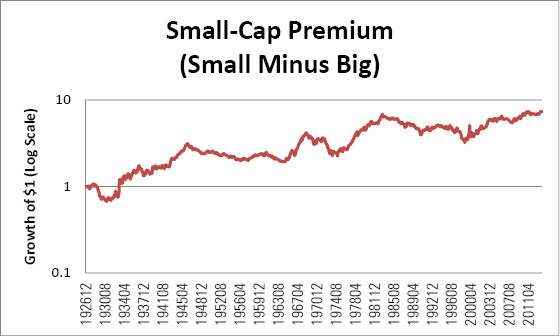
 

El-Erian Told to Chill by Monk Teaching Davos Meditation; “I don’t blame him” for resigning. That’s an impossible job. Those funds are just so big, you never get any sleep at night. It’s really hard to move the needle, and you’re constantly worried

El-Erian Told to Chill by Monk Teaching Davos Meditation

Buddhist monk Matthieu Ricard has a message for managers like Mohamed El-Erian, the Pacific Investment Management Co. chief executive officer who said this week he’s resigning: time to chill out.

El-Erian’s decision to quit shows how too many business leaders are pushing themselves to the breaking point, said Ricard, who’s leading early-morning meditation workshops at the World Economic Forum in Davos, Switzerland.

“What’s the point if you don’t have a sense of the quality of the moment passing by?” asked Ricard, a French citizen who founded the Karuna-Shechen humanitarian association. “It doesn’t have to be blissing out under a mango tree, but some kind of joy.” Ricard’s been easy to spot in the cavernous Davos convention center this week, thanks to flowing robes of red and yellow fabric complemented by an Apple iPad.

Allianz SE (ALV), the parent of Newport Beach, California-based Pimco, this week said 55-year-old El-Erian would resign after six years at the firm. He was viewed by investors as the heir apparent to co-founder Bill Gross, who said he was “shocked” by El-Erian’s resignation to “recharge the batteries.”

The departure comes as the global financial elite gathered at Davos are urged by organizers to pay more attention to stress and mental health. An unprecedented 25 panels on health and wellness are planned throughout the week, including a seminar on meditation led by actress Goldie Hawn and sessions on the effects of constant technology use on the brain.

El-Erian won’t get the benefit of those sessions. He told Bloomberg Radio last year he avoids the 2,600-delegate event because he’d “rather read about Davos than be there and run around.” He declined to comment.

No Blame

“I don’t blame him” for resigning, said billionaire Denis O’Brien, chairman of Hamilton, Bermuda-based Digicel Group Ltd., the largest telecommunications company in the Caribbean. “That’s an impossible job. Those funds are just so big, you never get any sleep at night. It’s really hard to move the needle, and you’re constantly worried about things you can’t control.”

Gross, 69, is a fan of many of the de-stressing techniques being advocated in Davos. A devotee of yoga and meditation, Gross particularly enjoys standing on his head to clear his thoughts, he told the Washington Post (GHC) in 2008.

To contact the reporters on this story: Matthew Campbell in Davos, Switzerland at mcampbell39@bloomberg.net; Jacqueline Simmons in Davos, Switzerland at jackiem@bloomberg.net

China appoints Xi to head national security commission

China appoints Xi to head national security commission

Friday, January 24, 2014 – 19:00

Reuters

BEIJING – Chinese President Xi Jinping has been appointed head of the new national security commission by the ruling Communist Party’s decision-making Politburo, the latest sign of his rapid consolidation of power.

The move puts Xi in charge of a commission that deals with crises at home and abroad and comes nearly a month after the government said that Xi would head a leading group to steer the country’s overall reforms.

Premier Li Keqiang and Zhang Dejiang, number three in the party’s hierarchy and head of China’s largely rubber-stamp parliament, will be vice-chairmen of the commission, state news agency Xinhua said on its microblog.

It will also include several other members of the Standing Committee, the apex of power in China. Xinhua gave no further details.

Details of how the commission would operate were left unclear when it was announced in a government communique in November, but China had hinted it would have a domestic focus.

Experts say it is based on the National Security Council in the United States and would increase coordination among the various wings of China’s security bureaucracy, split now among the police, military, intelligence and diplomatic services.

Possible international flashpoints for China include Japan, North Korea and the South China Sea.

China says it also faces considerable threats at home, pointing to continued unrest in two regions heavily populated by ethnic minorities which chafe at Chinese rule – Tibet and Xinjiang.

At a key party plenum meeting in November, China unwrapped its boldest reforms since Deng Xiaoping set the country on a course of opening up to the world in the 1970s and 1980s.

Demand for protection against U.S. equity selloff soars to record

Demand for protection against U.S. equity selloff soars to record

Fri, Jan 24 2014

By Angela Moon

NEW YORK (Reuters) – Demand for protection against a U.S. stock-market selloff soared on Friday as traders scooped up call options in CBOE Volatility index VIX , Wall Street’s favorite index of anxiety.

January call options – contracts betting on the rise of the underlying security – on the VIX this week rose to a record 8.4 million contracts at the Chicago Board Options Exchange (CBOE.O: QuoteProfileResearchStock Buzz) while the index itself jumped nearly 30 percent on Friday and about 44 percent for the week.

Since the VIX usually moves inversely to the performance of the S&P 500 stock index .SPX, traders often use the index to hedge against a market decline.

Reflecting the surge in demand for short-term protection, the spread between the VIX and three-month VIX futures briefly turned negative on Friday. Generally, due to the mean-reverting nature of the VIX, when the VIX is low, VIX futures trade at a premium.

“We haven’t had a correction for a while now, and while I think the market is overreacting a bit, concerns about China and other emerging market equities and currencies are weighing,” said Randy Frederick, managing director of active trading and derivatives at Charles Schwab in Austin, Texas.

“Looking at the implied volatility of VIX calls versus VIX puts, it’s relatively cheaper to buy VIX calls now so it’s a good time to buy (VIX calls) if you think it’s headed higher.”

Wall Street was closing out its worst week since June 2012, weighed by concerns about growth in China that fed a broad selloff across the globe, but particularly in emerging markets. The S&P 500 is down 2.3 percent so far this week.

Reflecting the recent bearish sentiment in equities, fund managers cut their net long positions in S&P 500 futures contracts in the week ended January 21 by 1,024 to 224,255, U.S. Commodity Futures Trading Commission data showed on Friday.

While the VIX is at its highest since October, it is still way below its 20-year average of 20.50.

Along with the spike in VIX, VIX-related exchange-traded products also jumped including the iPath S&P 500 VIX short-term futures exchange-traded note VXX (VXX.P: QuoteProfileResearchStock Buzz) and ProShares UltraPro Short Russell2000 exchange-traded fund UVXY (UVXY.P: QuoteProfileResearch,Stock Buzz), up 9.8 percent and 19.9 percent, respectively.

The iPath VIX ETN tracks activity in near-term futures contracts and is a way to bet on volatility without actually buying options. With more than 47 million shares traded Friday, it was the third-most active exchange-traded product on U.S. exchanges.

STILL A LONG WAY TO GO

Earlier this week, a trader was reported to have paid 90 cents for 90,000 May expiration call options at the 23 strike on the VIX index. Considering that the index was below 13 at that time, the trader was betting the VIX to roughly double by May. On Friday, premiums on the May call options were centered around $1.10 per contract.

“While that’s a decent gain from its purchase price, we can’t help but feel as though traders are still assigning relatively low likelihood to a sustained rebound in volatility,” said Andrew Wilkinson, chief market analyst at Interactive Brokers in Greenwich, Connecticut.

“Maybe that is because in the last year the VIX index has only traded above a 20 reading on about five occasions. And so while the market may be running scared again today, option traders are not yet willing to throw in the towel on the bull market,” he said.

Other notable trade on the VIX for the day was a 33,000-lot of Feb 19 calls for 59 cents, according to WhatsTrading.comoptions strategist Frederic Ruffy. The most active options were the Feb 14 puts, Feb 22 calls, and Feb 16 calls.

As of the afternoon session on Friday, 460,000 calls traded, exceeding the recent average daily volume of 454,000 contracts, while 190,000 puts traded, compared to the daily average of 140,000 contracts.


U.S. pensions’ funding gap closes, driving corporate profits

U.S. pensions’ funding gap closes, driving corporate profits

Fri, Jan 24 2014

By David Randall

NEW YORK (Reuters) – Corporate America is rapidly healing one of the last wounds suffered in the 2008 financial crisis.

Large companies’ pension plans are reporting among their best returns on record in 2013, dramatically closing funding gaps that had opened up because of losses in the 2008-2009 stock market collapse, and as government bond yields sank.

All told, companies in the S&P 500 saw an aggregate improvement of more than $300 billion in their pension plans, a gain that brought assets to around 93 percent of expected obligations, according to International Strategy & Investment, a New York research firm. That is a robust recovery from 2008, when they hit an all-time low of only 70.5 percent.

For investors, the performance of corporate pension plans is a small but under-appreciated side effect of the bull market that has now lasted for nearly five years. It will free up corporate cash for dividends, stock buybacks, and new investments, while helping to drive earnings growth, which could give a further nudge up to stock prices, analysts say.

Some companies may also see upgrades to their bond ratings, lowering their future borrowing costs.

David Zion, an analyst at ISI who co-authored the report, estimates that the strong performance of pension plans will save companies in the S&P 500 a total of $26 billion in the current fiscal year, resulting in a 1.6 percent boost for the 2014 earnings per share of the index. Analysts tracked by Thomson Reuters currently expect earnings per share to rise 10.7 percent this year.

The benefits mostly accrue to older industrial companies, or those who were traditionally unionized, as some of their workers and many of their retirees tend to have the more generous defined-benefit plans that are directly funded by the companies. The newer technology and service companies, who tend to rely on 401K plans that are largely the responsibility of workers to fund, are mostly not affected.

Some companies reporting their fourth-quarter earnings in the past few days have already said their results are benefiting from reduced pension costs.

Business jet manufacturer Textron Inc, for instance, saw its shares jump to a five-year high Wednesday after its earnings beat analyst estimates. Along with a rebound in the business jet market, the company is riding the performance of its pension plan. In 2010, it contributed about $417 million to the plan as its funding ratio fell to 77 percent, while in 2014, it expects to contribute just $80 million – a decline of nearly 81 percent. And now its pension plan is funded at an estimated 101 percent level, according to ISI.

The same day, AT&T Inc said it expects to record a pre-tax gain of about $7.6 billion in the fourth quarter from its pensions and post-employment benefit plans. A day earlier, Verizon Communications Inc reported fourth-quarter 2013 earnings of $5.07 billion, $3.7 billion of which was due to increases in the value of its pension and other benefit plans.

“These kind of cost-savings over a three-to-four year span don’t happen often,” said Eugene Stone, chief investment strategist at PNC Asset Management, referring to the decline in pension costs at companies since the end of 2009. “This is going to provide a tailwind to earnings for 2014 that hasn’t been there lately,” he said.

The gains have largely come from the stock market. The S&P 500 soared 32.4 percent, including dividends, last year, and has

climbed nearly 170 percent since its low in 2009.

In addition, the so-called discount rate – which serves as a proxy for the interest rate a company could expect on a bond today to fund its future obligations – increased as the yield on the 10-year Treasury note rose off of historic lows in the second half of last year. A higher discount rate means that companies do not have to contribute as much to pension plans.

COST SAVINGS

Gains in defined benefit plans had an impact on many S&P 500 companies in 2013, ISI analyst Zion said. Only 58 companies in the S&P 500 now have pensions that are less than 80 percent funded, compared with 197 a year ago, and some recorded pension gains that totaled more than 10 percent of their market caps.

United States Steel Corp, for instance, saw its pension assets rise more than $1 billion (not including the company’s contributions), an improvement that brought its pension plan to a 92 percent funded level. The gain was the equivalent of almost 31 percent of its market value at the end of 2012 of $3.4 billion. The Goodyear Tire and Rubber Co, Northrop Grumman Corp and Owens-Illinois Corp saw gains of 15 percent or more of their end-2012 market caps.

Because most Wall Street analysts typically focus more on a company’s ongoing business than its pension obligations, those cost savings could result in earnings surprises, Zion said.

US Steel, for example, should see a benefit of 74 cents in earnings per share directly from the improvement in its pension funding, a level that amounts to 65 percent of consensus estimates of $1.15 per share for 2013, Zion said. Alcoa Inc, meanwhile, should get a pension benefit of 16 cents per share, a level that equates to 40 percent of consensus estimates of 41 cents per share. It is unclear how much of the benefit has already been factored into those earnings estimates by analysts.

HELP ON THE MARGINS

To be sure, few investors say they would invest in a company simply because its pension costs are falling.

For example, Matthew Kaufler, a co-manager of the $1 billion Federated Clover Value Fund, has held a position in Macy’s Inc for several years. He was pleased to see the department store chain announced on January 8 that it had decided to forgo a $150 million contribution to its pension plan in the fourth quarter because of better-than-expected returns.

The pension plan savings “was a positive but in the list of positives it was not at the top,” Kaufler said. “People fundamentally want Macy’s to sell lots of clothes and home goods. That’s what drives the business, not the pension plan performance.”

But higher funding levels do make these companies seem safer bets over the long run because it means their balance sheets look better, portfolio managers say.

“For so many of these companies, the magnitude of the downturn was so great that they were kicked in the shins,” said Scott Lawson, an analyst who works on the $178 million Westwood LargeCap Value Fund. “Now, with the plans back to their prior funding levels, it lowers the risk profile.”

TAKING RISK OFF THE TABLE

Several companies are heading into 2014 with pensions plans that are in dramatically better shape than a year ago. Harley Davidson Inc, for example, saw a 36 percentage point gain, to 118 percent of obligations, in its funding levels over the past twelve months, according to ISI estimates.

Yet despite the gains in pension assets, companies may still face some risk in the long-term, analysts say. Any sudden reversal in the stock market is one concern. Workers living longer is another.

A 60-year old worker who retires today is expected to live 26.7 years longer on average, a 1.8-year improvement over previous lifespan estimates released by the Society of Actuaries in 2000. That nearly two year increase will result in a 6 percent increase in pension obligations, said Karin Franceries, an executive director at J.P. Morgan Asset Management.

In the past, companies often cited overfunding as a reason to terminate their pension plans. More recently, companies such as General Motors Co and Ford Motor Co, cut their pension risks by offloading their plans onto insurance companies, which then offer annuities to plan participants.

Now, though, many companies may find it more attractive to keep their own plans, said Zorast Wadia, a principal at actuarial consulting firm Milliman, which produces an annual study of pension funding. Insurance companies typically want plans to have a funding rate of 115 percent or more before they will take on their risks, Wadia said.

“A lot of these companies are going to find it’s cheaper to keep (it),” Wadia said, referring to the pension plans.

Equities now typically make up about 40 percent of plan assets, though some companies, such as Warren Buffett’s Berkshire Hathaway Inc, had as much as 72 percent of pension plan assets in stocks as recently as 2012.

“These plan sponsors are coming off the best year in their careers, and I expect many of them are going to be happy to take some risk off the table,” Wadia said.

It may be the final paradox of a 2013 market rally that few saw coming: stocks have helped pension plans so much that they decide to sell them and buy bonds instead.


Big gains for natural gas fuel big losses for hedge funds

Big gains for natural gas fuel big losses for hedge funds

Fri, Jan 24 2014

By Barani Krishnan and Jeanine Prezioso

(Reuters) – Natural gas was the biggest gainer among commodities last year but the hedge fund that has historically led gains in the space had its first losing year, and many others were down double-digits after being on the wrong side of the market.

U.S. gas prices gained more than 26 percent in 2013, the largest rally in eight years as brutally cold weather boosted gas demand. Prices rose, and toward the end of the year, the market saw wild swings in the spread between the March and April gas contracts.

Investors suspect that natural gas hedge funds lost heavily on spread trades of the March and April contracts, after miscalculating winter and spring gas demand and price action.

Prominent funds, from the $1 billion Velite Benchmark Capital in Houston to the smaller Sasco Energy Partners in Connecticut, finished the year down about 20 percent or more, according to industry sources and performance data obtained by Reuters.

“It was a tough year without doubt for most of us. The losses were pretty broad-based,” said Kyle Cooper, managing director of research at Cypress Energy Capital Management in Houston, a small $20 million hedge fund that lost 17 percent.

Hedge funds typically do not reveal their book, so it was hard to ascertain the price bets or size of the positions laid out by the gas funds, and the trades where they lost money.

It is also unclear how funds have fared in the first weeks of this year as natural gas futures prices have surged 20 percent so far this month.

Velite ended down 25 percent, according to two sources familiar with its numbers. It was the fund’s first loss since its launch in 2006, and was also the most high-profile loss among gas funds. Velite was founded by natural gas trader David Coolidge, 49, who became the top natural gas fund manager after ex-Enron wunderkind John Arnold retired two years ago.

Velite declined comment.

Big price swings are not unusual in natural gas, but the fluctuating March-April spread caught even the most experienced traders by surprise. The spread, known as the “widowmaker” for sharp losses it has caused in the past, gyrated wildly in a 20-cent range in December as forecasters predicted milder temperatures and then arctic-like chills.

In December, the gap between March and April 2014 gas moved from 4 cents on December 4 to 19 cents on December 12, as funds expected inventories to drain by the end of the winter heating season as Arctic chills swept across the United States.

It then contracted to as low as 9 cents five days later only to blow out to 30 cents on December 23, leaving ample room for winners and losers.

INCREDIBLE VOLATILITY

This year, the market has continued to surge, with front-month gas futures hitting above $5 per million British thermal units on Friday, a peak since June 2011, after some of the coldest temperatures in two decades. Next-day gas prices in New York City rose to a record above $100 per mmBtu on Tuesday.

“We’re still having incredible volatility now,” Cooper said. “This means we could have more big losses in January, and possibly some big winners if they got it right.” He declined to say how Cypress had performed for the month so far.

Of last year’s losers, Fairfield, Connecticut-based Sasco reported a 20-percent slide on a capital of $244 million, performance data obtained by Reuters showed.

Houston-based Skylar Capital, which opened with about $100 million at the end of 2012 and is run by former Arnold protégé Bill Perkins, lost about 25 percent, industry sources said.

Copperwood, also in Houston and run by ex-Enron veteran Greg Whalley, declined about 27 percent on a capital of $800 million, two market sources said.

All the funds declined comment.

Compared to them and Velite, the average commodity-energy fund on Chicago’s Hedge Fund Research rose 1.2 percent in 2013.

WRATH OF THE WIDOWMAKER

While the widowmaker was the likely cause of pain for some funds, others prospered by avoiding it.

e360 Power, an energy fund in Austin, Texas, which also trades electrical power, profited on its gas positions by focusing on market fundamentals and “trading around the ranges and the opportunities that were presented,” said James Shrewsbury, principal at the firm. The fund, which manages $170 million, rose 47 percent on the year.

The widowmaker attracts mainly fund managers, said Julian Rundle, chief investment officer at Dorset Asset Management, which allocates money to commodity managers.

Once a fund began losing money on the trade, it was hard for it to unwind without further losses, Rundle said.

“The key point was you had to really pay up to get out of that thing.”


Billionaire Eurnekian Targets Greek Airports Following Crisis

Billionaire Eurnekian Targets Greek Airports Following Crisis

Argentine billionaire Eduardo Eurnekian’s Corp. America holding company is bidding for all of Greece’s airports as the group looks to expand in Southern Europe and take advantage of discount prices after the crisis.

Corp. America’s airport operating unit is bidding for 21 Greek airports, Martin Eurnekian, head of the division and a nephew of Eduardo, said in an interview in Davos on Jan. 22. The group, which is acquiring a 23 percent stake in Pisa, Italy’s airport this week, is also trying to complete a plan to integrate Tuscany’s airports by adding Florence, he said.

“We’re going to be very aggressive on all fronts,” said Eurnekian, 35. “A lot of opportunities have opened up after the crisis.”

Greece, which sparked Europe’s sovereign woes in 2009 and required two bailouts, has seen its economy contract for 21 consecutive quarters. While Greece originally agreed to a goal of raising 50 billion euros ($68 billion) by 2015 through asset sales as part of austerity measures required by the EU and the International Monetary Fund, officials had to scale back their plans as transactions were delayed.

The country plans to sell stakes in two ports in February.

Corp. America, which operates 51 airports worldwide, with the majority in Argentina, is also preparing to bid for concessions in Cuzco, Peru, Barranquilla, Colombia, and the main international airport of Santiago later this year, Eurnekian said. The company, based in Buenos Aires, is renovating the Brasilia airport before the World Cup in June with plans to triple sales through retail by 2015 and make it the main domestic hub of Latin America’s largest economy.

Financing Sources

The Corp. America airport operator unit, which generates as much as $1.2 billion of revenue a year, doesn’t have any financing needs in the bond market for now, Eurnekian said. The company used proceeds from its $300 million bond sale in 2010 to renovate the Ezeiza airport in Buenos Aires and is receiving financing at low costs from Brazilian development bank BNDES, he said.

While the bid round for the Santiago airport would imply higher capital costs than more undeveloped markets, the company is working with a financial institution to look for a local partner and make a competitive bid, Eurnekian said. Chile will require as much as $800 million investment, he said.

A press official at the Chilean Public Works Ministry said no one was immediately available to comment on the bid round.

“Our mandate is to grow in the Americas and Europe with a focus on the Mediterranean,” he said. “We always invest in projects with the goal of maintaining managerial control.”

To contact the reporters on this story: Juan Pablo Spinetto in Davos, Switzerland at jspinetto@bloomberg.net; Daniel Cancel in Buenos Aires at dcancel@bloomberg.net

What’s Behind the Emerging-Market Meltdown

What’s Behind the Emerging-Market Meltdown

Emerging-market economies had a brutal week. For years, during the crash and its aftermath, they did well as the advanced economies slumped. Recently, not so much. Many developing countries are seeing their currencies drop and their bonds and equities hammered. Just as the global recovery appeared to be strengthening, a fresh source of instability has presented itself.

The issue now is how to keep the turmoil from derailing the global expansion. In a way, this was not an unexpected development: The recession in the advanced economies caused central banks to push short-term interest rates to zero and buy assets to drive long-term rates down as well. Capital flowed to the developing world in search of better returns. As investors prepare for a resumption of normal monetary policy, demand for emerging-market assets is bound to fall. The question has always been whether this adjustment would be smooth or abrupt.

The problem is that two things are amplifying the adjustment of capital flows: first, the dependence of global capital markets on the dollar, and hence on the policies of the U.S. Federal Reserve; and second, policy mistakes in some of the most-watched developing economies. In the short term, there’s little to be done about the dollar’s destabilizing pre-eminence. But economic reform in some of the main emerging-market economies, desirable in its own right, would help calm nerves.

Paradoxically, the U.S. market crash of 2007 and 2008 entrenched the dollar’s global dominance. Investors sought safety, and U.S. government debt remains the world’s safest asset. Despite tremendous federal borrowing, U.S. debt was soon in short supply. The Fed’s quantitative easing took trillions out of the market, and emerging-market governments bought dollars as a cushion against bad news and to hold their currencies (and export prices) down.

As a result, the emerging markets are unduly sensitive to fluctuations — real or imagined — in U.S. monetary policy. The Fed has recently begun to pivot away from quantitative easing, signaling that the era of extraordinarily loose U.S. monetary policy will come to an end. This is making investors think twice about putting their money in developing countries.

The Fed has begun to taper QE too soon — inflation in the U.S. is still low, and the labor market is still slack. On the other hand, the reduction in the pace of asset purchases is gentle (some would say to a fault), and at some point winding down the Fed’s unorthodox measures was going to be necessary.

The remedy for undue global sensitivity to U.S. monetary policy isn’t a different approach by the Fed; rather, it’s burden-sharing. Eventually, other currencies, such as the euro and the renminbi, need to function alongside the dollar as reserve currencies. In the meantime, better U.S. fiscal policy – – less budget contraction now, when the economy needs stimulus, and more later — would also lighten the Fed’s load.

There’s also more emerging-market governments can do. They should recognize that this week’s financial-market turmoil was, to varying degrees, their own fault. Argentina, which felt the full force of the storm with collapsing bond and equity prices and a steeply devalued peso, is a textbook case of economic mismanagement. No mistake has been left unmade — including cooking the books about the true rate of inflation.

There’s news to concern investors in other and more important emerging markets, too. Growth in China has been expected to slow for years: It now appears to be happening, and the government’s ability to manage the necessary economic restructuring is in doubt. The world’s second-worst-performing currency lately is the Turkish lira: Political protests, corruption scandals and flailing leadership are calling the country’s economic prospects, and its place in Europe, into question. Russia is stumbling. So is Brazil.

We’ll have more to say about these emerging economies in the coming days as we look at the stress points of a post-QE world. For now, suffice to say, the best way for emerging-market governments to restore confidence would be to improve their policies. In this week’s financial turmoil, factors beyond their control were in play, but they aren’t innocent bystanders, and they aren’t powerless.

To contact the Bloomberg View editorial board: view@bloomberg.net.

China to Cut Dependence on Coal for Energy as Smog Chokes Cities; China’s coal use accounted for 65.7 percent of its total energy consumption in 2013

China to Cut Dependence on Coal for Energy as Smog Chokes Cities

China plans to cut its dependence on coal as the world’s biggest carbon emitter seeks to clear smog in cities from Beijing to Shanghai.

The nation is aiming to get less than 65 percent of its energy from coal this year, according to a government plan released today. Energy use per unit of gross domestic product will decline 3.9 percent from last year, compared with 2013’s target for a 3.7 percent decrease.

The plan may help President Xi Jinping’s drive to reduce pollution as environmental deterioration threatens public health and the economy. More than 600 million people were affected by a “globally unprecedented” outbreak of smog in China that started last January and spread across dozens of provinces, the Institute of Public & Environmental Affairs based in Beijing said Jan. 14.

“China previously targeted to cut coal consumption to below 65 percent in 2017,” Helen Lau, an analyst at UOB-Kay Hian Ltd. in Hong Kong, said by phone today. “Now they have officially pulled it earlier to 2014, which reflects that they want to speed up restructuring energy consumption and are determined to reduce air pollution.”

China’s coal use accounted for 65.7 percent of its total energy consumption in 2013, the 21st Century Herald newspaper reported Jan. 13, citing an official it didn’t name.

Coal Use

The country’s total energy consumption will rise 3.2 percent to 3.88 billion metric tons of coal equivalent, while output is expected to increase 4.3 percent to 3.54 billion tons, the government plan shows. Coal use will climb 1.6 percent to 3.8 billion tons, while production may gain 2.7 percent to 3.8 billion tons.

The government will encourage imports of high-quality, less-polluting coal and limit fuel with high sulfur and ash content, according to the National Energy Administration plan. Power consumption is expected to rise 7 percent to 5.72 trillion kilowatt hours.

China’s oil demand is forecast to rise 1.8 percent to 510 million tons, while crude output will climb 0.5 percent to 208 million tons. Natural gas demand will increase 14.5 percent to 193 billion cubic meters and production will reach 131 billion, up 12 percent, the NEA said.

To contact Bloomberg News staff for this story: Jing Yang in Shanghai at jyang251@bloomberg.net; Sarah Chen in Beijing at schen514@bloomberg.net