China’s provincial economies: Unhappy convergence; Poorer provinces are suffering most as the economy slows
May 20, 2014 Leave a comment
Provincial economies: Unhappy convergence; Poorer provinces are suffering most as the economy slows
May 10th 2014 | HONG KONG | From the print edition
CHINA’S economy is slowing: GDP grew by 7.4% in the first three months of this year, compared with 7.7% in the final quarter of 2013. Just one of 31 provinces hit its growth target. The pain is being felt most keenly in the underdeveloped if resource-rich west and south-west of the country; Yunnan saw the biggest drop in growth of any province.
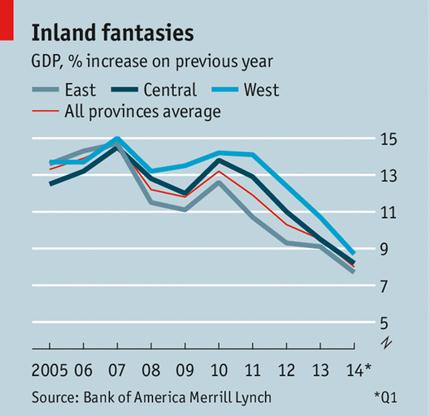
Trumpeted campaigns to “develop the west” and speed the “rise of central China” have been designed to narrow the gap with richer coastal regions. But the difference in growth between western and central China and the coast, wide just a few years ago, has steadily narrowed (see chart). The ten biggest first-quarter decelerations all occurred in provinces with below-average GDP per person.
Entrenched inequality is a concern for China’s leaders, yet their own policies add to the headwinds these regions face. The government wants to move the economy away from inefficient, polluting growth that depends on debt-financed investment—just the sort of thing that has been driving inland provinces along. (Indeed, weaker incentives for local officials to puff up their GDP figures may have accentuated the dipping growth in provincial economies.) Heilongjiang, which missed its growth target by the biggest margin, is victim to a parallel drive to reduce industrial overcapacity.
Policymakers will try to prevent inland provinces from losing out too much amid the shift to a fresh economic model, argues Tim Summers of Chatham House, a London think-tank. Some infrastructure spending is still continuing: a “mini-stimulus” unveiled in April promised accelerated railway construction inland. Raising spending on low-income housing also stands to help western regions.
Whatever happens, poorer provinces will be hard-pressed to grow as fast as they did a few years ago. Many are appreciably bigger than they were, Lu Ting of Bank of America Merrill Lynch notes. That makes it more difficult to achieve the same growth rates. To capitalise on their reserves of low-cost labour, some inland cities have pursued low-value manufacturing, luring factories away from the coast. But rising wages in coastal China feed through to bulkier pay packets inland, too.
Eastern regions have a head start in trying to tap higher value-added sources of growth such as e-commerce. Backward provinces inland can still expect to outpace their coastal cousins. But the idea that they might sustain double-digit growth is, in Mr Lu’s words, a “fantasy”.
 About bambooinnovator
 Bamboo Innovator