HSBC shareholders revolt on pay; More than a fifth of shareholders’ votes were cast against HSBC’s three-year pay policy in the latest sign of investor unrest during a stormy season of annual meetings
May 28, 2014 Leave a comment
May 23, 2014 4:52 pm
HSBC shareholders revolt on pay
By Sharlene Goff, Retail Banking Correspondent
More than a fifth of shareholders’ votes were cast against HSBC’s three-year pay policy in the latest sign of investor unrest during a stormy season of annual meetings.
The rebellion came despite the bank’s last-ditch attempt to head off a revolt by cutting its chairman’s potential bonus.
HSBC last week abandoned an earlier offer to pay Douglas Flint a one-off bonus of up to £2.25m in shares. The bank said it would cap the maximum the chairman could receive at £1m – or 44 per cent of his fixed pay.
Nevertheless, 20.65 per cent of votes were cast against the remuneration policy in the new binding vote on future pay structures.
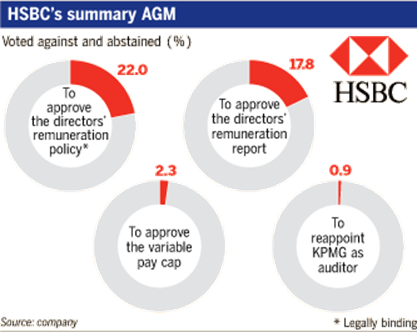
In the run-up to the annual meeting on Friday, some investors had criticised the bank’s policy on the new fixed pay “allowances” it is granting to senior employees to circumvent the EU bonus cap. Unlike some other banks, HSBC has not capped these allowances at 100 per cent of salary.
Banks and other companies have suffered a string of protests against high pay in recent weeks – the largest since the “shareholder spring” of 2012.
Kentz, the FTSE 250 engineering company, last week became the first company to lose the new binding vote on pay, which was introduced as part of last year’s government reforms to crack down on excessive remuneration.
Standard Chartered was the only other British bank to face a large protest against its pay policy, after 40 per cent of its investors’ votes were cast against the plan.
Barclays, AstraZeneca, Pearson (the owner of the Financial Times) and Reckitt Benckiser have suffered big protests against their 2013 remuneration reports rather than the binding vote on future pay.
Meanwhile, Deutsche Bank faced criticism from shareholders at its annual meeting in Frankfurt on Thursday over its decision to tap investors for €8bn in a fresh capital raising as well as its high litigation costs.
HSBC said that just over 16 per cent of shareholder votes were cast against its 2013 remuneration report – more than the 11 per cent for 2012.
Some of its investors were unhappy with the bank’s decision to consider paying Mr Flint a bonus to reflect the extra responsibilities he had taken on for regulation, compliance and conduct.
But Sir Simon Robertson, chairman of HSBC’s remuneration committee, told investors he thought Mr Flint, who was paid about £2.4m last year, was “underpaid”. He said the bonus was a “one-off and exceptional” payment.
Sir Simon stressed that the bank paid less than US rivals such as JPMorgan and Citigroup, despite competing with them. He added that complying with tougher rules on pay, such as the new EU bonus cap, was a “significant challenge” for HSBC given the proportion of profits generated outside Europe.
“We need to be careful not to destroy the business,” he warned.
The vast majority, 98 per cent, of votes cast by the bank’s shareholders approved its plans to lift the bonus cap to 200 per cent of salary, rather than the basic 100 per cent level introduced by the EU.
HSBC shareholders revolt over executive pay plan
Setback for bank as a fifth vote against pay policy, which included £1m potential bonus for chairman Douglas Flint
The Guardian, Friday 23 May 2014 17.45 BST
HSBC has been hit by a shareholder rebellion with a fifth voting against its pay policy that included a £1m potential bonus for chairman Douglas Flint.
The vote on pay policy, which can force a company to tear up its pay plans if it does not get enough shareholder backing, was a “signal of fairly significant discontent” by the standards of annual meetings, the advisory group Share Action said.
As well as the 20% voting against the pay plan, 10% opposed the re-election to the board of Sir Simon Robertson, the HSBC board member responsible for remuneration.
The controversy blew up earlier this month when HSBC proposed a potential £2.26m share bonus for Flint, a former finance director who has been chairman since 2010. The bank had been forced to scale this back to a potential £1m to quell a revolt from big City investors who felt Flint’s job had not changed enough to merit the reward.
Robertson told the meeting that Flint had never asked for the bonus. “I think Douglas is underpaid for what he does and he does an extremely good job,” he said.
Louise Rouse at Share Action said HSBC’s pay policy did not add up. “If he didn’t ask for a rise then why did they give him one. You shouldn’t pay anyone more than you need to,” she said. “It seems institutional shareholders have won the battle on the chairman’s bonus but there is a longer term war to be fought.”
The bank was also criticised for asking shareholders to vote on allowing bonuses at 200% of salary, in line with Brussels rules on the bonus cap. One shareholder noted that HSBC’s top five executives earn an average of £6m a year. Defending the policy, Flint said: “We pay way under what American banks pay… We are in competition with banks who are not subject to these European regulations and we have to be careful not to destroy the business from which you get your profits and dividends.”
 About bambooinnovator
 Bamboo Innovator