Scientists said Wednesday that flu infections were rising among pigs raised for slaughter on farms in south and southeastern China, also plagued by bird flu

Study shows flu infections rising among Chinese pigs

POSTED: 08 May 2013 9:24 AM
Scientists said Wednesday that flu infections were rising among pigs raised for slaughter on farms in south and southeastern China, also plagued by bird flu.

PARIS: Scientists said Wednesday that flu infections were rising among pigs raised for slaughter on farms in south and southeastern China, also plagued by bird flu.

And the risk of spillover to humans was “constant or growing”, according to one of the authors of a study published in Proceedings of the Royal Society B. Read more of this post

Unmeltable, Uncrushable: The Holy Grail in Painkillers

Updated May 5, 2013, 9:18 p.m. ET

Unmeltable, Uncrushable: The Holy Grail in Painkillers

By TIMOTHY W. MARTIN and JONATHAN D. ROCKOFF

MK-CC835_PAINRA_G_20130505182405OB-XI821_PAINRA_G_20130505214516

The arms race to build a safer painkiller is under way.

In the wake of a key decision by the Food and Drug Administration, more than a dozen pharmaceutical companies—from startups to Pfizer Inc. PFE -1.06% —are vying to create painkilling drugs that are difficult to abuse.

The FDA moved last month to block the manufacture and sale of generic versions of the original OxyContin, which has gone off patent but which is easier to abuse than the current version. A newer version of OxyContin, introduced by its maker, Purdue Pharma LP, in 2010, contains an infusion of polymer that makes the pill difficult to crush, meaning addicts can’t get all of the extended-release ingredients at once to get high. Read more of this post

Big drugmakers think small with nanomedicine deals

Big drugmakers think small with nanomedicine deals

Fri, May 3 2013

By Ben Hirschler

LONDON (Reuters) – Is nanomedicine the next big thing? A growing number of top drug companies seem to think so. The ability to encapsulate potent drugs in tiny particles measuring billionths of a meter in diameter is opening up new options for super-accurate drug delivery, increasing precision hits at the site of disease with, hopefully, fewer side effects. Three deals struck this year by privately held Bind Therapeutics, together worth nearly $1 billion if experiments are successful, highlight a new interest in using such tiny carriers to deliver drug payloads to specific locations in the body. U.S.-based Bind is one of several biotechnology firms that are luring large pharmaceutical makers with a range of smart drug nanotechnologies, notably against cancer.

Read more of this post

Emil Frei III, Who Put Cancer Cures in Reach, Dies at 89

May 4, 2013

Emil Frei III, Who Put Cancer Cures in Reach, Dies at 89

By MARGALIT FOX

Emil_FREI_26

Dr. Emil Frei III, an oncologist whose trailblazing use of combination chemotherapy — in which anticancer drugs are administered simultaneously rather than singly — helped make certain cancers curable for the first time, died on Tuesday at his home in Oak Park, Ill. He was 89.

His daughter Judy Frei confirmed the death.

Combination chemotherapy is now a standard treatment for a wide range of cancers, including breast, bone and testicular cancers, and has been credited with saving millions of lives worldwide. Read more of this post

To Fight Pandemics, Reward Research; An outbreak of avian flu in Asia raises questions about national preparedness for pandemics. A reward system for medical innovators would be a step in the right direction

May 4, 2013

To Fight Pandemics, Reward Research

By TYLER COWEN

THAT frightening word “pandemic” is back in the news. A strain of avian influenza has infected people in China, with a death toll of more than 25 as of late last week. The outbreak raises renewed questions about how to prepare for possible risks, should the strain become more easily communicable or should other deadly variations arise.

Our current health care policies are not optimal for dealing with pandemics. The central problem is that these policies neglect what economists call “public goods”: items and services that benefit many people and can’t easily be withheld from those who don’t pay for them directly.

Protection against communicable diseases is a core example of a public good, as is basic scientific research, which can yield new ideas that may be spread at very low additional cost. (In contrast, Medicare, which is publicly financed, has some elements of a public good, but any particular expenditure tends to benefit an individual receiving treatment, rather than being spread over a number of beneficiaries.)

One obvious step forward would be to exempt biomedical research from cuts of the current federal budget sequestration. Research and development grants are a way to pay potential innovators up front — an important move, as an innovator can’t always charge high-enough prices for the value of its remedies when they’re actually needed. Read more of this post

Scientists Develop Epilepsy Warning Device

Scientists Develop Epilepsy Warning Device

By Agence France-Presse on 6:57 pm May 2, 2013.
Paris. A tiny device implanted in the brain of epilepsy sufferers has for the fist time been able to predict the onset of seizures, scientists reported on Thursday.

The potentially life-saving device works with electrodes that monitor electrical activity on the brain surface, they wrote in The Lancet Neurology.

The electrodes were connected to a second device implanted under the skin of the chest, which transmitted the data wirelessly to a hand-held device that calculated the probability of a seizure.

The device lights up in red for a high risk, white for moderate, or blue for low seizure probability. Read more of this post

Brain, Interrupted. Does distraction matter — do interruptions make us dumber?

May 3, 2013

Brain, Interrupted

By BOB SULLIVAN and HUGH THOMPSON

TECHNOLOGY has given us many gifts, among them dozens of new ways to grab our attention. It’s hard to talk to a friend without your phone buzzing at least once. Odds are high you will check your Twitter feed or Facebook wall while reading this article. Just try to type a memo at work without having an e-mail pop up that ruins your train of thought.

But what constitutes distraction? Does the mere possibility that a phone call or e-mail will soon arrive drain your brain power? And does distraction matter — do interruptions make us dumber? Quite a bit, according to new research by Carnegie Mellon University’s Human-Computer Interaction Lab. Read more of this post

A Sense of Where You Are: The way the brain records and remembers movement in space may be the basis of all memory

April 29, 2013

A Sense of Where You Are

The way the brain records and remembers movement in space may be the basis of all memory

By JAMES GORMAN

TRONDHEIM, Norway — In 1988, two determined psychology students sat in the office of an internationally renowned neuroscientist in Oslo and explained to him why they had to study with him. Unfortunately, the researcher, Per Oskar Andersen, was hesitant, May-Britt Moser said as she and her husband, Edvard I. Moser, now themselves internationally recognized neuroscientists, recalled the conversation recently. He was researching physiology and they were interested in the intersection of behavior and physiology. But, she said, they wouldn’t take no for an answer. “We sat there for hours. He really couldn’t get us out of his office,” Dr. May-Britt Moser said. “Both of us come from nonacademic families and nonacademic places,” Edvard said. “The places where we grew up, there was no one with any university education, no one to ask. There was no recipe on how to do these things.” “And how to act politely,” May-Britt interjected. “It was just a way to get to the point where we wanted to be. But seen now, when I know the way people normally do it,” he said, smiling at the memory of his younger self, “I’m quite impressed.”

So, apparently, was Dr. Andersen. In the end, he yielded to the Mosers’ combination of furious curiosity and unwavering determination and took them on as graduate students. They have impressed more than a few people since. In 2005, they and their colleagues reported the discovery of cells in rats’ brains that function as a kind of built-in navigation system that is at the very heart of how animals know where they are, where they are going and where they have been. They called them grid cells. Read more of this post

Bug-Eyed Camera With 200 Lenses Seen Improving Surgery

Bug-Eyed Camera With 200 Lenses Seen Improving Surgery

Bugs, the bane of Sunday afternoon picnics, are opening a new horizon for researchers who are mimicking some of their more extraordinary attributes in a wave of research that may save lives in the future.

A digital camera with 200 lenses that mimics the compound eyes of ants may help improve endoscopes, the tiny cameras doctors use to explore the insides of patients. A tiny robot that borrows the aerial prowess of a house fly may one day help find injured victims buried in rubble after disasters.

The two technologies, announced separately in science journals this week, are the latest advances that use biological systems as models to design materials and machines. While copying nature has long been a staple of human innovation, recent technology advances that let scientists look more closely at insects and stronger collaboration between engineers and biologists have set off a wave of new discoveries.

“The walls that divided the life sciences and the physical sciences are sort of becoming transparent, so we’re trading ideas,” said Kevin Ma, a mechanical engineering graduate student at Harvard University in Cambridge, Massachusetts, who helped design the robotic fly. “That also helps with the trend toward biologically inspired technologies, because of the cross- pollination of the fields.” Read more of this post

New bird flu poses “serious threat”, scientists say; “This is a very, very serious disease in those who have been infected. So if this were to become more widespread it would be an extraordinarily devastating outbreak”

New bird flu poses “serious threat”, scientists say

Wed, May 1 2013

By Kate Kelland

LONDON (Reuters) – A new strain of bird flu that is causing a deadly outbreak among people in China is a threat to world health and should be taken seriously, scientists said on Wednesday. The H7N9 strain has killed 24 people and infected more than 125, according to the Geneva-based World Health Organization (WHO), which has described it as “one of the most lethal” flu viruses. The high mortality rate, together with relatively large numbers of cases in a short period and the possibility it might acquire the ability to transmit between people, make H7N9 a pandemic risk, experts said. “The WHO considers this a serious threat,” said John McCauley, director of the WHO Collaborating Centre for Influenza at Britain’s National Institute for Medical Research. Speaking at a briefing in London, experts in virology said initial studies suggest the virus has several worrisome characteristics, including two genetic mutations that make it more likely to eventually spread from person to person. “The longer the virus is unchecked in circulation, the higher the probability that this virus will start transmitting from person to person,” Colin Butte, an expert in avian viruses at Britain’s Pirbright Institute, said. Of the some 125 people infected with H7N9 so far, around 20 percent have died, approximately 20 percent have recovered and the remainder are still sick. The infection can lead to severe pneumonia, blood poisoning and organ failure. “This is a very, very serious disease in those who have been infected. So if this were to become more widespread it would be an extraordinarily devastating outbreak,” Peter Openshaw, director of the center for respiratory infection at Imperial College London, told the briefing. Read more of this post

Cancers Share Gene Patterns; Cancer will increasingly be seen as a disease defined by its genetic fingerprint rather than by the organ where it originated

May 1, 2013

Cancers Share Gene Patterns, Studies Affirm

By GINA KOLATA

Scientists have discovered that the most dangerous cancer of the uterine lining closely resembles the worst ovarian and breast cancers, providing the most telling evidence yet that cancer will increasingly be seen as a disease defined primarily by its genetic fingerprint rather than just by the organ where it originated.

The study of endometrial cancer — the cancer of the uterine lining — and another of acute myeloid leukemia, published simultaneously on Wednesday by Nature and The New England Journal of Medicine, are part of a sprawling, ambitious project by the National Institutes of Health to scrutinize DNA aberrations in common cancers.

Over the past year, as part of this project, researchers have reported striking genetic changes in breast, colon and lung cancers that link them to other cancers. One kind of breast cancer was closely related to ovarian cancer. Colon cancers often had a genetic change found in breast cancer. And about half of squamous cell lung cancers might be attacked by drugs being developed for other cancers. Read more of this post

Robot Aids in Therapy for Autistic Children

Updated May 1, 2013, 12:03 p.m. ET

Robot Aids in Therapy for Autistic Children

By SHIRLEY S. WANG

SAN SEBASTIÁN, Spain—A two-foot-tall robot therapist may help children with autism learn to be more social, according to intriguing findings from a study being presented this week at the annual conference of the International Society for Autism Research here.

Results from the new study of 19 children with autism—thought to be the largest trial to date of such technology—found that kids improved their conversation skills more when interacting with the robot, compared with sessions with a human therapist alone. Parents reported these children had greater improvement at home as well.

Researchers long have been interested in using technology to help treat autism, a developmental condition characterized by social deficits and repetitive behavior, because many of these children seem particularly interested in computers, iPads and other devices—often more so than they are interested in people. Read more of this post

“It grows very well, this virus”: Scientists Infect Chicks in Race to Halt Lethal H7N9 Bird Flu Spread; “If one in five people getting infected die, that’s a pretty frightening infection”

Scientists Infect Chicks in Race to Halt Bird Flu Spread

Deep inside a high-security laboratory an hour from Melbourne, scientists working behind air-locked doors inject six-week-old chickens with a virus that has killed one in five people it’s known to have infected. The pathogen is H7N9 bird flu, and it came to Australia’s second-biggest city 12 days ago in a 0.5 milliliter sample — 10 would fit on a teaspoon — from a patient in China’s Anhui province. Antibodies from the chickens will help create tests for the virus, part of a race to head off a global outbreak. While disease trackers have yet to pinpoint how the 127 human infections in China and Taiwan occurred, they say contact with poultry is the most likely cause. Birds carry the disease without showing symptoms, making tests to monitor farms and markets vital to halting its spread, said Peter Daniels, assistant director of the Australian Animal Health Laboratory.

“If one in five people getting infected die, that’s a pretty frightening infection,” said Daniels, 64, whose lab is the world’s largest high-security bio-containment research facility. “It may be that it won’t start spreading person to person. But if it does, the world is facing a severe disease situation.” Read more of this post

Men twice as likely to contract the lethal H7N9 bird flu than women: report

Men twice as likely to contract H7N9 than women: report

Staff Reporter, 2013-04-30

Men are twice as likely to contract the deadly H7N9 avian influenza than women, according to Taiwan’s Central Epidemic Command Center. Based on analysis of existing H7N9 cases reported in China, which have risen to 125 as of Sunday, including 23 deaths, the center found that there were twice as many male victims than there were female. In terms of age, those 50 years or older account for 74% of all cases, with patients aged between 30 to 39 following at 11%, and those aged between 40 and 49, accounting for 7%. Patients aged between 20 and 29 account for 5%, while only 3% of victims are under ten years old. Read more of this post

New gene therapy trials aim to mend broken hearts

Published: Tuesday April 30, 2013 MYT 8:06:00 AM

New gene therapy trials aim to mend broken hearts

LONDON: British scientists are stepping up clinical tests of gene therapy in a bid to help people with advanced heart failure pump blood more efficiently. Researchers said on Tuesday they planned to enrol patients into two new clinical trials using Mydicar, a gene therapy treatment made by privately held U.S. biotech company Celladon. After more than 20 years of research, the ground-breaking method for fixing faulty genes is starting to deliver, with European authorities approving the first gene therapy for an rare metabolic disease last November. In the case of heart failure, the aim is to insert a gene called SERCA2a directly into heart cells using a modified virus, delivered via a catheter infusion. Lack of SERCA2a leads to ever weaker pumping in people with heart failure. Although drugs offer some relief, there is currently no way of restoring heart function and the prognosis for those with advanced disease is worse than for many cancers. Read more of this post

Deadly H7N9 avian influenza may have spread to Guangdong as health authorities in Dongguan shut down the city’s live poultry trade on Sunday

Dongguan shuts down poultry trade amid fears H7N9 has hit southern China

Staff Reporter, 2013-04-29

The deadly H7N9 strain of the avian influenza may have spread to southern China as health authorities in Dongguan, Guangdong province shut down the city’s live poultry trade on Sunday, reports the Guangzhou-based Southern Metropolis Daily. The Dongguan agricultural bureau confirmed on Saturday evening that it gave orders for vendors at live poultry markets in Dongcheng district to remove all live poultry from the premises by 6pm Sunday as a precaution after one tested sample revealed “abormalities.” The bureau refused to say if the sample had tested positive for H7N9, the new strain of the bird flu that has so far killed 23 people and infected a total of 120 across the eastern, northern and central parts of the country. Authorities also did not say when the market would reopen. Reporters at the scene found that in the rush to meet official orders, much of the livestock were being removed from the market without undergoing proper disinfecting procedures. Dongguan health authorities have not reported any H7N9 cases as of April 18 and are still awaiting results from latest samples. Tests for two suspected cases earlier in the month have returned negative for the virus.


Watch out for human-to-human H7N9 flu warns top US virologist Anthony Fauci, the head of the National Institute of Allergy and Infectious Diseases (NIAID)

Watch out for human-to-human H7N9 flu warns US expert

POSTED: 29 Apr 2013 4:00 AM

There is no evidence that the deadly H7N9 bird flu has yet spread between humans in China but health authorities must be ready for the virus to mutate at any time, a top US virologist has warned.

WASHINGTON – There is no evidence that the deadly H7N9 bird flu has yet spread between humans in China but health authorities must be ready for the virus to mutate at any time, a top US virologist has warned.  Read more of this post

Hong Kong Steps Up H7N9 Bird Flu Fight as floods of mainland Chinese tourists descend on HK for the Labor Day holiday

Updated April 28, 2013, 3:38 p.m. ET

Hong Kong Steps Up Flu Fight

By TE-PING CHEN

Hong Kong immigration and hospital officials are stepping up efforts to fend off the spread of H7N9 bird flu, which surfaced outside China for the first time last week, as floods of mainland Chinese tourists descend on Hong Kong for the Labor Day holiday. The government is deploying greater manpower at the border at the mainland Chinese city of Shenzhen, one of the busiest border crossings in the world, to screen travelers for elevated body temperatures, and tour operators are being urged to monitor the condition of individual tourists. Some 4.2 million people are expected to cross Hong Kong’s borders during the holiday, which runs from April 27 to May 1, most crossing via Shenzhen.

Read more of this post

H7N9 bird flu virus more lethal than SARS in 2003: medical expert

H7N9 more lethal than SARS: medical expert

CNA, 2013-04-27

The new H7N9 avian flu virus is more lethal than the strain of coronavirus that caused the global outbreak of severe acute respiratory syndrome (SARS) in 2003, a doctor at National Taiwan University Hospital said Friday. Citing a University of Hong Kong research report, Huang Li-min, head of the hospital’s Department of Pediatric Infectious Diseases, said people infected with the H7N9 virus can get sick quickly, and the disease has a fatality rate currently estimated at over 10%. “Such a ratio is higher than that of the SARS virus,” Huang said, noting that the World Health Organization estimated the mortality rate for SARS at about 8%. According to data on the website of Taiwan’s Centers for Disease Control, China had 114 confirmed H7N9 cases, with 23 deaths as of 6 pm Friday, which translated into a mortality rate of about 20%. But the University of Hong Kong report said there are at least as many undiscovered cases as confirmed cases, likel putting the new bird flu strain’s fatality rate at slightly higher than 10%. The H7N9 strain of the flu was not known to infect people until March 31, when China reported its first cases of human infections of the virus. Read more of this post

Chinese Scientists Warn Danger of People-to-People Transmission of H7N9; Three “staircases” of the virus genome have been displaced; the fourth displacement will result in people-to-people transmission

Chinese Scientists Warn Danger of People-to-People Transmission of H7N9

04-27 11:11 Caijing

Three “staircases” of the virus genome, which is like a spiral stairs, have been displaced, Li said.

A group of Chinese scientists have warned the danger of H7N9 spreading from people to people as China has confirmed 120 cases of infection of the new strain of bird flu, with 23 fatal. A research group of professors from China’s top universities led by Li Lanjuan, a H7N9 expert, has found that the bird flu virus is increasingly apt to infect mammals, which adds to the risk of people-to-people contraction, according to a Friday’s report by Qianjiang Evening, a newspaper based in southeast China’s Zhejiang Province. Three “staircases” of the virus genome, which is like a spiral stairs, have been displaced, Li said. Stability of the stairs would be sabotaged and people-to-people transmission could become reality if displacement of a fourth should appear, she warned.   “Hopefully there won’t be a fourth displaced staircase,” said Li Lanjuan who vowed closer monitoring. An investigation group of the World Health Organization (WHO) Wednesday called for closer international and domestic cooperation as it said experts still have limited knowledge of the virus. The group reiterated that there’s not enough evidence showing the virus being transmitted from people to people.  No typical symptoms have been found in poultry carrying the virus, which makes it harder to track, the group said. Taiwan reported its first case of H7N9 infection Tuesday, someone who stayed in Suzhou, Zhejiang Province from March 28th to April 9th. Zhejiang is the most-hit area in the mainland, reporting 45 people infected by H7N9, with 6 of them being killed. The bird flu strain has been spread to 11 provinces including Taiwan.

H7N9 bird flu spreads to central China’s Hunan; total infections rise to 119 with 24 dead

http://english.people.com.cn/102775/207149/index.html

H7N9 bird flu spreads to central China’s Hunan

AFP News – 51 minutes ago

China’s deadly outbreak of H7N9 bird flu has spread to the central province of Hunan, local health authorities said Saturday, the third announcement in three days of a case in a new location. A 64-year-old woman in Shaoyang City, who developed a fever four days after coming into contact with poultry, was confirmed to have the virus, the Xinhua state news agency reported. It follows the first confirmed cases in the eastern province of Jiangxi on Thursday and the southeastern province of Fujian on Friday. More than 110 people in mainland China have been confirmed with H7N9, with 23 deaths, since the government announced on March 31 that the virus had been found in humans. Most cases have been confined to eastern China. The island of Taiwan has also reported one case. A Chinese expert earlier this week warned of the possibility of more cases in a wider geographical area. “Until the source of H7N9 avian influenza is… brought under effective control, sporadic cases might continue to appear,” said Liang Wannian of China’s National Health and Family Planning Commission. Poultry has been confirmed as the source of the H7N9 flu among humans, but experts fear the prospect of such a virus mutating into a form easily transmissible between humans, which could then have the potential to trigger a pandemic.

China finds new bird flu case in eastern Fujian province, signaling the spread of the H7N9 virus

China finds new bird flu case in eastern Fujian province: Xinhua

BEIJING (Reuters) – Chinese authorities discovered on Friday the first case of a new strain of bird flu in the eastern province of Fujian, signaling the spread of the virus which has killed 23 people in China, the official Xinhua news agency reported. The flu was first detected in March. This week, the World Health Organisation called the virus, known as H7N9, “one of the most lethal”, and said it is more easily transmitted than an earlier strain that has killed hundreds around the world since 2003. Fujian’s health authority said a 65-year-old man surnamed Luo had tested positive for the virus, Xinhua reported. Thirty-seven people who had been in close contact with the man had not shown symptoms of the flu. Chinese scientists confirmed on Thursday that chickens had transmitted the flu to humans. This week, a man in Taiwan become the first case of the flu outside mainland China. He caught the flu while travelling in China.

Published on Apr 26, 2013

SHANGHAI (AFP) – China’s deadly outbreak of H7N9 bird flu has spread to a province in the country’s south, the government said on Friday, marking the second announcement in two days of a case in a new location. The local health bureau in the south-eastern province of Fujian said a 65-year-old man was confirmed to have the virus. On Thursday, the eastern province of Jiangxi confirmed its first case of H7N9, in a 69-year-old-man. More than 110 people in mainland China have been confirmed with H7N9, with 23 deaths, since the government announced on March 31 that the virus had been found in humans. Most cases have been confined to eastern China. The island of Taiwan has also reported one case. A Chinese expert earlier this week warned of the possibility of more cases in a wider geographical area. Read more of this post

Malaysia has banned all imported chicken from China and is urging its own poultry farmers to beware of bird flu after Taiwan reported a case of the deadly strain, the first outside mainland China

April 26, 2013, 10:36 a.m. ET

Malaysia Bans Chicken Imports From China

By SHIE-LYNN LIM

Malaysia has banned all imported chicken from China and is urging its own poultry farmers to beware of bird flu after Taiwan reported a case of the deadly strain, the first outside mainland China.

Malaysia will only resume imports of China’s poultry when China is able to contain the new avian flu subtype and is declared free from the strain, Nazahiyah Sulaiman, spokeswoman at Malaysia’s Department of Veterinary Services (DVS) said. Malaysia joins Vietnam and Indonesia, which banned all poultry products from Asia’s largest economy earlier this month. Read more of this post

H7N9 cases likely to increase in Taiwan, health officials; 133 reported cases of flu-like illnesses starting from April 3, 30% are seasonal flu, 70% unconfirmed

H7N9 cases likely to increase in Taiwan, health officials say

Friday, Apr 26, 2013
The China Post/Asia News Network
By Ann Yu

In light of the confirmed case of H7N9 in Taiwan on April 24, Chang Feng-yih, the commander of the Central Epidemic Command Center (CECC) for H7N9 influenza has reported that the number of H7N9 cases is likely to increase following the bird migration season in Autumn, and has asked all officials to stay alert. He added that there have been 133 reported cases of flu-like illnesses starting from April 3, with 30 per cent confirmed later to be seasonal flu. Read more of this post

Harvard Cell Growth Discovery Seen Treating Diabetes

Harvard Cell Growth Discovery Seen Treating Diabetes

Harvard University scientists discovered a hormone that spurs the growth of beta cells, the body’s insulin factories, a finding that holds promise for treating diabetes in a new way. Researchers first found the hormone, called betatrophin, in mice, where it increases beta cell growth by as much as 33 times, said Douglas Melton, co-director of the Department of Stem Cell and Regenerative Biology at Harvard in Cambridge, Massachusetts. An almost-identical hormone in humans appears to serve the same function, Melton and his colleagues said today in the journal Cell. The discovery has drawn the interest of drugmakers looking at the $42 billion market for diabetes medicines. Harvard has applied for a patent on betatrophin, and the molecule has been licensed to Hamburg, Germany-based Evotec AG and Johnson & Johnson (JNJ), Melton said. New drugs are needed as patients develop resistance to older therapies.

“We’re very excited about this,” Melton said in a telephone interview. “The finding just makes so much sense to me, and it could be a new way forward in treating diabetes.” About 347 million people, or 5 percent of the world’s population, have diabetes, a condition that can lead to heart disease, stroke, eye disease and nerve damage, according to the World Health Organization. Many patients develop these conditions even while getting treatment, so new drugs are needed, Melton said.

Read more of this post

Doctors Denounce Cancer Drug Prices of $100,000 a Year; More than 100 influential cancer specialists argued that some drug prices are unsustainable and perhaps even immoral

April 25, 2013

Doctors Denounce Cancer Drug Prices of $100,000 a Year

By ANDREW POLLACK

With the cost of some lifesaving cancer drugs exceeding $100,000 a year, more than 100 influential cancer specialists from around the world have taken the unusual step of banding together in hopes of persuading some leading pharmaceutical companies to bring prices down.

Prices for cancer drugs have been part of the debate over health care costs for several years — and recently led to a public protest from doctors at a major cancer center in New York. But the decision by so many specialists, from more than 15 countries on five continents, to join the effort is a sign that doctors, who are on the front lines of caring for patients, are now taking a more active role in resisting high prices. In this case, some of the specialists even include researchers with close ties to the pharmaceutical industry.

The doctors and researchers, who specialize in the potentially deadly blood cancer known as chronic myeloid leukemia, contend in a commentary published online by a medical journal Thursday that the prices of drugs used to treat that disease are astronomical, unsustainable and perhaps even immoral. Read more of this post

Venture capital flight away from life sciences as the costs, time, and uncertainty involved in developing medical ideas have risen to “crisis” levels

April 25, 2013 9:58 pm

Venture capital flight away from life sciences

By April Dembosky in San Francisco

Venture capitalists are fleeing investments in life sciences, as the costs, time, and uncertainty involved in developing medical ideas have risen to “crisis” levels, according to a new report released on Thursday.

First-time financings are suffering in particular, with only 20 life sciences companies receiving start-up funding in the first quarter of 2013, the lowest number seen since the second quarter of 1995. Read more of this post

Latin America Threatened With Cancer Epidemic

Latin America Threatened With Cancer Epidemic

By Agence France-Presse on 9:29 am April 26, 2013.
Sao Paulo. Latin America faces a cancer epidemic unless governments act quickly to improve health care systems and treat the poor, scientists said.

The researchers pointed to around 13 deaths for every 22 cancer cases in the region, compared to around 13 deaths for every 37 cases in the United States and around 13 deaths for every 30 cases in Europe.

The main reason, according to the study published in the British journal The Lancet Oncology, is that too many people are diagnosed with cancer at a late stage when the disease is much harder to treat and more likely to kill.

“Researchers estimate that by 2030, 1.7 million cases of cancer will be diagnosed in Latin America and the Caribbean, with more than one million deaths from cancer predicted to occur annually,” said the report launched at the Latin American Cooperative Oncology Group (LACOG) 2013 conference in Sao Paulo. Read more of this post

Innovator: Matt Rabinowitz Sifts Gene Data for Healthy Pregnancies; Traditional screenings during a pregnancy’s first trimester miss 15% of Down syndrome cases and yield false positives 5% of the time

Innovator: Matt Rabinowitz Sifts Gene Data for Healthy Pregnancies

By John Tozzi on April 25, 2013

tech_innovator1813__01__630x420

Ten years ago, prenatal screenings gave a clean bill of health to Matt Rabinowitz’s nephew. The tests didn’t show that he had Down syndrome, which raises infant mortality risks. The boy died six days after birth. While Rabinowitz mourned, the Stanford-educated data scientist began to research genetic testing. “It just seemed amazing to me that that would happen in the 21st century,” he says. Traditional screenings during a pregnancy’s first trimester miss 15 percent of Down syndrome cases and yield false positives 5 percent of the time. False alarms can lead to more invasive diagnostics, such as amniocentesis and chorionic villus sampling, which are highly accurate but increase risk of miscarriage. In the past three years, four companies have developed noninvasive tests that predict the risk of birth defects by analyzing fetal DNA that’s mingled with the mother’s blood. Rabinowitz’s company, Natera, introduced the newest of these tests in March. Based in San Carlos, Calif., Natera’s more than 200 employees use cloud computing to analyze the genetic data they extract from maternal blood samples. The software scans 19,500 of a cell’s 10 million genetic markers. Using data from the human genome project and samples of the parents’ genes, “you can reconstruct the entire DNA of the child from that single cell,” Rabinowitz says. He says it detects miscarriage-threatening conditions other screenings can miss, such as triploidy, which occurs when cells carry extra copies of each chromosome. Read more of this post

Alzheimer’s: The Costliest Killer

Alzheimer’s: The Costliest Killer

By Peter Coy on April 25, 2013
BW18_OR_alzheimers_inline

In 2006 former television journalist Meryl Comer described in the Alzheimer’s & Dementia journal what it’s like to care for a husband with early-onset Alzheimer’s disease. “At night I slip between the bed covers, careful not to disturb the stranger lying there,” she wrote. “Soon he will wake screaming and flailing his arms as if fighting off demons. … Exhausted, I drift off only to reawaken and find myself lying by his side in a pool of urine.” Eleven years earlier, before his diagnosis at age 58, Comer’s husband, Harvey Gralnick, had been chief of hematology and oncology at the National Institutes of Health (NIH). Now he was detached from reality and unpredictably violent. He knocked out her two front teeth once when she tried to bathe him—an incident she left out of her article. Comer clung to one hope. “Today,” she wrote, “the field is on the brink of major breakthroughs that may lead to more effective treatments and, ultimately, to prevention.” Seven years after Comer wrote that article, things are worse. Her husband lingers on, protected at home from the secondary infections that kill many Alzheimer’s patients in nursing homes. Now her 93-year-old mother—who in 2006 was just beginning to exhibit Alzheimer’s-related paranoia—has full-blown symptoms and lives with her as well. Comer, who has been named president of the Geoffrey Beene Foundation Alzheimer’s Initiative, puts in 12-hour shifts caring for her husband and mother and spends $100,000 a year on home nursing care, none of it covered by Medicare. She expects to go bankrupt eventually.

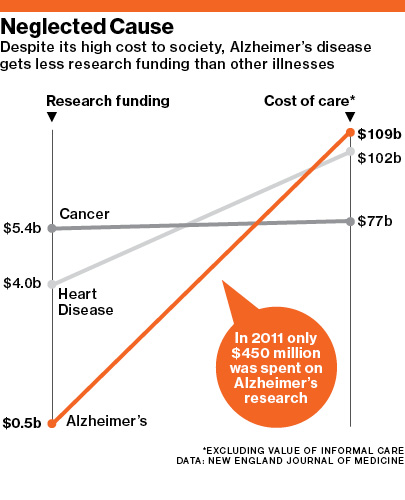
Alzheimer’s disease remains incurable and 100 percent fatal. Because of modern medicine’s successes, more people are outliving heart disease, cancer, and stroke, only to be hunted down by Alzheimer’s and other forms of dementia. It’s hard to conceive of a worse way to die than to lose one’s mind. Asked last year in a Home Instead Senior Care/Marist Poll which disease they were most afraid of having, 44 percent of Americans named Alzheimer’s, as many as named cancer and stroke combined. If nothing is done, Alzheimer’s will become the “financial sinkhole of the 21st century,” says gerontologist Ken Dychtwald, chief executive officer of Age Wave, a consulting firm. Already, treating dementia of all kinds costs more than heart disease or cancer, more than $150 billion a year in the U.S., including the value of informal care, according to a Rand Corp. study released on April 3. That number could more than double by 2040 as baby boomers age into the Alzheimer’s danger zone, Rand says. Compounding the economic impact, women, who provide most of the care, are often forced to drop out of the labor force. Read more of this post