The Global Innovation 1000: Navigating the Digital Future

October 22, 2013

The Global Innovation 1000: Navigating the Digital Future

Booz & Company’s annual study of R&D spending reveals the tools that are transforming innovation—from customer insight to product launch.

by Barry Jaruzelski, John Loehr, and Richard Holman

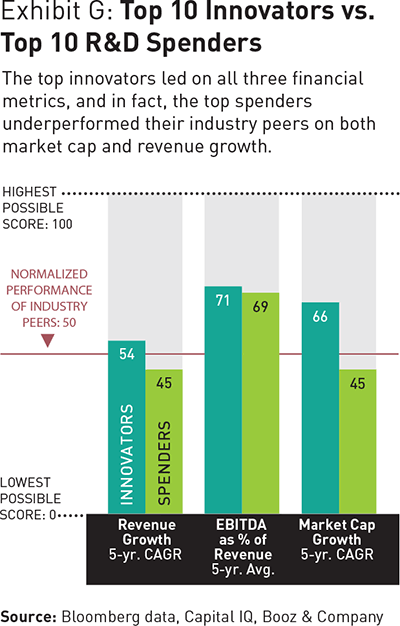
At Catalent, a U.S.-based producer of pharmaceutical products and provider of advanced drug delivery technologies and services, digital tools often support the practices of the company’s 18 research and development sites around the world. Data pours in from R&D, sales and marketing, operations, quality assurance, and regulatory affairs, as well as customers. Evjatar Cohen, vice president for global innovation and portfolio management, and his team make sense of it all with a slate of new market and customer insight enablers. “Collecting the data is just part of what we do,” he says. “It’s really about using that input to come up with market uptake estimates for each potential product and an understanding of its business value. That aids us greatly in deciding where to focus our day-to-day activities as well as planning our long-term strategy.”

00221_ex01b00221_ex0200221_exfb00221_exgb Read more of this post

The highly unusual company behind Sriracha, the world’s coolest hot sauce; Tran’s dream is “to make enough fresh chili sauce so that everyone who wants Huy Fong can have it. Nothing more.”

The highly unusual company behind Sriracha, the world’s coolest hot sauce

By Roberto A. Ferdman @robferdman October 21, 2013

images (38)130611_sriracha_2

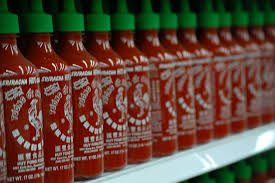
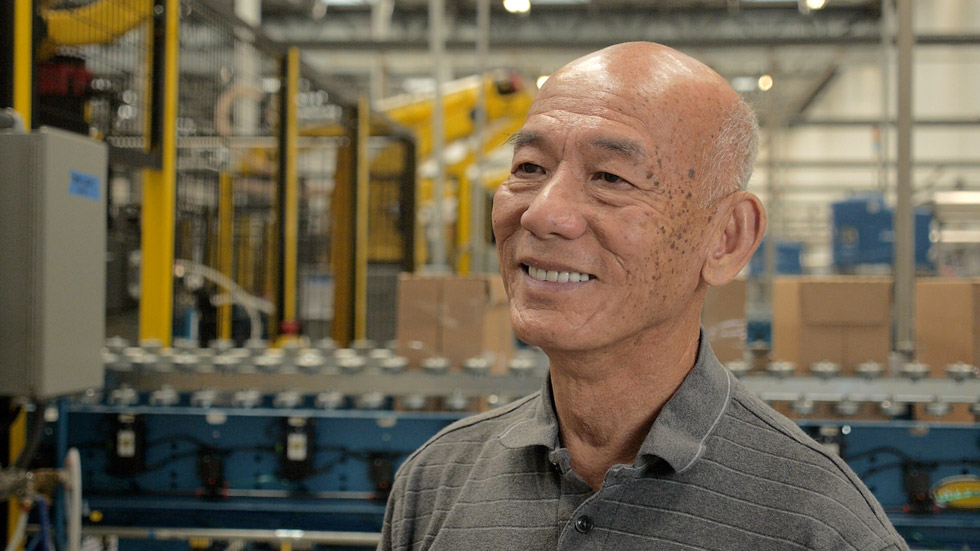
If David Tran were a more conventional CEO, he would be a fixture at conferences, a darling of magazine profiles, and a subject of case studies in the Harvard Business Review. Sriracha hot sauce, made by Huy Fong Foods, which Tran founded 33 years ago in Los Angeles, is one of the coolest brands in town. There are entire cookbookswritten to celebrate Sriracha’s versatility; memorabilia ranging from iPhone covers to t-shirts and all sorts of other swaga documentary in the works to chronicle its rise; and innumerable imitators. Sriracha sales last year reached some 20 million bottles to the tune of $60 million dollars, percentage sales growth is in the double digits each year, and it does all this without spending a cent on advertising. Yet Tran shuns publicity, professes not to care about profits, hardly knows where his sauces are sold, and probably leaves millions of dollars on the table every year. His dream, Tran tells Quartz, “was never to become a billionaire.” It is “to make enough fresh chili sauce so that everyone who wants Huy Fong can have it. Nothing more.” Read more of this post

The Technology in Domino’s Pizza: How Asian Firms Can Have Enduring Pizzazz (Bamboo Innovator Insight)

The following article is extracted from the Bamboo Innovator Insight weekly column blog related to the context and thought leadership behind the stock idea generation process of Asian wide-moat businesses that are featured in the monthly entitled The Moat Report Asia. Fellow value investors get to go behind the scene to learn thought-provoking timely insights on key macro and industry trends in Asia, as well as benefit from the occasional discussion of potential red flags, misgovernance or fraud-detection trails ahead of time to enhance the critical-thinking skill about the myriad pitfalls of investing in Asia at the microstructure- and firm-level.

  • The Technology in Domino’s Pizza: How Asian Firms Can Have Enduring Pizzazz, Oct 21, 2013 (Moat Report Asia, BeyondProxy)
Pizzazz

Dear Friends and All,

The Technology in Domino’s Pizza: How Asian Firms Can Have Enduring Pizzazz

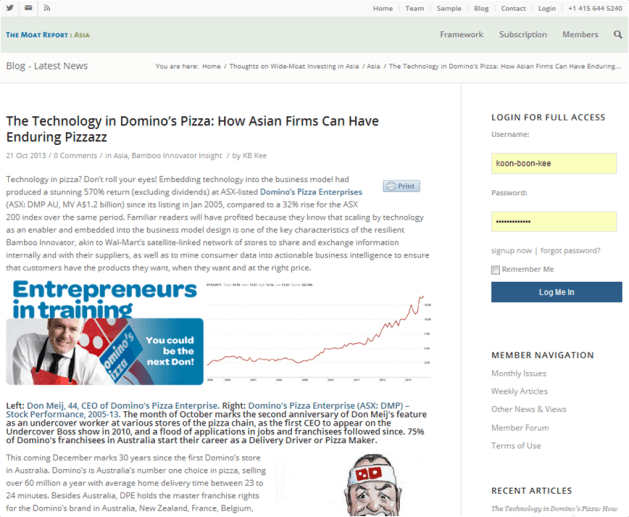
Technology in pizza? Don’t roll your eyes! Embedding technology into the business model had produced a stunning 570% return (excluding dividends) at ASX-listed Domino’s Pizza Enterprises (ASX: DMP AU, MV A$1.2 billion) since its listing in Jan 2005, compared to a 32% rise for the ASX 200 index over the same period. Familiar readers will have profited because they know that scaling by technology as an enabler and embedded into the business model design is one of the key characteristics of the resilient Bamboo Innovator, akin to Wal-Mart’s satellite-linked network of stores to share and exchange information internally and with their suppliers, as well as to mine consumer data into actionable business intelligence to ensure that customers have the products they want, when they want and at the right price.

This coming December marks 30 years since the first Domino’s store in Australia. Domino’s is Australia’s number one choice in pizza, selling over 60 million a year with average home delivery time between 23 to 24 minutes. Besides Australia, DPE holds the master franchise rights for the Domino’s brand in Australia, New Zealand, France, Belgium, Monaco and The Netherlands, and is the largest franchisee for the brand in the world. DPE also recently acquired 75% of Domino’s Japan from Bain Capital in Aug/Sep 2013 for A$128 million, plus agreeing to supply new debt funding of another A$96.4 million for a total of about A$225 million, adding 259 Japanese stores (216 corporate and 43 franchise) to increase DPE’s total store network to over 1,200 stores. Thus, for value investors seeking exposure to Japan but are wary of the governance risks of the domestic stocks, DPE provides an interesting alternative with significantly lower governance risk. Stocks listed outside of Japan with exposure to Japan could be an interesting topic of discussion in the highly insightful Japan Investing Summit on Nov 5-6. Long-time value investors in Japan are cognizant that stocks with high net cash or net current asset as a percentage of their market cap are potential value traps since the cash and liquid assets are “borrowed” by their powerful bank shareholders as part of the keiretsu network, a phenomenon documented empirically as the “keiretsu” valuation discount and investor activism pushing for change usually becomes an act of kicking the hornet’s nest. Empirical fans would find the research of Takeo Hoshi (Stanford University), Anil Kashyap and Douglas Skinner (Chicago Booth School of Business), and Suraj Srinivasan (Harvard Business School) to be particularly useful in understanding governance risks in Japan.

Back to pizza. What did Domino’s Pizza do to embed technology into its business model? What are the 5 Key Bamboo Innovator Takeaways?

The Moat Report Asia Members’ Forum has been getting penetrating quality dialogues from our existing institutional subscribers from North America, the Nordic, Europe, the Oceania and Asia, including professional value investors with over $20 billion in asset under management in equities. Questions range from:

  • The nuances of internal dealings in Asia, including the case discussion of the recent deal in which HK billionaire’s Lee Shau-kee Henderson Land acquiring Towngas or Hong Kong & China Gas (3 HK) from his family holdings, seemingly déjà vu from the early Oct 2007 transaction when the market peak.
  • The case of F&N Singapore spinning out its property unit FCL Trust and getting “free” special dividend-in-specie and the potential risk in asset swap restructuring to deleverage the hidden debt in the entire Group balance sheet.
  • The dilemma of whether to invest in a Southeast Asian-listed company and hidden champion with a domestic market share of 60% due to family squabbles.
  • Discussion of the wise and thoughtful 107-year-old Irving Kahn’s investment into a US-listed but Hong Kong-based electronics company with development property project in Shenzhen’s Qianhai zone and the possible corporate governance risks that could be underestimated or overlooked, as well as their history of listing some assets in HK in 2004.. This is also a case study of “buy one get one free” in John’s highly-acclaimed book The Manual of Ideas in which the “free” property is lumped together with the (eroding) core business to make the combined entity look cheap and undervalued. What are the potential areas that value investors need to watch out for when adapting the SOTP (sum-of-the-parts) method in Asia?
  • And many more intriguing questions.

Do find out more in how you can benefit from authentic and candid on-the-ground insights that sell-side analysts and brokers, with their inherent conflict-of-interests, inevitable focus on conventional stock coverage and different clientele priorities, are unwilling or unable to share. Think of this as pressing the Bloomberg “Help Help” button to navigate the Asian capital jungle. Institutional subscribers also get access to the Bamboo Innovator Index of 200+ companies and Watchlist of 500+ companies in Asia and the Database has eliminated companies with a higher probability of accounting frauds and  misgovernance as well as the alluring value traps.

Eleanor Catton Is Youngest Winner of Man Booker With ‘Luminaries’ at 28; Catton is only the second New Zealander to win the award

Catton Is Youngest Winner of Man Booker With ‘Luminaries’

ELEANOR-CATTON

Eleanor Catton won the Man Booker Prize tonight with her second novel “The Luminaries.” At 28, she is the youngest author to claim the prize, and she does so with a book whose 832 pages make it the longest winner. Set during the New Zealand gold rush, Catton’s murder mystery overcame competition from the bookies’ favorite, Jim Crace’s “Harvest,” and four other finalists to capture the U.K.’s most prestigious literary award. She accepted the prize, which comes with 50,000 pounds ($80,000), at a black-tie dinner in London’s medieval Guildhall.

Read more of this post

Can Asia Produce a Precision Castparts (PCP), a 1,000X Compounder? (Bamboo Innovator Insight)

The following article is extracted from the Bamboo Innovator Insight weekly column blog related to the context and thought leadership behind the stock idea generation process of Asian wide-moat businesses that are featured in the monthly entitled The Moat Report Asia. Fellow value investors get to go behind the scene to learn thought-provoking timely insights on key macro and industry trends in Asia, as well as benefit from the occasional discussion of potential red flags, misgovernance or fraud-detection trails ahead of time to enhance the critical-thinking skill about the myriad pitfalls of investing in Asia at the microstructure- and firm-level.

Asia PCPDear Friends and All,

Can Asia produce a Precision Castparts Corp (PCP)? PCP grew from a small metal casting workshop to become one of the best compounders in American capital history, up over 1,700x in three decades plus to a global giant with a market cap of $34.7 billion. In other words, an initial investment of $100,000 compounds to over $170 million.

This is one of the questions that I asked rhetorically in our recent Members’ Forum dialogue with one of our thoughtful Institutional Subscribers, who come from various continents spanning from North America, the Nordic, Europe and Asia, including professional value investors with over $20 billion in asset under management. This is not a trivial question since the median market cap of Asian companies is below $100 million, which is PCP’s market value before 1980. Even Buffett’s Berkshire Hathaway was attracted to the wide moat of PCP and initiated the purchase of 1.248 million shares in 3Q2012, a stake subsequently increased to 1.977 million shares that’s now worth over $450 million in its latest 13F filing; the astute capital allocators also overcome this major psychological barrier faced by many value investors: buying a stock that has already gone up multiple-folds. It is common for value investors to run screens for “cyclically cheap” stocks trading at 52-weeks low or 3-5 years low and “overlook” stocks like PCP or Fastenal who are long-term industry consolidators with their business models overcoming short-term cyclicality.

In the Forum, our institutional subscriber was initially asking about how the net cash position of a steel and aluminum stockist-cum-fabricator family business listed in Southeast Asia can be nearly two-third of its market cap which is below $100 million. The stock appears cheap, trading at a price-to-book of 0.68x. So a natural counter question: Could the high net cash be misleading and the stock is a value trap? How about tunneling opportunities of the cash via related party transactions? Is the listed company a front to act as a loan guarantor for its unlisted companies in the business group so that the high net cash mask the massive hidden off-balance-sheet debt at the group level? All these are prevalent situations in Asia that value investors using quant screens neglect to investigate, especially when share prices and volume of the illiquid stocks are manipulated.

And what similarities do PCP and the below chart of a Northeast Asian-listed stock, a family business which has 25% domestic market share in a relatively stable-demand product and run by the Seul family for 58 years, appear to have in common? What are the important differences that resulted in PCP becoming a resilient Bamboo Innovator but not the Asian company below?

Taihan Electric Wire Co. Ltd. (001440.KS) – Stock Price Performance, 1983-2013

BII_Oct2013_841

The Moat Report Asia Members’ Forum has been getting penetrating quality dialogues from our existing institutional subscribers from North America, the Nordic, Europe and Asia. Questions range from:

  • The nuances of internal dealings in Asia, including the case discussion of the recent deal in which HK billionaire’s Lee Shau-kee Henderson Land acquiring Towngas or Hong Kong & China Gas (3 HK) from his family holdings, seemingly déjà vu from the early Oct 2007 transaction when the market peak.
  • The case of F&N Singapore spinning out its property unit FCL Trust and getting “free” special dividend-in-specie and the potential risk in asset swap restructuring to deleverage the hidden debt in the entire Group balance sheet.
  • Discussion of the wise and thoughtful 107-year-old Irving Kahn’s investment into a US-listed but Hong Kong-based electronics company with development property project in Shenzhen’s Qianhai zone and the possible corporate governance risks that could be underestimated or overlooked, as well as their history of listing some assets in HK in 2004.. This is also a case study of “buy one get one free” in John’s highly-acclaimed book The Manual of Ideas in which the “free” property is lumped together with the (eroding) core business to make the combined entity look cheap and undervalued. What are the potential areas that value investors need to watch out for when adapting the SOTP (sum-of-the-parts) method in Asia?
  • And many more intriguing questions.

Do find out more in how you can benefit from authentic and candid on-the-ground insights that sell-side analysts and brokers, with their inherent conflict-of-interests, inevitable focus on conventional stock coverage and different clientele priorities, are unwilling or unable to share. Think of this as pressing the Bloomberg “Help Help” button to navigate the Asian capital jungle. Institutional subscribers also get access to the Bamboo Innovator Index of 200+ companies and Watchlist of 500+ companies in Asia and the Database has eliminated companies with a higher probability of accounting frauds and  misgovernance as well as the alluring value traps.

Nestle Has Patent For Nespresso System Revoked

October 11, 2013, 8:23 a.m. ET

Nestle Has Patent For Nespresso System Revoked

By John Revill

ZURICH–A European regulatory body revoked a Nestle SA (NESN.VX) patent covering its Nespresso coffee system, the latest blow to the Swiss food giant’s efforts to protect its lucrative brand from encroaching rivals. The European Patent Office’s appeals board said Nestle’s patent for a device that handles coffee capsules as they sit in the Nespresso machine was invalid and will detail its reasons in the next few weeks. The patent covered the way capsules are ejected from the machine after being used. Read more of this post

Behind the Best Innovations: Obvious, Annoying Problems; Like Square and Uber, Nest Seeks to Reinvent the Mundane

October 9, 2013, 2:39 p.m. ET

Behind the Best Innovations: Obvious, Annoying Problems

Like Square and Uber, Nest Seeks to Reinvent the Mundane

FARHAD MANJOO

MK-CG933_HIGHDE_D_20131009191941 MK-CG932_HIGHDE_D_20131009191820

The Nest Learning Thermostat programs itself and automatically saves energy when you’re away. Nest’s ‘smart’ smoke detector

Two years ago, Nest, a start-up founded by a group of ex-Apple AAPL +1.17%engineers and designers, unveiled a “smart” home thermostat. Folks in the tech industry responded with a familiar, collective two-step. First, puzzlement: A thermostat? Who buys thermostats? And then, when they got a chance to see the Nest in action, there was respectful envy: A thermostat! Of course! There had been Internet-connected thermostats before Nest’s version, just as there had been digital music players before the iPod. But like Apple Inc.’s music player, the Nest thermostat was so much more clever than anything else on the market that it seemed a reinvention of the entire industry. Read more of this post

Casanovas on Foot Baffle Toyota CEO as Japan Sales Shrink: Cars

Casanovas on Foot Baffle Toyota CEO as Japan Sales Shrink: Cars

While Toyota Motor Corp. (7203) President Akio Toyoda is on the cusp of a record year for profit, kids nowadays make him nervous. They’re so clueless that boys without cars have the nerve to ask girls out. “In the past, if you wanted to date someone, you couldn’t ask her out if you didn’t have a car,” Toyoda, 57, told a packed auditorium of about 900 Meiji University students in Tokyo on Sept. 26. “It’s all changed now. Money goes on monthly phone bills. Also, parking’s expensive and it’s easy to get around Tokyo on public transport.” Read more of this post

JULIAN ROBERTSON: I Think We’re In The Middle Of A Bubble Market And When It Breaks It Will Be ‘Pretty Bad’

JULIAN ROBERTSON: I Think We’re In The Middle Of A Bubble Market And When It Breaks It Will Be ‘Pretty Bad’

JULIA LA ROCHE OCT. 7, 2013, 3:51 PM 4,159 5

In recent weeks, we’ve had three investing legends — Stan Druckenmiller, Carl Icahn and Warren Buffett — all suggest that the stock market is fully valued. Now Julian Robertson, the 81-year-old founder of Tiger Management, has said the same thing in an interview with CNBC’s Maria Bartiromo on “Closing Bell” today. Robertson also thinks we’re in the middle of a bubble market right now and when it does burst the reactions will be “pretty bad.”  Here’s an excerpt from Robertson’s interview with Bartiromo courtesy of CNBC. (Emphasis ours).    Read more of this post

Debt Dwarfing Manchester United Shows Turkish Soccer Rot

Debt Dwarfing Manchester United Shows Soccer Rot: Turkey Credit

Turkish soccer champion Galatasaray’s $57 million of debt due in the next 12 months, racked up by hiring coach Roberto Mancini and players including former Chelsea star Didier Drogba, is drawing whistles from investors. The team, standing 10th in the Turkish Super Lig as of Oct. 4, and beaten 6-1 by Real Madrid last month in European competition, has seen its shares slump 25 percent this year amid deteriorating finances. Its $4.5 million in cash at the end of September wouldn’t cover one season of salary for Mancini, the former coach of English team Manchester City, hired last week on a $17 million three-year contract plus bonuses. Ivory Coast forward Drogba has a 10 million-euro ($13.6 million) contract. Read more of this post

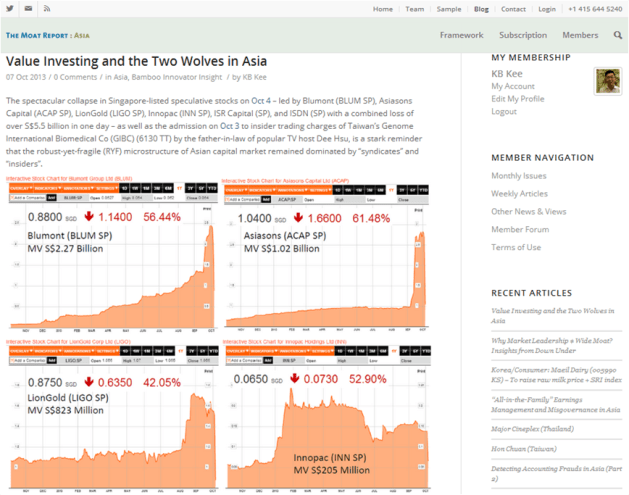
Value Investing and the Two Wolves in Asia: The Case of the Collapse of Singapore’s Speculative Stocks (Bamboo Innovator Insight)

The following article is extracted from the Bamboo Innovator Insight weekly column blog related to the context and thought leadership behind the stock idea generation process of Asian wide-moat businesses that are featured in the monthly entitled The Moat Report Asia. Fellow value investors get to go behind the scene to learn thought-provoking timely insights on key macro and industry trends in Asia, as well as benefit from the occasional discussion of potential red flags, misgovernance or fraud-detection trails ahead of time to enhance the critical-thinking skill about the myriad pitfalls of investing in Asia at the microstructure- and firm-level.

Spore Syndicate

Pixar: “Give us the black sheep. I want artists who are frustrated. I want the ones who have another way of doing things that nobody’s listening to. Give us all the guys who are probably headed out the door.”

Innovation lessons from Pixar: An interview with Oscar-winning director Brad Bird

What does stimulating the creativity of animators have in common with developing new product ideas or technology breakthroughs? A lot.

April 2008 | byHayagreeva Rao, Robert Sutton, and Allen P. Webb

If there’s one thing successful innovators have shown over the years, it’s that great ideas come from unexpected places. Who could have predicted that bicycle mechanics would develop the airplane or that the US Department of Defense would give rise to a freewheeling communications platform like the Internet? Senior executives looking for ideas about how to make their companies more innovative can also seek inspiration in surprising sources. Exhibit One: Brad Bird, Pixar’s two-time Oscar-winning director. Bird’s hands-on approach to fostering creativity among animators holds powerful lessons for any executive hoping to nurture innovation in teams and organizations. Read more of this post

Gold Befuddles Bernanke as Central Banks’ Losses at $545 Billion

Gold Befuddles Bernanke as Central Banks’ Losses at $545 Billion

Ben S. Bernanke, the world’s most-powerful central banker, says he doesn’t understand gold prices. If his peers had paid attention, they might have stopped expanding reserves that lost $545 billion in value since bullion peaked in 2011. Bernanke, who holds economics degrees from Harvard College and the Massachusetts Institute of Technology and led the Federal Reserve through the biggest financial disaster since the Great Depression, told the Senate Banking Committee in July that “nobody really understands gold prices and I don’t pretend to really understand them either.” Read more of this post

Specialty chemicals: Bed bugs and fracking are not the only things Ecolab has going for it

Specialty chemicals: Bed bugs and fracking are not the only things Ecolab has going for it

Oct 5th 2013 | ST PAUL |From the print edition

20131005_WBD001_0

“WE ARE the nerds in the businesses nerds don’t usually bother with,” says Douglas Baker, the boss of Ecolab since 2004. Some companies, Ferrari for example, are household names even though most people have never tried their products. Ecolab, a specialty-chemicals firm, is the opposite, practically unknown to the millions of people who consume the fruits of its labour. Exterminating bedbugs is not a staple of Facebook chatter. Yet Ecolab’s hygiene-oriented nerds now play a crucial role in industries ranging from hotels, hospitals and water supply to fracking, a method of extracting natural gas. Many of these seem set for rapid growth. As a result, its share price has more than doubled since August 2011, adding more than $1 billion to the fortune of its biggest shareholder, Bill Gates.

Read more of this post

The Story Of The Creation Of The iPhone Explains Why Apple Can’t Just ‘Innovate’ A New Product Every Other Year

The Story Of The Creation Of The iPhone Explains Why Apple Can’t Just ‘Innovate’ A New Product Every Other Year

JAY YAROW OCT. 5, 2013, 10:02 AM 7,876 10

One of the strangest criticisms to dog Apple in the two years since Steve Jobs died is that the company is no longer innovative.  Innovation is one of those fickle words that’s relatively loaded.  Microsoft, for instance, is often blasted for lacking innovation despite the fact that it has labs filled with amazing inventions and home-built first-of-its-kind technology. Google and Facebook are often lauded for their innovation, despite the fact that they often release me-too products that are essentially iterations of what already exists.  We’re not trying to knock Google and Facebook. They often release innovative products.  But, every major technology company is innovative. Without innovation these companies die.  Still, some people say innovation is dead at Apple.  The reason the innovation tag hangs over Apple is that the company’s success is perceived to depend upon the release of ground-breaking new products since it is not a monopoly in its product markets. The iPhone has less than 20% of the smartphone market. The Mac has less than 10% of the PC market. The iPad is at 32% of the tablet market, and falling. The iPod is dominant, but largely irrelevant today. Read more of this post

If You Want Innovation, You Have to Invest in People

If You Want Innovation, You Have to Invest in People

by Mehran Mehregany  |   11:00 AM October 3, 2013

As the convergence of digital technologies drives unprecedented levels of change in global marketplaces, it is very much a reality that a company must, as Bill Gates put it, “innovate or die!” In the race for relevance to future customers, the greater a company’s innovation capacity, the greater its chance of success. So how does a firm build its power and agility in innovation? The answer is simple and, to my mind, obvious – yet, it is not the direction in which most innovation-seeking firms seem to be channeling their efforts. Having designed and managed innovation programs in a variety of settings, I know that a company’s innovation capacity comes down to its talent pool, and its commitment to building knowledge and competencies one individual at a time. Read more of this post

Reserve Bank of India data showed the highest ratio of short-term external debt to currency reserves in more than a decade

Goldman to Nomura Warn on Debt to Reserves Ratio: India Credit

Reserve Bank of India data showed the highest ratio of short-term external debt to currency reserves in more than a decade, raising alarm bells at Goldman Sachs Group Inc. and Nomura Holdings Inc. The $97 billion maturing in less than a year amounted to 34.3 percent of reserves as of June 30, the highest since at least March 2001, RBI figures released Sept. 30 show. The ratio was 146.5 percent during a balance-of-payments crisis in March 1991, according to the report’s partial data for the 1990s. Including longer-term debt, repayments due by June 2014 total $170 billion, or 60 percent of reserves. Indonesia’s comparable ratio is 55.8 percent. Read more of this post

India’s Wealthy Must Open Their Gates and Fight Chaos

India’s Wealthy Must Open Their Gates and Fight Chaos

Lately India has been in the news for all the wrong reasons. Its once tigerish economy is growing at its slowest rate in more than a decade. Newspapers are filled with ever more depressing stories of rape, official plunder and gut-wrenching poverty. To an outsider the headlines can seem surreal: Last week the cabinet actually voted to allow convicted criminals to serve in Parliament and state legislatures, before being forced to back down. Read more of this post

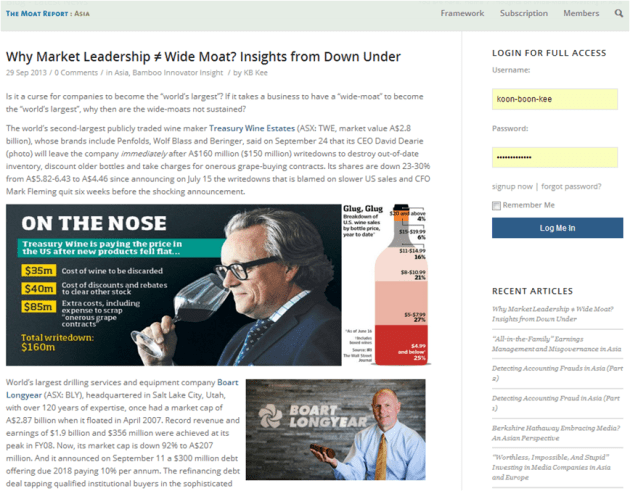
Why Market Leadership ≠ Wide Moat? Insights from Down Under (Bamboo Innovator Insight)

The following article is extracted from the Bamboo Innovator Insight weekly column blog related to the context and thought leadership behind the stock idea generation process of Asian wide-moat businesses that are featured in the monthly entitled The Moat Report Asia. Fellow value investors get to go behind the scene to learn thought-provoking timely insights on key macro and industry trends in Asia, as well as benefit from the occasional discussion of potential red flags, misgovernance or fraud-detection trails ahead of time to enhance the critical-thinking skill about the myriad pitfalls of investing in Asia at the microstructure- and firm-level.

Makret Leadership Down Under


Managing the “Unmanageable”: Radical Innovation

Managing the “Unmanageable”: Radical Innovation

by David Küpper, Markus Lorenz, Andreas Maurer, and Kim Wagner

SEPTEMBER 25, 2013

Overview

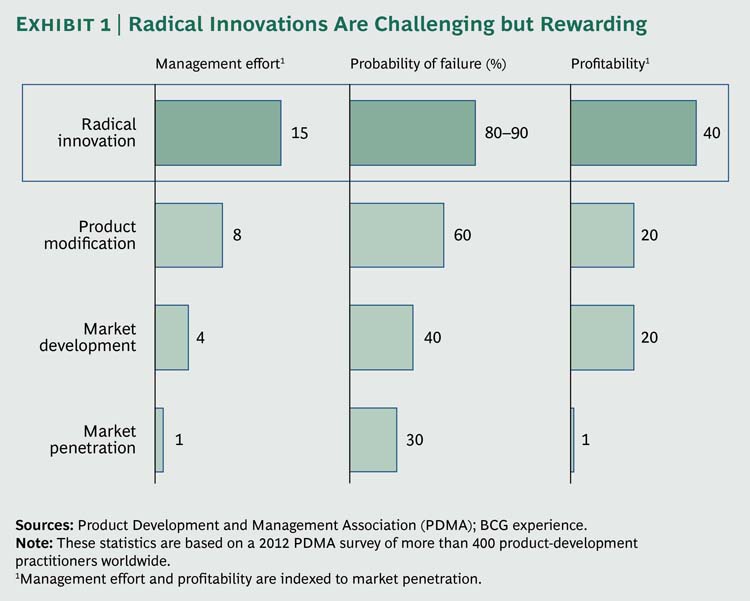
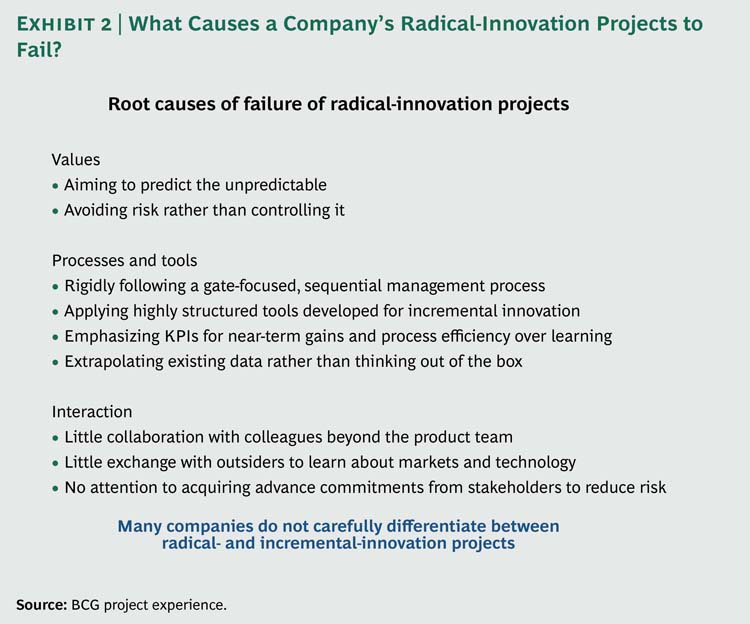
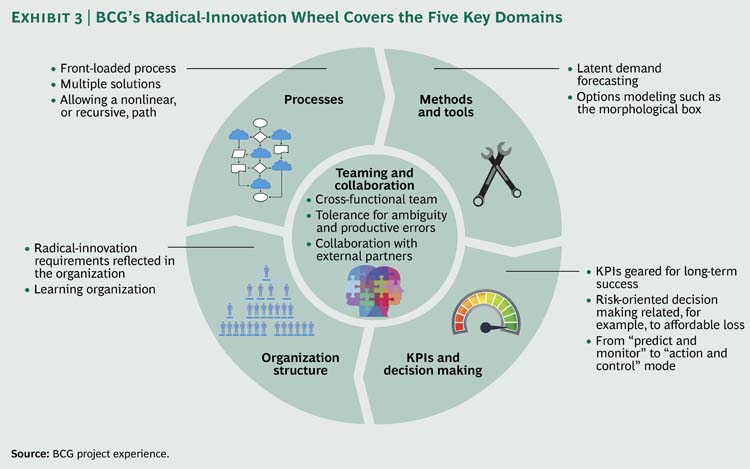
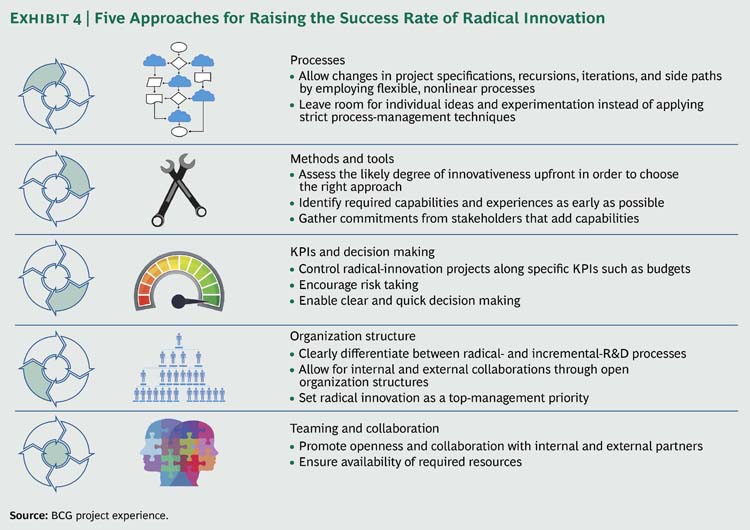
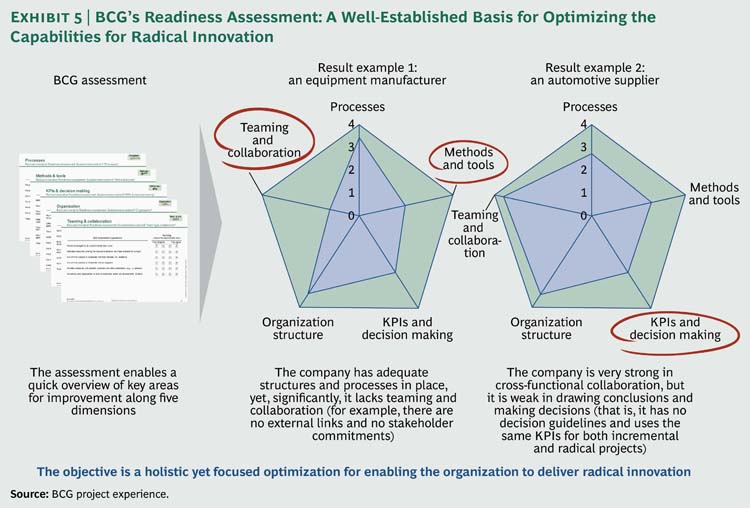
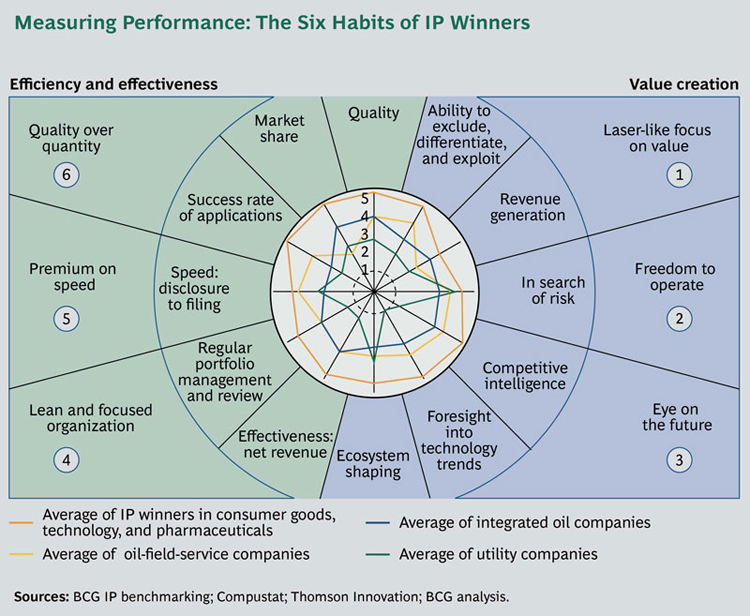
In recent decades, one of management’s objectives has been to add discipline to innovation. Companies have greatly improved the efficiency of new-product development, and managers have been able to draw on a variety of processes, methods, and tools to maximize the return on their R&D investment. Unfortunately, these advances have had the unintended consequence of discouraging radical innovation: technical breakthroughs that render existing products obsolete or that create new markets altogether. In this report, we look at products—not services or business model innovation. Unlike incremental innovation, radical innovation involves a great deal of uncertainty—the very quality that is not tolerated by most management techniques. As a result of this intolerance for uncertainty, companies have been undertaking less and less radical innovation. A recent study by the Product Development and Management Association found that radical innovation accounted for only 10 percent of an average company’s innovation portfolio, down from 21 percent in 1990. As the new productivity measures gained traction, managers naturally gravitated to projects that succeeded under the new constraints. More and more, breakthrough projects with high failure rates and less predictability lost out when investment priorities were set.

Managing_Unmanagable_Ex1_Large_tcm80-145175 Managing_Unmanagable_Ex2_Large_tcm80-145178 Managing_Unmanagable_Ex3_Large_tcm80-145181 Managing_Unmanagable_Ex4_Large_tcm80-145184 Managing_Unmanagable_Ex5_Large_tcm80-145187 Read more of this post

The Most Innovative Companies 2013: Lessons from Leaders

The Most Innovative Companies 2013: Lessons from Leaders

by Kim Wagner, Eugene Foo, Hadi Zablit, and Andrew Taylor

SEPTEMBER 26, 2013

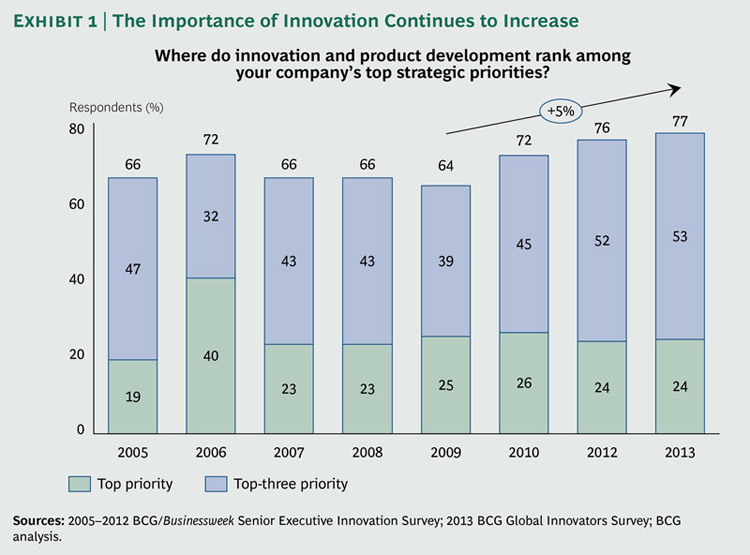
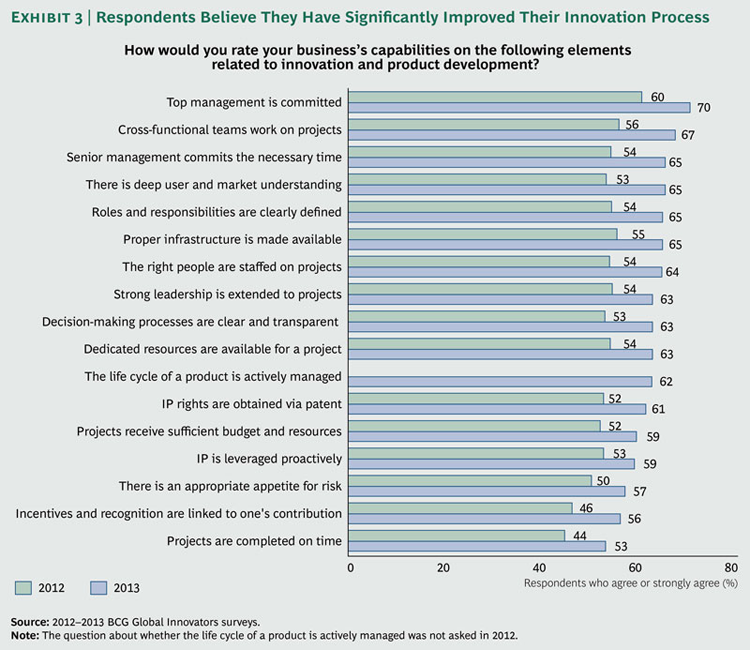
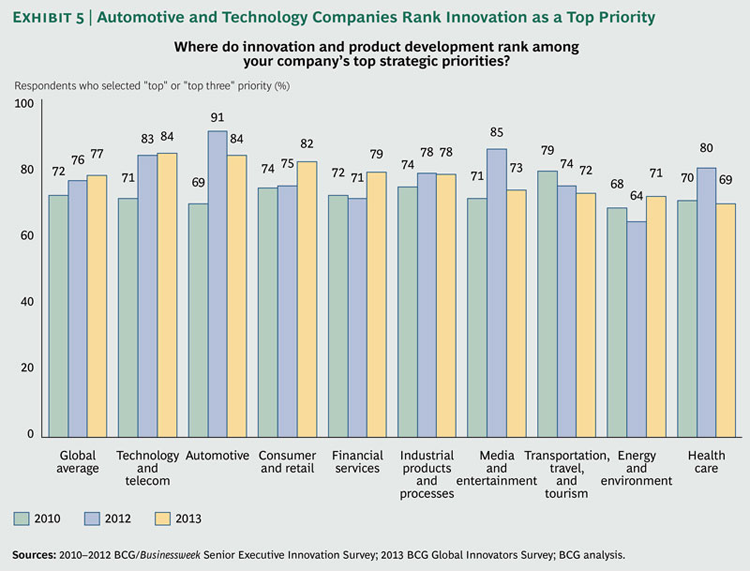
“Innovate or die,” goes the oft-cited corporate cry, and according to The Boston Consulting Group’s most recent survey of innovation and new-product development, companies across all industries and regions have taken the admonition to heart. Respondents ranked the importance of innovation higher than ever, building on a trend of the last five years.

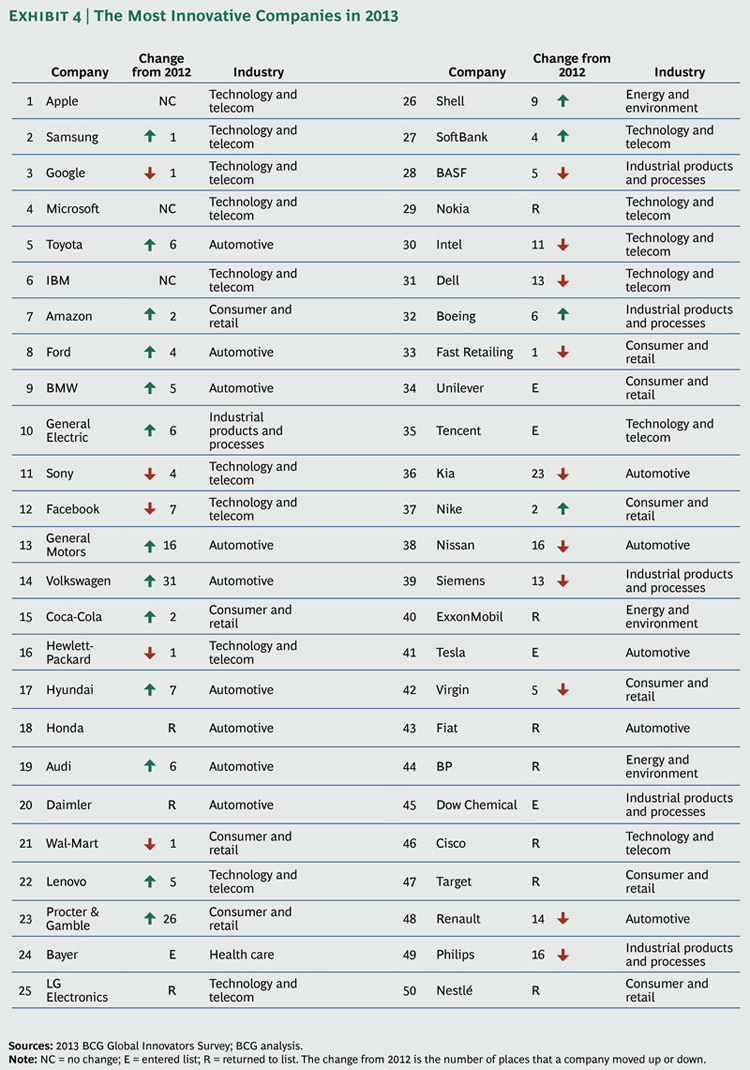
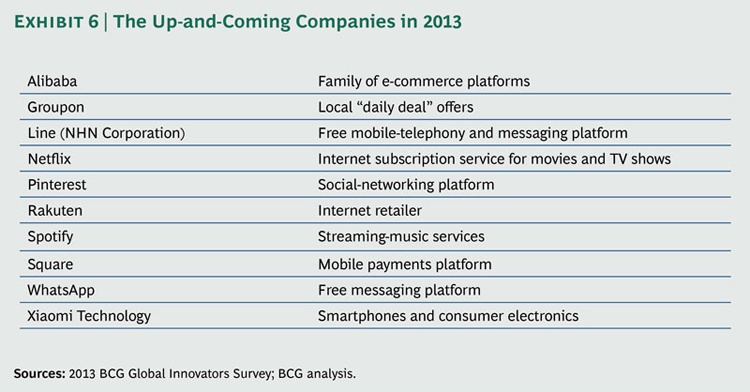
(https://www.bcgperspectives.com/content/interactive/innovation_growth_most_innovative_companies_interactive_guide/)BCG has explored the state of innovation with eight surveys since 2005. The data collected from more than 1,500 senior executives each year allow for comparisons over time as well as across regions and industries. The findings capture executives’ views of their own innovation plans, as well as their opinions of other companies’ innovation track records. As in past surveys, the 2013 results reveal the 50 companies that executives rank as the most innovative, weighted to incorporate relative three-year shareholder returns, revenue growth, and margin growth. The list has its share, as always, of well-known technology innovators (especially among the top ten), but automakers also show a strong surge, a trend that began last year and gathered strength in the current results. This time, we also asked respondents to identify up-and-coming companies at which innovation is driving rapid growth.

Most-Innovative-Companies-2013_ex1_large_tcm80-144756 Most-Innovative-Companies-2013_ex2_large_tcm80-144759 Most-Innovative-Companies-2013_ex3_large_tcm80-144762 Most-Innovative-Companies-2013_ex4_large_tcm80-144765 Most-Innovative-Companies-2013_ex5_large_tcm80-144768 Most-Innovative-Companies-2013_ex6_large_tcm80-144741 Most-Innovative-Companies-2013_ex-sidebar_large_tcm80-144753 Most-Innovative-Companies-2013_ex7_large_tcm80-144744 Read more of this post

Norway’s innovators help oil industry move to harsher climes

Norway’s innovators help oil industry move to harsher climes

Fri, Sep 27 2013

* Subsidies, rebates, tax breaks fuel innovation

* Norway may lead in automation, Arctic, subsea technology

* Statoil seen driver behind innovation

By Balazs Koranyi and Stephen Eisenhammer

OSLO/ABERDEEN, Scotland, Sept 27 (Reuters) – A drillship that cuts through two metres of ice, radar that detects oil spills in Arctic darkness and a drill that burrows through rock like a mole are among Norwegian innovations helping the oil industry as it moves into harsher climes. Small companies in Norway, backed by tax subsidies, a home-grown oil major and an abundance of experienced engineers, are bringing in technology that is leading the oil and gas industry in Arctic exploration and subsea production. “This is an incredibly conservative industry, and it takes 10 years to adopt and commercialize new technology,” said Stig Hognestad, the chief executive of small technology firm Ziebel. “Nobody wants to be the first because it’s risky … and Norway’s the exception.” Read more of this post

Why ‘Thought Diversity’ Is The Future Of The Workplace

Why ‘Thought Diversity’ Is The Future Of The Workplace

ALISON GRISWOLD 31 MINUTES AGO 204 1

The future of workplace diversity is here, and it’s not what you think. In fact, it’s how you think. While we’ve long known that gender, race, and cultural diversity create better organizations, the newest workplace frontier is all about our minds. According to a recent study by consulting and professional services company Deloitte, cultivating “diversity of thought” at your business can boost innovation and creative problem-solving. People bring different cultures, backgrounds, and personalities to the table — and those differences shape how they think. Some people are analytical thinkers, while others thrive in creative zones. Some are meticulous planners, and others love spontaneity. By mixing up the types of thinkers in the workplace, Deloitte believes companies can stimulate creativity, spur insight, and increase efficiency. Read more of this post

How to Avert the Next European Economic Crisis

How to Avert the Next European Economic Crisis

The European Union’s economic crisis exposed grave flaws in the design of its single-currency system. A new report from the International Monetary Fund examines the biggest of these defects and recommends fundamental reform: The EU, says the IMF, needs to take a step toward fiscal union. It’s not what most European policy makers want to hear. But it’s advice they should follow. Read more of this post

“All-in-the-Family” Earnings Management and Misgovernance in Asia (Bamboo Innovator Insight)

The following article is extracted from the Bamboo Innovator Insight weekly column blog related to the context and thought leadership behind the stock idea generation process of Asian wide-moat businesses that are featured in the monthly entitled The Moat Report Asia. Fellow value investors get to go behind the scene to learn thought-provoking timely insights on key macro and industry trends in Asia, as well as benefit from the occasional discussion of potential red flags, misgovernance or fraud-detection trails ahead of time to enhance the critical-thinking skill about the myriad pitfalls of investing in Asia at the microstructure- and firm-level.

Celltrion

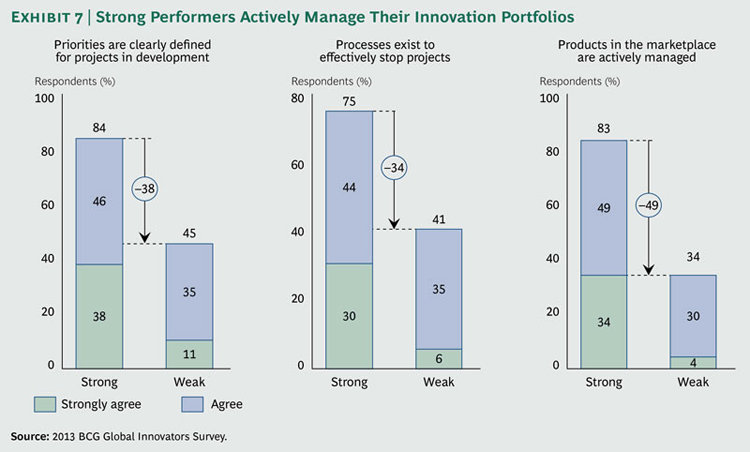
Three Signs That You Should Kill an Innovative Idea

Three Signs That You Should Kill an Innovative Idea

by Michael Schrage  |   8:00 AM September 24, 2013

Whether you’re a digital start-up or an institutional entrepreneur, three simple heuristics offer an excellent way to determine whether a fledgling innovation initiative should be put out of its misery (and yours).  Even if the innovation business case appears compelling and its numbers sound, should these three pathologies appear, don’t hesitate or delay: Kill your innovation effort ASAP.

1) No Pleasant Surprises

Almost all innovation efforts have the hiccoughs and bumps in the road. Design schedules invariably slip and that “quick-and-dirty” prototype ends up costing much more than expected. That’s normal. But listen closely for and pay attention to the pleasant surprises:  The coding that takes two weeks to develop and test instead of two months; the material that has more malleability and strength at lower cost; that really smart supplier who makes one of her smarter designers available to collaborate. The absence of pleasant surprise is not unlike the dog that doesn’t bark: A signal that something that should be happening isn’t. If the innovation idea or proposal really represents a novel value creation opportunity, there’ll be serendipities sprinkled amidst the inevitable unpleasantness. Those “small wins” may not look or feel like much but, almost always, they signal new opportunities for exploitation and advance. Read more of this post

Playing It Safe Is Riskier than You Think

Playing It Safe Is Riskier than You Think

by Bill Taylor  |   9:00 AM September 17, 2013

There are all sorts of reasons why so many big organizations can be slow to make changes that everyone agrees need to be made. “Our current margins are too good, even though the business is being eroded by new competitors.” “Our current products are still popular, even though a new generation of offerings is getting traction.” “Our current distribution system can’t reach the customers we need to reach to build a new business.” Read more of this post

Detecting Accounting Frauds in Asia (Part 2) (Bamboo Innovator Insight)

The following article is extracted from the Bamboo Innovator Insight weekly column blog related to the context and thought leadership behind the stock idea generation process of Asian wide-moat businesses that are featured in the upcoming monthly entitled Moat Report Asia. Fellow value investors get to go behind the scene to learn thought-provoking timely insights on key macro and industry trends in Asia as well as benefit from the occasional discussion of potential red flags, misgovernance or fraud-detection trails ahead of time to enhance the critical-thinking skill about the myriad pitfalls of investing in Asia at the microstructure- and firm-level.

Detecting Accounting Frauds in Asia Part 2

Companies Use IRS to Raise Bonuses With Earnings Goals

Companies Use IRS to Raise Bonuses With Earnings Goals

After Exelon Corp. (EXC) earned less than top executives needed to reach their annual cash bonus target last year, the company’s directors provided a way to help bridge the gap: nonexistent profits. The board tacked on 6 cents a share — equal to $85 million — that the Chicago-based power company never made, augmenting earnings solely for the purpose of calculating bonuses. Exelon said that it would have earned the sum except for a regulatory setback on electricity rates and that the pennies helped thousands of employees avoid smaller payouts. Read more of this post

Ray Dolby, Inventor of Surround Sound, Dies at 80; while Ray Dolby was an engineer at heart, his achievements “grew out of a love of music and the arts.”

Ray Dolby, Inventor of Surround Sound, Dies at 80

Ray-Dolby-2270426 DOLBY-obit-web-articleLarge-v2

Ray Dolby, the billionaire U.S. inventor whose name became synonymous with high-end home and cinema surround sound, has died. He was 80. He died yesterday at his home in San Francisco, according to a statement by Dolby Laboratories Inc. (DLB) He had been suffering from Alzheimer’s disease and was diagnosed in July with acute leukemia, the San Francisco-based company said. Through the company he founded in 1965, Dolby pioneered noise-reduction and surround-sound technologies that are used in movies, cinemas, personal computers and home theater equipment. The Dolby logo — two block-letter Ds, facing each other — became a sign of audio quality, indicating the presence of Dolby technology that reduced the hiss from cassette tapes, for instance, or added a digital soundtrack to movies. Tom Dolby, one of his sons, said in the statement that while his father was an engineer at heart, his achievements “grew out of a love of music and the arts.” When Dolby Laboratories went public in 2005, its shares surged 35 percent on the first day of trading. The founder, who held more than 50 patents, received $306 million from the IPO, and his 69.8 percent stake became worth $1.65 billion. As of yesterday his net worth was $2.85 billion, according to the Bloomberg Billionaires Index. Read more of this post