The Cold Truth About Emotional Investing: New research shows that even the pros invest more from the heart than from logic

May 2, 2013, 3:58 p.m. ET

INTERVIEW

The Cold Truth About Emotional Investing

New research shows that even the pros invest more from the heart than from logic

By ANDREW BLACKMAN

When it comes to investing, emotion is commonly seen as a weakness that must be shunned. But new research from professors David Tuckett and Richard Taffler suggests that emotions play an inevitable part in all investing, by amateurs and pros alike.

In their recent book “Fund Management: An Emotional Finance Perspective,” the professors present the results of interviews with 52 experienced fund managers in the U.S., U.K., France and Asia. The picture that emerges is one of acute anxiety and emotional conflict.

The bottom line, they say: Individuals and pros perform better when they acknowledge that investing is inherently emotionally charged and when they understand how emotions affect their behavior.

We talked with Prof. Taffler, professor of finance and accounting at Warwick Business School in the U.K., and Prof. Tuckett, a fellow of the Institute of Psychoanalysis in London and visiting professor at University College London, about the role of emotions in investing. Here are edited excerpts of those conversations. Read more of this post

A New Era for Do-It-Yourself Investing. Many investors want to call the shots—while turning to tools and people for help as needed

Updated May 3, 2013, 11:37 a.m. ET

A New Era for Do-It-Yourself Investing

Many investors want to call the shots—while turning to tools and people for help as needed

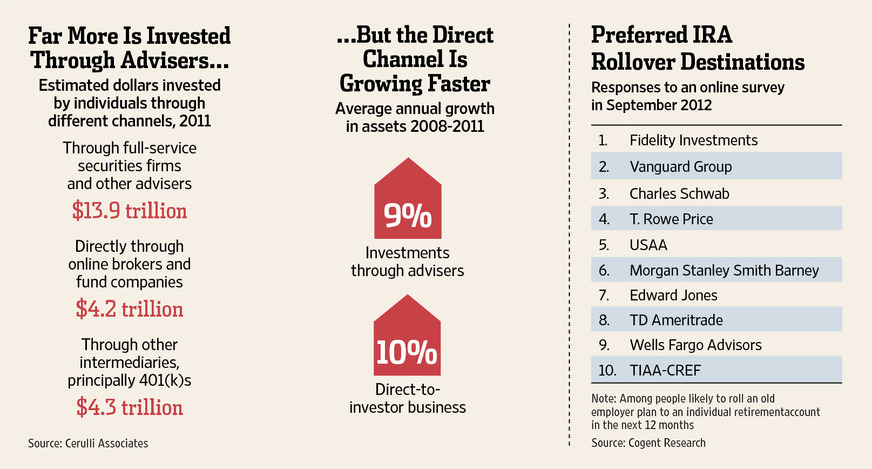
Instead of going it entirely on their own, more investors are pursuing a kind of modified DIY approach, tapping an array of increasingly sophisticated online tools and a-la-carte advice services offered by financial firms. The result is that there has been strong growth in customer assets at the mutual-fund and discount-brokerage companies that have traditionally served the do-it-yourself market, a group that includes Vanguard Group, Fidelity Investments and Charles Schwab Corp.SCHW +6.27%

IF-AB144_DIYcov_G_20130502113550IF-AB146_DIYjum_G_20130501151515 Read more of this post

Berkshire Skips Apple Bonds as Buffett Says Not at Those Yields

Berkshire Skips Apple Bonds as Buffett Says Not at Those Yields

Warren Buffett, the billionaire chairman and chief executive officer of Berkshire Hathaway Inc. (BRK/A), said he isn’t investing in corporate debt, including Apple Inc. (AAPL)’s record offering, because yields are too low. “We’re not buying corporate bonds of any kind now,” Buffett, 82, said May 4 during an interview with Bloomberg Television’s Betty Liu in Omaha, Nebraska, where Berkshire held its annual meeting. “Not at those yields.” Berkshire held $12.2 billion of corporate bonds as of March 31, according to a quarterly filing issued on May 3. That’s down 14 percent from two years earlier. The value of Berkshire’s equity portfolio climbed 54 percent to $97.2 billion in the two years ended March 31 as markets rallied and Buffett added shares of International Business Machines Corp. Yields on debt from corporate securities to Treasuries have tumbled as the Federal Reserve slashed interest rates and bought bonds to help the economy recover from recession. The payout rate on dollar-denominated company debt fell to a record 3.35 percent on May 2, according to the Bank of America Merrill Lynch U.S. Corporate & High Yield Index. Yields have averaged 5.87 percent during the past decade.

Read more of this post

Buffett and Munger dances to “Gangnam Style” + Buffett jokes in the cold and rainy Omaha weather: “If we had a company that sold coats we would have left you out there.”

Here’s What Buffett’s Saying at the Berkshire Annual Meeting

By Matt Koppenheffer | More Articles | Save For Later
May 4, 2013 | Comments (0)

Before Warren Buffett and Charlie Munger even sat down at Berkshire Hathaway‘s (NYSE:BRK-A  ) (NYSE: BRK-B  annual meeting, the annual “Berkshire video” showed a cartoon version of Buffett and Munger dancing to “Gangnam Style.” With that under your belt, it’s hard to feel that your day didn’t start off right. But that was just the warm-up for the much-awaited Q&A session with Buffett and Munger. Here is a look at some of what Buffett and Munger have been saying so far.

On first quarter earnings. Buffett noted that closures and persistentcy in GEICO policies. He called this trend “solid gold.”

On challenging Ariel Hsing in ping-pong at Borsheims. Buffett: “If you’re courageous you’ll show up with your paddle and you’ll look like an idiot.”

On trailing the market. Buffett conceded that if the market continues on the trajectory it’s on so far in 2013, Berkshire could trail the S&P 500  (SNPINDEX: ^GSPC  ) for a five-year period for the first time. Buffett said that it “won’t be a happy day, but won’t totally discourage us.” Munger chimed in with: “We’re slowing down, but it’ll still be very pleasant.”

On selling things to Berkshire shareholders. A shareholder asking a question thanked Buffett for letting everyone in early (it was cold and raining in Omaha this morning). Buffett quipped: “If we had a company that sold coats we would have left you out there.”

On selling Berkshire shares. To head off any rash moves by family members, Munger warned: “I want to say to the many Mungers in the audience, don’t be so stupid as to sell these shares.” Buffett quickly followed up with: “That goes to the Buffetts too.”

On negative implications of the H.J. Heinz  (NYSE: HNZ  )  deal. A questioner wondered whether Berkshire’s preferred position in the Heinz deal and the high price paid suggested that Buffett isn’t optimistic about the returns available in the market. Buffett responded simply that that was “totally inaccurate.” Munger later added on: “As you said, the report was totally wrong.”

On hiring executives from AIG  (NYSE: AIG  ) . Buffett pointed out that “these are people that reached out to Berkshire, in the case at least one of them had reached out numerous times in the past” and added that “we’ve had a number of people reach out since the announcement was made.” That’s a big positive for Berkshire since it’s looking to aggressively build out its commercial insurance capabilities.

Buffett maps out hopes for Berkshire without him

Buffett maps out hopes for Berkshire without him

8:19pm EDT

By Jonathan Stempel and Jennifer Ablan

OMAHA, Nebraska (Reuters) – Warren Buffett on Saturday gave the most extensive comments to date about the future of Berkshire Hathaway Inc after he is gone, saying he still expects the conglomerate to be a partner of choice for distressed companies.

Buffett, 82, also defended his plan to install his son, Howard, who has little investing experience, as nonexecutive chairman, saying the younger man’s role would be to ensure that Berkshire had the right CEO in place.

During the financial crisis and its immediate aftermath, Berkshire helped prop up a number of companies, among them blue-chips such as General Electric and Goldman Sachs. Buffett’s investments were viewed by many shareholders as a seal of approval from one of the world’s most respected businessmen.

Short-seller Doug Kass, invited by Buffett to Berkshire’s annual meeting on Saturday to offer contrarian points of view, asked whether a successor would have the same heft. Buffett said it would not matter.

“Berkshire is the 800 number when there is really some panic in the markets, and people really need significant capital,” Buffett said. Read more of this post

The Smartest Thing Warren Buffett Ever Said

The Smartest Thing Warren Buffett Ever Said

By Matt Koppenheffer | More Articles | Save For Later
April 30, 2013 | Comments (1)

Berkshire Hathaway  (NYSE: BRK-A  ) (NYSE: BRK-B  ) CEO Warren Buffett is never shy about sharing wisdom. The brilliant investor is known for witty quips (“Rule No. 1: Never lose money. Rule No. 2: Never forget Rule No. 1.”) as well as longer parables (such as “The Superinvestors of Graham-and-Doddsville“). But could any one of Buffett’s gems of wisdom be the best? Could there be one Buffett-ism to rule them all? To find out, I grabbed five game Fools to weigh in.

Scott Phillips: In trying to distill Warren Buffett’s brilliance, many Buffett-watchers lean heavily on the Oracle of Omaha’s formative years at the metaphorical knee of his mentor, the famed value investor Ben Graham. Graham was notoriously mechanical in his investing; seeking to find companies with specific financial characteristics, then buy them in bulk. However, Buffett — particularly after he met his business partner and Berkshire Vice-Chairman Charlie Munger — is far from the myopically mechanical investor some would paint him to be. Indeed, in his 1982 Chairman’s letter to Berkshire Hathaway shareholders, Warren Buffett wrote: Managers and investors alike must understand that accounting numbers are the beginning, not the end, of business valuation. Yes, the reported numbers matter — a lot — but they are a guide to starting to understand the business, not neatly packaged answers. Buffett’s brilliance was in taking the fundamental lessons he’d learned from Graham and improving on them by understanding the factors that build and sustain great companies. Buffett has said he has one message for the managers of Berkshire’s subsidiaries — “widen the moat.” He wants them to focus on doing those things that make the business stronger and less vulnerable to the competition. Talking about Coca-Cola (NYSE: KO  ) , he said “Give me $10 billion and how much can I hurt Coca-Cola? I can’t do it.” That fact won’t show up in black and white on the financial statements, but is far more important than the numbers themselves.

Jason Moser: I had the great fortune of attending the Berkshire meeting last year, and while I’ve followed Buffett for a while now, something he said during the Q&A session last year resonated with me. Someone asked him his opinion on gold, to which he replied (and I’m paraphrasing): Let’s say you own an ounce of gold today. You hold it, love it and caress it. In 50 years you’ll still own an ounce of gold. Now say you own 100 acres of farmland today. In 50 years you’ll still own that same 100 acres of farmland. The difference is you’ll also have had the time to produce crops to grow more stuff to buy more farmland and whatever else you want. In other words, there’s a tremendous cycle of production there. Gold on the other hand is more or less an unproductive asset. This, to me, is key to why Buffett has been such a successful investor all these years. Not only is he able to focus on longer periods of time, but also the ever-so-valuable cycles of production that can occur during that time. It should therefore come as no surprise that if you gave me a bar of gold today, I would sell it and go buy stocks.

Tim Beyers: While Buffett is often thought of as the patron saint of value investing, I find him in many ways to be the quintessential Rule Breaker. Just listen to what he said at last year’s confab: I would never spend a lot of time valuing declining businesses. The same amount of energy and intelligence brought to other businesses is just going to work out better. I’d never have believed it had I not heard it myself. After all, what is value investing if not for figuring the worth of an oversold business that may, in fact, be in decline? Buffett’s lesson here, I think, is to be open to a broad range of stock ideas. Don’t merely look for a low price-to-earnings ratio. Look instead for businesses that are surprisingly strong defenders of the majority share of a profitable niche, such as Walt Disney  (NYSE: DIS  ) . The House of Mouse isn’t cheap at 20 times earnings, but can you name an enterprise with more big-name brands under its belt? Marvel, Star Wars, Pixar, and all those princesses that seven-year-old girls worship? Don’t be surprised if Berkshire takes a close-up tour of the Magic Kingdom.

Jacob Roche:

It takes 20 years to build a reputation and five minutes to ruin it. If you think about that, you’ll do things differently. This quote always stuck with me because it’s so applicable to both life and business. It takes a long history of coming through for people to build a reputation with your friends, family, and coworkers, but one big mistake can shatter that reputation and leave a lasting bitter taste in the mouths of people who know you. Whether you’re the normally responsible friend who had too a few too many drinks at a party, or the go-to guy at work who told off the wrong client, a person’s worst impression of you is usually their most lasting. This is even more true for the highest levels of management in a large company. It can take decades for a company to earn the trust of its customers, shareholders, and employees. And while a big accounting scandal may take years to fully percolate, it starts with one bad decision. Whether it was the massive accounting scandals at Enron, Worldcom, or evenWaste Management, an unethical decision that could have been avoided can, at best, result in massive fines, like WM’s half-billion dollar shareholder suit, or even jail time in the case of Enron and Worldcom executives. These unfortunate fates could have been avoided by managers at the top simply deciding to do things differently in that crucial moment.

Dan Dzombak:

Buffett: I tell college students, when you get to be my age, you will be successful if the people who you hope to have love you, do love you. Charlie and I know people who have buildings named after them, receive great honors, etc., and nobody loves them — not even the people who give them honors. Charlie and I talk about wouldn’t it be great if we could buy love for $1 million. But the only way to be loved is to be lovable. You always get back more than you give away. If you don’t give any, you won’t get any. Everybody loves Don. There’s nobody I know who commands the love of others who doesn’t feel like a success. And I can’t imagine people who aren’t loved feel very successful.

Munger: You don’t want to be like the motion picture exec who had so many people at his funeral, but they were there just make sure he was dead. Or how about the guy who, at his funeral, the priest said, “Won’t anyone stand up and say anything nice for the deceased?” and finally someone said, “Well, his brother was worse.”

Buffett: Most people in this room and most college students I talk to will have plenty of money, but some will have few friends.

— 2003 Berkshire Hathaway Annual Meeting

Coming from one of the richest people in the world, the quote is a good reminder that there’s a lot more to a successful life than just money. My definition of success is long-term sustainable happiness, and having friends who love you is a key part of that. A close network of friends has been shown to help fight illness and depression, speed recovery, slow aging, and prolong life. While it takes effort to be lovable, Buffett has shown that the benefits are massive and certainly worth the effort.

Risky Business: The Quiz That Could Steer You Wrong

May 3, 2013, 6:13 p.m. ET

Risky Business: The Quiz That Could Steer You Wrong

By JASON ZWEIG

BF-AE903_INVEST_G_20130503172321

With the stock and bond markets butting up against record highs, and volatility not far from all-time lows, that little red devil on your shoulder is whispering in your ear that it’s safe to take more risk again. Can you count on your broker or financial adviser to tell you how much risk is right for you?

Read more of this post

Receiver Gains Control of Some Assets of China’s ZST; Case Is Test of Investors’ Ability to Recoup Losses in Wake of Accounting Questions

May 3, 2013, 1:25 p.m. ET

Receiver Gains Control of Some Assets of China’s ZST

Case Is Test of Investors’ Ability to Recoup Losses in Wake of Accounting Questions

By MICHAEL RAPOPORT

The court-appointed receiver empowered to seize the assets of a U.S.-traded Chinese company facing accounting questions has chalked up his first successes.

The receiver, Robert Seiden, says he has obtained control over subsidiaries of the Chinese company, ZST Digital Networks Inc., ZSTN +13.33% in the British Virgin Islands and Hong Kong. He also has gained control of a ZST Digital bank account in Hong Kong, and is in the process of doing the same with ZST Digital bank accounts in China.

Mr. Seiden has been tasked with seizing and selling ZST Digital assets as part of a court’s novel remedy for a U.S. investor locked in a legal dispute with the network-equipment maker. The high-profile case may test the extent to which U.S. investors can recover losses from Chinese companies whose shares drop in the wake of accounting or disclosure problems. Read more of this post

Chobani CEO: Our Success Has Nothing To Do With Yogurt; the company’s now infamous Greek yogurt is netting more than $1 billion in annual sales — and it only went to market five years ago.

Chobani CEO: Our Success Has Nothing To Do With Yogurt

Megan Durisin | May 3, 2013, 11:19 AM | 2,559 | 3

Chobani Yogurt has been one of the most explosive food start-ups to ever hit the market.

The company’s now infamous Greek yogurt is netting more than $1 billion in annual sales — and it only went to market five years ago.

But Chobani’s CEO and founder, Hamdi Ulukaya said the company’s instant success wasn’t all about the product.

“Chobani is not a yogurt story,” he said. “It’s a manufacturing story.”

Ulukaya gave a presentation earlier this week to a packed audience at New York University‘s Stern School of Business, sponsored by the Berkley Center for Entrepreneurship & Innovation. In it, he outlined the story of the company’s rapid growth.

Ulukaya scraped together funding to buy an old yogurt plant in upstate New York in 2005, with help from a Small Business Administration Loan. He didn’t have any concrete plans, and the place wasn’t in good shape — with water dripping from the ceiling and paint peeling for the walls. But when he got the idea to start making Greek yogurt in the U.S., the company fixed the factory up and ran with it, and Ulukaya said he practially lived in the plant for five years to get Chobani off the ground.

“I knew that something could be done with yogurt because growing up in Turkey, we knew what to expect from yogurt,” he said at NYU.

Chobani was an instant success when it hit shelves in 2007, with orders consistently increasing. Ulukaya soon had big yogurt companies, like Dannon, knocking at his door, asking him to sell. He also could have turned to private equity companies for funding. Those strategies are typically the most appealing to food start-ups, Ulukaya said, because if they don’t, the larger companies imitate it and use their large manufacturing bases to get it to the masses.

But he decided not to sell, and that’s when Chobani’s focus turned to expansion — and fast.

“No start-up has done it any other way, so I wanted to do it in another way,” Ulukaya said. “I bet on these guys being lazy, that they’re not going to wake up that fast, and I said, ‘I’m going to be fast.'”

And fast it was. Ulukaya didn’t outsource anything — keeping control of the yogurt from its production in the factories to the time it hit shelves. The company built a big warehouse across the street from the plant in two months, and soon after built another huge plant in Idaho, which went up in just a year.

He also bet on the product being successful and priced it based on what it would cost in the future if sales increased, instead of factoring in the high input costs that the company had to face at the onset. (The yogurt goes for about $1 per cup.)

“This was not going to be about selling,” Ulukaya said. “This was going to be about making.”

The strategy worked. The company now produces 2.2 million cases of yogurt a week, Ulukaya said, and has passed $1 billion in sales. When they started, Greek yogurt made up 0.2% of the yogurt market in the U.S. Now it makes up 50%, and Chobani has at least half of that market share, he said.

It’s been a huge shock to the yogurt sector, which had been dominated by two or three big companies for decades prior and mostly pumped out products that were high in sugar, coloring and preservatives, Ulukaya said. And the majority of the money to fund Chobani’s new plants, employees and warehouses was internally generated.

Ulukaya also prides the company’s success on its small-town roots and dedicated employees, who he said didn’t have a holiday off for the first five years.

“Never has a food aisle been challenged like this and changed so quickly by a startup ever,” Chobani said. “Some say we’re the fastest growing startup ever, including technology.”

The Generosity Strategies that Help Companies Grow

The Generosity Strategies that Help Companies Grow

by Eddie Yoon  |   2:00 PM May 2, 2013

Netflix reported another great quarter last month, with big subscriber and stock growth. It’s hard to believe it was just two years ago that the company and its CEO were widely ridiculed — and even subject to a Saturday Night Live parody.

Certainly much credit is due to adding new tricks to its tool kit by creating new content like House of Cards, a programming success that’s highlighted how it is using its analytic power to find news ways to satisfy customers.

I’ve written three HBR posts on Netflix since its difficult 2011. All were bullish on its future. I had many left-brain reasons why to be bullish — the quantified upside of digital streaming, its leadership, distribution and analytics advantages, etc. But I think there was emotional ‘data’ that I’ve acquired as a 10 year subscriber that stitches all the rational reasons together and amplifies them.

Put simply, Netflix is a generous company. And generosity can be a highly effective growth strategy. Read more of this post

Next Time You’re About To Call A Startup ‘Stupid’ Remember These Two Stories

Next Time You’re About To Call A Startup ‘Stupid’ Remember These Two Stories

Megan Rose Dickey | May 1, 2013, 8:07 AM | 3,707 | 7

When a startup is in its early stages, it’s not always easy to determine if the product will be a hit.

Dustin Curtis, the creator of online magazine platform Svbtle, initially thought two startups that are now extremely successful were stupid when he first saw them.

“For some cruel reason, I keep finding myself in the position of being introduced to things in their infancy (often before they are even launched), dismissing them as stupid, and then watching them become unbelievably popular,” Curtis writes on Svbtle. “This has happened to me at least four times. Each time I vow never to call anything stupid again, and then, invariably, it happens again.”

It happened with Pinterest, the social bookmarking service worth around $2 billion. And then it happened again with Vine, the video app that Twitter acquired last year.

With Pinterest, Curtis wasn’t sold on the idea that middle-aged women would flock to a fashion- and design-oriented site for collecting and sharing products. Especially not one created by a twenty-something guy, Pinterest founder and CEO Ben Silbermann.

When Curtis met with Silbermann, he quickly dismissed the idea, concluding the product was stupid. Read more of this post

How To Read Through A Company’s SEC Filings Like A Pro

How To Read Through A Company’s SEC Filings Like A Pro

Ashley KinderganThe Financialist | May 1, 2013, 12:40 PM | 3,554 | 3

Checking out a company’s annual report is a must for investors.

The 10-K forms that public companies file with the Securities and Exchange Commission include audited financial statements, which along with other pertinent information, provides an overview of a firm’s financial health. Luckily, Credit Suisse’s accounting and tax research team says “you don’t need to be an accountant laureate” to interpret these dense documents. In a two-part series, The Financialist will offer practical tips on how to mine a 10-K, based on a recent Credit Suisse note entitled “10-K Checklist.” Click our annotated images below to zoom in.

The Checklist: An Annotated Overview Read more of this post

Pilgrimage to Omaha + Entrepreneurship, Asian-style! (Go to BeyondProxy.com, where value investing lives)

Bamboo Innovator is featured in BeyondProxy.com, where value investing lives:

Pilgrimage to Omaha + Entrepreneurship, Asian-style! May 1, 2013 (Weblink: BeyondProxy.com)

Pilgrimage to Omaha

Buffett Bear, Doug Kass, Adds Spice to Meeting as Rally Lulls Investors; Kass, 64, has shorted Berkshire stock in a bet the price will fall

Kass, Berkshire’s Bear, is ready to “surprise” Buffett

1:25am EDT

By Jennifer Ablan and Jonathan Stempel

Doug Kass, founder of hedge fund Seabreeze Partners Management Inc, sits at his desk at his home in Palm Beach

(Reuters) – Hedge fund trader Doug Kass had his first brush with fame at the age of 10, when he appeared on a television quiz show, Tic-Tac-Dough, and won every day for a week.

More than five decades later, Kass might find another sort of celebrity this Saturday when he will have the opportunity to quiz billionaire investor Warren Buffett at Berkshire Hathaway Inc’s annual meeting in Omaha, Nebraska. Buffett in March handpicked Kass, founder of hedge fund Seabreeze Partners Management Inc, to be Berkshire’s first “credentialed bear” to attend the meeting, and “spice things up. Kass, 64, has shorted Berkshire stock in a bet the price will fall. He is one of three members of an analyst panel that, along with shareholders and journalists, gets to question Buffett and Berkshire Vice Chairman Charlie Munger for five hours at the meeting, which draws more than 35,000 people to Omaha each year. “I had a lot of fun going to the Woodstock music festival on Max Yasgur’s farm in Bethel, New York in August 1969. I expect to have almost as much fun – and remember it – going to the Woodstock of Capitalism in Omaha,” Kass said in an interview. He declined to disclose the size of his Berkshire short, but called it an “average-sized position” that he initiated only a few days before Buffett’s invitation. Kass is known for his maverick positions, and his stock picks and pans have been followed widely by virtue of his prolific writings for TheStreet.com. He has a column – at one time called “The Contrarian” – to discuss neglected or undervalued stocks and sectors that he calls “purchase candidates,” as well as fully exploited or overvalued investments that he thinks are worth selling short. In April, Kass told clients and readers that he was bearish on economic growth and stocks.

Read more of this post

Buffett Further Trims Moody’s Stake as Shares Surge 21%; “What was once a bulletproof franchise may not be bulletproof”

Buffett Further Trims Moody’s Stake as Shares Surge 21%

Berkshire Hathaway Inc. (BRK/A), led by billionaire Chairman Warren Buffett, further trimmed its holdings of Moody’s Corp. (MCO) as the credit-ratings firm’s stock has surged this year. Berkshire sold about 1.75 million shares this week at prices ranging from $59.93 to $60.94 apiece, according to a filing issued yesterday. New York-based Moody’s has advanced 21 percent in 2013. Moody’s plunged in February when its larger competitor, Standard & Poor’s, said it could face a U.S. lawsuit over inflated mortgage-bond ratings. Buffett, 82, has pared his stake from 48 million shares in 2009. Buffett has said Moody’s didn’t anticipate a slide in housing prices.

“What was once a bulletproof franchise may not be bulletproof,” the billionaire said in a 2010 Bloomberg Television interview. “It’s still quite a franchise.” Read more of this post

Buffett Pays $2.05 Billion for Remaining 20% Stake in Iscar at $10B Valuation, Doubled from $5B Value in 2006 When Berkshire Bought 80% In Cutting Gear Firm

Buffett Pays $2.05 Billion for Remaining Stake in Iscar

Berkshire Hathaway Inc. (BRK/A) agreed to pay $2.05 billion for the 20 percent of IMC International Metalworking Cos. that it doesn’t already own as Chairman Warren Buffett expands his bet on the Israeli manufacturer.

IMC, known as Iscar, makes cutting gear for industries including aerospace and auto manufacturing. Jacob Harpaz will remain chief executive officer of Tefen, Israel-based IMC, the companies said today in a statement.

Buffett has structured deals to buy Marmon Holdings and IMC to allow the selling families to retain a stake in the companies they built. Omaha, Nebraska-based Berkshire can then increase its ownership with the price based on the results after the initial deal. He said in 2006 that he bought 80 percent of Iscar in a transaction that valued the company at $5 billion.

“As you can surmise from the price we’re paying for the remaining interest, IMC has enjoyed very significant growth over the last seven years,” Buffett, 82, said in the statement. Read more of this post

Bloomberg has calculated ratios of CEO compensation relative to average employees for the Top 250 companies in the S&P 500

How Much More Is Your CEO Making Than You?

Tyler Durden on 04/30/2013 13:32 -0400
Three years after Congress first told the SEC that it required public companies to uncloak the details of their CEO compensation relative to his lowly employees; the ever-ready SEC has yet to implement any rules. However, in an effort to ease the tough job that the SEC has, Bloomberg has calculated ratios for the Top 250 companies in the S&P 500, based on industry-specific averages for pay and benefits for the rank-and-file (since companies don’t disclose median worker pay). The table below, of the top 50 companies (meaning highest CEO pay relative to workers), suggests it remains good to be king (and Ron Johnson just made another #1 Spot earning an estimated 1,795x the average JCP employee – money well spent…).

20130430_CEO_0

Warren Buffett’s Analogy About About Boobs And Porn Shop Operators Is Just Brilliant

Warren Buffett’s Analogy About About Boobs And Porn Shop Operators Is Just Brilliant

Sam Ro | Apr. 30, 2013, 10:02 PM | 6,067 |

This week is the annual shareholder meeting for Berkshire Hathaway, the gigantic conglomerate run by billionaire Warren Buffett.

Buffett has a way of explaining complicated finance topics so that they’re fun and understandable.

Carleton English of Belus Capital Advisors points us to this gem of a quote from 2008 where he takes a jab at private equity.

Someone had asked the Oracle of Omaha why people sell their companies to him instead of private equity firms.  This is the type of question that you might hear later this week.  Here’s Buffett’s response: “You can sell it to Berkshire, and we’ll put it in the Metropolitan Museum; it’ll have a wing all by itself; it’ll be there forever. Or you can sell it to some porn shop operator, and he’ll take the painting and he’ll make the boobs a little bigger and he’ll stick it up in the window, and some other guy will come along in a raincoat, and he’ll buy it.”

According to Bloomberg, Buffett delivered this doozy during some Q&A with a 300 executives in Toronto. He’s basically explaining that there is more than one way for a company to get to a certain market value. Private equity often involves a lot of debt, a lot of cuts, and usually a lot of risk before a company is turned around and sold back on the market. Berkshire and Buffett, on the other hand, often take a more passive approach.  Typically, Buffett seeks out what he considers to be undervalued, yet well run companies.  And then he just waits for them to get to their intrinsic values. Anyways, we hope this weekend’s events in Omaha yield some more great quotes.

Warren Buffett Says Sell to Me, Not `Porn Shop,’ as Growth Dips

By Richard Teitelbaum – Jun 25, 2008

June 25 (Bloomberg) — Warren Buffett is in Toronto, fielding questions from a crowd of 300 executives. One asks what makes people want to sell their companies to him.

The Berkshire Hathaway Inc. chief executive officer replies that he tells a prospective seller to think of the company as a work of art.

“You can sell it to Berkshire, and we’ll put it in the Metropolitan Museum; it’ll have a wing all by itself; it’ll be there forever,” he says at the February meeting. “Or you can sell it to some porn shop operator, and he’ll take the painting and he’ll make the boobs a little bigger and he’ll stick it up in the window, and some other guy will come along in a raincoat, and he’ll buy it.” Read more of this post

Berkshire size, Buffett age cloud annual gathering

Berkshire size, Buffett age cloud annual gathering

12:11pm EDT

By Jonathan Stempel and Jennifer Ablan

(Reuters) – Warren Buffett may be on safari for major acquisitions, which he likes to call elephants, but shareholders may wonder if his Berkshire Hathaway Inc has become the biggest elephant in the room. Berkshire has grown to look more and more like corporate America, as Buffett expands outside its core insurance business into such areas as energy, industrial products, newspapers, and in February ketchup, when he teamed up with Brazil’s 3G Capital investment firm to buy H.J. Heinz Co for $23.2 billion. Few of the 35,000 or more people who will this weekend make a pilgrimage to Berkshire’s hometown of Omaha, Nebraska for the company’s annual shareholder weekend, which Buffett calls “Woodstock for Capitalists,” are likely to criticize that strategy. While Buffett has managed to handily beat the Standard & Poor’s 500 so far this year, outperforming the overall market is getting tougher for Berkshire as it grows and diversifies, investors and analysts said.

Buffett, 82, and Vice Chairman Charlie Munger, 89, will at Saturday’s annual meeting field five hours of questions about the company, governance, the economy and – with a $15 billion cash cushion even after the Heinz purchase is completed – their next elephant. “Larger deals are needed to move the needle,” said Doug Kass, founder of hedge fund Seabreeze Partners Management Inc, who has shorted Berkshire stock partly because its size, including a $262 billion market value, makes it more difficult to record market-beating returns. Kass has been tapped by Buffett as a “credentialed bear” to ask questions and “spice up” the meeting. Buffett himself recognized the performance question when he noted in his March shareholder letter that Berkshire has lagged the broader market since the latter bottomed out four years ago. Read more of this post

New Book on Buffett: “The Oracle & Omaha: How Warren Buffett and His Hometown Shaped Each Other”

The Oracle & Omaha: How Warren Buffett and his hometown shaped each other

Warren Buffett, “The Oracle of Omaha,” often speaks fondly of his hometown. The city provided him a comfortable home base, away from Wall Street’s distractions. In return, Omaha benefited from the worldwide attention that came his way and from the generosity of his early investors. It turned out to be a profitable relationship for both The Oracle & Omaha.

THE_ORACLE_AND_OMAHA_BOOKCOVER.jpg[1]


Buffett’s decision to hire two investment lieutenants is paying off for Berkshire Hathaway, and it’s paying off for the two younger money managers, too.

PUBLISHED MONDAY, APRIL 29, 2013 AT 1:00 AM / UPDATED AT 7:28 AM

BERKSHIRE’S MONEYMAKERS

Investors earn handsome paychecks by handling Buffett’s business

By Steve Jordon
WORLD-HERALD STAFF WRITER

Warren Buffett’s decision to hire two investment lieutenants is paying off for Berkshire Hathaway, and it’s paying off for the two younger money managers, too. Todd Combs, 42, and Ted Weschler, 51, are expected to receive bonuses exceeding $50 million each based on their investment results in 2012, evidence that they and Buffett made the right choices when they connected. Weschler and Combs had admired Buffett long before meeting him, and both actively sought connections that led to their hiring.  Read more of this post

P&G has a higher PE than Google as investors drive up the shares of dividend-paying companies, fueling a debate over whether these haven stocks are getting dangerously expensive

Updated April 28, 2013, 4:42 p.m. ET

In Stocks, Payouts Trump Potential

By JONATHAN CHENG

AM-AY259_ABREAS_G_20130428133605

Analysts expect paper-towel, toothpaste and soap maker Procter & GamblePG +0.68% to churn out per-share earnings growth of about 6% this year. Google‘sGOOG -0.95% profits will jump 18%, other analysts predict. So which stock is hotter? The answer: P&G, trading at 18 times projected per-share earnings and far above its five-year average of 15.4, according to data provider FactSet. In contrast, Google has a P/E ratio of 16.6, below its five-year average of 17.2. Investors are attracted by P&G’s sturdy dividend yield of 3.1%, assuring them at least a modest return on a stock known for its reliable performance. Google pays no dividend.

Investors searching for higher yields are driving up the shares of dividend-paying companies, fueling a debate over whether these traditional haven stocks are getting dangerously expensive. Some buyers argue that dividend stocks have entered a period where demand for income will keep valuations high, perhaps for years, thanks to Federal Reserve easy-money policies that are expected to remain in place at least into 2015. Skeptics say the “this time is different” thesis will prove wrong, and that investors will discover they have overpaid. Read more of this post

Economies Of Scale As A Service; ARM has 2300 employees, but there are>35 billion ARM-based chips; What happens is that moats dry up, and are bridged, and previously impregnable incumbents start looking very vulnerable

Economies Of Scale As A Service

JON EVANS

posted yesterday

Credit where it’s definitely due: this post was inspired by a Twitter conversation with Box CEOAaron Levie.

Don’t look now, but something remarkable is happening. Instagram had twelve employees when it was purchased for $700 million; all of its actual computing power was outsourced to Amazon Web Services. Mighty ARM has only 2300 employees, but there are more than 35 billion ARM-based chips out there. They do no manufacturing; instead they license their designs to companies like Apple, who in turn contract withcompanies like TSMC for the actual fabrication. Nest Labs and Ubiquiti are both 200-employee hardware companies worth circa $1 billion…who subcontract their actual manufacturing out to China. Warren Buffett has long advocated investing in businesses with “moats” around their business model. Often that moat is an economy of scale; the notion that a hundred widgets cost a dollar each but a million widgets only a dime apiece. Read more of this post

Retailers concerned as Li-Ning, “China’s Nike”, holds fire sale to clear stock, offering discounts of up to 80%; Most items on sale were priced between 39 yuan and 79 yuan (US$6-$13)

Retailers concerned as Li-Ning holds fire sale to clear stock

Staff reporter, 2013-04-27

Leading Chinese sportswear company Li-Ning held a 48-hour online sale on April 22, offering discounts of up to 80%, the state-run China News Service reported on its website. Most items on sale were priced between 39 yuan and 79 yuan (US$6-$13), and everything was sold before the sale period ended, said the report. This was Li-Ning’s second 48-hour sale this month aimed at clearing out its backlog of unsold stock. The company reported a loss of 2 billion yuan (US$321 million) in 2012, the first time it had lost money since it began trading publicly in 2004. Yet the poor performance didn’t prevent the company from spending 1.32 billion yuan (US$212 millon) on advertising and marketing, which included the recruitment of NBA star Dwyane Wade to endorse its products for ten years for a fee of US$100 million. Some buyers were critical of the fire sale despite the attractive discounts, with some complaining that many of the products were from 2010 and long out of fashion, while others questioned the quality of the goods because of the low prices. Yan Yaolong, a market analyst with the online store JD, said that while Li-Ning may have thought it was a good idea to offload its inventory, the plan could backfire in the long term, as consumers may now wait for future sales rather than pay full price for its products — or be reluctant to wear the brand if it becomes perceived as cheap. The sales could also hurt the relationship between Li-Ning and its retailers, who complained that the low prices offered online would prevent customers from coming to their stores, said reports.

Don’t just do something, sit there; Fund managers trade too much. Retail investors can learn not to

Don’t just do something, sit there; Fund managers trade too much. Retail investors can learn not to

Apr 27th 2013 |From the print edition

20130427_FND001_0

CALL it hyperactivity, call it the temptation to fiddle. Chief executives have a tendency to make acquisitions just to show they are doing something. Similarly, fund managers, sitting at their desks all day, have the urge to trade. Otherwise why go into the office at all?

But these trades inevitably incur costs, and not just in the form of fees disclosed to mutual-fund investors as part of a fund’s total expense ratio. When a large fund sells its stake in a small company, for example, the share price may fall significantly as supply overwhelms demand. A recent paper* in the Financial Analysts Journal (FAJ) found these hidden costs were, on average, higher than the funds’ declared expenses and had a significant negative impact on returns. The academics looked at the record of 1,758 American equity mutual funds between 1995 and 2006. They estimated trading costs by looking at changes in portfolio holdings (which are revealed every quarter), checking the bid-ask spreads for the stocks concerned and making an allowance for the price impact of trades. Relying on portfolio-turnover statistics is not sufficient. Smaller stocks are less liquid than shares in multinationals, and the costs of trading in the small-cap sector are much greater. The paper found that the difference in total expense ratios between small-cap and large-cap funds was just a third of a percentage point (1.39% compared with 1.07%). But the difference in aggregate trading costs, once the price impact was factored in, was much larger, at over two percentage points a year (3.17% versus 0.84%). Read more of this post

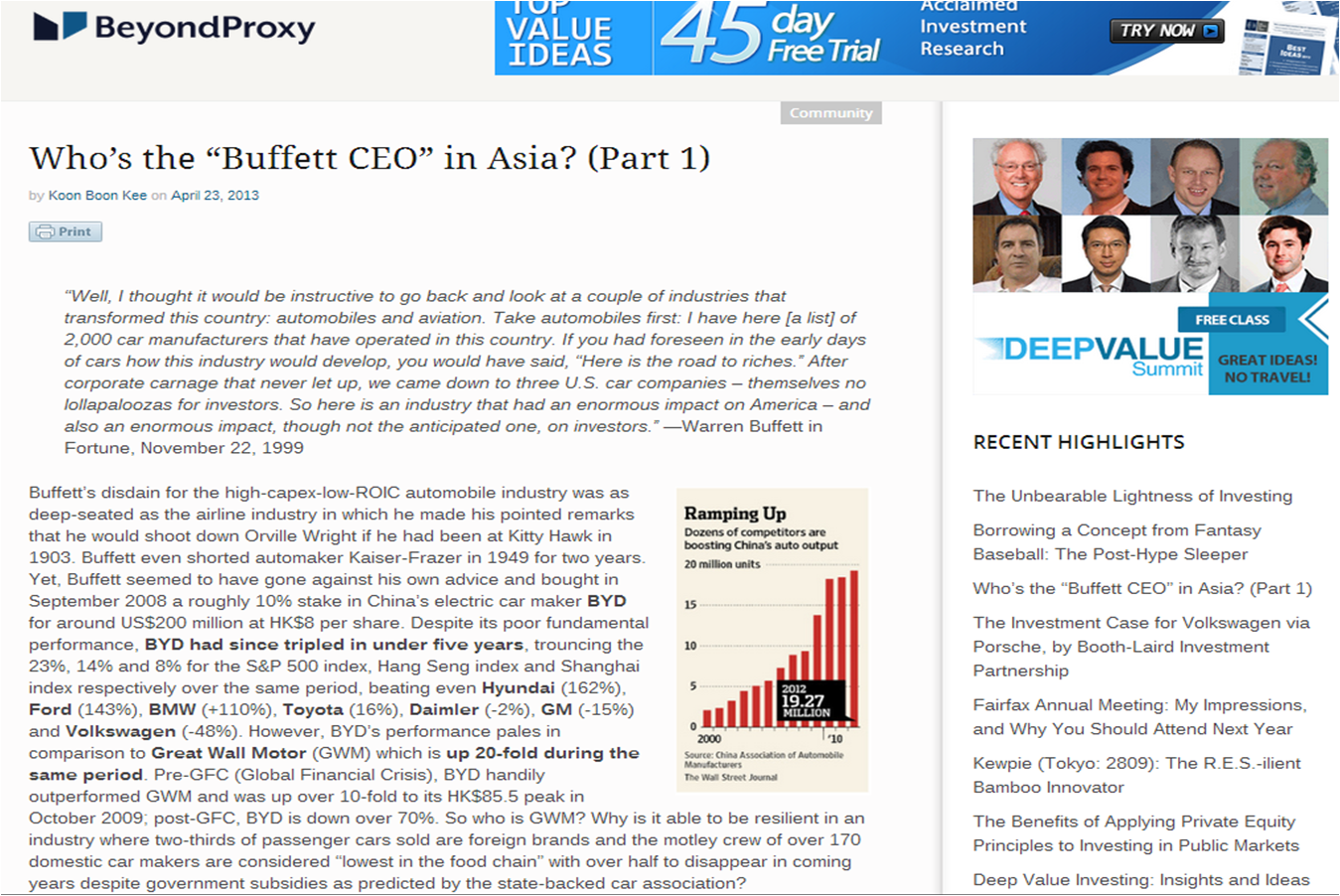
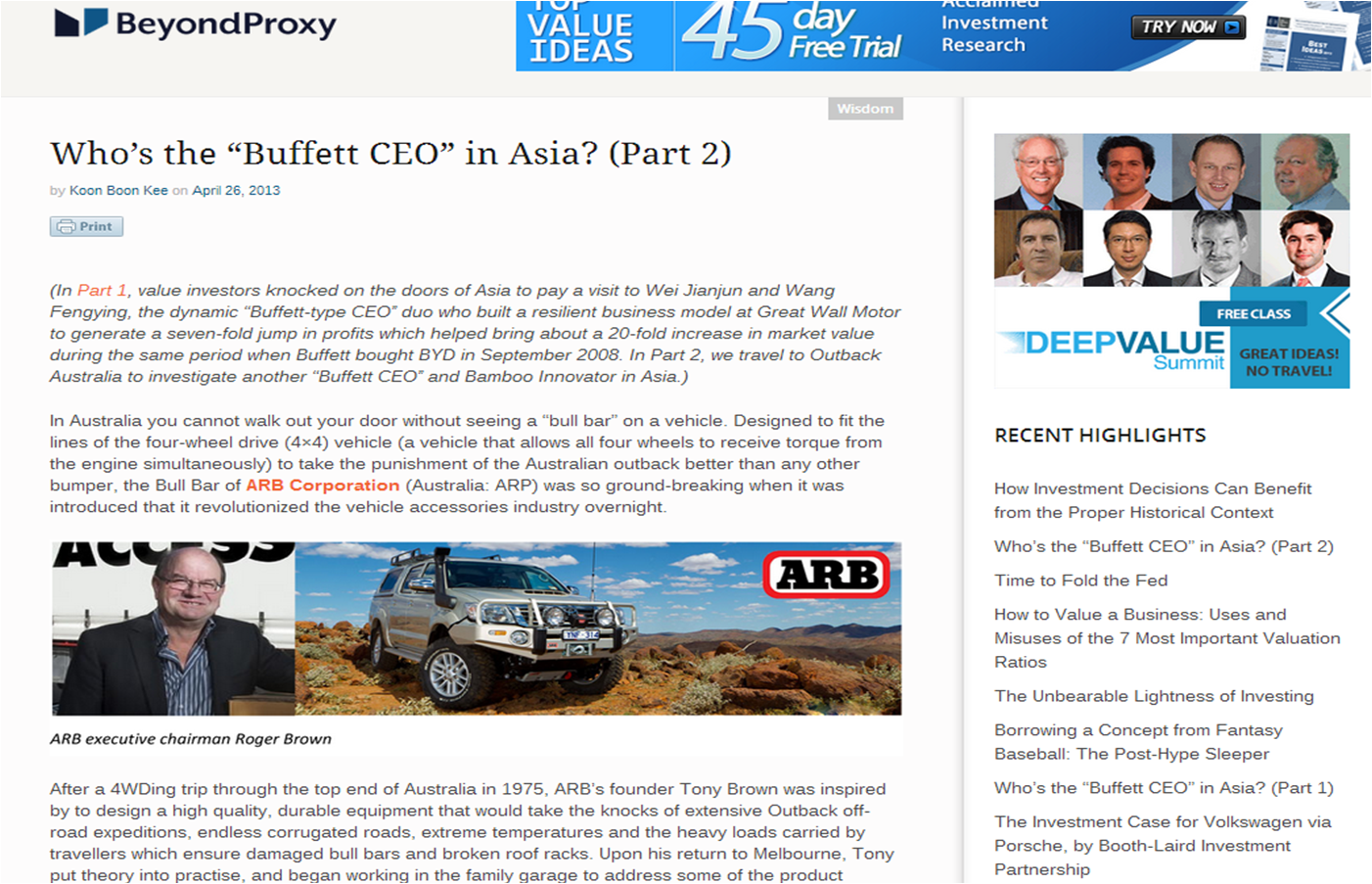
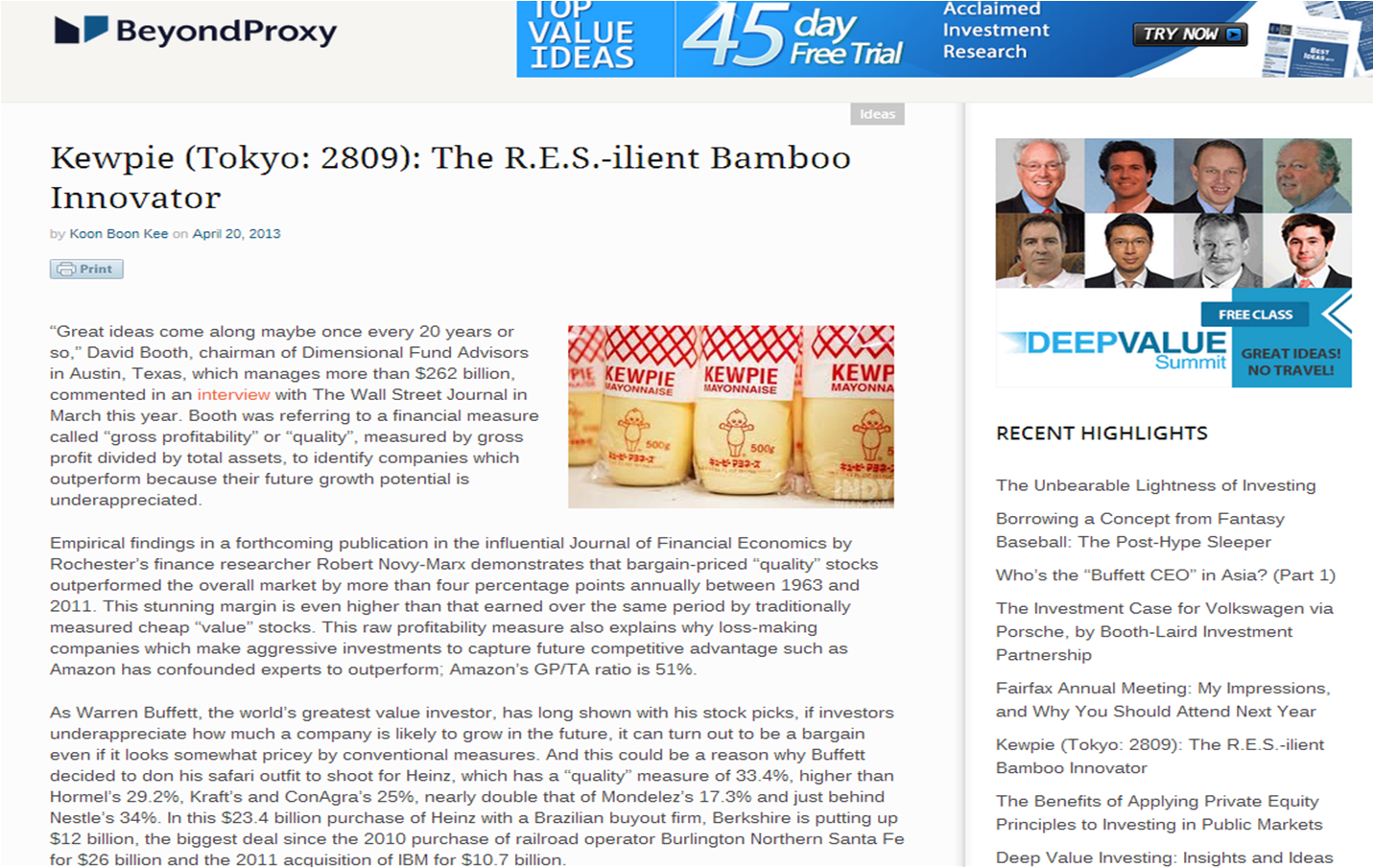
Knock, Knock, Who’s the “Buffett CEO” in Asia? Part 1 and 2 (Go to BeyondProxy.com, where value investing lives)

GWMARBKewpieJMATAsiaBamboo Innovator is featured in BeyondProxy.com, where value investing lives:

Who’s the Buffett CEO in Asia? Part 1 on China’s Great Wall Motor, April 23, 2016 (Weblink: BeyondProxy.com)

Who’s the Buffett CEO in Asia? Part 2 on Australia’s ARB Corporation, April 26, 2013 (Weblink: BeyondProxy.com)

Kewpie: Japan’s Heinz and R.E.S.-ilient Bamboo Innovator, April 20, 2013 (Weblink: BeyondProxy.com)

Value Investors in Asia: Making Sense of the Micro Vs. Macro Dilemma, April 16, 2013 (Weblink: BeyondProxy.com)

Google search proves to be new word in stock market prediction

Last updated: April 25, 2013 9:47 pm

Google search proves to be new word in stock market prediction

By Richard Waters in London

Searches of financial terms on Google can be used to predict the direction of the stock market, according to an analysis of search engine behaviour stretching back nearly a decade. The research, by UK and US academics, is the latest attempt to mine online behaviour patterns for clues about future movements in financial markets.

The findings appeared to show that people do more searches on terms such as “stocks”, “portfolio” and “economics” when they are worried about the state of the markets, said Tobias Preis, associate professor of behavioural science and finance at Warwick Business School. Rises in search volumes for such terms are generally followed by stock market declines, according to the research published in the journal Scientific Reports. By contrast, a fall in financial searches often points to greater optimism among investors, leading to a rising market. Read more of this post

Buffett Tells Coke CEO Study Failure, Avoid Complacency; “You want a restlessness, a feeling that somebody’s always after you, but you’re going to stay ahead.”

Buffett Tells Coke CEO Study Failure, Avoid Complacency

Warren Buffett, who controls the largest stake in Coca-Cola Co. (KO), knows how to steal a show.

The billionaire investor showed up at the soda maker’s annual meeting today to help sell the company’s message to shareholders in an on-stage interview with Chief Executive Officer Muhtar Kent. The surprise appearance drew a standing ovation as Buffett advised Kent to stay ahead of competitors by reviewing what made other businesses falter.

“I like to study failure,” Buffett, 82, said at the meeting held in the Cobb Galleria Center in Atlanta. “We want to see what has caused businesses to go bad, and the biggest thing that kills them is complacency. You want a restlessness, a feeling that somebody’s always after you, but you’re going to stay ahead.”

Berkshire Hathaway Inc. (BRK/A), which Buffett has led for more than four decades, owns 400 million Coca-Cola shares after a share split last year, with a value of almost $17 billion. Berkshire, which owns See’s Candies and an equity stake in American Express Co. (AXP), favors companies that have loyal customers and can withstand competition, Buffett said. Read more of this post

You can see why PwC might feel nervous about Bumi, the Indonesian coal miner and FTSE 250 constituent. The accountant signed off the June 2011 prospectus subsequently blighted by investor infighting and allegations of fraud.

Last updated: April 22, 2013 8:51 pm

Lombard: PwC’s grounds to feel anxious

By Jonathan Guthrie

Accountant signed off Bumi’s June 2011 prospectus

You can see why PwC might feel nervous about Bumi, the Indonesian coal miner and FTSE 250 constituent. The accountant signed off the June 2011 prospectus for the creation of a business subsequently blighted by investor infighting and allegations of fraud. The recriminations appear to have sensitised the auditor, whose punctiliousness has resulted in Bumi delaying its annual results and suspending its shares. This action is extremely unusual. Most companies report their numbers with clockwork regularity. Bumi’s inability to do so further undermines the credibility of a group whose board narrowly dodged removal by Nat Rothschild and other rebel shareholders in February. Suspension means there is no transparent price in the shares, leaving investors holding an illiquid investment. Trading will not recommence on the London stock market until Bumi has dispelled the doubts that PwC has over Berau, its Indonesian subsidiary. The auditor is worried that ex-executives of Berau signed contracts with suppliers and customers that were never disclosed to the parent group. Quantifying these liabilities, if any, will take too long for Bumi to meet an obligation to report results within four months of the year-end. Nick von Schirnding, Bumi chief executive, hopes to publish 2012 results in May. In June, investors should supposedly have the chance to vote on a proposal for the Bakries, a powerful Indonesian family, to buy out Bumi’s 29 per cent stake in Bumi Resources, another coal miner, in return for cash and the cancellation of their shareholding in Bumi. Will everything happen to schedule? A pessimist would say that if anything can go wrong for Bumi, living embodiment of Sod’s law, it generally does. Pressure is mounting on City advisers who brought foreign miners to list in London. Two of them, Bumi and Eurasian Natural Resources Corp, have become mired in corporate governance rows and allegations of wrongdoing. PwC is auditor to both.

Last updated: April 22, 2013 7:39 pm

Bumi shares halted amid payments concern

By Christopher Thompson

Bumi, the Indonesian coal miner founded by Nat Rothschild, has suspended its shares as it tries to account for tens of millions of dollars in payments to local landowners. Bumi said in a statement on Monday that trading in its shares would be suspended until the publication of its 2012 annual results, which has been delayed indefinitely. Read more of this post

Big buyout firms find size isn’t all in China business; High-profile missteps tell a cautionary tale as investors lick their wounds and rethink their approach to a huge and complex market

Big buyout firms find size isn’t all in China business

Tuesday, 23 April, 2013, 12:00am

George Chen george.chen@scmp.com

High-profile missteps tell a cautionary tale as investors lick their wounds and rethink their approach to a huge and complex market

bdfklgjsdfklgj5o

Some of the world’s biggest private equity players are learning the hard lesson that size does not guarantee success when it comes to making investments in China.

Industry sources have told the South China Morning Post that US buyout giant TPG Capital recently began to sell its entire holding in a Shanghai-based leasing firm, ending a bad five-year relationship with it.

Many industry watchers described it as a textbook case of how challenging the deal-making environment in China is, despite all the upbeat news headlines.

“Apparently, TPG wants to put the story to an end,” said one source. “Everybody is more cautious than a couple of years ago when making deals in China. We’ve seen many [similar] cases, and lessons should be learned.”

TPG’s plan to exit from its investments in UniTrust Finance & Leasing Corp, formerly known as Nissin Leasing (China), came after some of its rivals ran into difficulty doing deals or managing local firms on the mainland, despite pouring money into China in a bet on business growth. Read more of this post