Korean food and restaurants going global

2013-03-29 16:33

Korean food and restaurants going global

By Park Si-soo
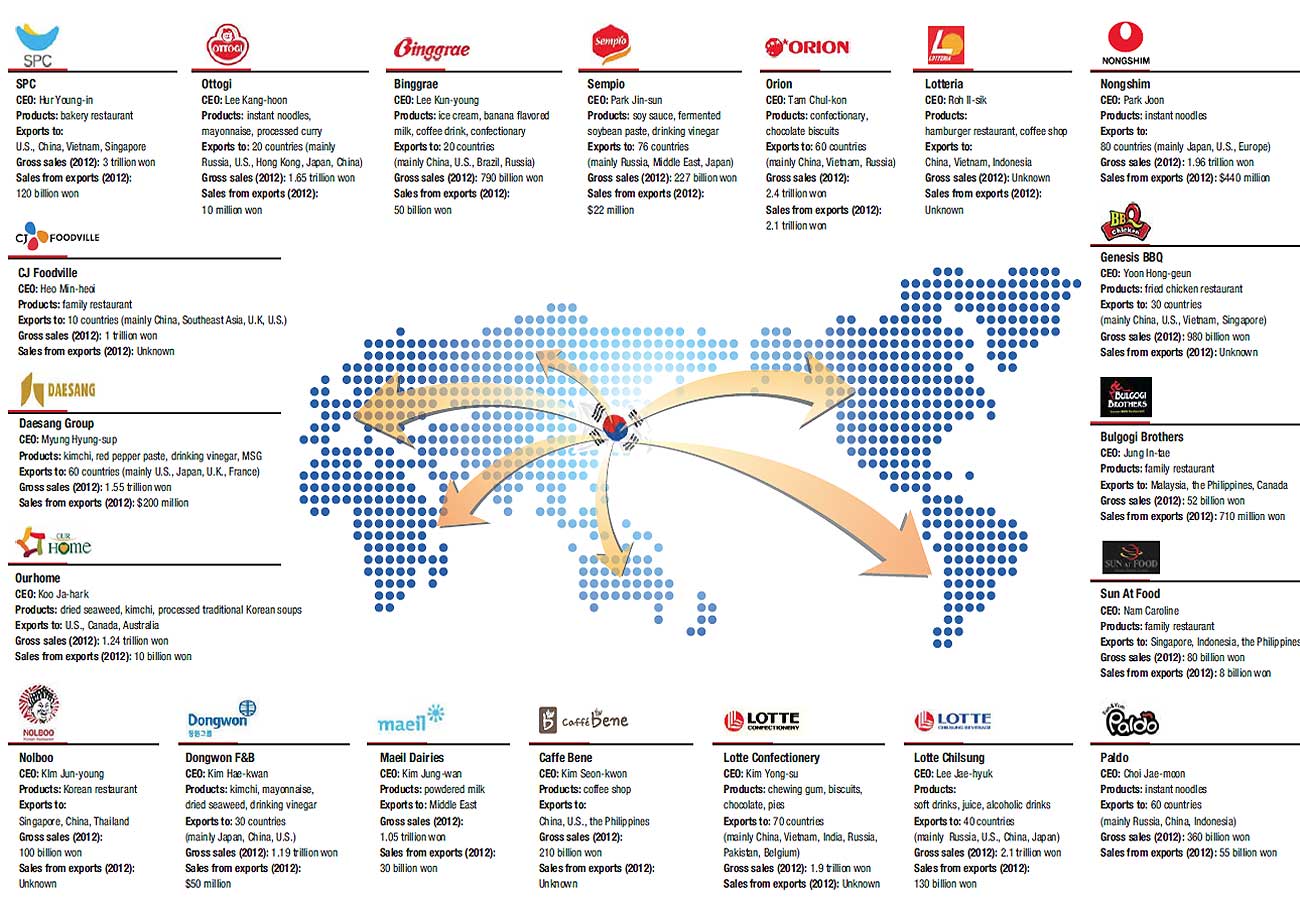
This is Korea’s next export item: food. A growing number of local food companies are carving out business footprints overseas, seeking to conquer dining tables around the world. The trend is facilitated by homegrown restaurant chains that are increasingly flexing their muscle to conquer what gourmets call “hubs of international cuisine” such as New York, London and Paris. Several companies have already set up sales networks in more than 60 countries and are trying to cement their presence by establishing manufacturing bases there. While their overseas sales have so far generated income from China, Japan, America and Southeast Asian countries that have many Korean immigrants, they are now trying to diversify revenue sources by taking advantage of the boom in Korean pop culture that is sweeping Russia, Europe and Latin American countries. The Korea Agro-Fisheries and Food Trade Corp. (aT) said the country exported kimchi worth $3.87 million to the U.S. last year, up 38.6 percent from the previous year. Shipments of red pepper paste to the U.S. surged by 24.9 percent during the same period, aT said. Exports of Korean ice cream to Brazil jumped a whopping 102.2 percent last year, it noted, saying its popularity is quickly spreading to surrounding countries. “We have a good start,” a spokesman for the company said. “I believe food products will emerge as a new growth engine for the country along with semiconductors, smartphones and automobiles.”

hally_1300_900

Does Blame Predict Performance of Investment Managers?

Does Blame Predict Performance?

March 2013 | Jason Hsu

As an econometrician and a fund-of-funds portfolio manager, I spend much time researching quantifiable metrics to help me identify managers who can outperform consistently. There is, in fact, a rich body of literature exploring different manager selection criteria. Academic papers have considered portfolio manager attributes, such as tenure, the CFA designation, advanced degrees, and even SAT scores; they have also examined fund characteristics, such as portfolio turnover, expense ratios, and assets under management. Practitioners, especially investment consultants, have additionally focused on more nuanced and qualitative elements such as investment philosophy, compensation scheme, turnover of key professionals, ownership structure, and succession planning.

Ironically, perhaps, most people have given up on the hope that past positive alpha can predict future outperformance with any reliability.1 Some might even go as far as asserting that manager outperformance is mean-reverting due to cyclicality in styles and “luck.”

Some of the above-mentioned attributes may provide very incremental information on the true quality of the manager. However, most econometricians, asset owners, and investment consultants confess (although not all publicly) that effective methods for picking top quartile performers remain elusive. As one of my friends at a large Middle Eastern sovereign wealth fund famously proclaimed, “We are convinced that managers who can consistently deliver alpha exist. We are, however, also convinced that we do not know how to find them.” Perhaps, then, the science of manager selection really is about winning what Charley Ellis calls “the loser’s game.” Read more of this post

Due Diligence Disasters

Top-Due-Diligence-Disasters

The Manual of Ideas: The Proven Framework for Finding the Best Value Investments

The Manual of Ideas: The Proven Framework for Finding the Best Value Investments [Hardcover]

John Mihaljevic (Author)

51Kfbwn7N9L._SY300_

Book Description

Publication Date: August 19, 2013

Reveals the proprietary framework used by an exclusive community of top money managers and value investors in their never-ending quest for untapped investment ideas

Considered an indispensable source of cutting-edge research and ideas among the world’s top investment firms and money managers, the journal The Manual of Ideas boasts a subscribers list that reads like a Who’s Who of high finance. Written by that publication’s managing editor and inspired by its mission to serve as an “idea funnel” for the world’s top money managers, this book introduces you to a proven, proprietary framework for finding, researching, analyzing, and implementing the best value investing opportunities. The next best thing to taking a peek under the hoods of some of the most prodigious brains in the business, it gives you uniquely direct access to the thought processes and investment strategies of such super value investors as Warren Buffett, Seth Klarman, Glenn Greenberg, Guy Spier and Joel Greenblatt.

  • Written by the team behind one of the most read and talked-about sources of research and value investing ideas
  • Reviews more than twenty pre-qualified investment ideas and provides an original ranking methodology to help you zero-in on the three to five most compelling investments
  • Delivers a finely-tuned, proprietary investment framework, previously available only to an elite group of TMI subscribers
  • Step-by-step, it walks you through a proven, rigorous approach to finding, researching, analyzing, and implementing worthy ideas

Missing Tycoon Mars Overseas Push of China’s Private Businesses; Liu’s rise to riches and sudden disappearance aren’t just the makings of a made-for-Hollywood potboiler. They’re a warning of the risks investors take when dealing with opaque private businesses in China, where fortunes depend on political ties and the favors of state entities, and even the wealthiest entrepreneurs can vanish if they lose the patronage of powerful government allies

Missing Tycoon Mars Overseas Push of China’s Private Businesses

Even by the standards of China’s rough and tumble breed of entrepreneurs, billionaire Liu Han’s brushes with death mark him out.

After dodging a hitman’s bullets in 1997, which led to the execution of a rival tycoon and two of his relatives almost a decade later, Liu, 47, finds himself ensnared in more killings. This time, his own brother is the suspect, and the Sichuan Hanlong Group founder is being held by police for helping him evade capture over a 2009 triple murder, state media reported.

The arrest throws into jeopardy Hanlong’s planned mining investments, casting doubt on the future of Sundance Resources Ltd. (SDL)’s $4.7 billion iron-ore project in West Africa and General Moly Inc. (GMO)’s Mt. Hope, Nevada, molybdenum mine. His detention still hasn’t been confirmed by authorities and there has been no official indication of who is now running Liu’s empire, which spans energy, real estate, chemicals and technology.

Liu’s rise to riches and sudden disappearance aren’t just the makings of a made-for-Hollywood potboiler. They’re a warning of the risks investors take when dealing with opaque private businesses in China, where fortunes depend on political ties and the favors of state entities, and even the wealthiest entrepreneurs can vanish if they lose the patronage of powerful government allies. Read more of this post

Matthew 25 Fund Inspired by Scripture Returns 27%

Matthew 25 Fund Inspired by Scripture Returns 27%

When the Matthew 25 Fund fell 40 percent in 2008, it kept Mark Mulholland awake at night.

Mulholland, the founder and sole manager of the mutual fund — named after a Bible passage — says he would lie in bed thinking about the damage he had done to his investors, particularly the elderly whose nest eggs might not recover before they died. The assets he managed dwindled to $22 million from $115 million, Bloomberg Markets will report in its May issue.

What Mulholland didn’t worry about were the stocks in his portfolio.

“The companies we owned were so cheap that barring a total collapse of the economic system, I knew at some point we were going to make a lot of money,” he says.

That time has come. Mulholland, 53, bought smartphone maker Apple Inc. (AAPL) in 2008 for $80 to $128 a share. He also hung onto his investment in companies such as Sidney, Nebraska-based Cabela’s Inc., (CAB) a retailer of hunting and fishing products, and Medina, Minnesota-based Polaris Industries Inc. (PII), which makes all-terrain vehicles.

The rebound in those stocks helped propel the now-$452 million fund to gains that beat the Standard & Poor’s 500 Index by a wide margin. The fund returned 13.1 percent annualized during the five years ended on Feb. 15 compared with 4.7 percent for the S&P 500 (SPX). Matthew 25 (MXXVX) gained 26.8 percent over three years and 25.4 percent in one year. Read more of this post

How Samsung Became the World’s No. 1 Smartphone Maker

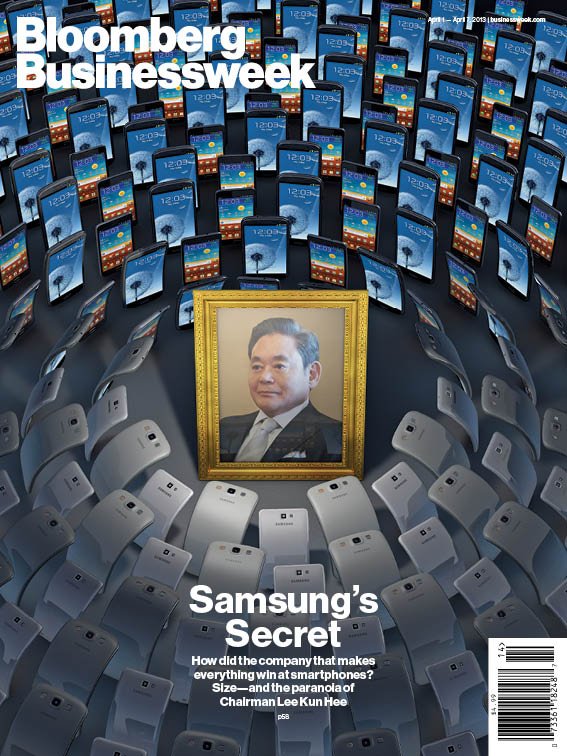
Here’s Bloomberg Businessweek’s Cover About How Samsung Became The King Of Smartphones

Steve Kovach | 59 minutes ago | 18 | 

Bloomberg Businessweek’s cover story this week is all about the rise of Samsung. Here’s a sneak peek at the cover art:

4-1-13 newsstand

How Samsung Became the World’s No. 1 Smartphone Maker

By Sam Grobart on March 28, 2013

I’m in a black Mercedes-Benz (DAI) van with three Samsung Electronics PR people heading toward Yongin, a city about 45 minutes south of Seoul. Yongin is South Korea’s Orlando: a nondescript, fast-growing city known for its tourist attractions, especially Everland Resort, the country’s largest theme park. But the van isn’t going to Everland. We’re headed to a far more profitable theme park: the Samsung Human Resources Development Center, where the theme just happens to be Samsung.

feature_samsung14__01__inline605feature_samsung14__04__inline605

Photograph by Tony Law for Bloomberg BusinessweekSamsung’s Human Resources Development Center

feature_samsung14__01__304

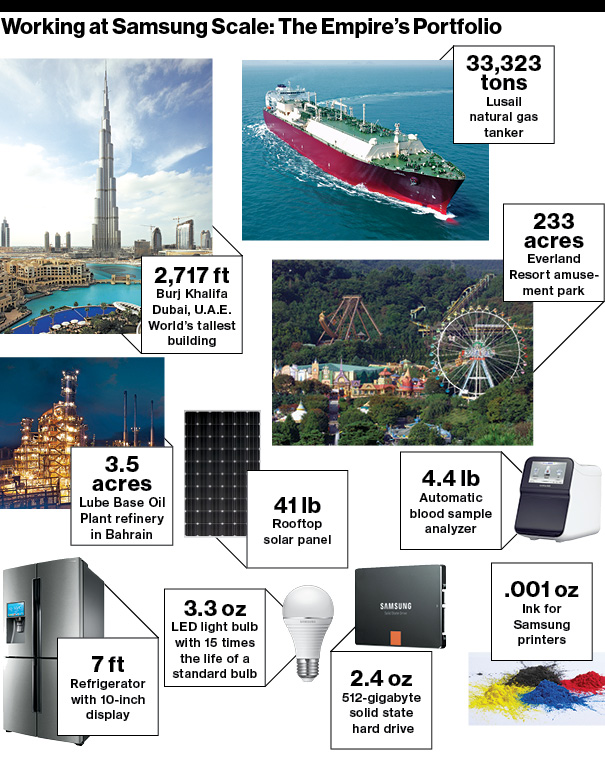
feat_samsung14_samsungscale-chart_605

feat_samsung14_mobile-chart_605 Read more of this post

The Ambow Massacre — Baring Private Equity Fails in Its Take Private Plan

The Ambow Massacre — Baring Private Equity Fails in Its Take Private Plan

March 27th, 2013

Peter Fuhrman is Chairman, Founder & CEO at China First Capital, (中国首创)a leading China-focused specialist international investment bank and advisory firm for private capital markets and M&A transactions.

ambowbaringchart

In the last two years, more than 40 US-listed Chinese companies have announced plans to delist in “take private” deals.  About half the deals have a PE firm at the center of things, providing some of the capital and most of the intellectual and strategic firepower. The PE firms argue that the US stock market has badly misunderstood, and so deeply undervalued these Chinese companies. The PE firms confidently boast they are buying into great businesses at fire sale prices.

The PE firm teams up with the company’s owner to buy out public shareholders, with the plan being at some future point to either sell the business or relist it outside the US. At the moment, PE firms are involved in take private deals worth about $5 billion. Some of the bigger names include Focus Media7 Days InnSimcere Pharmaceutical.

The ranks of “take private” deals fell by one yesterday. PE firm Baring Private Equityannounced it is dropping its plan to take private a Chinese company called Ambow Education Holding listed on the New York Stock Exchange. Baring, which is among the larger Asia-headquartered private equity firms, with over $5 billion under management,  first announced its intention to take Ambow private on March 15. Within eleven days, Baring was forced to scrap the whole plan. Read more of this post

In the shadow of well-known brands like Volvo and Ericsson, an acquisition-packed decade has made technology firm Hexagon one of Sweden’s most valuable companies and a rare newcomer among its top blue chips.

From tuna to tech, Hexagon breaks Swedish mould

Rollen, the president and chief executive officer of Hexagon, poses by the London Eye in London

11:44am EDT

By Niklas Pollard and Johannes Hellstrom

STOCKHOLM (Reuters) – In the shadow of well-known brands like Volvo and Ericsson, an acquisition-packed decade has made technology firm Hexagon one of Sweden’s most valuable companies and a rare newcomer among its top blue chips.

The company, market leader in precision measurement technology used in fields from microchip making to surveying dam construction, is now worth more than Swedish world number two white goods maker Electrolux after taking its business so far from its roots as to be unrecognizable.

When Ola Rollen stepped through the doors at Hexagon as CEO in 2000, leaving a job as head of a division at engineer Sandvik, he entered a company with lots of businesses but no business idea and scarcely any growth prospects.

Founded in 1975, Hexagon was then a sprawling conglomerate with its fingers in everything from tuna fish imports to vehicle hydraulics and, as financier Melker Schorling told Rollen at a meeting in downtown Stockholm in 1999, it was basically garbage.

Schorling had bought a controlling stake in the company the year before, aiming to build something from the ground up. Rollen, who first made a name for himself as a young CEO of metals firm Kanthal, had attracted his attention. Read more of this post

100 Years of Georg Wilhelm Claussen: A Century for Brands and People. He stands for continuity and innovation, for successful brand management and humane cooperation.

100 Years of Georg Wilhelm Claussen: A Century for Brands and People

  • For almost 75 years Georg W. Claussen has been part of the success story of Beiersdorf
  • For more than three decades he shaped the development of world brands like NIVEA, Eucerin, Labello, 8×4, Hansaplast and tesa as Chairman of the Board and on the Supervisory Board
  • On June 5th the Hamburg-native will turn 100

Hamburg, June 4, 2012 – Georg W. Claussen is an unusual German company figure – the grand nephew of Dr. Oscar Troplowitz, the man who in 1911 invented the largest skincare brand with NIVEA – he consistently lived corporate responsibility and embodies like no other the values of Beiersdorf. He stands for continuity and innovation, for successful brand management and humane cooperation.

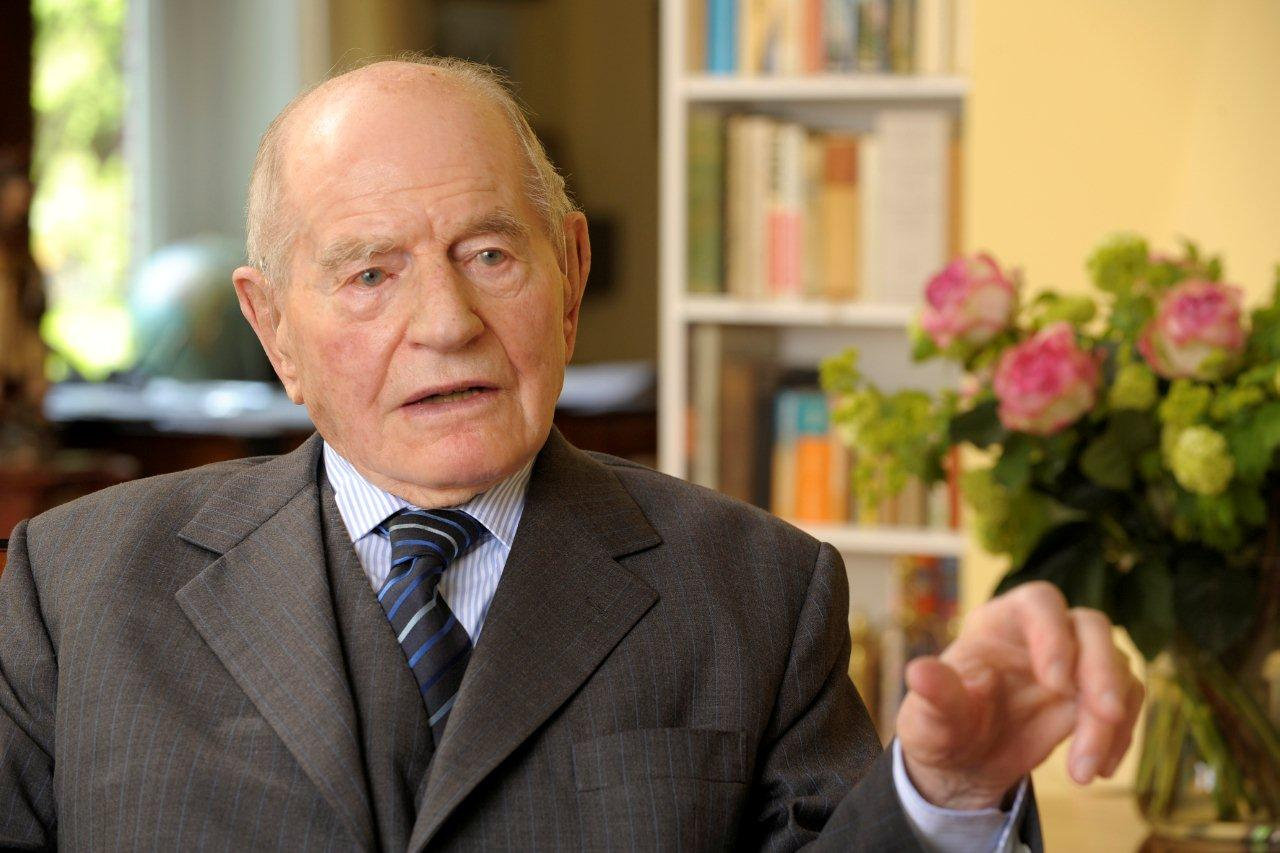
_Original_9916_1477624_georg_w_claussen_beiersdorf
Record Setting Life Achievement
As a young man in 1938, Claussen entered the company and starting in 1952, he was a member of the board. In 1957 he became the Chairman of the Managing Board of the then 75-year old Beiersdorf AG. For 22 years he held this position until he switched to the Supervisory Board for another nine years. More than three decades long he shaped the development of world brands like NIVEA, Hansaplast, 8×4 and tesa. Since 1989, he has been part of the company as an Honorary Chairman of the Company. He completed 58 Annual General Meetings behind the podium, first as Chairman of the Board, later as Chairman of the Supervisory Board, then as Honorary Chairman of the Company – surely a unique record in German economy.

An Impressive Figure
The “Elder”, as he is lovingly and respectfully named at Beiersdorf, is in very close contact with the company. Until recently he still worked regularly in his office on the 5th floor of company headquarters on Unnastrasse. “Mr. Claussen was a partner in dialogue for the board and management on many subjects,” said HR and Finance Board Member Dr. Ulrich Schmidt, who has known Claussen for almost 30 years. “As a businessman, not only the brands and markets were important to Claussen, but also the people.” And he embodies something that has become rare today: “Hanseatic Understatement.” He does good without having to talk about it. In this way his outstanding engagement for his home city of Hamburg, and his generous support of numerous institutions and facilities of art, culture, science and social work have earned great respect. The Claussen Simon Foundation, for example, founded in 1982, supports science and its offspring. Read more of this post

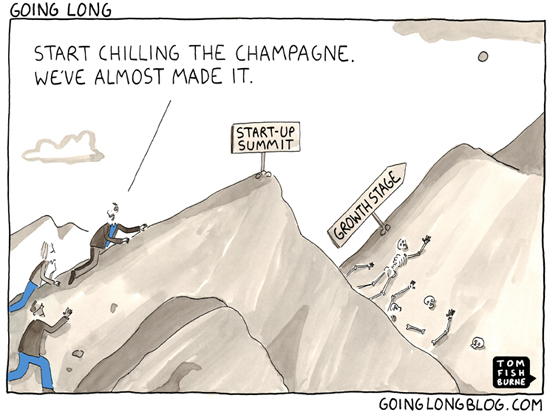
The Long March – Transitioning from a Start-up to a Growth Stage Company with Big Ambition; The Growth Stage Recipe – Ingredients Required to Build a Big Winner

The Long March – Transitioning from a Start-up to a Growth Stage Company with Big Ambition

Glenn Solomon (@glennsolomon) is a Partner with GGV Capital. Some of his recent investments include Pandora, Successfactors, Isilon, Square, Zendesk, Quinstreet and Nimble Storage. This post is part of a series for growth stage entrepreneurs who are thinking big; the full series can be found at www.goinglongblog.com.

Congratulations Ms. Entrepreneur. After years of toiling and challenging insurmountable odds, you’ve finally moved through the gates of start-up hell. You’ve established product/ market fit, you’re 10x better that your competition and you’ve begun to scale customers and revenues. You’ve also assembled a talented and passionate team who is bought into your culture. Take a breath. Take a bow. Now, come to the frightening realization… if you want to build a big company, you’ve got much more work ahead. The moves you make at the growth stage are increasingly important. Different challenges emerge and the bets become bigger, the stakes higher.

GGV.550.fourthpostGGV.550.firstpost

GGV.550.secondpost Read more of this post

The Index Liquidity Riddle: More Is Less

Updated March 22, 2013, 1:27 p.m. ET

The Index Liquidity Riddle: More Is Less

By JUSTIN LAHART

BF-AE637_INDEXH_G_20130322172406

You would think that the whole point of a stock index is to be, well, an index of the stock market’s performance.

But thanks to the popularity of exchange-traded funds, or ETFs, stock indexes have in recent years been doing double duty as investment vehicles. At the same time, there have been subtle but important changes in the way indexes are constructed.

Bottom line: The indexes aren’t measuring exactly what they used to.

It is a lot easier to manage an ETF if the stocks that underlie it are easily traded. If, instead, the stocks are illiquid, there is a risk their prices will get artificially inflated when money flows into the ETF. The opposite can happen when money flows out. Read more of this post

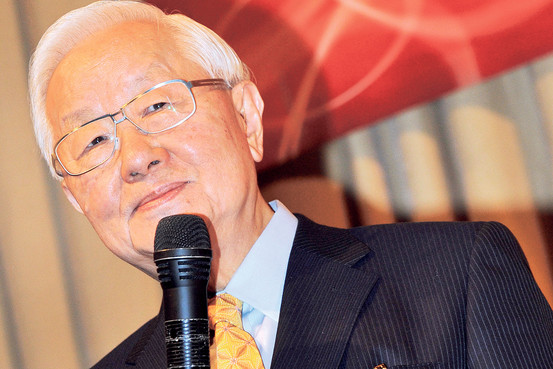
World’s Best CEOs: Morris Chang, Founder/Chairman of TSMC (Market Cap $85 Billion) Rides the Train

Rich Taiwanese Businessman Morris Chang Rides the Train

by Stuart Dingle on Thursday, October 11, 2012

From Yahoo Taiwan:

Taiwan_Morris_Chang_Rides_Train_021

Morris Chang riding the train to work? Its true. Photo spreading on internet like wildfire

TSMC chairman Morris Chang also rides the train to work? Today a photo rapidly spread around the internet, showing TSMC Chairman Morris Chang surprisingly riding the train with the general public, the big boss gave up his luxury car to ride on the general public transit system, leading to widespread discussion among netizens, who rapidly spread the news. Because a ‘big boss riding the train’ is truly too difficult to imagine, when this photo was exposed on Facebook, it was first suspected to have been photoshopped, or simply showed someone who ‘looks a lot like Morris Chang’ riding the train. However, some attentive netizens compared the photos with others, and discovered that this March, ‘Commonwealth magazine’s‘ 492nd edition featured Morris Chang on the cover page,and both the tie worn by Morris Chang on the cover,and the tie worn by Morris Chang in the photo, had an identical style and colour, meaning that the man in the photo is unmistakeably Morris Chang.

It’s understood that when Morris Chang attended this year’s TSMC shareholder meeting, he was worried about being delayed by traffic, so the punctual Morris Chang took the train before getting on the High Speed Rail to Taipei, not only reducing carbon emissions but also ensuring he won’t be delayed. The female student pictured in the photo sitting next to Morris Chang was immersed in her study on the train, with some netizens jokingly saying that if this student would just raise her head and talk to Morris Chang for ten minutes, it would be worth 10 years of study.

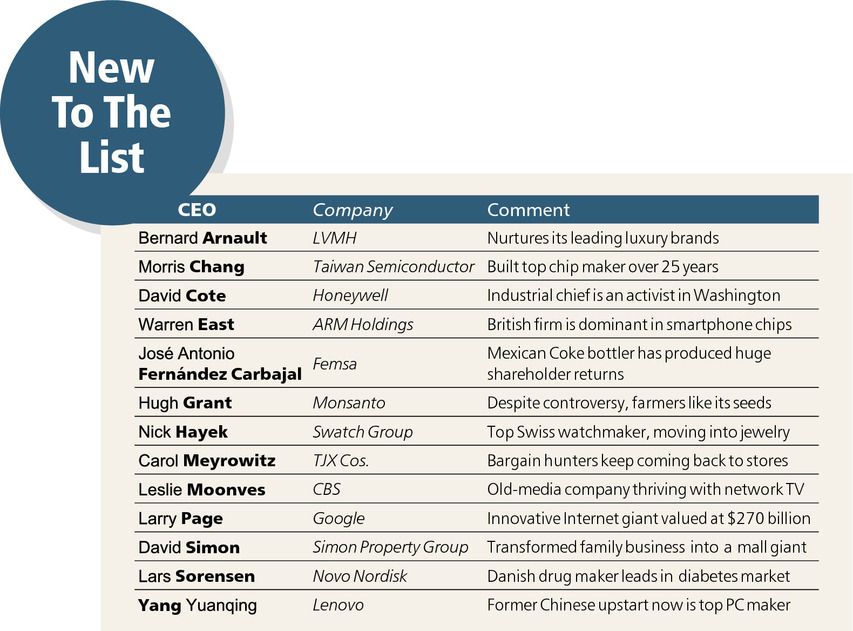
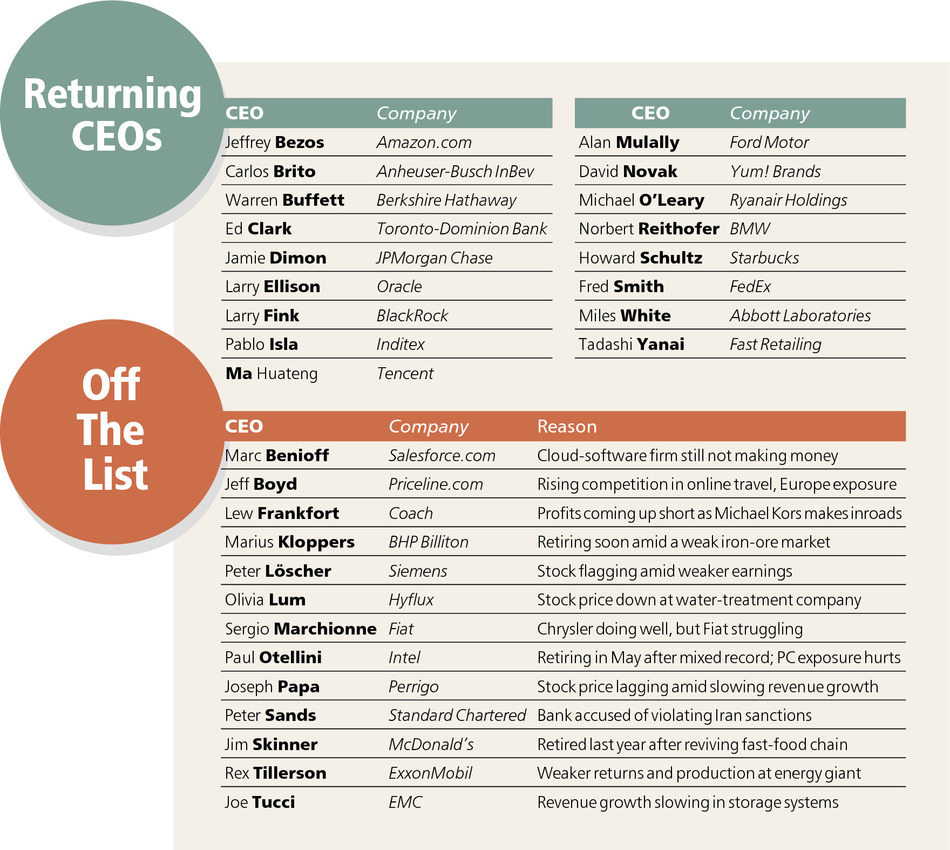
World’s Best CEOs; Profiles of the World’s Best CEOs — Many Paths to Greatness

SATURDAY, MARCH 23, 2013

Profiles of the World’s Best CEOs — Many Paths to Greatness

Profiles of our 30 superstars at Google, BlackRock, BMW — and more.

BA-BB432_ceo_so_G_20130323003833BA-BB369_ceo_ch_G_20130322235543

ON-BA406_NEWCEO_G_20130323013610

ON-BA405_CEOs03_G_20130323013605 Read more of this post

Nassim Taleb: Lectures on Risk and(Anti)fragility

https://docs.google.com/file/d/0B_31K_MP92hURjZxTkxUTFZnMVk/edit?pli=1

Low-Quality Stocks Have Zoomed. Time to Shift Gears?

March 22, 2013, 6:22 p.m. ET

Low-Quality Stocks Have Zoomed. Time to Shift Gears?

By MARK HULBERT

BF-AE633_HULBER_G_20130322160304

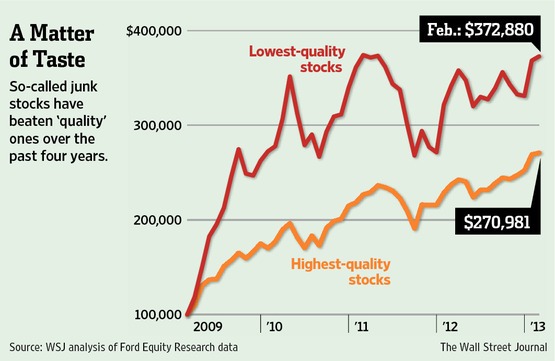
“Junk” continues to beat “quality” on Wall Street. Nearly four years after the end of the recession of 2007-09, it should be the other way around.

The Federal Reserve’s monetary stimulus is a big reason for this unexpected outcome.

Because the Fed’s easy-money policies won’t continue indefinitely, however, investors might want to begin reducing their holdings of low-quality stocks—which will be among the biggest casualties when the Fed turns off the spigot. Read more of this post

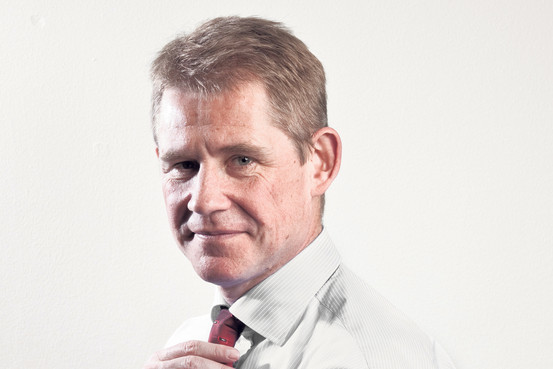
Warren East, who led ARM Holdings from start-up to near monopoly designer of smartphone chips, with its processors at the heart of Apple’s iPhone and Samsung’s Galaxy, is to step down as chief executive after 12 years. A pound invested in the company’s shares 10 years ago would be worth about 18 pounds now, and the company itself is valued at nearly 13 billion pounds ($19 billion).

ARM’s CEO Warren East to step down after 12 years

10:32am EDT

By Rosalba O‘Brien and Paul Sandle

ARM CEO East speaks during a Samsung Electronics keynote address at the CES in Las VegasARM

LONDON (Reuters) – Warren East, who led ARM Holdings from start-up to near monopoly designer of smartphone chips, with its processors at the heart of Apple’s iPhone and Samsung’s Galaxy, is to step down as chief executive after 12 years.

Group president Simon Segars will replace 51-year-old East from July, the British company said on Tuesday.

Since East, an engineer, joined in 1994, ARM has evolved from one processor product line to be the dominant player in mobile computing, providing microprocessors that run nearly all the world’s smartphones, and around a third of all consumer devices.

“After you’ve been doing it for 12 years you do get a bit tired (…) and think ‘Maybe that’s a bit of a brake on the business and somebody else should have a go’,” he told Reuters.

ARM licenses its processor designs to chipmakers including Apple, Samsung, Qualcomm and Texas Instruments. Its low-power processors have enabled it to dominate mobile computing, leaving rival Intel far behind in the sector.

In Cambridge, ARM has been at the heart of the so-called ‘Silicon Fen’, a cluster of high-tech firms at the southern tip of the English Fenland, about an hour’s drive north of London. Founded in 1990, ARM now employs 2,300 people, with 2013 revenues forecast at around $1.03 billion.

“We’ve built a global company based here in the UK, proving it can be done in technology, and I intend to do a bit more of that,” said East, who eschews the casual clothes and colorful style of California’s Silicon Valley in favor of smart suits and a sober manner.

East, whose total pay including share awards and long-term incentives was 7.6 million pounds in 2012, said it was too early to talk about his next move, but that another executive role was unlikely in the short term.

A pound invested in the company’s shares 10 years ago would be worth about 18 pounds now, and the company itself is valued at nearly 13 billion pounds ($19 billion). Read more of this post

HE SHOULD HAVE FINISHED HIS SMOOTHIE: How One VC Passed On A 2,500X Return; At SXSW, Brian Chesky, co-founder and CEO of Airbnb, reminisced about the difficulties of building a business.

HE SHOULD HAVE FINISHED HIS SMOOTHIE: How One VC Passed On A 2,500X Return

Megan Rose Dickey | Mar. 15, 2013, 8:51 AM | 1,908 | 1

Airbnb CEO Brian Chesky InterviewAt SXSW, Brian Chesky, co-founder and CEO of Airbnb, reminisced about the difficulties of building a business.

Airbnb, an online marketplace for renting out rooms and homes, is a $2.5 billion company, according to Bloomberg.

But in the company’s early days, Airbnb founder and CEO Brian Chesky had a hard time convincing investors to back his company.

At one point, Chesky was asking for $100,000 in exchange for a 10 percent stake in the company, Bloomberg’s Adam Satariano reports. But Chesky couldn’t seem to get anyone to bite. In fact, one investor even walked out mid-pitch, leaving his half-finished smoothie behind.

Today, that investment would be worth roughly $250 million — a 2,500x return.

Earlier this year, Wedbush Securities analyst Michael Pachter estimated that Airbnb booked 12 million to 15 million nights in 2012. He thinks that could increase to 100 million nights, whereby Airbnb could generate $1 billion a year in revenues. Read more of this post

Buffett’s book recommendation this year: Investing Between the Lines: How to Make Smarter Decisions By Decoding CEO Communications

Investing Between the Lines: How to Make Smarter Decisions By Decoding CEO Communications [Hardcover]

L.J. Rittenhouse (Author)

Book Description

Publication Date: December 18, 2012

The essential guide to making smarter decisions by decoding CEO Communications

Recommended reading in Warren Buffet’s 2013 Shareholder Letter

Investing Between the Lines introduces a revolutionary method for evaluating the financial integrity of a company. You don’t need special access to “insider” information or a degree in accounting to figure it out. In fact, the secret is right in front of you—in black and white—in the words of every shareholder letter, annual report, and corporate correspondence you receive.

Investing Between the Lines shows you how to:

  • Decipher the “FOG” of confusing company communications
  • Decode the real meaning behind corporate jargon and platitudes
  • Separate the facts from the fluff in annual reports and quarterly earnings calls
  • Safeguard your money by investing in companies that steward investor capital

Too often, corporate executives and investment professionals are expected to deliver short-term results. As a result, they are compelled to turn to accounting techniques and unclear language to meet these expectations.

In Investing Between the Lines, L.J. Rittenhouse lays out her time-tested approach for recognizing at-risk businesses before trouble hits. This is the same method she used to predict the collapse of Enron and the fall of Lehman.

From comparing the statements of Ford, GM, and Toyota to revealing why FedEx and Wells Fargo have been so successful, Investing Between the Lines shows that Rittenhouse’s system is one of the most powerful tools a corporate leader or investor can have. Once you learn the clues to decode CEO communications, you will be able to invest between the lines—to figure out exactly what a company’s CEO is or isn’t telling you.

Whether you’re a professional investor, a new shareholder, or a CEO who wants to improve how your company communicates, Investing Between the Lines is one of the best investments you’ll ever make. Read more of this post

So, How Did the Market Timers Do? With the Dow recently completing a round trip, we search for market-timing strategists who called the peak and the trough

TUESDAY, MARCH 12, 2013

So, How Did the Market Timers Do?

By MARK HULBERT | MORE ARTICLES BY AUTHOR

With the Dow recently completing a round trip, we search for market-timing strategists who called the peak and the trough.

Anxiously following the stock market’s ascent to new all-time highs, wondering when it will be time to get out?

Welcome to the club. A market-timing system that will reliably get us out at tops, and back in at market bottoms, is the investor’s Holy Grail.

How is this search going? Are we getting closer?

Now is a perfect time to ask these questions: With the stock market back to where it stood in October 2007, the last five-and-a-half years constitute an ideal laboratory in which to judge the success of market timing in the real world. Only after a full market cycle can we tell whether a timer can both get out at tops and get in at bottoms.

For this column I analyzed the returns since October 2007 of the more than 100 market-timing newsletters and web-based advisors monitored by the Hulbert Financial Digest (HFD). Most of these timers also are money managers, putting real money on the line with their bets. For purposes of this column, I focused only on that portion of their returns directly attributable to their market-timing calls—ignoring their abilities (or lack thereof) to pick individual securities.

One other feature of the HFD database is also of note: It is updated in real time, and therefore reflects the signals that the market timers actually made along the way. This is crucial in the market-timing debate, because it is otherwise all too easy, with the benefit of hindsight, to retrofit a market-timing system that would have worked wonderfully. The market-timing records that the HFD reports, in contrast, reflect transactions on those days that clients were specifically told to buy or sell.

The first lesson that emerges from the HFD data may be obvious, but is worth noting: No market timer called the market top in October 2007 and the bottom in March 2009, if by “called” we mean went completely to cash on Oct. 9, 2007, the exact day of the high, and got back 100% into stocks on March 9, 2009, the precise date of the bear market bottom. Read more of this post

Fortune 500? Singapore’s Bamboo Innovator 500!

Fortune 500? Singapore’s Bamboo Innovator 500!

By KEE Koon Boon

13 March 2013

“Singapore is too small and its talent pool is too small to produce a world-class manufacturing giant of the Fortune 500 class”, Singapore’s former Minister Mentor Lee Kuan Yew once said. A cryptic remark indeed because it does not imply that the venerable founder of modern Singapore thinks Singapore cannot produce knowledge-based giants, or resilient “Bamboo Innovators”.

Why “Bamboo Innovators”? Bamboos bend, not break, even in the most terrifying storm or devastating earthquake that would snap the mighty resisting oak tree. It survives, therefore it conquers. Disruptive industry trends and black-swan crises have become a permanent fixture in today’s marketplace. How wonderful it would be if countries, companies and individuals can stay resilient amidst the disruptive upheavals and unorthodox challenges – like the bamboo. The study of Bamboo Innovators can hopefully inspire companies to be productive innovators in order to surpass stall points in their business models during tumultuous periods, particularly SMEs aspiring to scale up to become global champions.

But why is it that Asian companies are predominantly product manufacturers in the first place? This could ironically be a result of the Asian values of hardwork and sacrifice. It is far easier for the Asian entrepreneur to be the middleman in getting orders from a few important anchor MNC customers who have access to the end customers, take capital risk in investing in tangible assets, and work hard in producing the required products with quality and efficiency, rather than attempt to build business models that have direct ownership of the hundreds and thousands of end customers. To do the latter would require interacting intensively with the end customers, a task which is beyond that of a lone powerful entrepreneur. As a result, Asian entrepreneurs are unwilling to share the rewards with their “undeserving” staff who did not take risk or sacrifice, thus treating employees as expenses, making most or all of the decisions and hoarding most of the resources and information themselves, running the firms as a “one-man-show”, and facing potential business continuity challenges from succession woes.

Keyence, established in 1974, is an illustration of the unconventional Asian firm. Takemitsu Takizaki, the 67-year-old founder, liberated the firm from manufacturing conventions and built a knowledge-based enterprise in laser sensors for use on automated factory assembly lines serving over 100,000 customers in 70 countries. Despite having only less than 1 percent global market share in a commodity-like product and only around 3,000 employees, Keyence commands a US$17 billion market value, approximately similar to Singapore’s Keppel Corp, a global leader in offshore oil rig design and building. It is also double the value of Nidec, another outstanding Japanese company which has more than 80 percent global market share in miniaturized motor and 100,000 employees.

Takizaki-san, who stepped down from the CEO role to be the Chairman in 2000, understood keenly that Keyence cannot improve on Japan’s legendary manufacturing efficiency. So, unlike its manufacturing-based competitors which focus on manufacturing and leave sales to distributors, wholesalers and agents, it deliberately avoids making products, except for manufacturing steps that involve trade secrets which are kept in-house. Most of its 3,000 employees are either “sales” or “research” staff. In their direct contact with the customers, Keyence’s in-house “sales” team pick up new product ideas on frequent factory visits. They would report back to the research department on what new machines their customers would find useful. They also tell the production department about demand for existing products, helping Keyence to regulate its output and reduce inventories. For instance, Keyence’s frontline solution providers observed from the production lines at instant noodle factories that the noodle quality was compromised because they were manufactured at variable thicknesses. Laser sensors that could measure noodles to 1/100th of a millimetre were develop and used by giants such as Nissin to keep noodle thickness consistent. 25 percent of sales at Keyence are generated from such new products, even higher than 3M.

To excel in these areas, Keyence had to cultivate a meritocratic culture and it is “notorious” for having one of the highest-paid salaries in corporate Japan for its employees. Bright young people from rival firms are attracted to Keyence by the performance-based pay. The engineers also get the chance to do their own research, rather than labouring for years under grey-haired supervisors. The average pay of the employees at Keyence is US$100,000.

“Ownership” of customer by decentralizing and empowering frontline employees also helped IBM to stave off a near-death experience in the early 1990s. When Lou Gerstner took over as CEO in April 1993, IBM had three consecutive years of financial losses, including losing a record $8 billion in 1993, and was about to be broken up. Lou reduced the Big Blue’s dependency in mainframe manufacturing, which was supplanted by personal computers and servers, and built the global platform for services to provide higher value to customers, a core business which today accounts for over 40 percent of its overall profits. Lou had multiplied the market cap 10-folds to $100 billion by the time he passed over the leadership baton in 2002 to Sam Palmisano, who quadrupled earnings and created an additional $130 billion in shareholders’ value in 10 years as he positioned IBM in software and analytics, a task now continued by the new CEO Virginia Rometty.

Keeping the frontline, or the “periphery”, to be resilient and innovative, and the center, or the “core”, to diffuse and enforce meritocratic values to all levels, has compounded immense value at both Keyence and IBM. This core-periphery growth pattern is also that of the bamboo whereby the vitality of its growth revolves around its “empty” center. Instead of sanely constructing itself inch by solid inch like trees, soberly climbing into the contested forest air, the nutrients and moisture that would have been exhausted making and maintaining its empty center can be utilized for growth of its periphery in the other culms (stem). From a builder’s viewpoint, the architecture of the bamboo culm presents a powerful configuration: fibers of greatest strength occur in increasing concentration toward the periphery of the plant.

Manufacturing and project-based companies often tout the size of their “orderbook” and their idea of “teamwork” is about hiring high-profile rainmakers or dealmakers who can bring in the sales orders and the job of everyone else is to execute efficiently and “productively”. The well-connected dealmaker may be able to pull in high-dollar projects but because of the difficulties in coordinating and executing large-scale complex projects, these projects or deals cannot be repeated and the hype associated with big orderbook starts to fade, particularly when cost overruns and delivery delays start to rear their ugly heads. Bigger becomes riskier. Even in manufacturing, the only way to perform and execute large-scale complex projects repeatedly is to create an intangible culture and environment of excellence where the interests of the mid-level and frontline individuals matter by aligning their interests and empower them to become. Customers are attracted to this contagious performance culture rather than to the dealmakers on a relationship basis, or even to the core “team”, resulting in a valuation breakthrough beyond the billion-dollar market value barrier that many Asian companies find hard to break.

A service-based economy does not emanate from taking a broad sector or industry approach, such as identifying “hot” services such as healthcare, education, media and so on. Such a headlong approach can only get the growth engine going only so far. Services sustainability has to stem from equitizing customer ownership based upon performance and interaction, trust, mutual respect and interdependency. This inevitably requires “emptiness” in the business model design like the bamboo with a core-periphery growth structure in order to scale up in a sustainable way. A powerful lone entrepreneur at the center who believes that he has work so hard and sacrificed so much, or a “I-did-it-all-by-myself” mentality, often does not believe in sharing with other “undeserving periphery” people if he does not cultivate a culture rooted in kindness, trust and cooperation.

Culture is like the invisible intricate underground root structure that makes the ground around a bamboo grove very stable – and make possible the flexibility and adaptability of the bamboo to bend, not break, with the wind. Kindness is like water nourishing the powerful roots of bamboo. A culture rooted in kindness definitely seems incompatible in a harsh, competitive business world. But kindness is trusting and ready to risk in new innovations. Kindness is an inner revolution; as is innovation. We become more fluid, more willing to risk. Kindness is about putting less in our possession and more in people. The boundaries between us and others begin to merge, so that we feel engaged and committed as part of a whole in which it is possible to share resources, emotions and innovations.

Rootedness in a culture of kindness and trust triggers the intense instinct, emotional focus and commitment with regard to actively planning for the enterprise’s future as one cohesive singular enterprise, to accept and embrace those who want to contribute, and to engender love amongst the members despite differential rewards and efforts as all work towards the objective of creating a resilient structure as a true compounder, the evergreen Bamboo Innovator.

Fortune 500? With “emptiness” in business model design and “rootedness” in a kindness culture, just like Keyence and Keppel which have almost US$20 billion in value, Singapore can have its own unique Bamboo Innovator 500 powerhouse with a US$10 trillion value.
Fugitive Fund Manager Stuffed Underwear With Cash, Fled; founder and former chief investment officer of Absolute Capital is accused of “cross trading” hundreds of millions of shares of penny stocks between the company’s funds to boost the value of the otherwise illiquid stocks

Fugitive Hedge Fund Manager Homm Arrested at Gallery

Florian Wilhelm Jurgen Homm, the German hedge-fund manager who has been a fugitive for more than five years, was arrested at the Uffizi Gallery in Florence on U.S. fraud charges.

Homm, 53, allegedly caused at least $200 million in losses to investors in hedge funds operated by Absolute Capital Management Holdings Ltd., according to a statement by the U.S. attorney’s office in Los Angeles. Homm was arrested yesterday by Italian authorities following a U.S. request, according to the statement.

Federal prosecutors in Los Angeles filed a criminal complaint March 6, charging Homm with conspiracy and fraud. The founder and former chief investment officer of Absolute Capital is accused of “cross trading” hundreds of millions of shares of penny stocks between the company’s funds to boost the value of the otherwise illiquid stocks.

The trades, through a Los Angeles-based broker-dealer that Homm co-owned, generated fees for Homm and Absolute Capital and also inflated the price of Absolute Capital on the London Stock Exchange, Alternative Investment Market, according to the statement. Homm “dumped” his shares and resigned from Absolute Capital on Sept. 18, 2007, “in the middle of the night,” according to the statement. Read more of this post

Jay Bowen’s stock picking has made the Tampa Firefighters and Police Officers Pension Fund one of the best-performing public pensions in the U.S

March 10, 2013, 6:20 p.m. ET

Oracle of Tampa Is a Rare Breed

By MICHAEL CORKERY

Jay Bowen’s stock picking has made the Tampa Firefighters and Police Officers Pension Fund one of the best-performing public pensions in the U.S. Some retired cops and firefighters attend pension board meetings to catch a glimpse of the money manager they consider their own Warren Buffett.

But in the hypercompetitive industry of pension fund investing, Mr. Bowen is an anomaly. The 51-year-old is the fund’s lone money manager, an unusual arrangement for a retirement system with $1.6 billion in assets.

“There is really nothing like this arrangement in the country,” says Mr. Bowen of the Tampa, Fla., fund, which is by far his largest client.

At a time when pensions are piling into riskier investments such as private equity and hedge funds that tend to carry high management fees, Mr. Bowen and his staff of four senior investment professionals at Bowen Hanes & Co. are a throwback to a bygone era. The firm invests almost entirely in stocks and bonds and doesn’t short stocks or use options or futures. Read more of this post

Could Bed Bath & Beyond Be Buffett Bait? With strong profits and steady growth, Bed Bath & Beyond was a great retailing story in the 20th century. The moves it’s making could make it an even better story in the 21st.

SATURDAY, MARCH 9, 2013

Could Bed Bath & Beyond Be Buffett Bait?

By ANDREW BARY | MORE ARTICLES BY AUTHOR

ON-BA282_BBBY03_G_20130309012113

With strong profits and steady growth, Bed Bath & Beyond was a great retailing story in the 20th century. The moves it’s making could make it an even better story in the 21st.

One of the country’s most successful retailers is on the bargain counter.

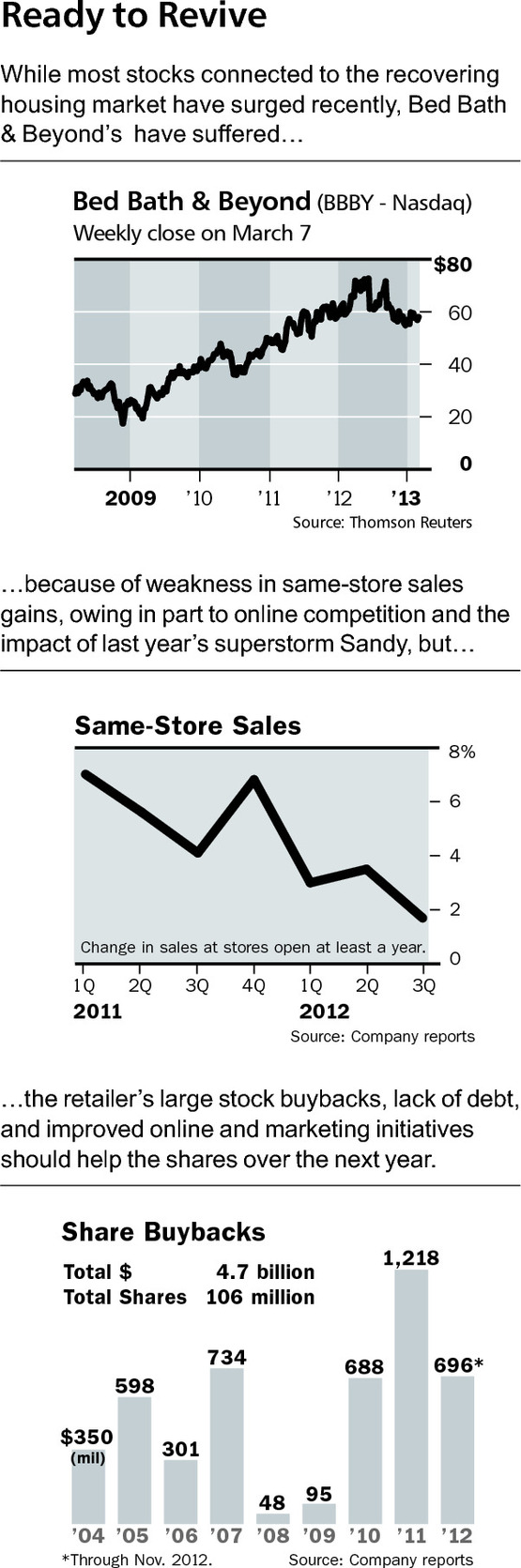
Bed Bath & Beyond has generated 16% annual growth in earnings per share over the past 10 years. But its shares, at $59, trade for less than 12 times projected profit for its fiscal year that ends in February 2014. The stock (ticker: BBBY) trades at a discount to other top retailers’, including Costco Wholesale (COST) and Target (TGT), neither of which has such a good profit history.

The shares could trade into the $70s in the next year, simply based on projected earnings gains and a higher price/earnings multiple. The insular company could attract interest from private-equity investors or even Berkshire Hathaway (BRK.A) if Bed Bath & Beyond’s co-founders, Leonard Feinstein, 75, and Warren Eisenberg, 82, decide to sell. However, there is no indication that the company is looking to sell.

A BUYER MIGHT PAY $85 a share—roughly 10 times this fiscal year’s projected earnings before interest, taxes, depreciation, and amortization (Ebitda)—consistent with prices paid for other quality companies, versus Bed Bath & Beyond’s current modest valuation of 6.5 times. The company’s $13 billion market value makes it large, but digestible. “This is a high-quality, cash-rich company that could see improving margins this year, particularly in the back half,” says Laura Champine, an analyst at Canaccord Genuity who carries a $74 price target on the stock. Bed Bath & Beyond has commanded an average of 15 times forward earnings in the past seven years.

The company, based in Union, N.J., operates 1,469 stores, including 1,004 Bed Bath & Beyonds, in all 50 states. The other 400-plus stores include World Market, which sells home furnishings, wine, and gourmet food; the fast-growing buybuy Baby chain, Christmas Tree Shops, and Harmon discount shops.

Bed Bath & Beyond has fallen from favor on Wall Street because of slowing comparable-store sales gains, mild profit disappointments, and concern that its weak Website makes it vulnerable toAmazon.com (AMZN) and other top Internet retailers. The company’s shares have slid 6% in the past year, even as virtually all stocks connected to the improving housing sector have surged.

Nonetheless, the company’s earnings in its just-concluded fiscal year ended in February likely rose a healthy 12%, to $4.56 a share, and are projected to increase 10% in its current fiscal year to $5.03.

Bed Bath & Beyond could be the most financially conservative big retailer in the U.S. It has no debt and it hasn’t carried a smidgen of debt for nearly all of the two decades since it went public in 1992. And it has $859 million—nearly $4 a share—in cash and marketable securities. The company has grown enormously, with revenue hitting an estimated $10.9 billion last year, versus $216 million in 1992 and it has accomplished this entirely with internally generated funds. Longtime investors have huge gains; the split-adjusted initial-offering price was $1 a share.

Management, led by CEO Steve Temares, plus co-Chairmen Feinstein and Eisenberg, run Bed Bath as if it were a private company. There are no investor days, limited financial disclosure, and no opportunity for questions on earnings conference calls. Want to know the sales breakdown among its chains? Bed Bath doesn’t disclose it. The retailer didn’t return Barron’s calls seeking comment. Read more of this post

Rigging the I.P.O. Game: What a decade-old dot-com I.P.O. case says about Wall Street today

March 9, 2013

Rigging the I.P.O. Game

By JOE NOCERA

ONCE upon a time, in a very different age, an Internet start-up called eToys went public. The date was May 20, 1999. The offering price had been set at $20, but investors in that frenzied era were so eager for eToys shares that the stock immediately shot up to $78. It ended its first day of trading at $77 a share.

The eToys initial public offering raised $164 million, a nice chunk of change for a two-year-old company. But it wasn’t even close to the $600 million-plus the company could have raised if the offering price had more realistically reflected the intense demand for eToys shares. The firm that underwrote the I.P.O. — and effectively set the $20 price — was Goldman Sachs.

After the Internet bubble burst — and eToys, starved for cash, went out of business — lawyers representing eToys’ creditors’ committee sued Goldman Sachs over that I.P.O. That lawsuit, believe it or not, is still going on. Indeed, it has taken on an importance that transcends the rise and fall of one small company during the first Internet craze. Read more of this post

Why fund names can’t always be trusted; ‘Absolute return’ funds that lose money, ‘smaller companies’ funds that hold FTSE 100 members, we look at the funds that don’t live up to their moniker.

Why fund names can’t always be trusted

‘Absolute return’ funds that lose money, ‘smaller companies’ funds that hold FTSE 100 members, we look at the funds that don’t live up to their moniker.

By Emma Wall

7:00AM GMT 09 Mar 2013

Fund managers have received a slap on the wrist for failing to achieve their investment goals. “Absolute return” funds aim to achieve positive returns in all market conditions – but the majority simply have not done what they claimed.

Angry investors accused the industry of misleading advertising, as funds such as BlackRock UK Absolute Alpha and GLG Alpha Select, which both sit in the Absolute Return sector, failed to deliver positive funds over the past three years.

In light of this poor performance, the Investment Management Association (IMA) has changed the sector’s name to “targeted absolute return” – a solution derided by critics.

Gina Miller, a co-founder of SCM Private, the fund manager, and a campaigner for transparency on charges, said the IMA had “taken 643 days to change one word”. She called the review an “absolute farce”. Read more of this post

Norway: The New Yale? Norway loads up on smaller stocks and so-called value stocks, which trade at lower prices in the short term

Updated March 7, 2013, 10:43 a.m. ET

THE INTELLIGENT INVESTOR

Norway: The New Yale?

Wealthy investors are embracing the Yale model of ‘alternative investments.’ But there may be a better strategy.

By JASON ZWEIG

UNLESS YOU’VE somehow kept your wealth a secret, your financial adviser has probably already urged you to “add alternatives” to your portfolio, or simply “invest like Yale.” But here’s a comeback to use next time this topic comes up: Tell the professional you’ve recently studied the Norway model—which will be true once you’ve finished reading this column.

There’s certainly much to be said for Yale’s investing approach. The university’s $19 billion endowment focuses almost exclusively on alternative assets, such as hedge funds, timber, oil and gas, real estate and private-equity funds that invest in corporate buyouts. It generally shuns stocks and bonds. Yale’s reasoning: As an institution with a perpetual time horizon and extensive resources, it can capitalize on the extra return alternative assets should offer because they can’t be easily traded like stocks and bonds.

Note that this is not a market-timing strategy. Yale did not forecast a poor future for stocks and bonds when its chief investment officer, David Swensen, began investing in alternative assets in 1990. Rather, the university believed its approach made sense because a large endowment was a perfect vehicle for holding and managing illiquid investments. Indeed, the strategy has worked as hoped: From 2000 through 2012, Yale’s endowment returned about 12 percent annually. Read more of this post

10 Worst Corporate Accounting Scandals

accounting-scandals

Jim Chanos on the Importance of Doing Your Own Work: Latest Interview; we should be looking at fundamentals, and not the personalities involved because it’s easy to stop doing fundamental work when you say ‘oh, Mr. XYZ is in it so if he sees something in it, who am I to argue?’

Jim Chanos on Dell, Herbalife & Importance of Doing Your Own Work: Latest Interview

Posted: 07 Mar 2013 11:10 AM PST

Kynikos Associates founder and notorious short-seller Jim Chanos appeared on CNBC this morning to share his latest thoughts on the market:

On China: He says to avoid the Chinese property bubble.  While he’s been short various plays on this in China, he says he’s “broadening out” to plays like construction equipment, etc. Read more of this post

Lessons From Stanley Druckenmiller: Hedge Fund Market Wizards; “George Soros has a philosophy that I have also adopted: The way to build long-term returns is through preservation of capital and home runs …

Lessons From Stanley Druckenmiller: Hedge Fund Market Wizards

Posted: 07 Mar 2013 11:20 AM PST

Legendary investor Stanley Druckenmiller recently came out of the shadows and gave a rare interview on a myriad of topics.  Given the popularity of that post, we thought it’d be interesting to see what lessons we could learn from this great investor so we looked at Druckenmiller’s interview in Jack Schwager’s book The New Market Wizards to see what we could learn. Druckenmiller formerly ran hedge fund Duquesne Capital as well as George Soros’ Quantum Fund, and he saw annual average returns of 30% since 1986.  He managed around $12 billion before shutting down Duquesne. A few years ago, he returned Duquesne outside capital and now runs a family office.  Many of his former employees founded PointState Capital with money from Druckenmiller and former Duquesne investors.

Lessons From Stanley Druckenmiller

In Jack Schwager’s book The New Market Wizards, Stanley Druckenmiller provides the following bits of wisdom:

On achieving a superior track record:  “George Soros has a philosophy that I have also adopted: The way to build long-term returns is through preservation of capital and home runs … Read more of this post