Angry NSEL investors accuse India’s Financial Tech of another fraud

Angry NSEL investors accuse Financial Tech of another fraud

Financial Technologies claims it is repaying foreign currency loans, but angry investors in NSEL allege that the promoters are taking money out of the company to pre-empt any adverse regulatory/judicial ruling. Financial Technologies shares touched a 2-month high of Rs 201 this morning after the company said it had sold its entire 100 percent equity ownership in Singapore Mercantile Exchange for USD 150 million. Read more of this post

New Olam strategy yet to convince investors; Group fights for confidence a year after Carson Block attack

November 18, 2013 6:30 am

New Olam strategy yet to convince investors

By Jeremy Grant in Singapore

A year ago this month, Sunny Verghese, chief executive of Olamfaced the biggest crisis in the Asian agribusiness group’s 20-odd years in existence. A man dressed in a baseball cap and jeans had visited his office in Singapore a few weeks before, purporting to represent investors with questions about Olam’s business model. Read more of this post

The lease bad solution: Proposals to clean up lease accounting will hit many firms’ balance-sheets

The lease bad solution: Proposals to clean up lease accounting will hit many firms’ balance-sheets

Nov 16th 2013 | NEW YORK |From the print edition

ONE of the world’s biggest accountants, PwC, breathlessly bills it as perhaps “the biggest-ever accounting change”. Businesses that lease property and equipment may soon have to start treating the leases as liabilities on their balance-sheets. All sorts of outfits that make heavy use of leasing—from retailers to airlines and, indeed, professional-services firms such as accountants—may end up looking far more indebted than their books currently show. Opponents of the reform predict dire consequences, for the companies and for the economy. Read more of this post

Dongbu Group to sell semiconductor business to raise $2.8bn; Dongbu Group aims to cut back debt from 6.3 trillion won to 2.9 trillion won by 2015, and lower the debt-to-equity ratio from 270 percent to 170 percent in the process

Dongbu Group to sell semiconductor business to raise $2.8bn

Hong Jong-sung, Park Yong-beom

2013.11.17 20:05:10

Dongbu Group chairman Kim Jun-ki chose to revive his conglomerate at the expense of relinquishing semiconductor business he started around 20 years ago. Under chairman Kim’s direction, Dongbu Group said Sunday it will “implement intensive restructuring to fulfill three trillion won ($2.8 billion) self-rescue plan and fully improve corporate finance by 2015.”  Read more of this post

It Pays to Look Under Tata’s Hood; Indian accounting standards give Tata discretion in accounting for R&D spending.

It Pays to Look Under Tata’s Hood

ABHEEK BHATTACHARYA 

Nov. 15, 2013 4:30 a.m. ET

BN-AK577_tatahe_G_20131115052210 BN-AK581_tatahe_G_20131115053325

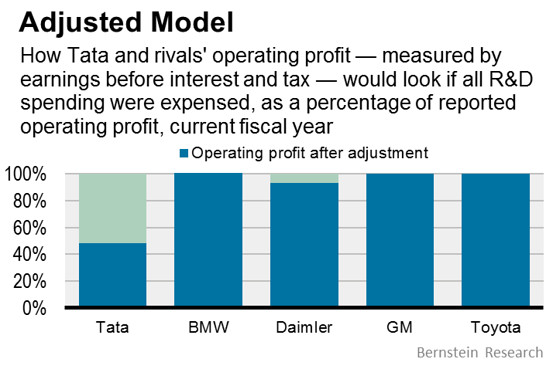
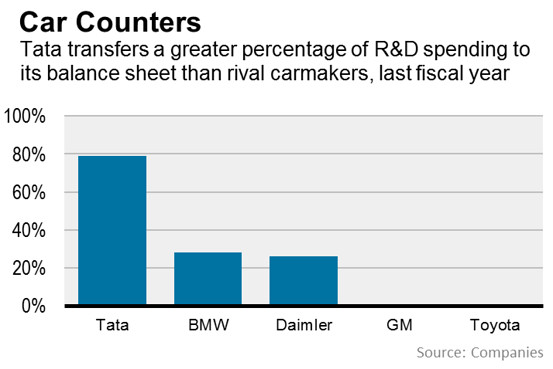
India’s Tata Motors 500570.BY +4.66% is in the big league of global car makers. When it comes to accounting for certain costs, though, it doesn’t play exactly the same way as its peers. India’s largest auto company by market value leapt onto the world stage after buying JaguarLand Rover in 2008. Now that the British luxury car maker makes up roughly 80% of Tata’s revenue, this Indian firm is competing with BMWBMW.XE -0.06% Mercedes-Benz and a host of American and Japanese premium brands. And when compared with some of these peers, Tata looks to be a relative bargain. Although its shares are up more than 20% so far this year, the stock trades at 9.6 times estimated profit for the fiscal year that ends next March. That is at a discount to Daimler, which owns Mercedes, and BMW. Yet Tata’s valuation may be flattered by the way it treats certain costs. This has the effect of boosting its profit—in the near term, at least. Taking that into account, Tata is more expensive than it initially appears. At issue is how Tata treats research and development costs. Tata’s R&D program, at 6% of sales, is higher than the 4% or 5% global car makers typically spend on new products and designs. Read more of this post

Insider Selling: Corporate Executives Give Favorable Stock Guidance, Sell Shares, Then Disclose Bad News

Executives Hit Sweet Spot on Stock Sales

Corporate Executives Give Favorable Stock Guidance, Sell Shares, Then Disclose Bad News

SUSAN PULLIAM and ROB BARRY

Nov. 13, 2013 11:00 p.m. ET

P1-BN995A_DELAY_G_20131113192409

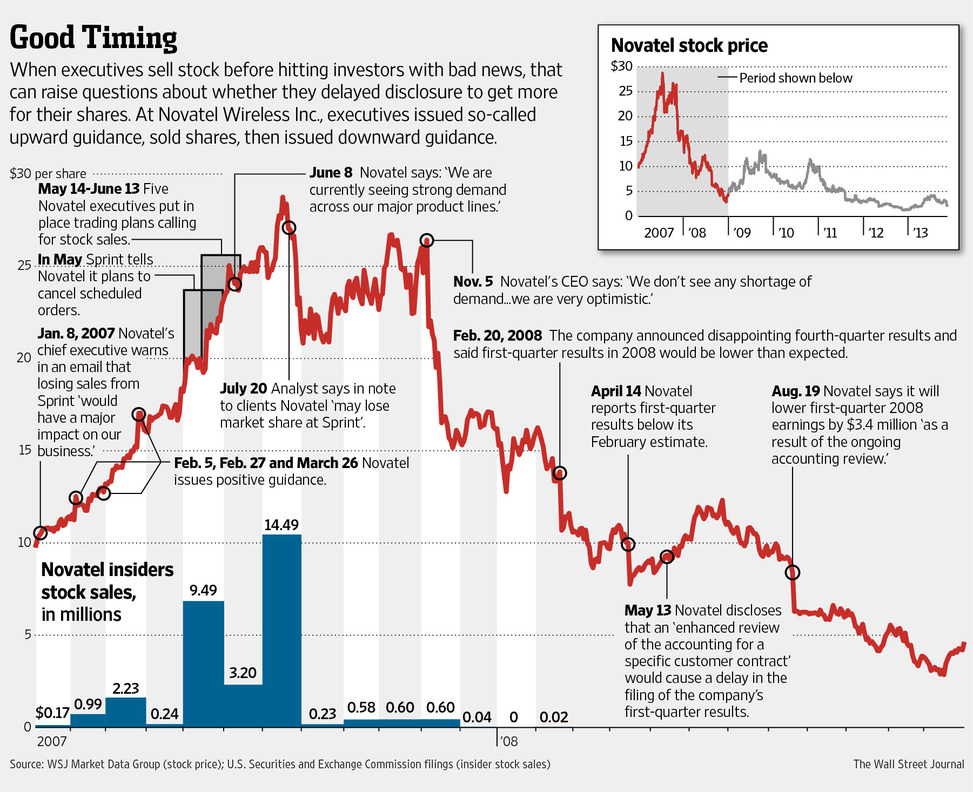
When George Weinert, then chief executive of Novatel Wireless Inc., NVTL -1.87% found out one of the company’s largest customers planned to cancel scheduled orders, he warned managers in an email that losing the sales “would have a major impact on our business.” His email, written in January 2007, has surfaced in a lawsuit because of what happened next. Novatel didn’t inform shareholders about the bad news. In a news release that May, the San Diego-based maker of telecommunications equipment said its quarterly earnings would exceed expectations, citing “strong sales” across the board. That June and July, Mr. Weinert sold $3.3 million of company stock. Read more of this post

Rubber Gloves to Condoms Give Ansell Edge in Emerging Markets

Rubber Gloves to Condoms Give Ansell Edge in Emerging Markets

Ansell Ltd. (ANN), the world’s largest maker of protective clothing, is seeking to boost expansion and best the competition by tapping middle-class growth in emerging markets with sales of high-tech gloves and upmarket condoms. “We’re focusing on emerging markets because working hands have moved from developed to developing markets and clearly we need to be where working hands are,” Chief Executive Officer Magnus Nicolin said in an interview in London. “We have the opportunity to grow rapidly for many years before we hit any kind of ceiling.” Read more of this post

Tile Shop Drops as Much as 30% After Short Seller Issues Report

Tile Shop Drops as Much as 30% After Short Seller Issues Report

Tile Shop Holdings Inc. (TTS) shares plunged after short-seller Gotham City Research LLC said the home-improvement company used improper accounting to inflate earnings. Tile Shop lost 28 percent to $15.22 at 12:07 p.m. in New York after falling as much as 30 percent, the most ever. Shares of the Plymouth, Minnesota-based company are worth as little as $1.54, a 93 percent decline from yesterday’s close, according to the report from Gotham City posted on its website today. Read more of this post

List of the 40 best performing S&P 1500 and S&P 500 since the bull market began on March 9th, 2009

If You Like 10-Baggers…

WEDNESDAY, NOVEMBER 13, 2013 AT 09:43AM

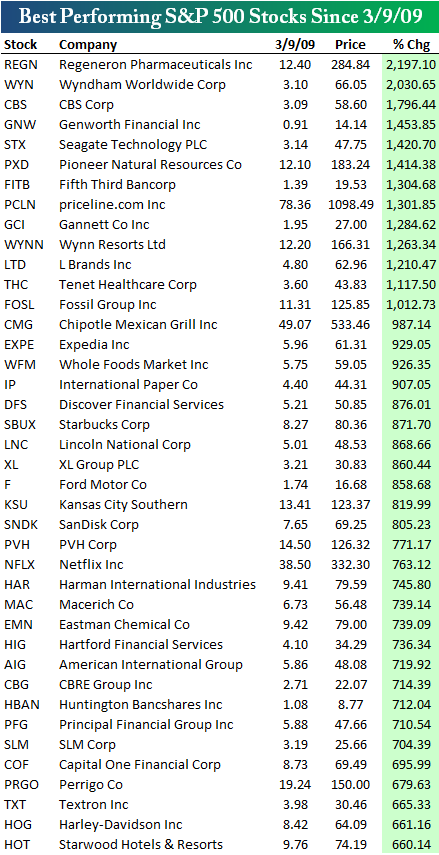
Below is a list of the 40 best performing S&P 1500 (current members) stocks since the bull market began on March 9th, 2009.  If you like looking at big winners, this list is for you.  As shown, all 40 stocks are up more than 1,400% (a “14-bagger“), and 24 are up more than 2,000% (a “20-bagger”).  There are even three stocks up more than 5,000% (a “50-bagger”)! The best performing stock currently in the S&P 1500 since the bull market began is Select Comfort (SCSS), which is up 7,864%.  As shown, on 3/9/09, SCSS closed at $0.25.  Today it is at $19.91. CalAmp (CAMP) is up the second-most with a gain of 5,888%, followed by 3D printing company 3D Systems (DDD) at 5,615%. The list above includes largecaps, midcaps and smallcaps, but below is a list of just the best performing largecaps (current S&P 500 members) since the bull market began.  As shown, there are 13 current S&P 500 members that have been “10-baggers” (gained more than 1,000%) since March 9th, 2009.  Regeneron (REGN) is up the most with a gain of 2,197%, followed by Wyndham Worldwide (WYN) at 2,030%.  CBS is up the third most with a gain of 1,796%.  On 3/9/09, CBS was a $3 stock — now it’s at $58.60. Some of the more notable name on the list below include priceline.com (PCLN) with a gain of 1,301%, Wynn Resorts (WYNN) at 1,263%, Chipotle Mexican Grill (CMG) at 987%, Ford Motor (F) at 858% (F was at $1.74 on 3/9/09!) and Netflix (NFLX) at 763%.

bestspr bestspx111213

Building a better income statement; If neither companies nor investors find GAAP reported earnings useful, it’s clearly time for a new approach

Building a better income statement

If neither companies nor investors find GAAP reported earnings useful, it’s clearly time for a new approach.

November 2013 | byAjay Jagannath and Tim Koller

A company’s annual income statement should be a transparent disclosure of its revenues and expenses that investors can readily interpret. Most aren’t, largely because income and expenses classified according to generally accepted accounting principles (GAAP) can be difficult to interpret. In fact, many sophisticated investors tell us they have to reengineer official statements to derive something they’re comfortable using as the starting point for their valuation and assessment of future performance. In response, many companies—including all of the 25 largest US-based nonfinancial companies—are increasingly reporting some form of non-GAAP earnings, which they use to discuss their performance with investors. Read more of this post

Analyzing Capital Ex: Buffett and Sears Case Study

Analyzing Capital Ex: Buffett and Sears Case Study

by csinvestingNovember 13, 2013

A reader asks about calculating capital expenditures and Buffett’s owner’s earnings. I believe only maintenance capex is deducted in determining owner’s earnings not growth capex because maintenance is mandatory while growth capex is discretionary.

Read more of this post

Why Smart Money Gets it Wrong in Financial Stocks: Pzena

Why Smart Money Gets it Wrong in Financial Stocks: Pzena

by ValueWalk Staff

“If it weren’t for bad luck, I’d have no luck at all.” –Stevie Ray Vaughan

Ok, so my mother never loved me. I reveled in schadenfreude as I watched the big money go down in flames buying financial fiascos during 2008/09.  My twisted ego might be comforted but what can we learn for the future? Try to think through what makes financial stocks difficult to value and especially risky in a credit crisis.  We will discuss under the heading, lesson, near the end of this post. Richard Pzena, called one of the smartest men on Wall Street, nearly sank his money management firm Pzena Investment Management, Inc. (NYSE:PZN) by buying FRE, FNM and Citigroup Inc (NYSE:C) in early 2008. See prior post:http://csinvesting.org/2011/11/15/pzena-pzn-disappointment-despair-and-tax-loss-selling/. Below is an inteview in early 2008 with Richard Pzena. Mr. Pzena gives his reasons for owning Freddie Mac / Federal Home Loan Mortgage Corp (OTCBB:FMCC), Fannie Mae / Federal National Mortgage Association (OTCBB:FNMA) Citigroup Inc (NYSE:Chttp://articles.moneycentral.msn.com/Investing/SuperModels/HowTheSmartMoneyGotItWrong.aspx Read more of this post

Charterhouse Heirs Struggle to Maintain Bonnyman Legacy

Charterhouse Heirs Struggle to Maintain Bonnyman Legacy

Charterhouse Capital Partners LLP, Britain’s oldest buyout firm, posted some of the industry’s biggest returns after spinning out of HSBC Holdings Plc. (HSBA) Handing off that legacy to the new generation is proving harder. While its London-based competitors expanded across Europe, Charterhouse operated from a single office in the shadow of St. Paul’s Cathedral, betting that a tight-knit culture would produce stronger returns. The strategy worked, with results surpassing CVC Capital Partners Ltd., Europe’s biggest private-equity firm, according to data compiled by Bloomberg. Read more of this post

A fight has erupted between a group of institutional investors and the owners of Singapore semiconductor company UTAC over a debt swap that will test governance standards in emerging bond markets

November 12, 2013 3:22 am

Singapore debt feud tests emerging bond markets

By Stephen Foley in New York

A fight has erupted between a group of institutional investors and the owners of Singapore semiconductor company UTAC over a debt swap that will test governance standards in emerging bond markets. The investors are clashing with TPG and Affinity Equity Partners, the private equity groups that took UTAC private in a $1.4bn buy-out in 2007, on the eve of the credit crisis. Read more of this post

Dairy Compounders Ignore Macro Noises: Bega Cheese +130%, PT Ultrajaya Milk +230% YTD (Bamboo Innovator Insight)

The following article is extracted from the Bamboo Innovator Insight weekly column blog related to the context and thought leadership behind the stock idea generation process of Asian wide-moat businesses that are featured in the monthly entitled The Moat Report Asia. Fellow value investors get to go behind the scene to learn thought-provoking timely insights on key macro and industry trends in Asia, as well as benefit from the occasional discussion of potential red flags, misgovernance or fraud-detection trails ahead of time to enhance the critical-thinking skill about the myriad pitfalls of investing in Asia at the microstructure- and firm-level.

The weekly Bamboo Innovator Insight series brings to you:

Cheese

Dear Friends and All,

Dairy Compounders Ignore Macro QE Noises: Bega Cheese +130%, PT Ultrajaya Milk +230% YTD

At the Singapore Cricket Club last Thursday, the Bamboo Innovator had lunch with one of our subscribers, Mr Hemant Amin, a highly accomplished and astute Indian value investor who runs a global industrial raw material procurement house and his own multi-million family office with concentrated bets in stocks such as Infosys which delivered over 60 times in handsome returns. Hemant also heads a value investor group called BRKets (www.brkets.com) with 11 other members. The name BRKets (pronounced as ‘brickets’) is a fusion of Berkshire Hathaway’s ticker code BRK and the Cricket Club where they meet. 6 of the BRKets members joined us for an interesting lunch discussion on value investing in Asia where we share our investment outlook, wide-moat business model analysis and stock ideas.

When Hemant ordered cheese platter for his desert, it triggered me to think about the inspiring stories of another outstanding Indian entrepreneur Devendra Shah and Barry Irvin of Bega Cheese. Shah turned the smallish Pune-based Parag Milk Foods into a high value dairy powerhouse with his bold decision in early 2008 to invest in the untapped opportunity in processed cheese in India, doubling by end 2008 the entire country’s cheese-making capacity from 40 tonnes to 80 tonnes. Interestingly, while the world is fixated on the QE tapering macro challenges, Warrnambool Cheese & Butter Factory (ASX: WCB AU, MV A$467m) is up 90% in less than three months since Sept. This was despite WCB posting its lowest profit since 2009 with FY13 (year end Jun) net profit down over 50% as it was the subject of a three-way bidding war by Canadian giant Saputo (TSX: SAP, MV C$9.6bn), Japan’s Kirin, and Bega Cheese (ASX: BGA AU, MV A$704m). Bega is a wide-moat company in our Bamboo Innovator Index since its listing in Aug 2011 with a market value of A$240m. NZ dairy giant Fonterra (FCG NZ, MV NZ$10.9bn), after its own contamination scare in Aug, joined in the industry consolidation battle by acquiring a 6% stake in Bega on Nov 2, adding on to Bega’s spectacular share price returns of 130% year-to-date. Ongoing competition in the raw milk market with supply affected by droughts in NZ and Australia and unseasonably cold weather conditions in Europe has kept upward pressure in prices paid to milk suppliers; the surge in the GDT (global dairy trade) price index from 800 to over 1,400 in the last year-and-a-half has hurt the profitability of processor such as WCB. Yet, despite both WCB and Bega being cheese processor companies, Bega has been able to achieve FY13 EBITDA and net profit growth of 13% and 25% respectively as compared to the FY13 decline of 28% and 51% for WCB. Meanwhile, the share price performance of dairy giants Saputo and Fonterra are flat YTD.

So why are Parag and Bega outperforming Bamboo Innovators in a cyclical commodity industry, especially when they are supposedly price-taking minnows in the midst of oligopolistic giants Fonterra, Murray Goulburn, Saputo, Amul (India), Royal Friesland Campina, Arla etc? What are the lessons for value investors when investing in companies related to the volatile commodities cycle? I admit that I was also surprised by the sharp jump in share price of well-managed boring consumer food companies such as Bega. But it once again proves the wisdom of one of our subscribers, Mr K, an intelligent value investor who has nearly doubled his returns from his investment since Mar this year in DKSH Malaysia (DKSH MK) after it was highlighted as a Bamboo Innovator; his thoughtful comments:

“I’d love money making ideas, but I also very excited about education, and understanding/ navigating Asian markets. If I can avoid stupid (frauds) mistakes, I think the upside will work out.”

By avoiding the “set-up” fraudulent companies which are promoted with that alluring sexy growth theme by a whole gamut of syndicates, insiders and brokers/dealmakers, and by staying long-term in undervalued wide-moat businesses – even if they are boring like cheese! – the short-term returns may be unexciting or even frustrating but the longer-term upside will eventually work out for the value investor.

How did Barry Irvin grow Bega Cheese from a single-site regional dairy processor in southern New South Wales (NSW) town of Bega, with 80 employees and selling only into the domestic market, to its position today as the southern hemisphere’s largest cheese-packing and processing business, with sales nudging to over A$1 billion a year, exporting to more than 40 countries and employing over 1,600 people? What caught the Bamboo Innovator’s attention in Bega before its Aug 2011 listing was an article in May 2011 in Sydney Morning Herald about how Irvin was the parent and caregiver of his autistic child Matthew, now 22. For two decades, the 51-year-old Irvin has juggled the responsibilities of caring for a disabled child, running the family farm and steering the ambitious former dairy co-operative through deregulation, acquisition, a public float..

helpLead-420x0Barry Irvin pictured with his son Matthew.

The role of a caregiver is special: they need to have that intangible quality of inner courage at its “core” to give strength to its “periphery”, much like the empty hollow center of a bamboo in which the nutrients and moisture that would have been exhausted making and maintaining this empty center can be utilized for growth of the periphery bamboo culm/stem. The architecture of the bamboo culm presents a powerful configuration: fibers of greatest strength occur in increasing concentration toward the periphery of the plant. With Irvin helming Bega, it is likely that the company will invest in the intangibles, in people and building long-term relationships..

Also, what are the lessons for value investors from the story of Indonesia’s PT Ultrajaya Milk (+230% YTD), controlled by the family of the late Ahmad Prawirawidjaja who established the business in 1958 from his house in Bandung? What are the 4 key Bamboo Innovator takeaways?
Capital Group questions how indices are used; Mismeasurement of performance worries originator of MSCI

November 11, 2013 12:01 am

Capital Group questions how indices are used

By James Mackintosh

Mismeasurement of performance worries originator of MSCI

The rise of the multinational has transformed the corporate landscape in the past half-century. Now, the inventor of the most widely-used global stock market indices thinks the measurement of equity performance needs to change too – and with it the dynamics of investing. Capital Group – which, as Capital International, was the originator of the MSCI index range – is concerned that the standard national, or even regional, benchmarks used by fund managers no longer measure what they set out to measure. This problem has been evident in the FTSE 100 index for a decade or more, as less than a quarter of the revenues of companies in the Footsie come from the UK, and many of their dividends are paid in dollars or euros. Read more of this post

Earnings, but Without the Bad Stuff; Managers of companies that have generated only losses, like Twitter, are happy to suggest metrics that they think are better suited for assessing their operations

November 9, 2013

Earnings, but Without the Bad Stuff

By GRETCHEN MORGENSON

Twitter’s red-hot stock offering last week makes clear that, as in the first Internet bubble, investors will pay up for a company even if it hasn’t turned a profit. And managers of companies that have generated only losses, like Twitter — and even those that are profitable — are happy to suggest metrics that they think are better suited for assessing their operations. Managements’ recommended measures, typically not found in generally accepted accounting principles, have an uncanny way of burnishing a company’s results. They do so by eliminating some pesky costs of doing business. As such, these benchmarks are also known as earnings without the bad stuff. They were central to the valuations that propelled Internet stocks skyward in the late 1990s. Then, the higher the market climbed, the kookier the metrics became. Read more of this post

The best-performing college endowments have less than $1 billion — places like Abilene Christian and Spalding University, not giants like Yale. People have become disenchanted with all these exotic investment vehicles. The consultants have really pushed these things.”

November 8, 2013

Fast-Growing Endowments, Without the Ivy

By JAMES B. STEWART

Stewart1-articleLarge

Jack Rich said Abilene Christian’s investments benefited from its board members’ knowledge of the oil industry.

Move over, Yale.

This week, the National Association of College and University Business Officers unveiled its preliminary results for endowment performance for the year that ended on June 30. And Yale, the longtime titleholder, was knocked from its perch for the most recent three- and five-year periods. The long success of the Yale model underlies the conventional wisdom that a top-performing endowment has to be big (over $1 billion), heavily invested in costly alternative strategies like hedge funds and private equity, and managed by a large and sophisticated staff of internal investment professionals. Read more of this post

Investors’ love of the familiar may be dangerous

November 8, 2013 7:07 pm

Investors’ love of the familiar may be dangerous

By Jonathan Eley

Why did the Royal Mail flotation capture the public imagination in the way it did? The pricing was certainly attractive, the dividends were appealing and the marketing was persuasive – but a new study suggests that brand familiarity was a big factor. When it comes to investing, familiarity breeds fondness, according to research carried out by Investec Wealth & Investment. The wealth manager questioned more than 2,000 people with a propensity to invest and found that over half were more likely to buy shares in well-known companies. A similar proportion said they would continue to hold such shares even if they performed poorly. Read more of this post

Can Malaysian-listed China firms buck their bearish trend? When an entire group of stocks are under water that the investors will wonder about the issues dragging their investments down.

Updated: Saturday November 9, 2013 MYT 7:04:24 AM

Can China firms buck their bearish trend?

BY GURMEET KAUR AND YVONNE TAN

china trading

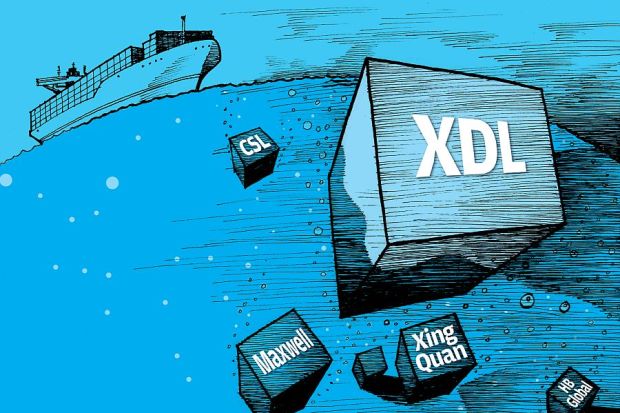
WHEN a stock trades below its initial public offering (IPO) price, investors may shrug it off and say the fault lies with the company or its valuations. It is when an entire group of stocks are under water that the investors will wonder about the issues dragging their investments down. That, in a nutshell is the story of China companies listed on Bursa Malaysia. All stocks except XiDeLang Holdings Ltd (XDL) are trading below their IPO price and questions are plentiful when one tries to understand why that is the case. Read more of this post

Linde chief retires in glory; Wolfgang Reitzle has transformed German industrial gases group

November 7, 2013 10:53 am

Linde chief retires in glory

By Tony Barber

Wolfgang Reitzle has transformed German industrial gases group

Construct a personality profile of the chief executive of an industrial gases group. Apart from essential leadership qualities, its features would include a passion for science and engineering, an insistence on organisational precision, a faith in long-term planning and a career devoted to one company. In short, it would call to mind a businessman such as Benoît Potier of France’s Air Liquide or John McGlade of Pennsylvania-based Air Products. Read more of this post

Foreign investors lack faith in Stan Shih to save Acer

Foreign investors lack faith in Stan Shih to save Acer

Staff Reporter

2013-11-08

Foreign investors do not believe that Acer founder Stan Shih rejoining the management after the departure of former CEO Wang Jeng-tang will make a difference to the Taiwan-based PC maker, our sister paper China Times reported on Nov. 7. Acer’s share price closed at NT$16.9 (US$0.57) on Nov. 6, while anonymous foreign investors claimed that NT$12 (US$0.41) a share will be the bottom. Read more of this post

Hot Investment Concepts You Should Approach With Caution

Hot Investment Concepts You Should Approach With Caution

Nov. 6, 2013 2:09 p.m. ET

New investment products might seem like the best thing since the ETF, but following trends isn’t always the surest—or safest—way to make money. With this issue in mind, we posed the following question to The Experts: Are there any current hot investment concepts that you think investors should be wary of? This discussion relates to a recent Investing in Funds & ETFs Report and formed the basis of a discussion on The Experts blog on Nov. 4.

Beware of Alternative Investments

CHARLES ROTBLUT : The push for holding alternative investments concerns me. These are funds designed to produce a different return than stocks. Getting more diversification isn’t a bad idea in and of itself, but these funds tend to come with higher fees and many were created after the last bear market. They also are often complex with characteristics that aren’t easily understood. The age of these funds is also a concern. Since many of the funds now available to non-accredited individual investors (which are most of us) were created after the last bear market, we don’t know how they will hold up during a period of financial stress. If a bear market makes it difficult for these funds to execute their strategies or sell certain positions, the losses for shareholders could be significant. Read more of this post

The Biggest Little Secret In Money Management

November 6, 2013

The Biggest Little Secret In Money Management

James Picerno

It happens all the time. A new strategy emerges from the obscure recesses of the research caverns and morphs into an ETF, mutual fund, or a separate account program. Or perhaps it’s outlined on an investor’s blog for all the world to see. Sometimes there are glowing reviews fueled by compelling back-tests. For the most successful strategies that spawn products, there are big inflows of assets. There’s usually plenty of hype too. But when you peel back the details and drill down into the core of the strategy du jour, you’ll typically find a familiar combination of variables: rebalancing with one or more factor tilts. Read more of this post

SEC chair questions growth metrics used by technology companies

SEC chair questions growth metrics used by technology companies

10:59am EST

By Sarah N. Lynch

WASHINGTON (Reuters) – Securities regulators are concerned that some metrics of growth used by technology companies are confusing investors, and may not translate into big profits, Securities and Exchange Commission Chair Mary Jo White said Wednesday. “Consider a company that correctly claims it has a hundred million users, and that the rate of user growth is expected to continue to grow at double-digit rates. That certainly sounds good and it would seem to bode well for the prospects of the company,” White said at a New York conference sponsored by the Practising Law Institute. Read more of this post

Muddy Waters: NQ’s largest purported source of revenue, Yidatong (“YDT”), is controlled by NQ, and its primary purpose is facilitating NQ’s fraud

November 6, 2013

If You Believe in Yidatong, You’ll Believe in Santa Claus (NYSE: NQ)

NQ’s largest purported source of revenue, Yidatong (“YDT”), is controlled by NQ, and its primary purpose is facilitating NQ’s fraud.  Believing NQ’s narrative of YDT — that YDT is an independent company annually facilitating billing of approximately $35 million for a variety of developers — at this point requires investors to suspend reason.  If the following does not convince an investor that NQ’s YDT narrative is fabricated, then the investor is either too emotionally invested in the stock, or is gullible enough to still believe in Santa Claus. Read more of this post

Japan Exchange and Nikkei to Start New Index Focusing on ROE

Japan Exchange and Nikkei to Start New Index Focusing on ROE

Japan Exchange Group Inc. (8697), operator of the world’s second-biggest equity market, will create an index with Nikkei Inc. that selects members based on return on equity, in a bid to highlight the nation’s best stocks. The bourse operator and Nikkei, which also runs the Nikkei 225 Stock Average, will compile the measure from Jan. 6, according to a statement on Japan Exchange’s website. The gauge will have 400 shares, with 386 Tokyo Stock Exchange first section companies, one from the second section, two from the TSE Mothers market and 11 from Jasdaq. Stocks will include Japan Tobacco Inc. (2914) and Toyota Motor Corp. (7203) as well as Rakuten Inc. (4755) and GungHo Online Entertainment Inc., the bourse said. Eligibility for the JPX-Nikkei Index 400 is based on quantitative factors such as return on equity, operating profit and market value, as well as qualitative aspects such as having at least two independent outside directors and providing earnings disclosure in English, the statement said. “The new index will be composed of companies with high appeal for investors,” according to the statement. “The new index will promote the appeal of Japanese corporations domestically and abroad, while encouraging continued improvement of corporate value.” Read more of this post

18 Singapore counters losing half their market value or more in October penny stock fallout

18 counters routed in penny stock fallout

Wednesday, Nov 06, 2013

Jonathan Kwok

The Straits Times

The extent of last month’s penny stock carnage on the local bourse is beginning to become clear, with 18 counters losing half their market value or more in October. At the top of the list of losers are Blumont Group, Asiasons Capital and LionGold Corp – whose well-publicised routs helped spark the losses in the rest. Other stocks that fell sharply include specialist relocater Chasen Holdings and Sky One Holdings, which provides logistics services in Hong Kong and mainland China. “It was a domino effect,” said remisier Alan Goh. “When such a big event (the losses in Blumont, Asiasons and LionGold) occurs and the losses are there, the same players may have less risk appetite for other penny stocks.” Read more of this post

Acer Chairman and CEO Wang Resigns After Posting Record Loss

Acer Chairman and CEO Wang Resigns After Posting Record Loss

Acer Chairman and Chief Executive Officer J.T. Wang resigned after the computer maker posted a record quarterly loss and said it will cut its global workforce by 7 percent amid a global PC slump. Wang will be replaced as CEO by current President Jim Wong from Jan. 1 and will retain the chairman’s role until June. Founder Stan Shih will lead a new Transformation Advisory Committee to propose strategic changes, the Taipei-based company said in a statement. Acer’s third-quarter net loss was NT$13.1 billion ($445 million), the largest on record and wider than the NT$59 million average loss estimate of analysts. Earnings were dragged down by a NT$9.94 billion write off related to five acquisitions, including Gateway Inc. and iGware Inc., it said today. The introduction of tablet devices, such as Apple Inc. (AAPL)’s iPad, and the failure of new versions of Microsoft Corp.’s Windows operating system to drive demand has pushed PC sales lower. Shipments dropped 11.4 percent in the second quarter from a year earlier, according to Bloomberg Industries data. The loss spurred Acer to announce a 7 percent cut in its global workforce and plans to issue 136 million new shares. The restructuring will result in a one-time cost of $150 million this quarter, it said. Read more of this post

Doosan Infracore Slumps on Unexpected Global Share Sale Report

Doosan Infracore Slumps on Global Share Sale Report: Seoul Mover

Doosan Infracore Co. (042670), South Korea’s largest construction equipment company, declined the most in more than two years in Seoul trading after a report of a possible $400 million depositary-receipt sale sparked investor concern that it would dilute shareholdings. Doosan Infracore fell 8.3 percent, the most since October 2011, to close at 13,250 won. The stock was the second-worst performer on the MSCI Asia Pacific Index. Doosan Heavy Industries & Construction Co. (034020), its biggest shareholder, dropped 3.3 percent. The building-equipment maker is considering selling depositary receipts overseas, Doosan Infracore said in a filing after the report by MoneyToday. Doosan Infracore hired JPMorgan Chase & Co. and HSBC Holdings Plc to help sell the receipts to raise funds for possible future investments in China and Europe as well as for its Bobcat unit in the U.S., MoneyToday reported today, citing unidentified investment banking officials. “News of Doosan Infracore seeking a global depositary receipt sale was totally unexpected,” said Richard Park, an analyst at Korea Investment & Securities Co. in Seoul. “If the report is correct, it won’t be good news for investors.” Doosan Infracore agreed to buy Bobcat for $4.9 billion from Ingersoll-Rand Co. in 2007.

To contact the reporter on this story: Kyunghee Park in Singapore at kpark3@bloomberg.net