Berkshire’s Benjamin Moore Seeks Third Chief in Two Years

Berkshire’s Benjamin Moore Seeks Third Chief in Two Years

By Zachary Tracer – Sep 28, 2013

Benjamin Moore, the paint maker owned by Warren Buffett’s Berkshire Hathaway Inc. (BRK/A), said Chief Executive Officer Robert Merritt left the company. Benjamin Moore, which hired Merritt last year, is searching for a new leader and expects to name a replacement “in the coming week,” the Montvale, New Jersey-based company said yesterday in a statement on its website. The paint company last year hired Merritt, a former executive at restaurant companies including Cosi Inc., to replace Denis Abrams. The unit has staff of about 2,200 people, according to the most recent annual report from Omaha, Nebraska-based Berkshire. Buffett, 83, agreed in 2000 to buy the paint company for about $1 billion as he expanded housing-related operations. He has identified the business as one of four Berkshire units that counts Tracy Britt as chairman. Another of the units, building products provider Johns Manville, in November named Mary Rhinehart as chief executive officer, replacing Todd Raba. Britt didn’t immediately return a message seeking comment. Eileen McComb, a spokeswoman for Benjamin Moore, also didn’t return a call.

To contact the reporter on this story: Zachary Tracer in New York at ztracer1@bloomberg.net

New York City Opera Plans for Bankruptcy After Years of Bungling

City Opera Plans for Bankruptcy After Years of Bungling

New York City Opera said today that it plans to file for bankruptcy next week after years of board missteps and an emergency fundraising appeal that flopped, according to the New York Times. The move marks the end of the 70-year-old company, once dubbed “the people’s opera” by Mayor Fiorello LaGuardia and a breeding ground for young talent that included Beverly Sills and Placido Domingo. Read more of this post

Termites’ powerful weapon against extermination? Their own natural-antibiotic poop

Termites’ powerful weapon against extermination? Their own poop

12:13pm EDT

By Barbara Liston

ORLANDO (Reuters) – Scientists trying to understand why destructive wood-eating termites are so resistant to efforts to exterminate them have come up with an unusually repugnant explanation. Termites’ practice of building nests out of their own feces creates a scatological force field that Florida scientists now believe is the reason biological controls have failed to stop their pestilential march all over the world. A nine-year study concluded that termite feces act as a natural antibiotic, growing good bacteria in the subterranean nests that attack otherwise deadly pathogens, according to the findings published this month in the Proceedings of the Royal Society B. Read more of this post

Half of British pilots admit to falling asleep in cockpit – survey

Half of British pilots admit to falling asleep in cockpit – survey

8:33am EDT

By Sarah Young

LONDON (Reuters) – More than half of British airline pilots say they have fallen asleep in the cockpit, a survey said, ahead of an EU vote on flying hours which a pilots’ association said could compromise flight safety. According to the British Airline Pilots’ Association (BALPA), 56 percent of 500 commercial pilots admitted to being asleep while on the flight deck and, of those, nearly one in three said they had woken up to find their co-pilot also asleep. Read more of this post

Why ‘Thought Diversity’ Is The Future Of The Workplace

Why ‘Thought Diversity’ Is The Future Of The Workplace

ALISON GRISWOLD 31 MINUTES AGO 204 1

The future of workplace diversity is here, and it’s not what you think. In fact, it’s how you think. While we’ve long known that gender, race, and cultural diversity create better organizations, the newest workplace frontier is all about our minds. According to a recent study by consulting and professional services company Deloitte, cultivating “diversity of thought” at your business can boost innovation and creative problem-solving. People bring different cultures, backgrounds, and personalities to the table — and those differences shape how they think. Some people are analytical thinkers, while others thrive in creative zones. Some are meticulous planners, and others love spontaneity. By mixing up the types of thinkers in the workplace, Deloitte believes companies can stimulate creativity, spur insight, and increase efficiency. Read more of this post

Why Large Companies Struggle With Business Model Innovation

Why Large Companies Struggle With Business Model Innovation

by Karan Girotra and Serguei Netessine  |   8:00 AM September 27, 2013

Innovation success stories are all strikingly similar: a bright idea, supported by a zealot-innovator who sees it through. The windfall of goodies follows. But failures happen for all sorts of reasons, and they often occur even when the idea is sound. This is especially true for business model innovations — when the new idea is not a product, service, or technology but a different way of engaging with the customers and earning revenue from them. Large organizations in particular struggle to implement these kinds of innovations, which is why you most often see them in the context of entrepreneurial ventures. In our research on business model innovations in large companies, we’ve identified three common problems in executing or rolling out a new business model in large organizations. Read more of this post

Scenic World Blue Mountains on their business and what keeps it on track

Family business case study: Scenic World

Success from out of the blue.

Fast facts

Located 1 Violet Street, Katoomba NSW 2780.
History Established in 1945 by Harry Hammon. David Hammon joined the firm in 2006 and became Joint Managing Director with sister Anthea, in 2011.

Converting a disused mining site into a bustling tourist attraction took a lot of foresight in 1945. Today, family-owned Scenic World is staking its claim to being one of Australia’s most popular attractions. Featuring the steepest passenger railway in the world and a glass-bottomed cable car, they know how to capitalise on what the Blue Mountain’s have to offer. David Hammon, Joint Managing Director for the company (with sister, Anthea), enthusiastically spoke with us about being a three-generation family business.

Has being a family business helped with your success?

We’re a third generation family business, so we’ve been running this site for 68 years now. After you’ve been somewhere for that long you get pretty good at it. I also think, as a family business, you tend to be a bit more dynamic and willing to try new things, and because we have that ‘freer’ perspective we can react faster. Our Facebook page is a really good example; we looked around and saw that nobody in our industry was doing it and we were able to react very quickly and gain an advantage. Because we have a flat structure and the board of directors was happy to let us run with it – we were able to set everything up quite fast – and we now have over 300,000 more ‘likes’ than the next best. Read more of this post

Building resilience: an introduction to business models

Building resilience: an introduction to business models 

August 06 2013

In today’s business environment it is more important than ever that organisations understand their business model, and are ready to adapt it to counter external threats.

Building resilience: an introduction to business models looks at how business models function and the factors that contribute to their success and failure.  It explores examples of innovative business models disrupting their markets as well as business models which have failed. It also looks at how management accountants can help build business model resilience into strategic planning. Our commercial environment is characterised by rapid change. New technologies are introduced, customer behaviours and desires shift with globalisation, supply and distribution chains mutate. And all at speeds unprecedented in economic history. This means that a business model which worked yesterday could fail tomorrow. With a holistic view of their organisation, management accountants are well placed to understand this link between the business model and commercial success. Read more of this post

Yu Guangyuang, the economist who inspired Deng Xiaoping’s reforms

Yu Guangyuang, the economist who inspired Deng Xiaoping’s reforms

Friday, 27 September, 2013, 12:00am

OBITUARY: Yu Guangyuan 1915-2013

Cary Huang cary.huang@scmp.com

30baa7c7cac23c6bb1dfff5ec3220394

Yu Guangyuan, a renowned economist who helped late paramount leader Deng Xiaoping launch his market reforms in late 1970s, died yesterday. He was 98. Yu, who also once advised liberal former party chiefs Hu Yaobang and Zhao Ziyang , co-wrote a keynote speech delivered by Deng at a crucial party meeting in 1978. Deng’s speech to the Third Plenum of the Communist Party’s 11th Central Committee that year is seen as heralding the era of market reform and openness. The plenum is now remembered as a watershed in modern Chinese political history. Read more of this post

Successful People Start Before They Think They’re Ready

Successful People Start Before They Think They’re Ready

JAMES CLEARBUFFER SEP. 26, 2013, 8:01 PM 4,442 6

In 1966, a dyslexic sixteen-year-old boy dropped out of school. With the help of a friend, he started a magazine for students and made money by selling advertisements to local businesses. With only a little bit of money to get started, he ran the operation out of the crypt inside a local church. Four years later, he was looking for ways to grow his small magazine and started selling mail order records to the students who bought the magazine. The records sold well enough that he built his first record store the next year. After two years of selling records, he decided to open his own record label and recording studio. Read more of this post

What books do Chinese leaders read? Zeng Guofan, author of “Icy Discernment”

What books do Chinese leaders read?

Thomas Friedman’s 2005 work “The World Is Flat” is the only foreign title on the top 10 list

Friday, 27 September, 2013, 3:17am

Amy Lichunxiao.li@scmp.com

cartoon.11

A top 10 reading list published by the State Organs Work Committee of CPC Central Committee offers a rare glimpse into one of the intellectual pursuits of China’s ruling elite.. The books voted to the top 10 list were chosen from among 103 titles, mostly non-fiction, recommended to party leaders and high government officials by the State Organs Work Committee over the past five years, a Beijing News report revealed on Thursday. The top 10 list is dominated by domestic authors discussing Chinese history, economics and politics. The only book by a foreign author to make the top 10 was American journalist and writer Thomas Friedman’s international bestseller The World Is Flat, A Brief History of the Twenty-First Century. Published in 2005, it was ranked seventh. Read more of this post

Two-thirds of doctors experience the emotional, mental and physical exhaustion characteristic of burnout. New research points to mindfulness, the ability to be fully present and attentive in the moment, as a possible remedy

SEPTEMBER 26, 2013, 12:01 AM

Easing Doctor Burnout With Mindfulness

By PAULINE W. CHEN, M.D.

According to the nurse’s note, the patient had received a clean bill of health from his regular doctor only a few days before, so I was surprised to see his request for a second opinion. He stared intently at my name badge as I walked into the room, then nodded his head at each syllable of my name as I introduced myself. Shifting his gaze upward to my face, he said, “I’m here, Doc, to make sure I don’t have anything serious. I’m not sure my regular doctor was listening to everything I was trying to tell him.” I smiled. To hide my embarrassment. I had walked into the exam room to listen to this patient; but my mind was a few steps behind, as I struggled with thoughts about the colleague who’d just snapped at me over the phone because she was in no mood to get another new consult, my mounting piles of unfinished paperwork, and the young patient with widespread cancer whom I’d seen earlier in the day. Thoughts about my new patient jumbled in the mix, too, but they came into focus only after I had pushed away the fears that I might have neglected to order a key test on my last patient, that I’d forgotten to call another patient and that I was already running behind schedule. That relentless inner conversation came to mind this past week when I read two studies on physician burnout and mindfulness in the current issue of The Annals of Family Medicine. Read more of this post

Wharton Applications Drop 12% Over Four Years; Business-School Experts and Students Say School Has Lost Its Luster

September 26, 2013, 7:39 p.m. ET

Wharton Applications Drop 12% Over Four Years

Business-School Experts and Students Say School Has Lost Its Luster

MELISSA KORN

MK-CG612_WHARTO_NS_20130926175707

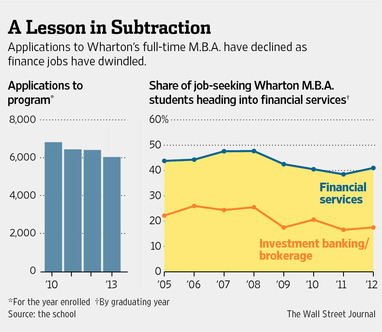
Something at Wharton doesn’t add up. Applications to the University of Pennsylvania’s business school have declined 12% in the past four years, with the M.B.A. program receiving just 6,036 submissions for the class that started this fall. That was fewer than Stanford Graduate School of Business, with a class half Wharton’s size. Wharton says the decline, combined with a stronger applicant pool and a higher percentage of accepted applicants who enroll, proves that the school is doing a better job targeting candidates. Read more of this post

Knowledge of Chinese Language Is Strategic Skill: Italian Experts

Knowledge of Chinese Language Is Strategic Skill: Italian Experts

2013-09-27 05:11:59 GMT2013-09-27 13:11:59(Beijing Time)  CRIENGLISH

In the globalized world, the knowledge of China’s language and culture is an increasingly important skill, Italian experts said on Thursday. Speaking at a conference in Milan, president of Italy China Foundation Cesare Romiti said that “expertise in China and its market has become fundamental.” Romiti, an economist and former executive of both state-owned firms and private companies, was among the first personalities in Italy to strengthen ties with China 10 years ago, when he founded the association to promote business and cultural links between the two countries. Read more of this post

Sea wolves: Sharks, it seems, are necessary for the ecological health of coral reefs

Sea wolves: Sharks, it seems, are necessary for the ecological health of coral reefs

Sep 28th 2013 |From the print edition

FOR decades, rangers in Yellowstone National Park, in the American West, had to cull the area’s red deer (known locally as elk, though they bear no resemblance to European elk, known locally as moose) because the animals’ numbers were grazing the place to death and thus threatening the livelihoods of other species. Many ecologists argued that the deer had once been kept under control by wolves, which had been hunted to extinction by people. When wolves were reintroduced to Yellowstone, in 1995, these arguments proved correct. The deer population fell to manageable levels, and culling stopped. Wolves, it turned out, played a crucial role in keeping the wider ecosystem intact. Now comes evidence that the same is true for another top predator: sharks. Read more of this post

Man Controls Artificial Leg Using Only His Brain, Researchers Say

Updated September 25, 2013, 7:16 p.m. ET

Man Controls Artificial Leg Using Only His Brain, Researchers Say

RON WINSLOW

Man Controls Artificial Leg Using Only His Brai

Researchers say that 32-year-old Zac Vawter successfully controlled movements of a motorized artificial leg using only his own thoughts. Video: Rehab Institute of Chicago.

In an advance that could eventually improve the mobility of thousands of people living with amputations, researchers said a 32-year-old man successfully controlled movements of a motorized artificial leg using only his own thoughts. Aided by sensors receiving impulses from nerves and muscles that once carried signals to his missing knee and ankle, the patient was able to climb and descend stairs and walk up and down inclines much as he could with a natural leg, based on directions that came from his brain. Importantly, he was able to flex the device’s ankle, enabling a near-normal gait, something not possible with current prosthetics. “It’s night and day” between the experimental bionic leg and the mechanical prosthetic limb he uses every day, said Zac Vawter, a software engineer from Yelm, Wash., who lost his right leg in a motorcycle accident four years ago. “Going upstairs with my normal prosthetic, my sound leg goes up first for every step,” he added. “With this I go foot-over-foot up the stairs and down the stairs.” Read more of this post

The 3 Books Amazon’s Jeff Bezos Asks His Senior Managers To Read

The 3 Books Amazon’s Jeff Bezos Asks His Senior Managers To Read

MAX NISEN SEP. 25, 2013, 5:02 PM 15,990 4

Jeff Bezos is one of the most successful entrepreneurs out there, able to build a company deeply integrated into people’s lives, all but ignoring Wall Street, and constantly looking toward the future.  But that doesn’t mean he doesn’t value other people’s advice. In a post on LinkedIn, CNBC tech correspondent Jon Fortt said the Amazon CEO had three all-day book clubs for his senior managers over the summer. It’s not a surprising management technique from a man who revers the written word. He typically starts meetings of his “S-team” of senior executives with 30 minutes of silence while they read through dense, six-page printed memos, so they’re all starting with the same ideas and framework in mind. In the recent book clubs, Bezos had those top executives read classics that helped him sketch out the future of his company. They are:

“The Effective Executive” by Peter Drucker

Drucker is one of the principle founders of modern management theory, helping create and broadly popularize ideas that seem commonplace now, like the fact that companies should be decentralized rather than run via command and control, and “management by objectives,” where both leaders and employees work toward a set of goals they understand and agree on. This particular book focuses on how to develop the personal habits of time management and effective decision-making that allow an executive to stay productive and contribute their best to an organization.

“The Innovator’s Dilemma” by Clayton Christensen

This book, first published in 1997, can safely be called one of the most influential business books of all time. Even if the term “disruption” has since been co-opted by the startup world and dramatically overused, his core theory of how businesses get disrupted is just as relevant today. New technology allows smaller companies to make cheaper products, which at first appeal only to customers at the margins. But before the largest businesses realize it, they take over entire markets.

“The Goal: A Process of Ongoing Improvement” by Eliyahu M. Goldratt and Jeff Cox

The last book is very different from the two previous ones. It’s not a classical business book based on a series of studies of a real-world company, but is instead a novel about a manager tasked with turning around a failing manufacturing plant. It sounds strange, but it was a best-seller and has helped spawn business theories in its own right.

12 Extremely Successful People Reveal How They Find Talent: Look for people who make you somewhat uncomfortable. Look for intellectual curiosity and people who are different than you

12 Extremely Successful People Reveal How They Find Talent

MAX NISEN AND VIVIAN GIANG SEP. 25, 2013, 4:06 PM 49,326

Talent is the most important asset in any company, and the most successful leaders know it. In a new LinkedIn series titled “How I Hire,” more than 80 top executives — including billionaire Richard Branson, former Bank of America exec Sally Krawcheck, and Warby Parker’s Neil Blumenthal — break down the core of their hiring philosophies.  Although these entrepreneurs and business leaders have stepped outside of the day-to-day process of hiring, they still spend a lot of time thinking about the sort of people they want on board. A common theme? Resumes and qualifications are less important than they seem. These leaders also look for passion, and seek people with unusual experience that can add something new. In other words, you can have the wrong resume, but still be right for a job. Virgin Chairman Richard Branson: Hire for personality first, and look at qualifications last. Read more of this post

Failure versus face: how can Asia produce startups despite its culture?

Failure versus face: how can Asia produce startups despite its culture?

September 26, 2013

by Anh-Minh Do

You can blame China. It’s the biggest, most influential, and most long-standing civilization in Asia that came up with such aphorisms as:

A family’s ugliness should never be publicly aired.

By ugliness it means misfortune. And since Chinese civilization has dominated, conquered, influenced, and traded with almost every civilization in the Asian continent, rest assured the Middle Kingdom’s values have spread far and wide. Asians don’t want to lose face, much less misplace it. This is a nightmare for building a healthy startup culture.

What face does for failure

As some historians and translators have noted, it’s impossible to translate ‘face’. But it boils down to doing what is acceptable and honorable in society in light of what other people think of you and yours. Failing will surely result in losing face. Is it any wonder then why Asian parents want their children to become doctors, engineers, and lawyers? These are secure jobs that are guaranteed careers. The Asian status quo is wealth, good family, and health. Breaking the status quo is certain to cause a loss of face. It’s too risky. But that’s what startups are about. Read more of this post

The Koffler Group, a US-based family office, has traditionally travelled light when it comes to debt, but Campden talks to the third-gen who has been fearless in making sure it now has a mixed bag of investments

TRAVEL MONEY

ARTICLE | 26 SEPTEMBER, 2013 10:43 AM | BY PAUL GOLDEN

OLYMPUS DIGITAL CAMERA

The family fortune may have been made by an inherently conservative investor with a flair for designing suitcases, but when it comes to investment strategy subsequent generations of the Koffler family have been determined not to carry any baggage. Sol Koffler is a poster child for the American dream. Arriving in the US from eastern Europe in 1920 at the age of 13, he started selling $1 suitcases as the Great Depression reached its peak. Over the next 46 years he built American Tourister into the second largest luggage company in the country. The Koffler Group family office was established in 1979 from the proceeds of the sale of American Tourister to the Hillenbrand Company and for 14 years was run on the same prudent lines by an entrepreneur who didn’t believe in taking on debt. Read more of this post

Two thirds of Australian family businesses do not have a succession plan in place despite the majority of family chief executives being over the age of 50 and nearly 20% being over the age of 65

AUSTRALIAN FAMILY FIRMS FAILING TO PREPARE FOR SUCCESSION

ARTICLE | 23 SEPTEMBER, 2013 04:40 PM | BY JESSICA TASMAN-JONES

Two thirds of Australian family businesses do not have a succession plan in place despite the majority of family chief executives being over the age of 50 and nearly 20% being over the age of 65, according to a KPMG and Family Business Australia survey. Seventy-two per cent of family businesses listed balancing family and business issues as the primary challenge for their family firm, and 67% said maintaining family ownership was a primary concern. The biennial report, this year titled Performers: resilient, adaptable, sustainable and conducted in collaboration with the University of Adelaide’s Family Business Education and Research Group, found 71% of families intend to retain family ownership, but around half would consider a sale if approached. First generation firms were more likely to consider a sale than family firms in their second generation or beyond. Read more of this post

What Should I Do Next with My Life? New Ways to Define Success

What Should I Do Next with My Life? New Ways to Define Success

Sep 24, 2013 

Wharton professor G. Richard Shell‘s new book, Springboard: Launching Your Personal Search for Success, encourages readers to embrace major transitions in life, from college to a first job, from one career to the next or from work to retirement. Based on a popular course Shell teaches at Wharton, the book departs from the conventional “how to succeed” formula by challenging readers to define success for themselves.

An edited version of the transcript appears below.

Knowledge@Wharton: You are well known for your work in negotiation and persuasion, so why write a book about success?

Shell: It’s been a long journey. The materials on success actually preceded the materials on negotiation and persuasion. I’ve been interested in success since I was in my 20s, and it also feeds into a passion I have in my teaching to help students and executives bring more self awareness to their career choices, whatever they are. The subject of success allows me to do that directly. Read more of this post

How to keep your indie soul; it can be a challenge for small, independent brands to maintain their spirit as they expand

September 25, 2013 4:25 pm

How to keep your indie soul

By Ian Sanders

Independent mindset: Dorian Waite of restaurant Honest Burgers

It is Monday lunchtime in London’s Soho and there is a line of people waiting outside Honest Burgers on Meard Street. There is plenty of choice for a lunchtime burger in Soho but Honest, a three-restaurant business that launched in Brixton market in 2010, is popular. The business seeks to differentiate itself through an independent spirit; having worked for chain restaurants in the past, co-founder Dorian Waite says he is striving for a different approach. “A lot of big businesses seem happy to deceive their customers,” he says. “Everything’s built around making money, not giving people what they want. We felt there was an opportunity to turn that on its head.” Read more of this post

Ben Graham: The Einstein of Money

Ben Graham: The Einstein of Money

by ValueWalk StaffSeptember 24, 2013

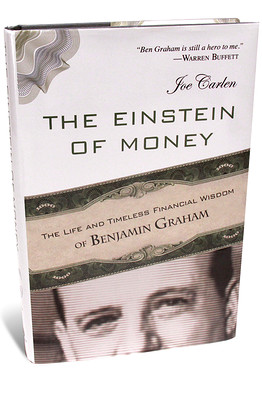
Book-Review-Einstein-of-Money

In 1934, Benjamin Graham revolutionized the investment world with the publication of his book Security Analysis. “The Value Bible,” as modern investors affectionately call it, contained Graham’s accumulated wisdom from years of evaluating and expertly buying/selling stocks in an unprecedented, but radically successful, manner. In fact, Graham defied all contemporary investing strategies in such a way that Warren Buffet, cited as the third richest man in the world, would credit Graham as the predominant influence on his investment strategy in an article published over 70 years after Security Analysis. Read more of this post

A massive statue of Buddha believed to be over 1,000 years old was shown to the media for the first time at the Haeinsa Temple in Hapcheon, South Gyeongsang Province

2013-09-25 19:48

1,000-year-old Buddha open to public

Baek Byung-yeul

130925_p01_buddha

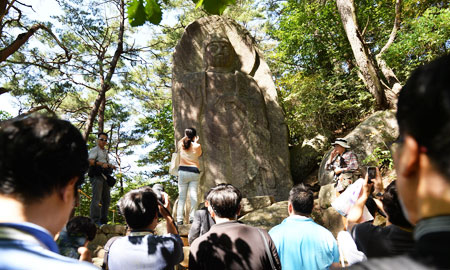
Tourists take photos of the “Maebul” or the rock-carved standing Buddha at the Haeinsa Temple in Hapcheon, South Gyeongsang Province, Wednesday. The temple unveiled the ninth-century statue prior to the opening of the 2013 Tripitaka Koreana Festival, which kicks off today for 46 days.
/ Korea Times photo by Shim Hyun-chul

HAPCHEON, South Gyeongsang Province — A massive statue of Buddha believed to be over 1,000 years old was shown to the media for the first time Wednesday at the Haeinsa Temple in Hapcheon, South Gyeongsang Province. The temple, which also keeps the “Tripitaka Koreana,” a 13th-century collection of Buddhist texts recorded on 80,000 woodblocks, and listed as a UNESCO Cultural Heritage, will unveil the statute to the public from Thursday to Nov. 10 to promote its annual “Tripitaka Koreana Festival.”
The sculpture, carved on a spread of rock located deep behind the temple complex, has been accessed only by monks since its creation in the 9th century, perhaps around the time when Haeinsa was built during the Silla Kingdom (57 B.C.-935 A.D.). It’s one of the country’s largest “maebul,” or rocked-carved standing Buddha statues, measuring 7.5-meters in height and 3.1 meters in width, and is a designated national treasure. “The Cultural Heritage Administration has been strictly limiting pedestrian access to the 2.7-kilometer trail (on the slopes of Mt. Gaya) that connects the statue with the temple. Permission for public access is temporary and only between 10:30 a.m. to 4 p.m.,” said an official from the temple. “The trail has been protected as a revered place for monks who regularly visit the statue for prayer, so we would like to request visitors to be extra considerate. There will be security guards placed around the statue and Haenisa monks will serve as guides.” The Tripitaka Koreana Festival, which was inaugurated in 2011, offers a variety of cultural events that organizers say can be enjoyed by all people. Tickets cost 4,000 won for children, 6,000 won for middle and high school students and 8,000 won for adults. It will open from 10 a.m. to 7 p.m. For more information, call (055) 211-6251 or visit its official English webpage at www.tripitaka-festival.com/english.do.

Jesus was the world’s first tweeter: Vatican

Jesus was the world’s first tweeter: Vatican

Wednesday, September 25, 2013 – 22:26

AFP

ROME – Jesus Christ was the world’s first tweeter because his pronouncements were “brief and full of meaning”, Vatican cardinal Gianfranco Ravasi said Wednesday. Christ “used tweets before everyone else, with elementary phrases made up of fewer than 45 characters like ‘Love one another'”, said Ravasi, the Vatican’s equivalent of a culture minister. “A bit like in television today, he delivered a message through a story or a symbol,” Ravasi said at a conference with Italy’s leading newspaper editors. The cardinal emphasised the importance of clergy making full use of modern-day computer technology. “If a cleric, a pastor is not interested in communication, they are defying their duty,” he said. The Vatican has stepped up its presence on the Internet in recent years, initially under Benedict XVI and now under Pope Francis, who has more than three million followers on Twitter in English alone. Francis has also resorted to more traditional media, cold-calling ordinary faithful who have written to him and writing lengthy letters on religious issues that have appeared in the Italian press.

The Benefits of Negative Feedback

The Benefits of Negative Feedback

by John Butman  |   9:00 AM September 16, 2013

I recently gave a lunchtime “author’s talk” at Children’s Hospital in Boston and, although I thought the talk went well, somebody in the audience didn’t like it at all. On the evaluation form, the person in question wrote a single word in the comment box: CONFUSING. Thank you, whoever you are. While everybody else gave me good marks and said nice things, which I appreciated, my critic forced me into self-examination. Was he the only one forthright enough to speak up, or was he the only one not paying enough attention to get it? What was confusing? The ideas? The presentation? Read more of this post

How The Founders Of Warby Parker Disrupted The Eyewear Industry By Going Against Their Original Idea

How The Founders Of Warby Parker Disrupted The Eyewear Industry By Going Against Their Original Idea

KAMELIA ANGELOVA AND ROBERT LIBETTI SEP. 25, 2013, 3:47 PM 2,248 1

This is the eighth post of the “Inspired to Strive” series, in which business leaders share their stories of success. “Inspired to Strive” is sponsored by CIT. See more posts in the series »

When Neil Blumenthal and his friends started Warby Parker, they wanted to disrupt the optical industry. But they never expected to do it so quickly. In three years, Warby Parker has built a recognizable brand with over 300 employees managing a successful online business and retail stores and showrooms in New York, Boston, Los Angeles, and San Francisco. Despite the fast-changing company dynamics, the four co-founders – Andrew Hunt, Jeffrey Raider, David Gilboa and Blumenthal – came up with ways to keep each other in check, and to make sure they made collective decisions about the direction of the company. We interviewed Blumenthal about the strategies his team used to get exposure and expand the company, and how betting against their original idea about an online-only business has paid off tremendously.

13 Everyday Phrases That Actually Came From Shakespeare

13 Everyday Phrases That Actually Came From Shakespeare

CHRISTINA STERBENZ SEP. 25, 2013, 11:20 AM 16,428 8

Just the mention of William Shakespeare makes some people cringe. Even I’ll admit his writing seems daunting at times. Whether a fan or not though, you probably use many of Shakespeare’s phrases on a regular basis. Here’s a list of 13 popular, albeit strange, sayings The Bard coined. In fact, we say or write some of these so often, they’ve become clichés.

1. “Green-eyed monster”

Meaning: jealousy.

In “Othello,” Iago describes jealousy as a monster which devours its source.

“Oh, beware, my lord, of jealousy!
It is the green-eyed monster which doth mock
The meat it feeds on” (Act 3, Scene 3).

In this case, Iago uses romance as an example. He thinks a man would rather know his wife is cheating than suspect her without proof. Read more of this post

Why Ferrari Chief Has Mellowed; Montezemolo’s Passion Is Still There, but He Takes a Philosophical Approach

September 25, 2013, 4:55 p.m. ET

Why Ferrari Chief Has Mellowed

Montezemolo’s Passion Is Still There, but He Takes a Philosophical Approach

JOSHUA ROBINSON

ES-AD164_FERRAR_G_20130925163739

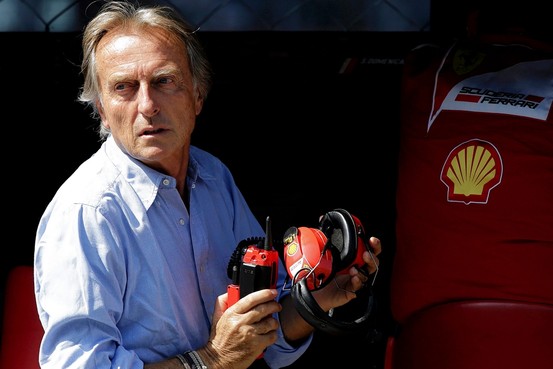
Ferrari chairman Luca di Montezemolo in the team’s pit during the third practice session of the Italian Grand Prix at the Monza circuit on Sept. 7.

MARANELLO, Italy—For the past 22 years, a third of the company’s history, Ferrari SpA has been in the hands of chairman Luca Cordero di Montezemolo. A successful, outspoken businessman who is often mentioned in discussions of high-level Italian politics—but hasn’t held public office—he is about as close as you can get to Italian royalty these days. But Formula One is still in his blood. Montezemolo, after all, was appointed Ferrari’s sporting director in 1974 by Enzo Ferrari himself. And, during his tenure, the team won two world titles. Now, from his office overlooking a constant parade of supercars, he isn’t quite as obsessed as he was. There was a time, he said, where he could only think, “If Ferrari comes second, it’s a disaster. It’s a disaster! We are obliged to win.” Read more of this post