Book Review by The Rational Walk: The Manual of Ideas

Book Review: The Manual of Ideas

The Rational Walk, Published on September 27, 2013 at 4:01 pm

It’s not given to human beings to have such talent that they can just know everything about everything all the time. But it is given to human beings who work hard at it – who look and sift the world for a mispriced bet – that they can occasionally find one.

— Charlie Munger

During a visit to Columbia Business School many years ago, a student asked Warren Buffett how one could best prepare for an investing career.  Mr. Buffett picked up a stack of financial reports he had brought with him and advised the students to read “500 pages like this every day”.  One of the students in the class happened to be Todd Combs.  Mr. Combs took the advice quite literally and eventually got into a habit of reading far more than 500 pages per day.  This work ethic contributed to a successful career running a hedge fund and a position at Berkshire Hathaway allocating several billion dollars of capital. Read more of this post
Arnault Pits Son Versus Daughter in LVMH Succession Test

Arnault Pits Son Versus Daughter in LVMH Succession Test

Two years ago, Bernard Arnault asked his son Antoine to run shoemaker Berluti, then this month he installed his daughter, Delphine, as executive vice president of Louis Vuitton. While her brief is to revive the handbag maker and Antoine’s task is to transform Berluti into a menswear titan, Arnault is auditioning both for another job: his own. At 64, the chief executive officer of LVMH Moet Hennessy Louis Vuitton SA (MC), already qualifies for his state pension. He hasn’t signaled he’s tiring of running the world’s largest luxury-goods company, but “at some point there is an element of succession that needs to take place,” said Berenberg analyst John Guy. Giving his children greater responsibility allows Arnault to test them, Guy said. Read more of this post
Ed Han and his wife went looking for birth announcements. What they ended up with was part of a $333 million payday

September 30, 2013

HOW I THOUGHT OF IT

The Stork Brought a Bright Idea for a Business

Ed Han and his wife went looking for birth announcements. They ended up with part of a $333 million payday. Back in 2005, Mr. Han, a new Stanford M.B.A., and his wife, Polly Liu, were expecting a daughter and were scouring the Web for just the right notices to celebrate the event. “Going back and forth with store clerks to review endless, illegible faxed proofs of baby announcements just weeks after having a baby and likely sleep deprived seemed quite unfun,” Mr. Han says. But they couldn’t find anything affordable and well designed. Mr. Han—who had already been thinking about starting a business with a couple of friends—saw an opportunity. He joined with Laura Ching and Kelly Berger to start an online company that would design personalized baby announcements, and then go after more of the U.S. card market. Read more of this post
Schwarzman Says Selling BlackRock Was ‘Heroic’ Mistake

Schwarzman Says Selling BlackRock Was ‘Heroic’ Mistake

Steve Schwarzman said his decision 19 years ago to sell what would become the world’s largest money manager was a “heroic” mistake. Schwarzman, who runs Blackstone Group LP (BX), the largest manager of alternative investments such as private equity, in 1994 sold a mortgage-securities unit with $23 billion in assets to PNC Bank Corp. for $240 million. Schwarzman, Blackstone’s co-founder, had disagreed with the group’s leader, Laurence Fink, over methods of compensation, and the men parted ways. The unit, which traded mortgages and other fixed-income assets, changed its name from Blackstone Financial Management to BlackRock Financial Management. Read more of this post
Phil Di Bella: Passion is the one thing experience can’t teach

Phil Di Bella: Passion is the one thing experience can’t teach

Published 30 September 2013 11:44, Updated 30 September 2013 12:57

Phil Di Bella

c14ab936-259a-11e3-bbca-a7ec88bfff7c_750334175--646x363

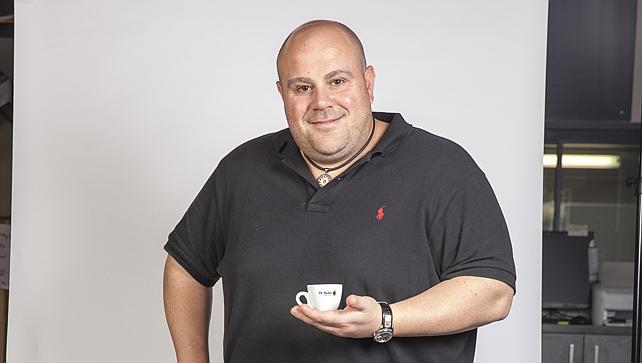
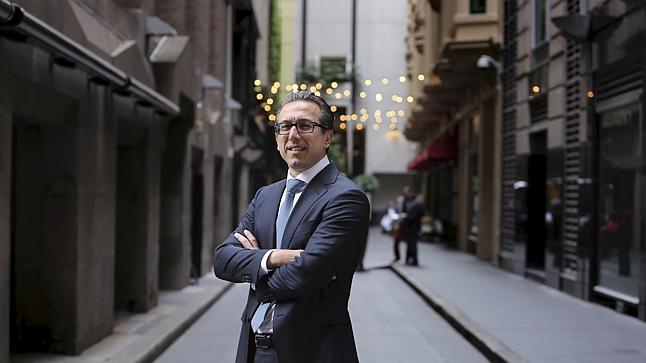
Phillip Di Bella says, ‘Identify your passion, and see if you can build a business around it.’Photo: Glenn Hunt

I spoke at a conference for Banana Growers not long ago. Now, I know you’re thinking, what does Phillip Di Bella know about growing bananas? Nothing! So why did they ask me to speak? What could I share that would inspire farmers? The answer is: passion. Or more specifically, my own passion for my work, and my mission to inspire it in others, whatever their ambition. I think it’s a message that we all need to be reminded of from time to time. Read more of this post
How to trust intelligently

How to trust intelligently

Posted by: Tedblogguest
September 25, 2013 at 11:52 am EDT

“The aim [in society] is to have more trust. Well frankly, I think that’s a stupid aim,” says Baroness Onora O’Neill in today’s talk, What we don’t understand about trust. She argues that the aim to build more trust is a cliché, and instead what we need is more trustworthiness. Below O’Neill gives a more nuanced picture of how to trust more intelligently, based on her criteria for trustworthiness.

By Onora O’Neill

Nobody sensible simply wants more trust. Sensible people want to place their trust where it is deserved. They also want to place their mistrust where it is deserved. They want well-directed trust and mistrust. Trust is well placed if it’s directed to matters in which the other party is reliable, competent and honest — so, trustworthy. Can you trust the corner shop to sell fresh bread? Can you trust your postman to deliver letters? Can you trust your colleagues not to gossip about confidential matters? Can you trust the tax man to calculate what you owe accurately? Trust is badly placed if it’s directed to matters in which others are dishonest or incompetent or unreliable. Read more of this post
Why the Danish mermaid is happier than the S’pore Merlion

Why the Danish mermaid is happier than the S’pore Merlion

According to the second World Happiness Report survey released earlier this month, cold and unspectacular Denmark was again ranked the happiest nation in the world. Singapore in 30th place can at least boast of being the happiest in Asia.

BY AVI LIRAN –

4 HOURS 10 MIN AGO

According to the second World Happiness Report survey released earlier this month, cold and unspectacular Denmark was again ranked the happiest nation in the world. Singapore in 30th place can at least boast of being the happiest in Asia. The standard of living in both countries is high. Singapore ranks 4th in gross domestic product per capita; Denmark is 16th. The Republic has 5.4 million inhabitants, slightly fewer than the 5.6 million Danes. However, Denmark has the lowest level of income inequality in the world, whereas Singapore has one of the highest among the advanced economies. What are the secret ingredients of the Danes’ happiness? Read more of this post
Change rewards culture to fix the integrity minefield

September 29, 2013 8:37 pm

Change rewards culture to fix the integrity minefield

By John Authers

Is the UK’s wealth management industry “open, honest, transparent and fair”? That was the question put to several hundred members of the Chartered Institute of Securities and Investment this week, at its annual debate in the City of London. All worked in the industry. To vote against implied a belief that they were working in a “closed, dishonest, opaque and unfair” industry. And yet almost half did vote against, with the motion carrying only by a wafer-thin majority. Read more of this post
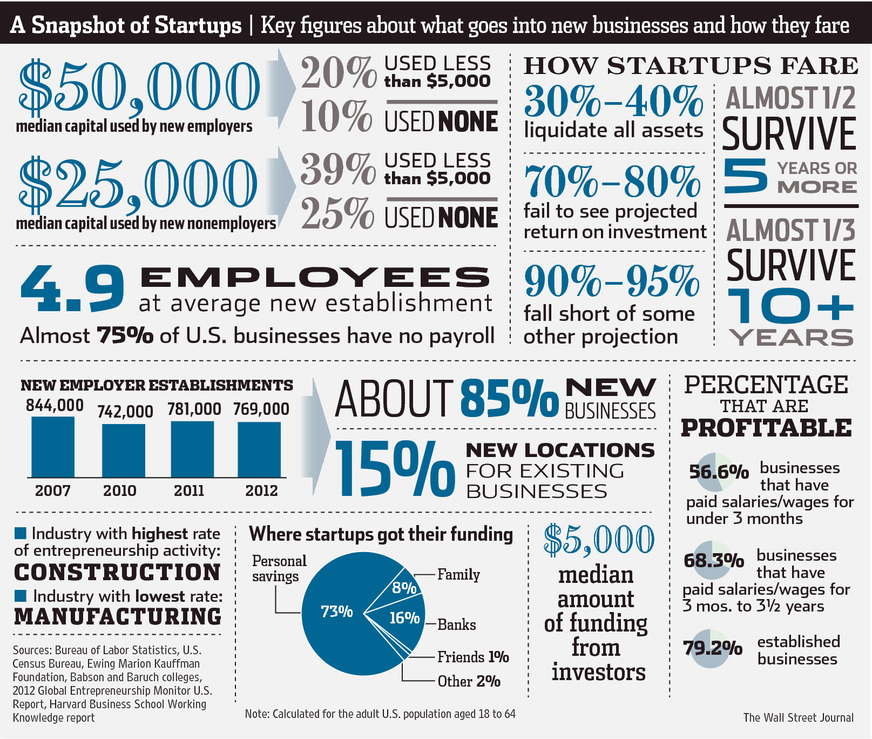
You Have a Great Idea. Now What Do You Do? Many people have no desire to start a business, but they want to make money from their inspiration. Here are some options for doing just that.

September 30, 2013

You Have a Great Idea. Now What Do You Do?

Many people have no desire to start a business, but they want to make money from their inspiration. Here are some options for doing just that.

NEIL PARMAR

SM-AA796_IDEAch_G_20130926120305

Want to know a couple of secrets? You don’t have to be an entrepreneur to have a great idea for a business. And you don’t need to start a business to profit from a great idea. Inspiration can strike anybody—it happens all the time. Someone is struggling with a chore around the house and thinks of a gadget that would be a big help. Or maybe they’re rooting around for obscure information online and realize an app could automate the job. Read more of this post
It’s a woman’s world when nühanzi step up

It’s a woman’s world when nühanzi step up

By Chen Chenchen (Global Times)    08:11, September 30, 2013

Several photos that recently went viral on Weibo, or China’s Twitter-like microblog,showing a girl drinking from a jug instead of a cup and another trimming her toenails withan awe-inspiring pair of pliers rather than a clipper, have drawn attention to the risingdemographic of nühanzi, or manly women. In a bid to redefine the word “female” in China, these “tough Chinese girls” are pointing usback to the periodic table. Given that “fe” represents “iron” – “female” could translate to”iron male” or someone manlier than a man himself, they argue.  Read more of this post

Jimmy Choo founder Tamara Mellon puts the boot into private equity; They come in and raid – raid your bank account and take your accomplishments. It’s all about fattening the pig for the slaughter, with no care about the people or the product. They came in, their only focus was their exit strategy, [and] on exit, you are thrown to the wolves.”

Jimmy Choo founder Tamara Mellon puts the boot into private equity

The Jimmy Choo co-founder wants to boot private equity out of fashion.

mellon_2685574b

Tamara Mellon co-founded Jimmy Choo in 1996, after a stint as Vogue’s accessories editor Photo: Rex Features

By Katherine Rushton

9:00PM BST 28 Sep 2013

The first fashion collection Tamara Mellon will produce under her own name includes an extraordinary garment called “Sweet Revenge” – a pair of tight-fitting leather leggings that end with high-heeled boots. The Jimmy Choo co-founder is counting on this item to put her new venture on the map. The name is deliberate. It is, she says with a wry laugh, an example of the kind of innovation that was all but bled out of the luxury shoe label before her departure in 2011. Mellon, 46, takes a dim view of the private equity industry’s compatibility with the fashion business, or any creative endeavour for that matter, after a bruising decade at Jimmy Choo while it was being passed between different private equity owners. “They’re the sociopaths of investment banking,” she says. “They come in and raid – raid your bank account and take your accomplishments. It’s all about fattening the pig for the slaughter, with no care about the people or the product. “I’ve been through three private equity deals, and it was the same thing, every time. They came in, their only focus was their exit strategy, [and] on exit, you are thrown to the wolves.” Read more of this post

How Converse went from bankruptcy to a $1.4 billion business

How Converse went from bankruptcy to a $1.4 billion business

By Laura Lorenzetti September 28, 2013

converse-annual-revenue-revenue_chartbuilder

As its parent company commands, Converse is just doing it. The 105-year-old brand has grown at breakneck pace since Nike rescued the company in 2003, two years after it filed for bankruptcy. Since its cultural heyday in the ’80s, the hip sneaker has experienced a rebirth. On Thursday, Converse posted an 18% increase in revenue over the past three months, a shining star on an overall impressive balance sheet for Nike. From now on Converse will report its earnings separately, heralding the brand’s standalone success. In 2002, the flailing company reported just $205 million in revenue. Since, Nike has transformed the brand into a $1.4 billion business—and this year’s revenue is on pace to surpass that number. Converse has seen the strongest growth in the North America, China and the UK, where it’s made significant investments over the past several years. How was Converse able to turn around?

Read more of this post
Managing the “Unmanageable”: Radical Innovation

Managing the “Unmanageable”: Radical Innovation

by David Küpper, Markus Lorenz, Andreas Maurer, and Kim Wagner

SEPTEMBER 25, 2013

Overview

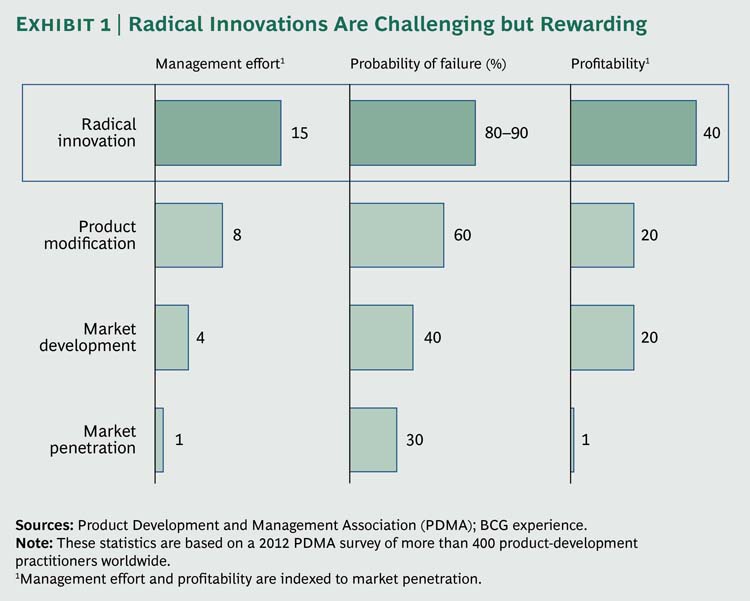
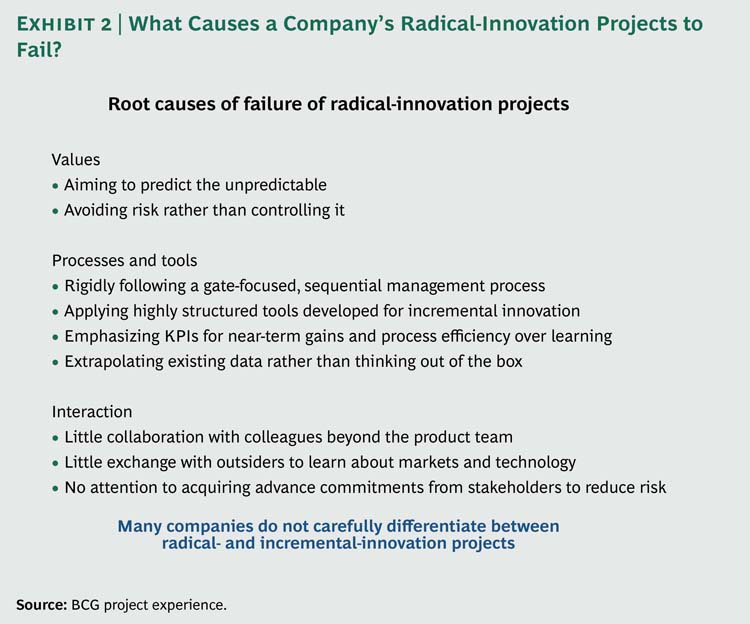
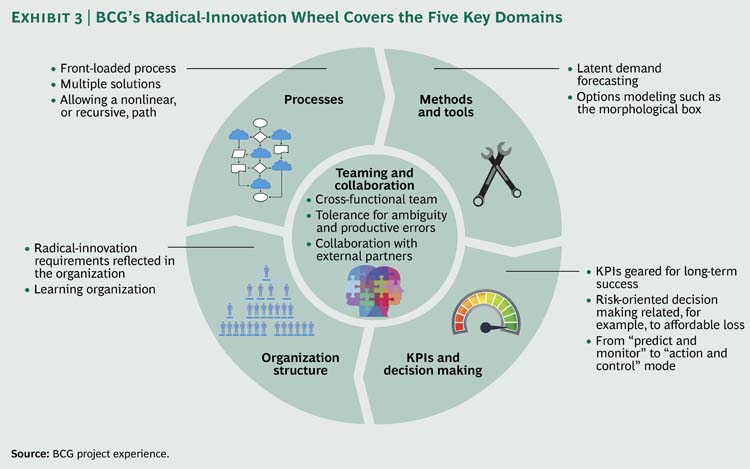
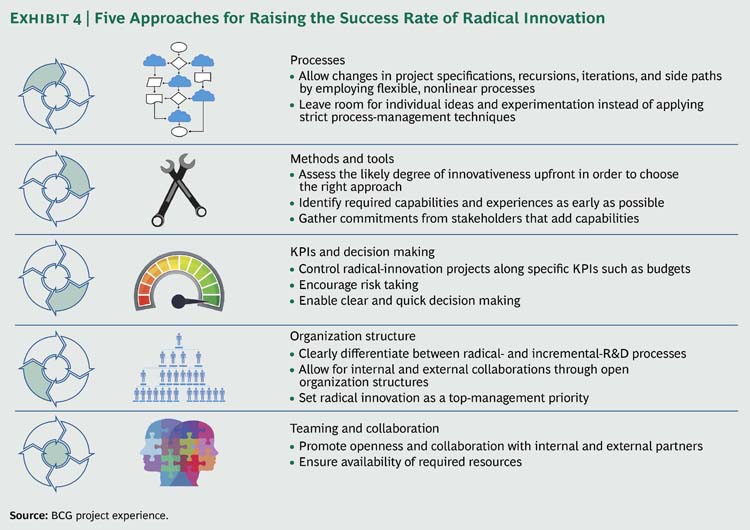
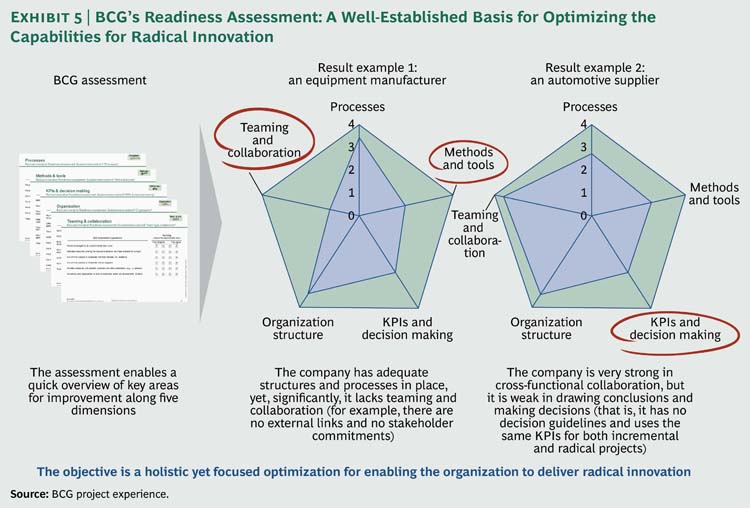
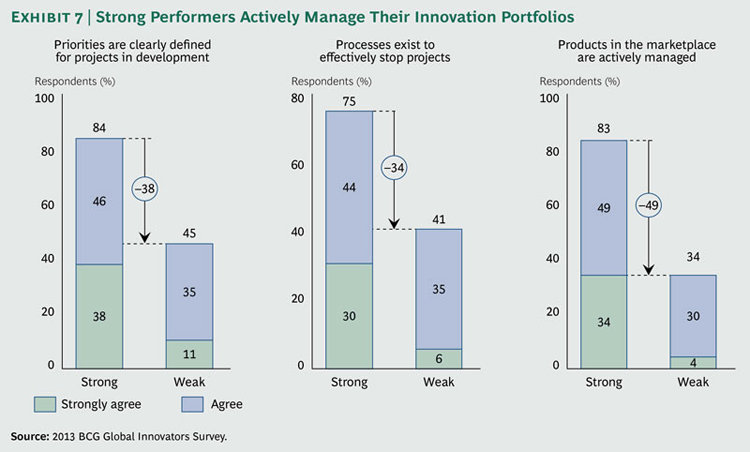
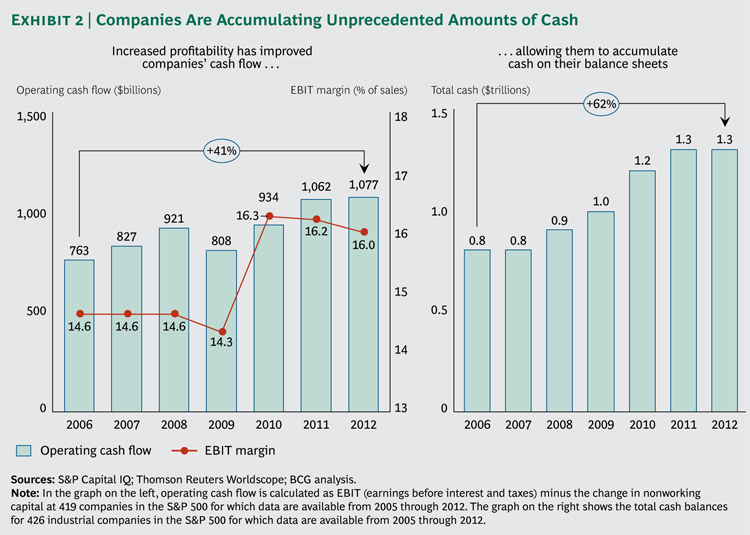
In recent decades, one of management’s objectives has been to add discipline to innovation. Companies have greatly improved the efficiency of new-product development, and managers have been able to draw on a variety of processes, methods, and tools to maximize the return on their R&D investment. Unfortunately, these advances have had the unintended consequence of discouraging radical innovation: technical breakthroughs that render existing products obsolete or that create new markets altogether. In this report, we look at products—not services or business model innovation. Unlike incremental innovation, radical innovation involves a great deal of uncertainty—the very quality that is not tolerated by most management techniques. As a result of this intolerance for uncertainty, companies have been undertaking less and less radical innovation. A recent study by the Product Development and Management Association found that radical innovation accounted for only 10 percent of an average company’s innovation portfolio, down from 21 percent in 1990. As the new productivity measures gained traction, managers naturally gravitated to projects that succeeded under the new constraints. More and more, breakthrough projects with high failure rates and less predictability lost out when investment priorities were set.

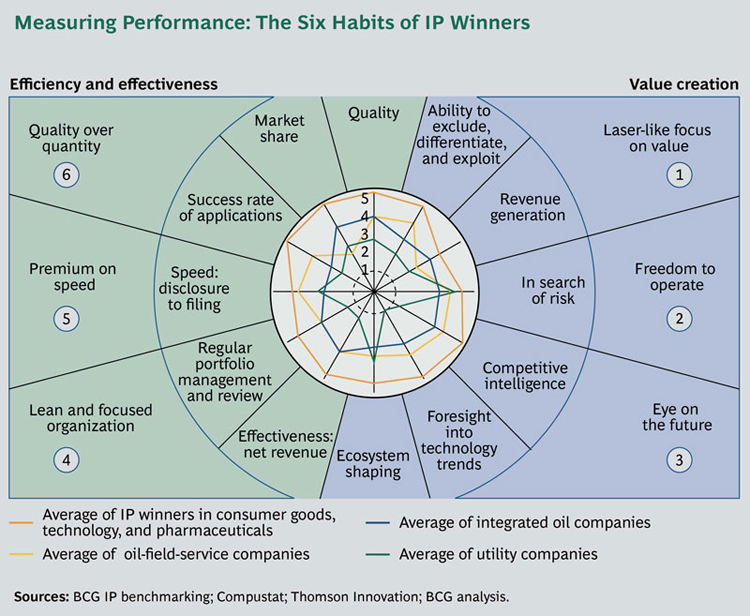
Managing_Unmanagable_Ex1_Large_tcm80-145175 Managing_Unmanagable_Ex2_Large_tcm80-145178 Managing_Unmanagable_Ex3_Large_tcm80-145181 Managing_Unmanagable_Ex4_Large_tcm80-145184 Managing_Unmanagable_Ex5_Large_tcm80-145187 Read more of this post

The Most Innovative Companies 2013: Lessons from Leaders

The Most Innovative Companies 2013: Lessons from Leaders

by Kim Wagner, Eugene Foo, Hadi Zablit, and Andrew Taylor

SEPTEMBER 26, 2013

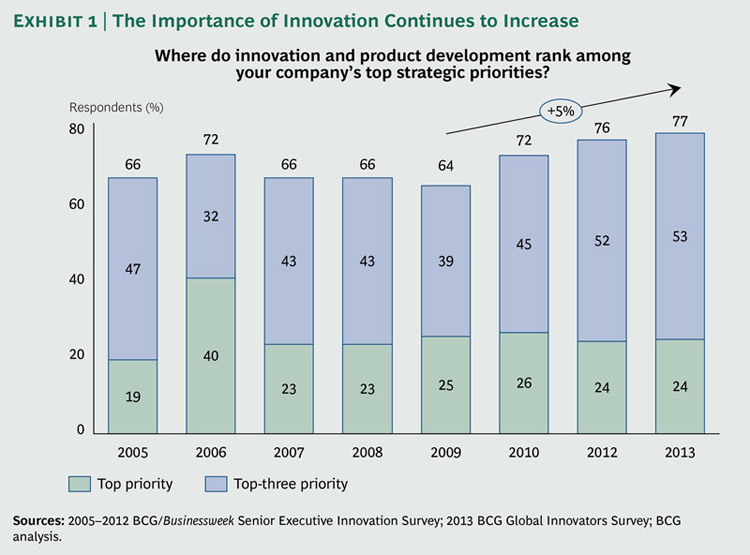
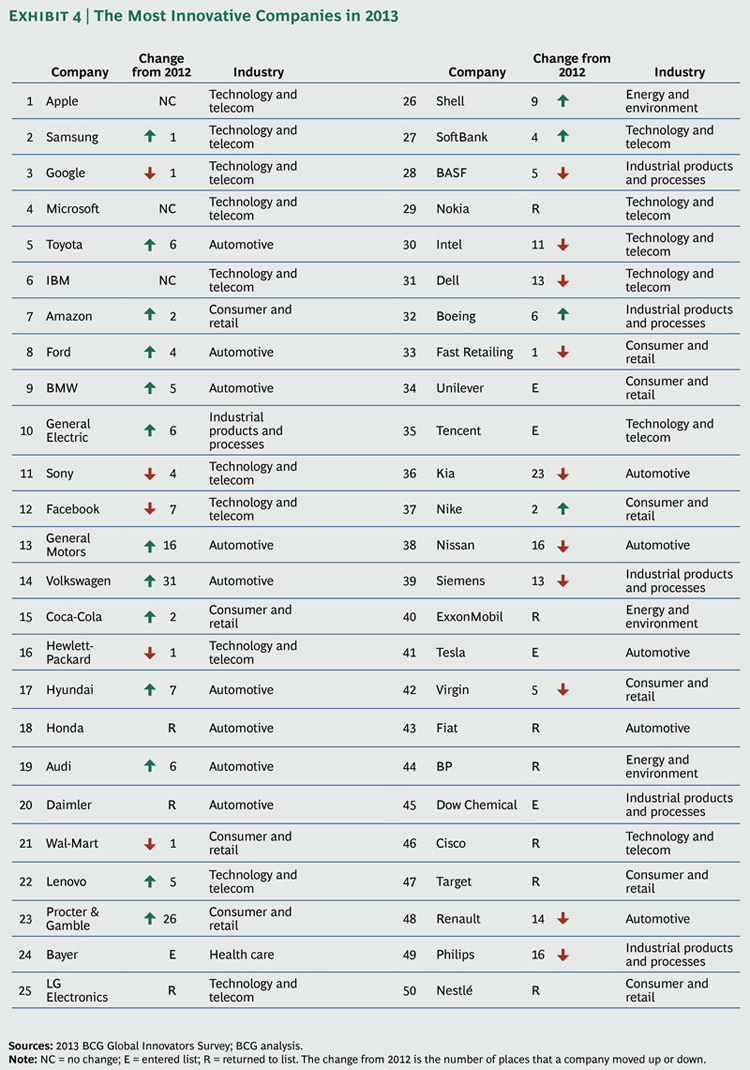
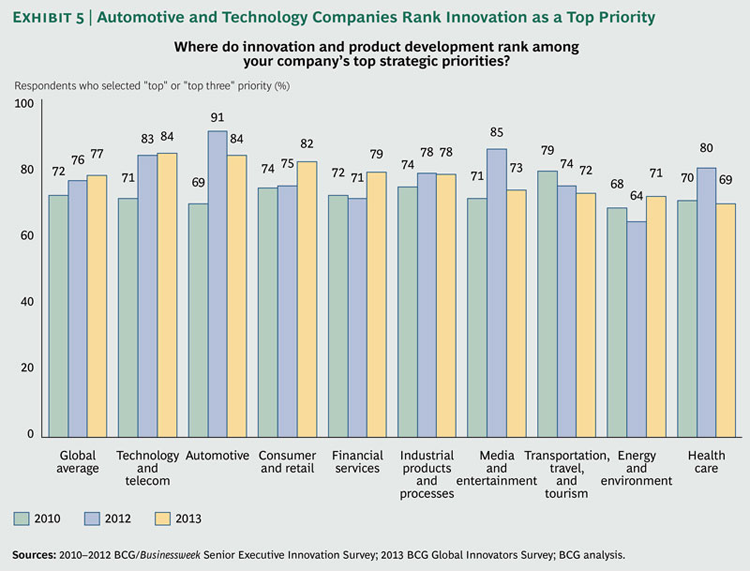
“Innovate or die,” goes the oft-cited corporate cry, and according to The Boston Consulting Group’s most recent survey of innovation and new-product development, companies across all industries and regions have taken the admonition to heart. Respondents ranked the importance of innovation higher than ever, building on a trend of the last five years.

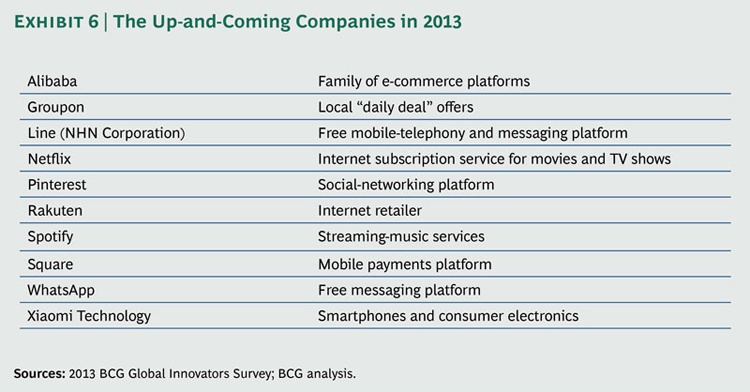
(https://www.bcgperspectives.com/content/interactive/innovation_growth_most_innovative_companies_interactive_guide/)BCG has explored the state of innovation with eight surveys since 2005. The data collected from more than 1,500 senior executives each year allow for comparisons over time as well as across regions and industries. The findings capture executives’ views of their own innovation plans, as well as their opinions of other companies’ innovation track records. As in past surveys, the 2013 results reveal the 50 companies that executives rank as the most innovative, weighted to incorporate relative three-year shareholder returns, revenue growth, and margin growth. The list has its share, as always, of well-known technology innovators (especially among the top ten), but automakers also show a strong surge, a trend that began last year and gathered strength in the current results. This time, we also asked respondents to identify up-and-coming companies at which innovation is driving rapid growth.

Most-Innovative-Companies-2013_ex1_large_tcm80-144756 Most-Innovative-Companies-2013_ex2_large_tcm80-144759 Most-Innovative-Companies-2013_ex3_large_tcm80-144762 Most-Innovative-Companies-2013_ex4_large_tcm80-144765 Most-Innovative-Companies-2013_ex5_large_tcm80-144768 Most-Innovative-Companies-2013_ex6_large_tcm80-144741 Most-Innovative-Companies-2013_ex-sidebar_large_tcm80-144753 Most-Innovative-Companies-2013_ex7_large_tcm80-144744 Read more of this post

How Value Patterns Shape Priorities for Value Creation

How Value Patterns Shape Priorities for Value Creation

by Gerry Hansell, Jeff Kotzen, Eric Olsen, Frank Plaschke, and Hady Farag

SEPTEMBER 17, 2013

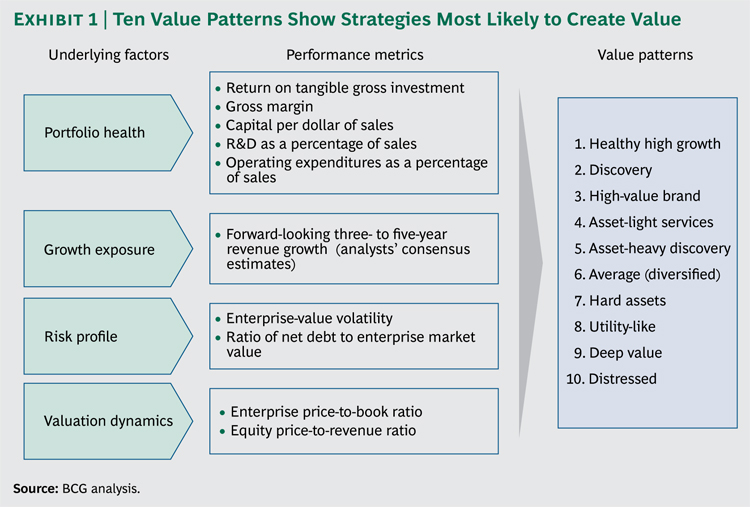
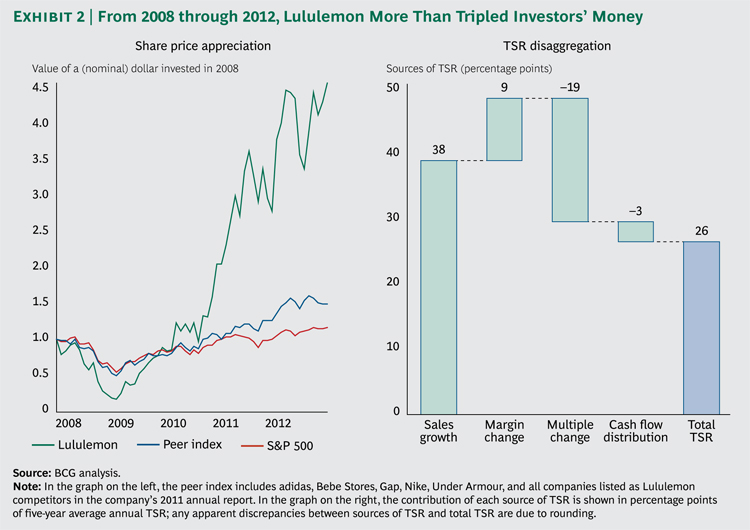
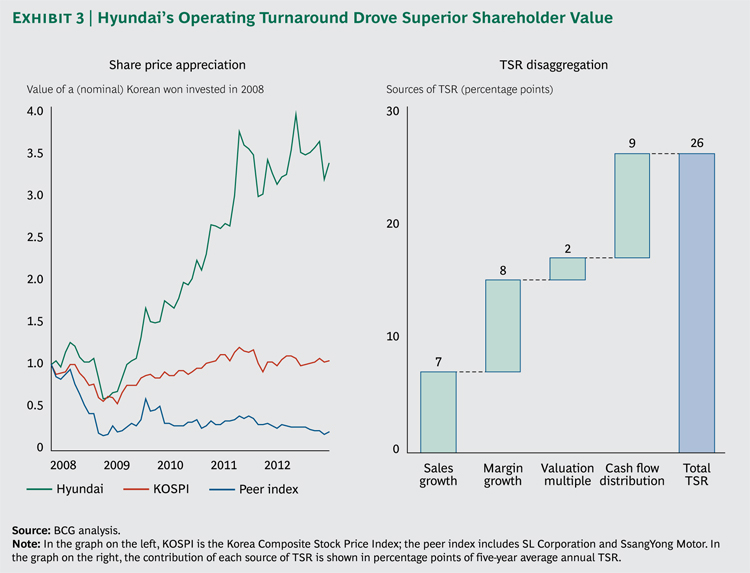
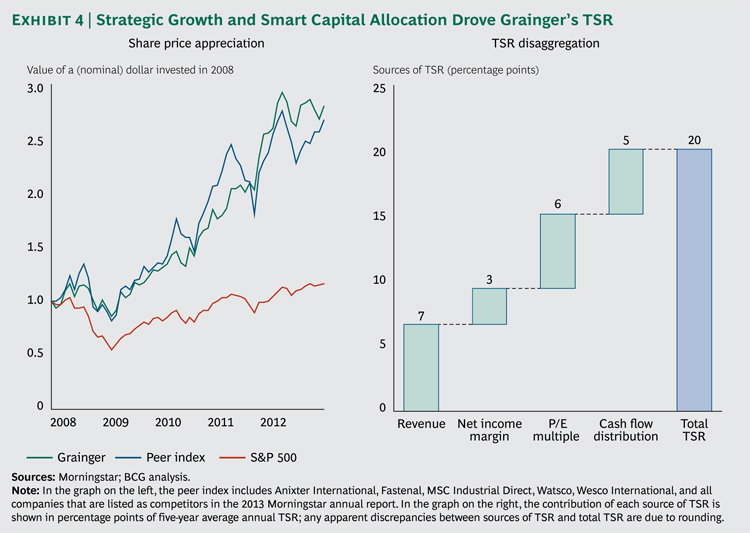
How do successful companies make the right choices in order to create attractive shareholder value? There is no one simple or universal formula. Companies as different as the North American retailer of high-end yoga and exercise clothes Lululemon Athletica, the Korean automaker Hyundai Motor Company, and the U.S. industrial supplier W.W. Grainger all delivered shareholder returns over the past five years that were strong enough to earn them a spot in our top-ten rankings in their respective industries. But they illustrate the diversity of company starting positions, and each achieved superior performance following quite different paths.

Value_Creators_2013_art2_Ex1_lg_tcm80-143751 Value_Creators_2013_art2_Ex2_lg_tcm80-143754 Value_Creators_2013_art2_Ex3_lg_tcm80-143757 Value_Creators_2013_art2_Ex4_lg_tcm80-143760 Read more of this post

Unlocking New Sources of Value Creation

Unlocking New Sources of Value Creation

by Gerry Hansell, Jeff Kotzen, Eric Olsen, Frank Plaschke, and Hady Farag

SEPTEMBER 17, 2013

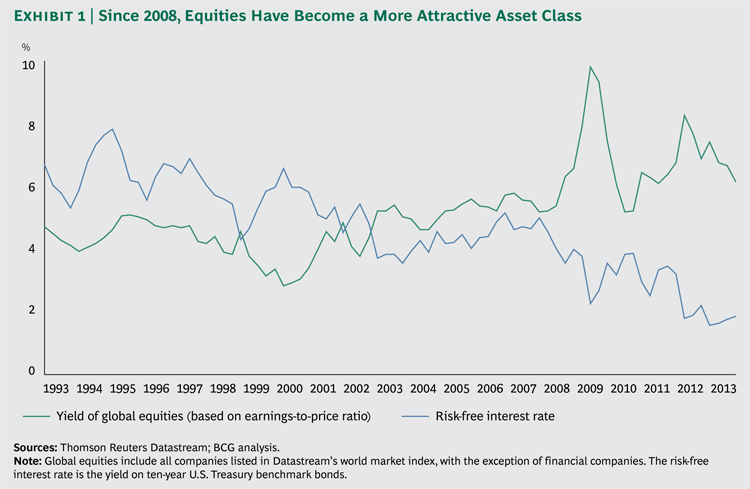
Unlocking New Sources of Value Creation is the fifteenth annual report in the Value Creators series published by The Boston Consulting Group. Each year, we offer commentary on trends in the global economy and world capital markets, share BCG’s latest research and thinking on value creation, describe our experiences working with clients to materially improve their value-creation performance, and publish detailed empirical rankings of the performance of the world’s top value creators. This year’s report offers four different perspectives on successful value creation. We begin by analyzing the recent disconnect between uneven global economic growth and buoyant global equity markets. Next, we describe how senior executives can use value patterns, a concept we introduced in last year’s report, to identify the most appropriate “unlocks” to create new value. We follow with a detailed case study of how one BCG client, the branded apparel company VF, has used a focus on total shareholder return to transform the company’s business, accelerate its growth to the point that today it is the world’s largest apparel company, and deliver shareholder value at the top end of its peer group. Finally, we conclude with our annual rankings of the top ten value creators worldwide and in 25 industries for the five-year period from 2008 through 2012.

Value_Creators_2013_Ex1_lg_tcm80-143734 Value_Creators_2013_Ex2_lg_tcm80-143737 Value_Creators_2013_SidebarEx_lg_tcm80-143740 Read more of this post
The 2013 Value Creators Rankings (BCG)

The 2013 Value Creators Rankings

by Gerry Hansell, Jeff Kotzen, Eric Olsen, Frank Plaschke, and Hady Farag

SEPTEMBER 17, 2013

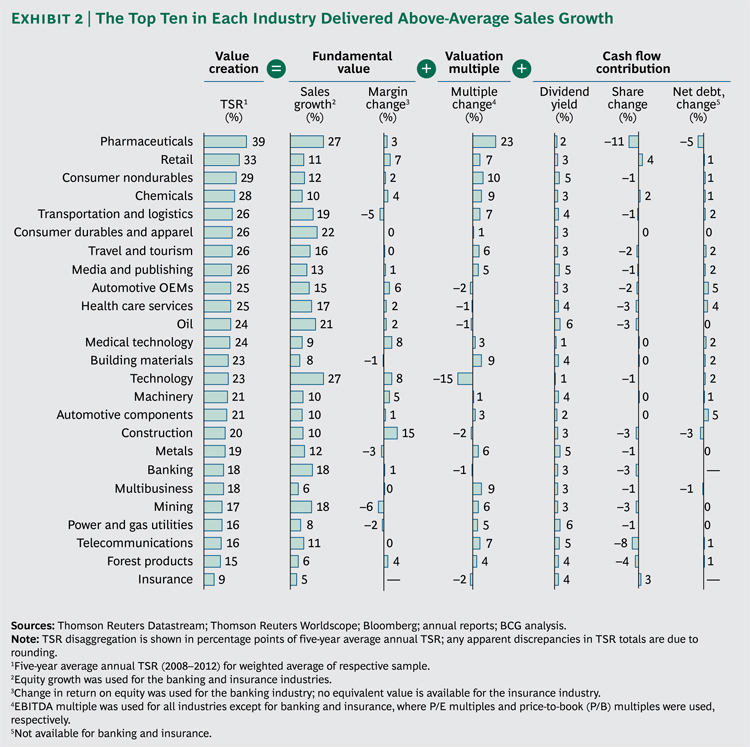
The 2013 Value Creators rankings are based on an analysis of total shareholder return at 1,616 global companies for the five-year period from 2008 through 2012. To arrive at this sample, we began with TSR data for more than 9,000 companies provided by Thomson Reuters. We eliminated all companies that were not listed on a world stock exchange for the full five years of our study or that did not have at least 25 percent of their shares available on public capital markets. We further refined the sample by organizing the remaining companies into 25 industry groups and establishing an appropriate market-valuation hurdle to eliminate the smallest companies in each industry. (The size of the market valuation hurdle for each industry can be found in the tables in “Industry Rankings(https://www.bcgperspectives.com/Images/BCG_Value_Creators_2013_Rankings.pdf).”) In addition to analyzing our 1,616-company comprehensive sample, we separately evaluated those companies with market valuations of more than $50 billion. We have included rankings for these large-cap companies in “Global Rankings (https://www.bcgperspectives.com/Images/BCG_Value_Creators_2013_Rankings.pdf).”

Value_Creators_2013_AppEx1_lg_tcm80-143906 Value_Creators_2013_AppEx2_lg_tcm80-143909 Read more of this post

Cracking the Code of Practical Creativity

Cracking the Code of Practical Creativity

SEPTEMBER 23, 2013

Nearly all organizations and their leaders feel the imperative to grow and to innovate and thereby to generate value for shareholders and society. Responding to this imperative demands creativity and discipline in equal measure—and most executives would say that, of the two, creativity is the harder to come by. BCG creativity experts Luc de Brabandere and Alan Iny, who have helped innumerable clients generate their next big breakthrough ideas, have detailed their approach in their new book, Thinking in New Boxes: A New Paradigm for Business Creativity. They recently shared their thoughts on how to drive practical creativity. Read more of this post

How Popeyes went upscale: Here’s how you turn around a fast-food brand, according to the Popeyes playbook.

How Popeyes went upscale

By Lydia DePillis, Updated: September 27, 2013

Over the past few years, on the once-dingy midtown strip of 14th Street in Washington D.C., corner stores and carry-outs have yielded to upscale bars and boutiques. You can walk for blocks and blocks without finding so much as a sandwich for less than the price of a movie ticket. Until, that is, you hit Popeyes — the greasy chicken ‘n biscuits fast food joint that’s been around for three decades, and feels increasingly out of place as vintage clothing stores, glistening condos, and farm-to-table restaurants spring up on all sides. Inside, however, the franchise is undergoing a transformation of its own. Read more of this post

How Many ‘Greater Fools’ Does It Take to Make a Bubble?

Sep 27, 2013

THE INTELLIGENT INVESTOR

How Many ‘Greater Fools’ Does It Take to Make a Bubble?

JASON ZWEIG

BF-AF870_INVEST_G_20130927162557

Where do market “bubbles” come from? A team of neuroscientists and economists has produced the first scientific evidence for what prudent investors have long believed: Paying attention to what others are doing is the easiest way for traders to get carried away. This new research can’t prevent the mass contagions that lead to bubbles. But it might help you step back before you get swept up in the next one. Economists have struggled and failed to explain why markets turn into manias. Some have denied bubbles exist; others have argued bubbles must somehow be “rational.” Often, the argument is that bubbles are caused by “uninformed” traders, or “dumb money,” while the “smart money” sits on the sidelines. The latest findings suggest, however, that bubbles might be caused not by traders who lack information but by those who have too much.

Read more of this post

2,564 Birthday anniversary of Confucius celebrated around China

Birthday anniversary of Confucius celebrated around China

(Xinhua)    16:44, September 28, 2013

A performer takes part in a memorial ceremony to mark the 2,564th birthday anniversary of Confucius at the Confucius Temple in Qufu, east China’s Shandong Province, Sept. 28, 2013. Qufu is known as the hometown of the great Chinese philosopher and educator Confucius. (Xinhua/Guo Xulei)

F201309281639074921743112

Have-Nots Squeezed and Stacked in Hong Kong

September 27, 2013

Have-Nots Squeezed and Stacked in Hong Kong

By BETTINA WASSENER and GRACE TSOI

XXhousing-slide-VY7W-articleLarge

In Hong Kong, a Cubicle to Call Home: One of Asia’s premier banking, trading and logistics centers is a difficult place for low-income residents to live.

HONG KONG — On the first floor of a hulking residential building, at the end of a dimly lighted corridor, a narrow door opens up into Hong Kong’s economic underbelly. Twenty-two men live in this particular 450-square-foot apartment in the neighborhood of Mong Kok, in cubicles each hardly larger than a single bed, stacked above one another along two narrow passageways that end in a dank toilet and shower room. Each cupboardlike cubicle has a sliding door, a small television, some shelves and a thin mattress. Most of the men have lived here for months, some for years. “Luckily there is air-conditioning. If not, sleeping would be impossible,” said Ng Chi-hung, 55, who is unemployed and occupies one of the bottom bunks. “If you live in such environment, you have to adapt to everything.” Read more of this post

Book Review: ‘David and Goliath’ by Malcolm Gladwell

September 27, 2013, 6:07 p.m. ET

Book Review: ‘David and Goliath’ by Malcolm Gladwell

Malcolm Gladwell too often presents as proven laws what are just intriguing possibilities and musings about human behavior.

CHRISTOPHER F. CHABRIS

David Boies is the super-lawyer who represented IBM against the U.S. government, the U.S. government against Microsoft, Al Gore against George W. Bush and gay marriage against California’s Proposition 8. A man at the top of his profession, presiding over a firm of 200 lawyers, he would seem to be a metaphorical Goliath. But Malcolm Gladwell sees this literal David as a figurative David too, because Mr. Boies came from humble origins and faced mighty obstacles to success. Read more of this post

The “Breaking Bad” school: The best show on television is also a first-rate primer on business

The “Breaking Bad” school: The best show on television is also a first-rate primer on business

Sep 28th 2013 |From the print edition

THERE are obvious reasons for watching “Breaking Bad”: for once the Hollywood hype surrounding the television series is justified. But there is also a less obvious reason: it is one of the best studies available of the dynamics of modern business. A Harvard MBA will set you back $90,000 (plus two years’ lost income). You can buy a deluxe edition of all five seasons of “Breaking Bad”, complete with a plastic money barrel, for $209.99, or a regular edition for less than $80. Read more of this post

James Packer’s former money man shares the billionaire’s top tips: You only need one or two very good ideas per year

Matthew Smith Reporter

James Packer’s former money man shares the billionaire’s top tips

Published 27 September 2013 10:13, Updated 27 September 2013 10:14

4849c5c8-12cf-11e3-897e-5efcaf8b3aed_762732829--646x363

Paul Skamvougera: You only need one or two very good ideas per year

It’s been a rapid rise for Paul Skamvougeras, who took over from Perpetual’s star fund manager John Sevior in July 2011. Despite his background in managing money for James Packer, investors weren’t immediately convinced with the replacement. “He might be good but is he Sevior good?” they asked. Fast forward two years and its “John who?” after “Skamma” notched up a 31.2 per cent return to July 31. Now he’s been asked to step into the breach once more following the departure of Charlie Lanchester. Today Skamvougeras talks about his three biggest positions and what he learnt from James Packer.  Read more of this post

Howard Schultz: What Next, Starbucks? The coffee CEO on the future of the company, from modern drive-thrus to wine and kale

September 27, 2013, 8:24 p.m. ET

Howard Schultz: What Next, Starbucks?

The coffee CEO on the future of the company, from modern drive-thrus to wine and kale

ALEXANDRA WOLFE

Starbucks SBUX +0.19% CEO Howard Schultz says he’s never been a “coffee person.” Sitting in his sprawling Seattle office overlooking Puget Sound, he says that what he’s always been is a merchant. It’s a title he is particularly comfortable with one morning earlier this month. A few hours before, his company’s stock price reached $76.24 a share, the highest it had been in its 42-year history. Read more of this post

Björn Wahlroos may be the most important business executive in Finland. Chairman of three of the biggest companies in the Nordic region – Nordea, the bank, Sampo, the financial services group, and UPM-Kymmene, the paper producer

September 22, 2013 5:15 pm

Finland’s former revolutionary

By Richard Milne

©Bloomberg

Not-so-cuddly: Björn Wahlroos’s nickname of Nalle, a term similar to teddy bear in English, belies his reputation

Björn Wahlroos may be the most important business executive in Finland. Chairman of three of the biggest companies in the Nordic region – Nordea, the bank, Sampo, the financial services group, and UPM-Kymmene, the paper producer – the dapper 60-year-old is renowned in his homeland almost as much for his sharp tongue as for his business prowess. Widely known as Nalle – similar to teddy bear in English – his life has followed an extraordinary trajectory. “I think it’s a great story” he says. Read more of this post

David Ek, the founder of Spotify talks about changing the music business and why ‘screwed-up’ healthcare might be next

September 27, 2013 2:19 pm

Lunch with the FT: Daniel Ek

By Andrew Edgecliffe-Johnson

The founder of Spotify talks about changing the music business and why ‘screwed-up’ healthcare might be next. Plus, listen to his top 10 favourite tracks

The elevated railroad that once ran down Manhattan’s west side was known as New York’s “Life Line”. Erected in 1934, it brought meat and other merchandise to the city’s warehouses from across the US. The last turkeys were unloaded in 1980 though and weeds grew over the steel strip between the West Village and Chelsea until 2009 when, renovated by wealthy locals, the Life Line reopened as the High Line, a fashionable urban park. Read more of this post

The Monkey Business of Pure Altruism

September 27, 2013, 8:30 p.m. ET

The Monkey Business of Pure Altruism

ROBERT M. SAPOLSKY

I’ve been reflecting on how Bill and Melinda Gates resemble a pair of monkeys. Earlier this month, the Lasker Awards were announced. The prestigious prize, known as the “American Nobel,” is given annually to a few extraordinary biomedical scientists. A Lasker for public service is also usually awarded—this year to the Gateses. Great move. They’ve given vast sums of money to medical research and have galvanized other billionaires into doing the same. They’ve targeted research about diseases that bring incalculable misery to the developing world. All with great wisdom. Read more of this post

Korean cancer patient to save family from medical costs kills himself; The Park administration had earlier promised to fully cover medical expenses for four terminal diseases including cancer

2013-09-27 16:55

Cancer patient to save family from medical costs kills himself

By Chung Hyun-chae
A 71-year-old man suffering with cancer took his own life in the port city of Busan on Thursday, apparently to relieve his family of financial pressure, police said Friday. The man surnamed Kim was diagnosed with liver cancer earlier this month, and was scheduled to undergo surgery on Saturday. He was to enter hospital on Friday. Kim’s son, 38, discovered the body of his father who hanged himself from a gas pipe in his studio apartment. A suicide note was found taped to the victim’s chest. “Please forgive me. If I undergo a surgery, it would pose a financial burden on all of you. Even though it is a pittance, please keep the 130,000 won in my purse and what’s left in my bank account,” the note read. “It appears he took his own life in order to not impose a financial burden on his children,” said a police officer. Kim lost his wife about 10 years ago and lived alone. Along with his son he leaves behind a 40 year old daughter. Read more of this post