If You Want to Be an Entrepreneur, Don’t Go to Harvard

August 15, 2013, 4:11 PM

Trending Topic: If You Want to Be an Entrepreneur, Don’t Go to Harvard

VIVEK WADHWA: My greatest disappointment after joining academia was to see my most promising students accept jobs at Goldman Sachs or McKinsey. Engineering students with ambitions to save the world would instead become financial analysts—who used their skills to “engineer” our financial system. Or they would take grunt jobs in management consulting—another waste of valuable talent. Why would they sell their souls? Because they had no choice, the burden of debt they amassed while getting their degrees was just too great. They had six-figure student loans to repay and couldn’t take the risk of joining a startup or founding their own business. Read more of this post

Singapore’s $300,000-Salaried Politician Baey Yam Keng: I am surprised and flattered by the interest in my “selfies”

MP Baey Yam Keng the narcissist talks about his selfies

August 17th, 2013 |  Author: Contributions

baeynew2e 600x338 Read more of this post

The Remarkable Story Of How Lobster Went From Being Used As Fertilizer and Unsightly “Cockroaches of the Sea” To A Beloved Delicacy

The Remarkable Story Of How Lobster Went From Being Used As Fertilizer To A Beloved Delicacy

MEGAN WILLETT AUG. 16, 2013, 2:00 PM 3,639 5

It’s time to eat all of the fresh lobster, seafood, and summer fare we can before Labor Day. But here’s something to think about while downing every lobster roll in sight before summer’s end — our beloved shellfish was once a throw-away food. Back when the first European settlers reached North America, they wrote that lobsters were so plentiful that piles up to two feet high would wash ashore in Massachusetts Bay Colony. Instead of this leading to epic clam bakes with buckets filled with butter, the colonists were embarrassed by these unsightly “cockroaches of the sea.” Read more of this post

Singapore to try out driverless shuttle on public roads

Singapore to try out driverless shuttle on public roads

By Ben Coxworth

August 16, 2013

navia

Singapore’s Nanyang Technological University will be running a Navia autonomous shuttle to the nearby JTC Corporation’s CleanTech Park (Photo: NTU)

Should you be at Singapore’s Nanyang Technological University (NTU) sometime soon, and wish to take the shuttle bus to JTC Corporation’s CleanTech Park, you might find yourself in a vehicle that drives itself. Plans call for just such an autonomous shuttle to start running the 2-km (1.2-mile) route, as a real-world test of driverless public transportation. The electric 8-passenger vehicle is a model already being made by France’s Induct Technology, and is known as the Navia. Passengers get on board at a designated stop, and select their destination stop on a touchscreen display of the route. The vehicle then heads out onto public roads at a maximum speed of 12.5 mph (20 km/h). It uses four LIDAR (LIght Detection And Ranging) units, along with stereoscopic optical cameras, to generate a real-time 3D depth map of its surroundings. This allows it to avoid obstacles, stay in its lane, and generally keep from getting into trouble. Once it’s completed its route, the shuttle automatically heads to its wireless fast charging station. It doesn’t require any rails, overhead lines, or other changes to the roads. The project partners (NTU, JTC and Induct) hope that the Navia or something like it could be an effective form of last-mile transportation, ferrying commuters between transit hubs such as train stations, and their homes or workplaces. The Navia can be seen in use in the video below.

Birds of a feather land together: How flocking birds avoid colliding when they touch down

Birds of a feather land together: How flocking birds avoid colliding when they touch down

Aug 17th 2013 |From the print edition

LANDINGS are the most perilous parts of flying. Airline pilots have to practise hundreds before they can carry passengers. Even then, they have co-pilots, air-traffic controllers and all sorts of gadgetry to help them. And they do it one plane at a time, on clearly marked runways. Now imagine swarms of aircraft all trying to land together on a small stretch of water with no assistance and no gizmos. The result would surely be disastrous. Waterfowl, however, frequently land in groups on featureless bodies of water, yet they rarely collide. So how do they manage it? Read more of this post

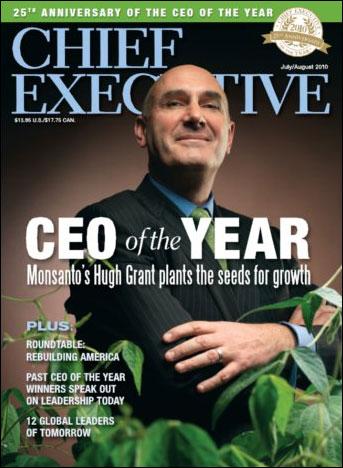
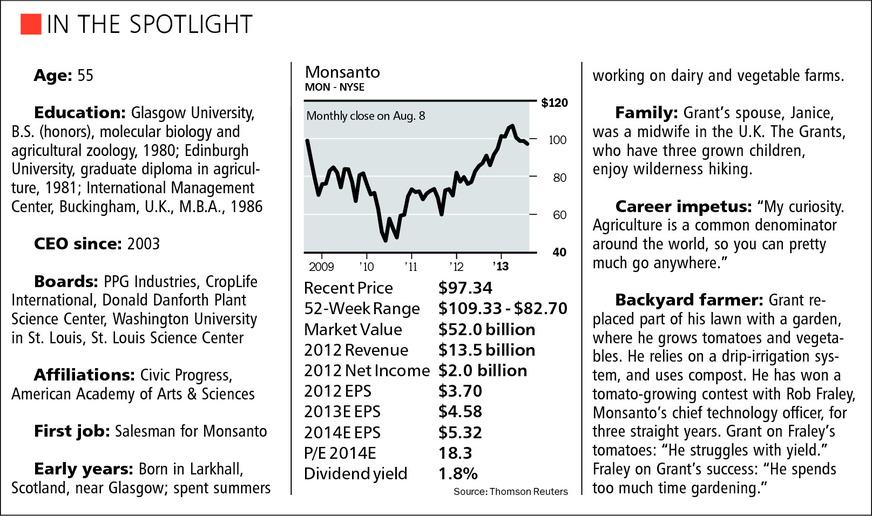
Monsanto CEO Hugh Grant aims to increase crop yields and feed a hungry planet. He’s now deft at countering critics—and enriching shareholders

SATURDAY, AUGUST 10, 2013

Planting the Seeds of Growth

By DYAN MACHAN | MORE ARTICLES BY AUTHOR

Monsanto CEO Hugh Grant aims to increase crop yields and feed a hungry planet. He’s now deft at countering critics—and enriching shareholders.

01ON-BB796_SPOTLI_G_20130810010512

Is Monsanto the Great Satan? Opponents of genetically modified seeds have called the company evil incarnate, notwithstanding its notable contributions toward lifting farmers out of poverty and expanding the food supply of a growing world. Environmental crusaders, movie stars, and politicians have all gotten in on the vilification act, charging that Monsanto’s seeds and the plants they produce are unsafe and violate farmers’ and consumers’ rights. Read more of this post

M&A as competitive advantage; Treating M&A as a strategic capability can give companies an edge that their peers will struggle to replicate

M&A as competitive advantage

Treating M&A as a strategic capability can give companies an edge that their peers will struggle to replicate.

August 2013 | byCristina Ferrer, Robert Uhlaner, and Andy West

Most companies approach deal making as an art rather than as a corporate capability deployed to support a strategy, and they see individual deals as discrete projects rather than integral parts of that strategy. Few have found a way to build and continuously improve, across businesses, an M&A capability that consistently creates value—and does so better than competitors. As a result, many lament how hard M&A is and worry about the statistics highlighting the failure rate of deals rather than how to build a capability that helps them win in the marketplace. Read more of this post

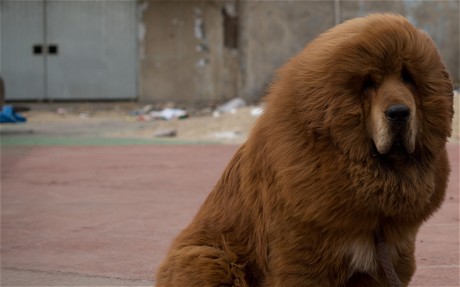
Lying about its lion, Chinese zoo closed for going to the dogs

Lying about its lion, Chinese zoo closed for going to the dogs

8:21am EDT

zooLuohe_2645858b tibetanmastiff_2644205c

BEIJING (Reuters) – A zoo in central China has been closed after visitors were outraged to discover its lion was really a bushy and barking Tibetan mastiff. The dog was not the only fake at People’s Park Zoo in the city of Luohe, which tried to pass off other common mammals and rodents as a leopard and snakes, Chinese media reported. Photographs showed the mastiff with its muzzle poking through the bars of its dingy enclosure. A grimy sign on the cage read “African Lion” in Chinese characters. The zoo apologized for the exhibits and was closed down for “rectification”, the Beijing News said, citing local officials. Animal rights activists have criticized Chinese zoos for their record of poor conditions and other abuses. Chinese zoo that substituted lions with dogs closes temporarily. The Chinese zoo which substituted its expensive and rare animals for cheaper “alternatives” has shut for one day, to allow the enclosure signs to be changed. Read more of this post

How to successfully launch a new product; Three entrepreneurs explain how they approach innovation and product development

How to successfully launch a new product

Three entrepreneurs explain how they approach innovation and product development.

MuddyBootsweb_2645248b

Miranda and Roland Ballard started their burger business in 2008 with £60,000 they’d originally saved as a deposit on a flat.

By James Hurley

6:46PM BST 15 Aug 2013

DO GO CHANGING

Mark Adams, chief executive of furniture manufacturer and retailer Vitsoe, is tired of hearing the word “innovation” used as a synonym for invention. His London-based company prefers “better over newer”. “Everyone has got hooked on the new – we’d all be much happier if we lost our attachment to novelty.” Vitsoe, which is projecting sales of £5.8m this year, was founded in 1959 to market a shelving system invented by Dieter Rams, the German industrial designer renowned for the gadgets he produced with Braun. The shelves still form the heart of the business – but that doesn’t mean nothing has changed. “People look at us from the outside and think we’re boring. In fact, we’re innovating every minute. You’re constantly taking the original idea and making it better. It’s just like evolution – small steps, not a new species every year. Our shelving system is 50 years old and we’re still developing it. That’s what design is all about – you have to keep it moving.” Read more of this post

Good Leaders Get Emotional

Good Leaders Get Emotional

by Doug Sundheim  |  12:00 PM August 15, 2013

Much of what comes out of people’s mouths in business these days is sugar-coated, couched, and polished. The messages are manufactured, trying to strike just the right tone. Genuine emotion stands in stark contrast. It’s a real person sharing a real feeling. When we hear it, we’re riveted — for one because it’s rare, but also because it’s real. Sometimes it’s uncomfortable and a little messy. But that’s what makes it powerful. No one is trying to hide anything.

We hide emotions in an attempt to stay in control, look strong, and keep things at arm’s length. But in reality, doing so diminishes our control and weakens our capacity to lead — because it hamstrings us. We end up not saying what we mean or meaning what we say. We beat around the bush. And that never connects, compels, or communicates powerfully. Read more of this post

At 127, Xinjiang woman is China’s oldest person

At 127, Xinjiang woman is China’s oldest person

2013-08-16 02:54:13 GMT2013-08-16 10:54:13(Beijing Time)  Shanghai Daily

U142P5029T2D619302F24DT20130816105413

Almehan Said was born on June 25, 1886, during the Qing Dynasty (1644-1911) in a village in Shule County of the northwest China region. She was the second oldest person in the country on a list issued by the Gerontological Society of China in 2010. A WOMAN from Xinjiang Uygur Autonomous Region has been named the oldest person in China — at age 127 — following the death of the previous holder in June, officials said. Almehan Said was born on June 25, 1886, during the Qing Dynasty (1644-1911) in a village in Shule County of the northwest China region. She was the second oldest person in the country on a list issued by the Gerontological Society of China in 2010. Read more of this post

Lewis Kornfeld, Made Radio Shack an Early Player in PCs, Dies at 97

August 15, 2013

Lewis Kornfeld, Made Radio Shack an Early Player in PCs, Dies at 97

By DANIEL E. SLOTNIK

kornfeld-obit-1-popup

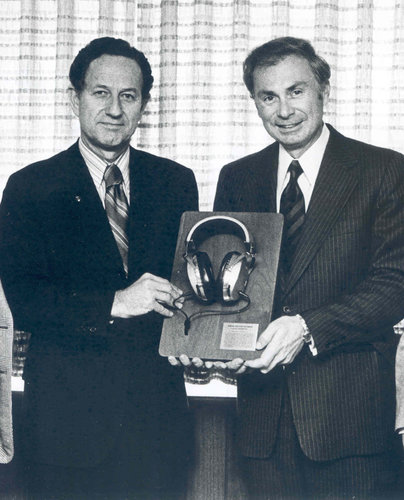
Lewis Kornfeld, left, became the chain’s president in 1970 and retired in 1981.

Lewis Kornfeld, who as president of Radio Shack helped the company become a major player in the early personal computer market in 1977 by releasing the TRS-80, one of the first mass-market and relatively affordable computers, died on Sunday in Fort Worth. He was 97. The cause was complications of lymphocytic leukemia, his wife, Rose Ann Kornfeld, said. When Radio Shack unveiled the TRS-80, personal computers mainly came in kits for aficionados to cobble together. Mr. Kornfeld presented a finished product that consumers could just plug in and use. The market for home computers was virtually untested at the time, but Mr. Kornfeld prided himself on having recognized their potential. Read more of this post

Should Creationism Be Controversial? Why are some people drawn to origin narratives like in Genesis, and others to the scientific story?

UPDATED AUGUST 15, 2013 5:27 PM

Should Creationism Be Controversial?

INTRODUCTION

Last week Steven Pinker made the case for scientific thinking outside the “sciences,” and he annoyed some critics. But a recent essay againstscientific thinking (even about scientific questions) prompted a louder outcry. After Virginia Heffernan, a technology journalist, wrote “Why I’m a Creationist,” the condemnations were swift and harsh. Is it really so controversial to believe in biblical creation? Why are some people drawn to origin narratives like in Genesis, and others to the scientific story? Read more of this post

How the wealthy keep themselves on top; The more unequal a society, the greater the incentive for the rich to pull up the ladder behind them

August 15, 2013 6:43 pm

How the wealthy keep themselves on top

By Tim Harford

The more unequal a society, the greater the incentive for the rich to pull up the ladder behind them

When the world’s richest countries were booming, few people worried overmuch that the top 1 per cent were enjoying an ever-growing share of that prosperity. In the wake of a depression in the US, a fiscal chasm in the UK and an existential crisis in the eurozone – and the shaming of the world’s bankers – worrying about inequality is no longer the preserve of the far left. There should be no doubt about the facts: the income share of the top 1 per cent has roughly doubled in the US since the early 1970s, and is now about 20 per cent. Much the same trend can be seen in Australia, Canada and the UK – although in each case the income share of the top 1 per cent is smaller. In France, Germany and Japan there seems to be no such trend. (The source is the World Top Incomes Database, summarised in the opening paper of a superb symposium in this summer’s Journal of Economic Perspectives.)

Read more of this post

Roger Mugford is the founding father of British pet psychology; Mugford is in demand as more people want pets but lack the skills to look after their wellbeing; The world market for pet accessories and products is projected to reach $17.2bn by 2015. 10.7m dogs in the US – or up to 17 per cent – suffer from separation anxiety.

August 15, 2013 4:57 pm

Bad dogs and the Englishman who calls them to heel

By Emma Jacobs

Creature comfort: Roger Mugford is in demand as more people want pets but lack the skills to look after their wellbeing

Bella is panting with happiness. The epitome of exuberance. But she has one weakness: sheep and wildfowl. She cannot stop herself sinking her teeth into them. Last month, on a summer stroll at Hampton Court, the royal palace once inhabited by Henry VIII, she grabbed a swan by its wing, chasing it into the river Thames, filmed by a boatful of tourists.

Consequently Bella, a cross bet­ween a Staffordshire bull terrier and a Rhodesian ridgeback, is a source of joy and stress to her owner Mark Reeves. His favourite pastime – country walks – is no longer relaxing because he is on constant alert for sheep or deer. After all, a farmer is allowed to kill a dog that worries livestock. Read more of this post

In Mexico, a Healer Who Asks for Nothing in Return; Sergio Castro, 72, is neither doctor nor priest, but he fills a gap in Mexico’s ragged safety net in health care, accepting no money from his patients, who are mostly Mayans

August 13, 2013

In Mexico, a Healer Who Asks for Nothing in Return

By ELISABETH MALKIN

SAN CRISTÓBAL DE LAS CASAS, Mexico — Every morning, Sergio Castro crisscrosses this city to treat the intimate struggles behind its closed doors. Past a black metal gate, Diego Raúl López Sánchez lay on a bed in a concrete room. A motorcycle crash left him paralyzed from the neck down a few months ago, and bedsores have branded his emaciated body. Mr. Castro cleaned and dressed the broken skin as he murmured softly to his patient. He offered advice to Mr. López’s wife, who seemed numb with despair at her husband’s new reality. He would return the next day. Neither doctor nor priest, Mr. Castro, 72, fills one of the countless holes in Mexico’s ragged safety net, which gapes wider here in the southern state of Chiapas than just about anywhere else in the country. Read more of this post

Compelling People: The Hidden Qualities That Make Us Influential

Compelling People: The Hidden Qualities That Make Us Influential [Hardcover]

John Neffinger (Author), Matthew Kohut (Author)

51etuvXtOfL._SY300_

Release date: August 15, 2013

How People Judge You—And How To Come Out Looking Good
You will never look at people the same way again—including yourself—after this lively look at how we make character judgments.
Drawing on cutting-edge social science research as well as their own work with Fortune 500 executives, members of Congress, and Nobel Prize winners, authors Matt Kohut and John Neffinger demystify the process we use to size each other up. It turns out that we judge each other primarily on two critical criteria: strength and warmth. The authors explain the inner workings of each, the tension that makes it so hard to project both at once, and the successful strategies that the most admired among us use to win respect and affection.
Offering practical advice for a range of common and challenging situations, Compelling People shows you not just how people already see you, but how to make sure your best qualities shine through.   Read more of this post

How to be an irresistible leader; Can charisma be taught? Harvard seems to think so. A new book on cultivating personal magnetism is required reading at the B-school

How to be an irresistible leader

By Anne Fisher, contributor August 15, 2013: 11:03 AM ET

Can charisma be taught? Harvard seems to think so. A new book on cultivating personal magnetism is required reading at the B-school.

FORTUNE — What is it exactly that makes some people command far more respect and attention, even devotion, than their peers? And if you’re not born with the kind of magnetism that compels people to admire and follow you, can you acquire it? “Charisma” comes from a Greek word that means “gift from the gods,” which may explain why most of us assume you’ve either got it or you don’t. Read more of this post

Understanding motivation — and apathy — is key to education

Understanding motivation — and apathy — is key to education

In learning, motivation is the key to success. Students who are not motivated to learn generally do not fare well. But there are various kinds of motivation.

BY K RANGA KRISHNAN –

5 HOURS 38 MIN AGO

In learning, motivation is the key to success. Students who are not motivated to learn generally do not fare well. But there are various kinds of motivation. A student can be highly motivated because he is curious or interested in a subject, or he wants to gain the approval of his parents or teachers. If it is the former, he is said to be intrinsically motivated: He acts for the fun of achieving something he really cares for, and not because he is afraid of losing face or being punished. From birth, humans are generally active, curious and ready to learn and discover. This innate motivation is the key to growth and development, and our self-directed ability to survive. It is this interest in novelty and being creative that leads to success in life. Read more of this post

LKY gets the Warhol treatment

PUBLISHED AUGUST 16, 2013

Kuan Yew gets the Warhol treatment

HELMI YUSOF

BT_20130816_HYLKY16_712960e

Artistic tribute: Sondhi’s painting ‘Singapore Icon: LKY Quartet 1’ (2013, mixed media on canvas, 24″x24″, at left) is priced at $1,400 – PHOTO: SUKESHI SONDHI

WHAT do politician Lee Kuan Yew and artist Andy Warhol have in common? Quite a number of things. Both are famous men born in the 1920s and both founded something – Mr Lee founded modern, independent Singapore in 1965, while Warhol founded the pop art movement in the 1960s. Perhaps, it is apt then that artist Sukeshi Sondhi has chosen to render Mr Lee in distinctly Warholian pop art style for her upcoming solo exhibition of some 20 paintings. Using an image of Mr Lee from the 1960s when he was a young man, she depicts him in various bright colours, repeating the same image across all her canvases. Read more of this post

Johnson Matthey has come far from its roots as a gold assayer in London’s Hatton Garden to become the world’s largest supplier of vehicle catalytic converters by volume

August 15, 2013 4:55 pm

Johnson Matthey looks to Brussels to drive up sales

By Mark Wembridge

Although devoid of links with famous historical figures that encourage such monuments in London, the British chemical engineering company believes that an event in 1974 at its plant is worthy of such note – it is the location where the world’s first catalytic converter was manufactured. Nearly four decades on, Johnson Matthey has grown to become the world’s largest supplier of vehicle catalytic converters by volume, with sales of devices that alter environmentally damaging car and truck emissions comprising more than half of the FTSE 100 company’s £2.7bn annual turnover. The group has come far from its roots as a gold assayer in London’s Hatton Garden, where it regularly burnt the floorboards and carpet in shops located in the London jewellery district to extract any leftover precious metals. Read more of this post

A Powerful Tool in the Doctor’s Toolkit; How caregivers present and administer treatments has a powerful effect on clinical outcomes

AUGUST 15, 2013, 2:39 PM

A Powerful Tool in the Doctor’s Toolkit

By DANIELLE OFRI, M.D.

It was well past midnight and most of the patients had settled in. The hospital ward was quiet, except for “the howler.”

The howler was a patient in his 30s who earned his nickname for his nightly bouts of yelling. This was in the early 1990s, during the peak of the AIDS epidemic. I was a second-year medical resident at Bellevue Hospital, in charge of the sprawling AIDS ward that night. Admissions were rolling in, one after another, each more feverish and emaciated than the previous. Read more of this post

Videogames About Alcoholism, Depression and Cancer; Developers are exploring deeply personal and wrenching stories

August 15, 2013, 6:30 p.m. ET

Videogames About Alcoholism, Depression and Cancer

Developers are exploring deeply personal and wrenching stories

CONOR DOUGHERTY

AR-AD342_EMOGAM_G_20130814174200

A scene from ‘Papo & Yo,’ about an alcoholic father. ‘That Dragon, Cancer’ is an autobiographical story that puts players in the role of a father whose son is dying of cancer. A new breed of highly personal videogames on topics including depression, autism and cancer are changing what it means to play videogames. WSJ’s Conor Dougherty and game creator Ryan Green join Lunch Break. Photo: That Dragon Cancer.

Among the many videogames at a recent arts and games festival in Baltimore, none was more difficult to navigate than “That Dragon, Cancer.” The challenge: Getting through it without crying. The game is about war, but not the bullet-blazing variety normally associated with gaming. It’s an autobiographical story that puts players in the role of a father whose 4-year-old son is dying of cancer. As Hannah Armbruster sampled the game, using a mouse to move a pixelated dad around its hospital-room setting, her face showed none of the excited contortions that might accompany “Call of Duty.” She took gulps of sadness and at one point rubbed her forehead in disbelief. When the game was over, she said, “Whoo,” removed her headphones and left the computer. Read more of this post

In an effort to be deemed authentic, luggage maker Tumi’s new campaign will feature less-well-known figures whose accomplishments seem more attainable.

August 15, 2013

Tumi Ads Use Less Famous Faces to Underline Its Accessibility

By STUART ELLIOTT

DECADES ago, a man named Garry Davis provocatively renounced his American citizenship and declared himself a citizen of the world. Now, Tumi, which sells luxury suitcases, bags and other products for travelers, is proclaiming the arrival of the “global citizen.”

In a worldwide campaign scheduled to begin on Sunday, Tumi is saying, in effect, that it will let competitors that include Louis Vuitton go to market with famous faces like Angelina Jolie, Keith Richards, Madonna and even Mikhail S. Gorbachev. According to Tumi and its creative agency, Yard, potential buyers of Tumi’s wares are more likely to respond to less-well-known figures who, though not megastars, are still men and women of distinction and achievement. Read more of this post

How To Decide Whether A Company Is Valuable Or Vulnerable; Gandhi once said you can measure the civilization of a people by how they treat their animals. Translated into corporate terms: you can measure how ideas are given arms and legs so they can move forward

How To Decide Whether A Company Is Valuable Or Vulnerable

MICHELLE KERRIGANWORKPLACE CONFIDENCE 41 MINUTES AGO 0

Gandhi once said you can measure the civilization of a people by how they treat their animals. Translated into corporate terms: you can measure the success of leaders by how they value teamwork and day-to-day operations. Recently, a law firm partner who specializes in joint ventures and venture capital transactions asked me what I look for in workplace success. It was an operational due diligence exercise to help investors determine “am I on a winner?” I gave her a list of questions to consider when assessing quality, whether you’re an investor or a CEO wondering about your own operation. Here are four to get you started:

The management: are they leaders?

The team: are they organized and primed to execute?

What happens when people ask questions?

Is there an overall sense of unity and positive energy?

Most people might just focus on the first question. Totally understandable. But, if you’re investing in a company with a growing or changing operation, you may want to take a closer look at the day-to-day workplace. That’s where the magic happens. Where the vision you’re investing in comes to life, in the form of people, process, and teamwork. It’s where ideas are given arms and legs so they can move forward. The value in any company depends on it, and so does the value of leadership. Answers to the bottom 3 questions will tell you a lot about the #1. Read more of this post

Ogilvy & Mather Has Launched A Behavioral Science School

Ad Agency Launched A Behavioral Science School

JESSICA DAVIESTHE DRUM AUG. 15, 2013, 9:30 AM 185

Ogilvy & Mather’s behavioural sciences practice #ogilvychange has launched its first summer school, giving students the chance to work on live marketing briefs. The school has chosen six university students from 70 applicants, all of whom have proven they are well-read in behavioural sciences literature and can apply their knowledge beyond the theory and outside their own laboratories. The course, which kicked off this week, will begin with a crash-course in applying behavioural science, before moving on to work on live behaviour-change marketing briefs with specialist teams from across the Ogilvy Group businesses. The will work alongside leading advocates of behavioural economics, including Ogilvy’s vice chairman Rory Sutherland and Dr Nichola Raihani from UCL. Ogilvy & Mather UK’s vice chairman Rory Sutherland said the advertising and marketing industry would benefit from having more psychologists and behavioural economists. “The new media world, and the new behavioural tasks we are being required to solve, make this an imperative. “But there is another reason, too. I would like them to explain why in God’s name the marketing function has for 50 years assumed it has absolutely nothing to learn from academic psychology,” he said. The positions were publicised at “top-tier” universities that offer psychology and behavioural sciences degrees, across social media sites and the IPA student careers website. Ogilvy & Mather launched #ogilvychange earlier this year.

Apples losing their crunch to global warming: study

Apples losing their crunch to global warming: study

POSTED: 15 Aug 2013 10:41 PM
Global warming is causing apples to become less crunchy, but sweeter. PARIS, France: Global warming is causing apples to lose some of their crunch but is also making them sweeter, a study said Thursday. Analysing data gathered from 1970 to 2010 at two orchards in Japan, a research team said there was clear evidence that climate change was having an effect on apple taste and texture. “All such changes may have resulted from earlier blooming and higher temperatures” during the growth season, they wrote in the journal Nature Scientific Reports. About 60 million tonnes of apples are produced every year, making it the world’s third most popular fruit. Previous studies had shown that global warming was causing apple trees to flower earlier, and that harvests were also affected by changes in rainfall and air temperature. The orchards used in the study produce the Fuji and Tsugaru apples, the two most popular kinds in the world. The farms are located in Japan’s Nagano and Aomori prefectures, which had seen a mean air temperature rise of 0.31 and 0.34 degrees Celsius (0.5 and 0.6 degrees Fahrenheit), respectively, per decade. The orchards were chosen because there had been no changes in cultivars or management practices for extended periods, thus ruling out non-climate factors like technological improvements in the apple change. The data collected over the years included measures of acid and sugar concentration, fruit firmness and watercore — a disease that causes water-soaked areas in the flesh of an apple. The analysis showed a decrease in acidity, firmness and watercore, but a rise in sugar concentration over time. “We think that a sweeter apple is a positive thing and a loss of firmness is a negative thing,” study co-author Toshihiko Sugiura of the National Institute of Fruit Tree Science in Fujimoto told AFP. “We think most people like sweet and firm apple fruits, although everyone has his own taste. A soft apple is called ‘Boke’ in Japanese which means a dull or senile fruit.” The study said that the results “suggest that the taste and textural attributes of apples in the market are undergoing change from a long-term perspective, even though consumers might not perceive these subtle change.” The research claims to be the first to measure changes in the taste and texture of food as a result of climate change.

How LeapFrog’s CEO Built the Educational Toy Company; Mike Wood Left the Legal Profession to Focus on Plastic Toy Letters; Glitches Early On Delayed Production

Updated August 14, 2013, 8:59 p.m. ET

How LeapFrog’s CEO Built the Educational Toy Company

Mike Wood Left the Legal Profession to Focus on Plastic Toy Letters; Glitches Early On Delayed Production

ADAM JANOFSKY

MK-CF565_SBHIBI_G_20130814191012

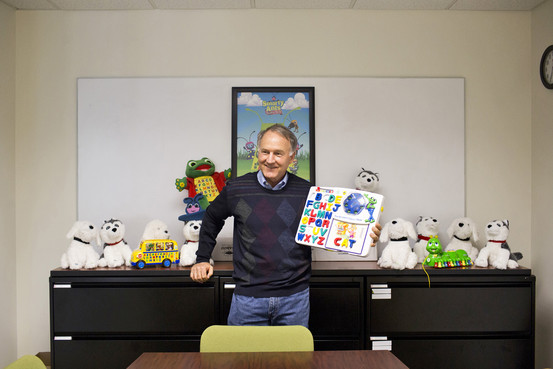
Mike Wood, creator of educational toy company LeapFrog, at his office in San Rafael, Calif., on Tuesday.

Mike Wood had been practicing law for about 11 years when he encountered a challenge that would change his life: teaching his 3-year-old son to read. His son Mat had memorized the letters of the alphabet, but struggled to learn the sounds that the letters represented. Over the next five years, Mr. Wood researched marketing and phonics, a teaching method that focuses on the correlation between letter groupings and sounds, while holding down his partnership at a technology law firm. He decided to take sound chips—like the ones used in singing greeting cards—and put them in plastic toy letters. When a child pushed down on a letter, it would make the sound that the letter represented. Mr. Wood designed a prototype, left his job and set up focus groups with mothers. He then found a buyer at Toys “R” Us Inc. and a manufacturer in China. In 1995, he started LeapFrog Enterprises Inc., LF +0.57% an educational toy company. By 2002, LeapFrog had $520 million in annual revenue, and its best-selling product, a hand-held learning device called LeapPad, was in nine million homes. The Emeryville, Calif., company’s stock soared almost 99% after it went public that July, making it the top-performing IPO of the year. Read more of this post

The Entire History Of The World In One Chart

The Entire History Of The World In One Chart

SLATE AUG. 14, 2013, 1:37 PM 10,499 9

The Vault is Slate’s history blog. Like us on Facebook, follow us on Twitter @slatevault, and find us on Tumblr. Find out more about what this space is all about here.

This “Histomap,” created by John B. Sparks, was first printed by Rand McNally in 1931. The David Rumsey Map Collection hosts a fully zoomable version here. This giant, ambitious chart fit neatly with a trend in nonfiction book publishing of the 1920s and 1930s: the “outline,” in which large subjects (the history of the world! every school of philosophy! all of modern physics!) were distilled into a form comprehensible to the most uneducated layman. The 5-foot-long Histomap was sold for $1 and folded into a green cover, which featured endorsements from historians and reviewers. The chart was advertised as “clear, vivid, and shorn of elaboration,” while at the same time capable of “holding you enthralled” by presenting: the actual picture of the march of civilization, from the mud huts of the ancients thru the monarchistic glamour of the middle ages to the living panorama of life in present day America. The chart emphasizes domination, using color to show how the power of various “peoples” (a quasi-racial understanding of the nature of human groups, quite popular at the time) evolved throughout history. It’s unclear what the width of the colored streams is meant to indicate. In other words, if the Y axis of the chart clearly represents time, what does the X axis represent? Did Sparks see history as a zero-sum game, in which peoples and nations would vie for shares of finite resources? Given the timing of his enterprise—he made this chart between two world wars and at the beginning of a major depression—this might well have been his thinking. Sparks followed up on the success of this Histomap by publishing at least two more: the Histomap of religion (which I’ve been unable to find online) and the Histomap of evolution.

histomapfinal.jpg.crop.article920-large

Harnessing the Power of Surprise for Business Breakthroughs

Harnessing the Power of Surprise for Business Breakthroughs

Aug 14, 2013

we’re wired to appreciate positive surprises. our brains are set up to appreciate the way they challenge assumptions while adding value to things we care about

Think about the first time you picked up an iPod, iPhone or iPad and experienced the touch screen as an extension of your fingertips. Reflect back on the first time you played the Nintendo Wii, drove a Toyota Prius, used Purell hand sanitizer, discovered the trendy design of Method soap, visited Starbucks, or saw Cirque du Soleil. The list of the usual suspects of breakthroughs could go on and on. Though these things are all quite different from one another, they tend to produce similar feelings of positive surprise—with a hint of delight, wonder, and intrigue—when we first encounter them. Read more of this post