Think you work hard? Bet you don’t; The disease of overwork is partly in our minds and it has a bearing on how stressed we feel

March 30, 2014 2:22 pm

Think you work hard? Bet you don’t

By Lucy Kellaway

The disease of overwork is partly in our minds and it has a bearing on how stressed we feel Read more of this post

Viktor Frankl on the Art of Presence as a Lifeboat in Turbulent Times and What Suffering Teaches Us About the Meaning of Life

Viktor Frankl on the Art of Presence as a Lifeboat in Turbulent Times and What Suffering Teaches Us About the Meaning of Life

The life-story of Austrian psychiatrist and Holocaust survivor Viktor Frankl, born on March 26, 1905, is one of history’s greatest testaments to the tenacity of the human spirit. In his remarkable 1946 psychological memoir Man’s Search for Meaning (public library), previously discussed at length here, Frankl reflects on what his devastating time at Auschwitz taught him about the most essential driver of life – the inextinguishable human hunger for meaning, which separated those who survived from those who perished. Read more of this post

Philosopher Daniel Dennett on How to Criticize with Kindness and the Four Steps to Arguing Intelligently

Philosopher Daniel Dennett on How to Criticize with Kindness and the Four Steps to Arguing Intelligently

“In disputes upon moral or scientific points,” Arthur Martine counseled in his magnificent 1866 guide to the art of conversation“let your aim be to come at truth, not to conquer your opponent. So you never shall be at a loss in losing the argument, and gaining a new discovery.” Of course, this isn’t what happens most of the time when we argue, both online and off, but especially when we deploy the artillery of our righteousness from behind the comfortable shield of the keyboard. That form of “criticism” – which is really a menace of reacting rather than responding – is worthy of Mark Twain’s memorable remark that “the critic’s symbol should be the tumble-bug: he deposits his egg in somebody else’s dung, otherwise he could not hatch it.” But it needn’t be this way – there are ways to be critical while remaining charitable, of aiming not to “conquer” but to “come at truth,” not to be right at all costs but to understand and advance the collective understanding. Read more of this post

Grit and the Secret of Success

Grit and the Secret of Success

“Inspiration is for amateurs – the rest of us just show up and get to work,” Chuck Close scoffed“A self-respecting artist must not fold his hands on the pretext that he is not in the mood,” Tchaikovsky admonished“Show up, show up, show up, and after a while the muse shows up, too,” Isabel Allende urged“You have to finish things,” Neil Gaiman advised aspiring writers. But while our cultural history may brim with creators who intuited the importance of doggedness in success, it wasn’t until recently that psychologists were able to ascertain the science behind this intuitive observation. We now know that genius-level excellence takes enormous dedication and that the impetus to reboot from autopilot is crucial to reaching such a level, but arguably the most significant work in the field comes from pioneering psychologistAngela Duckworth, who came up with the notion of “grit” – that very doggedness essential for success – and went on toreceive a MacArthur Genius grant for her research. Read more of this post

Does Thinking Fast Mean You’re Thinking Smarter?

Does Thinking Fast Mean You’re Thinking Smarter?

The research into the relationship between quick thinking and methodical reasoning could take some time to decipher

By Maria Konnikova

APRIL 2014

In 1884, at his specially built Anthropometric Laboratory in London, Sir Francis Galton charged visitors three pence to undergo simple tests to measure their height, weight, keenness of sight and “swiftness of blow with fist.” The laboratory, later moved to the South Kensington Museum, proved immensely popular—“its door was thronged by applicants waiting patiently for their turn,” Galton said—ultimately collecting data on some 17,000 individuals. Read more of this post

We Shop Because We’re Lonely, We’re Lonely Because We Shop; being lonely made you more materialistic, and being materialistic made you lonelier

We Shop Because We’re Lonely, We’re Lonely Because We Shop

NICHOLAS HUNE-BROWN

FEBRUARY 27, 2014

It is a sad paradox of modern existence that on a planet thick with humans—a place chock-full of them—so many are so desperately alone. A recent survey found that more than a third of Americans over 44 are lonely, and almost half of them have felt that way for more than six years. Here we are, desperate mariners floating through a sea of humanity—people everywhere but not a one to have a casual drink with on a Thursday evening while chatting about the latest episode of True Detective. What are we doing wrong? Read more of this post

The Germ Theory of Democracy, Dictatorship, and All Your Most Cherished Beliefs; Is culture just a side effect of the struggle to avoid disease?

The Germ Theory of Democracy, Dictatorship, and All Your Most Cherished Beliefs

BY ETHAN WATTERS • March 03, 2014 • 6:00 AM

Mosquito. (Photo: Rolf E. Staerk/Shutterstock)

Is culture just a side effect of the struggle to avoid disease?

One morning last fall, the evolutionary biologist Randy Thornhill was standing with me in front of the gorilla enclosure at the Albuquerque zoo. He was explaining a new theory about the origins of human culture when Mashudu, a 10-year-old western lowland gorilla, decided to help illustrate a point. In a very deliberate way, Mashudu sauntered over to the deep cement ravine at the front of his enclosure, perched his rear end over the edge, and did his morning business. Read more of this post

The Moment of Clarity: Using the Human Sciences to Solve Your Toughest Business Problems Hardcover

The Moment of Clarity: Using the Human Sciences to Solve Your Toughest Business Problems Hardcover

by Christian Madsbjerg  (Author), Mikkel B. Rasmussen  (Author)

Businesses need a new type of problem solving. Why? Because they are getting people wrong.

Traditional problem-solving methods taught in business schools serve us well for some of the everyday challenges of business, but they tend to be ineffective with problems involving a high degree of uncertainty. Why? Because, more often than not, these tools are based on a flawed model of human behavior. And that flawed model is the invisible scaffolding that supports our surveys, our focus groups, our R&D, and much of our long-term strategic planning. Read more of this post

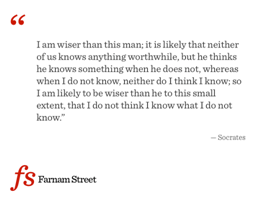
Socrates and the Search For Wisdom

Socrates and the Search For Wisdom

March 28, 2014 by Shane Parrish

image001-1

The arrogance of limited knowledge results in foolishness.

This is an excerpt from Plato’s Apology, from Plato: Complete Works (an excellent edition that is part of the Great Books program). Read more of this post

On Machiavelli: The Search for Glory

On Machiavelli: The Search for Glory (Liveright Classics) [Kindle Edition]

Alan Ryan (Author)

Book Description

Publication Date: November 18, 2013

An essential, comprehensive, and accessible guide to the life and works of Machiavelli. Read more of this post

One Simple Idea: How Positive Thinking Reshaped Modern Life

One Simple Idea: How Positive Thinking Reshaped Modern Life [Kindle Edition]

Mitch Horowitz (Author)

Book Description

Publication Date: January 7, 2014

From the millions-strong audiences of Oprah and The Secret to the mass-media ministries of evangelical figures like Joel Osteen and T. D. Jakes, to the motivational bestsellers and New Age seminars to the twelve-step programs and support groups of the recovery movement and to the rise of positive psychology and stress-reduction therapies, this idea–to think positively–is metaphysics morphed into mass belief. This is the biography of that belief. Read more of this post

A Few General Principles Associated With Wise Behavior; What does it mean to be wise? What is Wisdom?

A Few General Principles Associated With Wise Behavior

March 25, 2014 by Shane Parrish

Paul Baltes, once described wisdom as “a topic at the interface between several disciplines: philosophy, sociology, theology, psychology, political science, and literature, to name a few.” Farnam Street aims to be at the crossroad of these disciplines. Read more of this post

How Busy People Make Time to Read – And You Can Too

HOW BUSY PEOPLE MAKE TIME TO READ—AND YOU CAN TOO

HAVEN’T FINISHED A BOOK SINCE COLLEGE? BETWEEN WORK, FAMILY, AND SOCIAL LIVES, TRYING TO FIND TIME TO READ CAN BE MORE EFFORT THAN RELAXING HOBBY. HERE’S HOW TO MAKE MORE TIME FOR YOUR FAVORITE PAGE-TURNERS. Read more of this post

Why Are Physicists Drawn to Economics?

MARCH 21, 2014 BY CHRIS HOUSE

Why Are Physicists Drawn to Economics?

Even before the financial crisis, there has always been a surprising number of ex-physicists who find their way to graduate study in economics. It could be that many of these math-physics people have simply concluded that they no longer like physics and are interested in economics instead. (Moreover, the job market for economics Ph.D’s is much better than the job market for physics Ph.D’s.) I suspect however that some of them are here because they have some incorrect perceptions about the field. A student with a mathematical-physics background could easily convince himself that he has superior mathematics abilities than typical economists and superior statistical and computational skills than most economists.[1] He might go on to conclude that, as a consequence of his superior mathematical and computational abilities, he should be able to enter economics and start contributing quickly and easily. He might also anticipate that he could easily adapt established models or techniques in physics to study economic phenomena and impress the profession. Read more of this post
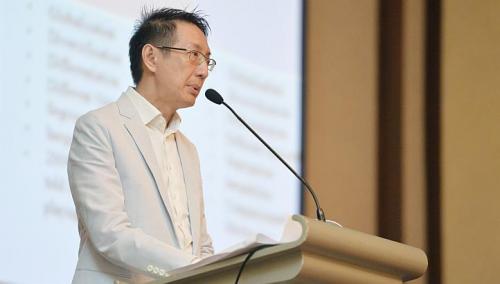
Beware growing ‘parentocracy’ in Singapore: NIE don; He warns of students who get ahead thanks to parents with more resources, not merit

Beware growing ‘parentocracy’: NIE don

He warns of students who get ahead thanks to parents with more resources, not merit

image001-10 Read more of this post

‘Card Factory has 16 years of unbroken like-for-like sales growth’; Richard Hayes, chief executive, says the retailer has opened a shop a week for the past decade; The average British person buys 30 greetings cards a year

‘Card Factory has 16 years of unbroken like-for-like sales growth’

Richard Hayes, chief executive, says the retailer has opened a shop a week for the past decade

Private equity group Charterhouse bought Card Factory for £350m in 2010 and is understood to be working with UBS and Morgan Stanley on an IPO Photo: PA

image001-9 Read more of this post

Start-up advice from Innocent and Skype founders

Start-up advice from Innocent and Skype founders

Entrepreneurial trailblazers Niklas Zennström and Richard Reed help to mentor three start-ups as part of the Albion Startup Kitchen series

Cooking up a start-up storm: (from left) Jonathan Mulonson, Martin Johnson, Niklas Zennström, Skype’s founder; Richard Reed of Innocent Drinks; Ed Cowburn and Emily Brooke  Read more of this post

Business has the power to do immense good; Business leaders – and shareholders – need to be thoughtful about the kind of organisations they are trying to build over the long term

Business has the power to do immense good

Business leaders – and shareholders – need to be thoughtful about the kind of organisations they are trying to build over the long term

image001-8

Sir Andrew says it is important to remember that the millions of people who work for businesses each have the potential to do good for the communities they are part of Photo: Bethany Clarke Read more of this post

Tom Erickson of Acquia, on the Philosophy of ‘Ready, Fire, Aim’; The chief executive of an open-source software company says he wants to hire people “who are going to jump in and own their work, who are going to risk something, and risk failing.”

Tom Erickson of Acquia, on the Philosophy of ‘Ready, Fire, Aim’

MARCH 29, 2014

By ADAM BRYANT

This interview with Tom Erickson, chief executiveof Acquia, an open-source software company, was conducted and condensed by Adam Bryant. Read more of this post

How to Think About the Risk of Autism

How to Think About the Risk of Autism

By SAM WANG

STUDY published last week found that the brains of autistic children show abnormalities that are likely to have arisen before birth, which is consistent with a large body of previous evidence. Yet most media coverage focuses on vaccines, which do not cause autism and are given after birth. How can we help people separate real risks from false rumors? Read more of this post

Robert Shiller’s Nobel Knowledge; Robert Shiller on the art of stock-picking and the complex psychology of investors

Robert Shiller’s Nobel Knowledge

Yale University economics professor and Nobel laureate, Robert Shiller on the art of stock-picking and the complex psychology of investors

DAVID WESSEL

Updated March 26, 2014 11:02 a.m. ET

ROBERT SHILLER, A 67-YEAR-OLDYale University professor best known for his early, accurate prediction that U.S. house prices were a bubble just waiting to burst, has long worked at the intersection of psychology and economics. He recently shared the Nobel in economics for insights into why prices of stocks and houses fluctuate as they do, particularly work showing that markets move too much to be explained by rational investors responding to changing fundamentals. Read more of this post

Recession no laughing matter for clown industry

Recession no laughing matter for clown industry

Sunday, March 30, 2014 – 10:33

AFP

NORTHBROOK, United States – In a global recession, being a clown is no laughing matter. Read more of this post

Thai monks’ gold facial scheme foiled

Thai monks’ gold facial scheme foiled

Saturday, March 29, 2014 – 03:40

The New Paper

A group of monks in a well-known temple in Thailand’s Petchabun province has been performing a ritual “to enhance women’s charms”. And this strange ritual could land them in trouble.

image001

The monks, it is claimed, have been charging between 5,000 and 10,000 baht (S$195 and S$390) for pasting a mask of sandalwood oil and gold foil on women’s faces. Read more of this post

6 Changes That Will Make You More Imaginative; With some intentional shifts in how you go about your creative process, you can finally become as innovative as you want to be

6 CHANGES THAT WILL MAKE YOU MORE IMAGINATIVE

WITH SOME INTENTIONAL SHIFTS IN HOW YOU GO ABOUT YOUR CREATIVE PROCESS, YOU CAN FINALLY BECOME AS INNOVATIVE AS YOU WANT TO BE.

BY MARTY NEUMEIER

Originality is fundamental to innovation and the key to building sustainable businesses and brands. However, in order to innovate, we must move from the known to the unknown–we must dream. Read more of this post

Presidential libraries: Style and guile; The search for a home for Mr Obama’s library and museum has begun

Presidential libraries: Style and guile; The search for a home for Mr Obama’s library and museum has begun

Mar 29th 2014 | CHICAGO | From the print edition

“AT THEIR best, they are lively classrooms of democracy,” says Richard Norton Smith, a historian who specialises in presidential libraries. They are also something of a misnomer. People who wander in expecting to borrow “The Cat in the Hat” tend to find instead a museum, a replica of the Oval Office and many floors of documents. Read more of this post

A new fossil reptile is unlike anything previously found

A new fossil reptile is unlike anything previously found

Mar 29th 2014 | From the print edition

image001-1

YUNNAN province, in China, is home to the Luoping formation, a trove of spectacularly preserved fossils of creatures that roamed the seas 240m years ago, during the Triassic period. The latest—and arguably most spectacular yet—is Atopodentatus unicus, described this week in Naturwissenschaften by Long Cheng, of the Wuhan Institute of Geology and Mineral Resources, and his team. Read more of this post

The outer solar system: Something new under the sun; A miniature planet sheds light on the extremities of the solar system

The outer solar system: Something new under the sun; A miniature planet sheds light on the extremities of the solar system

Mar 29th 2014 | From the print edition

image001-32

MODERN telescopes can see things billions of light-years away, so it may seem surprising that there remains anything to be discovered in the Earth’s backyard. But there is. On March 27th, for example, in a paper published in Nature, Chadwick Trujillo of the Gemini Observatory, in Hawaii, and Scott Sheppard of the Carnegie Institution for Science, in Washington, DC, announced that they have found a new member of the sun’s retinue, in a part of the solar system of which astronomers know little. Read more of this post

Chameleons: The Misuse of Theoretical Models in Finance and Economics

Chameleons: The Misuse of Theoretical Models in Finance and Economics

Paul Pfleiderer

Stanford University

March 2014

Abstract

In this essay I discuss how theoretical models in finance and economics are used in ways

that make them “chameleons” and how chameleons devalue the intellectual currency and

muddy policy debates. A model becomes a chameleon when it is built on assumptions

with dubious connections to the real world but nevertheless has conclusions that are

uncritically (or not critically enough) applied to understanding our economy. Read more of this post

Keen On. Scale: How To Spread Excellence From The Few To The Many

Keen On… Scale: How To Spread Excellence From The Few To The Many

Posted 10 hours ago by Andrew Keen, Columnist

Bob Sutton is one of Silicon Valley’s most influential business gurus. A professor at Stanford’s Engineering School, he is the author of bestselling books like The No Asshole Ruleand Good Boss, Bad Boss.  And his latest book is Scaling Up Excellence: Getting to More without Settling for Less, which argues that what distinguishes great companies like Pixar, Twitter, Google and Facebook from dysfunctional companies like Zynga is their ability to scale their organization. Read more of this post

Dancing Giants: Startup guru Steve Blank bashes big companies that stack the deck

Dancing Giants: Startup guru Steve Blank bashes big companies that stack the deck

BY ADAM L. PENENBERG 
ON MCH 28, 2014

Steve Blank is a kind of folk hero in startup circles. A successful entrepreneur, Blank, though his writings and Lean LaunchPad seminars at Stanford and online — more than 150,000 students have taken it – has become kind of a startup guru whose aim is to take the guesswork out of product development. Most companies don’t fail because they couldn’t attract a management team or gin up a product, he says. They fail because they didn’t create a product that will sell. Both he and Eric Ries, a former student, have become synonymous with the lean startup methodology that provides a systematic approach to creating startups. Read more of this post