Can a New Culture Fix Troubled Companies?

March 12, 2013, 7:30 p.m. ET

Can a New Culture Fix Troubled Companies?

By JOANN S. LUBLIN

Bob Flexon, chief executive of Dynegy Inc., DYN +2.03% occupies a 64-square-foot cubicle, identical to the ones used by the 235 colleagues who surround him at its Houston headquarters. Hourly employees sometimes stop by his desk to chat.

MK-CB542_CORPCU_G_20130312170955

Eric Kayne for The Wall Street Journal

Dynegy CEO Bob Flexon, shown in his 64-square-foot cubicle on an open floor, where 235 headquarters colleagues surround him.

It’s a long way from the expansive office suite, $15,000 marble desk and Oriental rugs that Mr. Flexon inherited when he arrived at Dynegy in July 2011, four months before the power producer filed for bankruptcy.

Under his command, Dynegy shifted its headquarters last May to a single, open floor in a different building.

The move, which saved $5 million a year, is the most visible symbol of Mr. Flexon’s attempts to overhaul the company’s culture. He aims to transform a business previously focused on day-to-day survival into an agile operator poised for growth.

Among other changes, he made frequent visits to the company’s power plants, banned employees from checking email and phones during meetings and restored annual performance reviews. “The idea was to instill a winning spirit,” Mr. Flexon says. Though Dynegy emerged from bankruptcy last October, its cultural restructuring remains a work in progress.

Increasingly, leaders of troubled businesses try to fix the company’s culture along with its bottom line. Since the financial crisis struck in 2008, CEOs have sought to improve collaboration and decision making, recognizing that a strong culture is “a critical component of their long-term success,” says Nick Neuhausel, a partner at consulting firm Senn Delaney, which advised Dynegy.

“The right culture change can—without question—improve results,” says John Kotter, co-author of the book “Corporate Culture and Performance” and head of research at consulting firm Kotter International. But putting a sick business on a healthier strategic path while changing its culture “is much more difficult than most executives realize,” he cautions. Read more of this post

Fortune 500? Singapore’s Bamboo Innovator 500!

Fortune 500? Singapore’s Bamboo Innovator 500!

By KEE Koon Boon

13 March 2013

“Singapore is too small and its talent pool is too small to produce a world-class manufacturing giant of the Fortune 500 class”, Singapore’s former Minister Mentor Lee Kuan Yew once said. A cryptic remark indeed because it does not imply that the venerable founder of modern Singapore thinks Singapore cannot produce knowledge-based giants, or resilient “Bamboo Innovators”.

Why “Bamboo Innovators”? Bamboos bend, not break, even in the most terrifying storm or devastating earthquake that would snap the mighty resisting oak tree. It survives, therefore it conquers. Disruptive industry trends and black-swan crises have become a permanent fixture in today’s marketplace. How wonderful it would be if countries, companies and individuals can stay resilient amidst the disruptive upheavals and unorthodox challenges – like the bamboo. The study of Bamboo Innovators can hopefully inspire companies to be productive innovators in order to surpass stall points in their business models during tumultuous periods, particularly SMEs aspiring to scale up to become global champions.

But why is it that Asian companies are predominantly product manufacturers in the first place? This could ironically be a result of the Asian values of hardwork and sacrifice. It is far easier for the Asian entrepreneur to be the middleman in getting orders from a few important anchor MNC customers who have access to the end customers, take capital risk in investing in tangible assets, and work hard in producing the required products with quality and efficiency, rather than attempt to build business models that have direct ownership of the hundreds and thousands of end customers. To do the latter would require interacting intensively with the end customers, a task which is beyond that of a lone powerful entrepreneur. As a result, Asian entrepreneurs are unwilling to share the rewards with their “undeserving” staff who did not take risk or sacrifice, thus treating employees as expenses, making most or all of the decisions and hoarding most of the resources and information themselves, running the firms as a “one-man-show”, and facing potential business continuity challenges from succession woes.

Keyence, established in 1974, is an illustration of the unconventional Asian firm. Takemitsu Takizaki, the 67-year-old founder, liberated the firm from manufacturing conventions and built a knowledge-based enterprise in laser sensors for use on automated factory assembly lines serving over 100,000 customers in 70 countries. Despite having only less than 1 percent global market share in a commodity-like product and only around 3,000 employees, Keyence commands a US$17 billion market value, approximately similar to Singapore’s Keppel Corp, a global leader in offshore oil rig design and building. It is also double the value of Nidec, another outstanding Japanese company which has more than 80 percent global market share in miniaturized motor and 100,000 employees.

Takizaki-san, who stepped down from the CEO role to be the Chairman in 2000, understood keenly that Keyence cannot improve on Japan’s legendary manufacturing efficiency. So, unlike its manufacturing-based competitors which focus on manufacturing and leave sales to distributors, wholesalers and agents, it deliberately avoids making products, except for manufacturing steps that involve trade secrets which are kept in-house. Most of its 3,000 employees are either “sales” or “research” staff. In their direct contact with the customers, Keyence’s in-house “sales” team pick up new product ideas on frequent factory visits. They would report back to the research department on what new machines their customers would find useful. They also tell the production department about demand for existing products, helping Keyence to regulate its output and reduce inventories. For instance, Keyence’s frontline solution providers observed from the production lines at instant noodle factories that the noodle quality was compromised because they were manufactured at variable thicknesses. Laser sensors that could measure noodles to 1/100th of a millimetre were develop and used by giants such as Nissin to keep noodle thickness consistent. 25 percent of sales at Keyence are generated from such new products, even higher than 3M.

To excel in these areas, Keyence had to cultivate a meritocratic culture and it is “notorious” for having one of the highest-paid salaries in corporate Japan for its employees. Bright young people from rival firms are attracted to Keyence by the performance-based pay. The engineers also get the chance to do their own research, rather than labouring for years under grey-haired supervisors. The average pay of the employees at Keyence is US$100,000.

“Ownership” of customer by decentralizing and empowering frontline employees also helped IBM to stave off a near-death experience in the early 1990s. When Lou Gerstner took over as CEO in April 1993, IBM had three consecutive years of financial losses, including losing a record $8 billion in 1993, and was about to be broken up. Lou reduced the Big Blue’s dependency in mainframe manufacturing, which was supplanted by personal computers and servers, and built the global platform for services to provide higher value to customers, a core business which today accounts for over 40 percent of its overall profits. Lou had multiplied the market cap 10-folds to $100 billion by the time he passed over the leadership baton in 2002 to Sam Palmisano, who quadrupled earnings and created an additional $130 billion in shareholders’ value in 10 years as he positioned IBM in software and analytics, a task now continued by the new CEO Virginia Rometty.

Keeping the frontline, or the “periphery”, to be resilient and innovative, and the center, or the “core”, to diffuse and enforce meritocratic values to all levels, has compounded immense value at both Keyence and IBM. This core-periphery growth pattern is also that of the bamboo whereby the vitality of its growth revolves around its “empty” center. Instead of sanely constructing itself inch by solid inch like trees, soberly climbing into the contested forest air, the nutrients and moisture that would have been exhausted making and maintaining its empty center can be utilized for growth of its periphery in the other culms (stem). From a builder’s viewpoint, the architecture of the bamboo culm presents a powerful configuration: fibers of greatest strength occur in increasing concentration toward the periphery of the plant.

Manufacturing and project-based companies often tout the size of their “orderbook” and their idea of “teamwork” is about hiring high-profile rainmakers or dealmakers who can bring in the sales orders and the job of everyone else is to execute efficiently and “productively”. The well-connected dealmaker may be able to pull in high-dollar projects but because of the difficulties in coordinating and executing large-scale complex projects, these projects or deals cannot be repeated and the hype associated with big orderbook starts to fade, particularly when cost overruns and delivery delays start to rear their ugly heads. Bigger becomes riskier. Even in manufacturing, the only way to perform and execute large-scale complex projects repeatedly is to create an intangible culture and environment of excellence where the interests of the mid-level and frontline individuals matter by aligning their interests and empower them to become. Customers are attracted to this contagious performance culture rather than to the dealmakers on a relationship basis, or even to the core “team”, resulting in a valuation breakthrough beyond the billion-dollar market value barrier that many Asian companies find hard to break.

A service-based economy does not emanate from taking a broad sector or industry approach, such as identifying “hot” services such as healthcare, education, media and so on. Such a headlong approach can only get the growth engine going only so far. Services sustainability has to stem from equitizing customer ownership based upon performance and interaction, trust, mutual respect and interdependency. This inevitably requires “emptiness” in the business model design like the bamboo with a core-periphery growth structure in order to scale up in a sustainable way. A powerful lone entrepreneur at the center who believes that he has work so hard and sacrificed so much, or a “I-did-it-all-by-myself” mentality, often does not believe in sharing with other “undeserving periphery” people if he does not cultivate a culture rooted in kindness, trust and cooperation.

Culture is like the invisible intricate underground root structure that makes the ground around a bamboo grove very stable – and make possible the flexibility and adaptability of the bamboo to bend, not break, with the wind. Kindness is like water nourishing the powerful roots of bamboo. A culture rooted in kindness definitely seems incompatible in a harsh, competitive business world. But kindness is trusting and ready to risk in new innovations. Kindness is an inner revolution; as is innovation. We become more fluid, more willing to risk. Kindness is about putting less in our possession and more in people. The boundaries between us and others begin to merge, so that we feel engaged and committed as part of a whole in which it is possible to share resources, emotions and innovations.

Rootedness in a culture of kindness and trust triggers the intense instinct, emotional focus and commitment with regard to actively planning for the enterprise’s future as one cohesive singular enterprise, to accept and embrace those who want to contribute, and to engender love amongst the members despite differential rewards and efforts as all work towards the objective of creating a resilient structure as a true compounder, the evergreen Bamboo Innovator.

Fortune 500? With “emptiness” in business model design and “rootedness” in a kindness culture, just like Keyence and Keppel which have almost US$20 billion in value, Singapore can have its own unique Bamboo Innovator 500 powerhouse with a US$10 trillion value.


Education 2.0 in Singapore: The Bitzu’istic Bamboo Innovator

Education 2.0 in Singapore: The Bitzu’istic Bamboo Innovator

By KEE Koon Boon

12 March 2013

“Can my kid watch how you milk cows?”

“Can my kid see how you print the newspaper?”

As a young boy, Gil Shwed was taken on learning adventure trips by his loving mother – to dairy farm, to printing house, including to his father’s office in 1972 where he saw a computer for the first time when he was five years old. Enlivened, and grounded in the values of sacrificial love since young, Gil pursued excellence in an “education” in computer skills by signing himself up for an afternoon computer class in a religious community center at nine, embarking on a summer job coding for a language-translation software company at twelve, and taking computer science classes at the Hebrew University while in high school.

While his high-profiled peers boisterously chased fashionable dollar-seeking career strategies with their well-endowed grades and holistic CV, Gil diligently and silently persisted in building a computer security software, an idea that he had cooked up during his four-year mandatory military conscript in which he strung together military computer networks in a way that would allow some users access to confidential materials while denying access to others. After leaving the army service, Gil, together with his two friends, Shlomo Kramer and Marius Nacht, would work together on borrowed computers in the cramped and hot apartment that belongs to Kramer’s grandmother without much extrinsic reward, and without the psychological security of a “proper” real job, until 1 a.m., then comforted themselves with companionship and Japanese food or went for a drink on the beach.

Gil’s “education” was made market-relevant when plugged into the unique self-organized ecosystem that constantly searches for and supports innovative ideas and new products. A VC fim shared in Gil’s vision and gave him technical and business assistance. The trio unveiled their product at a computer show in Las Vegas in 1994 and won the best software award. That product was called FireWall and their flagship product has never been breached. Their company, Check Point Software Technologies, went on to list in NASDAQ in 1996 and its market capitalization had since multiplied 12-folds to around US$10 billion presently.

“Education” with that bitzu’ism quality was at the heart of the pioneering ethos that connected not only the trio together but also into the global marketplace, adding on to the social capital that higher “education” brings to society when resilient “Bamboo Innovators” are created. A bitzu’ist is a Hebrew word that loosely translates to “pragmatist” with a resilient quality, like the bamboo that bend but not break in the wildest storms that snapped the mighty resisting oak trees. The bitzu’ist is “the builder, the irrigator, the pilot, the gunrunner, the settler” – all rolled together into one.

Gil thinks of his home country Israel as a “startup nation”: “We managed to create a country from zero. We’ve had an entrepreneurial spirit for over 100 years. Brought in immigrants. Fed them. Created a legal system. Built cities. Set up farms in the desert. Invented techniques like drip irrigation. One thing that really helps us here is that we don’t have a local market. We are thinking of customers who are 6,000+ miles away from home.” Adversity, like necessity, breeds inventiveness. Surrounded by hostile neighbors that makes regional trade impossible and endowed with little natural resources, Israel has the highest density of start-ups in the world with one for every 1,800 Israelis from its population base of 7.4 million with seventy different nationalities as Israelis think globally to create international products. These physical constraints ironically positioned Israel for the global turn toward knowledge- and innovation-based economies and companies. After the US, Israel has more companies listed on the NASDAQ than any other country in the world, including the entire European continent, as well as India, China, Korea, Singapore combined. These agile startups darting between the legs of multinational monsters are hungry global champions, with some long-term entrepreneurs who looked not for the tempting quick flips but stayed the painful course to build and last for the long-term, such as Gil’s Check Point, scaling up to become world leaders, brick by brick.

Warren Buffett, the world’s greatest investor and the apostle of risk aversion, broke his decades-long record of not buying any foreign company with the purchase of an 80 percent stake in Iscar Metalworking, the world’s second largest maker of cutting tools which is founded in 1952 in a wooden garage, for US$4 billion in May 2006 – seemingly vulnerable assets in war-torn Israel. Buffett’s view is that if Iscar’s facilities are bombed, it can go build another plant. The plant does not represent the value of the company. It is the “intangible” – the talent of the management, the international base of loyal customers, and the brand – that constitute Iscar’s value. As Iscar’s founder Stef Wertheimer puts it firmly, “We do not miss a single shipment. For our customers around the world, there was no war.” By responding to threats this way, Wertheimer and his team have transformed the very dangers that may make Israel seem risky into evidence of Israel’s inviolable assets. Israelis, by making their economy and their business reputation both a matter of national pride and a measure of national steadfastness, have created for foreign investors a confidence in Israel’s ability to honor, or even surpass, its commitments.

What is striking about Israel is that the development of human capital is the key to growing the economy. Its “education” was made relevant because it was plugged into the unique ecosystem such that the combination of sacrifices and competence has a performance-based outlet to be converted into longer-term relevance for the global marketplace in building a “Bamboo Innovator” company such as Check Point.

In the growth of Singapore 1.0 since its self-governance, the system in education is rightly about forging a meritocratic and highly-competitive “standardized” education system to lift the technical competence and social mobility of the masses to the plateau where they will be able to get the rays of the sun emitted by the multinational companies in its export-oriented economic strategies. This is augmented by higher valued-added services from logistics, shipping and maritime support to legal, finance and accounting, generating high-wages to beat inflationary pressures. This was masterful strategic grand-positioning amidst the geopolitical forces of power in the “hard times” era to meet the exigencies of the global forces in order for the population to stay employed and survive.

In other words, Education 1.0 is about plugging in to the needs of capable MNCs, who, in turn, connect the small, open economy of Singapore to the real marketplace. Along the way, short-term transactional-based tangible wealth was collected amongst the individuals through industriousness in work, and passed on when invested in private assets that have the potential for long-term capital appreciation, such as property, to foster a sense of ownership and stability. As the late Dr Goh Keng Swee, the indefatigable economic architect of Singapore, elucidated: “The way to better life was through hard work, first in schools… and then on the job in the work place. Diligence, education and skills will create wealth.”

Yet, the highly-skilled workforce is not able to house whatever of their “intangibles” in know-how into building and even owning “Bamboo Innovators”. The capitalization of tangible “profits” that accrue from these intangible know-how are housed in and owned by the MNCs vehicles. In investing lingo terms, a high-salaried worker in MNC has a “Price-Earnings” (PE) ratio of one while a MNC can have a PE value of 20 times. A productive “Bamboo” worker is one who, when a wind blows away his or her MNC title and position, can still remain resilient innovators to create value because they have that indestructible “intangible” quality. Interestingly, it is the hollow “emptiness” in its center – the “intangibles” – that gives the bamboo great strength and flexibility in a raging storm. In addition, there are growing concerns expressed by the MNCs that the Singapore workforce lacks the initiative and innovativeness that the knowledge-based industries desire, imposing a barrier to a breakthrough in wages and productivity.

Making further economic and social advancements from this blockage by putting guile ahead of industriousness, their “retained earnings” are deployed into scalping, speculative and hedonic activities which can be socially destabilizing. Their accumulated wealth and assets for its own sake evolve to a sense of entitlement, festering into a dangerous liability that erodes character, moral values, and social cohesion. And healing attempts or reform through efforts in “character education” and “creative thinking” alone is not only difficult but also decidedly off-track. As economist David Landes puts it aptly, nothing is more dilutive to drive and ambition than a sense of entitlement, ingraining in the minds of the elites and the population that they are superior, which reduces their “need to learn and do”. This kind of distortion makes an economy inherently uncompetitive.

Thus, even though America consistently ranked far below Singapore and the East Asian nations in educational metrics such as standardized test scores or prizes won in math and science competitions, the U.S. “education ecosystem” with that bitzu’ism quality continuously enabled the emergence of long-term entrepreneurs with a sense of mission, such as Sam Walton (Wal-Mart), Warren Buffett and Charlie Munger (Berkshire Hathaway), Bill Gates (Microsoft), Steve Jobs (Apple), Ray Kroc (McDonald’s), Jim Sinegal (Costco), Howard Schultz (Starbucks), Jeff Bezos (Amazon), the “Google guys”, and so on.

Instead of getting diminishing marginal returns from repeating the strategy of Education 1.0 that treats educational achievements as instrumental, the education system in this “complex uncertain times” era requires enabling the population to grope and reach directly into the global marketplace, to be sensitive and alert to existing anomalies and paradigms of how things ought to function and behave in the marketplace. It is this sensitiveness and alertness that lead to their discovery through their strong conviction and belief that they can do it significantly better by creating “Bamboo Innovators”. A nation of long-term entrepreneurs who are able to burst asunder the limits of existing knowledge to find and exploit the niches of relative advantage when they introduced their new innovations to positively create value for the customers and society.

At the heart of the educational curricula in any discipline and subject is for the educators and teachers to connect and sensitive the students to the chaotic global marketplace. The disengaged students, upon seeing the reflection of their foggy and incompatible images in this grand mirror, would see inside themselves, embarking on a self-discovery and self-learning journey or Work to equip themselves with both the knowledge and character to once again see themselves more clearly in this mirror. They will experience the uncanny: the raw sensual data reaching their eyes before and after are the same, but with the pertinent framework of meaning, the chaotic features and anomalies in the marketplace are visible. Visible for them to experience the burning sense of mission to sacrifice in undertaking the lifelong Work of building durable enterprises with compulsion, persistence and a sense of urgency. The sacrifices and, at times, pain, can break the heart, but doing anything else would be unimaginable. There will be no idle time to waste for every moment has a strategic importance. Sensitized students will be constantly attentive to the possibility that they may be mistaken, and they will be enlivened by a sense of responsibility towards the Work, internalizing the well-working of the Work as an object of passionate concern and personal committment. This is an ethical virtue.

And being rich or poor is irrelevant in the bitzu’istic education ecosystem without that delusive and destructive chase towards instrumental educational achievements, such as creating “input” in “grades” or “output” in “checklist-based holistic CV” or “high graduation salary”, for it is now plugged into the marketplace. This experience of the uncanny does not reveal itself to idle spectators; to “get it” is an ethical virtue. The poor can beat the rich because they can be more virtuous. Both the poor and the rich can rise through the marketplace by staying productive as diligent builders of enduring enterprises, “Bamboo Innovators” such as Check Point which remain relevant no matter how the uncertain world around us changes as they hold fast to the resilient principles in value creation.

In a rendition of Dr Goh’s view on the spirit of education as both “a search for truth” and “the way to better life”, the mother of purpose and progress in Education 2.0 is to center around the understanding of how and why resilient companies continue to create value in uncertain and difficult times – and educating students to dare greatly to become “Bamboo Innovators” at an individual level like Gil Shwed in building enduring creations can originate that “indestructible intangible” quality which they carry within themselves as an inner compass to navigate the world. After all, as former Israeli President Shimon Peres puts it, “the most careful thing is to dare”, which also articulates the pioneering definition of the Singaporean trait of kiasuism to scale new heights, just like the expression “the bamboo blossoms at ever higher nodes”.

GOD 1, MAMMON 0; Religious-based family firms were common in the west in the 19th century, and with the rise of the new economies faith is once again driving businesses

GOD 1, MAMMON 0

ARTICLE | 11 MARCH, 2013 10:14 AM | BY PENNY WEBB

If you stick around long enough, most things will come back into fashion. Until recently, the family-owned firm with a religious ethos would be regarded in fashionable western business schools as vaguely 19th century, conjuring images of earnest Quakers in sober attire, building model villages and fretting over the character of the working man.

Pioneers such as Joseph Rowntree and George Cadbury are known for their philanthropy and their faith; it is often overlooked that they were brilliant businessmen. By the late 20th century and early 21st, good works had been nationalised by the state and philanthropy was seen as dated. The “modern” way of doing business had become secular, orientated around financial data and aggressively rational – or at least, rational-sounding.

The only value was maximising shareholder value, and it was assumed that deviation from this quest would lead only to loss of focus and waste. In recent years, however, the absence of values other than profit maximisation – standardised around the ludicrously short-term indicator of the quarterly return – has been exposed as catastrophically unfit for purpose, in business and economic terms as well as politically and socially.

We now know that amoral business comes at an economic as well as a social cost. Accounting scandals, mis-selling of financial products, Libor-rigging, trading in securitised products that traders themselves did not understand (the list goes on) are practices that have destroyed entire businesses and much shareholder capital, and pitched western economies into an avoidable crisis.

To underline the point, throughout this whole period hundreds, perhaps thousands, of companies run on “old fashioned” principles of honest conduct with customers, provision of good careers for loyal staff and managing for the long term, are left standing. Read more of this post

The Holocaust: FDR’s indelible failure

The Holocaust: FDR’s indelible failure

By Richard Cohen, Tuesday, March 12, 7:31 AM

On April 12, 1945, my grandfather approached me as I played outside the house and asked where my mother was. He looked stricken, and so I quickly followed him inside and heard him say words that made my mother burst into tears: President Roosevelt had died. My mother’s grief and panic were so palpable — her brother was fighting in the Pacific, her brother-in-law was fighting in Europe — that it scared me. In our house, FDR was not merely the president. He was a god.

He is a god no more. His New Deal is no longer solely credited with ending the Great Depression — World War II did that — and the war in Europe was not won, as we all once thought, primarily by the United States but more so by the Soviet Union. Yet these, to my mind, are trifles compared to the criticism that Roosevelt was passive in the face of the Holocaust. It’s not that he did nothing, it’s that he did nothing much.

This accusation of immense moral failure — or indifference — is now being addressed by a new book, “FDR and the Jews,” by Richard Breitman and Allan J. Lichtman. It sets out to find a middle ground and instead makes things worse. It is a portrait of a president who, in the authors’ own words, “did not forthrightly inform the American people of Hitler’s grisly ‘Final Solution’ or respond decisively to his crimes.” This is a Roosevelt who almost always had a more pressing political concern — American isolationism, American anti-Semitism, a fear and hatred of immigrants — and who stayed mum while a bill to allow 20,000 Jewish children into the United States died in Congress.

Roosevelt inattentively also permitted a cabal of heartless anti-Semites in the State Department to control the country’s visa policies. Desperate Jews, fleeing from the Nazis, were denied asylum in the United States. One of them was Otto Frank. His daughter Anne perished at the Bergen-Belsen concentration camp. Read more of this post

‘Despite All the Money, I’m Not Happy.’ Startup Lessons from Sohu CEO Charles Zhang; 张朝阳精神危机:我什么都有 但居然这么痛苦

‘Despite All the Money, I’m Not Happy.’ Startup Lessons from Sohu CEO Charles Zhang

Mar 12, 2013 at 14:00 PM by C. Custer, in OpinionStartups

47761464hd6d50b261387&690

Sohu founder and CEO Charles Zhang is, by the standards of most tech entrepreneurs, doing very well. His startup has long since blossomed into a full-blown tech giant, and success has brought him both prestige and heaps of money. Yet in a recent interview on Yang Lan One-on-OneZhang told the host that he is actually miserable:

I think there’s something wrong with me. I truly have everything, and yet I am so miserable. Happiness is totally unrelated to how much money you have.

Zhang has reportedly removed himself from the day-to-day operations of the company and has stayed out of the public limelight (for the most part) over the past year. In the Yang Lan interview, he revealed that this was because his anxiety was making it impossible for him to work. He also said that he had found his success was changing him:

Successful people often have this need to do things their own way. [After I became successful] I became more of a perfectionist; I wanted to control the outcome of everything, and even felt that I could live to the age of 150.

More details and quotes from the interview are here for those who can read Chinese, but instead of speculating about Zhang’s mental state, I just want to highlight a couple of the things we can learn from this interview. Many of us are entrepreneurs searching for that big breakthrough or investors working hard to turn money into more money, and Zhang’s reminder that money cannot buy happiness might be cliche, but it’s important to remember. Of course, that’s not to say that having lots of money isn’t nice (or at least I imagine it’s nice; if anyone wants to send me a huge sum of money I’d be happy to give that lifestyle a try and review it here). But if money is your endgame, it’s possible you’ll end up like Zhang, standing at the top of a pyramid and wondering why bothered to climb it in the first place. The other thing Zhang’s interview reminds is that success can and does change people. Maybe Zhang’s issues are deeper than that and maybe they aren’t — I’m not qualified to speculate on anyone’s mental state one way or the other. But it’s important to keep an eye on your own psyche as you move through the entrepreneurship process and make sure that you’re OK with any changes that are happening. Becoming more of a perfectionist might be a good thing to some people, but others may want to avoid becoming a domineering control freak (and let’s be honest, there are plenty of startup founders who fit that description even before they’re successful). We wish Zhang the best, as we do to all entrepreneurs at every stage of the game from bootstrappers to billionaires. At the same time, though, I wish that everyone in the startup scene would spend a little more time thinking about their own definitions of happiness and the effects being an entrepreneur can have on their psyche. We spend so much time talking about what technology is innovative, and yet many of us are chasing the exact same goal: make a globally relevant product and get rich. Perhaps sometimes we should approach our own thinking patterns with the same spirit of disruption and innovation we bring to hackathons and tech conferences.

张朝阳精神危机:我什么都有 但居然这么痛苦

2013年03月05日 01:59  新浪科技 爱文

“我觉得我出问题了,我是真的什么都有,但是我居然这么痛苦。幸福跟钱的多少真的是没关系。”经过一年多的“闭关”,搜狐董事局主席张朝阳在接受《杨澜访谈录》专访时首次披露内心的精神危机。 Read more of this post

The New Power of Memory; Sharp Recall Skills Prove Key to Future Success; Some Excel at ‘Mental Time Travel’

March 11, 2013, 7:12 p.m. ET

The New Power of Memory

Sharp Recall Skills Prove Key to Future Success; Some Excel at ‘Mental Time Travel’

By SHIRLEY S. WANG

A key purpose for memory isn’t to just remember the past, but to be able to imagine the future. Shirley Wang reports on Lunch Break. Photo: AP.

Memory allows for a kind of mental time travel, a way for us to picture not just the past but also a version of the future, according to a growing body of research.

The studies suggest that the purpose of memory is far more extensive than simply helping us store and recall information about what has already happened.

Researchers from University College London and Harvard University have made strides charting how memory helps us draw a mental sketch of someone’s personality and imagine how that person might behave in a future social situation. They detailed their latest findings in work published in the journal Cerebral Cortex last week.

What the scientists showed could have implications not just for those who suffer memory loss, like the elderly, but young adults and their ability to plan and socialize. The researchers are also following up what they’ve found by trying to see whether the ability to recall past events may be related to creativity and imagination.

The body of work is “broadening out our view of how we use memory,” says Daniel Schacter, a psychology professor at Harvard.

This ability to imagine or anticipate what may come is important to our ability to plan and problem-solve and helps us make better decisions in social situations. The researchers also hope to uncover new ways of improving human memory.

“Using past experiences to anticipate possible future happenings” lets people weigh approaches to a coming situation without needing to try out the actual behaviors, Dr. Schacter says.

Little is known about why some people might naturally have better abilities to recall experiences or imagine future ones. Read more of this post

CLAY CHRISTENSEN: Jeff Bezos, Scott Cook, And Steve Jobs Got Disruption Right; “Data is heavy. People want to solve problems and tell their bosses they solved it, not bring them issues all the time. As a result, the higher you get, the less real information you receive

CLAY CHRISTENSEN: Jeff Bezos, Scott Cook, And Steve Jobs Got Disruption Right

Max Nisen | Mar. 11, 2013, 6:31 PM | 1,255 | 1

It’s been some 16 years since Clay Christensen published “The Innovator’s Dilemma” and brought the concept of disruptive innovation to the wider world. Despite that, many companies and executives still haven’t managed to take its core lesson to heart, that it’s not enough to just look at the data. You have to constantly ask questions and look to the future. In an interview appearing at strategy+business, Christensen argues that many executives are pushed to make decisions that are quick and profitable, and they frequently rely heavily on incomplete data. “Data is heavy,” Christensen says. People want to solve problems and tell their bosses they solved it, not bring them issues all the time. As a result, the higher you get, the less real information you receive.

The most successful executives think about why things might turn out differently, have a theory, and constantly update it. Few people are good at that. They don’t ask the right questions, and they aren’t paranoid enough.  Read more of this post

Solving the Puzzles of Mimicry in Nature; Analyzing the DNA of dangerous butterflies who copy other unpalatable species, scientists have found that some shared color-controlling genes, signaling past interbreeding

March 11, 2013

Solving the Puzzles of Mimicry in Nature

By SEAN B. CARROLL

12CREA-articleLarge

The wing patterns of two unpalatable butterfly species, Heliconius erato, top row, and Heliconius melpomene, show striking similarities. DNA studies suggest that some species generated similar patterns independently; others share color-controlling genes.

Perhaps no destination has attracted and inspired more great naturalists than Brazil. Charles Darwin, on his epic voyage on the H.M.S. Beagle, first made landfall at Bahia in 1832; two fellow Englishmen, Alfred Russel Wallace and Henry Walter Bates, arrived at Pará in 1848. Wallace roamed the Amazon for four years, and the indefatigable Bates for 11.

In 1852, a naturalist named Fritz Müller arrived from Germany. Much less known today, Müller, unlike his English contemporaries, moved to Brazil with his wife and young child and had no intention of ever returning to Prussia. A freethinker who refused to swear an oath to God required for his medical graduation, Müller traded a medical career in Europe for a mud-floor hut at the edge of virgin forest in the Blumenau colony in Santa Catarina.

While Darwin and Wallace would conceive of the theory of evolution by natural selection, its acceptance was aided greatly by Bates and Müller. And thanks to Bates and Müller, perhaps no group of animals contributed more to the early growth of evolutionary science than butterflies. Their ideas continue to inspire naturalists today and have led to surprising new insights into how evolution works.

Both men found Brazil ablaze with colorful butterflies. Bates noticed among his collections certain species whose bright wing patterns closely resembled those of other butterfly families in the area. In puzzling out why one species would mimic another, he realized that harmless butterflies were mimicking noxious species that were unpalatable to birds and lizards, and therefore not attacked by predators.

Only a few years after Darwin published “On the Origin of Species,” Bates suggested that this sort of mimicry — now called “Batesian” — was timely proof of the principle of natural selection. Read more of this post

Henan peasants ask local environmental officials to drink the “pure underground water” in his village; 河南农民请环保厅长喝地下“纯净水”

1363009494305533_840_560

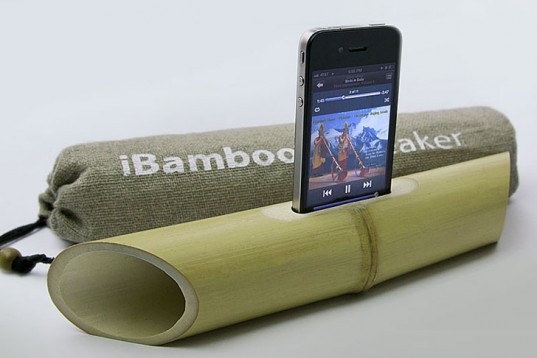
iBamboo is an Electricity-Free iPhone Speaker Made from a Piece of Bamboo

iBamboo is an Electricity-Free iPhone Speaker Made from a Piece of Bamboo

by Mark Boyer, 04/20/12

iBamboo-speaker-lead-537x358ibamboo-urban-2-537x358

iPhone users aren’t exactly at a loss when looking for a place to dock their phones these days. But even in a market that’s flooded with a myriad docking and music amplification systems, theiBamboo Speaker by designer Anatoliy Omelchenko of Triangle Tree manages to separate itself from the pack. The simple-yet-chic design consists of a single piece of bamboo — one of the world’s greenest natural materials — with a slot cut into it where the iPhone is placed. The natural shape of the speaker amplifies the tunes, producing a pseudo-stereo effect that requires no electricity.

This isn’t the first electricity-free iPhone speaker we’ve encountered, but the iBamboo has some notable advantages over the competition. The one-foot-long bamboo tube is lightweight and durable, and because it’s made from natural material, no two speakers will be identical. Bamboo is one of the fastest-growing plants in the world, and it produces more oxygen than an equivalent mass of trees.

Earlier this year, Omelchenko told Gizmag that in response to requests for plastic versions of the iBamboo Speaker he was working on prototyping a new version of the speaker that’s made from recycled plastic. The iBamboo Urban design is shaped exactly like the natural bamboo version, and it’s reportedly even more durable. Unlike the original iBamboo speaker, which adds warmth to music and is good for listening to jazz and folk music, Omelchenko tells Gizmagthe that the Urban design has a crisper sound. According to the iBamboo website, the original iBamboo design is currently out of stock, and once it hits the market, the recycled plastic version will retail for $30.

Fugitive Fund Manager Stuffed Underwear With Cash, Fled; founder and former chief investment officer of Absolute Capital is accused of “cross trading” hundreds of millions of shares of penny stocks between the company’s funds to boost the value of the otherwise illiquid stocks

Fugitive Hedge Fund Manager Homm Arrested at Gallery

Florian Wilhelm Jurgen Homm, the German hedge-fund manager who has been a fugitive for more than five years, was arrested at the Uffizi Gallery in Florence on U.S. fraud charges.

Homm, 53, allegedly caused at least $200 million in losses to investors in hedge funds operated by Absolute Capital Management Holdings Ltd., according to a statement by the U.S. attorney’s office in Los Angeles. Homm was arrested yesterday by Italian authorities following a U.S. request, according to the statement.

Federal prosecutors in Los Angeles filed a criminal complaint March 6, charging Homm with conspiracy and fraud. The founder and former chief investment officer of Absolute Capital is accused of “cross trading” hundreds of millions of shares of penny stocks between the company’s funds to boost the value of the otherwise illiquid stocks.

The trades, through a Los Angeles-based broker-dealer that Homm co-owned, generated fees for Homm and Absolute Capital and also inflated the price of Absolute Capital on the London Stock Exchange, Alternative Investment Market, according to the statement. Homm “dumped” his shares and resigned from Absolute Capital on Sept. 18, 2007, “in the middle of the night,” according to the statement. Read more of this post

Getting the Journalism You Pay For; What happens to in-depth reporting in the age of the blog post? We need to find ways of paying for it.

March 10, 2013, 7:07 p.m. ET

Getting the Journalism You Pay For

What happens to in-depth reporting in the age of the blog post?

By L. GORDON CROVITZ

Journalists naturally worry about the future of journalism as technology upends traditional business models, resulting in huge job losses. A recent kerfuffle involving a veteran foreign correspondent turned freelance journalist illustrates why readers also should care how serious journalism will be funded.

An editor of The Atlantic magazine’s website last week asked Nate Thayer to rewrite a 4,000-word article he had published on another site (about 25 years of U.S.-North Korean diplomacy) into a 1,000-word version for The Atlantic. Mr. Thayer balked and instead posted the email exchange on his blog site under the headline, “A Day in the Life of a Freelance Journalist—2013.”

The Atlantic’s Web editor wrote: “We unfortunately can’t pay you for it, but we do reach 13 million readers a month.” Mr. Thayer responded: “I am a professional journalist who has made my living by writing for 25 years and am not in the habit of giving my services for free to for-profit media outlets so they can make money by using my work and efforts by removing my ability to pay my bills and feed my children.” Mr. Thayer suggested, “I am sure you can do what is the common practice these days and just have one of your interns rewrite the story as it was published elsewhere, but hopefully stating that is how the information was acquired.” Read more of this post

How Paypal co-founder and billionaire Elon Musk Hires: ‘It Matters Whether Someone Has A Good Heart’

How Elon Musk Hires: ‘It Matters Whether Someone Has A Good Heart’

Alyson Shontell | Mar. 9, 2013, 4:23 PM | 5,562 | 2

Technology entrepreneur and SpaceX founder Elon Musk told the audience at South by Southwest, a large conference in Austin, the biggest mistake he’s ever made.

It has to do with hiring the wrong people.

For a long time, Musk says he hired talented people over kind people, but he tries to balance that now.

“[My biggest mistake is probably] weighing too much on someone’s talent and not someone’s personality,” said Musk. “I think it matters whether someone has a good heart.” Read more of this post

Elron: The pioneer turns 50; Legendary founder Uzia Galil (“I’ve never sold a share”) and CEO Ari Bronshtein look back, but mainly forward

Elron: The pioneer turns 50

Legendary founder Uzia Galil (“I’ve never sold a share”) and CEO Ari Bronshtein look back, but mainly forward.

Elron past and present

Uzia Galil: What we did then is not the right thing to do now; CEO Ari Bronshtein: Elron is an incubator of new technologies.

10 March 13 19:25, Shlomit Lan

Uzia Galil was pleasantly surprised. The man who laid one of the cornerstones of Israeli high tech, Elron Electronic Industries Ltd. (TASE: ELRN), from which Elscint, Elbit Systems Ltd. (Nasdaq: ESLT; TASE: ESLT), and many other companies were spun off, was skeptical as he arrived for the gala meeting with Elron CEO Ari Bronshtein, to mark the company’s 50th anniversary.

“I came here,” said Galil near the end of the interview with “Globes”, “with reservations; the only thing I thought I was about to hear from him (Bronshtein) was how to make money. It’s not that that isn’t important, but I thought to myself, for heaven’s sake, every signal the company sends isn’t of a company that wants to build, but a signal that there is someone who needs money which can be taken from it. Instead, I see that he believes in innovation and in investment in new things.”

From the perspective of his 88 years and his legendary track record, Galil can allow himself to speak with complete frankness, while citing examples of his mistakes rather than his successes. Bronshtein, who is half Galil’s age, is much more calculating in his remarks and gently tries to turn the conversation in the directions he wants, without forgetting to honor Galil and explain how much contemporary Elron retains the vision of its founder.

Elron is not the high-tech powerhouse that it once was, but a mid-sized investment company with a market cap of NIS 570 million, which has put up for sale its most important portfolio company, Given Imaging Ltd. (Nasdaq: GIVN; TASE: GIVN). A sale could greatly help Elron’s parent company, IDB Holding Corp. Ltd. (TASE:IDBH) get through its current crisis.

Galil is not only Elron’s founder, but also a shareholder. “I’ve never sold an Elron share,” he says. “There were times when the share was at $50, and you know where it is now (its current share price is NIS 19.86). These are called sentimental shares. Fortunately, I have another sentimental share, Elbit Systems.” (An Elron spin-off controlled by the Federmann family, and which is doing great business and has a market cap of NIS 6 billion).

Galil not only created a high-tech industry before the term was coined, but before Israel had a real knowledge-intensive industry at all. Elron began as a laboratory in 1957, and it was established as a company in 1962. Moshe Arens introduced Galil to Dan Tolkowsky, a former Air Force commander and subsequently a VP at Discount Investment Corporation (TASE: DISI) (he would go on to become its CEO), which was owned by the Recanati family at the time. Through Michael Doron, Israel’s economic attaché in New York, Galil approached Laurance and David Rockefeller. “Between the Recanatis and Rockefellers, I raised $160,000, which was a lot of money at the time,” he laughs. Read more of this post

Will We Ever See Another Four Great Inventions from China? Examining Chinese innovation from the consumers’ point-of-view

Will We Ever See Another Four Great Inventions from China?

Examining Chinese innovation from the consumers’ point-of-view.

By Brandon Berry Edwards 艾顿, Lilian Tse 谢丽欣, and Vivian Weng 翁维蔬

will-we-ever-see-2

China’s Four Great Inventions—papermaking, the compass, gunpowder, and printing—were innovations from bygone eras. When looking at China’s history over the past 50 years, it’s very difficult to find a single innovation that has made a significant impact on the world. Instead, the “Chinese version of something Western” phenomenon has characterized much of China’s recent product launches. For example, there is Taobao.com, which is essentially the Chinese version of eBay. Whether China can shed its copycat reputation and become a source of global innovation has become a constant source of debate. While the country’s economy has been growing at an astonishing rate, with an increasingly sophisticated domestic market, the country’s highly centralized government and weak intellectual property system have severely hampered China’s standing as a global innovator.

It may be too simplistic to assume that the notion of innovation is understood, standardized, and commonly defined across the world. China is considered the world’s largest developing market, displaying both characteristics of other emerging markets as well as its own wholly unique notions of success. The simple concept of innovation is very nuanced in China and is most deeply understood by listening to Chinese consumers directly and analyzing what has and hasn’t worked in the marketplace thus far.

Chinese consumers now set new standards

While the macro-economic view of China’s innovation is well covered, the point of view of the Chinese consumer is less known. Read more of this post

Relive the Financial Crisis Four Years Later through Collapse! — The Commemorative Game of the Financial Crisis

Relive the Financial Crisis Four Years Later

SUNDAY, MARCH 10, 2013 AT 01:15PM

The bull market turned four this weekend, and in honor of the anniversary what better way is there to relive the events of the Financial Crisis than by having a little fun.  One way is through Collapse! — The Commemorative Game of the Financial Crisis.

collapse-1

Collapse! is the commemorative game that takes a lighthearted approach to the very serious events of the financial crisis.  The game uses a Jenga like format and allows players to relive the tension, anxiety, and second-guessing characterized by this crazy period in history.  While global markets currently find themselves in a frenzy over the debt crisis in Europe, Collapse! allows investors to relive and reminisce about our own “bad old days.” Read more of this post

Bamboo Helps Bali Village Stay in Step With Nature; “Bamboo shoots are flexible and strong, and great for low-income housing in earthquake-prone areas,”

Bamboo Helps Bali Village Stay in Step With Nature
Anita Surewicz | March 09, 2013

20130309125510343

\’Bamboo shoots are flexible and strong, and great for low-income housing in earthquake-prone areas,\’ says Green Village creative director Elora Hardy. (Photo courtesy of Green Village)

Those looking for a luxury abode that couples cutting-edge style and environmental sensibility should look no further than the Green Village, located 25 minutes outside the arts community of Ubud. Set on two hectares of land along the Agung river, the striking bamboo villas, each one unique, are designed to blend into the flow of the surrounding landscape. While some of the homes have been constructed specifically for families who have children at the nearby eco-friendly Green School, other residents are attracted to Green Village and see it as a one-of-a-kind community that can’t be found anywhere else in the world. “We started construction of the first house in May 2010 and have since built seven houses, with the eight being constructed across the river,” says Elora Hardy, creative director at Ibuku, the team behind the Green Village and Green School. “All are privately owned, either as residences or holiday homes, and some are available for rent.” The houses are certainly striking: the majority of them have multiple, open-plan living areas, and air-conditioned rooms with woven walls.

Yet their most characteristic feature is that they are made from more than 90 percent bamboo.

“We try to use bamboo as much as possible, for both construction and interior decoration because it is strong, flexible and beautiful,” says the Bali-raised Hardy, who traveled back to the island from New York to work on the project.

With its three-year growth cycle and carbon sequestration capacity, bamboo might just be the most environmentally friendly building material currently available.

“Bamboo grows plentifully in clumps, which grow new shoots each year. If not harvested, the bamboo will eventually disintegrate, making room for a new generation,” Hardy says, adding that the bamboo used for the construction of the Green Village comes from individual farmers in Bali and Java.

Hardy is committed to opening people’s minds to the viability of bamboo as a construction material, and in particular its application possibilities in a tropical climate.

“Bamboo shoots are flexible and strong, and great for low-income housing in earthquake-prone areas,” she says.  Read more of this post

When your company’s incentive system backfires; Narayana Hrudayalaya Hospital is able to produce world-class outcomes at a fraction of the cost of other hospitals. There are no incentives based on volume or revenue for its surgeons and other employees. Purpose is the driver while profits are the enabler

When your company’s incentive system backfires

How many times have you seen an incentive system produce the exact opposite of the desired behaviour? Why does this happen? And why can’t organisations see, let alone fix, these problems?

BY VIJAY GOVINDARAJAN –

4 HOURS 44 MIN AGO

How many times have you seen an incentive system produce the exact opposite of the desired behaviour? Why does this happen? And why can’t organisations see, let alone fix, these problems?

Here’s one example of how incentive systems can backfire. Srikanth went to visit a client in an Asian city. The client suggested that Srikanth catch a bus to his factory. He went to the bus stop and waited. Several buses whizzed by without stopping, even though they all had plenty of empty seats. After half a dozen buses failed to stop. Srikanth finally caught a cab.

Upon arriving late at the factory, he apologised to the client and told him the cause for his delay. The client laughed and said, “The driver’s bonus depends on whether or not he reaches his destination on time. So when drivers find themselves running behind schedule during peak hours, they do not bother picking up passengers.”

This was the height of insanity — an incentive system that succeeded only in defeating its purpose.

During rush hour, the exact time when more passengers needed to be picked up, it was better for the driver to leave them on the curb. Frustrated citizens, lost revenue and increased costs, all thanks to a misaligned incentive system. Furthermore, everyone seemed to be aware of the problem except the organisation that ran the buses. Or, equally baffling, the company knew about the issue but chose to ignore it. Read more of this post

15 Year Old Kid Develops Foolproof Test for Pancreatic, Ovarian and Lung Cancer; Test Costs 3 Cents, Takes 5 Minutes

Saturday, March 09, 2013 11:14 AM

15 Year Old Kid Develops Foolproof Test for Pancreatic, Ovarian and Lung Cancer; Test Costs 3 Cents, Takes 5 Minutes

Here’s an inspiring story for the weekend. Jack Andraka, a fifteen year old freshman in high school, developed a paper sensor that could detect pancreatic, ovarian and lung cancer in five minutes for as little as 3 cents. He conducted his research at John Hopkins University.
Jack got the idea after a friend died of pancreatic cancer. His initial research started on Wikepedia, then after he had an idea, Jack approached 200 research labs. 199 labs turned him down. The 200th said “maybe”.

Heartwarming Video: Lab Chimps’ Jaws Drop Upon Seeing Sunlight For The First Time In Their Lives

Lab Chimps’ Jaws Drop Upon Seeing Sunlight For The First Time In Their Lives

Dina Spector | Mar. 9, 2013, 11:29 AM | 3,952 | 15

The Humane Society has posted this heartwarming video of lab chimpanzees stepping outside for the first time after decades of being cooped up in cages (via @pourmecoffee).

In January the US government said it would release all but 50 chimpanzees used for research. Most of these chimps, some who are more than 50 years old, have never seen sunlight.

The animals will get a new lease on life at a national sanctuary in Louisiana called Chimp Haven.

The sanctuary now has more than 100 chimps in their care, who are free to climb trees, run around and groom each other in a five-acre playground.

Watching the freed chimps step outside for the first time after a lifetime behind bars is a reminder of just how human-like these animals are. You can actually see their jaws drop.

Global in background and outlook, Coca-Cola CEO Muhtar Kent knows when to play the diplomat, and when to be the tough guy. Why his own secret formula works

SATURDAY, MARCH 9, 2013

Cultural Ambassador

By DYAN MACHAN | MORE ARTICLES BY AUTHOR

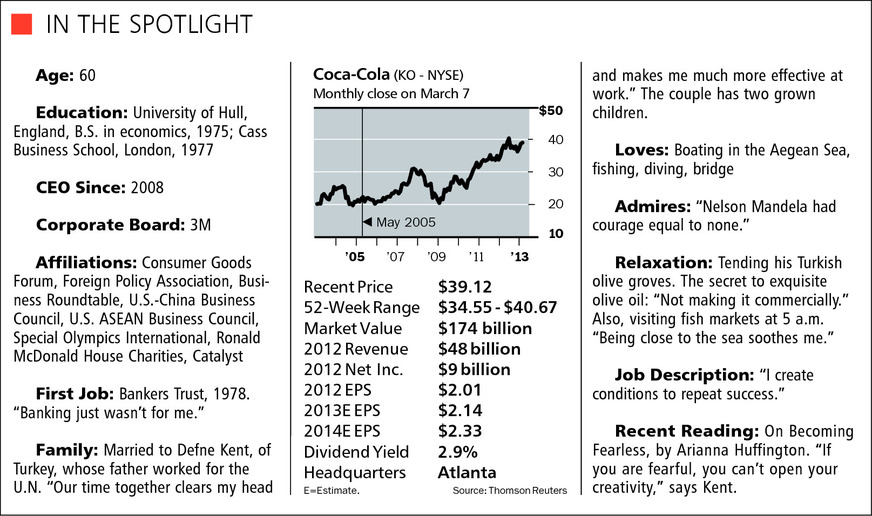
BA-BB285_ceoken_DV_20130309000013ON-BA281_SPOTLI_G_20130309012107

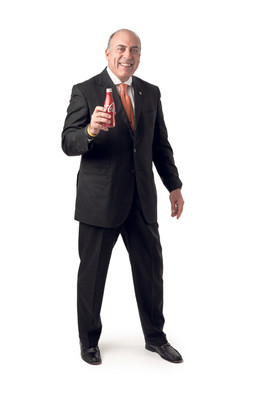
Global in background and outlook, Coca-Cola CEO Muhtar Kent knows when to play the diplomat, and when to be the tough guy. Why his own secret formula works.

The son of a Turkish diplomat, Coca-Cola Chief Executive Muhtar Kent knows his social etiquette. When served with live, “wiggly” animals at a formal dinner in a foreign country, he recognized he had no choice but to slurp them down. Kent, 60, relates the story over a plate of trout, incontrovertibly dead, in the plush dining room of Coca-Cola headquarters, overlooking Atlanta’s skyline. When representing a product that is served 1.8 billion times a day, and is sold in 207 countries, you behave as a good guest, he says.

A true citizen of the world, Kent has spent his life, and his career, adapting to others’ customs. “His genes are international,” says Dan Moskovitz, a Miami-based operations consultant, who has known Kent for 20 years.

Born in the U.S., Coke’s CEO spent his early childhood in Thailand, India, Iran, and Turkey, and could chatter in Turkish, Urdu, Thai, and Persian, although he has since lost his facility with all but Turkish. He attended an American boarding school in Turkey and British universities, and later added English, French, and Italian to his adult linguistic repertoire.

That cultural immersion alone made Kent well suited to run Coke (ticker: KO), which earns 74 cents of every dollar outside of North America. “He can step off an airplane in Malawi, and will know what to do, and know people there,” says Howard Buffett, a Coca-Cola director and son of Warren Buffett, whose Berkshire Hathaway (BRKA) owns 400 million, or 8.9%, of Coke’s shares. Buffett sees similarities between Kent and his legendarily folksy father. “My dad can speak to 5-year-olds and the toughest New York analyst,” he says. “Muhtar Kent is the same way.”

AS CEO OF COKE since 2008, Kent does what is expected, and then some. But what the world expects of global brands like Coke, the world’s largest beverage company, with $48 billion of annual sales, has changed in the past five years. It isn’t enough for Coke to sell more than 500 beverage brands—the list also includes Powerade, Minute Maid, and Dasani water. The company also must tackle poverty and improve the quality of life wherever Coca-Cola can be found.

Kent is on board with the program. “We have distribution that can get to every corner of the world,” he says. “Why shouldn’t we use some of that capability to make communities get stronger? Communities get stronger, our business gets stronger.”

Instant, interactive communication has sparked the sea change, he adds. There is no going back to the days when consumer-product companies could merely dictate through advertisements what consumers ought to believe. “With social media, consumers talk to each other,” he says. “To the extent that they hold you in a positive light, you win. It’s a huge change.” Read more of this post

Why aren’t colleges and universities educating students for the modern economy? The president of an information-technology search and consulting firm explains

SATURDAY, MARCH 9, 2013

Where the Jobs Are

By JOHN P. MCCREA | MORE ARTICLES BY AUTHOR

Why aren’t colleges and universities educating students for the modern economy? The president of an information-technology search and consulting firm explains.

I interviewed an interesting job candidate recently. He was interesting, well, like a car wreck. It’s always instructive to look at a disaster, especially if you want to avoid one.

I run an information-technology search and consulting firm in Reston, Va., called Achieve-it. The job candidate was a top-20 law school graduate—I’ll call him Mr. Overqualified, Esq.—who was applying for an entry-level information-technology job in the Washington, D.C., area. He was debt-ridden and desperate for work, but it wasn’t because he was unemployable. He arrived in our offices well dressed, had a professional manner, and actually arrived on time.

The ad he responded to asked only for a B.S. in a hard science and an aptitude with computers. So we were perplexed by his application, because not only did he have a J.D. from a top-20 law school, but he had already passed the state bar exam. He was more qualified to sue us than petition us for employment, especially for the job we had open. And that’s where the scary part comes in: Why would a guy with this pedigreed education apply for an entry-level job paying $20 an hour?

YOU KNOW THE ANSWER, of course: He has over $100,000 in student-loan debt. To hold it together for the moment, he was working as an Excel jock for a local firm and living with his parents. He was earning $8 an hour. When Mr. Overqualified stepped off the graduation stage at his law school, he might as well have been stepping off a cliff.

At least he was using his tech skills; he could have been earning the same amount slinging burgers at McDonald’s. Mr. Overqualified told us that yes, he regretted the time he wasted in law school; he wondered if he could ever pay off his student debt. Lawyering was once a reliable route to a big house, a nice car, and a productive life. Now Mr. Overqualified can’t even find the on ramp to the middle class. Read more of this post

Rigging the I.P.O. Game: What a decade-old dot-com I.P.O. case says about Wall Street today

March 9, 2013

Rigging the I.P.O. Game

By JOE NOCERA

ONCE upon a time, in a very different age, an Internet start-up called eToys went public. The date was May 20, 1999. The offering price had been set at $20, but investors in that frenzied era were so eager for eToys shares that the stock immediately shot up to $78. It ended its first day of trading at $77 a share.

The eToys initial public offering raised $164 million, a nice chunk of change for a two-year-old company. But it wasn’t even close to the $600 million-plus the company could have raised if the offering price had more realistically reflected the intense demand for eToys shares. The firm that underwrote the I.P.O. — and effectively set the $20 price — was Goldman Sachs.

After the Internet bubble burst — and eToys, starved for cash, went out of business — lawyers representing eToys’ creditors’ committee sued Goldman Sachs over that I.P.O. That lawsuit, believe it or not, is still going on. Indeed, it has taken on an importance that transcends the rise and fall of one small company during the first Internet craze. Read more of this post

Why fund names can’t always be trusted; ‘Absolute return’ funds that lose money, ‘smaller companies’ funds that hold FTSE 100 members, we look at the funds that don’t live up to their moniker.

Why fund names can’t always be trusted

‘Absolute return’ funds that lose money, ‘smaller companies’ funds that hold FTSE 100 members, we look at the funds that don’t live up to their moniker.

By Emma Wall

7:00AM GMT 09 Mar 2013

Fund managers have received a slap on the wrist for failing to achieve their investment goals. “Absolute return” funds aim to achieve positive returns in all market conditions – but the majority simply have not done what they claimed.

Angry investors accused the industry of misleading advertising, as funds such as BlackRock UK Absolute Alpha and GLG Alpha Select, which both sit in the Absolute Return sector, failed to deliver positive funds over the past three years.

In light of this poor performance, the Investment Management Association (IMA) has changed the sector’s name to “targeted absolute return” – a solution derided by critics.

Gina Miller, a co-founder of SCM Private, the fund manager, and a campaigner for transparency on charges, said the IMA had “taken 643 days to change one word”. She called the review an “absolute farce”. Read more of this post

Bridgewater May Be the Hottest Hedge Fund for Harvard Grads, but It’s Also the Weirdest

Bridgewater May Be the Hottest Hedge Fund for Harvard Grads, but It’s Also the Weirdest

by Daniel Gross Mar 7, 2013 4:45 AM EST

Bridgewater Associates is the $145 billion hedge fund elite college grads are clamoring to work for. Daniel Gross on the oddball firm’s special sauce.

In the Northeast, spring is in the air, and at Ivy League schools, kids are planning their postgraduate futures. But this year, many of the smart young finance things who used to flood to positions at name-brand banks in lower Manhattan are casting their sights elsewhere. It’s not a bank. It’s not in New York. And it’s not a century-old global institution with a patrician name.

It’s Bridgewater Associates. Based in Westport, Connecticut, and founded and led by a person who is equal parts investing savant and shaman, Bridgewater might best be described as an alternative alternative asset-management company. It’s the creation of Ray Dalio, who was memorably described in a great New Yorker profileby John Cassidy thusly: “He looked a bit like an aging member of a British progressive-rock group.” Big shots like Stephen Schwarzman of Blackstone and Steven Cohen of SAC Capital may garner the headlines. But in recent years Dalio and Bridgewater have ridden new investment flows and superior performance to become America’s largest hedge fund, with about $145 billion in assets.

Bridgewater, which has 1,300 employees, isn’t for ex-jocks or day traders. Rather, it tends to attract—and look for—self-styled intellectuals and deep thinkers who like constructing arguments as much as they enjoy constructing portfolios. It’s “the thinking Yalie’s destination,” as one recent Yale graduate put it. Undergrads at Harvard report that the scandal-free firm is more desirable than Goldman Sachs, previously the ne plus ultra for young grads on the make. “Bridgewater is very popular because it is one of the few hedge funds that will accept people right out of college,” says a Harvard undergraduate who interviewed with the firm. “Also, the hours tend to be better. In investment banking you’re working 100 hours a week, and at hedge funds it is more like 70.” (This student may be overestimating the amount of time employees of both investment banks and hedge funds spend working). Read more of this post

The Price of Marriage in China: China’s economic surge — and vast wealth inequality — have bred a new type of matchmaker, referred to as a love hunter

March 9, 2013

The Price of Marriage in China

By BROOK LARMER

LOVEHUNTERS-articleLarge10-LOVEHUNTERS-JP1-popup

In a Beijing shopping mall, the “love hunter” Yang Jing, right, and an assistant talked to a woman about joining the database of Diamond Love and Marriage, a matchmaking service.

FROM her stakeout near the entrance of an H & M store in Joy City, a Beijing shopping mall, Yang Jing seemed lost in thought, twirling a strand of her auburn-tinted hair, tapping her nails on an aquamarine iPhone 4S. But her eyes kept moving. They tracked the clusters of young women zigzagging from Zara to Calvin Klein Jeans. They lingered on a face, a gesture, and then moved on, darting across the atrium, searching.

“This is a good place to hunt,” she told me. “I always have good luck here.”

For Ms. Yang, Joy City is not so much a consumer mecca as an urban Serengeti that she prowls for potential wives for some of China’s richest bachelors. Ms. Yang, 28, is one of China’s premier love hunters, a new breed of matchmaker that has proliferated in the country’s economic boom. The company she works for, Diamond Love and Marriage, caters to China’s nouveaux riches: men, and occasionally women, willing to pay tens and even hundreds of thousands of dollars to outsource the search for their ideal spouse.

In Joy City, Ms. Yang gave instructions to her eight-scout team, one of six squads the company was deploying in three cities for one Shanghai millionaire. This client had provided a list of requirements for his future wife, including her age (22 to 26), skin color (“white as porcelain”) and sexual history (yes, a virgin).

“These millionaires are very picky, you know?” Ms. Yang said. “Nobody can ever be perfect enough.” Still, the potential reward for Ms. Yang is huge: The love hunter who finds the client’s eventual choice will receive a bonus of more than $30,000, around five times the average annual salary in this line of work.

Suddenly, a signal came.

From across the atrium, a co-worker of Ms. Yang caught her eye and nodded at a woman in a blue dress, walking alone. Ms. Yang had shaken off her colleague’s suggestions several times that day, but this time she circled behind the woman in question.

“Perfect skin,” she whispered. “Elegant face.” When the woman walked into H & M, Ms. Yang intercepted her in the sweater aisle. “I’m so sorry to bother you,” she said with a honeyed smile. “I’m a love hunter. Are you looking for love?”

Three miles away, in a Beijing park near the Temple of Heaven, a woman named Yu Jia jostled for space under a grove of elms. A widowed 67-year-old pensioner, she was clearing a spot on the ground for a sign she had scrawled for her son. “Seeking Marriage,” read the wrinkled sheet of paper, which Ms. Yu held in place with a few fragments of brick and stone. “Male. Single. Born 1972. Height 172 cm. High school education. Job in Beijing.”

Ms. Yu is another kind of love hunter: a parent seeking a spouse for an adult child in the so-called marriage markets that have popped up in parks across the city. Long rows of graying men and women sat in front of signs listing their children’s qualifications. Hundreds of others trudged by, stopping occasionally to make an inquiry. Read more of this post

Want a longer, happier life? Embrace pessimism, study says

Want a longer, happier life? Embrace pessimism, study says

Sarah Boesveld | 13/02/27 7:46 PM ET
A growing body of research has credited the power of positive thinking for contributing to good health and a longer, happier life. But a new study out of Germany suggests people who are pessimistic about their futures — specifically older people — may find greater life satisfaction down the road than their more optimistic peers.

“The optimists are those who basically close their eyes, shut their eyes and don’t really want to know about the truth” about the inevitable costs of aging and death, he said. “That’s how we interpreted this finding — that basically these things [pessimistic expectations] really help people to be aware that they need to be cautious.”

The longitudinal study, published this month in the American Psychological Association’s journal Psychology and Aging, set out to discover how anticipations about future life satisfaction change over time.

More than two-thirds of older Germans, aged 65 to 96, who thought life would only get worse actually had better health outcomes, said lead study author Frieder R. Lang, a professor at the University of Erlangen-Nuremberg and the German Institute for Economic Research.

“If you really think about the future in five years, understanding that although things are fine right now they might get worse, this seems to have a positive effect on lower disability risks and lower mortality risks,” he said in an interview Wednesday from Germany. Read more of this post

Rolex chief Patrick Heiniger who ran the watchmaker between 1992 and 2008 and designed a crucial restructuring

March 8, 2013 6:38 pm

Patrick Heiniger, watch executive

By James Shotter

©AFP

Even by Switzerland’s exacting standards, Rolex is notoriously discreet. So too was Patrick Heiniger, who ran the watchmaker between 1992 and 2008. One journalist landed an interview with him only after 15 years of trying. Many more never succeeded.

Yet if anything, such elusiveness piqued rather than stilled public interest in the standard-bearer of the Swiss watch industry. And that curiosity was never more intense than on the day in December 2008 when Rolex abruptly announced that Heiniger was leaving “to pursue personal interests”.

With typical coyness, Heiniger, who has died in Monaco from an unspecified illness aged 62, added nothing to the company’s explanation. Many wondered whether a sudden yen for other pursuits really was the full story.

On the same day, Rolex informed the world in a rare statement that it had not lost a fortune with Bernard Madoff, the US fund manager whose Ponzi scheme had been rumbled just two weeks earlier. The group also felt obliged to deny suggestions of collapsing sales, massive overstocking and trying to impose its wares on unwilling dealers, as the escalating financial crisis took its toll on global demand for luxury timepieces.

Whatever the merits of such claims, it is certainly true that in the preceding boom years Heiniger had Rolexfirmly in expansion mode. Having been appointed only the third managing director in Rolex’s history in 1992, five years later he also became chief executive. He spent much of the 1990s overseeing the vertical integration of the watchmaker. That was a crucial strategic move, which helped secure its prized autonomy by giving Rolex control of the manufacturing of all important components.

As well as buying up suppliers, Heiniger dramatically simplified the production process. Twenty sites became three, all in and around Geneva, the city that founder Hans Wilsdorf had made the company’s home 14 years after it came into being in London in 1905. Read more of this post

Reality TV for the Red Planet: A Dutch entrepreneur’s financial plan for a colony on Mars is based on selling the television rights to cover the project every step of the way

March 8, 2013

Reality TV for the Red Planet

By NICOLA CLARK

MARS1-articleLarge

“How many people do you think would want to watch the first humans arrive on Mars?” said Bas Lansdorp, of Mars One.

PARIS — As Wernher von Braun, the rocket scientist, used to say, the most overwhelming obstacle to exploring the cosmos isn’t gravity. It’s the paperwork.

Not to mention the money.

So when Bas Lansdorp began dreaming more than a decade ago about establishing the first permanent human colony on Mars, his primary focus was not on overcoming the technological challenges. It was the business model.

“All the technology we need exists already — or nearly exists,” he said. “I just couldn’t figure out how to finance it.”

Mr. Lansdorp, a 36-year-old Dutch engineer and entrepreneur, does not have the name recognition of Dennis Tito, the American financier and space tourist, who announced a plan last month to send two people on a round-trip Mars flyby in 2018. Nor can Mr. Lansdorp hope to match the deep pockets of Elon Musk, the billionaire founder of SpaceX and Tesla Motors, who has proposed sending as many as 80,000 people to the Red Planet and charging them $500,000 each. Richard Branson, the Virgin entrepreneur, has space aspirations, too.

But Mr. Lansorp is convinced that he has found the perfect plan to raise the $6 billion he says he needs to land an initial crew of four people on the Martian surface by 2023. The entire mission — from the astronauts’ selection and training to their arrival and construction of a permanent settlement — would be broadcast as a worldwide, multiyear reality television show.

“How many people do you think would want to watch the first humans arrive on Mars?” Mr. Lansdorp asked in a recent interview, recalling the more than 600 million viewers who were said to have tuned in to the grainy, black-and-white images of Neil Armstrong’s first steps on the moon in 1969. Read more of this post