Sakura flowers blossom in southwest China’s Guizhou province
March 9, 2013 Leave a comment
Sakura flowers blossom in Guizhou
2013-03-09 02:15:21
R.E.S.-ilience in Value Creation 《竹经:经商经世离不得立根创新》
March 9, 2013 Leave a comment
Sakura flowers blossom in Guizhou
2013-03-09 02:15:21
March 8, 2013 Leave a comment
March 7, 2013, 6:45 p.m. ET
Sci-Fi’s Underground Hit
Authors are snubbing publishers and insisting on keeping e-book rights. How one novelist made more than $1 million before his book hit stores.
Hugh Howey’s postapocalyptic thriller “Wool” has sold more than half a million copies and generated more than 5,260 Amazon reviews. Mr. Howey has raked in more than a million dollars in royalties and sold the film rights to “Alien” producer Ridley Scott.
And Simon & Schuster hasn’t even released the book yet.
INSTALLMENT PLAN: Writing ‘Wool’ was ‘almost a compulsion for him,’ Mr. Howey’s wife says.
In a highly unusual deal, Simon & Schuster acquired print publication rights to “Wool” while allowing Mr. Howey to keep the e-book rights himself. Mr. Howey self-published “Wool” as a serial novel in 2011, and took a rare stand by refusing to sell the digital rights. Last year, he turned down multiple seven-figure offers from publishers before reaching a mid-six-figure, print-only deal with Simon & Schuster.
Simon & Schuster has put down six figures for print rights to a post-apocalyptic thriller called “Wool” that it believes could draw the same readers that made “The Hunger Games” trilogy a success. WSJ’s Alexandra Alter reports on Lunch Break. Getty Images.
“I had made seven figures on my own, so it was easy to walk away,” says Mr. Howey, 37, a college dropout who worked as a yacht captain, a roofer and a bookseller before he started self-publishing. “I thought, ‘How are you guys going to sell six times what I’m selling now?’ ”
It’s a sign of how far the balance of power has shifted toward authors in the new digital publishing landscape. Self-published titles made up 25% of the top-selling books on Amazon last year. Four independent authors have sold more than a million Kindle copies of their books, and 23 have sold more than 250,000, according to Amazon.
Publishing houses that once ignored independent authors are now furiously courting them. In the past year, more than 60 independent authors have landed contracts with traditional publishers. Several won seven-figure advances. A handful have negotiated deals that allow them to continue selling e-books on their own, including romance writers Bella Andre and Colleen Hoover, who have each sold more than a million copies of their books. Read more of this post
March 8, 2013 Leave a comment
How much is a piece of content worth?
BY BRYAN GOLDBERG
ON MARCH 7, 2013
The publishing industry has changed immeasurably in the last decade, and its massive transformation can be summed up in one question… “How much is a piece of content worth?”
This complex question was brought into the national dialogue very recently when noted journalist Nate Thayer wrote a scathing condemnation of an editor for The Atlantic who dared ask him to contribute for free.
Thayer’s frustration has become a rallying cry for many freelance journalists who feel that their work is undervalued. He claims he was once offered $125,000 to write six articles a year. So, when a new editor offered him zero dollars to write, he was quite upset. [Note: an earlier version of this story cited his rate at $500/article, though he has no official market rate].
In fairness, Nate Thayer is an exceptional journalist — he has risked his life to cover Cambodia, and not a lot of people can say that they have risked their lives for anything. If we live in a world where people like Nate can’t exist to cover wars, corruption, etc, then the world will be worse.
But, at the end of the day, publishing is a business. As I’ve said many times, it needs to be treated like one, and so Nate Thayer has a right to understand how digital publishing interacts with revenue. Read more of this post
March 8, 2013 Leave a comment
Even in Canada, wealth influences treatment: study
Thu, Mar 7 2013
NEW YORK (Reuters Health) – Poorer people have a harder time getting a doctor’s appointment in Canada, a new study suggests – even though the country’s universal health insurance pays doctors the same amount regardless of the type of patient they see.
Researchers who called primary care practices pretending to be a bank employee or on welfare were 80 percent more likely to be offered an appointment when taking on the wealthier persona.
“We expected that we would find the result that we did, which was that there would be preferential treatment,” said Dr. Stephen Hwang, who worked on the study at St. Michael’s Hospital and the University of Toronto.
“As a physician who provides care for people who are marginalized or disadvantaged, they not infrequently tell me that they feel like they’ve been treated poorly by healthcare providers in the past simply because they’re poor,” he told Reuters Health. Read more of this post
March 8, 2013 Leave a comment
Hong Kong Prison Homes Spur Virus Risk Decade After SARS
Chan Sung-ming says the coughs and sneezes echoing through the plywood walls of his windowless, 60- square foot Hong Kong apartment get him thinking: is there a bug going around and could it be deadly?
A decade after SARS began a lethal odyssey via Hong Kong, which has the world’s most-densely populated urban areas, Chan says his apartment — one of eight in a space about the size of a squash court — makes him feel more prone to airborne germs.
Even as the city spends HK$1.6 billion ($206 million) a year on a disease-tracking center to prepare for future contagions, a tripling in the price of homes in the past decade have forced its 7.2 million residents closer together. That’s stoking the potential for a rapid rise of bugs like the severe acute respiratory virus that exploded there in early 2003.
“In Hong Kong, we live vertically, not horizontally,” said Sian Griffiths, director of the Chinese University of Hong Kong’s school of public health. “It’s as if we’ve turned a village street on its end. People are so close together here, the risk of transmission is greater.”
Chan’s apartment is smaller than some of the city’s prison cells. The 36-year-old electrician says the cramped living arrangements mean he hears his neighbors’ every cough and bowel movement, and sometimes shares their pathogens too. Read more of this post
March 8, 2013 Leave a comment
March 7, 2013
It’s About the Work, Not the Office
By JENNIFER GLASS
THE recent decision by Marissa Mayer, the chief executive of Yahoo, to eliminate telecommuting for all workers brings her company back in line with most of corporate America, where working from home is more illusion than reality. Although many — some estimate most — American jobs could successfully be performed at home, only roughly 16 percent of American employees actually telecommute in any given year. And that figure is reached only by using a very generous definition of telecommuting — working from home at least one hour per week.
The idea behind the Yahoo announcement, as well as a more limited announcement from Best Buy this week that will add restrictions to its telecommuting policy, was that bringing workers back to the office would lead to greater collaboration and innovation. This is despite numerous studies showing that telecommuting workers are more productive than those working on-site.
Yet a work force culture based on long hours at the office with little regard for family or community does not inevitably lead to strong productivity or innovation. Two outdated ideas seem to underlie the Yahoo decision: first, that tech companies can still operate like the small groups of 20-something engineers that founded them; and second, the most old-fashioned of all, that companies get the most out of their employees by limiting their autonomy. Read more of this post
March 8, 2013 Leave a comment
Jim Chanos on Dell, Herbalife & Importance of Doing Your Own Work: Latest Interview
Posted: 07 Mar 2013 11:10 AM PST
Kynikos Associates founder and notorious short-seller Jim Chanos appeared on CNBC this morning to share his latest thoughts on the market:
On China: He says to avoid the Chinese property bubble. While he’s been short various plays on this in China, he says he’s “broadening out” to plays like construction equipment, etc. Read more of this post
March 8, 2013 Leave a comment
Lessons From Stanley Druckenmiller: Hedge Fund Market Wizards
Posted: 07 Mar 2013 11:20 AM PST
Legendary investor Stanley Druckenmiller recently came out of the shadows and gave a rare interview on a myriad of topics. Given the popularity of that post, we thought it’d be interesting to see what lessons we could learn from this great investor so we looked at Druckenmiller’s interview in Jack Schwager’s book The New Market Wizards to see what we could learn. Druckenmiller formerly ran hedge fund Duquesne Capital as well as George Soros’ Quantum Fund, and he saw annual average returns of 30% since 1986. He managed around $12 billion before shutting down Duquesne. A few years ago, he returned Duquesne outside capital and now runs a family office. Many of his former employees founded PointState Capital with money from Druckenmiller and former Duquesne investors.
Lessons From Stanley Druckenmiller
In Jack Schwager’s book The New Market Wizards, Stanley Druckenmiller provides the following bits of wisdom:
On achieving a superior track record: “George Soros has a philosophy that I have also adopted: The way to build long-term returns is through preservation of capital and home runs … Read more of this post
March 7, 2013 Leave a comment
Study: Walmart Most Popular Place For People To Fall In Love At First Sight
March 4, 2013 2:29 PM
HOUSTON (CBS Houston) — Forget online dating. According to one study, people just need to go to Walmart to look for love. A study in February’s Psychology Today reveals that a majority of people in 15 states felt that they fell in love at first sight at Walmart. The study, based on “missed connections” posts found on Craigslist, finds that people in Texas, Florida, Ohio, Montana and North Carolina, among others, believe that they spotted their future husband or wife at the giant retail store. The gym was another popular “missed connection” spot with people from three states believing they saw their future mister or misses there. Other popular places included the supermarket, bar and subway. One of the more surprising ones came from Kansas as people said they fell in love while eating a Big Mac and fries at McDonald’s. Psychology Today’s study was done from data based on each state’s 100 most recent “missed connections” posts on Craigslist.
March 7, 2013 Leave a comment
From chair maker to chairman: Leading with trust
Published: 7 Mar 2013 at 00.00’Just responding to the competition is not enough. We have to bear in mind all the time that we need to keep our business growing,” says Pisith Patamasatayasonthi, the president and chief executive of Index Living Mall Co Ltd. “Since Index was established in 1973, I have tried to expand the business in different aspects in order to grow and be competitive at all times.”
Pisith: Managing people is key
A modest and soft-spoken executive, Mr Pisith says he learned the value of constantly seeking new ideas through his own work experience, especially when dealing with foreign customers. “I came from a small family retail business upcountry,” he says. “My first product was a folding chair. Although I’m not a carpenter myself, I was able to manage and work through my people, who were experienced chair makers. “At this very early stage of my own business, I saw clearly that the rule of management _ whether one is a small retailer or a chair maker _ is the same, which is effective management of people. However, managing through people is not as easy as it seems to be.” Read more of this post
March 7, 2013 Leave a comment
Bosowa boss tells of humble beginnings, rivalry with Kalla
Tassia Sipahutar, The Jakarta Post, Jakarta | Business | Wed, March 06 2013, 10:59 AM
Family affairs: (From left to right) Bosowa Corporation founder Aksa Mahmud, wife Ramlah and eldest child Erwin celebrate the company’s 40th anniversary in Makassar, South Sulawesi, in this file photo. Established in 1973, Bosowa is now one of the country’s major companies, with strong presence in eastern Indonesia. (Antara/Yusran Uccang)
Aksa Mahmud, founder of conglomerate Bosowa Corporation, is a self-made businessman. Despite his lack of business education, he managed to build a US$1.2 billion business empire from scratch and became one of the nation’s richest people.
Aksa developed his business sense at an early age while growing up in a small village in Lapasu, South Sulawesi.
“I have always wanted to make my own money. At school, I used to sell candy, cakes, whatever snacks I could get my hands on. I also sold ice blocks and dates during the fasting month,” the 67-year-old said while sipping coffee at his Aryaduta hotel in Makassar, South Sulawesi.
At present, Bosowa is one of the most successful companies in the country, with a strong presence in the eastern part of Indonesia. It spans a wide variety of sectors, from infrastructure to finance.
It currently runs a cement business through PT Semen Bosowa Indonesia and PT Semen Bosowa Maros, a car dealership with Mitsubishi and Mercedes-Benz brands, and a transportation business with taxi and air services. Bosowa also holds 14.3 percent and 21.7 percent stakes in the publicly listed PT Nusantara Infrastructure and PT Bank QNB Kesawan, respectively. Read more of this post
March 7, 2013 Leave a comment
Steven Ujifusa on William Francis Gibbs and His Ships
Published : March 06, 2013 in Knowledge@Wharton
Named one of TheWall Street Journal‘s top 10 nonfiction books of 2012, Steven Ujifusa’s A Man and His Ship: America’s Greatest Naval Architect and His Quest to Build the SS United States brings William Francis Gibbs’ story to life. Wharton legal studies and business ethics professor G. Richard Shell recently sat down with Ujifusa to learn more about what inspired the author to tell Gibbs’ story, what led Gibbs to build ships and how the builder’s firm became responsible for 70% of all ships built during World War II. Read more of this post
March 7, 2013 Leave a comment
Talking It Out: The New Conversation-centered Leadership
Published : March 06, 2013 in Knowledge@Wharton
Every year, hundreds of thousands of new graduates enter the business world, eager to climb the corporate ladder. Their progress on the early rungs of that journey will often be determined by qualities like hard work, determination, knowledge and technical proficiency. But business consultants Alan S. Berson and Richard G. Stieglitz argue that those same qualities prove less helpful at higher rungs on the ladder, and may even be one’s downfall if they are not balanced by a very different set of leadership qualities. They sum up the thesis of their new book, Leadership Conversations: Challenging High-Potential Managers to Become Great Leaders, like this: “As you move into upper leadership levels, your technical skills — what you know — become less important. What counts is whom you know and, perhaps more important, who knows and trusts you.”
The importance of building strong working relationships within an organization may seem self-evident. But Berson and Stieglitz go well beyond a call to establish and maintain open lines of communication. The kind of conversations they are advocating for are not simply talk for talk’s sake. Rather, they are the heart and soul of any thriving organization’s culture: a strategic tool incorporating very specific techniques toward very specific ends.
A Changed Environment
Leadership Conversations is part of a growing recognition that the so-called “command and control” model of organizational leadership is fast becoming outdated in today’s world. The reasons for this shift are many. Today’s business environment is increasingly global, diverse, fluid and unpredictable. Technological change and the rise of social media have fundamentally altered the way companies interact with their customers. Rigidly hierarchical organizations risk losing ground to more nimble, collaborative ones. Read more of this post
March 7, 2013 Leave a comment
Michael Mauboussin on the ‘Success Equation’
Published : March 06, 2013 in Knowledge@Wharton
How do we know which of our successes and failures can be attributed to either skill or luck? That is the question that investment strategist Michael J. Mauboussin explores in his book The Success Equation: Untangling Skill and Luck in Business, Sports, and Investing.Wharton management professor Adam M. Grant recently sat down with Mauboussin to talk about the paradox of skill, the conditions for luck and how to avoid overconfidence.
An edited transcript of the conversation follows.
Adam M. Grant: Michael, we’re delighted to have you here today to talk about your book The Success Equation…. I would love to hear you speak a little bit about this paradox of skill that you have discovered and the relationship between luck and skill.
Mauboussin: Let me first tell you what the definition of the “paradox of skill” is. Specifically, it says that in activities where skill and luck define outcomes, as skill improves, luck becomes more important in determining outcomes. [By that definition,] more skill means more luck, which seems very paradoxical. It’s not my idea. I learned about it from Stephen Jay Gould, the very eminent biologist at Harvard. He talked about it in the context of Ted Williams, the last player to hit over 400 in major league baseball, which he did in 1941. Gould was wondering why no one has been able to achieve over 400 since that time. He looked at [variables such as] maybe because the guys play at night, or they travel too much. Really, none of those things checked out. Then he said, maybe Williams is just this amazing player — an immortal among mortals…. But if you look at every other sport, for example, things measured against the clock — there has been absolute performance everywhere you look, so that doesn’t seem to be the case. Then he thought about it more carefully, and he realized the actual result is because everyone’s gotten better, and as a result, the standard deviation of skill has actually narrowed. If you think about batting average for your season and your player, some level of skill plus some level of luck gives you your outcome. What’s happened generally is that the standard deviation of skill has gone down. Why? Because you’re recruiting players from the world now, versus from just parts of the United States. You’re training better. You’re coaching better — all those kinds of things….
The point is this paradox of skill. We’ve seen the differential skill narrowing. We see it really all over the place. We see it in the world of investing. We see it in the world of business. I think it is very interesting. As skill improves, especially in competitive markets, luck becomes more important determining outcomes. Read more of this post
March 7, 2013 Leave a comment
Daniel Pink on Why ‘To Sell Is Human’
Published : March 06, 2013 in Knowledge@Wharton
Bestselling author Daniel Pink’s new book, To Sell Is Human: The Surprising Truth about Moving Others, argues we are all in the sales business. Whether you are an educator, an art director or a project manager, part of your work involves convincing people to make an exchange. Pink recently visited the University of Pennsylvania as a guest lecturer in the Authors@Wharton series, and also teaches in Wharton’s Advanced Management Program. Wharton management professor Adam M. Grant interviewed Pink while he was there to learn more about the ideas in his book, including why consumers mistrust salespeople, what the new ABCs of selling are and why questions may be the greatest selling tool.
An edited transcript of the conversation follows.
Adam M. Grant: We’re excited to have you here to discuss your new book, To Sell Is Human. Could you start off by talking to us a little bit about why we are all in sales?
Daniel Pink: There are a couple of animating ideas in the book, Adam. One of them is that — like it or not — we’re all in sales. If you look at the labor data, one in nine people in the economy today make a living selling stuff. They are car dealers, real estate agents. But I had an instinct about those other eight in nine. I went out and did some survey research and found that those other eight in nine are people who are nominally in sales. They are managers; they are project team leaders; they are teachers and art directors. They are spending an enormous amount of their time in what I call non-sales selling. They’re selling. They’re convincing you to make an exchange. Give me something you have in exchange for something that I have. But it’s not denominated in dollars. It’s denominated in time; it’s denominated in attention; it’s denominated in effort. If you look at how white-collar workers are spending their time — whether they are in traditional sales or in some other kind of function — a lot of their time and efforts are spent convincing, persuading, cajoling and influencing people. The truth is that when you tell people you’re in sales, a lot of people don’t like it very much at all. Read more of this post
March 7, 2013 Leave a comment
Empathy, the real measure of a doctor
There is a hug I will never forget. Our twin babies had been born severely premature and had just breathed their last. An obstetrician not involved in their care, who was just walking past, looked in and stopped. We just hugged quietly; no words were needed.
5 HOURS 10 MIN AGO
There is a hug I will never forget. Our twin babies had been born severely premature and had just breathed their last. An obstetrician not involved in their care, who was just walking past, looked in and stopped. We just hugged quietly; no words were needed.
Medical school deans have identified empathy as the most important attribute they look for in potential doctors. In this era of powerful diagnostics and instant information, the relevance of empathy has never been greater. Expensive machines and elegant consultation rooms do not and cannot offer empathy. Only humans can. Read more of this post
March 6, 2013 Leave a comment
Buffett Says Gloat Like Rockefeller When Watching Trains
Billionaire Warren Buffett said his Berkshire Hathaway Inc. (BRK/A) will benefit from rising U.S. oil production as the company’s trains and tank cars move fuel around the country.
Buffett, 82, highlighted demand for rolling stock made by Berkshire’s Union Tank Car in his annual letter to shareholders March 1. His company acquired the manufacturer, which traces its roots to John D. Rockefeller’s Standard Oil Trust, as part of the 2008 purchase of Marmon Holdings Inc. Buffett told investors to watch for the UTLX logo.
“As a Berkshire shareholder, you own the cars with that insignia,” he wrote to investors in his Omaha, Nebraska-based company. “When you spot a UTLX car, puff out your chest a bit and enjoy the same satisfaction that John D. Rockefeller undoubtedly experienced as he viewed his fleet a century ago.”
U.S. oil output had a record surge last year as new technology made drilling faster, cheaper and better at unleashing crude from rock formations. That’s reducing reliance on imported oil and benefiting railroads and tank car companies.
Berkshire’s railroad, Burlington Northern Santa Fe, is now carrying about 500,000 barrels of oil a day, or roughly 10 percent of what’s produced in the U.S. excluding Alaska and offshore, Buffett said. That’s helped keep volume growing at BNSF as coal shipments decline.
“Fortunately, they discovered oil where our railroad was,” Buffett, Berkshire’s chairman and chief executive officer, said in an interview yesterday on CNBC.
Car leases are generating $1,500 per month for 10-year deals, and more than double that for shorter terms, said Justin Long, an analyst with Stephens Inc. based in Little Rock, Arkansas. Before the recent boom, the cars leased for about $650 per month, Toby Kolstad, president of Rail Theory Forecasts LLC, said in December. Read more of this post
March 6, 2013 Leave a comment
Learning From the Octopus: How Secrets from Nature Can Help Us Fight Terrorist Attacks, Natural Disasters, and Disease
Rafe Sagarin (Author)
Book Description
Publication Date: March 27, 2012 | ISBN-10: 0465021832
Despite the billions of dollars we’ve poured into foreign wars, homeland security, and disaster response, we are fundamentally no better prepared for the next terrorist attack or unprecedented flood than we were in 2001. Our response to catastrophe remains unchanged: add another step to airport security, another meter to the levee wall. This approach has proved totally ineffective: reacting to past threats and trying to predict future risks will only waste resources in our increasingly unpredictable world.
In Learning from the Octopus, ecologist and security expert Rafe Sagarin rethinks the seemingly intractable problem of security by drawing inspiration from a surprising source: nature. Biological organisms have been living—and thriving—on a risk-filled planet for billions of years. Remarkably, they have done it without planning, predicting, or trying to perfect their responses to complex threats. Rather, they simply adapt to solve the challenges they continually face.
Military leaders, public health officials, and business professionals would all like to be more adaptable, but few have figured out how. Sagarinargues that we can learn from observing how nature is organized, how organisms learn, how they create partnerships, and how life continually diversifies on this unpredictable planet.
As soon as we dip our toes into a cold Pacific tidepool and watch what we thought was a rock turn into an octopus, jetting away in a cloud of ink, we can begin to see the how human adaptability can mimic natural adaptation. The same mechanisms that enabled the octopus’s escape also allow our immune system to ward off new infectious diseases, helped soldiers in Iraq to recognize the threat of IEDs, and aided Google in developing faster ways to detect flu outbreaks.
While we will never be able to predict the next earthquake, terrorist attack, or market fluctuation, nature can guide us in developing security systems that are not purely reactive but proactive, holistic, and adaptable. From the tidepools of Monterey to the mountains of Kazakhstan, Sagarin takes us on an eye-opening tour of the security challenges we face, and shows us how we might learn to respond more effectively to the unknown threats lurking in our future. Read more of this post
March 6, 2013 Leave a comment
To Become More Adaptable, Take a Lesson from Biology
by Rafe Sagarin | 12:30 PM March 5, 2013
Remember when Apple’s stock traded at $7 a share? I do, because that’s when I sold my shares. Tech experts’ sage predictions had convinced me that the Mac would never make a dent in the PC market. As it turned out, the Mac didn’t need to make a dent, because Apple mutated its cute computer DNA into cute music players and phones that fit massive unfilled niches. Yet even the genius architect of this turnaround made faulty predictions sometimes. Remember the invention Steve Jobs said was going to be “bigger than the PC”? You may have seen a mall cop riding onerecently.
Even the best of us are horrible at predicting the future. That’s too bad, because our world is full of risk that we’d love to avoid and opportunity that we’d love to seize.
Fortunately, there’s a rich source of lessons on how to thrive in an unpredictable world, and it has been cranking out success stories for 3.5 billion years. It’s called biology.
All of Earth’s successful organisms have thrived without analyzing past crises or trying to predict the next one. They haven’t held “planning exercises” or created “predictive frameworks.” Instead, they’ve adapted. Adaptability is the power to detect and respond to change in the world, no matter how surprising or inconvenient it may be.
While there’s much chatter in the management world about the need to be adaptable, only a few creative companies and innovative managers have probed the natural world for its adaptability secrets. But when they have, they’ve been remarkably successful. A study of nature offers straightforward guidance through four key practices of adaptable systems.
Decentralization. The most successful biological organisms are structured or organized in such a way as to eschew centralized control in favor of allowing multiple agents to independently sense and quickly respond to change. An octopus, despite its surprisingly intelligent brain, doesn’t order each arm to change a certain color when it needs to hide quickly. Rather, individual skin cells across its body sense and respond to change and give the octopus a collective camouflage. Read more of this post
March 5, 2013 Leave a comment
From Value to Vision: Reimagining the Possible with Data Analytics
Big Idea: Data & Analytics March 05, 2013
David Kiron, Renee Boucher Ferguson and Pamela Kirk Prentice
Signs of an Analytics Revolution
Three Ways to Compete with Analytics
Case Study: Caesars Entertainment
Mindset and Culture
Key Actions
Outcomes: Power Shifts to Those with Insight
On Becoming an Analytics Innovator
The Analytically Challenged
The Analytics Practitioners
Authors
David Kiron is the executive editor of MIT Sloan Management Review’s Big Ideas initiatives. He can be reached at dkiron@mit.edu.
Renee Boucher Ferguson is the Data & Analytics contributing editor at MIT Sloan Management Review, researching the current and new analytical approaches that change how executives make decisions and innovate. She can be reached at rbfergus@mit.edu.
Pamela Kirk Prentice is the chief research officer at SAS Institute Inc., specializing in deriving insights from qualitative and quantitative information to help address key business issues. She can be reached at pamela.prentice@sas.com.
Companies benefit from analytics
Global study from MIT Sloan Management Review and SAS finds companies gain competitive edge by using analytics.
March 5, 2013
New research released today by MIT Sloan Management Review and SAS reports that 67 percent of companies surveyed are gaining a competitive advantage by using analytics — marking a 15 percent increase from last year and 80 percent increase from two years ago.
The report, “From Value to Vision: Reimagining the Possible with Data Analytics,” derived from a global survey of more than 2,500 business executives, identifies a group of companies leading the way in the analytics revolution, dubbed “Analytical Innovators.” Companies in this category report both strong competitive advantage and improved innovation from using analytics, which are means of interpreting certain data to gain insight and drive business planning. Analytical Innovators are significantly more likely to exhibit three characteristics: a widely shared belief that data is a core asset; more effective use of more of their data for faster results; and support for analytics by executives.
Another important characteristic of Analytical Innovators is their report of power shifts in their organizations: Analytical Innovators are four times more likely than less analytically inclined companies to say that analytics have shifted the power structure within their organizations.
“This is a significant finding, in that power shifts can be disruptive. They often call into question experience and intuition that managers and employees have built up over years,” says David Kiron, executive editor for MIT Sloan Management Review. “Now, those who know how to marshal the data and put analytics behind their decision making are in a position of advantage.”
The study also identified two types of companies less analytically sophisticated than Analytical Innovators: Analytics Practitioners (representing 60 percent of respondents), which have made significant progress, but have not achieved the top level of competitive advantage and innovation from using analytics; and the Analytically Challenged (28 percent of respondents), which are less mature in their use of analytics and have not derived as much value from them as the other groups.
“As we studied all three groups, we were able to clearly see the specific differentiators among the groups,” says Pamela Prentice, chief research officer for SAS. “This enabled us to develop a framework for companies to evaluate their own standing, and to provide recommendations based on a company’s current status.”
The study’s recommendations for the Analytically Challenged include:
March 5, 2013 Leave a comment
P&G’s Legendary Ex-Chief On How Today’s CEOs Are Failing
Max Nisen | 5 minutes ago | 15 |
A.G. Lafley was one of the most successful executives in recent times. During his nine years at the top of Procter & Gamble, the consumer product company’s value increased by more than $100 billion. In a recent interview, Lafley told the Wall Street Journal what he saw as current CEOs’ biggest shortcoming:
They don’t think they need a strategy, or their strategies are flawed. They think they have a hot product or hot service, and these don’t last forever. They think that benchmarking, best practices and copying what the rest of the industry does is a strategy. They try to be all things to all people. If you’re not clear about which customers you’re going to serve, how to serve them in a unique and better way that creates real value for them, and your core competencies, you’re just not going to have as much of a chance to win.
Essentially, Lafley is arguing, executives hate to make choices. When they take charge and commit to a strategy or a particular customer group, they become responsible for the consequences. Instead, they play it safe. They look to best practices, and they look to competitors. That may be the easiest path, but that’s not one where you can win. They also get seduced by success, expecting that what’s worked in the past will serve them just as well in the future. During his time at P&G, Lafley developed a 5-step program designed not just to succeed in a market, but to win it entirely, which he lays out in “Playing To Win.” Businesses have to decide what winning is, where to play, how to win, what their core competencies are, and what management systems they need to execute their strategy. Not only that, but they have to build those kinds of questions into their culture, so things are approached strategically on every level and constantly re-evaluated.
March 5, 2013 Leave a comment
March 5, 2013, 8:22 PM
China’s Richest Man Says Capital Markets ‘Suck’
China’s richest man has a strong statement for those looking to invest: “The capital markets suck in China.”
Zong Qinghou climbed his way to the top of the list of China’s wealthiest by amassing a fortune of $12.6 billion through his privately listed beverage empire Hangzhou Wahaha Group Co. On Tuesday, he made clear he didn’t gain his wealth through the country’s stock market.
“When the ordinary people invest in it, the market should reward them with some benefits. But it does not,” Mr. Zong said on the sidelines of China’s annual parliamentary session, taking aim at speculators he says ruin the stock market for others. “The speculation has totally ordinary investors of any benefits.” Read more of this post
March 5, 2013 Leave a comment
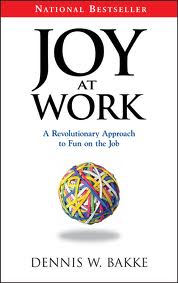
Joy at Work: A Revolutionary Approach To Fun on the Job [Paperback]
Dennis W. Bakke (Author)
Book Description
Publication Date: July 1, 2006
Imagine a company where people love coming to work and are highly productive on a daily basis. Imagine a company whose top executives, in a quest to create the most “fun” workplace ever, obliterate labor-management divisions and push decision-making responsibility down to the plant floor. Could such a company compete in today’s bottom-line corporate world? Could it even turn a profit? Well, imagine no more.
In Joy at Work, Dennis W. Bakke tells the true story of this extraordinary company–and how, as its co-founder and longtime CEO, he challenged the business establishment with revolutionary ideas that could remake America’s organizations. It is the story of AES, whose business model and operating ethos -“let’s have fun”-were conceived during a 90-minute car ride from Annapolis, Maryland, to Washington, D.C. In the next two decades, it became a worldwide energy giant with 40,000 employees in 31 countries and revenues of $8.6 billion. It’s a remarkable tale told by a remarkable man: Bakke, a farm boy who was shaped by his religious faith, his years at Harvard Business School, and his experience working for the Federal Energy Administration. He rejects workplace drudgery as a noxious remnant of the Industrial Revolution. He believes work should be fun, and at AES he set out to prove it could be. Bakke sought not the empty “fun” of the Friday beer blast but the joy of a workplace where every person, from custodian to CEO, has the power to use his or her God-given talents free of needless corporate bureaucracy.
In Joy at Work, Bakke tells how he helped create a company where every decision made at the top was lamented as a lost chance to delegate responsibility–and where all employees were encouraged to take the “game-winning shot,” even when it wasn’t a slam-dunk. Perhaps Bakke’s most radical stand was his struggle to break the stranglehold of “creating shareholder value” on the corporate mind-set and replace it with more timeless values: integrity, fairness, social responsibility, and a sense of fun. Read more of this post
March 5, 2013 Leave a comment
The Decision Maker: Unlock the Potential of Everyone in Your Organization, One Decision at a Time [Hardcover]
Dennis Bakke (Author)
Book Description
Publication Date: March 5, 2013
Who makes the important decisions in your organization? Strategy, product development, budgeting, compensation—such key decisions typically are made by company leaders. That’s what bosses are for, right? But maybe the boss isn’t the best person to make the call.
That’s the conclusion Dennis Bakke came to, and he used it to build AES into a Fortune 200 global power company with 27,000 people in 27 countries. He used it again to create Imagine Schools, the largest non-profit charter-school network in the U.S.
As a student at Harvard Business School, Bakke made hundreds of decisions using the case-study method. He realized two things: decision-making is the best way to develop people; and that shouldn’t stop at business school. So Bakke spread decision-making throughout his organizations, fully engaging people at all levels. Today, Bakke has given thousands of people the freedom and responsibility to make decisions that matter.
In The Decision Maker, a leadership fable loosely based on Bakke’s experience, the New York Times bestselling author shows us how giving decisions to the people closest to the action can transform any organization.
The idea is simple.
The results are powerful.
When leaders put real control into the hands of their people, they tap incalculable potential. The Decision Maker, destined to be a business classic, holds the key to unlocking the potential of every person in your organization. Read more of this post
March 5, 2013 Leave a comment
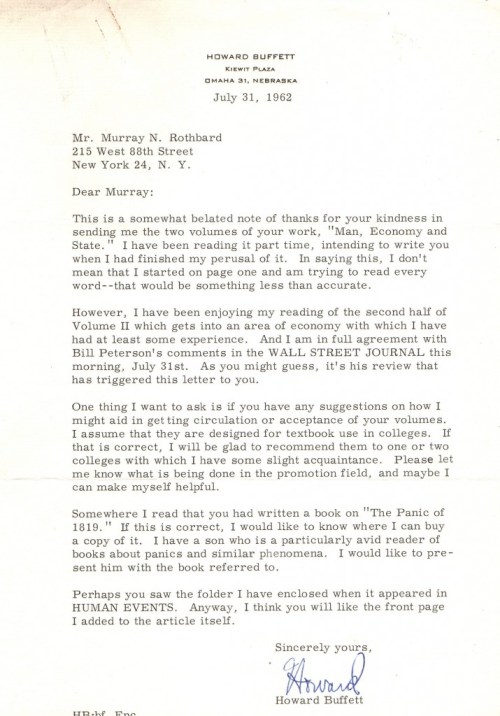
Letter from Howard Buffett to Murray Rothbard: “I have a son who is a particularly avid reader of books about panics and similar phenomena.”
March 4, 2013 by Tobias Carlisle
This letter from Howard Buffett, the highly libertarian “Old Right” United States Representative father of Warren, to anarcho-capitalist historian and economist Murray Rothbard, if real, is incredible. Buffett the Elder wrote to Rothbard that he “read that Rothbard had written a book on ‘The Panic of 1819‘” and wanted to know where he could buy a copy for his son “who is a particularly avid reader of books about panics and similar phenomena.”
Here is the letter:
The timing of the letter – July 31, 1962 – is interesting. The first “flash crash” occurred in May 1962, and was at the time the worst crash since 1929. Time LIFE described the 1962 “flash crash” thus:
The signs, like the rumblings of an Alpine ice pack at the time of thaw, had been heard. The glacial heights of the stock boom suddenly began to melt in a thaw of sell-off. More and more stocks went up for sale, with fewer and fewer takers at the asking price. Then suddenly, around lunchtime on Monday, May 28, the sell-off swelled to an avalanche. In one frenzied day in brokerage houses and stock exchanges across the U.S., stock values — glamor and blue-chip alike — took their sharpest drop since 1929.
Memory of the great crash, and the depression that followed, has haunted America’s subconscious. Now, after all these years, was that nightmare to happen again?
The article continues that, “although the Dow Jones Industrial Average fell almost 6 percent on that one vertiginous Monday and the market was anemic for a year afterwards, the markets as a whole, at home and abroad, did bounce back.” Good to know.
March 5, 2013 Leave a comment
Singapore Zoo to celebrate 40th anniversary with special programmes
Among the activities include a search for people born on June 27, 1973 to join the Zoo’s birthday party, as well as 40 per cent discounts off admission prices for visitors who turn 40 in 2013. -AsiaOne
Tue, Mar 05, 2013
AsiaOne
SINGAPORE – The Singapore Zoo is rolling out celebratory activities from now until the end of the year to commemorate its 40th anniversary. Read more of this post
March 5, 2013 Leave a comment
Big data in the age of the telegraph
Daniel McCallum’s 1854 organizational design for the New York and Erie Railroad resembles a tree rather than a pyramid. It empowered frontline managers by clarifying data flows.
March 2013 • Caitlin Rosenthal
In 1854, Daniel McCallum took charge of the operations of the New York and Erie Railroad. With nearly 500 miles of track, it was one of the world’s longest systems, but not one of the most efficient. In fact, McCallum found that far from rendering operations more efficient, the scale of the railroad exponentially increased its complexity.1
The problem was not a lack of information: the growing use of the telegraph gave the company an unprecedented supply of nearly real-time data, including reports of accidents and train delays.2 Rather, the difficulty was putting that data to use, and it led McCallum to develop one of the era’s great low-tech management innovations: the organization chart. This article presents that long-lost chart (see sidebar, “Tracking a missing org chart”) and shows how aligning data with operations and strategy—the quintessential modern management challenge—is a problem that spans the ages. Read more of this post
March 5, 2013 Leave a comment
Franklin Roosevelt’s 1933 ‘Fear Itself’ Inauguration
Not since Abraham Lincoln’s 1861 inauguration had an incoming U.S. president faced so comprehensive a crisis as Franklin D. Roosevelt did in early 1933. The U.S. banking system was crumbling, millions of Americans were unemployed, international relations were strained, and efforts to reverse the Great Depression’s effects had floundered.
In mid-February, the president-elect survived an assassination attempt in Miami. Five people where hit, including Chicago Mayor Anton Cermak, who died three weeks later. Two weeks after the shooting, Roosevelt’s nominee for attorney general, Senator Thomas Walsh of Montana, died suddenly aboard a train. Not good omens for the new administration.
Even so, on Saturday, March 4, Roosevelt and President Herbert Hoover rode in an open car from the White House to the Capitol’s East Portico. There, Chief Justice Charles Evans Hughes administered the oath of office, and the U.S.’s 32nd chief executive turned to address the nation. More than 175 radio stations broadcast his words globally.
The address proved a touchstone for many Americans.
This is pre-eminently the time to speak the truth, the whole truth, frankly and boldly. This great nation will endure as it has endured, will revive and will prosper. So, first of all, let me assert my firm belief that the only thing we have to fear is fear itself — nameless, unreasoning, unjustified terror which paralyzes needed efforts to convert retreat into advance. In every dark hour of our national life a leadership of frankness and vigor has met with that understanding and support of the people themselves which is essential to victory. Read more of this post
March 5, 2013 Leave a comment
Hidden Billionaire Garavoglia Pouring Campari Fortune
Jillkerry Ward, a 37-year-old bartender at upscale French restaurant Le Cirque in New York, grabbed a glass Friday night and poured a negroni: two parts gin, a splash of sweet vermouth and two shots of Campari.
“We probably pour 10 to 15 of these every night,” she said, garnishing the cocktail with an orange. “It’s a classic.”
Davide Campari-Milano SpA (CPR), which sells the bitter aperitif and is Italy’s largest maker of alcoholic beverages, has doubled in value in the last five years and reached a record in October as demand for Campari in Italy increased. Thirst for the company’s other brands, such as Skyy vodka and Wild Turkey bourbon, has expanded in the U.S. and Brazil as well.
The surge has made 79-year-old Rosa Anna Magno Garavoglia Italy’s oldest known female billionaire. Garavoglia, who controls a 31 percent economic interest in the company, has a net worth of at least $1.5 billion, according to the Bloomberg Billionaires Index. She has never appeared on an international wealth ranking.
The company, based in Milan, had revenue of 1.3 billion euros ($1.7 billion) in revenue in the last 12 months, up 30 percent over its fiscal year 2009 sales. It controls more than 45 brands in 190 countries, including the rights to produce and distribute Jagermeister liqueur and Glenfiddich Scotch whisky. Read more of this post
March 5, 2013 Leave a comment
Billionaire Doctor Prescribes Small Teva Deals for Israeli Giant
As American billionaire Phillip Frost prepared to take over as chairman of Teva Pharmaceutical Industries Ltd. (TEVA) in March 2010, some investors fretted about what would become of Israel’s crown jewel.
Eli Hurvitz, a national icon who had won the government’s Israel Prize for his lifelong contributions to the country, had set a patriotic tone at the world’s largest generic-drug maker before stepping down that year to fight his own cancer. Read more of this post