Great Leaders Know When to Forgive

Great Leaders Know When to Forgive

by Rosabeth Moss Kanter  |   8:00 AM February 26, 2013

Leaders must be firm and foster accountability, but they also must know when to forgive past wrongs in the service of building a brighter future. One of the most courageous acts of leadership is to forgo the temptation to take revenge on those on the other side of an issue or those who opposed the leader’s rise to power.

Instead of settling scores, great leaders make gestures of reconciliation that heal wounds and get on with business. This is essential for turnarounds or to prevent mergers from turning into rebellions against acquirers who act like conquering armies.

Nelson Mandela famously forgave his oppressors. After the end of apartheid, which had fostered racial separation and kept blacks impoverished, Mandela became South Africa’s first democratically elected President. Some in his political party clamored for revenge against members of the previous regime or perhaps even all privileged white people. Instead, to avoid violence, stabilize and unite the nation, and attract investment in the economy, Mandela appointed a racially integrated cabinet, visited the widow of one of the top apartheid leaders, and created the Truth and Reconciliation Commission that would clear the air and permit moving forward. Read more of this post

Fast Retailing to Asahi Named to Women-Empowering Firms List; The exchange labeled the women-empowering companies selection the “Nadeshiko” list

Fast Retailing to Asahi Named to Women-Empowering Firms List

Fast Retailing Co. (9983), Asia’s largest apparel seller, and Nissan Motor Co. are among the Japanese companies that do the most to empower female employees, according to the Tokyo Stock Exchange.

The world’s largest bourse outside the U.S. selected those companies and 15 others for its list of firms that provide child care services and career advancement opportunities for female employees, the bourse said in a statement today.

“Expectations are increasing that women will help revive the Japanese economy,” said Hiroki Kawai, an official at Japan Exchange Group Inc. (8697), which operates the Tokyo Stock Exchange.

The list was compiled with the help of the Ministry of Economy, Trade and Industry and is the exchange’s third specialty selection. The exchange has said it expects the lists to encourage trading, which plunged 58 percent on the first section to 307 trillion yen ($3.34 trillion) in the six years ended Dec. 31.

“We started by picking a theme that would make investors want to cheer companies on by investing,” Kawai told reporters today in Tokyo. He said it can be difficult for individual investors to carefully select from the more than 2,000 companies on the Tokyo bourse.

The exchange initially chose as many as two top companies from each of 33 industry sub-sectors, then narrowed the selection based on two criteria: Promoting women to management positions and offering support allowing a balance of work and family needs. Read more of this post

Culture as Risk Mitigant: Cockpit, Country and Company

Culture as Risk Mitigant: Cockpit, Country and Company

Posted: 02/21/2013 11:27 am

How did the national airline of Korea transform itself from one of the most accident-prone to one of the safest carriers in the world in less than a decade? As Malcolm Gladwell forcefully argues in Outliers, the driver was “cockpit culture.”

Most plane crashes are the result of an accumulation of minor malfunctions rendered disasterous by human interaction. As is hauntingly evident from flight recorder transcripts, preventable errors have prevailed due to a breakdown of teamwork and communication.

Cultures can be distinguished by the scale of their power index — the rigidity with which hierarchical distance is maintained — and the extent to which individuals are reliant on rules as opposed to resourcefulness in the face of ambiguities.

The assertiveness and choice of words with which a deputy communicates with his captain or his controller is a direct function of his cultural context. Consequently, linguists and psychologists proved to be as relevant to airline safety as technical engineers. Read more of this post

The trust crisis in the workplace

The trust crisis in the workplace

Ray Williams | Feb 25, 2013 5:16 PM ET
Recent polls would seem to indicate that people are becoming increasingly cynical about organizations and leaders.

A DDI International study of 57 organizations on the issue of trust in the workplace indicated respondents trusted their co-workers, but a majority mistrusted their leaders, and particularly senior leaders.  The 2012 Edelman Trust Barometer reported that the majority of people distrusted government, financial institutions and business leaders — particularly CEOs. Read more of this post

Kindness + The Accounting of Words and Value Investing

I was just discussing this afternoon about how can one “measure/quantify” the criteria of “kindness”. This is in relation to Yahoo’s Marissa Mayer scrapping the “work-from-home” policy which would affect several working mothers and the policy does not seem aligned with a culture of kindness and trust to foster productivity and innovations. And there are reports that Marissa Mayer paid to have a nursery built in her office; “not all Yahoos have that kind of money and clout” was the feedback gathered by journalist Nicholas Carson from some Yahoo staff. In the R.E.S.-ilience framework of Bamboo Innovators, R stands for Rootedness in a Kindness culture. Perhaps the lack of Kindness can be “quantified” by the disproportionate size of the office and size of perks to the top executives and managers. In a positive way, Kindness can be “measured” by the “number of jokes/humor” in annual reports and company publications, just like Warren Buffett’s folky humor in his widely-followed Berkshire Hathaway’s Letter to Shareholders. Words can reveal kindness and there is growing awareness of how linguistic/textual analysis can be used to highlight the intentions of managers and leaders. Talk about using unorthodox “data”. Below is a brief article “The Accounting of Words and Value Investing” that I wrote in September 2010 which also has relevance to investigating Bamboo Innovators.

Koon Boon

26 Feb 2013

Singapore

27 September 2010 (Updated 22 March 2013)

The Accounting of Words and Value Investing for Bamboo Innovators

By KEE Koon Boon

Have taken down this article as i am submitting this for a posting at a media outlet for a 1-month exclusivity period. Will update accordingly. Thank you.

Deviant Leaders: Falling Hard; Can top bosses be rude, abusive, egocentric and fiscally irresponsible, as long as the bottom line looks good?

Deviant Leaders: Falling Hard

by Jane Williams | Feb 25, 2013

Can top bosses be rude, abusive, egocentric and fiscally irresponsible, as long as the bottom line looks good?

When it comes to infringements around the office, business leaders seem to get away with a lot: A blind eye may be turned when a manager swipes his company credit card to cover a US$200 private lunch, but a worker caught stuffing a coffee tin from the tea room into his backpack could expect to face great condemnation and possibly the loss of his job.

But there’s a limit, even at the very top, as former CEOs Bernie Ebbers (WorldCom), Dennis Kozlowski (Tyco International), and Kenneth Lay (Enron) discovered. When leaders fall, they fall hard.

New INSEAD research has found leaders in general receive greater leniency for their perceived anti-social or “deviant” behaviour, but when a line is crossed – when their deviant actions are perceived to be “most severe” – they face harsher punishment than would an underling.

“Research shows that because of their power and status leaders are perceived as deserving of certain privileges,” Natalia Karelaia, INSEAD Assistant Professor of Decision Sciences and co-author of the paper When Deviant Leaders are Punished more than Non-leaders: The Role of Deviance Severity told INSEAD Knowledge. “But prototypical leaders are also expected to act in a responsible and just manner, so when severe deviances – those that inflict significant harm on others – are committed by leaders, they are likely to be seen as significant acts of betrayal of leadership expectations.” Read more of this post

Shocking Aerial Views Of Hong Kong’s Tiny ‘Cage’ Apartments

Shocking Aerial Views Of Hong Kong’s Tiny ‘Cage’ Apartments

Adam Taylor | Feb. 25, 2013, 3:00 PM | 94,004 | 27

Over the past few decades, Hong Kong has become one of the world’s most important cities and a global financial hub.

However, increased prosperity hasn’t trickled down to everyone. According to the Gini co-efficiency, which measures inequality, Hong Kong is the least equal city in the developed world.

Local advocacy group Society for Community Organization says that hundreds of thousands of people are still living in caged homes and wood-partitioned cubicles. What’s worse, the number of people living this way appears to be increasing, as economic migrants arrive in the city from mainland China.

To highlight the struggle, SoCO took shots of the homes to show just how tight these living quarters are.

The apartments were so small that they had to be photographed from the ceiling to capture them.

this-is-the-smallest-apartment-shown-it-is-28-square-feet-with-proportions-of-around-4-x-7 8090hkd-103115usd-per-square-foot-per-month-is-common

Richard Branson Says That Marissa Mayer Got It Wrong About Remote Employees; Ex-Yahoos Confess: Marissa Mayer Is Right To Ban Working From Home; Marissa Mayer, Who Just Banned Working From Home, Paid To Have A Nursery Built At Her Office; Not all Yahoo have that kind of money or clout

Richard Branson Says That Marissa Mayer Got It Wrong About Remote Employees

Aimee Groth | Feb. 25, 2013, 5:24 PM | 5,563 | 21

Last week Yahoo CEO Marissa Mayer sent out a controversial memo telling remote employees that they either had to start working from a Yahoo office or quit.

Since then, everyone has been weighing in, including Virgin Founder Richard Branson. In a post this morning titled, Give People The Freedom Of Where To Work, he wrote:

To successfully work with other people, you have to trust each other. A big part of this is trusting people to get their work done wherever they are, without supervision. It is the art of delegation, which has served Virgin and many other companies well over the years.

We like to give people the freedom to work where they want, safe in the knowledge that they have the drive and expertise to perform excellently, whether they at their desk or in their kitchen. Yours truly has never worked out of an office, and never will.

So it was perplexing to see Yahoo! CEO Marissa Mayer tell employees who work remotely to relocate to company facilities. This seems a backwards step in an age when remote working is easier and more effective than ever.

If you provide the right technology to keep in touch, maintain regular communication and get the right balance between remote and office working, people will be motivated to work responsibly, quickly and with high quality.

Working life isn’t 9-5 any more. The world is connected. Companies that do not embrace this are missing a trick.

Ex-Yahoos Confess: Marissa Mayer Is Right To Ban Working From Home

Nicholas Carlson | Feb. 25, 2013, 3:16 PM | 85,571 | 63

Last Friday, Yahoo HR boss Jackie Reses sent out a memo telling all remote employees that they needed to find a way to be working in an office by June.

This upset lots of Yahoo employees – including some working mothers, who say they wish they could afford to build a nursery at the office the way CEO Marissa Mayer has.

But we’ve just heard from a former Yahoo engineer who tells us Mayer is making the exact right call.

“For what it’s worth, I support the no working form home rule. There’s a ton of abuse of that at Yahoo. Something specific to the company.”

This source said Yahoo’s large remote workforce led to “people slacking off like crazy, not being available, spending a lot of time on non-Yahoo! projects.” Read more of this post

INTUIT FOUNDER: ‘Success Makes Companies Stupid’

INTUIT FOUNDER: ‘Success Makes Companies Stupid’

Max Nisen | Feb. 25, 2013, 6:35 PM | 854 | 3

Intuit is one of the unsung success stories of Silicon Valley. The maker of software like Quicken, TurboTax, and QuickBooks has been around for 30 years and made $4.15 billion in revenue last year.

Intuit’s founder, Scott Cook, believes that success can actually be dangerous to the company. At a seminar with Harvard Business School faculty, he said that “Success is a powerful thing, it tends to make companies stupid, and they become less and less innovative.”

According to Harvard Business School Working Knowledge, Cook argues that companies need to adopt the lean startup model pioneered by Eric Ries. That means “launching as quickly as possible with a “minimum viable product,” a bare-bones creation that includes just enough features to allow for useful feedback from early adopters. The company then releases a quick succession of product upgrades, forming hypotheses and conducting experiments with each new version along the way.”

Getting feedback early and often means the product improves quickly, picking up new users along the way.

That’s the polar opposite of the way many successful companies come up with new products. They spend years developing things, many of which are only minor improvements on what already exists. Once something’s set into motion, it has a great deal of inertia and can take a long time to stop, even if it’s not working.

That’s an easy way for a company to stagnate. However, adopting something like the lean startup model takes a significant cultural shift. It’s not easy to take product teams used to taking years and get them to take ideas from birth to execution in months. It also takes creating a culture that’s OK with failure and starting again, which is the opposite of what you see in many large companies.

Some companies choose to have a small part of their company, like a skunk works, to constantly try to innovate. But when it’s a small part of the company, you see small benefits. Far more effective is forcing a whole company to constantly experiment and innovate.

JCPenney COO: ‘I Hated The JCPenney Culture, It Was Pathetic’

JCPenney COO: ‘I Hated The JCPenney Culture, It Was Pathetic’

Kim Bhasin | Feb. 25, 2013, 11:51 AM | 16,278 | 13

P1-BK427_PENNEY_NS_20130224170304P1-BK428_PENNEY_G_20130224170604

JCPenney experienced a seismic shift on corporate culture when CEO Ron Johnson took the helm of the company more than a year ago.

The new guard didn’t like JCPenney’s old way of doing things at headquarters.

Not one bit.

Dana Mattioli at The Wall Street Journal spoke with JCPenney COO Michael Kramer about the company’s culture and the mass layoffs at the company’s headquarters. He’s one of the execs brought in by Johnson, who he’d previously worked with at Apple.

“I hated the JCPenney culture,” Kramer told the WSJ. “It was pathetic.” Read more of this post

Lee Kuan Yew, A Wise Man for the World: Singapore’s philosopher-king on an ascendant China, the threat of Islamism and America’s entitlements crisis

February 25, 2013, 4:19 p.m. ET

A Wise Man for the World

Singapore’s philosopher-king on an ascendant China, the threat of Islamism and America’s entitlements crisis.

By KAREN ELLIOTT HOUSE

China already dominates Asia and intends to become the world’s leading power. The United States is not yet a “second rate power,” but the inability of its political leaders to make unpopular decisions bodes poorly. Russia, Japan, Western Europe and India are, for the most part, tired bureaucracies. If Iran gets the bomb, a nuclear war in the Middle East is almost inevitable.

These are among the many frank forecasts laid out in a slim volume based on the experiences and insights of Lee Kuan Yew, the founder of modern Singapore, its prime minister from 1959 to 1990, and Asia’s ranking philosopher-king for much of the past half-century. Tiny Singapore has always been too small a stage for a leader of Mr. Lee’s intellect and ego. His interests have extended across the globe, as has his influence. For decades, world leaders, corporate CEOs, scholars and journalists have made the pilgrimage to Singapore to seek his views.

“Lee Kuan Yew: The Grand Master’s Insights on China, the United States, and the World” forms a kind of last testament of the ailing, 89-year-old Mr. Lee. It is based on interviews with Mr. Lee by the authors—Graham Allison, a professor of government at Harvard’s Kennedy School, and Robert Blackwill, a former U.S. diplomat—to which the authors add a distillation of Mr. Lee’s speeches, writings and interviews with others over many years. Read more of this post

East Meets West in Class

Updated February 25, 2013, 5:02 p.m. ET

East Meets West in Class

Pericles Lewis is founding president and professor of humanities at Yale-NUS College, a joint venture between Yale University and National University of Singapore, to open in August.

IV-AA332A_LEWIS_G_20130225140903 Read more of this post

Stress-Busting Smiles: A Genuine Grin Can Help the Heart; Is Polite Faking Enough to See Benefits?

Updated February 25, 2013, 9:29 p.m. ET

Stress-Busting Smiles

A Genuine Grin Can Help the Heart; Is Polite Faking Enough to See Benefits?

By SUMATHI REDDY

Smiling could be good for your health.

Researchers are finding that wearing a smile brings certain benefits, like slowing down the heart and reducing stress. This may even happen when people aren’t aware they are forming a smile, according to a recent study. The work follows research that established that the act of smiling can make you feel happier.

Some research suggests only a full and genuine smile affects the body in positive ways. Other studies, though, indicate even a polite smile may be beneficial. Frowning also may have a health effect: Preventing people from frowning, such as with the use of Botox, can help alleviate depression, a recent study found.

“You can influence mental health by what you do with your face, whether you smile more or frown less,” says Eric Finzi, a dermatologic surgeon and co-author of the study on frowning. Read more of this post

How to Best Protect Your Brand From a Coup d’Etat; Soon, a Singapore court will decide a lawsuit involving one of Indonesia’s most well-known brands, with not only millions of dollars at stake but also ownership of the brand itself

How to Best Protect Your Brand From a Coup d’Etat
Commentary | Prudence Jahja & Andrew Diamond | February 25, 2013

Soon, a Singapore court will decide a lawsuit involving one of Indonesia’s most well-known brands, with not only millions of dollars at stake but also ownership of the brand itself.

How Ku De Ta, the long-standing Bali beach club and an establishment known for its chic and laid-back demeanor, became embroiled in a hotly contentious, multiparty lawsuit 1,600 kilometers away from its sublime beachfront location in Seminyak is a story that every Indonesian brand owner should learn by heart.

It is a story that has important implications for doing business in this increasingly globalized world. And while this decision is eagerly anticipated by the parties and intellectual property lawyers who focus on trademarks and brand protection, for everyone else the decision itself does not matter, as the lessons to be learned from this case have been clear for quite some time, however the court rules.  Read more of this post

Priceline Founder Jay Walker: Imagination Drives Innovation

February 25, 2013, 4:59 p.m. ET

The Power of Imagination

Jay Walker on the fuel that drives innovation

Jay S. Walker founded Priceline.com and is curator of TEDMED, a group dedicated to improving the future of health and medicine. Here are edited excerpts from his remarks at the Unleashing Innovation conference. 

Tedmed curator Jay Walker talks about the history of great ideas and shows off an illustrated book woven entirely in silk–a breakthrough marketing tool pitching an 18th-century revolution in loom technology.

On why imagination has been undervalued for so long: For most of human history, there was a ruling class and then there was everybody else. If you were part of everybody else, it wasn’t your job to imagine a different future, different ways of doing things. So, imagination is a fairly modern phenomenon. It really only takes force in the 1800s in the way we think of it today, where you can make a living and not get killed for being imaginative.

On encouraging imagination: People talk about wanting more innovation. But innovation is a process result. Imagination is the fuel. You’re not going to get innovation if you don’t have imagination. Most organizations do not value imagination, do not encourage it, do not reward it. In many cases, they don’t even think about it. But if you’re not thinking about imagination, I guarantee you’re not going to have meaningful innovation.

On why imagination is crucial for business: Imagination drives good problem formation because imagination thinks about customers. What might my customers want tomorrow? What might my customers want in six months, a year, two years that they don’t want today? That’s imagination. And that’s hard work. There’s no right or wrong answer, there’s nobody there to say, “You did it perfectly. Here’s your bonus for that.”

The issue is not to ask your customers what they want today, but to try to imagine what the customer is going to want in a world where, for instance, their cellphone is in their glasses. What is my customer going to want in a world with transparency, where they are able to talk to every one of my other customers? If you ask your customers what they want, you will not get disruptive innovation. Read more of this post

The Entrepreneur’s DNA: Hal Gregersen on what makes a successful entrepreneur

Updated February 25, 2013, 5:00 p.m. ET

The Entrepreneur’s DNA

Hal Gregersen on what makes a successful entrepreneur

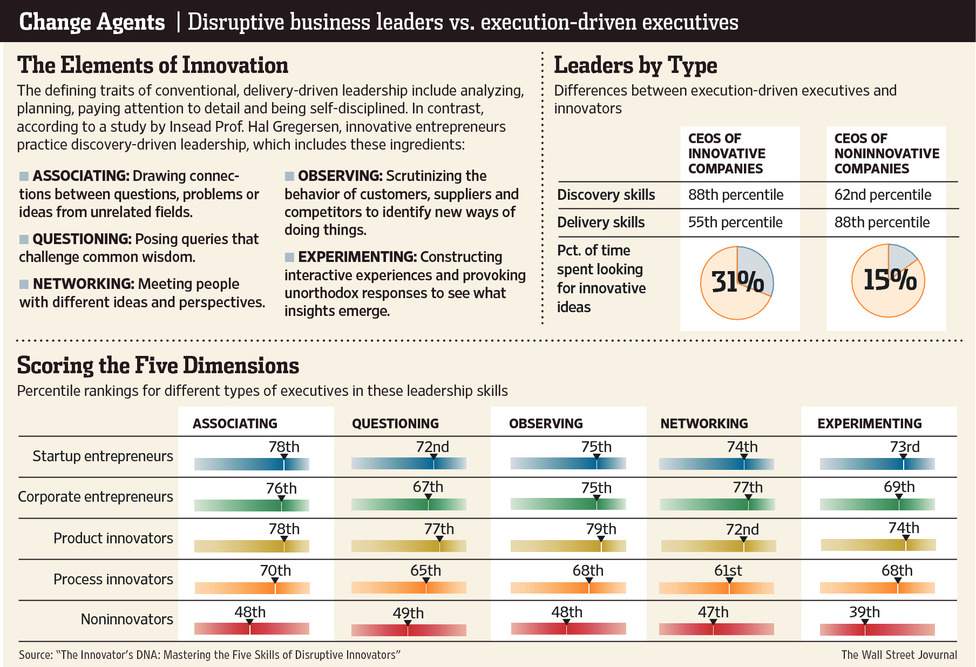
Hal Gregersen is an author and professor of innovation and leadership at graduate business school Insead. What follows are edited excerpts from his discussion at the Unleashing Innovation conference.

IV-AA310_GREGER_G_20130225132405 Read more of this post

Wombs for rent: Indian surrogate mothers tell their tales

Published: Monday February 25, 2013 MYT 1:51:00 PM

Wombs for rent: Indian surrogate mothers tell their tales

NEW DELHI: As baby Lili celebrates her first birthday in Australia, far away in India her surrogate mother recalls the day the child was born – and on whom she never laid eyes.

“I averted my gaze,” says Seita Thapa, recounting her experience of giving birth at the Surrogacy Centre India clinic in New Delhi last February on behalf of a gay male couple who used an egg donated from another woman.

“Why would I want to see the child? – I have my own children,” said the mother of two teenagers aged 16 and 18, adding that the clinic gives courses that “prepare us mentally for the fact it’s not our baby”.

Commercial surrogacy is a booming industry in India with legions of childless foreign couples looking for a low-cost, legally simple route to parenthood.

While the Indian government has been pushing the country as a medical tourism destination, the issue of wealthy foreigners paying poor Indians to have babies has raised ethical concerns in many Indian minds about “baby factories”.

The Confederation of Indian Industry, a leading business association, estimates the industry now generates more than $2 billion in revenues annually. Read more of this post

Wang Wei’s journey from deliveryman to logistics tycoon of SF Express with over US$2.4 billion in revenue

Wang Wei’s journey from deliveryman to logistics tycoon

Staff Reporter
2013-02-19

wang wei-153655_copy1

A rare photo of SF Express founder Wang Wei. (Internet photo)

Wang Wei is the low-key founder of SF Express, one of China’s two leading express delivery companies.

The 41-year-old Wang started SF Express nearly 20 years ago and has since developed the company into an delivery giant that recorded 15 billion yuan (US$2.4 billion) in revenue in 2011. Despite the extraordinary success of his company, Wang has said SF Express does not advertise and that he does not intend to take the company public or use it to make strategic investments. It is an attitude that has made Wang well-respected among China’s leading entrepreneurs, including Alibaba founder and chairman Jack Ma. Read more of this post

The Ways Art Investors Blow It; Adding art to your portfolio can be a lot trickier than putting it on your wall.

February 25, 2013

The Ways Art Investors Blow It

Three common mistakes novices fall prey to—and how to avoid them

By DANIEL GRANT

Adding art to your portfolio can be a lot trickier than putting it on your wall.

With regular investments looking uncertain these days, individuals and financial pros are snapping up artwork to diversify their holdings—and, with any luck, realize big returns.

WE-AA434_FINEAR_G_20130221154803

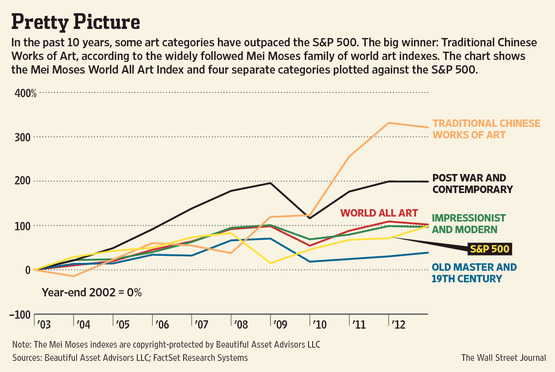
But with more competition for desired pieces, prices are soaring ever higher and the chances of making a costly mistake are rising too. Here’s a look at some of the pitfalls of art investors face and how to avoid them. Read more of this post

Comic-book investing is a funny business—and sometimes a profitable one

February 25, 2013

Wham! Ka-Pow! Zounds!

Comic-book investing is a funny business—and sometimes a profitable one

By STEVE ROSENBUSH

In August 2008, comic-book dealer Metropolis Collectibles Inc. auctioned a copy of Action Comics No. 1—which introduced the character of Superman in 1939—for $317,200. At the time, it was the largest sum ever paid for a comic book.

When the real estate and stock markets tanked in 2008, some savvy investors turned to the so-called “golden age” comic books, and the market has continued to boom. WSJ’s Steve Rosenbush talks to Vincent Zurzolo, COO of Metropolis Collectibles.

Last November, Metropolis sold another copy of Action Comics No. 1. The price this time: $2.2 million.

While some other asset classes withered in the wake of the recent financial crisis, comic books have emerged triumphant. They’re not all investment superheroes, but overall demand has risen steadily in recent years, says Ed Jaster, a senior vice president and comic-book specialist at Heritage Auctioneers & Galleries Inc. in New York. Read more of this post

Chief Taste Tester, Innovator and Boss Behind the Tabasco Brand

Updated February 24, 2013, 7:24 p.m. ET

PAUL MCILHENNY | 1944-2013

Chief Taste Tester, Innovator and Boss Behind the Tabasco Brand

By MARK PETERS

One of Paul McIlhenny’s favorite roles as leader of the Louisiana-based family company that makes Tabasco was taste tester.

The chairman and chief executive of McIlhenny Co., who died Saturday at the age of 68, was heavily involved in recent years with the development of new products that went beyond the company’s iconic pepper sauce. It was part of Mr. McIlhenny’s love of the food business that also included befriending celebrity chefs and cooking Louisiana Creole dishes, said Tony Simmons, president of McIlhenny Co. and Mr. McIlhenny’s cousin. Read more of this post

1 Corinthians 13:4: Love is patient, love is Kind

This verse from the Bible is shared to me by a kind friend and investment veteran this morning after reading my “Bamboo Innovator” article, saying he particularly “like the statement : ‘To trust is to be kind to others – & making ourselves vulnerable’.” Thank you for your kind encouragement.

1 Corinthian 13:4: “Love is patient, love is kind. It does not envy, it does not boast, it is not proud. it does not dishonor others, it is not self-seeking, it is not easily angered, it keeps no record of wrongs. Love does not delight in evil but rejoices with the truth. It always protects, always trusts, always hopes, always perseveres.”

love-is-patient-Print1

Edmund Phelps: Less Innovation, More Inequality; America’s peak years of indigenous innovation ran from the 1820s to the 1960s. A slowdown in dynamism since then has contributed to soaring inequality

FEBRUARY 24, 2013, 9:13 PM

Less Innovation, More Inequality

By EDMUND S. PHELPS

ONE source of the outsize inequalities in America is the dynamism that made economic activity so rewarding. An economy open to new concepts and novel ventures is bound to generate unequal gains. To tax all of those gains would close off the prospects for success that many entrepreneurs need if they are to undertake ambitious ventures — a big mistake. But it would also be a mistake to misunderstand the relation of inequality and innovation. It is less innovation — not more — that has widened inequality in the United States in recent decades.

America’s peak years of indigenous innovation ran from the 1820s to the 1960s. There were a few financial panics and two depressions, to be sure. But in this period, a frenzy of creative activity, economic competition and rapid growth in national income provided widening economic inclusion, rising wages for all and engaging careers for most. Innovations gave workers better tools to work with and better products to make, thus lifting their wages. Then this innovation began to retreat, most of it to an area of land along the West Coast. In the early 1970s the rate of indigenous innovation (as measured by its estimated contribution to the rate of growth in labor productivity) dropped by about half — to around 1 percent since then, from about 2 percent before then.

The economist Robert J. Gordon has noted this slowdown in innovation, which he lays to the end of big breakthroughs. My view is that innovation has declined in the everyday processes that businesses tinker with incrementally as they try to become more productive over time. This decline of innovation across many fields — with notable exceptions like Silicon Valley, biotechnology and clean energy — has set back much of the earlier gains in productivity in American history. Read more of this post

Five Star Billionaire by Tash Aw – review; Tash Aw’s tale of five migrant workers carving out lives in a modernising Shanghai is the stuff of a hit TV miniseries

Five Star Billionaire by Tash Aw – review

Tash Aw’s tale of five migrant workers carving out lives in a modernising Shanghai is the stuff of a hit TV miniseries

Adam Mars-Jones

The Observer, Sunday 24 February 2013

Shanghai, a city ‘with a heart as deep and unknown as the forests of the Amazon’. Photograph: Alamy

At one point in Tash Aw’s fine new novel about what people call “the newChina” a young woman is trying to photograph herself on her mobile phone in a park in Guangzhou, hoping to enliven her internet dating profile with an image that doesn’t make her look like an immigrant factory worker (which she is). An old man who sells tickets for the rowing boats on the lake offers to take the picture for her. He looks uncertainly at her phone. She wonders if he understands how to work it. Then he says: “This phone is so old. My grandson had one just like this three years ago when he was still in middle school.” This is the world of the book, where traditional societies seem to have leapfrogged their way into a modernity without signposts, where the past isn’t solid enough to build on but too substantial to be ignored.

The five main characters, three men and two women, all come to Shanghai (by some definitions the world’s largest city) from Malaysia, though their backgrounds range from old money to rural deprivation. As a title, Five Star Billionaire is close to brash, and the book’s storyline could persuasively be pitched to a producer in search of a blockbuster miniseries, but the reading experience it offers is coolly engrossing – with elements of frustrating evasion – rather than propulsive. Tash Aw doesn’t exactly kill plot momentum or the emotional impact of the situations he creates, but he certainly keeps them in check. Narrative hints are often indirect, like clues in a detective story, as when a passing reference to a character having written an article deploring the architecture of Gaudí suggests that a conversation almost a hundred pages earlier wasn’t in fact spontaneous. Read more of this post

Schools think too narrowly on entrepreneurship; Identifying new business opportunities should be core to management education

February 24, 2013 11:46 pm

Schools think too narrowly on entrepreneurship

By Tim Faley and Peter Adriaens

Identifying new business opportunities should be core to management education

Growth is the top concern of corporate executives, economic developers and government officials desperately trying to reduce unemployment. That growth will be driven by entrepreneurs creating new businesses and new lines of business within existing companies.

Institutes of higher learning are responding with courses and dedicated entrepreneurial centres. In the US alone, the number of schools offering courses in entrepreneurship has grown from fewer than 100 in 1977 to more than 2,000 today. These institutions hold the promise of teaching those skills necessary to forge a new generation of successful serial entrepreneurs. But that dream has been derailed.

In fact, the promise of entrepreneurship is being corrupted by false mythologies. A false mythology about entrepreneurship, particularly prevalent at today’s universities and business schools, is stifling entrepreneurship.

Entrepreneurs need more than an idea, a pitch and some cash to build great companies. Graduate management schools, which should be the beacon of sanity in this debate, while consistently communicating that it takes two years to learn how to manage an ongoing concern, often treat the creation of such a concern as trivial – a topic that can be mastered in a weekend exercise or week-long immersion class. What is the message in that?

Many business schools think about entrepreneurship far too narrowly. They believe that it is only about students creating cute little businesses and lump the subject in with other student services and club activities.

In fact the very opposite is true; identifying new business opportunities and managing their growth should be core to what business schools teach in the 21st century. Entrepreneurial skills – the ability to identify opportunities and threats, to formulate and assess businesses around those opportunities, to put them into operation, to fund them and grow those nascent ventures – are critical for any organisation concerned with growth. Business schools have a very different role to that of incubators. Business schools have a knowledge and skill-building mission. The focus should be on the fishing, not the fish. Read more of this post

Righteous Republic: The Political Foundations of Modern India

February 24, 2013, 4:07 p.m. ET

India’s Founding Fathers

By SUDHA KOUL

Britain dominated India for almost two centuries—initially through the East India Co. and later directly as the Raj—finally granting it independence in 1947. The Indian anti-colonial struggle was unique in that it reached its goal without violent overthrow. This was one of the great achievements of the nationalist movement’s enlightened leadership.

In “Righteous Republic: The Political Foundations of Modern India,” the historian Ananya Vajpeyi shows how these leaders looked to ancient Indian texts and traditions as they led the nation toward swaraj, or self-rule. The author profiles five prominent anti-colonial leaders and examines how each of them contributed to the nation’s successful “search for the self”: Mahatma Gandhi and Jawaharlal Nehru, who need no introduction; the Bengali poet and Nobel laureate Rabindranath Tagore; his nephew, the artist Abanindranath Tagore; and B.R. Ambedkar, the architect of the Indian constitution.

India had a glorious past, with millennia of learning, literature, science and art, culture and tradition. Yet by the time the country became the jewel in the crown of Queen Victoria, who was proclaimed Empress of India in 1877, knowledge of the ancient Indic political tradition—the ideas and practices by which “the precolonial kingdoms of the Mughals, the Deccani Sultans, the Nayakas, the Marathas, the Rajputs, and the Sikhs” ruled the subcontinent—had been all but erased thanks to a combination of colonial rule and internal decay. When Indians were told that democracy was a gift of the West, for example, very few questioned the assumption, even though panchayats, or self-governing village bodies, had existed for thousands of years on the subcontinent. Read more of this post

Why We Must Think Bigger by Charles Moldow, General Partner, Foundation Capital

Charles Moldow, General Partner, Foundation Capital

Why We Must Think Bigger

FEBRUARY 22, 2013 AT 3:01 PM PT

One day, about six billion years from now, the sun will burn out.

This cataclysmic inevitability was brought to my attention over the holidays by my 6-year-old son. Far off though it may be, he believes our solar system’s imminent demise is cause for alarm sooner rather than later. (For him, that means sooner than getting a flu shot — but later than downloading the most recent service pack for Minecraft.)

Of course, I recognize my 6-year-old is thinking too far ahead. Too big.

But he did get me wondering, are the rest of us thinking big enough? Especially those of us who develop — and invest in — new innovations.

If not for being stuck on an antiquated United Airlines plane unequipped with Wi-Fi (is there any other type?), I may not have found the time to commit this thought to paper — I would likely have been overwhelmed by the next flurry of emails or meeting requests. It’s easy to lose sight of the big picture. In fact, as I survey the current startup landscape and consider the kinds of companies attracting VC dollars, it seems like the investing community isn’t thinking of the big picture at all.

Today, investors are less interested in transformative companies and more interested in trendy ones. Funding is flowing — and flowing fast — toward “quick-response startups.” These companies, more often than not, are launched during all-night hack-a-thons. They’re the wired brainchildren of eager coding buddies and Costco-like volumes of Red Bull. Read more of this post

SimCity, for Real: Measuring an Untidy Metropolis; An initiative at New York University is joining a global drive to apply modern sensor, computing and data-sifting technologies to urban environments

February 23, 2013

SimCity, for Real: Measuring an Untidy Metropolis

By STEVE LOHR

THE notion of a “science of cities” seems contradictory. Science is a realm of grand theory and precise measurement, while cities are messy agglomerations of people and human foible. But science is precisely the ambition of New York University’sCenter for Urban Science and Progress. Founded last year, the center has been getting under way in recent weeks, moving into new office space and firing off its first project proposal to the National Science Foundation.

The center’s director is Steven E. Koonin, a Brooklyn native and graduate of Stuyvesant High School, who came to N.Y.U. after a stint in the Obama administration as the under secretary for science in the Department of Energy. He is both a theoretical physicist and science policy expert. The center shouldn’t lack for intellectual rigor.

The initiative at N.Y.U. is part of a broader trend: the global drive to apply modern sensor, computing and data-sifting technologies to urban environments, in what has become known as “smart city” technology. The goals are big gains in efficiency and quality of life by using digital technology to better manage traffic and curb the consumption of water and electricity, for example. By some estimates, water and electricity use can be cut by 30 to 50 percent over the course of a decade.

Cities from Stockholm to Singapore are deep into smart city projects. The market looms as big, lucrative business for technology companies. Read more of this post

“Physically Together”: Here’s the Internal Yahoo No-Work-From-Home Memo for Remote Workers and Maybe More

“Physically Together”: Here’s the Internal Yahoo No-Work-From-Home Memo for Remote Workers and Maybe More

FEBRUARY 22, 2013 AT 10:18 PM PT

Kara Swisher

Courtesy of a plethora of very irked Yahoo employees, here is the internal memo sent to the company about a new rule rolled out today by CEO Marissa Mayer, which requires that Yahoo employees who work remotely relocate to company facilities.

“Speed and quality are often sacrificed when we work from home,” reads the memo to employees from HR head Jackie Reses. “We need to be one Yahoo!, and that starts with physically being together.”

Painfully awkward as this is phrased, it means every Yahoo get to your desks stat!

reported earlier today that the move will apparently impact only several hundred employees, such as customer service reps, who work from home full time. But numerous sources told me that the decree extends to any staffers who might have arrangements to work from home just one or two days a week, too.

The changes begin in June, according to the Yahoo memo.

After that, employees who work from home must comply without exception or quit. One top manager was told that there would be little flexibility on the issue.

The anger from impacted employees was strong today, because many felt they were initially hired with the assumption that they could work more flexibly.

In fact, even waiting for the cable guy is questionable. “And, for the rest of us who occasionally have to stay home for the cable guy, please use your best judgment in the spirit of collaboration,” wrote Reses.

The tone and tactics have infuriated some at the company. Wrote one impacted Yahoo employee to me: “Even if that was what was previously agreed to with managers and HR, or was a part of the package to take a position, tough … It’s outrageous and a morale killer.”

Most tech companies encourage workers to stay on their campuses, offering free food and other perks. But none enforce such rules beyond staff needed to operate an office.

“Our engineers would not put up with that,” said one tech exec. “So, we’d never focus on it.”

In the comments section of my first story on the HR change at Yahoo, WordPress founder Matt Mullenweg wrote:

“For anyone who enjoys working from wherever they like in the world, and is interested in WordPress, Automattic is 100% committed to being distributed. 130 of our 150 people are outside of San Francisco.”

The issue is an interesting and controversial one, with some certain that working at home is the wave of the future, while others considering it hurtful to productivity.

Well, we’ll presumably see which this way goes in time.

Earlier, when asked about the change, a Yahoo spokesperson said the company does not comment on internal matters. The memo was released after my story on the change was published this morning.

But, you don’t need any comment when you can read for yourself the new working order at the Silicon Valley Internet giant:

YAHOO! PROPRIETARY AND CONFIDENTIAL INFORMATION — DO NOT FORWARD

Yahoos,

Over the past few months, we have introduced a number of great benefits and tools to make us more productive, efficient and fun. With the introduction of initiatives like FYI, Goals and PB&J, we want everyone to participate in our culture and contribute to the positive momentum. From Sunnyvale to Santa Monica, Bangalore to Beijing — I think we can all feel the energy and buzz in our offices.

To become the absolute best place to work, communication and collaboration will be important, so we need to be working side-by-side. That is why it is critical that we are all present in our offices. Some of the best decisions and insights come from hallway and cafeteria discussions, meeting new people, and impromptu team meetings. Speed and quality are often sacrificed when we work from home. We need to be one Yahoo!, and that starts with physically being together.

Beginning in June, we’re asking all employees with work-from-home arrangements to work in Yahoo! offices. If this impacts you, your management has already been in touch with next steps. And, for the rest of us who occasionally have to stay home for the cable guy, please use your best judgment in the spirit of collaboration. Being a Yahoo isn’t just about your day-to-day job, it is about the interactions and experiences that are only possible in our offices.

Thanks to all of you, we’ve already made remarkable progress as a company — and the best is yet to come.

Jackie

INSIDE JCPENNEY: Widespread Fear, Anxiety, And Distrust Of Ron Johnson And His New Management Team

INSIDE JCPENNEY: Widespread Fear, Anxiety, And Distrust Of Ron Johnson And His New Management Team

Kim Bhasin | Feb. 22, 2013, 10:29 AM | 9,676 | 17

JCPenney may have a glossy new exterior, but inside the 111-year-old retailer, there is a major culture clash.

There’s widespread anxiety, fear, distrust, and resistance to CEO Ron Johnson within the company, according to several JCPenney executives.

Rumors have spun out of control, even among the executives at headquarters, and they have trickled down to the front line workers in stores, the execs told us.

We’ve corresponded with dozens of JCPenney employees throughout its transformation over the past year.

Some are executives at the company’s headquarters in Plano, TX. Others are regional coordinators and managers. We’ve also heard from store managers, associates, and stylists who deal directly with customers and receive their marching orders from far above.

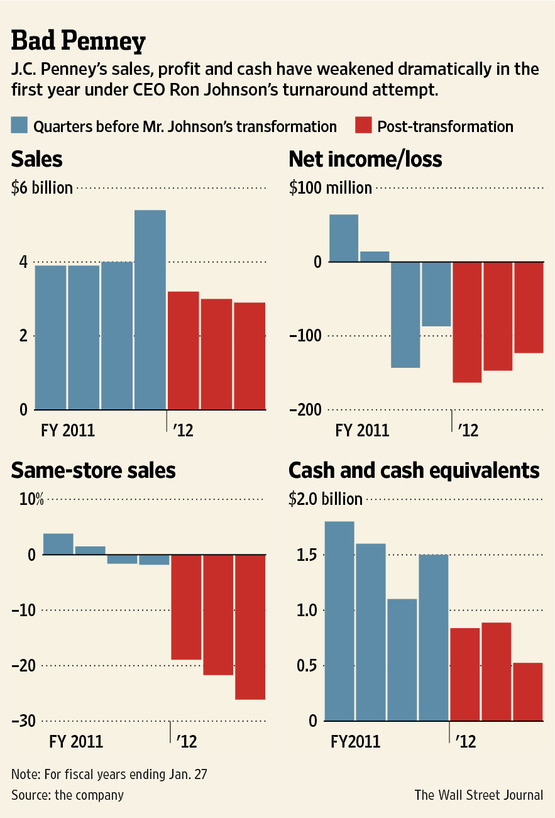
The latest numbers also reveal that the company is in a tailspin.

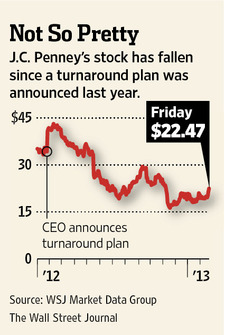
The stock price is down a whopping 54 percent in the last year. Same-store sales have been abysmal every quarter. Some analysts are even worried that the company may be approaching a cash crisis. Read more of this post