Maker’s Schedule, Manager’s Schedule; Most powerful people are on the manager’s schedule. It’s the schedule of command

Maker’s Schedule, Manager’s Schedule

Paul Graham

July 2009
One reason programmers dislike meetings so much is that they’re on a different type of schedule from other people. Meetings cost them more.

There are two types of schedule, which I’ll call the manager’s schedule and the maker’s schedule. The manager’s schedule is for bosses. It’s embodied in the traditional appointment book, with each day cut into one hour intervals. You can block off several hours for a single task if you need to, but by default you change what you’re doing every hour. When you use time that way, it’s merely a practical problem to meet with someone. Find an open slot in your schedule, book them, and you’re done.

Most powerful people are on the manager’s schedule. It’s the schedule of command. But there’s another way of using time that’s common among people who make things, like programmers and writers. They generally prefer to use time in units of half a day at least. You can’t write or program well in units of an hour. That’s barely enough time to get started.

When you’re operating on the maker’s schedule, meetings are a disaster. A single meeting can blow a whole afternoon, by breaking it into two pieces each too small to do anything hard in. Plus you have to remember to go to the meeting. That’s no problem for someone on the manager’s schedule. There’s always something coming on the next hour; the only question is what. But when someone on the maker’s schedule has a meeting, they have to think about it. Read more of this post

McDonald’s to open on Zhangjiajie mountaintop; Zhangjiajie received 35.9 million visitors from home and abroad and had a tourism revenue of 20.87 billion yuan last year.

McDonald’s to open on Zhangjiajie mountaintop

English.news.cn   2013-03-01 15:32:17

CHANGSHA, March 1 (Xinhua) — American fast-food giant McDonald’s is expected to open an outlet on the top of the Tianmen Mountain of Zhangjiajie scenic spot in central China’s Hunan Province before May 1. McDonald’s has signed a 20-year rental contract with the owner of the Tianzi fast-food restaurant located atop the 1,518-meter-high peak, an official with the scenic spot’s infrastructure construction headquarters said on Friday. McDonald’s will invest 20 million yuan (3.2 million U.S. dollars) in renovating the outlet, a staff member of the retailer’s public relations department added, while confirming the targeted timeline for opening.

Zhangjiajie, classified by UNESCO as a World Geopark and also a World Heritage Site, was formally warned by the organization in January for inadequately disseminating knowledge of earth sciences to the public. It has also been criticized for over-commercializing in the past decade. A total of 124 hotels and 1,791 residents on the mountain have been relocated in the government’s renovation campaign. Zhangjiajie received 35.9 million visitors from home and abroad and had a tourism revenue of 20.87 billion yuan last year.

Luxottica Billionaire Del Vecchio Says ‘Why Not’ to Grillo as Premier

Billionaire Del Vecchio Says ‘Why Not’ to Grillo as Premier

Billionaire Leonardo Del Vecchio, the second-richest Italian, praised Beppe Grillo for taking a novel approach to public policy in Italy and said he could support the ex-comic as a prime minister.

“Grillo the premier, why not?” Del Vecchio told Italian newswire Ansa today in Milan. A spokeswoman for Del Vecchio’s Luxottica SpA (LUX) confirmed the comments and said the entrepreneur’s remarks were made off the cuff after he was approached by journalists on his way to lunch.

Grillo, 64, is at the center of negotiations over the formation of Italy’s next government after his upstart political party won more than 160 seats in the Feb. 24-25 general election. Grillo, who ran on a platform of anti-austerity and more robust social safety nets, is jockeying with established politicians like Pier Luigi Bersani and three-time premier Silvio Berlusconi for influence over the next administration.

“I don’t think Grillo is stupider than the ones we have had up to now,” Del Vecchio told Ansa. “I don’t mind the way he has of reasoning over ideas.” Read more of this post

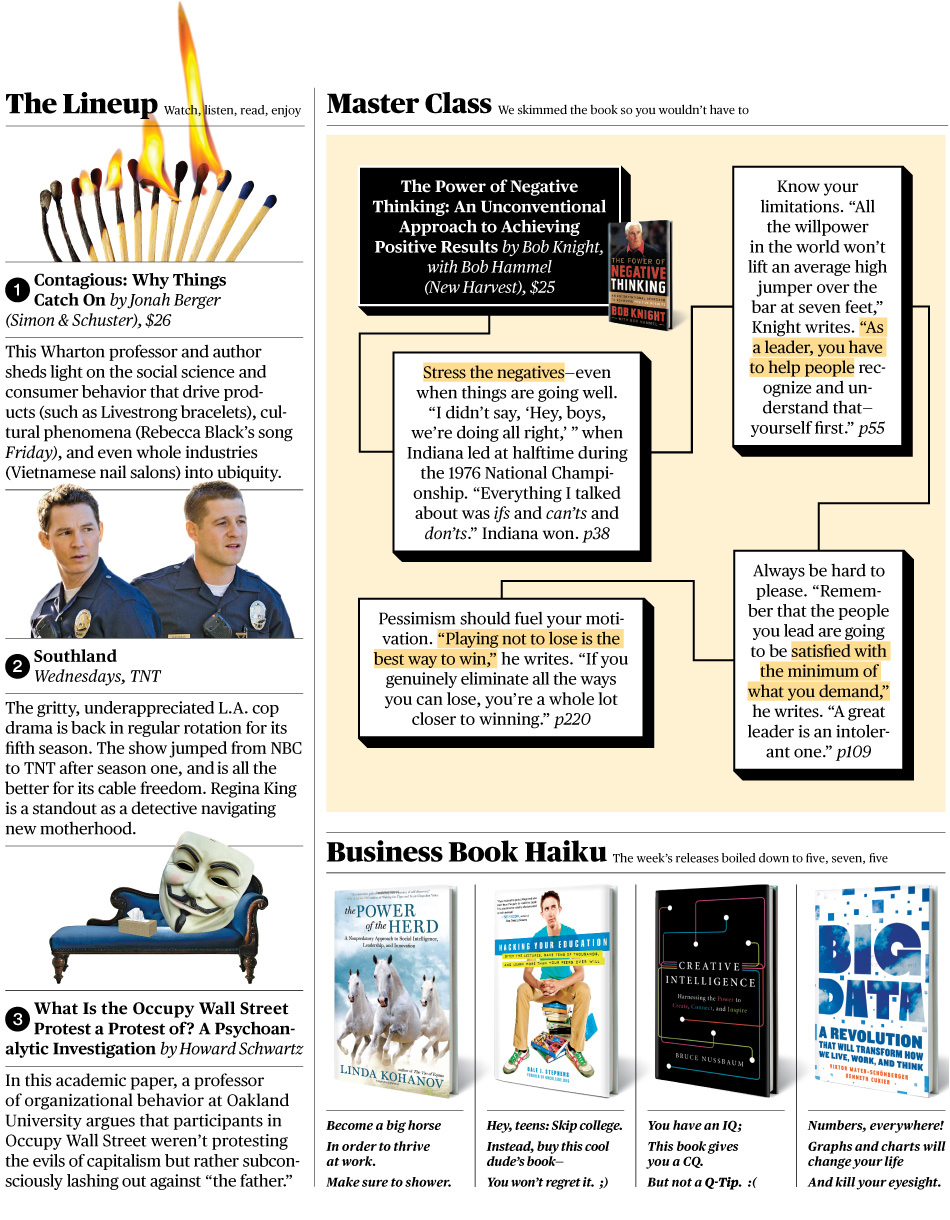
Bob Knight’s ‘The Power of Negative Thinking’ and More

etc_roundup10__01__950

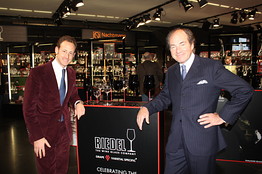
Blood and Wine: An 11th generation Riedel with his own ideas assumes the helm of the family-owned Austrian wine glass company beloved by oenophiles

February 28, 2013, 11:48 A.M. ET

Blood and Wine

This article was written by Carrie Coolidge.

It was the suit that announced a new chief executive, with his own distinct style and ideas, was taking charge at Riedel, Austria’s 1756-founded family firm that makes the fine-stem wine glasses beloved by oenophiles across the globe.

Dressed in a burgundy-colored velvet suit, the 35 year-old Maximilian J. Riedel strode purposefully through his company’s showroom in search of the Bloomingdale’s buyer who had flown to Frankfurt, Germany, to see the latest designs offered by his family’s eponymous company. At the world’s largest consumer goods fair that recently took place at Messe Frankfurt, the Riedel firm had constructed an elaborate if temporary stage to present its wine glasses and decanters to wholesale customers coming from around the world to place orders for their retail stores.

ON-BA151_Riedel_D_20130228112400

Max and Georg Riedel Read more of this post

How grandparents are being replaced by Google

How grandparents are being replaced by Google

Grandparents are being replaced by the internet as rising numbers of children ignore family advice for answers online instead, a new survey has found.

The survey of 1,500 grandparents found that children are instead increasingly using the internet to answer simple questions Photo: AFP

By Telegraph Reporters

7:30AM GMT 28 Feb 2013

Researchers found that older generations are being replaced by Google, Wikipedia and YouTube, with their grandchildren not asking them basic questions that they can look up themselves. According to the survey, fewer than one in four grandparents say they have been asked for advice on basic domestic chores such as washing clothes, learning to cook a family recipe or sewing a button. Only a third of those surveyed said they had been asked “what was it like when you were young?”. Read more of this post

In Japan, the Rising Cost of Elder Care—and Dying Alone

In Japan, the Rising Cost of Elder Care—and Dying Alone

By Kanoko Matsuyama on February 28, 2013

Itoko Uchida, 82, was counting on the nephew she raised to support her during old age. He refused, she says, forcing the Tokyo widow to pay 710,000 yen ($7,600) to a nonprofit, which will assist with her nursing home application and act in lieu of a close relative on health-care matters. Some 420,000 Japanese nationwide are waiting for a nursing home bed.

An erosion of traditional Confucian values, which stress the obligations children have to their parents, means fewer elderly are being cared for at home by relatives. By 2025, one in three citizens in Japan will be 65 or older, up from 12 percent of the population in 1990, the Organisation for Economic Co-operation and Development estimates. “The system is designed for the 1970s, when multiple generations lived together and family caregiving was thought to continue forever,” says Hiroshi Takahashi, a professor of health sciences at the International University of Health and Welfare in Otawara, north of Tokyo. “But that’s not the reality now.” Read more of this post

Buffett to Update His Acquisition Hunt; Investors Are Curious if Berkshire CEO Is Still Looking for Big Deals After Heinz

Updated February 28, 2013, 5:23 p.m. ET

Buffett to Update His Acquisition Hunt

Investors Are Curious if Berkshire CEO Is Still Looking for Big Deals After Heinz

By ANUPREETA DAS And SERENA NG

Two years ago, Warren Buffett told Berkshire Hathaway Inc. BRKB +0.94%shareholders he was on the lookout for major acquisitions, as part of his unending effort to profitably employ the buckets of cash his company collects every month.

Since then, however, the billionaire investor has fired what he called his “elephant gun” just twice. Berkshire in February said it would join with a Brazilian investment firm to buy ketchup maker H.J. Heinz Co. HNZ -0.11% for $23.4 billion. In 2011, Berkshire bought engine lubricant-maker Lubrizol Corp. for $9 billion.

MI-BU438_BERKSH_G_20130228161413MI-BU435_BERKSH_NS_20130228160603

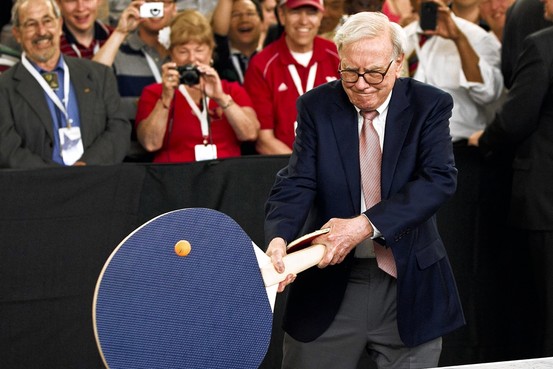
Shareholders watch as Warren Buffett, chairman and CEO of Berkshire Hathaway, deploys an oversize bat against table tennis prodigy Ariel Hsing in Omaha, Neb., in May.

The challenge of finding a big target at the right price will again be on investors’ minds when Berkshire files its annual report Friday afternoon. The report includes the shareholder letter penned by the 82-year-old Mr. Buffett, which over the years has been the source of many of the bon mots for which the Omaha, Neb., company’s chairman and chief executive is known. Read more of this post

From rags to riches to jail; Mexico’s top union leader; She was Mexico’s most powerful woman, feared by presidents and held the future of millions of school children in her hands; now facing charges of embezzling around $200 million from union coffers to fund a lavish, jet-set lifestyle

Published: Friday March 1, 2013 MYT 8:29:00 AM

From rags to riches to jail; Mexico’s top union leader

MEXICO CITY: She was Mexico’s most powerful woman, feared by presidents and held the future of millions of school children in her hands, but the head of one of Latin America’s biggest trade unions now languishes behind bars on corruption charges.

With a penchant for plastic surgery, designer purses and luxury villas, Elba Esther Gordillo, the 68-year-old leader of Mexico’s main teachers’ union, has come to embody the abuse of power by the country’s political class.

She now wears a prison uniform at Santa Martha Acatitla women’s prison on the edge of Mexico City, facing charges of embezzling around $200 million from union coffers to fund a lavish, jet-set lifestyle. Read more of this post

Buffett Betrayed by Calls Shows Nobody Safe From Leaks

Buffett Betrayed by Calls Shows Nobody Safe From Leaks

The surge in H.J. Heinz Co. options before Berkshire Hathaway Inc. (BRK/A)’s $23 billion takeover bid shows that even the world’s most successful investor isn’t immune to leaks.

Federal authorities began a criminal probe after almost 2,600 Heinz June $65 call options changed hands on Feb. 13, compared with 14 the day before, according to data compiled by Bloomberg. It was the second instance in two years of well-timed trading before billionaire Warren Buffett’s company announced an acquisition. In March 2011, call volume in Lubrizol Corp. climbed to 12 times more than puts days before Berkshire offered to buy the world’s largest producer of lubricant additives.

While Buffett is under no suspicion, the government suit shows it’s getting harder to keep secrets in mergers and acquisitions, according to Robert Pavlik, chief market strategist at Banyan Partners LLC, which oversees $1.4 billion. Regulators have probed at least a dozen cases of options trading before events such as takeover announcements since 2007, including AstraZeneca Plc (AZN)’s purchase of MedImmune Inc. and BHP Billiton Ltd. (BHP)’s bid for Potash Corp. of Saskatchewan Inc., data compiled by Bloomberg show.

“People are looking for whatever edge they can get, which includes trying to game the system,” Pavlik said in a Feb. 22 phone interview from New York. “With these kinds of big deals there are a lot of participants, and anyone with access to information has friends and family who may engage in nefarious activity simply based on an off-the-cuff remark.” Read more of this post

Desigual’s Swiss Billionaire Meyer Forms Fortune With Kissing Party

Swiss Billionaire Meyer Forms Fortune With Kissing Party

Dressed in nothing but their lingerie and boxer shorts, more than 300 shoppers lined up outside the Desigual shop in the Soho neighborhood of New York City on Sept. 23, 2010, for a free outfit.

“I got out here at 1 a.m.,” said one customer in a video posted by the company on YouTube, her driver’s license stuffed into a pink bra as bypassers snapped pictures of the crowd, who were attending a marketing event Desigual called an Undie Party.

She emerged from the store hours later, posing in a black and green jacket. Other shoppers screamed with glee as they walked away in the color-splashed designs and prints the retailer is known for.

Such promotions — and others, like kissing festivals in London, Paris and Berlin — have helped make Thomas Meyer, the 50-year-old founder and owner of the Barcelona-based fashion chain, a billionaire.

Desigual, which is Spanish for “atypical,” has tripled its annual sales in the past five years to 700 million euros ($903 million), according to Orbis, a database of company information published by Bureau van Dijk. The company sold more than 22 million garments in 2012 through 330 of its own stores and 11,200 other points of sale in more than 100 countries.

Net Worth

Meyer has a net worth of at least $1.1 billion, according to the Bloomberg Billionaires Index. He has never appeared on an international wealth ranking.

“Desigual is a very unique, fast-growing brand that is doing well globally,” David Haigh, chief executive officer of Brand Finance Plc, a London-based consultancy, said by phone. Brand Finance releases an annual report on the most valuable publicly listed fashion companies in Spain. “They are very differentiated from other fashion brands. Their garments are edgy and complex.”

The company is valued at $1.6 billion, according to the Bloomberg ranking, based on the average enterprise value-to- earnings before interest and tax, and enterprise value-to-sales multiples of two publicly traded peers: Philadelphia-based Urban Outfitters Inc. (URBN) and Cheltenham, England-based Supergroup Plc. (SGP) Enterprise value is defined as market capitalization plus total debt minus cash. Read more of this post

Michelle Obama: The Business Case for Healthier Food Options; In recent years, they have generated more than 70% of the growth in sales for packaged-goods companies

February 27, 2013, 7:29 p.m. ET

Michelle Obama: The Business Case for Healthier Food Options

In recent years, they have generated more than 70% of the growth in sales for packaged-goods companies.

By MICHELLE OBAMA

For years, America’s childhood obesity crisis was viewed as an insurmountable problem, one that was too complicated and too entrenched to ever really solve. According to the conventional wisdom, healthy food simply didn’t sell—the demand wasn’t there and higher profits were found elsewhere—so it just wasn’t worth the investment.

But thanks to businesses across the country, today we are proving the conventional wisdom wrong. Every day, great American companies are achieving greater and greater success by creating and selling healthy products. In doing so, they are showing that what’s good for kids and good for family budgets can also be good for business.

Take the example of Wal-Mart WMT -0.30% . In just the past two years, the company reports that it has cut the costs to its consumers of fruits and vegetables by $2.3 billion and reduced the amount of sugar in its products by 10%. Wal-Mart has also opened 86 new stores in underserved communities and launched a labeling program that helps customers spot healthy items on the shelf. And today, the company is not only seeing increased sales of fresh produce, but also building better relationships with its customers and stronger connections to the communities it serves. Read more of this post

Signatures Of Famous CEOs, And The Secrets They Reveal

Would be great if the signature analysis can be extended to outstanding CEOs and leaders who are not commonly featured in a high-profile way since preconceived notions and pre-“knowledge” about their “character” can be gathered..  KB

Signatures Of Famous CEOs, And The Secrets They Reveal

Jay Yarow | Feb. 27, 2013, 9:00 PM | 43,613 | 3

We asked a handwriting analyst to look at the signatures of some big-name technology executives and tell us what they say about their personalities.

Sheila Lowe, president of the American Handwriting Analysis Foundation, provided a blurb for us on Jeff BezosSteve Ballmer, and many more.

In researching this story, another handwriting analyst said Lowe is “great” at analysis. Lowe’s group, the AHAF, is trying to get cursive back in school curricula.

Lowe cautioned that it’s difficult to truly read a person’s character based just on their signature. You need some handwriting samples.

“A signature by itself gives only a limited amount of information (it’s like looking at a photo of someone’s nose and trying to describe their whole face),” Lowe told us over email. “The signature is like the cover on a book, and doesn’t always jibe with what’s inside. It’s what the person wants you to know about them.”

Since these people are in tech, we’re guessing it’s been years since any of them hand-wrote notes. As a result we have to use signatures we’ve found through various online sources.

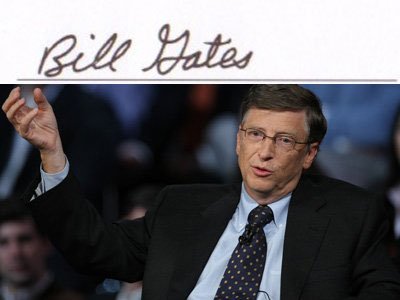
With Bill Gates, Microsoft’s chairman, what you see is what you get
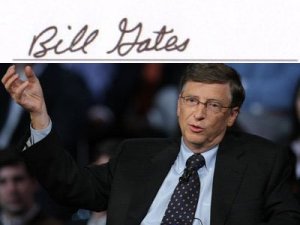
with-bill-gates-microsofts-chairman-what-you-see-is-what-you-get

Lowe: “Bill Gates takes the time to write a clear, clean, unpretentious signature that says, ‘What you see is what you get.’ There are signs of quick thinking, but the round dot over the ‘i’ says he’s patient with details. He’s willing to take the time to listen.”

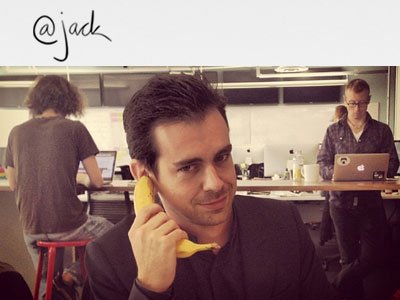
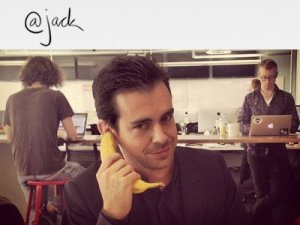
Jack Dorsey, founder of Twitter and CEO of Square’s, “@” signature is about saying “who I am is what I do”
jack-dorsey-founder-of-twitter-and-ceo-of-squares--signature-is-about-saying-who-i-am-is-what-i-do

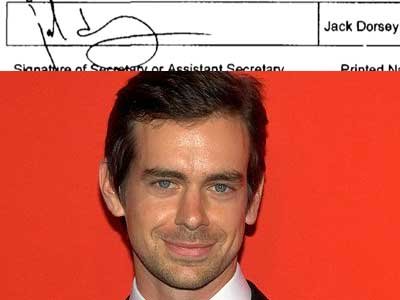
Jack Dorsey has two signatures we’ve seen online. This one plays on his Twitter founding.

Lowe’s take on this: “Jack Dorsey’s extremely simplified signature drops his last name and with the @ symbol, identifies him with what he does (‘who I am is what I do’). The k ends with a downward trail. If that’s how he normally signs, it may signify a desire to continually look back at the past and figure out how to benefit from his experiences, or to figure out how he got where he is now.”

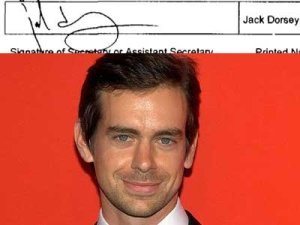
Jack Dorsey’s more formal signature shows he’s a bottom line kind of guy
jack-dorseys-more-formal-signature-shows-hes-a-bottom-line-kind-of-guy

Here’s another Dorsey signature we found that’s more formal. Says Lowe, “This is more his public persona. This one is a logo-type signature, which happens to be easy to forge in its lack of complexity. It’s another case of illegibility that allows the writer to hide anything he doesn’t want the world to see. He’s a bottom line kind of guy, impatient and with that strong ending stroke, aggressive.”

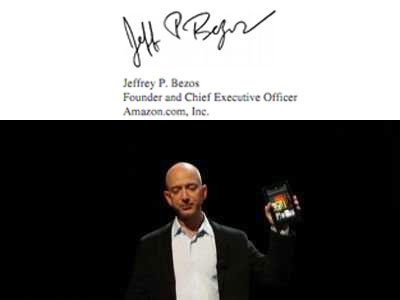
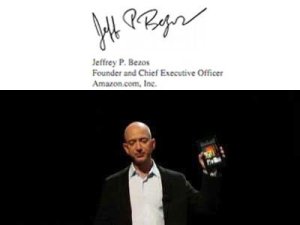
Amazon CEO Jeff Bezos is not as outgoing as he would have us believe
amazon-ceo-jeff-bezos-is-not-as-outgoing-as-he-would-have-us-believe

Lowe: “Jeff Bezos’ first name leans left before moving rightward with his last name, which is not completely legible and ends in a dynamic movement upward. Despite the fact that he might have a lot to say (notice the open “o” in his last name), he’s not as outgoing as he would like us to think he is, but we would need to see more handwriting to figure out why. That final stroke is somewhat aggressive and acts as a wall to keep others out.”

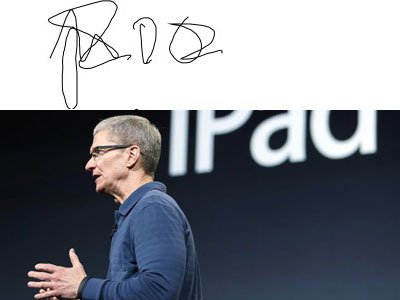
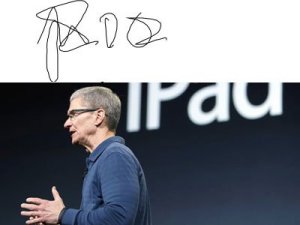
Apple CEO Tim Cook’s sloppy signature says he doesn’t want us to know much about him
apple-ceo-tim-cooks-sloppy-signature-says-he-doesnt-want-us-to-know-much-about-him

Tim Cook also has two signatures online. This one is his sloppier signature. Says Lowe of this one, “Tim Cook has a signature that resembles some sort of alien hieroglyphic. Since a signature is written for the purpose of communicating who you are, we can assume that Tim doesn’t want us to know much about him. What we can see, however, is that his mind is moving faster than he can write. He gets to the bottom line at warp speed and isn’t interested in hearing all the mundane details. If you come to him with a plan, make sure you’ve done your homework.”

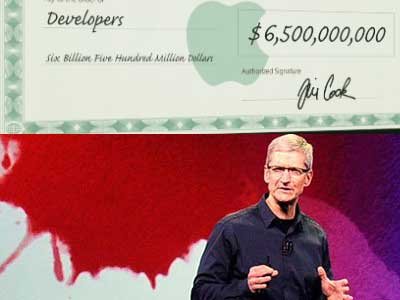
Tim Cook also has a cleaner signature, which indicates family pride
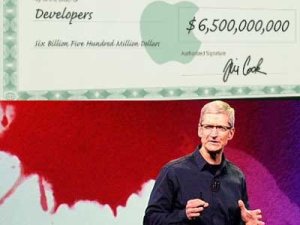
tim-cook-also-has-a-cleaner-signature-which-indicates-family-pride

We also found this Cook signature, which was on a check for developers. Says Lowe of this one, “He probably felt the need to be clearer, knowing his signature would be seen on this rather large check, so took more time with it. We don’t know which is his “normal” signature—probably the other one. This one has a very large ‘C’ in the last name—his father’s name—so there’s respect or regard for his family of origin.”

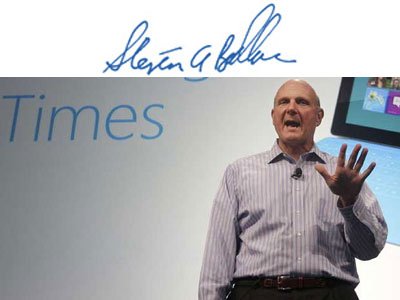
Microsoft CEO Steve Ballmer sets his own standards and doesn’t care what others think
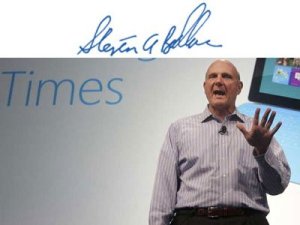
microsoft-ceo-steve-ballmer-sets-his-own-standards-and-doesnt-care-what-others-think

Lowe: “Steve Ballmer’s signature is interesting for a couple of reasons. First, he crosses the ‘t’ in Stephen far to the right, indicating forward-looking enthusiasm. Second, the ll in Ballmer has a rather strange shape that reaches into the stratosphere and make me wonder if he’s a pilot. We see this type of formation in people who have a great deal of pride in their accomplishments. He wants to be seen as an intellectual, which may lead him to make things sound a lot more complicated than they really are. He sets his own standards and has less interest in what others think.”

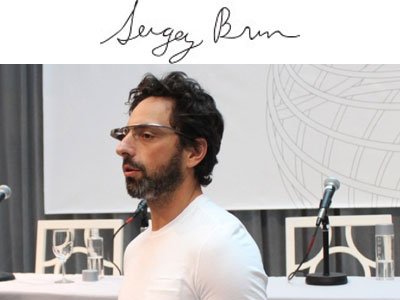
Google co-founder Sergey Brin’s signature suggests he wants to be known as Sergey, not Mr. Brin
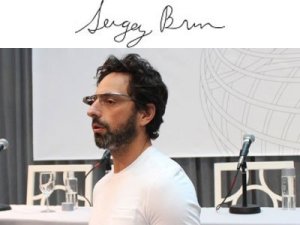
google-co-founder-sergey-brins-signature-suggests-he-wants-to-be-known-as-sergey-not-mr-brin

Lowe: “Sergey Brin’s somewhat sloppy signature is at least readable. He wrote it quickly, not paying much attention to the details—there’s no dot over his i. He has a sociable, casual approach, and with the capital S being taller than the capital B, he would rather be seen as ‘Sergey,’ than ‘Mr. Brin.'”

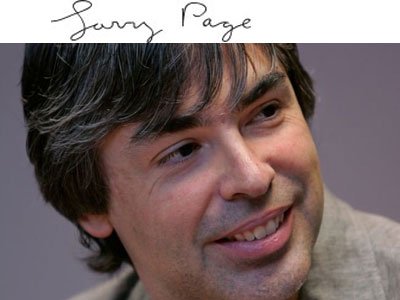
Google CEO Larry Page is a good listener
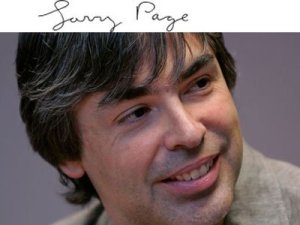
google-ceo-larry-page-is-a-good-listener

Lowe: “Larry Page just throws his clear signature down on the paper and doesn’t care what others think. The vowel letters are wide open, which suggests he is a good listener. However, the wide space between first and last name indicates the need for a wide berth of personal space. Don’t stand too close when you speak to him.”

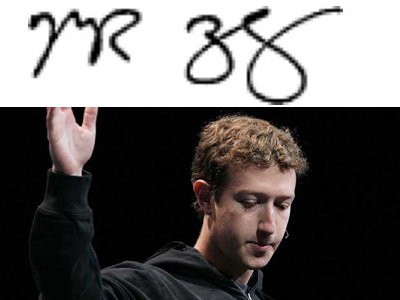
Facebook CEO and founder Mark Zuckerberg is pretty secretive
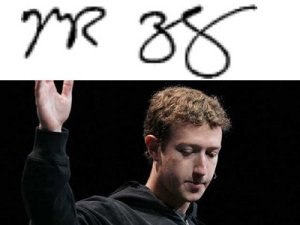
facebook-ceo-and-founder-mark-zuckerberg-is-pretty-secretive

Lowe: “Mark Zuckerberg apparently doesn’t feel the need to share more than just his initials. True, it’s a long name to write, but anyone not knowing what the name says, would find it impossible to guess. He is definitely the man behind the curtain, pulling the strings in the background.”

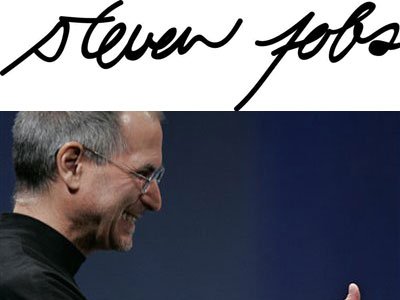
Once Apple’s co-founder Steve Jobs started going, there was no stopping him
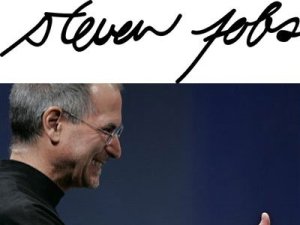
once-apples-co-founder-steve-jobs-started-going-there-was-no-stopping-him

Lowe: “Steve Jobs wrote with a thick marker pen (like his black turtlenecks) and didn’t capitalize his signature. This points to humility, at least in the way he felt about himself, if not his work. The low upper loop indicate someone down to earth, whose focus was on the here and now. The t cross stays mostly to the left of the downstroke, and apart from the capitals, there are no breaks between the letters. He might have needed a second cup of coffee to really get going, but once he did, he was a steamroller who never stopped until he had finished what he started.”
Many women were appalled at the Yahoo news, noting that Mayer, with her penthouse atop the San Francisco Four Seasons, her Oscar de la Rentas and her $117 million five-year contract, seems oblivious to the fact that for many of her less-privileged sisters with young children, telecommuting is a lifeline to a manageable life.

February 26, 2013

Get Off of Your Cloud

By MAUREEN DOWD

When Marissa Mayer became queen of the Yahoos last summer, she was hailed as a role model for women. The 37-year-old supergeek with the supermodel looks was the youngest Fortune 500 chief executive. And she was in the third trimester of her first pregnancy. Many women were thrilled at the thought that biases against hiring women who were expecting, or planning to be, might be melting.

A couple months later, it gave her female fans pause when the Yahoo C.E.O. took a mere two-week maternity pause. She built a nursery next to her office at her own expense, to make working almost straight through easier. The fear that this might set an impossible standard for other women — especially women who had consigned “having it all” to unicorn status — reverberated. Even the German family minister, Kristina Schröder, chimed in: “I regard it with major concern when prominent women give the public impression that maternity leave is something that is not important.” Almost two months after her son, Macallister, was born, Mayer irritated some women again when she bubbled at a Fortune event that “the baby’s been way easier than everyone made it out to be.” “Putting ‘baby’ and ‘easy’ in the same sentence turns you into one of those mothers we don’t like very much,” Lisa Belkin chided in The Huffington Post. Now Mayer has caused another fem-quake with a decision that has a special significance to working mothers. She has banned Yahoos, as her employees are known, from working at home (which some of us call “working” at home). It flies in the face of tech companies’ success in creating a cloud office rather than a conventional one. Mayer’s friend Sheryl Sandberg of Facebook wrote in her new feminist manifesto, “Lean In: Women, Work, and the Will to Lead,” that technology could revolutionize women’s lives by “changing the emphasis on strict office hours since so much work can be conducted online.” She added that “the traditional practice of judging employees by face time rather than results unfortunately persists” when it would be more efficient to focus on results.

Many women were appalled at the Yahoo news, noting that Mayer, with her penthouse atop the San Francisco Four Seasons, her Oscar de la Rentas and her $117 million five-year contract, seems oblivious to the fact that for many of her less-privileged sisters with young children, telecommuting is a lifeline to a manageable life.

The dictatorial decree to work “side by side” had some dubbing Mayer not “the Steinem of Silicon Valley” but “the Stalin of Silicon Valley.”

Mayer and Sandberg are in an elite cocoon and in USA Today, Joanne Bamberger fretted that they are “setting back the cause of working mothers.” She wrote that Sandberg’s exhortation for “women to pull themselves up by the Louboutin straps” is damaging, as is “Mayer’s office-only work proclamation that sends us back to the pre-Internet era of power suits with floppy bow ties.”

Men accustomed to telecommuting were miffed, too. Richard Branson tweeted: “Give people the freedom of where to work & they will excel.” Read more of this post

Buffett once said that shunning dividends in his early years running Berkshire Hathaway allowed him to refocus the company on better businesses, much as a person would overcome “a misspent youth.”

Buffett Outlining Dividend Plan May Ease Successor’s Path

Warren Buffett once said that shunning dividends in his early years running Berkshire Hathaway Inc. (BRK/A) allowed him to refocus the company on better businesses, much as a person would overcome “a misspent youth.”

The 82-year-old billionaire is now focused on his legacy as he prepares the company he’s overseen for almost five decades for new management. Using his annual letter tomorrow to outline a dividend strategy could help explain to shareholders how the company’s next leaders should approach the challenge of allocating profits.

“It may ease the burden on the successors” if they are able to initiate a dividend, said Richard Cook, co-manager of the Cook & Bynum Fund (COBYX), which counts Berkshire among its largest holdings. Berkshire and its units “generate a lot of cash.”

Buffett has sought to teach shareholders about business, investing and corporate governance through the annual letters and meetings held in Omaha, Nebraska, where Berkshire is based. As the company grew with investment gains and acquisitions, so did its cash pile, which reached $47.8 billion at the end of September. That’s made the task of allocating the funds more difficult, because it’s hard to find worthwhile, large investments, Buffett has said. Read more of this post

God a Click Away as Web Courses Fuel Falwell’s College

God a Click Away as Web Courses Fuel Falwell’s College

Three times a week almost 13,000 students at Liberty University assemble for an hour of singing and speeches, evoking the spirit of a revival meeting that also attracts Republican politicians and Christian celebrities such as New York Jets quarterback Tim Tebow. The collegians make up just 14 percent of the student body. The Lynchburg, Virginia-based school founded by Baptist minister Jerry Falwell in 1971 has an additional 82,500 online students, more than twice as many as three years ago, making Liberty the largest, private nonprofit university in the U.S. “When I look at those numbers it still boggles my mind,” said Jerry Falwell Jr., a soft-spoken lawyer who took over the institution after his father died in 2007.

Nonprofit private and state schools alike are discovering what for-profit colleges such as Apollo Group Inc. (APOL)’s University of Phoenix and Washington Post Co. (WPO)’s Kaplan University figured out more than a decade ago. Faced with a swelling number of overleveraged student borrowers, cuts in public subsidies and paltry endowment investment returns, they are embracing the Internet as a viable alternative to educating students. Read more of this post

In-N-Out Burger Employees Can Work Their Way Up To $120,000 A Year With No Degree Or Previous Experience

In-N-Out Employees Can Work Their Way Up To $120,000 A Year With No Degree Or Previous Experience

Ashley Lutz | Feb. 27, 2013, 11:49 AM | 2,624 | 4

In-And-Out Burger prides itself on being a better fast food chain.

Employees start at a higher-than-average salary and even have the opportunity to advance to make $120,000, according to a recent report from the Orange County Register.

The median pay for food service managers across restaurants nationwide is about $48,000 per year.  Read more of this post

How to Be Mindful in an ‘Unmanageable’ World

How to Be Mindful in an ‘Unmanageable’ World

by Tony Schwartz  |   2:00 PM February 27, 2013

“I believe this is a very special moment in history, a kind of perfect storm. There is a growing recognition — to borrow language from AA — that our world has become unmanageable.” Those words have been reverberating in my head ever since Arianna Huffington, founder of the Huffington Post, said them over the weekend during the Wisdom 2.0 conference in San Francisco. She wasintroducing an iPhone app called “GPS for the Soul,” which is designed to measure heart rate variability as a window into your stress level at any given moment during the day.

It seemed fitting to me that Arianna described the challenges so many of us face in our work — and in our lives more broadly — by using the language of addiction. Her words rang especially true because I happen in the midst of reading a book by Bryan Robinson titled “Chained to the Desk: A Guidebook for Workaholics.”

The addiction of our times is digital connection, instant gratification, and the cheap adrenalin high of constant busyness. The heartening news is that more and more leaders in big companies are beginning to recognize the insidious costs of moving so relentlessly and at such high speeds. Read more of this post

Bosses are reining in staff because they can; The lesson from Marissa Mayer’s whip-cracking at Yahoo is that this is an age of harder work

February 27, 2013 7:59 pm

Bosses are reining in staff because they can

By John Gapper

The lesson from Marissa Mayer’s whip-cracking at Yahoo is that this is an age of harder work

Marissa Mayer, Yahoo’s new chief executive, has caused consternation by insisting that employees who have worked from home must in future come to the office. Her critics have pointed out that home workers are as productive, if not more so, as those in cubicles.

They are, however, missing the point. Ms Mayer is mostly doing this as a rough and ready way to reform Yahoo’s notoriously dysfunctional and disorganised culture. She is also doing it because she can.

The lesson to draw from Ms Mayer’s whip-cracking – in Silicon Valley, of all places – is that this is an age of harder work. From intense teamwork at the top to monitoring and surveillance at the bottom, managers are squeezing more from employees than they previously would have dared. Read more of this post

Billionaire inventor James Dyson: Why we invent in Britain, but build in Singapore

Why we invent in Britain, but build in Singapore

James Dyson

Published at 12:01AM, February 26 2013

Singapore offers skills, location and a supply chain. The UK’s future lies in ideas and patents

For the past 15 years, Dyson’s highly-skilled engineers have been developing a tiny revolution in our laboratories. It is a new motor a third the size of a traditional one, but which can spin 100,000 times a minute — five times faster than a Formula One engine. Making 6,000 adjustments a second for optimal performance, the Dyson digital motor can supercharge prosaic machines.

At Dyson we invest heavily in our ideas and develop all of our technology in Britain: All our research takes place in Malmesbury where we employ 850 world-class design engineers and scientists — about a third of them recent graduates.

Our new motor performs like no other — and because we are developing it in our own laboratories, with our own people, no one else can get their hands on it (despite trying!).

This is not only good for Dyson, but also for Britain. The intellectual property is owned here and all the profits will flow back to the United Kingdom where we pay more than 85 per cent of our global tax.

But last week, Dyson opened a new £150 million (S$281.4 million) motor manufacturing facility in Singapore. Why?

Savvy governments understand the need to support advances like our new motor and to create incentives for companies to develop them. They also value the highly skilled workforce able to develop them — 40 per cent of graduates are engineers, versus 2 per cent in Britain. They realise that the more successful the company, the more they export, bringing more revenue into the country and employing more people.

And the potential for discovery at the moment is enormous, particularly in the sphere of materials. There are significant gains to be made from materials such as carbon 60 and graphene, which was discovered in Manchester. This is 40 times stronger than steel and 1,000 times more conductive than silicon.

Thankfully, Britain is moving in the right direction and there is a renewed desire to develop technology on its shores.

Prime Minister David Cameron has increased the research and development tax credit — which supports companies that take risks and invest in developing ideas for the future — to 225 per cent. As a result, patent applications rose 29 per cent in 2011 and investors have reacted positively.

But Britain still has a shortage of engineers — it has a 60,000 engineering deficit. Who will develop the ideas?

IDEAS AS TRUMP CARDS

Britain is not the only country that is creating incentives for invention — and companies such as ours are in global competition. Singapore understands this and rewards investment in research and development with a thumping 400 per cent tax credit. The country supports and values inventiveness and backs it up with an education system that encourages ingenuity — they have plenty of world-class engineers.

Bereft of natural resources, Singapore realises that human resources and ideas are its trump cards.

The result is a buoyant economy, with highly inventive companies such as Rolls-Royce knocking at its door.

Building a complex motor such as the one that Dyson is developing, with minute tolerances, requires the precision of a fully automated production line. The highly-skilled workforce, the tax incentives and the nearby supply chain make Singapore appealing for us.

We will make six million motors this year; increasing our production capacity by 100 per cent — a necessary jump to meet rising demand, particularly from Japan and America. We source the motor’s 22 components from across Asia, so it makes little sense to ship them to Britain, only to export the finished motors back again. So Singapore is the obvious place for production.

Britain’s focus should be on generating ideas and patenting them — that is the high-value part of the process and the one that will earn this country a competitive advantage. Britons must focus on being the best problem solvers in the world, developing technology and then exporting it.

And for this Britain needs high quality engineers, backed up by supportive government incentives. The country has the foundations in place — but continuing government support, both through the education system and tax system, is essential.

Sir James Dyson is the founder of Dyson, the technology company. This commentary first appeared in British daily The Times.

Ancient King’s Hat Holds Clues To Korean Alphabet

Ancient King’s Hat Holds Clues To Korean Alphabet

Agence France Presse | Feb. 27, 2013, 6:18 AM | 937 | 1

korean-king-sejong

Park Ji-Hwan/AFP

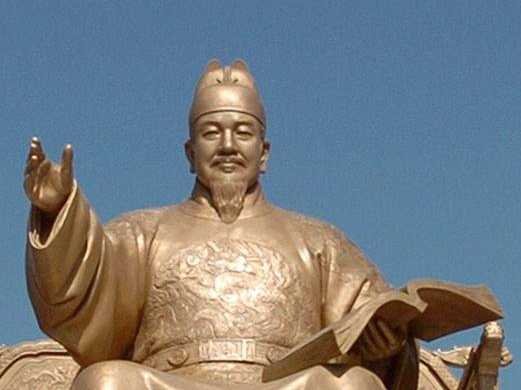
A hat which belonged to South Korea’s most revered monarch King Sejong has been recovered more than 500 years after it was looted by Japanese invaders, a senior scholar said Wednesday.

Apart from its intrinsic value as an historical relic, the discovery has thrilled scholars after documents were found stitched inside the hat carrying explanations of King Sejong’s greatest legacy — the Hangeul alphabet.

The monarch known as Sejong the Great ruled from 1418-1450. His reign had a profound impact on Korean history with the introduction of the Hangeul phonetic alphabet that replaced classical Chinese characters.

Hangeul vastly increased literacy — previously restricted to the top scholarly class — and remains the official script of both South and North Korea. Read more of this post

Japanese Robot Suit Approved For Worldwide Rollout

Japanese Robot Suit Approved For Worldwide Rollout

Agence France Presse | Feb. 27, 2013, 7:35 AM | 2,355 | 3

japan-robot-suitjapan-robot-suit-1 (1)

photo_1361955397250-1-0

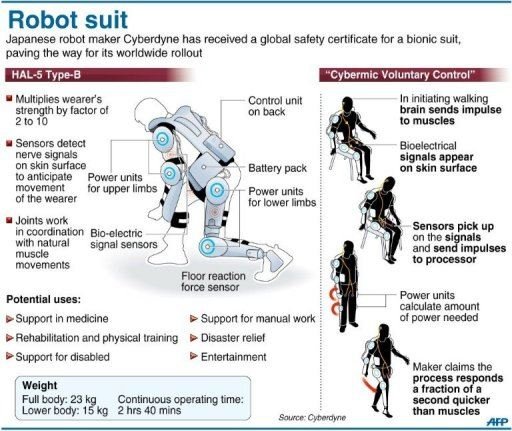
A robot suit that can help the elderly or disabled get around was given its global safety certificate in Japan on Wednesday, paving the way for its worldwide rollout. Read more of this post

Want to Change the World? Be Resilient.

Want to Change the World? Be Resilient.

by John McKinley  |   1:00 PM February 26, 2013

What’s the difference between someone with a good idea and a person who can transform their ideas into real impact? To tackle the world’s biggest problems, we need to be able to identify and support the people who are capable of creating lasting change. At Acumen Fund, we spend a lot of time trying to find and train aspiring and established leaders from around the world who have the right mix of talent, ideas, and passion.

And what we’ve found time and again is: Resilience matters most.

Resilient leaders have three key characteristics:

  1. Grit: Short-term focus on tasks at hand, a willingness to slog through broken systems with limited resources, and pragmatic problem-solving skills.
  2. Courage: Action in the face of fear and embracing the unknown.
  3. Commitment: Long-term optimism and focus on big-picture goals.

Read more of this post

Is traditional leadership on its way out? Today leadership is about Creativeship, which he defines as “the creation of sustainable cultures and business models.”

Is traditional leadership on its way out?

Ray Williams | Feb 26, 2013 5:47 PM ET
In an earlier article in the Financial Post, I argued “If management is so good at predicting outcomes through analytical and scientific methods why have so few public companies performed well?” The leadership of today’s business institutions has increasingly been put under the microscope.

“Companies that are managed the traditional way — by executives developing analytically driven strategy and shaping the organization to meet the needs of the business as they see them — are obsolete. Management as we have known it, is too cumbersome,” argues Thomas Hout in an article in the Harvard Business Review.  That sentiment is also held by Alan Murray, who in an article in the Wall Street Journalwrites that management, as an innovation, won’t survive the 21st century.

Barbara Kellerman, author of The End of Leadership, contends that the leadership industry is a $50 billion a year business, that has been unable to produce true leaders and in essence, failed. Kellerman argues while leaders once dominated and controlled followers, now followers are more educated and independent, and leaders must now rely on influence and persuasion.

Bob Kelleher, author of Creativeship: A Novel for Evolving Leaders contends the definition of leadership as “the ability to lead people, build fellowship and make money” is archaic and so “yesterday.” Read more of this post

Getting Cities Right

Mahmoud Mohieldin, Zoubida Allaoua

Getting Cities Right

26 February 2013

WASHINGTON, DC – The developing world is experiencing rapid urbanization, with the number of city dwellers set to reach four billion in 2030 – double its 2000 level. But unplanned and uncoordinated urban development is risky, threatening to replace migrants’ hopes for a better life with unsanitary living conditions, joblessness, and high exposure to natural disasters.

In many respects, urbanization is rational. After all, cities are the hubs of prosperity, where more than 80% of global economic activity is concentrated. And their density facilitates the delivery of public services, including education, health care, and basic services. Indeed, it costs $0.70-0.80 per cubic meter to provide piped water in urban areas, compared to $2 in sparsely populated areas.

But the high concentration of assets and people, especially in coastal areas, is an economic liability, with around $3 trillion in assets at risk from natural hazards. Vulnerability will increase further over the next two decades, as cities triple their built-up land, to 600,000 square kilometers, often without basic infrastructure or policies to prevent construction and settlement on disaster-prone and vulnerable sites.

To get urbanization right, policymakers must take urgent action to build sustainable cities. Read more of this post

Will Programmers Rule?

Raghuram Rajan, Professor of Finance at the University of Chicago Booth School of Business and the chief economic adviser in India’s finance ministry, served as the International Monetary Fund’s youngest-ever chief economist and was Chairman of India’s Committee on Financial Sector Reforms. He is the author ofFault Lines: How Hidden Fractures Still Threaten the World Economy.

Will Programmers Rule?

26 February 2013

NEW DELHI – Marc Andreessen made his first fortune writing the code that became Netscape Navigator, the Internet browser. He is now a venture capitalist who evangelizes about the growing importance of software in business today. Indeed, he proclaims that software is taking over the world – that it will be the primary source of added value – and offers the following prediction: the global economy will one day be divided between people who tell computers what to do and people who are told by computers what to do.

Andreessen’s aim is to shock his listeners – not just for effect, but to get them to do something about it. To stop the world from being divided between a few alpha programmers and many drones, he wants the potential drones to stop taking easy liberal arts courses in college. Instead, he wants them to focus on courses in science, technology, engineering, and math (STEM), where the good jobs will be. But will this solve the problem that he poses?

Perhaps not. Two attributes of software creation allow a few talented programmers to corner the market and take all the associated profits. Read more of this post

Finding the Just-Right Level of Self-Esteem for a Child

Updated February 26, 2013, 7:35 p.m. ET

Finding the Just-Right Level of Self-Esteem for a Child

By SUE SHELLENBARGER

Is high self-esteem the key ingredient to your child’s success? New research reveals heaping on the praise doesn’t necessary lead to happiness down the road. WSJ Work & Family columnist Sue Shellenbarger, and parents Jason and Cara Greene, join Lunch Break to discuss. Photo: Jason Greene.

A wave of recent research has pointed to the risks of overpraising a child. But for parents, drawing the line between too little praise and too much has become a high-pressure balancing act.

Cara Greene, a mother of three children ages 1 to 8, is wary of deliberately pumping up her kids’ egos, for fear of instilling the sense of entitlement she sees in young adults “who have been told they’re wonderful and they can do anything.” But she also wants them to have healthy self-esteem. Read more of this post

The Most Ridiculous Service Fees … for Now

The Most Ridiculous Service Fees … for Now

By Eric Spitznagel on February 21, 2013

Exorbitant corkage fees at restaurants are only the beginning. A look at some of the most preposterous service charges in recent memory.

etc_upcharge09__01__950

Two Cows: The Infographic to provide everything you need to know about ecomoomics.

Two Cows: The Infographic

Tyler Durden on 02/26/2013 14:01 -0500

There are many complexities in the socio-economic structures that the nations (and corporations) of the world have used (and abused) over the years. Volumes have been written to explain the intricacies of Capitalism, Fascism, Communism, and Socialism; and how these impact various corporations from Iran to Greece to Australia. However, in the interest of brevity, the following infographic – utilizing nothing more than two cows (which perhaps should now be horses, considering their inflationary displacement capacity for firms like IKEA and Nestle) to provide everything you need to know about ecomoomics.

6653870_700b

Watch Zuck, Bill Gates, Jack Dorsey, & Others In Short Film To Inspire Kids To Learn How To Code

Watch Zuck, Bill Gates, Jack Dorsey, & Others In Short Film To Inspire Kids To Learn How To Code

COLLEEN TAYLOR

posted 2 hours ago

Code.org, the new non-profit aimed at encouraging computer science education launched last month by entrepreneur and investor brothers Ali and Hadi Partovi, has assembled an all-star group of the world’s most well-known and successful folks with programming skills to talk about how learning to code has changed their lives — and isn’t quite as hard as people might think.

As you can see in the five minute clip embedded above, the short film (nine minutes in its full length version) which was directed by Lesley Chilcott, known as the producer of Waiting for Supermanand An Inconvenient Truth, is a who’s who featuring Mark ZuckerbergBill GatesJack Dorsey,Drew HoustonTony Hsieh, Miami Heat player Chris Bosh (he studied computer imaging at Georgia Tech before joining the NBA), and many more. It’s a very human look at what can certainly seem to many as a dry or intimidating subject, and it’s really a pleasure to watch. Read more of this post