CVS’s Lesson: Carpe Diem

CVS’s Lesson: Carpe Diem

by Paul A. Argenti  |   2:12 PM February 7, 2014

When CVS/Caremark announced that it would forego some $2 billion in sales of tobacco and related products recently, CEO Larry J. Merlo stated that: “We came to the decision that providing health care and selling cigarettes just don’t go together in the same setting.” What he did not say, however, is how that laser-like focus on the company’s strategy also turned reputational risk into an opportunity. CVS is now one of a small group of companies that have realized that their reputation is the most valuable asset they have and that building a stronger reputation by avoiding risks to that reputation can create a significant competitive advantage. Let’s look at how these companies are protecting their reputation and brands while enhancing and realizing strategic value from them. Read more of this post


‘It is raw, it is surprising’: How McDonald’s gross McNugget video is becoming the new marketing standard

‘It is raw, it is surprising’: How McDonald’s gross McNugget video is becoming the new marketing standard

Armina Ligaya | February 8, 2014 7:30 AM ET
image001-20

http://www.youtube.com/watch?v=hF0BwSul2Es

A stark glimpse at how chicken parts, skin and seasonings ground in an industrial-sized steel blender into a pulpy, beige goop eventually become McNuggets has been dubbed marketing genius — but it certainly wasn’t pretty. Read more of this post

Imbalances in hormones causing aging; , we can theoretically get young if we can make the telomere recover by applying growth hormones

2014-02-07 17:44

Imbalances in hormones causing aging
image001-18According to the doctor who specializes in anti-aging, there are around 11 theories on why people get old. Among them, telomere theory, antioxidant theory, neuro-endocrinology, and calorie restriction theory are the ones most actively studied.By Yoon Ja-young
Dreaming of living to be 120 may no longer just be that with the development of medicine and a generally healthier populace. What matters more is how to age healthy. Dr. Lucia Chung, who runs Palm Springs Seoul Clinic in Cheongdam-dong, a branch clinic of the Palm Springs Life Extension Institute in the United States, says anti-aging treatments aim at enabling a healthy life after retirement by restoring balance within our body. Read more of this post

Would You Lie for Me? If we do not recognize the extent to which our suggestions and actions are likely to affect others’ behavior, we may be careless about the things we say and do. We may fail to speak up for what we think is right

Would You Lie for Me?

FEB. 7, 2014

By VANESSA K. BOHNS

WHAT is the chance that you could get someone to lie for you? What about vandalizing public property at your suggestion?

Most of us assume that others would go along with such schemes only if, on some level, they felt comfortable doing so. If not, they’d simply say “no,” right? Read more of this post

Blazing Trails in Brain Science: Dr. Thomas R. Insel’s twisted path to his role as director of the National Institute of Mental Health is a tour of where psychiatric science has been, where it’s going and why

Blazing Trails in Brain Science

By BENEDICT CAREYFEB. 3, 2014

image001-16

Launch media viewer

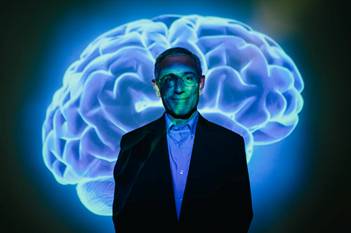
Dr. Thomas R. Insel is the longest-serving director of the National Institute of Mental Health since its founder left. Lexey Swall for The New York Times

BETHESDA, Md. — The police arrived at the house just after breakfast, dressed in full riot gear, and set up a perimeter at the front and back. Not long after, animal rights marchers began filling the street: scores of people, young and old, yelling accusations of murder and abuse, invoking Hitler, as neighbors stepped out onto their porches and stared. Read more of this post

Master of the Markets: Architect of Intercontinental Exchange, Sprecher conquered Wall Street and the world with a sprawlng empire of trading exchanges and clearing firms.

SATURDAY, FEBRUARY 8, 2014

Master of the Markets

By STEVEN M. SEARS | MORE ARTICLES BY AUTHOR

Architect of Intercontinental Exchange, Sprecher conquered Wall Street and the world with a sprawlng empire of trading exchanges and clearing firms.

If Jeffrey Sprecher had built something that captured the public’s imagination, he might be as famous today as Steve Jobs. Like Apple’s late, visionary leader, Sprecher revolutionized a major industry, creating great wealth in the process. But because derivatives exchanges like the Intercontinental Exchange, or ICE, which he founded and runs, fascinate few people outside of the financial markets, Sprecher is largely unknown beyond Wall Street. Indeed, he was unknown to many on Wall Street until ICE, which is based in Atlanta, bought NYSE Euronext, parent of the New York Stock Exchange, last year. Read more of this post

Lessons Learned at Harvard: Slammed in the financial crisis, the university’s endowment has been tweaked, in part to add liquidity

SATURDAY, FEBRUARY 8, 2014

Lessons Learned at Harvard

By ANDREW BARY | MORE ARTICLES BY AUTHOR

Slammed in the financial crisis, the university’s endowment has been tweaked, in part to add liquidity.

image001-14

Jane Mendillo has one of the most prominent jobs in the investment world. As the CEO of Harvard Management, she oversees the $32.7 billion Harvard endowment, the largest university endowment in the country. Read more of this post

This Obscure Gas Improves Athletes’ Performance — And It’s Legal For Now

This Obscure Gas Improves Athletes’ Performance — And It’s Legal For Now

THE ECONOMIST

FEB. 7, 2014, 4:57 AM 4,190

XENON is one of the shyest members of the periodic table of the elements. Chemically, it is almost inert, and physically, it makes up only 0.000009% of the atmosphere, so it is not surprising that it was among the last of the naturally occurring elements to be identified, in 1898. Biologically, however, it is not shy at all. In some countries, notably Russia, it is used as an anaesthetic. It is also known to protect body tissues from the effects of low temperatures, lack of oxygen and even physical trauma. In particular, it increases levels of erythropoietin, also known as EPO, a hormone that encourages the formation of red blood cells. Read more of this post

How To Come Up With A Breakthrough Idea

How To Come Up With A Breakthrough Idea

GEOFFREY JAMESINC.
FEB. 7, 2014, 6:01 PM 1,359

You’re stuck. Really stuck.

Scenario 1: You’ve encountered a problem at work, but all your usual tactics can’t solve it. You sense you need a more creative approach, but your imagination isn’t delivering the goods. What now? Read more of this post

25 Horrible Things That Happen If You Don’t Get Enough Sleep

25 Horrible Things That Happen If You Don’t Get Enough Sleep

LAUREN F FRIEDMAN

FEB. 7, 2014, 12:24 PM 123,817 7

In our 24/7 culture, sleep loss is a major problem. Back in 1942, we averaged almost 8 hours of sleep a night — now that’s down to 6.8. (Seven to 9 hours per night are what’s generally recommended.)

Almost 40% of Americans get less than 7 hours of sleep a night, a recent Gallup poll found, and an estimated 70 million Americans have a sleep disorderRead more of this post

Jeremy Grantham’s Investment Lessons Learned From “Mistakes Made Over 47 Years” – Chapter 1

Jeremy Grantham’s Investment Lessons Learned From “Mistakes Made Over 47 Years” – Chapter 1

Tyler Durden on 02/07/2014 18:01 -0500

From GMO’s Jeremy Grantham

Investment Lessons Learned: Mistakes Made Over 47 Years

Chapter 1 (the first of several future chapters)

When I was a teenager, my parents had their friends over on most Sundays for a drink. (Actually, it was a 1950’s version of “a few drinks.”) During these sessions I was impressed by the confident expressions of current and future success laid out by my stepfather’s closest friend. His firm was a manufacturer of scaffolding, a  patented easily-assembled variety, for which he was the main international salesman. After two or three years I could stand it no longer and at 16, because my parents did not invest in the market and for lack of a better idea, I arrived at a bank branch in a south London suburb with the bank book from my “home safe account,” which was designed for children’s savings and which I had had for as long as I could remember. Asking to see the branch manager, I surprised and amused him by asking for his help in investing everything in my account – £16. I remember the investment well: Acrow A shares. It was his first experience with investing for a home safe account but he could see no problem and without parental confirmation or any fuss at all did the trade. And so my first commission was paid out. And, by the way, £16 was a lot. I had been extremely frugal. (The exchange rate was 4:1 and $64 of buying power in 1954 translates to about $560 today.) Read more of this post

4th Financial Services Executive Found Dead; “From Self-Inflicted Nail-Gun Wounds”

4th Financial Services Executive Found Dead; “From Self-Inflicted Nail-Gun Wounds”

Tyler Durden on 02/07/2014 17:02 -0500

The ugly rash of financial services executive suicides appears to have spread once again. Following the jumping deaths of 2 London bankers and a former-Fed economist in the USThe Denver Post reports Richard Talley, founder and CEO of American Title, was found dead in his home from self-inflicted wounds – from a nail-gun. Talley’s company was under investigation from insurance regulators.  Read more of this post

The tenacious mavericks who stick with their inventions

February 6, 2014 5:55 pm

The tenacious mavericks who stick with their inventions

By Andrew Bounds

image001-11

Dogged: Craig Milnes and his team have set themselves the goal of creating the perfect sound

What links a loudspeaker costing £65,000 and a supercar? The answer is a technology developed for audiophiles by a British company, which has been adopted in other sectors. Read more of this post

Einstein reshaped how we understand space and time, energy and matter. But he scoffed at notions, like the big bang and black holes, that followed from his insights

Book Review: ‘The Perfect Theory’ by Pedro G. Ferreira

Einstein reshaped how we understand space and time, energy and matter. But he scoffed at notions, like the big bang and black holes, that followed from his insights.

SAM KEAN

Feb. 7, 2014 5:36 p.m. ET

What did Albert Einstein win the Nobel Prize for? Hearty congratulations if you said the photoelectric effect. Most people assume he won for his theory of general relativity, and for good reason. In a sweeping unification of several disparate fields, his theory showed that space and time formed a single intertwined continuum and that this “spacetime” could be warped and curved by matter. Scientifically, relativity stands as Einstein’s most enduring achievement, and its power, flexibility and universal scope remain unmatched. It swept away centuries of metaphysical baggage, bringing a clean, modern worldview into being. Read more of this post

Americans are addicted to advice: We honestly believe that someone out there knows how to fix all our problems. Joe Queenan asks: So why are we still so screwed up?

A Word of Advice … on Advice

Americans are addicted to advice. Joe Queenan asks: So why are we still so screwed up?

JOE QUEENAN

Feb. 7, 2014 6:27 p.m. ET

A few weeks ago, a neighbor I like very much came over for coffee. While inspecting the vast record and compact disc collection that takes up a large part of my living room, he suggested that I load all my CDs onto a server to clear away the clutter. He also said that I should convert my LPs to MP3 files and get wireless speakers installed in every room. I said thanks, those are really great suggestions. But I am never going to do any of this stuff. Read more of this post

To be exceptional, you have to go against the grain. You have to be a rule-breaker. An individual. But merely separating oneself from the pack isn’t enough. One has to approach adveristy as “hidden opportunities for achievement”

Being Exceptional Is Easier Than You Think

By John Maxfield | More Articles | Save For Later
January 31, 2014 | Comments (5)

image001-2

Think about somebody in your life, or perhaps a historical figure, that you consider to be an exceptional human being.

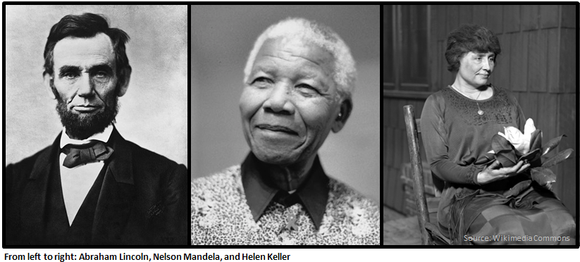
Say, for example, Abraham Lincoln, Nelson Mandela, or Hellen Keller.

What is it about people like this that makes them exceptional? Is it a unique combination of qualities like honesty, kindness, and generosity? Or is it a distinct and separate trait altogether, such that one could even be exceptional yet dishonest and unkind? Read more of this post

Warren Buffett: The Three Things I Look For in a Person

Warren Buffett: The Three Things I Look For in a Person

By Shane Parrish | More Articles | Save For Later
February 2, 2014 | Comments (18)

Students often go to visit Warren Buffett. And when they do, he often plays a little game with them.

He asks each student to pick a classmate. Not just any classmate, but the classmate you would choose if you could have 10% of their earnings for the rest of their life. Which classmate would you pick and why? Read more of this post

ow To Stop Making Excuses And Use Fear To Your Advantage

How To Stop Making Excuses And Use Fear To Your Advantage

SCOTT CHRISTENTREPRENEUR
58 MINUTES AGO 452

Imagine the following scenario: you’re in a classroom taking a test — one that’s quite easy. The professor then approaches you and offers you a choice: you can either take a “performance-enhancing drug” or a drug that inhibits your performance. Which would you choose? Read more of this post

How the best athletes overcome less-than-ideal physiques for their sports

2014 Sochi Olympics: Imperfect Bodies, Seeking Olympic Perfection

How the best athletes overcome less-than-ideal physiques for their sports

MATTHEW FUTTERMAN

Feb. 6, 2014 7:24 p.m. ET

image001-6

Yuna Kim is 5-foot-5, tall for a figure skater, but her technique makes up for it, and her height gives her a commanding presence on the ice. European Pressphoto Agency

When hurdling star Lolo Jones first raised her hand for U.S. bobsled duty in 2012, coach Todd Hays looked at her 135-pound frame and thought she should stick with her day job. Read more of this post

Get a PhD-but leave academia as soon as you graduate

Get a PhD—but leave academia as soon as you graduate

By Allison Schrager 2 hours ago

Allison Schrager is an economist with a focus on pension issues.

Enrolling in a PhD program is, from an economic perspective, a terrible decision. But that doesn’t mean you shouldn’t do it. Just don’t let it ruin your life. Read more of this post

CUHK on hiring spree for rising stars; The Chinese University of Hong Kong has been on a headhunting mission in advance of the possible retirement of 200 to 250 teaching staff

CUHK on hiring spree for rising stars
Friday, February 07, 2014
The Chinese University of Hong Kong has been on a headhunting mission in advance of the possible retirement of 200 to 250 teaching staff.

Provost Benjamin Wah Wan-sang said recruitment began last November and the university plans to hire between 30 and 40 professors and associate professors in total. Read more of this post

Business schools are better at analysing disruptive innovation than at dealing with it

Those who can’t, teach

Business schools are better at analysing disruptive innovation than at dealing with it

Feb 8th 2014 | From the print edition

image001-4

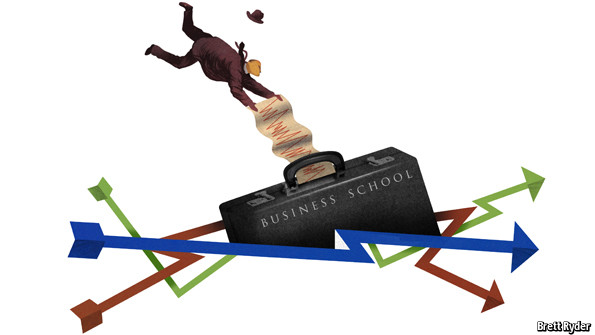
IN EVERY profession there are people who fail to practise what they preach: dentists with mouths full of rotten teeth, doctors who smoke 40 a day, accountants who forget to file their tax returns. But it is a rare profession where failure to obey its own rules is practically a condition of entry. Business schools exist to teach the value of management. They impart some basic principles—like setting clear goals and managing risk. They also teach how dangerous the business world has become. The most fashionable phrase today is “disruptive innovation”: professors solemnly warn people that entire industries face powerful new forces and that comfortable incumbents are at the mercy of swift-footed challengers. But when it comes to their own affairs, business schools flout their own rules and ignore their own warnings. Read more of this post

‘It’s so unnecessary’: Heenan Blaikie co-founder blames internal rivalries for law firm’s demise; The once-venerable law firm of Heenan Blaikie LLP, started with handshakes in 1973, has ended because of squabbling

‘It’s so unnecessary’: Heenan Blaikie co-founder blames internal rivalries for law firm’s demise

Allison Lampert, Postmedia News | February 6, 2014 | Last Updated: Feb 6 7:30 PM ET
MONTREAL — The once-venerable law firm of Heenan Blaikie LLP, started with handshakes in 1973, has ended because of squabbling, Roy Heenan said Thursday. Read more of this post

Philip Seymour Hoffman didn’t know how to be happy

Philip Seymour Hoffman didn’t know how to be happy

By Lauren Alix Brown @laurenalixb February 6, 2014

Back in December 2012, Philip Seymour Hoffman sat down with philosopher Simon Critchley at the Rubin Museum to talk about happiness. Days after reeling from the actor’s death, much has been made of the singular pain of addiction and the lonely descent into acting in a difficult role. But the interview touches on something universal, a base human inability to simply be happy. Within the first two minutes of the interview, Hoffman declares, “I really don’t know what it means to be happy.” Read more of this post

Book Review: Tiger Mom’s Superiority Complex; The book is racism masquerading as social science, but that doesn’t mean that it’s all wrong

Book Review: Tiger Mom’s Superiority Complex

By Jessica Grose February 06, 2014

Yale law professor Amy Chua gained fame—and stoked fires in the mommy wars—in 2011 with a Wall Street Journal piece called “Why Chinese Mothers Are Superior.” The essay introduced Chua’s provocative book, The Battle Hymn of the Tiger Mother, which embraced cultural stereotypes about Asian moms having academically successful offspring because they don’t let their kids watch TV, get out of playing the piano or violin, or “not be the No. 1 student in every subject except gym and drama.” Three years later, Tiger Mom is back, with her claws only slightly retracted, and a co-author, her husband, fellow Yale law professor, and novelist Jed Rubenfeld. Their book, The Triple Package: How Three Unlikely Traits Explain the Rise and Fall of Cultural Groups in America, has no problem with absolutes, either. Read more of this post

Charlie Rose Talks to Bridgewater’s Ray Dalio

Charlie Rose Talks to Bridgewater’s Ray Dalio

By Charlie Rose February 06, 2014

Your animated film, How the Economic Machine Works, has 750,000 hits on YouTube. Explain what it’s about and what compelled you to make it.
It’s a 30-minute description of how I believe the economy works like a machine, a very simple explanation. I’m a global macroeconomic investor, so it’s from a very practical perspective. I’m 64 years old. I’ve reflected back on what I’ve learned, and I felt it was important to get it out there. Many economists … they’re not living in the world of markets every day. They’re not putting money on the line. So they don’t have to engage in the kind of hardheaded analysis you do because you are managing $150 billion. Read more of this post

Other People’s Views: When should you care about what your peers and friends think and when should you not

Other People’s Views

FEB. 6, 2014

David Brooks

Let’s say you’re turning 40 and you realize you want to leave accounting and become a hip-hop artist. People will say you’re having a pathetic midlife crisis, but should you do it anyway?

Let’s say you’re on the phone in a crowded place and you want to tell your buddy a dirty joke, which may offend the people around you. Should you tell it? Read more of this post

Jeremy Grantham on Tesla, Fertilizer Wars; GMO’s famed investor also discusses peak oil and fracking. Plus, investing lessons learned over 47 years

THURSDAY, FEBRUARY 6, 2014

Jeremy Grantham on Tesla, Fertilizer Wars

By JEREMY GRANTHAM | MORE ARTICLES BY AUTHOR

GMO’s famed investor also discusses peak oil and fracking. Plus, investing lessons learned over 47 years.

Fossil Fuels: Is Tesla a Tease or a Triumph? 
In an earlier report, “The Race of Our Lives,” I finished on the unusually optimistic point (for me) that a combination of declining fertility and eventual declining population combined with unexpectedly strong progress in renewable energy might just save our modern civilization from a slow and, no doubt, irregular descent into dystopia. More recently, while still believing we are in this critical race, I have become increasingly impressed with the potential for a revolution in energy, which will make it extremely unlikely that a lack of energy will be the issue that brings us to our knees. Even in the expected event that there are no important breakthroughs in the cost of nuclear power, the potential for alternative energy sources, mainly solar and wind power, to completely replace coal and gas for utility generation globally is, I think, certain. The question is only whether it takes 30 years or 70 years. That we will replace oil for land transportation with electricity or fuel cells derived indirectly from electricity is also certain, and there, perhaps, the timing question is whether this will take 20 or 40 years. To my eyes, the progress in these areas is accelerating rapidly and will surprise almost everybody, I hope including me. Read more of this post

From Sick Man of Europe to Economic Superstar: Germany’s Resurgent Economy

From Sick Man of Europe to Economic Superstar: Germany’s Resurgent Economy
Christian Dustmann, Bernd Fitzenberger, Uta Schönberg and Alexandra Spitz-Oener
In the late 1990s and into the early 2000s, Germany was often called “the sick man of Europe.” Indeed, Germany’s economic growth averaged only about 1.2 percent per year from 1998 to 2005, including a recession in 2003, and unemployment rates rose from 9.2 percent in 1998 to 11.1 percent in 2005. Read more of this post

When Ideas Trump Interests: Preferences, Worldviews, and Policy Innovations

When Ideas Trump Interests: Preferences, Worldviews, and Policy Innovations
Dani Rodrik
Ideas are strangely absent from modern models of political economy. In most prevailing theories of policy choice, the dominant role is instead played by “vested interests”—elites, lobbies, and rent-seeking groups which get their way at the expense of the general public. Read more of this post