An Economist’s Guide to Visualizing Data

An Economist’s Guide to Visualizing Data
Jonathan A. Schwabish
Once upon a time, a picture was worth a thousand words. But with online news, blogs, and social media, a good picture can now be worth so much more. Economists who want to disseminate their research, both inside and outside the seminar room, should invest some time in thinking about how to construct compelling and effective graphics.

Six Steps To Salvaging An Unproductive Day

Six Steps To Salvaging An Unproductive Day

LISA EVANSENTREPRENEUR
FEB. 5, 2014, 10:27 PM 2,748

We’ve all had those days when we have a million things to do, but can’t seem to get ahead on any of them. Not only do unproductive days detract from your business’ success, it can also have an effect on your well-being, affecting your mood and stress levels. While simply throwing in the towel, heading home and returning to the office refreshed the next day may seem an attractive option, there’s still a chance to turn around your day and boost your productivity. Read more of this post

Secret to Homemade Coke: Instant Cold, No Canisters; Coca-Cola and Keurig Dream of Less Lugging, More Glugging

Secret to Homemade Coke: Instant Cold, No Canisters

Coca-Cola and Keurig Dream of Less Lugging, More Glugging

ANNIE GASPARRO and MIKE ESTERL

Feb. 6, 2014 8:00 p.m. ET

For a century, the executives of Coca-Cola Co. KO +1.12% have done everything possible to put their famed cola “within arm’s reach of desire,” to the point that one chief executive frequently pondered an extra tap at the kitchen sink—with Coke flowing from it. Read more of this post

More Men in Prime Working Ages Don’t Have Jobs; Technology and Globalization Transform Employment Amid Slow Economic Recovery

More Men in Prime Working Ages Don’t Have Jobs

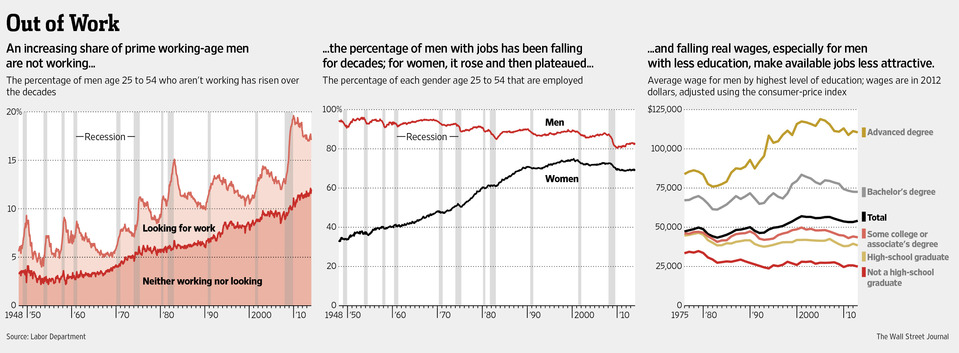
Technology and Globalization Transform Employment Amid Slow Economic Recovery

MARK PETERS and DAVID WESSEL

Updated Feb. 6, 2014 6:12 p.m. ET

image001-4

More than one in six men between the ages of 25 and 54, prime working years, don’t have jobs, a chronic condition that shows how technology and globalization are transforming jobs faster than many workers can adapt, economists say. David Wessel, Hutchins Center on Fiscal and Monetary policy director, joins MoneyBeat. Photo: Wesley Hitt for The Wall Street Journal. Read more of this post

Why Mark Zuckerberg has calmed down about openness and authenticity

Why Mark Zuckerberg has calmed down about openness and authenticity

By Matt McFarland, Updated: February 6 at 8:52 am

Amid all the talk of Facebook this week as it celebrates its 10th anniversary, I’m struck by how CEO Mark Zuckerberg has tweaked his tune on the the benefits of openness.

As Facebook rose to prominence, Zuckerberg preached the value of open platforms and sharing information.  ”If people share more, the world will become more open and connected. And a world that’s more open and connected is a better world,” he wrote in 2010. The year before he defined his company as one “that’s trying to bring innovative things to people that help them share more and make the world more open.” Read more of this post

When average is over, lifelong learning is key

When average is over, lifelong learning is key

In a recent book titled Average Is Over, noted economist Tyler Cowen talks about how income disparity has increased and will continue to increase in the world.

BY K RANGA KRISHNAN –

07 FEBRUARY

In a recent book titled Average Is Over, noted economist Tyler Cowen talks about how income disparity has increased and will continue to increase in the world. Read more of this post

Teaching mathematics: Time for a ceasefire; Technology and fresh ideas are replacing classroom drill-and helping pupils to learn

Teaching mathematics: Time for a ceasefire; Technology and fresh ideas are replacing classroom drill—and helping pupils to learn

Feb 1st 2014 | SHANGHAI AND TEL AVIV | From the print edition

image002
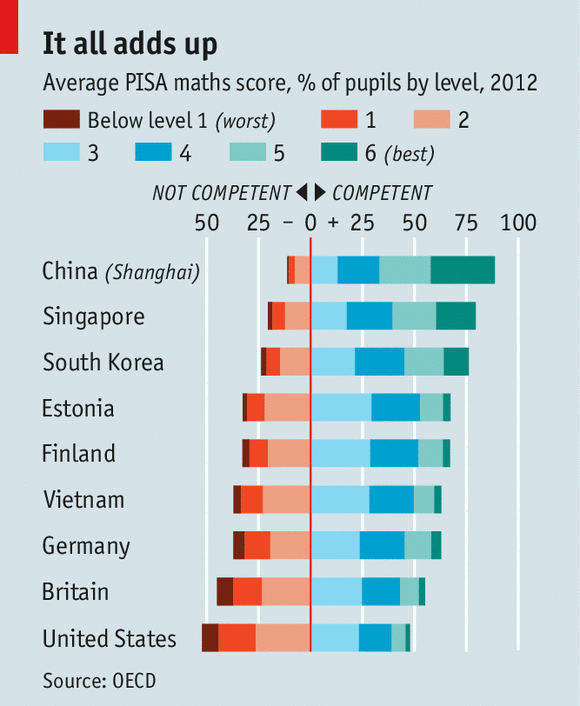
IF THE world’s education systems have a common focus, it is to turn out school-leavers who are proficient in mathematics. Governments are impressed by evidence from the World Bank and others that better maths results raises GDP and incomes. That, together with the soul-searching provoked by the cross-country PISA comparisons of 15-year-olds’ mathematical attainment produced by the OECD, a club of mostly rich countries, is prompting educators in many places to look afresh at what maths to teach, and how to teach it. Read more of this post

Is it time for governments to launch a new wave of privatizations?

Defending the motion

Bernardo Bortolotti  

Professor of Economics, University of Turin; Director, Sovereign Investment Lab, Bocconi University

A large-scale privatisation programme alleviates public finances because cash revenues can be used to redeem public debt, and savings in interest payments may give leeway to expansionary fiscal policy.

Against the motion

Elliott Sclar  

Urban Planning Professor and Director, Centre for Sustainable Urban Development, Columbia University

The motivational misalignment between long-term public needs and shorter-term private needs for investment return is at the core of all the instances of failure in public-asset sales and leases.

The moderator’s opening remarks

Feb 4th 2014 | Matthew Valencia  

Our debate tackles a perennial economic question that is also inherently political. Privatisation has long been championed by proponents of laissez-faire capitalism, usually on the political right, and opposed, often bitterly, by trade unions and others on the left. Over the past quarter of a century it has ebbed and flowed, in line partly with the complexion of governments and partly with the state of financial markets. (Who wants to sell when prices are in a slump?) Global privatisation receipts have been strong in recent years, but much of the action has been in large developing countries, such as China and Brazil. Is it time for advanced economies to rediscover the boldness of the 1980s and the early part of the last decade? Read more of this post
Lessons From The Samurai: The Secret To Always Being At Your Best

FEBRUARY 6, 2014 by ERIC BARKER

Lessons From The Samurai: The Secret To Always Being At Your Best

Reading a few books by samurai there was one thing I saw repeated again and again and again that surprised me.

It has nothing to do with swords, fighting or strategy. Actually, quite the opposite when you think about it.

What did so many of history’s greatest warriors stress as key to success and optimal performance? Read more of this post

Seth Godin: Why I want you to steal my ideas

Seth Godin: Why I want you to steal my ideas

February 3, 2014 at 11:30 am EST

image001

By Seth Godin

Please don’t steal my car.

If you drive away with it, I won’t have it any more, which is a real hassle.

Please don’t steal my identity or my reputation either. Neither travels well, and all the time you’re using it, you’re degrading something that belongs to me.

But my ideas? Sure, yes, please, by all means, take them. Read more of this post

India’s MIT (Manipal Institute of Technology) costs less than $6,000 a year-and look where it got Microsoft’s new CEO Satya Nadella

India’s MIT costs less than $6,000 a year—and look where it got Satya Nadella

By Heather Timmons @HeathaT 7 hours ago

Few institutions could be as pleased with Microsoft’s recent appointment of new CEO Satya Nadella as the Manipal Institute of Technology. Read more of this post

A peek inside a VC’s thought process

A peek inside a VC’s thought process

By Adam Lashinsky, Sr. Editor at Large February 6, 2014: 7:04 AM ET

Maveron’s Dan Levitan, in his own words, on how he met Trupanion CEO Darryl Rawlings and decided to invest in his company.

FORTUNE — Maveron is a U.S. venture capital firm based in Seattle and San Francisco that was co-founded in 1998 by Starbucks CEO Howard Schultz and investment banker Dan Levitan. The firm focuses exclusively on consumer businesses, and has made a name for itself with successful investments in the billion-dollar companies eBay (EBAY), Capella University (CPLA), Groupon (GRPN), and Zulily (ZU). (Another, the fast food chain Potbelly [PBPB], is more than halfway to the billion-dollar-valuation mark.)

In a recent interview, Levitan explained how he came to invest in Trupanion, a Seattle-based startup company that offers health insurance for pet animals. It’s a fascinating look at the investment process for a venture capital firm. Below, Levitan in his own words, as told to Fortune senior editor-at-large Adam Lashinsky. Read more of this post

Book Talk: Leadership in the world’s most extreme workplace

Book Talk: Leadership in the world’s most extreme workplace

Wed, Feb 5 2014

By Pauline Askin

SYDNEY (Reuters) – At age 34, Rachael Robertson accepted the biggest challenge of her life: to lead a large, 12-month expedition in Antarctica. Two months on, she found herself having to ask the team of 120 how they managed to get through a year’s supply of condoms in just eight weeks. Read more of this post

Stop Looking for Passion at Work; The meaning of your life won’t likely be found on the job

Posted: January 21, 2014

David Silverman is an author, teacher andsenior executive at a Fortune 100 firm.

Stop Looking for Passion at Work

I recently came across an interesting career website called the Paper Tuner. Among a variety of mostly good and useful material, however, I also found this:

I have one word for this TED presentation where we are told that we are pursuing our careers all wrong: shame. And I mean that in the sense of the word that means “shame on you for making people feel bad about themselves for not finding success through the workplace.” I say that because the presenter, Larry Smith, pushes hard on what I consider the “big lies” of what I’ll call the IPO-wins-Internet culture. (He also insists on calling Steve Jobs “Steven J”—really?) Read more of this post

Making Better Decisions over Time; The technique of deliberate practice can dramatically improve performance, but knowing its limits is as important as understanding its value

January 6, 2014  

Making Better Decisions over Time

The technique of deliberate practice can dramatically improve performance, but knowing its limits is as important as understanding its value.

by Phil Rosenzweig

Managers make a wide range of decisions, from routine calls they face on a recurring basis, to large-scale strategic decisions they may encounter just once in their careers. For issues that are often repeated, the technique of deliberate practice—which involves action, feedback, modification, and action again—is a powerful way to boost performance. The technique works when a decision is part of a sequence, in which feedback from one part can improve the next. Not all decisions work in this manner, however. Knowing the difference is crucial. Read more of this post

100 Books Everyone Should Read Before They Die

100 Books Everyone Should Read Before They Die

MEGAN WILLETT

FEB. 5, 2014, 12:01 PM 37,176 17

Amazon book editors have just released a list of their 100 Books To Read In A Lifetime.

Many of the books are 20th century classics or recent bestsellers — the oldest book on the list is Jane Austen’s 1813 masterpiece “Pride and Prejudice.” It also spanned multiple genres, with adult fiction, nonfiction, children’s, and young adult novels such as “The Hunger Games” and “Harry Potter” making the list. Read more of this post

A Solution for Bad Teaching: Tweaking tenure could help students and researchers

A Solution for Bad Teaching

By ADAM GRANT

FEB. 5, 2014

PHILADELPHIA — IT’S no secret that tenured professors cause problems in universities. Some choose to rest on their laurels, allowing their productivity to dwindle. Others develop tunnel vision about research, inflicting misery on students who suffer through their classes. Read more of this post

The Art of Negotiation: How to Improvise Agreement in a Chaotic World

The Art of Negotiation: How to Improvise Agreement in a Chaotic World Hardcover

by Michael Wheeler  (Author)

A member of the world-renowned Program on Negotiation at Harvard Law School introduces the powerful next-generation approach to negotiation.
For many years, two approaches to negotiation have prevailed: the “win-win” method exemplified inGetting to Yes by Roger Fisher, William Ury, and Bruce Patton; and the hard-bargaining style of Herb Cohen’s You Can Negotiate Anything. Now award-winning Harvard Business School professor Michael Wheeler provides a dynamic alternative to one-size-fits-all strategies that don’t match real world realities.  Read more of this post

Emotions as a negotiating tool; The Art of Negotiation: How to Improvise Agreement in a Chaotic World

February 5, 2014 4:00 pm

Emotions as a negotiating tool

By Alicia Clegg

Nelson Mandela famously spent some of his time in prison studying Afrikaner history and teaching himself Afrikaans, the language of his jailers. He understood that being able to see the world through the eyes of his adversaries would be important in any future negotiations. Read more of this post

‘Influx’ may propel sci-fi writer Daniel Suarez into the void left by Tom Clancy and Michael Crichton; Rejected by 48 literary agents, he began self-pub in 2006. His sophisticated tech knowledge quickly attracted a cult following

Daniel Suarez Sees Into the Future

‘Influx’ may propel the sci-fi writer into the void left by Tom Clancy and Michael Crichton

EBEN SHAPIRO

Updated Feb. 5, 2014 10:24 a.m. ET

image005-1 image006

Daniel Suarez Michal Czerwonka for The Wall Street Journal

Thriller writer Daniel Suarez has a lot of readers with important jobs. Read more of this post

Cheaters … Win? Why Systems to Prevent Deception Don’t Work

Cheaters … Win? Why Systems to Prevent Deception Don’t Work

Jan 30, 2014

Swiping office supplies from work. Jumping the turnstile to get a free ride on the subway. Stealing a car and taking it for a joyride. All of these are clearly unethical behaviors that should evoke a negative emotional response after the event — if the mere promise of feeling guilt or remorse doesn’t stop the individual from doing it in the first place. Read more of this post

The ‘Moneyball’ Approach to Hiring CEOs

The ‘Moneyball’ Approach to Hiring CEOs

Feb 03, 2014

It was the lesson of the best-selling book-turned-movie, Moneyball: Don’t throw money at big-name baseball players or judge future performance by purely physical attributes. Assess them, instead, by more relevant measurements, like their on-base percentage. Read more of this post

Meritocracy encourages insatiable need for reward

Meritocracy encourages insatiable need for reward

Often, naysayers of our meritocratic system focus on those who may get left behind.

FROM GURMIT SINGH KULLAR –

06 FEBRUARY

Often, naysayers of our meritocratic system focus on those who may get left behind.

I agree generally with the Education Minister’s view, in “Avoid making meritocracy a dirty word, says Heng” (Jan 29), on maintaining the status quo. Read more of this post

How to beat the ‘Problem of More’

How to beat the ‘Problem of More’

February 4, 2014: 4:30 PM ET

Fortune.com selects the most compelling short essays, anecdotes, and author interviews from “250 Words,” a site developed by Simon & Schuster to explore the best new business books — wherever they may be published. Read more of this post

Finding your Zen at work: Rethink full-time; As professional and personal lives blend, the full-time job should be an option — not the goal. Let’s apply the extraordinary American creativity and innovation to work not just at work

Finding your Zen at work: Rethink full-time

February 5, 2014: 11:14 AM ET

As professional and personal lives blend, the full-time job should be an option – not thegoal.

By Sophie Wade

FORTUNE – Are we approaching a decade of discontent?

We hear much about the jobless, and that those who’ve found work should simply be grateful. However, Americans aren’t happily employed. More than half, 70%, of U.S. employees reported last year that they were actively dis-engaged or not engaged in their work, according to a Gallup Poll. Read more of this post

Former Bank of England governor Lord King names Niccolo Machiavelli’s The Prince as his favourite book; says he likes the “ruthless truth telling” in 16th century book about power

Lord King names Niccolo Machiavelli’s The Prince as his favourite book

Former Bank of England governor Lord King says he likes the “ruthless truth telling” in 16th century book about power

By Andrew Trotman

8:00PM GMT 04 Feb 2014

Former Bank of England governor Lord King has revealed that Niccolo Machiavelli’s The Prince, the 16th guidebook on power beloved by Napoleon, Stalin and Nixon, is his favourite book. Read more of this post

If robots divide us, they will conquer; The rise of intelligent technologies may cost us dear – unless we understand the dangers

February 4, 2014 6:57 pm

If robots divide us, they will conquer

By Martin Wolf

The rise of intelligent technologies may cost us dear – unless we understand the dangers

With one rub of his lamp, Aladdin could command an intelligent being able to fulfil all desires. His genie was a spirit. But the dream of powerful and intelligent artificial servants has also encompassed physical beings. Now, it is becoming a reality built of silicon, metal and plastic. But is it a dream or a nightmare? Will clever machines prove beneficial? Or will they be Frankenstein monsters? Read more of this post

Arthur Ortenberg, a Liz Claiborne Founder, Dies at 87

Arthur Ortenberg, a Liz Claiborne Founder, Dies at 87

By DOUGLAS MARTINFEB. 5, 2014

image001

The designer Liz Claiborne and Arthur Ortenberg were co-founders of the fashion powerhouse named after her. Bill Cunningham/The New York Times Read more of this post

Beats Music CEO On Why Delegating Is The Secret To Success; How do you manage tackling a new market? Trust your team and let talented people do what they do

BEATS MUSIC CEO ON WHY DELEGATING IS THE SECRET TO SUCCESS

HOW DO YOU MANAGE TACKLING A NEW MARKET? TRUST YOUR TEAM AND LET TALENTED PEOPLE DO WHAT THEY DO.

BY SAMANTHA COLE

With the launch of a streaming music service, Beats Music CEO Ian Rogers does more by doing less. Read more of this post

Philippine leader likens China’s rulers to Hitler

Philippine leader likens China’s rulers to Hitler

Wednesday, February 5, 2014 – 18:13

AFP

MANILA – Philippine President Benigno Aquino has warned China’s efforts to claim disputed territories are like Nazi Germany’s before World War II, drawing a fierce Chinese response on Wednesday branding him ignorant and amateurish.

In an interview with the New York Times, Aquino called for world leaders not to make the mistake of appeasing China as it seeks to cement control over contested waters and islands in the strategically vital South China Sea. Read more of this post