Church finances: Holy disorder; The bankruptcy of a Catholic diocese that diversified into business reflects scant supervision

January 21, 2014 6:37 pm

Church finances: Holy disorder

By Alex Barker in Maribor

The bankruptcy of a Catholic diocese that diversified into business reflects scant supervision

Father Joze Golovsek is praying for a bailout. But if it comes to the worst and the banks seize his church, he can take solace from knowing they cannot asset-strip the angels. Read more of this post

‘God of Gamblers’ Chow Yun Fat hates gambling

‘God of Gamblers’ Chow Yun Fat hates gambling

POSTED: 22 Jan 2014 14:42

m_FVTM
Chow Yun Fat may be best known for playing the ‘God of Gamblers’ Ko Chun in the iconic 1989 film of the same name, but he says he actually hates gambling.

BEIJING: Hong Kong actor Chow Yun Fat, who played the ‘God of Gamblers’ Ko Chun in the iconic 1989 film of the same name, revealed Tuesday at a media conference for his new film “From Vegas to Macau” that he actually hates gambling, reported Chinese media. Read more of this post

Diamond Foods CFO on Recovering From a Crisis after settling fraud charges with SEC

January 21, 2014, 4:36 PM ET

Diamond Foods CFO on Recovering From a Crisis

EMILY CHASAN

Senior Editor

Diamond Foods Inc. settled fraud charges this month with the Securities and Exchange Commission, but the snack food company still has work to do to put its accounting scandal behind it. Read more of this post

Jessica Alba Went Against Advice Not To Start A Company That Has Since Raised $52 Million

Jessica Alba Went Against Advice Not To Start A Company That Has Since Raised $52 Million

KIRSTEN ACUNA

JAN. 21, 2014, 3:22 PM 7,762 9

Jessica Alba is a triple threat as an actress, mother, and entrepreneur. Alba appeared on “Late Night with Jimmy Fallon” to discuss motherhood, her new role in IFC’s “The Spoils of Babylon,” and her family company. Now two years old, The Honest Company makes non-toxic baby products including diapers and household cleaners. Read more of this post

Naked god sculptures exorcised from China’s Jinan after two days

Naked god sculptures exorcised from Jinan after two days

Staff Reporter

2014-01-22

C119N0031H_2014資料照片_N71_copy1

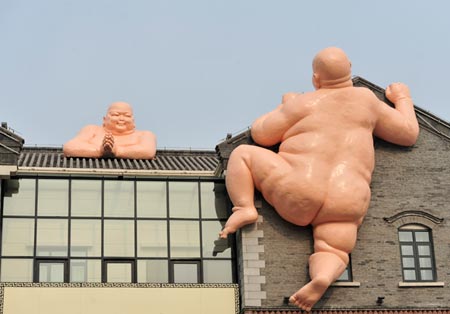
The two giant sculptures in Jinan, Shandong province.The Buddhas Jumping the Wall. (Photo/CNS)

Two giant sculptures of nude Chinese deities that went up this week in Jinan, the capital of Shandong province, have already been removed by the city government, Xinhua reports. The artwork, whose name translates as “naked gods climbing a house,” made its appearance on Jan. 18. One of the two figures rests with its arms draped over the roof of the house while he watches the other, still climbing the wall of another house. The two plump, bald gods have earned them the name Buddha Jumps Over the Wall, after a famous Chinese dish. Less than two days after their debut, however the sculptures were removed after the city government condemned them as ugly and strange.

The day LKY shocked Yudhoyono

The day Mr Lee shocked Yudhoyono

Tuesday, January 21, 2014 – 06:54

Zubaidah Nazeer

The Straits Times

INDONESIA – In the first year of his presidency, Indonesian President Susilo Bambang Yudhoyono was told that his country’s issues were so complex that he would achieve only a third of what he set out to do in the five-year term. Read more of this post

Pimco’s El-Erian Resigns after six years as the firm struggles to stem record redemptions from its main fund

Pimco’s El-Erian Resigns as Hodge Named Chief Executive

Mohamed El-Erian, responsible for leading Pacific Investment Management Co.’s transformation from the world’s biggest bond manager to a diversified investment firm, resigned after six years as the firm struggles to stem record redemptions from its main fund. Read more of this post

Socially responsible investing has got the backing of famous names, has seen a huge rise in assets under management and is focused on the future, but are family offices actually interested?

THE GOOD MONEY

ARTICLE | 20 JANUARY, 2014 05:48 PM | BY ATTRACTA MOONEY

Associating the word ‘social’ with anything these days usually creates an instant buzz – think social media and social networks. And when it comes to socially responsible investing (SRI) it is young investors who are apparently on trend. A study from Spectrem Group reveals 35% of very wealthy investors under 46 consider the social responsibility of their investments. “If the individual is younger, they tend to be more aware of the issues and think about socially responsible funds more than older investors,” says Catherine McBreen, managing director of the research firm. Read more of this post

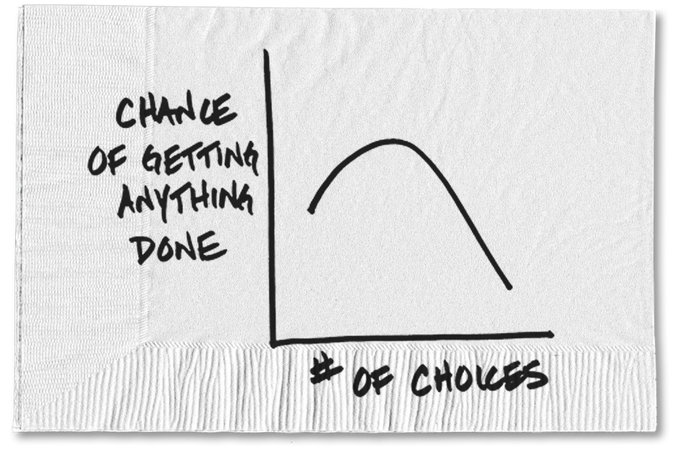
The Trap of Too Many Choices

The Trap of Too Many Choices

By CARL RICHARDSJAN. 21, 2014

012014bucks-carl-sketch-master675

I recently got a new smartphone. In the setup process, I was presented with all sorts of options. Selecting a language was pretty easy, but I had to think harder about some of the other ones. Did I want the phone to use my location? Did I want to share data anonymously? Did I want to log in with an existing account or did I need to set up a new one? Read more of this post

Bill Gates to Spend Rest of Life on Philanthropic Work

Bill Gates to Spend Rest of Life on Philanthropic Work

Microsoft Corp. (MSFT) Chairman Bill Gates will work on philanthropy full time for the rest of his life and contribute part time as a board member of the software maker, which is seeking a new chief executive officer. Read more of this post

The Asian Superlative Horse for Value Investors: The Tale of Cosmax Vs L’Oreal

Dear Friends and All,

The Asian Superlative Horse for Value Investors: The Tale of Cosmax Vs L’Oreal

The Three Apples was on my mind in August 2007 when the Bamboo Innovator was in Seoul presenting to a group of about 50 Korean SME CEOs and the commerce minister at the KITIA-PwC conference. The first, “Eve’s apple,” the apple of morality. The second, the “Apple of Beauty,” the one which was given to Aphrodite by the Trojan prince. The third, “Newton’s apple of science”, the one that inspired Newton for the development of his theory of universal gravitation. The Three Apples is the corporate symbol of Korea’s Cosmax (Kospi: 044820 KS, MV $720 million), an ugly-duckling cosmetics company that the Bamboo Innovator decided to pay a visit amongst the over two thousand companies listed in Korea after the conference.

Cosmax was shunned by both foreign and local investors then because it doesn’t have its own brand – it does the contract manufacturing (ODM/OEM) for L’Oreal, Shu Uemura, Maybelline, J&J, Mary Kay, Amorepacific and so on. Companies with brands are the ones who command valuation premium, the veterans would sneer. The financial numbers of Cosmax was also ugly as it was undertaking a capex exercise to expand in China, depressing its profit margins while the plants are being constructed. KS (Kyung-soo) Lee (photo), founder and chairman of Cosmax, explained: “These three symbols hinged on the apple, explain the leaders, reflect exactly our industrial philosophy based on honesty, on our mission to contribute to a life more beautiful and finally on our goal for R&D.”

The Bamboo Innovator remembered the management sharing how Cosmax/KS were often advised by investors to go with the trend and venture downstream to building their own brand. Cosmax will not compete with its clients and adds value with new ODM products that are developed only after analyzing trends, KS Lee emphasized, stamping his integrity to stay independent to innovate with its own business model. The company highlighted its ability to create “formulas” and boasts that nearly all of its products are manufactured from them. One of the company’s most popular products is a gel eyeliner it devised for L’Oreal. KS had worked at Dong-A Pharmaceutical and Daewoong Pharmaceutical before starting Cosmax in 1992, then called Miroto Korea. President and CEO CH (Chul-hun) Song rose through the ranks of LG Household & Health Care’s cosmetics manufacturing division before joining Cosmax in 2004. At Cosmax’s R&D center, many heads of departments have joined Cosmax from Amorepacific, including company director Kim Joo-ho and directors Park Myeong-sam and Moon Seong-joon. Since August 2007 as the company expanded with a new factory in Shanghai (constructed in 2006 and the tipping point of commercialization in 2008) and Guangzhou, Cosmax has rose over 13-fold to a market value of $720 million from around W4,000 to W56,000, but not before enduring a gut-wrenching plunge to W1,410 in Oct 2008 during the Global Financial Crisis.

The recent exit of L’Oreal’s Garnier brand and Revlon from China and the continued success of Cosmax in China goes to highlight that beauty in Asia should not be judged skin-deep in chasing brands and pretty financial numbers. The porcelain beauty of Chinese women takes $35 billion to upkeep so exiting from such a seemingly attractive market speaks volume about the increasing difficulties faced by established western brands in China and emerging markets. L’Oreal made the surprising announcement less than two weeks ago that it is pulling its successful Garnier brand from the rapidly evolving Chinese market, which made up a little over 1% of L’Oreal’s $2 billion sales in China. The positioning of the Garnier line with relatively mass-market pricing has seen an initial promising start as the #1-selling brand in China since launching in 2006 with superstar Zhang Ziyi but it failed to gain traction as consumer grew wary of mass-market products and they no longer believe mass-market products are good for them. Revlon also said it was cutting its ailing operations in China, which account for about 2% of its total sales, and slashing more than 15% of its workforce, or 1,100 jobs, including those of 940 beauty advisers.

As hockey legend Waynes Gretzsky would say, skate to where the puck is going to be, not where it has been. The Bamboo Innovator was of the view that the profits and valuation premium in the value chain is possibly shifting to manufacturers with R&D/ODM capabilities to handle large batch orders as product lifecycle shortens and speed-to-market is crucial and there will only be a few of these companies, including Cosmax, who have the capability and capacity to handle these orders. Cosmax is capable of…

<Article snipped>

The story of Cosmax also reminded the Bamboo Innovator of an old Taoist tale of the Superlative Horse on how to find the neglected, the misunderstood opportunities, and its age-old wisdom is particularly apt as we approach the Chinese Lunar Year of the Horse at the month end of January:

Duke Mu of Chin said to Po Lo: ‘You are now advanced in years. Is there any member of your family whom I could employ to look for horses in your stead?’

Po Lo replied: ‘A good horse can be picked out by its general build and appearance. But the superlative horse – one that raises no dust and leaves no track – it is something evanescent and fleeting, elusive as thin air. The talents of my sons lie on a lower plane altogether; they can tell a good horse when they see one, but they cannot tell a Superlative Horse. I have a friend, however, one Chiu-fang Kao, a hawker of fuel and vegetables, who in things appertaining to horses is nowise my inferior. Pray see him.’

Duke Mu did so, and subsequently dispatched him on a quest for a steed. Three months later, he returned with the news that he had found one. ‘It is now in Shach’iu,’ he said.

‘What kind of a horse is it?’ asked the Duke.

‘Oh, it is a dun-coloured mare,’ was the reply.

However, the animal turned out to be a coal-black stallion. Much displeased, the Duke sent for Po Lo. ‘That friend of yours,’ he said, ‘whom I commissioned to look for a horse, has made a fine mess of it. Why, he cannot even distinguish a beast’s colour or sex. What on earth can he know about horses?’

Po Lo heaved a sigh of satisfaction. ‘Has he really got as far as that?’ he cried. ‘Ah, then he is worth ten thousand of me put together. There is no comparison between us. What Kao keeps in view is the spiritual mechanism. In making sure of the essential, he forgets the homely details; intent on the inward qualities, he loses sight of the external. ‘He sees what he wants to see, and not what he does not want to see. He looks at things he ought to look at, and neglects those that need not be looked at. So clever a judge of horses is Kao that he has it in him to judge something better than horses.’

And when the horse finally arrived, it turned out, indeed, to be a superlative animal.

his is a fabulous tale of Superlative Horses and of men who have the patience and the uncanny instinct to identify horses that raise no dust and leave no track. One cannot escape noticing the relationship among the three men – the underlying trust, the sense of self-worth, the respect for one another’s views and, of course, the obvious loyalty. In value investing, the payoff/returns might not be immediate, as in the case of Cosmax and Duke Mu’s judgment of Kao’s assessment of the Superlative Horse, and usually result in fray nerves, anxiety and unhappiness. Trust and support of one another is critical. At the Moat Report Asia and Bamboo Innovator community, which recently saw the addition of clients who raise no dust and leave no track – a secretive Singapore-based billionaire who’s a highly successful super value investor and a European-based multi-billion family office – we believe our value-add is in the authentic and independent sharing of investment opinions and views in order to get closer to the Truth – and this means that we need to take the social and business risk of being disagreeable at times. For value investing to be productive, there has to be a candid dialogue with a group of people who genuinely care for one another.

The more over-powering message, one that is relevant in our search for the resilient compounder, is that we should go beyond the external – the nice financial numbers, the certificates, the accolades, the family links and the PR – and seek out the intrinsic leadership qualities in individuals and the wide-moat of the companies.

To read the exclusive article in full to find out more about the story of Cosmax and Sa Sa (HKSE: 178 HK) and the value investing lessons from the old Taoist tale of the Superlative Horse, please visit:


Cosmax

The Calm Smile of the Bodhisattva

Korea’s Gilt Bronze Maitreya Bodhisattva Bangasayusang

Bodhisattva_contemplativo_-_Museu_Nacional_da_CoréiaSilla-131101-1

014-01-19 16:36
The Calm Smile of the Bodhisattva
By Choe Chong-dae 
Although I am not a Buddhist but a member of Cheondo-gyo (Donghak, Eastern Learning), the most influential religion in Korea, I have visited countless ancient Buddhist temples at home and abroad over the decades because of my great interest in our Buddhist cultural heritage.
Whenever I visit a Buddhist temple, I always pay respect to the main Buddha statue first because the holy image is a symbol that represents the virtues of mercy, compassion, wisdom, generosity, philanthropy and enlightenment.
Despite differences of religion, ideology and nationality, many people in the world admire the significance and profound aesthetic value of Buddhist art and give respect to the basic tenets of Buddhist philosophy.  It is uncontestable that Buddhism has played a significant role in the spiritual development of modern civilization.
I am most inspired by the sublime tranquility of the Maitreya Bodhisattva in the Meditation statues in the Gyeongju National Museum and the National Museum of Korea.
It is encouraging that ancient Silla Dynasty artifacts have captivated the heart of many New Yorkers at the exhibition titled ”Silla: Korea’s Golden Kingdom” that is on display at the Metropolitan Museum of Art in New York through Feb. 23.
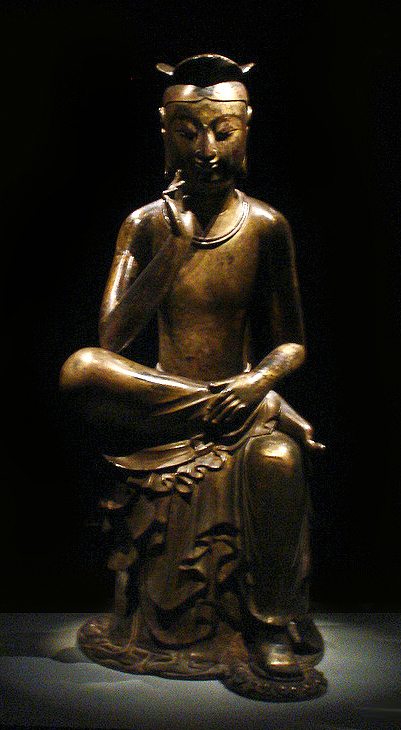
There are approximately 100 sophisticated ancient Silla cultural assets including Buddha statues, golden crowns and ornaments such as belts, rings and earrings on exhibit in New York.  I surmise that the highlight of the display at the Metropolitan Museum of Art is Korea’s National Treasure No. 83, the precious ”Geumdong Mireuk Bosal Banga-sang,” the gilt-bronze Pensive Maitreya Bodhisattva in Meditation.
This statue is regarded as one of the greatest masterpieces of all Korean Buddhist sculpture. It was discovered in the 1920s in Gyeongju, the ancient capital of Silla. It measures 93.9 cm tall and was made in the 7th century.
The Bodhisattva image is in profound contemplation and its facial features are not very happy. It seems to depict human anguish. However, when I look more closely, I see a mysterious smile on his indescribably peaceful face. In a sense, the figure shows a holiness that cannot be easily described in words.  The Pensive Maitreya Bodhisattva in Meditation statue reminds me of Rodin’s famous sculpture “The Thinker.”
Rodin’s “Thinker” is a solitary thinker, sitting all by himself. The nude figure sits in intense contemplation, twisting awkwardly, resting his right elbow on his left knee. Rodin’s statue is a powerful yet enigmatic figure in profound concentration. The pose of “The Thinker”, like the Pensive Buddha statue, leads us into thoughtful quiet and contemplation.
It is presumed that the Pensive Bodhisattva statue style originated in India because the statue suggests the way Shakyamuni is assumed to have lost himself in deep thought while reflecting on the evanescence of human life when he was the young Crown Prince “Siddhartha” prior to renouncing the world.
This gilt-bronze Maitreya Bodhisattva statue was almost excluded from the New York exhibit because of one administrator’s fear that the statue could be damaged in transit. However, after heated debates among cultural experts in Korea, the objection of the former head of the Cultural Heritage Administration of Korea was overridden.
I hope this revered statue will evoke peace, harmony, love, and good fortune for 2014 with its serious posture and graceful, calm smile. Our Korean Maitreya Bodhisattva looks vibrant and engaged in real life, almost like it is alive.
The smiling statue is the apex of historical, religious, artistic and aesthetic values. May 2014 be the year North and South Korea unite as one peaceful nation in the Maitreya’s (friendly) vision.
Choe Chong-dae is a guest columnist of The Korea Times and the president of Dae-kwang International Co., as well as a director of the Korean-Swedish Association. He can be reached at dkic98@chol.com

A Bodhisattva is the symbol of compassion who seeks enlightenment while also trying to save all sentient beings by spreading the Buddha’s teachings. The Maitreya Bodhisattva is also referred to as the Ilsaengpoch’ (一生補處; Eka-jati-prati-baddha) Bodhisattva, meaning that the Matireya Bodhisattva will be the next Buddha after the Shakyamuni Buddha. According to the Mirukhasaengkyong sutra(彌勒下生經) and the Kwanmirukposal Sangsaengtosolch’onkyong sutra(觀彌勒菩薩 上生兜率天經), the Maitreya Bodhisattva was born in Varanasi in southern India to a Brahman family. He received the teachings from the Shakyamuni Buddha who predicted that he would become the next Buddha. The Maitreya Bodhisattva then ascended to Tusita Heaven where he now teaches the Dharma to the Gods residing there. Tusita Heaven refers to a heaven of full knowledge and satisfaction, where no greed or worldly desires exist. The Gods there have perfect knowledge(吾唯知足)and do not need materials or external objects to be satisfied. According to tradition, the Matireya Bodhisattva will return to the Saba(secular) world 5 670 000 000 years after the death of the Shakyamuni Buddha. He will attain Buddhahood under the Naga-puspa(dragon-flower) tree in a lotus garden(華林園) and will save all sentient beings with 3 Dharma Talks. The Maitreya Bodhisattva is the epitomy of compassion in Mahayana Buddhism and was the one predicted to be the future Buddha by the Shakyamuni Buddha himself. The Maitreya Bodhisattva represents a very important figure in Buddhism. It is believed that if one dilligently cultivates one’s virtues in this lifetime, one will be reborn into Tusita Heaven where he/she will meet the Maitreya Bodhisattva. Furthermore he/she will also be present at the Maitreya Bodhisattva’s first Dharma Talk after his enlightenment and attain enlightenment himself. Hence the tradition of worshipping the Maitreya, Amitab ha and Avalokitesvara Bodhisattvas remains strong among the Buddhist populace even today.

Are you cut out to be successful? Many people say they want to be successful, however, only a handful are truly willing to walk through fire to achieve it

Updated: Tuesday January 21, 2014 MYT 10:49:40 AM

Are you cut out to be successful?

BY PAM SIOW

While many say they want success, few are willing to walk through fire to achieve it. – AFPpic

YOU ARE not alone if you want to be a success. And while success means different things to different people, financial independence, more time to enjoy friends and family, and a low-stress lifestyle definitely help to create a fulfilled life. Read more of this post

Ben Franklin’s 13 Virtues and the systematic way he approached them

The Thirteen Virtues

by SHANE PARRISH on JANUARY 15, 2014

In The Autobiography of Benjamin Franklin, we find a list of thirteen virtues “all that at that time occurr’d to me as necessary or desirable.”

These names of virtues, with their precepts, were:

1. TEMPERANCE. Eat not to dullness; drink not to elevation.
2. SILENCE. Speak not but what may benefit others or yourself; avoid trifling conversation.
3. ORDER. Let all your things have their places; let each part of your business have its time.
4. RESOLUTION. Resolve to perform what you ought; perform without fail what you resolve.
5. FRUGALITY. Make no expense but to do good to others or yourself; i.e., waste nothing.
6. INDUSTRY. Lose no time; be always employ’d in something useful; cut off all unnecessary actions.
7. SINCERITY. Use no hurtful deceit; think innocently and justly, and, if you speak, speak accordingly.
8. JUSTICE. Wrong none by doing injuries, or omitting the benefits that are your duty.
9. MODERATION. Avoid extreams; forbear resenting injuries so much as you think they deserve.
10. CLEANLINESS. Tolerate no uncleanliness in body, cloaths, or habitation.
11. TRANQUILLITY. Be not disturbed at trifles, or at accidents common or unavoidable.
12. CHASTITY. Rarely use venery but for health or offspring, never to dulness, weakness, or the injury of your own or another’s peace or reputation.
13. HUMILITY. Imitate Jesus and Socrates.

As for how to acquire these virtues, Franklin advised:

My intention being to acquire the habitude of all these virtues, I judg’d it would be well not to distract my attention by attempting the whole at once, but to fix it on one of them at a time; and, when I should be master of that, then to proceed to another, and so on, till I should have gone thro’ the thirteen; and, as the previous acquisition of some might facilitate the acquisition of certain others, I arrang’d them with that view, as they stand above. Temperance first, as it tends to procure that coolness and clearness of head, which is so necessary where constant vigilance was to be kept up, and guard maintained against the unremitting attraction of ancient habits, and the force of perpetual temptations. This being acquir’d and establish’d, Silence would be more easy; and my desire being to gain knowledge at the same time that I improv’d in virtue, and considering that in conversation it was obtain’d rather by the use of the ears than of the tongue, and therefore wishing to break a habit I was getting into of prattling, punning, and joking, which only made me acceptable to trifling company, I gave Silence the second place.

What wisdom would you pass along to the world if you knew you were going to die soon

Achieving Your Childhood Dreams

by SHANE PARRISH on JANUARY 16, 2014

The “last lecture” is common with a lot of professors on college campuses. Professors are asked to consider what matters most to them. If you’ve ever sat in the audience for one of these lectures you can’t help but wonder what wisdom you’d want to impart to the world if it was your last chance? Read more of this post

The ski bums who understood the bottom line; how two friends build the global brand Fat Face

January 20, 2014 5:57 pm

The ski bums who understood the bottom line

By Lina Saigol and Andrea Felsted

Being a ski bum isn’t always a slippery slope.

For Tim Slade and Jules Leaver, it led them to establish an active casual wear clothing company recognisable across the globe. It all began in 1988 in the French ski resort of Méribel, where the two self-confessed ski bums were hanging around on the slopes and avoiding real work. But, finding themselves in need of cash, the pair started printing sweatshirts and fleeces with the slogan ‘Méribel ‘88’, which they planned to sell out of their rucksacks, allowing them to fund their winter hobby. Read more of this post

What eating tells you about people around you

SoShiokMon, Jan 20 2014

What eating tells you about people around you

Do you know you can tell what a person is like just by having a meal with them? According to a report by Huffington Post, people’s eating habits say more about them than they voluntarily disclose. Like that person who needs to know what everyone else is ordering before deciding on what to eat for themselves. Sounds familiar? Read more of this post

30 Lessons For Living

30 Lessons For Living

by SHANE PARRISH on JUNE 18, 2013

Who are the wisest Americans and what can they teach us?

We’re all interested in finding the right partner, staying with them, and (maybe even) raising children who turn out well.

Karl Pillemer wrote 30 Lessons for Living: Tried and True Advice from the Wisest Americans to provide us with practical advice from the experts about how to make the most out of life. (I had the chance to interview Karl as well.) Read more of this post

Why do we have such a problem with being alone? Personal freedom has never been more celebrated, yet we are terrified of being alone, and regard those who choose to be so with suspicion. Sara Maitland on the joy of solitude

Why do we have such a problem with being alone?

Personal freedom has never been more celebrated, yet we are terrified of being alone, and regard those who choose to be so with suspicion. Sara Maitland on the joy of solitude

Sara Maitland

The Guardian, Saturday 11 January 2014

I live alone. I have lived alone for more than 20 years now. I do not just mean that I am single – I live in what might seem to many people to be “isolation” rather than simply “solitude”. My home is in a region of Scotland with one of the lowest population densities in Europe, and I live in one of the emptiest parts of it: the average population density of the UK is 674 people per sq mile (246 per sq km). In my valley, we have (on average) more than three sq miles each. The nearest shop is 10 miles away, and the nearest supermarket more than 20. There is no mobile-phone connection and very little through-traffic uses the single-track road that runs a quarter of a mile below my house. On occasion, I do not see another person all day. I love it. Read more of this post

4 Little-Known Reasons Martin Luther King Was An Amazing Leader, Human: He Was a Systems Thinker

4 LITTLE-KNOWN REASONS MARTIN LUTHER KING WAS AN AMAZING LEADER, HUMAN

YOU ALREADY KNEW THAT TODAY IS THE 85TH BIRTHDAY CELEBRATION OF MARTIN LUTHER KING. BUT YOU DIDN’T KNOW THE ANGER, HUMOR, AND DEPTH OF INSIGHT IN THE MAN HIMSELF.

BY DRAKE BAER

Martin Luther King Jr. seems more legend than man. But if we peer into Dr. King’s life, we can see that he was more and less than myth: a person with interior complexity and exterior grace beyond what a textbook can tell you. So let’s get to know his intense, hilarious, and prescient sides below. Read more of this post

Malaysia’s God problem erupts, tarnishing moderate image

Malaysia’s God problem erupts, tarnishing moderate image

Sun, Jan 19 2014

By Stuart Grudgings

KUALA LUMPUR (Reuters) – The Sunday Mass at Our Lady of Lourdes Catholic church seems like a model for the multicultural, tolerant Malaysia that its government likes to present to the outside world. Read more of this post

From selling discarded golf balls and washing cars to online retail heavyweight: the story behind $315 million Ruslan Kogan

From selling discarded golf balls and washing cars to online retail heavyweight: the story behind $315 million Ruslan Kogan

January 20, 2014

Shane Green

An immigrants’ son done good, Ruslan Kogan has established himself as one of Australia’s top young business guns, writes Shane Green.

Ruslan Kogan remembers the challenge of the canal. As a child growing up in the public housing commission flats of Elsternwick in Melbourne’s south-eastern suburbs, the canal – or more precisely the ability to jump it – held the promise of a better, more efficient way. Bounding the canal meant a faster trip to primary school, compared to the longer, more routine journey via the bridge. “Your coming of age in the Elsternwick commission flats was when you were able to jump the canal,” says Kogan, “and nobody jumps it on their first go.” Read more of this post

How to Nurture a Child’s Special Abilities

How to Nurture a Child’s Special Abilities

It’s easy to turn athletic gifts into something negative

KATY MCLAUGHLIN

Updated Jan. 18, 2014 9:15 p.m. ET

I went into labor with my first child, Paul, during the 2006 World Cup. We watched two games as I waited to give birth, my husband, Alejandro, on the edge of my hospital bed, breathless with excitement. He was really looking forward to the baby, too. Read more of this post

MOE reminds schools to be vigilant about student safety during PE

MOE reminds schools to be vigilant about student safety during PE

By Ng Jing Yng
POSTED: 20 Jan 2014 07:54
The Ministry of Education (MOE) has issued a circular to schools reminding them to stay vigilant about student safety during Physical Education lessons and co-curricular activities (CCAs), after two students died last week during PE lessons.

SINGAPORE: The Ministry of Education (MOE) has issued a circular to schools reminding them to stay vigilant about student safety during Physical Education lessons and co-curricular activities (CCAs), after two students died last week during PE lessons. Read more of this post

Swindlers Use Telephones, With Internet’s Tactics

Swindlers Use Telephones, With Internet’s Tactics

By NICK WINGFIELDJAN. 20, 2014

SEATTLE — Phone swindles are practically as old as the telephone itself. But new technology has led to an onslaught of Internet-inspired fraud tactics that try to use telephone calls to dupe millions of people or to overwhelm switchboards for essential public services, causing deep concern among law enforcement and other groups. Read more of this post

Why You Need To Go Ahead And Ditch The Mantra ‘Do What You Love’

Why You Need To Go Ahead And Ditch The Mantra ‘Do What You Love’

MIYA TOKUMITSUSLATE
JAN. 19, 2014, 4:31 PM 11,967 17

New college graduates often get told to “do what they love.”

“Do what you love. Love what you do.”

The command is framed and perched in a living room that can only be described as “well-curated.” A picture of this room appeared first on a popular design blog and has been pinned, tumbl’d, and liked thousands of times. Though it introduces exhortations to labor into a space of leisure, the “do what you love” living room is the place all those pinners and likers long to be. Read more of this post

Australian scientists microchip bees to map movements, halt diseases

Australian scientists microchip bees to map movements, halt diseases

Wed, Jan 15 2014

By Thuy Ong

SYDNEY (Reuters) – Australian scientists are gluing tiny sensors onto thousands of honey bees to track their movements in a trial aimed at halting the spread of diseases that have wiped out populations in the northern hemisphere. Read more of this post

Carpe diem and YTT

2014-01-20 17:35

Carpe diem and YTT

Lee Sun-ho
A common Latin saying is “carpe diem.”  The phrase means “seize the day” as an end-of-the-year slogan or a New Year’s life resolution aimed at achieving something like the dream for a galloping blue horse. It is used as a motto to enjoy the pleasures of the moment without much concern for the future.
Carpe diem is taken from a poem published in 23 B.C. by the Latin poet Horace (65~8 B.C.). In Horace, the phrase is part of a longer credo, which can be translated literally as, “Pluck the day and put little trust in tomorrow.”  The ode says that the future is unforeseen and that one should not leave to chance future happenings, but rather one should do all one can today to make their future better. Read more of this post

Road to redemption: How McDonald’s’ once down-and-out brand recaptured hearts and minds

Road to redemption: How McDonald’s’ once down-and-out brand recaptured hearts and minds

Dan Ovsey | January 21, 2014 7:00 AM ET
When John Betts took over McDonald’s Canada in 2008 after successfully refurbishing the chain’s breakfast markets in the U.S., the relevance of the fast-food brand to Canadians was rapidly dwindling. Since then, the company has seen a grand renaissance among breakfast patrons spurred by the introduction of McCafe. That success allowed the company to overhaul the operations of more than 1,000 Canadian restaurants, add a higher quality, premium line to its menu and remodel its dining rooms to attract younger consumers. Mr. Betts recently sat down with FP’s Dan Ovsey at the chain’s new two-story, 9,000 square foot restaurant on Toronto’s Yonge Street to discuss the evolution of the brand’s transformation and how it was achieved without runaway costs, Mr. Betts’ collaboration with owner-operators to make operational improvements, the chain’s nominally shifting consumer demographics, and the company’s move toward more transparent customer service. Following is an edited transcript of their conversation. Read more of this post

Former Jianlibao chairman Zhang Hai flees China

Former Jianlibao chairman Zhang Hai flees China

Staff Reporter

2014-01-21

Former Jianlibao chairman Zhang Hai. (Photo/CNS)

Officials in southern China’s Guangdong province have confirmed that Zhang Hai, the former chairman of energy drink manufacturer Jianlibao Group, has fled the country after submitting fabricated evidence to receive a reduced sentence, reports the Shanghai-based National Business Daily. Read more of this post