Multiplexes rake in the rupees in Bollywood-mad India

Multiplexes rake in the rupees in Bollywood-mad India

4:06pm EST

By Nandita Bose and Abhishek Vishnoi

MUMBAI (Reuters) – For a country that produces twice as many movies a year as Hollywood, India has a problem that’s making cinema theatre operators beam: a shortage of modern multi-screen cinemas and plenty of increasingly affluent film fans. Multiplex operators like PVR Ltd, Inox Leisure, Reliance Mediaworks and Mexican chain Cinepolis are scrambling to set up theatres targeting the rapidly growing number of middle-class Indians willing to pay to watch Bollywood movies in more comfortable surroundings. Read more of this post

Billionaire Birla Said to Delay Idea Share Sale: Corporate India

Idea Said to Delay $482 Million Share Sale After Stock Declines

Idea Cellular Ltd. (IDEA), India’s second-largest listed mobile-phone operator, delayed plans to raise as much as 30 billion rupees ($482 million) in a stock sale after its shares fell, said two people with knowledge of the matter. The company, controlled by billionaire Kumar Mangalam Birla, may start the sale to institutions next year after originally aiming to complete it this month, said the people. They asked not to be identified because the deliberations are private. Idea shares dropped as much as 17 percent from an Oct. 15 all-time high before rebounding in the past week. The stock is still down 7.5 percent from last month’s 188.40 rupees peak, data compiled by Bloomberg show. Mumbai-based Idea had aimed to shell shares for least 190 rupees each, one person said. Bank of America Corp., Citigroup Inc., Morgan Stanley, Standard Chartered Plc, JPMorgan Chase & Co. and Axis Bank Ltd. are managing the share sale, the people said. Rajat Mukarji, a spokesman for Idea, declined to comment. Idea announced plans in August to raise money through a share sale to institutional investors. The company will also sell as much as 7.5 billion rupees of stock to an existing shareholder, Malaysia’s Axiata Group Bhd., according to a statement at the time.

To contact the reporter on this story: George Smith Alexander in Mumbai at galexander11@bloomberg.net

China’s slowdown is not just affecting the mainland – its shift in economic gears has also put a brake on the velocity of the Hong Kong stock market

November 19, 2013 6:45 pm

Hong Kong’s gears grind slowly

By Paul J Davies in Hong Kong

China’s slowdown is not just affecting the mainland – its shift in economic gears has also put a brake on the velocity of the Hong Kong stock market. This velocity measure – the turnover of the market divided by its total value – is close to its weakest level in a decade, according to Morgan Stanley. For the exchange itself, this is bad news – holding back its earnings both last year and this to a level below that recorded in 2011. Read more of this post

Wenzhou fake tycoon Lin Chunping gets life in jail for fraud

Wenzhou fake tycoon Lin Chunping gets life in jail for fraud

Wednesday, 20 November, 2013, 3:48am

Jeremy Blum jeremy.blum@scmp.com

The Wenzhou rice trader who invented a fictitious US bank which he claimed to have bought last year has been sentenced to life imprisonment yesterday for the separate crime of issuing fabricated tax documents. Lin Chunping during trial in the Wenzhou Intermediate People’s Court. Photo: Screenshot via Sina WeiboLin Chunping, 43, was accused of making 1,266 false value-added tax invoices worth 520 million yuan (HK$658 million) and selling them to companies across the country between September 2011 and May last year for profit, Xinhua reported, citing the city’s intermediate court verdict. Read more of this post

To Curb Graft, Party to Consider Changes to Official Housing System

11.20.2013 15:25

To Curb Graft, Party to Consider Changes to Official Housing System

Professor’s idea to provide homes for more leaders – then make sure they move out after they leave office – made it into plenum document

By staff reporter Zhou Tian

(Beijing) – The ruling Communist Party will explore ways to provide housing to officials as a way of trying to curb property-related graft, a document released after a major party meeting says. The idea for the system comes from Wang Yukai, a professor at the Chinese Academy of Governance, an institution in the capital that trains government officials. Wang proposed the idea to the party’s 18th Central Committee in July. His ideas were presented in an essay that explored how officials’ housing was handled abroad and in ancient China, and the feasibility of implementing new approaches. Read more of this post

The Booming Bottled Water Business Represents Everything That’s Wrong With Government Regulation In China

The Booming Bottled Water Business Represents Everything That’s Wrong With Government Regulation In China

MAMTA BADKAR NOV. 19, 2013, 4:49 PM 1,663 3

The bottled water business has boomed in China as concerns about contaminated water sources persist. Sales of bottled water are expected to surge to $16 billion by 2017, from $9 billion last year, according to Euromonitor International. “This water story illustrates how much China’s economy is distorted by unhealthy government power,” writes Andy Xie, independent economist and former Morgan Stanley chief Asia-Pacific economist, in Caixin Online. Read more of this post

Oberweis Defies Muddy Waters by Doubling Down on NQ Mobile

Oberweis Defies Muddy Waters by Doubling Down on NQ

Jim Oberweis, whose China-focused fund is the best performer this year, said he’s doubled his stake in NQ Mobile Inc. (NQ), betting that claims by Muddy Waters LLC about the company’s finances are unfounded. Oberweis Asset Management Inc. increased its holding to 1.8 million shares of NQ Mobile, from 990,894 on Sept. 30, he said in a telephone interview on Nov. 18 from Lisle, Illinois. This would make the firm the second-largest shareholder with a 5.8 percent stake, according to data compiled by Bloomberg. His China Opportunities Fund has returned 53 percent this year. Read more of this post

Jim Rogers: I’m Buying Chinese Stocks Including HollySys And Fab Universal

Jim Rogers: I’m Buying Chinese Stocks Including HollySys And Fab Universal

November 19, 2013

In this episode of China Money Podcast, returning guest and veteran investor Jim Rogers, chairman of Rogers Holdings, talked with our host Nina Xiang on his reading of China’s third plenum meeting, why China should open its financial markets completely “this afternoon”, and what Chinese stocks he has been buying lately.

Q: The just completed third plenum meeting provided a road-map for China’s future reforms. It created this renewed sense of optimism about China’s future. Do you share that feeling?

A: I was quite delighted to see what they said. The one overriding point is that the market is going to make the final decision. That is contrary to what is happening in the U.S., and that is why the world is moving to Asia. Read more of this post

Chinese Skeptics Deepening Biggest A-Share Discount in 3 Years

Chinese Skeptics Deepening Biggest A-Share Discount in 3 Years

China’s largest package of economic reforms since the 1990s is getting a bigger vote of confidence from foreign investors than from the nation’s own citizens. The benchmark index for Chinese stocks traded in Hong Kong has jumped 6.2 percent, more than twice the Shanghai gauge, since policy makers led by President Xi Jinping pledged to ease China’s one-child policy and liberalize interest rates on Nov. 15. That left mainland shares valued at a 5.8 percent discount, the most in three years, according to the Hang Seng China AH Premium Index. Read more of this post

China’s top leaders are giving the go-ahead to create new, privately held banks, opening up a sector that has been mostly off-limits to private capital and indirectly acknowledging that the current system isn’t working.

China Clears a Path for New Banks

Government, Seeking to Expand Access to Credit, to Permit Creation of Lenders

DINNY MCMAHON

Updated Nov. 19, 2013 9:57 p.m. ET

MI-BZ789_CBANKS_NS_20131119170904

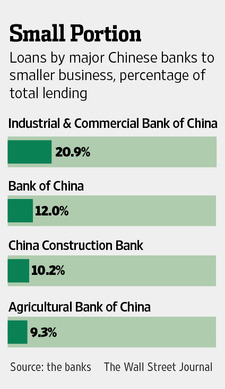
BEIJING—After decades of relying on state banks, China’s top leaders are giving the go-ahead to create new, privately held banks, opening up a sector that has been mostly off-limits to private capital and indirectly acknowledging that the current system isn’t working. A program endorsed last week by the Communist Party leadership calls for letting private investors that meet certain as-yet-undefined requirements set up small and medium-size banks and other financial institutions. Read more of this post

China To Ban Another Off-Balance Sheet Bank Channel

China To Ban Another Off-Balance Sheet Bank Channel: Press

Created on Monday, November 18, 2013 – 21:54 EST

BEIJING (MNI) – New rules limiting borrowing and lending practices in the Chinese interbank market may not be as draconian as previously feared but will still close off a channel which currently allows banks to transfer assets off their balance sheets, according to Caijing magazine. The weekly says that, according to newly finalized rules from the China Banking Regulatory Commission (CBRC), banks will no longer be allowed to use tri-party agreements to transfer those assets off, but won’t ban the agreements outright as the interbank market had rumored. Read more of this post

China Has ‘High’ Chance of Small Bank Failure, Official Says

China Has ‘High’ Chance of Small Bank Failure, Official Says

One or two small Chinese banks may fail next year as they face pressure from their reliance on short-term borrowing, a Communist Party economic official said. Small banks get about 80 percent of their funding from interbank markets and deposits in savings vehicles known as wealth management products, Fang Xinghai, a bureau director at the Central Leading Group for Financial and Economic Affairs, said at a conference in Beijing today. They face risks from the mismatch with their long-term loans to borrowers such as local-government financing vehicles, he said. Read more of this post

China Central TV: champion of the people with a blurred picture

November 20, 2013 3:15 am

China Central TV: champion of the people with a blurred picture

By FT reporters

At the end of October, a young journalist in handcuffs, green prison jacket and a freshly-shaved head appeared on China Central Television, the state-owned national broadcaster, and confessed to taking bribes in exchange for writing negative articles about a large Chinese company. Just days earlier, the newspaper that employed Chen Yongzhou, 27, had published front-page banner headlines calling for his release, while human rights groups had mobilised to defend him. But after his admission on national television, the issue quickly died away. Read more of this post

China banks forced to delay or dramatically reduce Chinese bond issues as the impact of a tight onshore credit market begins to be felt

November 19, 2013 9:34 am

China banks forced to delay bond issues

By Paul J Davies in Hong Kong and Simon Rabinovitch in Shanghai

China Development Bank and fellow state policy lender Agricultural Development Bank of China have had to delay or dramatically reduce Chinese bond issues as the impact of a tight onshore credit market begins to be felt. The China Railway Corporation, another state entity, was forced to delay a deal recently, while well-known private companies including the electric carmaker BYD and internet company Baidu also saw deals delayed over the summer, according to bankers familiar with the situation. Read more of this post

China baby boom fears outweigh evidence of falling fertility rates

November 19, 2013 1:32 pm

China baby boom fears outweigh evidence of falling fertility rates

By Lucy Hornby

Fears of a baby boom are leading China to keep a tight grip on family size, with only a minor relaxation in the Communist party’s one-child policy despite evidence that birth rates have already fallen faster than intended. The party announced on Friday that couples where one spouse is an only child may have a second child, a policy change that could result in about 1m additional births a year but still fundamentally limits most couples’ ability to choose. Read more of this post

CBRC Promotes Interbank De-leveraging; Interbank business is just another channel for banks in their never-ending quest to circumvent regulatory controls, which is becoming increasingly complex and hidden

CBRC Promotes Interbank De-leveraging

11-19 14:15 Caijing

Interbank business is just another channel for banks in their never-ending quest to circumvent regulatory controls, which is becoming increasingly complex and hidden.

By staff reporters Dong Yuxiao and You Xi

Interbank financing has surged in China in the past few years, spurring banking regulators to introduce regulatory policies that will tighten their grip on interbank operations and limit growth of banks’ off-balance sheet assets. Caijing learned that relevant authorities at the China Banking Regulatory Commission (CBRC) have drafted the Interbank Financing Management Rules for Commercial Banks (the “Rules”). The Rules are expected to be approved and implemented in Feb. 2014 after being submitted to CBRC leadership in November. Read more of this post

Anger and Angst in Hospitals Where Doctors Die; Another deadly stabbing has forced soul-searching over China’s overcrowded hospitals and their underpaid doctors

11.20.2013 15:51

Anger and Angst in Hospitals Where Doctors Die

Another deadly stabbing has forced soul-searching over China’s overcrowded hospitals and their underpaid doctors

By staff reporters Lan Fang, Li Yan, Luo Jieqi, Ren Zhongyuan and Lin Jinbing and intern reporter Han Xiaomei

(Beijing) – There was a time when the words of the Hippocratic Oath meant a lot to Dr. Wen Mei. She’ll never forget standing proudly with her classmates, each in a sparkling white coat, and reciting the oath in unison on their first day of medical school. Wen’s idealistic school days are long gone. Like many hospital doctors in China, she’s had to change her perspective in the face of harsh workplace conditions, including dangers posed by angry patients, overcrowding that some experts say is behind a patient rage phenomenon in China, and puny salaries. Read more of this post

Will China and India Destroy the World?

Will China and India Destroy the World?

As Lawrence Summers makes a splash with a new research report about China and India, I’m reminded of a chat we had in Japan in May 2007. We were in Kyoto, where the Asian Development Bank was holding its annual meeting. I moderated a panel discussion, and Summers was asked to join us for the last 30 minutes to offer his take on the next wave of Asian tiger economies. Summers isn’t known for subtlety, and he bluntly questioned whether it was wise for rich nations to be shored up financially by developing ones in Asia that could crash at any time. The crowd was aghast. It was as if he’d belched into the microphone. Read more of this post

Tsunami-Blocking Mangroves Lure Carbon Investors: Southeast Asia; “Where the mangroves are, the people are happy”

Tsunami-Blocking Mangroves Lure Carbon Investors: Southeast Asia

Replanted mangrove trees in Southeast Asia are getting credit for protecting against deadly tsunamis and typhoons such as Haiyan in the Philippines and cutting greenhouse gas emissions. Mangrove regeneration in Northern Samar, about 100 miles (160 kilometers) north of the worst-hit Philippine city of Tacloban, helped minimize damage from the Nov. 8 storm, according to the Trowel Development Foundation, which oversaw the plantings. On Indonesia’s Sumatra island, where a 2004 tsunami killed 170,000 residents, companies including Danone and Credit Agricole SA (ACA) have put up about $4 million in exchange for tradable carbon offsets tied to the reforestation. Read more of this post

Large Investors Find Asian Hedge-Fund Options Limited

Large Investors Find Asian Hedge-Fund Options Limited

Asian Hedge Funds Are Performing Well, but Large Ones Are in Short Supply

MIA LAMAR And CHAO DENG

Updated Nov. 19, 2013 9:06 p.m. ET

Large overseas investors can’t get enough of big-name Asian hedge funds. Too bad there aren’t more of them. Deep-pocketed pension and endowment funds—many from the U.S.—are coming to Asia in droves, ready to put cash in the region’s hedge funds as the industry rounds out what is shaping up to be a second straight year of outperforming peers in the U.S. and Europe. Read more of this post

Asia’s New Aging Rich Break Family Bonds for Gilded Retirement

Asia’s New Aging Rich Break Family Bonds for Gilded Retirement

After P.S. Ramachandran turned 80, he and his wife decided it was time to stop living alone. Rather than take the traditional path of moving in with their son, the Ramachandrans chose an option once rare in India: a retirement community. “We wanted to be independent,” said Ramachandran, now 85, a former government official who moved to the Brindavan Senior Citizen Foundation’s retirement village overlooking the Nilgiri hills near Coimbatore city in southern India. “We have company and everything we need here, and activities to keep us busy as long as we’re physically able.” Read more of this post

Ritholtz: Warren Buffett’s Exxon Bungle

Warren Buffett’s Exxon Bungle

By Barry Ritholtz  Nov 20, 2013

How often do you make a decision to sell something for a giant gain? Quite a few times across the arc of a career, if you are a half-decent investor. But how often is that sell decision a terrible mistake? Today, I want to tell the tale of Warren Buffett’s bungled profit-taking in Exxon. We all have war stories of the profitable sale that should never have been made. I took profits in a 2001 purchase of Apple at $15 (pre-split) at $43 to buy a house. (It was post-iPod, pre-iPhone). So who am I to criticize the sale of XOM? Read more of this post

CHANOS: Big Oil Companies Are The Next Value Trap

CHANOS: Big Oil Companies Are The Next Value Trap

KATYA WACHTELREUTERS NOV. 19, 2013, 10:08 PM 3,741 9

NEW YORK (Reuters) – Short-seller Jim Chanos said Tuesday it is time for typical equity investors to be “a little more cautious” even as the stock market may continue to rise. Chanos, speaking the Reuters Global Investment Outlook Summit in New York said his fund Kynikos Associatesis “very bearish on coal” and he is “pretty much short” all the U.S. leveraged coal companies. Chanos also said he was bearish on national oil companies and the integrated majors like Exxon-Mobil, which he said are experiencing a “dropping return on capital” that “is really ominous.” The famous short-seller said Exxon-Mobil and other oil companies like it increasingly look like “value trap.” He also said investors would be “well warned” to analyze Caterpillar Inc’s financial unit.

Why The Retail Industry Can’t Keep Up With Zara

Why The Retail Industry Can’t Keep Up With Zara

ASHLEY LUTZ NOV. 19, 2013, 4:57 PM 3,392 1

Brands like Zara are rapidly expanding, while other specialty retailers struggle to get customers in stores. A recent report by Goldman Sachs perfectly sums up why fast fashion retailers are challenging traditional ones. “Unlike fast fashion retailers which have buying teams sourcing current trending fashion from third-party vendors, traditional specialty retailers have design teams creating product they believe is going to be trending 12-months out,” the researchers write.  Read more of this post

Paul Smith, 60 percent owner of a fashion house with sales of $288 million; Smith opened his tiny first store in Nottingham back in 1970 with future wife Pauline, a Royal College of Art graduate who became a lifelong influence

Paul Smith Collects Banksy, No Slave to Shareholders

Paul Smith picked an unlikely venue for his first international collection in 1976: an unglamorous ground-floor hotel room in Paris’s Latin Quarter. “I laid some black fabric over the bed, laid out my shirts, and two pieces of knitwear and two jackets in the wardrobe, and sat there, and nobody came!” recalls the designer with a laugh. On the last day, “one person came at four o’clock in the afternoon, and I was off. That was the start.” Read more of this post

For the first time in at least 10 years, Tesco, Asda, Sainsbury’s and Morrisons are all losing market share

New landscape for ‘big four’ supermarkets

For the first time in at least 10 years, Tesco, Asda, Sainsbury’s and Morrisons are all losing market share

By Telegraph View

11:47PM GMT 19 Nov 2013

Britain’s supermarket industry has entered a new era. For the first time in at least 10 years, Tesco, Asda, Sainsbury’s and Morrisons are all losing market share, according to Kantar. This is not just a statistical anomaly, it is a reflection that the supermarket industry has become ex-growth. There are straightforward reasons for this. Between the 1950s and 2008, grocery retailers rushed to open new self-service stores and then out-of-town supermarkets across the country. Read more of this post

Tea traders hope for imminent recovery

November 20, 2013 9:10 am

Tea traders hope for imminent recovery

By Javier Blas in Nairobi

When Williamson Tea Kenya, one of the biggest growers of the leaf in Africa, released its quarterly results earlier this month, it had a blunt warning: the price drop to a five-year low had created a “commercially unsustainable” market. The agribusiness group was not exaggerating:black tea prices have tumbled more than 40 per cent since January as top importers Pakistan and Egypt cut purchases just as output surged on the back of favourable weather in late 2012 and early 2013. Read more of this post

Oysters Boom as Raw Bars Drive Demand for More Varieties

Oysters Boom as Raw Bars Drive Demand for More Varieties

“Everyone’s growing oysters,” Chris Quartuccio says over his shoulder as he paddles a neon-orange kayak across Long Island’s Great South Bay, where he’s raising some 300,000 Blue Island oysters on the shallow seafloor, 50 miles east of Manhattan. He might be right. Close to a hundred oyster farms have sprung up during the past decade or so, in bays, creeks and tidal ponds strung along the Atlantic seaboard from Virginia to Canada’s Prince Edward Island, Bloomberg Pursuits magazine will report in its Holiday 2013 issue. Read more of this post

Coal Seen as New Tobacco Sparking Investor Backlash: Commodities

Coal Seen as New Tobacco Sparking Investor Backlash: Commodities

About $8 trillion of known coal reserves lie beneath the earth’s surface. The companies planning to mine and burn them are being targeted by a growing group of investors concerned with the greenhouse gases that will be made. Storebrand ASA (STB), which manages $74 billion of assets from Norway, sold out of 24 coal and oil-sands companies since July including Peabody Energy Corp. (BTU), the largest U.S. coal producer, citing a desire to cut fossil-fuel industry holdings. This month Norway’s opposition Labour Party proposed banning the country’s $800 billion sovereign wealth fund from coal investments. Read more of this post

Bitter aftertaste in Myanmar Breweries JV follows F&N takeover by Thai tycoon

Bitter aftertaste follows F&N takeover

20131119_myanmar_Bloomberg

Wednesday, Nov 20, 2013

Goh Eng Yeow

The Straits Times

For those who make it to the big time, reputation is everything. In fact, it is priceless. So publicity-shy Thai billionaire Charoen Sirivadhanabhakdi must find extremely discomfiting the bad publicity dogging Fraser & Neave (F&N). He now owns 90.3 per cent of the conglomerate after mounting a costly $13.7 billion takeover which ended in February. Read more of this post