Bank stress tests should address government debt holdings: Weidmann; sovereign debt holdings should over the medium term be treated the same way as corporate bonds, which are not treated as a risk-free asset

Bank stress tests should address government debt holdings: Weidmann

3:50pm EDT

DARMSTADT, Germany (Reuters) – The upcoming European bank stress tests should address banks’ holdings of sovereign debt, European Central Bank Governing Council member Jens Weidmann said on Wednesday. The ECB will run a series of checks on banks’ balance sheets before it will take up responsibility as the euro zone’s banking supervisor late next year and Weidmann said the tests would be a success if afterwards trust returned to the sector. “And this should also include for example that the stress test also stresses government bonds, which is currently under discussion,” Weidmann said without providing further detail for how exactly such holdings should be looked at. Weidmann, also the head of Germany’s Bundesbank, said in a speech banks’ sovereign debt holdings should over the medium term be treated the same way as corporate bonds, which are not treated as a risk-free asset. Currently Basel-III bank rules treat sovereign debt as a risk-free asset, which means that banks do not have to allocate extra capital to compensate for a potential loss in value.
 

Is It Wrong for Shareholder Value to Rule Business Thinking?

Is It Wrong for Shareholder Value to Rule Business Thinking?

Oct 30, 2013 Strategic Management Video

It has been a business maxim for years: Shareholder value trumps all when it comes to measuring corporate success. But by overrating shareholder value, management could focus too much on short-term stock price measures, given that outsized executive compensation often is fueled by stock options. And focusing too much on the short term can hurt a business over the long run, says Eric W. Orts, a Wharton professor of legal studies and business ethics. There are better measures of corporate success, he points out in an interview with Knowledge@Wharton about his new book, Business Persons: A Legal Theory of the Firm.

An edited transcript of the conversation follows. Read more of this post

Exchange Failure Prompts Commodity Bourse Audit: Corporate India

Exchange Failure Prompts Commodity Bourse Audit: Corporate India

India’s commodities futures market regulator has sought an audit of the Multi Commodity Exchange of India Ltd. after a related spot bourse failed in August. The Forward Markets Commission wants to examine large expenditures by the MCX and related-party transactions, Ramesh Abhishek, chairman of the regulator said in an interview. The MCX has set up a panel to run the bourse after the government in July ordered the National Spot Exchange Ltd., founded by MCX Vice Chairman Jignesh Shah, to halt trading. Read more of this post

U.K. Considers 0.75% Cap on Pension-Fund Charges to Help Savers

U.K. Considers 0.75% Cap on Pension-Fund Charges to Help Savers

The U.K. Treasury is to examine the case for capping the fees that pension funds are allowed to charge savers, in an effort to prevent exploitation of a new auto-enrollment system. Starting in April 2015, every employee will be signed up for a pension plan unless he or she opts out. According to the Treasury, this will mean as many as 9 million people saving for a pension for the first time or increasing their savings, and an extra 11 billion pounds ($18 billion) invested each year. Read more of this post

OGX Bankruptcy Filing Caps Batista’s $30 Billion Demise

OGX Bankruptcy Filing Caps Batista’s $30 Billion Demise

The oil company that transformed Eike Batista into Brazil’s richest man filed for bankruptcy protection today, culminating a 16-month decline that wiped out more than $30 billion of his personal fortune. The filing by OGX Petroleo & Gas Participacoes SA (OGXP3) puts $3.6 billion of dollar bonds into default in the largest corporate debt debacle on record in Latin America. OGX, a startup based in Rio de Janeiro, filed documents in a Rio business tribunal today, Sergio Bermudes, a lawyer representing Batista, said by telephone. An official at OGX’s press office, who isn’t an authorized spokesperson, declined to comment. Read more of this post

Exxon: A Tiger That Doesn’t Change Its Stripes; Rewards of Consistency and Capital Discipline Are Enduring for Exxon Investors

Exxon: A Tiger That Doesn’t Change Its Stripes

Rewards of Consistency and Capital Discipline Are Enduring for Exxon Investors

SPENCER JAKAB 

Updated Oct. 30, 2013 2:36 p.m. ET

MI-BZ398_AOT_NS_20131030171203

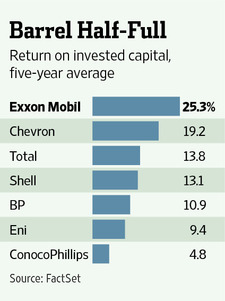
Hoping visitors simply wouldn’t notice, a Chinese zoo swapped its lion for a dog this summer. Owners of Exxon Mobil Corp. XOM -0.13% could be forgiven for thinking the energy giant has replaced the tiger in its tank with a pussycat. Over the past five years, the energy giant’s share price has lagged 46 percentage points behind a leading exchange-traded fund used to gain exposure to the oil-and-gas sector—quite a bit, considering Exxon is its largest holding. Thursday’s third-quarter results aren’t likely to help much if income from refining and marketing continues to sag. Read more of this post

Tanker Owners Scramble to Keep Up With Energy Boom; Rising North American Energy Exports Lead to Shipbuilding Frenzy

Tanker Owners Scramble to Keep Up With Energy Boom

Rising North American Energy Exports Lead to Shipbuilding Frenzy

COSTAS PARIS

Updated Oct. 30, 2013 9:53 a.m. ET

EM-AX689_USTANK_D_20131030073907

As the energy boom continues in North America, shipping operators and investors are now pouring billions of dollars into building new oceangoing tankers. Costas Paris explains the transforming product-tanker shipping demand. Photo: Getty Images

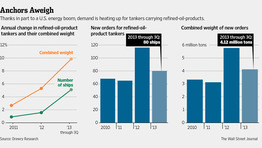
LONDON—Shipping operators and investors are pouring billions of dollars into building new oceangoing tankers to transport diesel, gasoline and aviation fuel—scrambling to keep up with North America’s energy boom. The shipbuilding frenzy is another knock-on effect of an energy revolution unfolding in the U.S. and Canada, where new drilling and extraction technology has unlocked vast new reservoirs of crude oil and natural gas. Read more of this post

Cash Crunch Crimps Struggling Cities; Fresno, Like Some Other Troubled Municipalities, Has Little Margin for Error

Cash Crunch Crimps Struggling Cities

Fresno, Like Some Other Troubled Municipalities, Has Little Margin for Error

TAMARA AUDI

Oct. 30, 2013 7:49 p.m. ET

NA-BY693_FRESNO_G_20131030182704

FRESNO, Calif.—In April, the mayor of this Central California city stood in front of municipal employees in a darkened room as bad news glowed on a large screen behind her. “Our problem is we have no money in the checking account at all,” Mayor Ashley Swearengin said to the silent room. “None.” The situation was so dire that covering an unexpected expense—a new air-conditioning unit or firetruck, for example—would mean slicing into the payroll or borrowing from another depleted city fund, she said. Read more of this post

FASB Chairman Pushes for Consistency in corporate disclosures

October 30, 2013, 4:18 PM ET

FASB Chairman Pushes for Consistency

By Emily Chasan

Senior Editor

The top U.S. accounting rule maker signaled this week he wants to focus on improving consistency in corporate disclosures, as the U.S. standard setter starts to move in a new direction. The Financial Accounting Standards Board is wrapping up a decade-long effort to bridge U.S. and international standards. Now Russell Golden, the new FASB chairman, intends to make it easier for investors to compare companies in different sectors with specific financial reporting needs. The board’s objective is to ensure investors have the information they need to make decisions about how to allocate capital among companies. Read more of this post

Focus on the extreme risks ‘that can kill you’ Towers Watson warns institutional investors

Extreme Risks – 2013

October 29, 2013 | Tim Hodgson

  • Extreme risks are potential events that are very unlikely to occur but could have a significant impact on economic growth and asset returns, should they happen.
  • Three of the risks are health related.
  • The starting point to building a robust investment portfolio and reducing tail risks is to introduce greater diversity.

This paper has focussed on the top 15 risks, but we acknowledge that it is not possible to anticipate all risks – by definition, there are ‘unknown unknowns’ out there that cannot be included even with the best analysis. The range of potential consequences of the identified risks is very wide. Local-endurable risks would be uncomfortable for institutions caught in the wrong locale, or with the wrong exposures, and would likely be enough to cause the weaker ones to become incapable of completing their mission. At the other end of the spectrum, global-crushing risks represent a systemic and potentially terminal outcome for investors. The value of this exercise, however, lies outside prediction. To navigate through this complex world, we suggest investors need to be open-minded, avoid concentrated risks, be sensitive to early warning signs, constantly adapt and always prepare for the worst.

Focus on the extreme risks ‘that can kill you’ Towers Watson warns institutional investors

Euro break-up and Killer pandemic out; Nuclear contamination and Extreme longevity in Read more of this post

Fund Managers May Face Multibillion-Dollar Research Costs

Fund Managers May Face Multibillion-Dollar Research Costs

Asset managers may no longer be able to pass on the multibillion-dollar costs to clients of the research they buy from investment banks, the chief executive officer of the U.K. markets regulator said. The Financial Conduct Authority is considering forcing global fund managers to pay for research instead of charging customers through trading commissions, Chief Executive Officer Martin Wheatley said in a speech today in London. Investment banks spent $5 billion last year on equity research used by asset managers, according to a report by Frost Consulting & Advisory and Quark Software Inc. Read more of this post

China’s Funding Woes Deepen; Bond Yields and Money Market Rates Hit Four-Month Highs

China’s Funding Woes Deepen

Bond Yields and Money Market Rates Hit Four-Month Highs

SHEN HONG

Updated Oct. 30, 2013 11:22 a.m. ET

SHANGHAI—Bond yields in China rose to four-month highs as poor demand for newly issued government debt triggered selling in a market where a shortage of funds had already pushed borrowing costs higher. But with investors betting that Communist Party leaders will unveil measures that could support stock prices after a meeting scheduled for Nov. 9-12, share prices shrugged off the rise in borrowing costs. Analysts say the increase is likely to be short-lived. Read more of this post

New Asian Crisis Looms and This Time the Fed Is to Blame

Oct 30, 2013

New Asian Crisis Looms and This Time the Fed Is to Blame

MICHAEL J. CASEY

Don’t look now, but another Asian crisis may be brewing–courtesy of the U.S. Federal Reserve.

A paper recently published by the Bank of International Settlements–a multilateral club of monetary authorities that includes the Fed–noted that central bank bond-buying, or “quantitative easing,” has made dollar-based loans so cheap that Asian companies are ramping up their borrowing in greenbacks. The paper’s authors fear that once the Fed and the Bank of Japan eventually turn off their liquidity taps, rising dollar interest rates will leave these Asian debtors unable to pay back the money.

That should trigger uncomfortable memories of the debt and currency “death spiral” of 1997-98, when plunging local currencies fueled a crisis in Asia that spread financial contagion around the world. Read more of this post

Who regulates the regulator in Singapore?

Who regulates the regulator?

October 30th, 2013

Share prices of Asiasons Capital, Blumont Group and LionGold Corp almost doubled in no-holds-barred trading… PHOTO: REUTERS. BT, 22/10/2013

The actions of Singapore Exchange (SGX), the market regulator, over the past three weeks have left many questions unanswered (“Penny stock drama likely to hold traders’ attention”; Monday). Why did it not take action when the prices of three locally listed companies – Blumont Group, Asiasons Capital and LionGold Corp – rose spectacularly? And why did it eventually decide to act and raise queries? Did its actions cause market panic, leading to the crash of these stocks? And why was the possibility of further probes announced only after the stocks resumed trading after their suspensions were lifted? Billions of dollars have been wiped out in a flash. Hasn’t the SGX learnt its lesson from the financial crisis in 2008 – that is, if you take your eye off the ball, there can be disastrous consequences? More importantly, does the regulator need regulation? The SGX has a lot of explaining to do, not only on the whats and whys of the recent fiasco, but also how it is going to prevent such incidents from happening again. The last thing Singapore needs is a reputation for poor market regulation.

Samuel Owen
* Letter first appeared in ST Forum (30 Oct).

Study Sheds Light on the Dark Side of China’s Urbanization

Study Sheds Light on the Dark Side of China’s Urbanization

RICHARD SILK

Oct. 30, 2013 11:10 a.m. ET

BEIJING—As many as 64 million Chinese households have had their land seized or their homes demolished during a decadeslong building boom, a study said, throwing an uncomfortable light on the dark side of the country’s urbanization process. China’s new generation of leaders, which took office in March, has championed urbanization as an engine of economic growth. China’s urbanization rate, at 53%, remains low by international standards. Bringing more workers from the agricultural sector into more productive work in cities could help lift China’s economic growth rate, which in 2012 fell to its slowest pace in more than a decade. Read more of this post

Chinese Banks’ Divided Capital; The divide in China’s banking system between the biggest and the rest is widening. Shareholders risk falling between the cracks

Chinese Banks’ Divided Capital

AARON BACK

Oct. 30, 2013 8:42 a.m. ET

The divide in China’s banking system between the biggest and the rest is widening. Shareholders risk falling between the cracks. The country’s largest state-owned banks appear reasonably well-capitalized. But balance sheets are looking precarious at the more nimble, midsize lenders. This is partly because the big-four state banks benefit from an uneven playing field. They are, for instance, the preferred channel for the central bank to inject short-term funds into the banking system. This means they can turn around and charge smaller banks high rates in the interbank market when liquidity is scarce, as happened in June’s credit crunch. Read more of this post

A potential deal for CVC Capital Partners CVC.UL to buy a majority stake in a Chinese restaurant chain highlights a growing willingness by smaller China firms to cede control to foreign private equity amid unfavorable IPO prospects

CVC-South Beauty talks show shift to majority stake sales in China

1:27am EDT

By Stephen Aldred and Prakash Chakravarti

HONG KONG (Reuters) – A potential deal for CVC Capital Partners CVC.UL to buy a majority stake in a Chinese restaurant chain highlights a growing willingness by smaller China firms to cede control to foreign private equity amid unfavorable IPO prospects. London-based CVC is in advanced talks to buy a majority holding in South Beauty Investment Co Ltd for $300 million, sources with knowledge of the matter told Reuters. Read more of this post

Why Laos Is Hyundai/Kia Country

October 30, 2013, 4:43 PM

Why Laos Is Hyundai/Kia Country

By Kanga Kong

Despite being South Korea’s third-largest export market, Southeast Asia is still best known in Korea for its golden beaches, temples and other tourist draws. But there’s a strong business link between the poorest country in the region and South Korea’s biggest car maker: According to estimates by the Korea Trade-Investment Promotion Agency, a Hyundai005380.SE -0.19%/Kia dealership calledKolao Holdings900140.SE 0.00% is the biggest nonstate company in Laos, where the government runs most businesses. Read more of this post

Mining CEO Pay Attacked by South African Fund Managers; “Costs are going up double digit, money is not coming in, yet we are seeing a big, big rise in executive pay.”

Mining CEO Pay Attacked by South African Fund Managers

South African fund managers overseeing almost $180 billion in assets said they are stepping up pressure on mining companies to curb executive pay as returns to shareholders dwindle. The industry “is going through a very, very hard period,” Fidelis Madavo, who helps manage about 1.4 trillion rand ($140 billion) at Public Investment Corp., South Africa’s state pension fund, said at a conference in Johannesburg yesterday. “Costs are going up double digit, money is not coming in, yet we are seeing a big, big rise in executive pay. We have been talking to CEOs individually on this.” Read more of this post

Thai Protest Against Amnesty Law May Attract 10,000 in Bangkok

Thai Protest Against Amnesty Law May Attract 10,000 in Bangkok

Thailand’s biggest opposition party said as many as 10,000 people will join a protest tomorrow against efforts to pass a law that it claims will benefit former leader Thaksin Shinawatra. Stocks fell to a three-week low. Parliament’s lower house will begin the second of three debates tomorrow on a bill that would give amnesty to people convicted of crimes linked to political clashes since the 2006 coup that ousted Thaksin. Protesters will gather at 6 p.m. local time in Bangkok, said Suthep Thaugsuban, a member of parliament for the opposition Democrat party. Read more of this post

Biggest Danish Pension Fund Girds for End to Crisis Stimulus

Biggest Danish Pension Fund Girds for End to Crisis Stimulus

Denmark’s biggest pension fund said investors need to brace themselves for potential disruptions once central banks start withdrawing the measures that have been propping up the global economy. “When the time for normalization of the monetary policy stance comes, investors may be faced with huge challenges,” ATP, based north of Copenhagen, said today in a statement on its website. “It is important to maintain a patient and flexible investment strategy in order to achieve positive returns.” Read more of this post

Emerging markets necessitate a rethink of business ducation

October 29, 2013 3:15 pm

Emerging markets necessitate a rethink of business education

By Mike Bastin

A collaboration between academics and regional specialists will better prepare students

With the global economy still sluggish in the west much of the talk about business success is focused on emerging markets.But are business schools in the west really preparing students for business success in China and elsewhere in Asia? Are they allocating sufficient time and resources to the teaching and understanding of such culturally different and changing business environments? And are business school academics suitably knowledgeable and experienced in emerging markets such as China? Read more of this post

Never lose the start-up mentality; Act like a start-up, even if you’re a well established company,

Never lose the start-up mentality

Act like a start-up, even if you’re a well established company, advises our entrepreneurial columnist.

Martin Luther King perhaps unwittingly captured the essence of the start-up spirit when he spoke of the “fierce urgency of now.” Photo: GETTY IMAGES

By Michael Hayman

9:09AM GMT 29 Oct 2013

My team is thrilled. The Start-ups 100, the listing of the most inspiring early stage businesses in Britain, has just ranked us as No.11. It’s a landmark for us. Not least because from next year we will cease to “officially” be a start up; we will have moved on to the ranks of the grown-ups. Indeed, some of the feedback we have had on the ranking is that many never really considered our firm as a struggling start-up anyway. We did, still do, and this is why. Read more of this post

China’s accounting industry matures with challenges

China’s accounting industry matures with challenges

(Xinhua)    20:51, October 29, 2013

China’s certified public accounting industry has grown to be worth over 50 billion yuansince the sector was re-established in the 1980s. Significant regulatory developments have accompanied its rapid progress. One regulatorystep China has taken ahead of Europe and the United States is mandatory rotation ofauditing irms.
The idea of forcing companies to change bookkeepers gained momentum after the 2008global financial crisis. Taxpayers were furious that some banks were given a clean bill ofhealth but later rescued using public cash. Read more of this post

Tom Friedman Is Too Optimistic About China’s Schools

Tom Friedman Is Too Optimistic About China’s Schools

By Adam Minter  Oct 29, 2013

The New York Times recently published “The Shanghai Secret,” a column by Thomas Friedman that explained how Shanghai’s students received the world’s top scores on the 2009 Program for International Student Assessment exams. Administered every three years (the 2012 results will be released Dec. 3), PISA is designed to assess how well 15-year-olds worldwide are prepared to apply their educations to real-world situations. Read more of this post

Chinese President Xi Jinping and the six other top officials reportedly were at Tiananmen Square on Monday when a vehicle crashed and exploded nearby, leaving five dead

China leaders were nearby during apparent Tiananmen Square attack

By Barbara Demick

October 29, 2013, 5:07 a.m.

BEIJING — Chinese President Xi Jinping and the six other top officials reportedly were at Tiananmen Square on Monday when a vehicle crashed and exploded nearby, leaving five dead. Although there is no indication that the physical safety of the leaders, who were attending meetings inside the Great Hall of the People, was jeopardized, the apparent suicide attack so close to the epicenter of power rattled the Chinese government and has raised doubts about the effectiveness of its often-stifling security apparatus. Read more of this post

South Korea’s financial authorities will take disciplinary actions against banks for their negligence to be on the lookout for the default of conglomerates.

Banks to face penalties over negligent lookout for default of conglomerates

2013.10.30 11:28:58

South Korea’s financial authorities will take disciplinary actions against banks for their negligence to be on the lookout for the default of conglomerates. The authorities will also increase the number of conglomerates who commit to improving financial structure to prevent another collapse of conglomerate as Tong Yang Group did. After Tong Yang Group’s subsidiaries filed for court receivership, the Financial Supervisory Service (FSS) decided to conduct a thorough evaluation of main creditor banks during its bank assessment to strengthen accountability of financial firms, said sources in the financial sector Wednesday.  Read more of this post

Moody’s Discussed Stripping New Zealand of Last AAA Rating

Moody’s Discussed Stripping New Zealand of Last AAA Rating

Moody’s Investors Service considered stripping New Zealand of its sole remaining top credit rating amid concern the nation’s current-account deficit is exacerbating its vulnerability to external shocks. New Zealand’s reliance on overseas investors means it can face difficulties when crises such as the Christchurch earthquakes and Fonterra Cooperative Group Ltd.’s contaminated milk scare occur, Steven Hess, Senior Vice President at Moody’s in New York, said in an interview in Wellington today. The kiwi fell today to a four-week low. Read more of this post

Madoff Money to Japan Mob Ties Breed Banks’ Global Pains

Madoff Money to Japan Mob Ties Breed Banks’ Global Pains

Japanese regulators said they’re looking for loans to gangsters by the nation’s three biggest banks. The 115-year-old Dutch lender Rabobank Groep was fined more than $1 billion for rigging interest rates. Deutsche Bank AG (DBK) and UBS AG (UBSN), Germany and Switzerland’s biggest lenders, both said they’re facing investigations into currency manipulation. It was another day in global banking. Read more of this post

India equities enjoy stunning rebound

October 29, 2013 1:52 pm

India equities enjoy stunning rebound

By James Crabtree

“Crisis? What crisis?” This seems to be the new motto for Indian markets. Stocks have built on a startling recovery, shrugging off a period of currency freefall and capital flight that had threatened to turn into a full-fledged crisis. The buoyant mood seemed confirmed on Tuesday, as Reserve Bank of India governor Raghuram Rajan’s decision to raise interest rates sent equities nearly 2 per cent higher. The benchmark Sensex index closed at 20,929, just a fraction below its all-time closing high, set last week. Read more of this post