Carmakers flock to new southeast Asian growth frontier

Last updated: October 6, 2013 5:06 pm

Carmakers flock to new southeast Asian growth frontier

By Ben Bland in Jakarta and Henry Foy in London


Until recently, the top choice for first-time car buyers in Indonesia was a Toyota Avanza or Daihatsu Xenia, the family and pothole-friendly seven-seat people carriers that dominate the nation’s traffic-clogged streets. But when Okko Agus Suwarso decided to buy his daughter a car, he opted for a five-seat Daihatsu Ayla, one of a new range of “low-cost, green cars” that global manufacturers are hoping will turbocharge growth in a thriving market at the forefront of an automotive boom in southeast Asia.

Read more of this post

The education of China’s oil company

The education of China’s oil company

8:15pm EDT

By Charlie Zhu and Bill Powell

HONG KONG/SHANGHAI (Reuters) – Yang Hua was a rising star at Chinese oil giant CNOOC Ltd back in 2005. Then, the 44-year-old chief financial officer participated in one of corporate China’s biggest belly flops ever. Yang helped CNOOC, the publicly listed arm of state-owned China National Offshore Oil Corp, craft an $18.5 billion bid for Unocal Corp of Los Angeles. It turned into a debacle. Political opposition exploded in Washington, where the company had done little preparation. At home in Beijing, some board members revolted after being blindsided by the bid, and some of China’s leaders were said to be queasy. CNOOC stood down and Unocal was sold to a rival, Chevron Corp. Read more of this post

New Yorkers grow to like part-pedestrianisation of Times Square; “You can actually look up at the lights of the city without being hit by a car now”

October 6, 2013 7:44 pm

New Yorkers grow to like part-pedestrianisation of Times Square

By Elaine Moore

When New York City announced plans topedestrianise parts of Times Square in 2009 the city’s residents were in uproar. Wouldn’t banning cars mean the end of the frenetic energy that gave Manhattan its edge? But in the four years since Mayor Michael Bloomberg took the decision, New Yorkers have grown increasingly accustomed to taking over parts of Broadway, walking, biking and sitting in plazas across the traffic lanes. The changes have been hailed a success by business owners, residents and tourists. “You can actually look up at the lights of the city without being hit by a car now,” said one visitor. Read more of this post

Banks take on Bloomberg with Markit; Messaging push challenges US group’s grip on communications

October 7, 2013 12:02 am

Eight investment banks embrace Markit viral messaging revolution

By Philip Stafford

Eight of the world’s largest investment banks will Monday launch their most ambitious assault on Bloomberg’s grip on daily communications in financial markets with the start of free viral messaging service. Markit, the UK data provider, will operate an industry-wide central directory switchboard to connect the messaging systems of Thomson Reuters, Goldman Sachs,Deutsche BankCitigroupCredit SuisseBarclaysJPMorgan ChaseMorgan Stanley,Bank of America Merrill Lynch and interdealer broker GFI Group. Read more of this post

Peter Voser says he regrets Shell’s huge $24 billion bet on US shale

October 6, 2013 3:23 pm

Peter Voser says he regrets Shell’s huge bet on US shale

By Guy Chazan

Peter Voser said the failure of Royal Dutch Shell’s huge bet on US shale was a big regret of his time as chief executive of the company. Speaking to the Financial Times three months before he is due to step down, Mr Voser also described the technical setbacks Shell has suffered in its exploration campaign off the coast of Alaska as one of his greatest disappointments in the job. Shell has invested at least $24bn in so-called unconventional oil and gas in North America. But it is a bet that has yet to pay off. Its North American upstream business has struggled to turn a profit and in August Shell announced a strategic review of its US shale portfolio after taking a $2.1bn impairment. “Unconventionals did not exactly play out as planned,” Mr Voser said.

Read more of this post

Arctic shipping routes will take at least 10 to 20 years to provide commercial opportunities, according to the chief executive of the world’s biggest container line

October 6, 2013 1:18 pm

Arctic shipping routes still a long-term proposition, says Maersk

By Richard Milne in Copenhagen

Arctic shipping routes will take at least 10 to 20 years to provide commercial opportunities, according to the chief executive of the world’s biggest container line. Nils Andersen, head of Denmark’s AP Møller-Maersk, poured cold water over suggestions that the Northern Sea Route over the top of Russia could provide a viable alternative to the Suez Canal for Asia-Europe trade.

Read more of this post

For “zombie” Fukushima operator, fresh financing masks long-term woes

For “zombie” Fukushima operator, fresh financing masks long-term woes

6:29pm EDT

By Mari Saito

TOKYO (Reuters) – Its stock price has nearly trebled this year, its near-term debt trades at par, banks have extended credit, and an enterprise value of $83 billion – a rough guide to how much it could cost to buy – makes it Asia’s biggest listed electricity utility. Yet Tokyo Electric Power (9501.T: QuoteProfile,ResearchStock Buzz), or Tepco, has lost $27 billion since the 2011 disaster at its Fukushima Daiichi nuclear plant, and faces massive liabilities as it decommissions the facility, compensates tens of thousands of residents forced to evacuate, and pays for decontamination of an area nearly the size of Connecticut. Read more of this post

Wal-Mart is Considering Acquisitions in China; The retailer, which has 398 stores in China, is No. 2 in market share here, behind Sun Art; Wal-Mart’s low-price business model isn’t catching on with Chinese consumers, many of whom prefer to shop for bargains online and in mom-and-pop stores

October 5, 2013, 7:11 a.m. ET

Wal-Mart Looks to Gain Ground in Asia

U.S. Retailer is Considering Acquisitions in China

LAURIE BURKITT

BEIJING—Wal-Mart Stores Inc.’s WMT -0.49% top executive for Asia said the company has revamped its practices and legal compliance in the region and is considering acquisitions in China, as the retailer faces headwinds in a cornerstone of its global expansion plans. Wal-Mart’s sourcing practices in Bangladesh have been under a microscope after safety problems emerged at some factories there. The company also faces a stagnant economy in Japan, government restrictions and scrutiny in India and slowing traffic and stronger rivals in China. In other regions—such as Brazil, where Wal-Mart has about 570 stores—the company has expanded more rapidly. Read more of this post

Wal-Mart says retail plans with India’s Bharti ‘not tenable’

Wal-Mart says retail plans with India’s Bharti ‘not tenable’

2:06am EDT

By Randy Fabi

NUSA DUA, Indonesia (Reuters) – Wal-Mart Stores Inc’s (WMT.N: QuoteProfileResearchStock Buzz) retail plans with India partner Bharti Enterprises are “not tenable” and both sides are looking for the best way to move forward, an executive with the U.S. retailer told Reuters. Wal-Mart was expected to make a decision on its Indian retail plans later this month and Bharti will accordingly decide if those plans match its overall retail ambitions. Read more of this post

Thailand Has No Easy Options to Pay for Rice Subsidy; “It’s not clear where the new fund of 270 billion baht is coming from”

October 7, 2013, 7:22 AM

Thailand Has No Easy Options to Pay for Rice Subsidy

WARANGKANA CHOMCHUEN

BANGKOK – Thailand has decided to continue its costly rice program, but critics are questioning how the government will find the money to pay for it. The controversial program turned three years old this past week, when the government announced it would maintain an earlier agreed-upon subsidy rate for the grain harvested in the wet season, and a slightly lower rate in the off season. It also limited the maximum value of rice each farming household can sell in order to curb the ballooning subsidy expense. Read more of this post

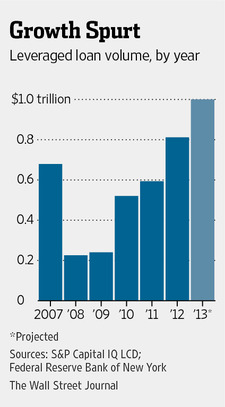
Shadow Loans Sound New Alarm; Regulators Cite Growing Role of Individual Investors

October 6, 2013, 7:46 p.m. ET

Shadow Loans Sound New Alarm

Regulators Cite Growing Role of Individual Investors

IANTHE JEANNE DUGAN

MI-BY902_SHADOW_NS_20131006174803

Debt-laden companies are on track to borrow a record $1 trillion this year in the nonbank “shadow lending” system, and regulators are sounding alarms about one of its fast-growing funders: individual investors. The burgeoning role of individuals in lending is highlighted as a top concern in a report released last week by the Federal Reserve Bank of New York as part of a continuing effort to overhaul shadow bankers—the web of largely unregulated financial firms unable to borrow in an emergency from the central bank and without traditional depositors that are insured. Read more of this post

Passive funds losing cost edge

October 4, 2013 6:27 pm

Passive funds losing cost edge

By Elaine Moore

Passive funds that allow investors to track the performance of worldwide stock markets are starting to lose their competitive edge on prices as providers of actively managed funds cut their fees. In spite of ultra-low annual fees offered by the largest providers of passive funds such as Vanguard, Legal & General Investments and HSBC, research by Morningstar has found that on average, retail equity index funds have a total expense ratio of 0.73 per cent. Read more of this post

Japan Tobacco to Expand in Smokeless Products Via M&A, Tie-Ups as consumers demand alternatives and regulations tighten worldwide; “There are many ways to enjoy tobacco, so it doesn’t necessarily have to be cigarettes”

Japan Tobacco to Expand in Smokeless Products Via M&A, Tie-Ups

Japan Tobacco Inc. (2914) plans to expand its range of smokeless tobacco products and is looking at tie-ups or acquisitions as consumers demand alternatives and regulations tighten worldwide. “There are many ways to enjoy tobacco, so it doesn’t necessarily have to be cigarettes,” Akira Saeki, an executive deputy president who heads the tobacco business, said in an interview in Tokyo. “Cigarettes’ appeal may be diminishing” as more people are bothered by smoke, he said. Read more of this post

S’pore ‘has much to learn from Swiss branding’

S’pore ‘has much to learn from Swiss branding’

Monday, Oct 07, 2013

Mok Fei Fei

The Straits Times

The widely acknowledged quality of Swiss cheese, clocks and chemicals holds valuable lessons for Singapore, according to the Second Minister for Trade and Industry on Friday. Mr S. Iswaran said Singapore must learn from the branding of excellence built over decades and even centuries by Swiss firms. The same mindset of nurturing specialised capabilities – Singapore has such excellence in water technology, aviation services and the offshore and marine sector – for the long haul will allow the country to bolster the prestige of its own brand. Switzerland’s competitive research and development (R&D) ecosystem and its highly skilled workforce also hold important learning points for Singapore, he noted. Its private sector is responsible for almost three-quarters of Switzerland’s gross domestic R&D spending, or about 2.2 per cent of its gross domestic product. Read more of this post

Aluminum Costs Seen Dropping as LME Unclogs Depots; The rise in physical premiums contrasts with slumping futures

Aluminum Costs Seen Dropping as LME Unclogs Depots: Commodities

The London Metal Exchange’s plan to ease congestion at warehouses storing near-record amounts of aluminum will accelerate deliveries and reduce premiums paid for supply, at a time when prices are already near a four-year low. Waiting times lengthened to a year or more in some locations, driving premiums added to the LME price to a record. Delays at depots spurred at least 16 lawsuits filed in U.S. courts as well as scrutiny from lawmakers and regulators. The surcharges, which rose almost 15-fold since 2008, are now retreating as traders anticipate the changes, which are scheduled to be reviewed by the LME’s board this month. Read more of this post

Navigating the pensions maze

October 4, 2013 6:26 pm

Navigating the pensions maze

By Josephine Cumbo

Less than a generation ago, millions of workers began saving for their retirement in company pensions which, as long as their employer stayed afloat, caused them very few headaches. Aside from the sacrifice of the monthly pension deduction, their employer largely took care of building up the pension and then paying an income for their former employees when they finally retired. That income was usually based on their salary at retirement, and the length of their service. But very few of today’s workers outside the public sector are afforded the comfort of these “golden era” pensions. More common nowadays is a company pension which lays the responsibility for investing contributions, and turning them into an income, squarely on the shoulders of the employee. Employees bear all the risk, even though they have no control over the pension scheme they save into, with this choice entirely up to the employer. Read more of this post

Wall Street digs in for a debt default; Traders are talking about the prospects of “dirty prices” and other default oddities

Wall Street digs in for a debt default

By Stephen Gandel, senior editor October 4, 2013: 9:49 AM ET

Traders are talking about the prospects of “dirty prices” and other default oddities.

FORTUNE — On Thursday, the Treasury Department released a report anticipating what would happen if we have a debt ceiling default. One prediction: a financial crisis that could “echo the events of 2008 or even worse.” It’s hard to see exactly how that could happen. If Treasury bonds were to plummet after a debt default, that could cause other bonds to drop in value as well, creating big losses for the banks — and perhaps putting them in jeopardy. But banks have been anticipating a jump in rates for a while. Many banks have already shown investors what would happen if rates suddenly rose three percentage points, which is a big jump. It’s not pretty, but no bank appeared to be in jeopardy. Read more of this post

LionGold’s preference for scrip transactions has seen many Australian investors end up with an exposure to the Singapore based company

Singapore’s LionGold suffers 40% share collapse

October 5, 2013

Peter Ker

Australian gold investors with exposure to Singapore company LionGold were on the wrong end of the company’s curious share price on Friday, when the stock suddenly fell by more than 40 per cent. LionGold, which has spent the past 18 months acquiring some of Australia’s most marginal gold assets in exchange for its own shares, was put in a trading halt by Singapore authorities out of concern that the market was not fully informed. Among the Australian assets that LionGold has acquired since taking an interest in gold 18 months ago are the fields near Ballarat that played host to the Eureka Stockade. Read more of this post

Regional Control Eludes Indonesian Firms

Regional Control Eludes Indonesian Firms

By Tito Summa Siahaan on 1:30 pm October 5, 2013.
Semen Indonesia may be one of the the biggest companies in Southeast Asia’s biggest economy, but its rival, SCG of Thailand, has a larger regional presence. (JG Photo/Dhana Kencana)

Telekomunikasi Indonesia, Bank Mandiri, Bank Rakyat Indonesia, Bank Central Asia, Indofood Sukses Makmur, Gudang Garam, Bumi Resources and Adaro Energy. These Indonesian firms are part of the top 50 listed companies in Southeast Asia by revenue, according to the Asean Investment Report, published by the Asean Secretariat in July. The largest of them all, state-controlled telecommunication firm Telekomunikasi Indonesia, ranked 13th in the list that was dominated by companies from Thailand, Singapore and Malaysia. More strikingly, in the same report, of the 10 largest banks in the region by assets, none hailed from Indonesia. Household names like Mandiri and BRI are well known within Indonesia, but outside, they lack cache and are minnows compared to regional champions such as DBS Group Holdings, OCBC and United Overseas Bank — all from Singapore. Even with the list based on financial reports of 2011, the data show that Indonesian corporations are still trying to catch up with their regional counterparts. Read more of this post

Policy Missteps Seen As Hurting Indonesia’s Appeal to Investors

Policy Missteps Seen As Hurting Indonesia’s Appeal to Investors

By Francezka Nangoy on 12:30 pm October 5, 2013.
DBS Group Holdings’ decision to bail out of its planned acquisition of Bank Danamon Indonesia this year may be one example of why investors are concerned about nationalism and protectionism issues in Indonesia. DBS’s deal was the most anticipated acquisition in Indonesia’s financial sector, highlighting the interest of foreign investors in Indonesia’s growing economy. Read more of this post

Bicycles and rickshaws in India: Some say Kolkata should back-pedal on its bicycle ban

Bicycles and rickshaws in India: Some say Kolkata should back-pedal on its bicycle ban

Oct 5th 2013 |From the print edition

20131005_ASP003_0

TRAVEL within any Indian city is usually crowded and slow. But Kolkata (formerly Calcutta), capital of West Bengal, has certain advantages. Its underground rail network, which was the first to open in India in 1984, is being extended. Uniquely in the country, electric trams clatter along its streets. Public transport may look dilapidated but it functions reasonably well: urban ferries, suburban trains, smoky buses and motorised rickshaws shunt around the city’s 14m residents. Read more of this post

What Deng Taught Xi Jinping: Pragmatism Trumps Ideology

What Deng Taught Xi Jinping: Pragmatism Trumps Ideology

By Christopher Johnston on 12:40 pm October 4, 2013.
When Xi Jinping became leader of the Chinese Communist Party he chose the location of his first official visit carefully. He did not pay tribute at Mao’s tomb, or tour the rural heartland of Hu Jintao. Instead, the new General Secretary traveled to Shenzhen, a prosperous special economic zone once overseen by his father. There he laid flowers at a bronze statue of Deng Xiaoping. Read more of this post

‘Property tours’ in China: Free travel, no commitment required

‘Property tours’ in China: Free travel, no commitment required

Staff Reporter

2013-10-05

“Excellent shops available, with down payment of 100,000 yuan (US$16,300) and a guaranteed lease period of 15 years at an annual return rate of between 8%-18%. Free transportation and accommodation will be provided to those who wish to see the shops over the National Day holiday.” The above advertisement has proved attractive for potential buyers keen to take advantage of getting a free trip with no commitment to buy anything required. Read more of this post

China gambles on theme park, whale sharks to lure punters from Macau casinos

China gambles on theme park, whale sharks to lure punters from Macau casinos

By Farah Master

HENGQIN ISLAND, China (Reuters) – It’s being touted as China’s answer to Orlando, a $5 billion resort and theme park complete with a mega rollercoaster and a whale shark tank situated on a sleepy southern island next to the world’s biggest gambling hub Macau. Chimelong, which is set to partially open next month, is the linchpin of China’s ambitious plans to expand Hengqin into a leisure hub similar to the coastal U.S. city globally renowned for its natural attractions and theme-park resorts by Walt Disney Co (DIS.N: QuoteProfileResearchStock Buzz) and Universal Studios. Read more of this post

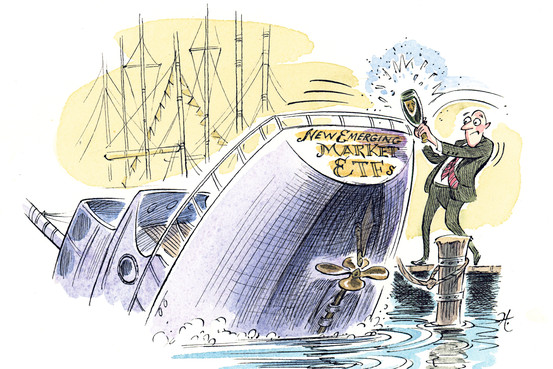
The latest trend in emerging-market exchange-traded funds is to leave out the biggest countries. But the focus should be on companies, not countries

SATURDAY, OCTOBER 5, 2013

New ETFs: Christening a Sinking Ship

By BEN LEVISOHN | MORE ARTICLES BY AUTHOR

The latest trend in emerging-market exchange-traded funds is to leave out the biggest countries. But the focus should be on companies, not countries.

BA-BD075_mfq_et_G_20131005000300

What was once a brilliant marketing concept has collapsed like a ton of bricks. That would be the BRICs, of course, the term for Brazil, Russia, India, and China coined by Goldman Sachs’ Jim O’Neill in 2001. Once a favorite of investors, it’s now so far out of favor that the latest trend seems to be excluding them from new emerging-market exchange-traded funds. But that ship has already sailed. Read more of this post

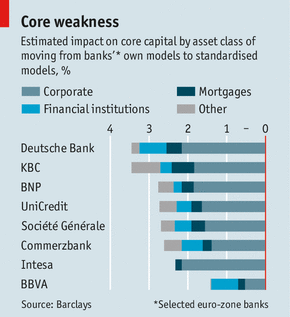
The asset-quality review: Close scrutiny of Europe’s banks may turn up unexpected shortfalls

The asset-quality review: Close scrutiny of Europe’s banks may turn up unexpected shortfalls

Oct 5th 2013 |From the print edition

20131005_FNC509

THE ink on the agreements that will hand supervision of the euro area’s biggest banks to the European Central Bank (ECB) is barely dry. Yet the ECB is already enmeshed in squabbles with national banking supervisors over the extent of its powers and the rigour with which it will undertake its first big task, a warts-and-all review of the balance-sheets of the banks it will take charge of in a year’s time. Read more of this post

Riding the wave: Corporate dealmakers should heed the lessons of past merger waves

Riding the wave: Corporate dealmakers should heed the lessons of past merger waves

Oct 5th 2013 |From the print edition

20131005_WBD000_0

WHY mergers and acquisitions (M&A) come in waves is not fully understood. Companies’ fortunes are affected by the economy’s ebb and flow, but this does not seem enough to explain why merger activity crests and breaks so dramatically. Yet crest and break it does. In America there have been at least five merger waves, in which the number of deals swelled, peaked then tumbled. The first, in the 1920s, ended with the onset of the Great Depression. It was less obvious why the following ones—in the 1960s and then in each decade since 1980—were so strong. Now, say some experts, a powerful sixth wave is forming. Read more of this post

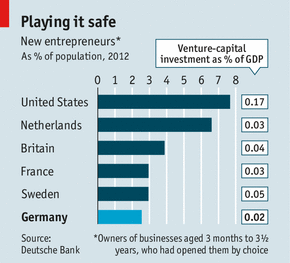
Business creation in Germany: A vigorous start-up scene has yet to produce its first big breakthrough; “All of the entrepreneurial spirits left here 200, 300 years ago,” jokes Maxim Nohroudi in his Berlin office

Business creation in Germany: A vigorous start-up scene has yet to produce its first big breakthrough

Oct 5th 2013 | BERLIN |From the print edition

20131005_WBC503

“ALL of the entrepreneurial spirits left here 200, 300 years ago,” jokes Maxim Nohroudi in his Berlin office. That is obviously not quite true. He met his business partner at Düsseldorf airport in 2010, their flight grounded by the eruption of Iceland’s Eyjafjallajökull volcano. If only there were an app to compare their options to get back to Berlin by schedule, price and time required, they thought. Now there is: Waymate, which quickly compares both inter-city and intra-city means of travel. To make money, Waymate plans to sell adverts aimed at people based on their location. Eventually the app will allow data to travel two ways, so that users can tell each other when a bus is stuck in traffic. Read more of this post

Pull closet indexing out of the closet; Fund manager practice is a tax on millions of investors

October 4, 2013 2:15 pm

Pull closet indexing out of the closet

John Authers

Fund manager practice is a tax on millions of investors

In the UK, people are trying to pull closet indexing out of the closet. It is a fight that could have global implications. This is one issue on which there is no need to sit on the fence. The debate betweenactive managers, who try to beat their benchmark, and passive managers, who merely track it, will go on and on. But everyone can agree that there is no case for closet indexing – the practice of running an “active” fund, charging active management fees but, in practice, offering an investment that merely hugs the index. Read more of this post

Tongyang Group Chairman Hyun Jae-hyun’s risky bets have led the mid-tier conglomerate to head toward a tragic end, producing innocent victims

2013-10-04 17:46

Tongyang investors to take fall

Financial regulator launches taskforce to help victims
By Kim Tae-jong

K2013100400118-200(1)

Aletter to Tongyang Group Chairman Hyun Jae-hyun was found in the car where a female employee at a Jeju branch of Tongyang Securities committed suicide on Oct. 2, feeling guilty about customers’ losses

Tongyang Group Chairman Hyun Jae-hyun’s risky bets have led the mid-tier conglomerate to head toward a tragic end, producing innocent victims.
The group’s five affiliates including Tongyang Cement & Energy and Tongyang Networks have been placed under court receivership, and its previous efforts to keep afloat through bond issuance have also harmed tens of thousands of retail investors.
Pressured by the guilt over customer losses, a female employee from a Jeju branch of Tongyang Securities took her own life on Oct. 2. The brokerage affiliate sold more than half of corporate bills and bonds issued by the group.
Identified only by her surname Ko, she was found dead in her car in an apparent suicide with a suicide note and letter to chairman Hyun found in the scene.
“Chairman Hyun, you can’t do this to your employees and customers,” she wrote in her letter to Hyun. “I recommended to customers (to buy our corporate bonds and bills) to offer them high interests. I really trusted Tongynag Group.”
She also expressed her deep regret over the financial damage caused to customers, demanding the group take measures to make full compensation for them.
The police stated she made a tragic decision, and that she suffered from complaints from customers who were subject to huge losses from their investment, after the group’s five affiliates sought court receivership. Read more of this post