Mexican Sun Lures Cash to Solar as Panel Prices Plunge

Mexican Sun Lures Cash to Solar as Panel Prices Plunge

Mexico, poised to allow foreign oil extraction for the first time in 75 years, is finding its abundant natural resources also appeal to investors in a much cleaner energy: sunshine. First Solar Inc. (FSLR) of the U.S. has bought its first projects in Mexico, while more than a dozen other developers including Germany’s Saferay GmbH and Spain’s Grupotec Tecnologia Solar SL own licenses there. Local investor Gauss Energia opened Latin America’s largest photovoltaic plant in the country last month. Read more of this post

Real’s Turnaround Seen Fleeting as Brazil Bewilders; The real has tumbled 25 percent since Rousseff took office in January 2011

Real’s Turnaround Seen Fleeting as Brazil Bewilders: Currencies

For the world’s biggest foreign-exchange trader, the Brazilian real’s 11 percent rally from a 4 1/2-year low is just another reason to sell one of the “bad apples” of emerging-market currencies. Deutsche Bank AG says a possible credit-rating downgrade and Brazil’s biggest current-account deficit in 11 years will cause the real to reverse recent gains. Speculators agree, with bearish bets on the currency doubling in a month on Latin America’s main stock exchange to a record $20 billion this week. Read more of this post

Singapore Exchange Suspends Trading in Shares of Three Speculative Companies after their prices plunged dramatically

Oct 3, 2013

Singapore Exchange Suspends Trading in Shares of Three Companies

CHUN HAN WONG

SINGAPORE—Singapore Exchange Ltd. suspended trading on three companies’ shares after their prices plunged dramatically in early Friday trade, wiping out strong gains notched in recent months. In less than an hour of trading, sterilization-services provider Blumont Group Ltd. lost more than 56% of its market value, while share prices of Asiasons Capital Ltd. and LionGold Corp. Ltd. plunged by 61% and 42% respectively. Friday’s sharp drops followed weeks of substantial gains in the three companies’ share prices, which had prompted the exchange to issue official queries seeking explanations for the increases. Read more of this post

Fears spread over chaebol’s debts; Investors, creditors study balance sheets after Tongyang’s woes

Fears spread over chaebol’s debts

Investors, creditors study balance sheets after Tongyang’s woes

BY MOON GWANG-LIP [joe@joongang.co.kr]

Oct 04,2013

Tongyang

A group of investors in Tongyang Group bonds stages a protest near the residence of Chairman Hyun Jae-hyun yesterday afternoon after allegations arose that the company issued fraudulent commercial paper

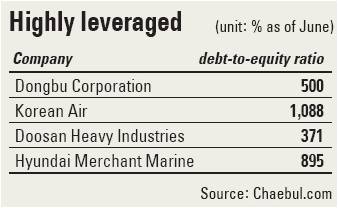
In the wake of the sudden financial meltdown of Tongyang Group, one of Korea’s top 40 conglomerates, attention is shifting to the debt levels of other large companies. Rumors are spreading in the local financial industry that some affiliates of Dongbu Group, Hanjin Group, Hyundai Group and Kolon Group – all within the top 40 – could face the same fate as the Tongyang subsidiaries now under court receivership. Financial authorities are cautioning against overreaction from investors and creditors-? they don’t want scared creditors making things worse for companies by calling in debts. But, some market analysts say that the Tongyang crisis may serve as a wake-up call for overdue financial reforms at many conglomerates.

Chaebol Leverage

Read more of this post

Pig Sales Fly Blind as Data Cut by Shutdown Hampers Firms

Pig Sales Fly Blind as Data Cut by Shutdown Hampers Firms

For Brian Duncan, a 49-year-old hog farmer in Polo, Illinois, the government shutdown is converting the economic fundamentals of his business into a guessing game. Duncan relies on U.S. Department of Agriculture commodity data to price his hogs. That information flow has been cut off with the partial shutdown of the federal government, which entered a fourth day today. The lapse has had a dramatic effect on his operation in north-central Illinois, he said. “Everyone in the food chain relies on the government to be an unbiased source of prices,” said Duncan, who sells 50,000 pigs a year to meat packers, including Tyson Foods Inc. (TSN), Smithfield Foods Inc. and Cargill Inc. “We have no clue what the price of hogs is or the price of the pork.” Read more of this post

Swiss Retirees Traverse Pension-Fund Abyss by Dog Walking

Swiss Retirees Traverse Pension-Fund Abyss by Dog Walking

Swiss retirees are soothing concerns over the country’s 42.4 billion-franc ($47 billion) pension-fund deficit by walking dogs, tending bars and giving financial advice. The number of pensioners for hire at Zurich-based Rent a Rentner AG almost doubled to 2,245 this year, said Peter Hiltebrand, who founded the online booking agency in 2009. The retirees, who range from age 60 to 90, set their own fees, starting at a minimum of about 20 francs an hour. “It started out as a crazy idea because I didn’t just want to stay home all day after I retired and wanted to remain active,” said 69-year-old electrician Hiltebrand. “I thought surely there must be other pensioners who’d be interested.” Read more of this post

Construction chaos in Australia: another builder collapses as sector faces 40th straight month in doldrums; 20-year-old Walton Construction handed over to administrators

James Thomson Editor

Construction chaos: another builder collapses as sector faces 40th straight month in doldrums

Published 04 October 2013 08:48, Updated 04 October 2013 10:09

The carnage in Australia’s building sector shows no signs of abating, with yet another major construction group placed in the hands of corporate undertakers yesterday. Craig Walton, managing director of Walton Construction, described Thursday as the toughest day of his life as he handed control of his 20-year-old construction group to administrators. ‘‘It is also the saddest day because of the impact on our employees and their families who have been so loyal and outstandingly professional over the whole journey,” Walton told Fairfax. The company, which at its peak turned over $360 million and had 340 employees, has been buffeted by the seemingly never-ending post-GFC construction sector hangover. Read more of this post

Around 40% of phone numbers that listed companies in China provided to investors go unanswered or are constantly engaged

Under 60% of Chinese listed companies answer the phone

Staff Reporter

2013-10-04

Around 40% of phone numbers that listed companies provided to investors go unanswered or are constantly engaged, according to the China Securities Investor Protection Fund Corporation, a securities supervisory body established by China’s State Council or cabinet. The corporation recently posed as an anonymous client and made three rounds of phone calls to 2,468 companies listed on China’s A-share market and published its results. Of the 7,404 phone calls the company made, around 58.7% were answered and their questions were properly addressed. Around 40.1% of their calls went unanswered while the remainder were busy or had another situation which prevented a satisfactory outcome. The company said it received valid and useful information in 85.3% of calls which were answered and around 91.7% of staff members answering the calls were polite and friendly. The percentage of answered phone calls was highest among companies listed in Hong Kong’s Growth Enterprise Market which allows growth companies to raise capital based on a strong disclosure principle. 73.7% of these companies picked up the phone. They were followed by the Small and Medium Enterprise Board, Shanghai Stock Exchange’s Main Board and Shenzhen Stock Exchange at 63.1%, 52.8% and 52.7%, respectively.

Hong Kong’s handcarts keep the city on a roll

Hong Kong’s handcarts keep the city on a roll

20131003_oldlady_hongkong_afp

Thursday, Oct 03, 2013

AFP

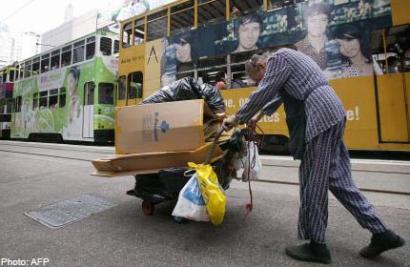
HONG KONG – It’s a simple contraption – an iron frame, foldout handle and four rubber wheels – but in Hong Kong the old-fashioned handcart is what keeps the city rolling. In the shadow of skyscrapers, Hong Kong’s working class trolley pushers transport everything from crates of live seafood to appliances, financial documents, furniture and mail. But among the street cleaners, market traders and removal men, it is probably the city’s elderly scavengers who best highlight how vital handcarts are to the city. Lee Cheung-Ho, 78, spends all day pushing her cart, and says she even goes out when there is a typhoon. “I have to go out and make a living,” she told AFP without stopping. “It helps even if I can only earn a few dollars.” The estimated 10,000 scavengers in Hong Kong collect cardboard, tin cans and scrap metal, selling it on for a few dollars to recycling centres to ship to mainland China. Read more of this post

Here comes the spoils society, ready to reap but not sow

Here comes the spoils society

By Robert J. Samuelson, Published: September 30

To the victors belong the spoils

— New York Sen. William L. Marcy, 1786-1857, arguing why victorious political parties deserve government jobs

We are, I fear, slowly moving from “the affluent society” toward a “spoils society.” In 1958, Harvard economist John Kenneth Galbraith published his bestseller, “The Affluent Society,” which profoundly influenced national thinking for decades. To the Great Depression’s survivors, post-World War II prosperity dazzled. Suburbia offered a quiet alternative to crowded and noisy cities. New technologies impressed — television, frozen foods, automatic washers and dryers. Never, it seemed, had so much been enjoyed by so many. Read more of this post

How Brazil’s Richest Man Lost $34.5 Billion

How Brazil’s Richest Man Lost $34.5 Billion

By Juan Pablo SpinettoPeter Millard, and Ken Wells October 03, 2013

feat_Batista41_d_315current_304x415feat_batista41chart_630

OGX’s FPSO OSX-1 oil production vessel in Rio

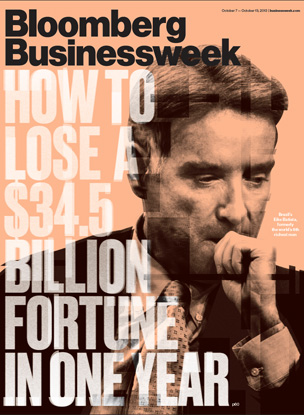
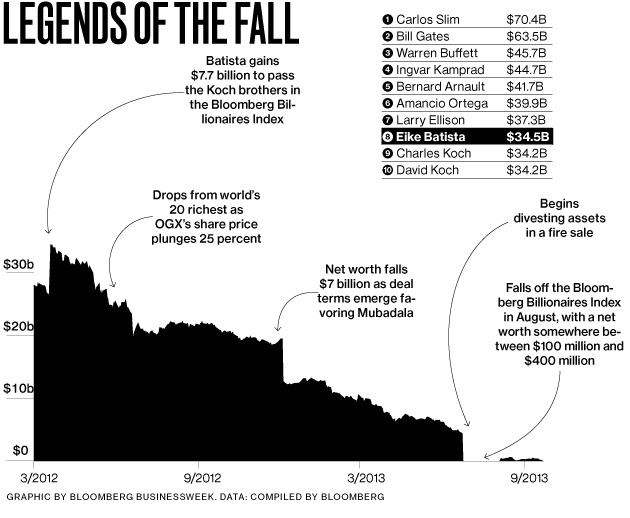
Eike Batista stands at the center of a specially built air-conditioned stage on his 22,000-acre-plus Açu port project, a massive oil and iron-ore shipping complex about 200 miles north of Rio de Janeiro. He’s beaming, flashing victory signs. He has on an orange-and-gray racing jacket of the type he wore as a champion speedboat racer two decades before. It clashes badly with his bright pink tie and gray pinstripe suit, but he doesn’t appear to care—in fact, the loud ensemble only serves to highlight a faux oil-stained handprint across the jacket’s left pocket—a corny hint about why he’s asked everyone here. Read more of this post

Taiwan famous show host Dee Hsu’s father-in-law admits to insider trading charges

Dee Hsu’s father-in-law admits to insider trading charges

Friday, October 4, 2013 – 10:51

The China Post/Asia News Network

TAIPEI, Taiwan — District prosecutors yesterday said Hsu Hsun-ping (徐洵平), chairman of Genome International Biomedical Co. Ltd. (GIBC), admitted during a questioning session that he participated in insider trading. From Wednesday morning through to Thursday morning the Taipei District Prosecutors Office questioned Hsu Hsun-ping, his wife Jiang Li-fen (姜麗芬), talk show host Dee Hsu’s (徐熙娣, also known as Little S) husband Mike Hsu (許雅鈞), and her father-in-law Hsu Ching-hsiang (許慶祥) over allegations of gaining profits through insider trading. The four of them hold GIBC shares. Read more of this post

SGX suspends trading in Asiasons, Liongold and Blumont shares

SGX suspends trading in Asiasons, Liongold and Blumont shares

Friday, Oct 04, 2013

Reuters

In a dramatic move this morning, the Singapore Exchange (SGX) suspended the trading of three stocks, namely Blumont, Asiasons Capital and Liongold. SINGAPORE – The Singapore Exchange Ltd on Friday suspended trading in Asiasons Capital Ltd and Liongold Corp Ltd after their share prices fell sharply in the morning session. Asiasons shares plunged 61 per cent while Liongold Corp shares dropped 42 per cent before their trading suspension. According to statements filed by both firms, the Singapore bourse operator invoked SGX-ST Rule 8.10 to immediately suspend trading “to safeguard the interests of the market as there could be circumstances that would result in the market not being fully informed”. It also suspended the trading of Blumont Group Ltd shares after the company said it plans to take over a foreign-listed coal mining company, sending its shares plunging by more than 50 per cent. “This is to safeguard the interests of the market as there could be circumstances that would result in the market not being fully informed,” a stock exchange filing said. Blumont said before market hours on Friday that it had reached an agreement on the terms of a proposed takeover bid of a coal mining company for up to S$146 million ($117 million).

Time to Ditch the Yale Endowment Model

Time to Ditch the Yale Endowment Model

Institutional investors are different from you and me — they have a lot more money. Pension plans in rich countries manage almost $30 trillion in assets, for example. This opens doors at the offices of hedge funds, private-equity firms and other expensive money managers and creates opportunities to directly invest in projects inaccessible to regular people, such as dams, natural-gas fields and real-estate developments. But while a select few institutions can generate higher returns — for less risk — than we lowly mortals can achieve with low-cost index funds, the average fund should avoid trying to get too creative. The modern style of institutional investing can be traced to Yale University’s David Swensen, who literally wrote the book on the subject. (Full disclosure, I’m a Yale graduate.) Three core ideas inform his thinking. Read more of this post

Porsche to BMW Help Bridge East-West German Divide

Porsche to BMW Help Bridge East-West German Divide

On a newly constructed bridge at Porsche AG’s growing factory in eastern Germany, a worker put up a handmade sign this summer with a tongue-in-cheek notice saying “Access to the West,” echoing Cold War language that once marked the former-communist region’s borders. For employees at the facility in Leipzig, a city where protests helped lead to German reunification 23 years ago today, the joke was obvious. With some of the most elite cars in the world rolling off lines there and a nearby Bayerische Motoren Werke AG (BMW) factory, the West has arrived. Read more of this post

Xi Jinping Is No Fun; China’s president turns back the clock, and the Communist Party elite put away their Rolexes

Xi Jinping Is No Fun

By Dexter Roberts October 03, 2013

econ_chinagraphic41_315

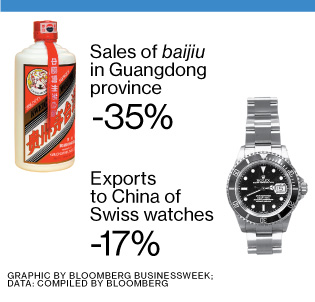
At the end of September, Chinese officials gathered in Shijiazhuang, in Hebei province, to discuss their shortcomings in Maoist-style self-criticism sessions. Under the watchful eye of President Xi Jinping, senior Communist Party members admitted to sins ranging from excessive ambition to detachment from the people. “Formalism, bureaucracy, hedonism, and extravagance,” are “undesirable work styles,” that are “harmful, stubborn in nature, and prone to relapse,” Xi warned the Hebei party secretary and other assembled provincial cadres, reported the Xinhua News Agency on Sept. 25. “Party members and officials should be taught to look in the mirror, straighten their attire, take a bath, and seek remedies,” Xi said. Read more of this post

Rise of China’s consumers drives tourist frenzy

October 3, 2013 7:40 am

Rise of China’s consumers drives tourist frenzy

By Simon Rabinovitch in Shanghai and Lucy Hornby in Beijing

With China’s highways snarled by traffic, thousands of tourists stranded at one of the country’s beloved national parks and millions more crushing into its most popular attractions, there is little question that the Chinese nation is once again on holiday. Early government estimates are that thisNational Day holiday week, which began on Tuesday, will be a record for the country in terms of domestic visitor numbers and tourism revenue, with both up about 20 per cent compared with the same period 12 months earlier. Read more of this post

Crucial China support for gold may fade; There are indications demand is beginning to slow

Last updated: October 3, 2013 6:56 pm

Crucial China support for gold may fade

By Neil Hume in London

Where would be we without China? It is a question many people in the commodities industry have asked in recent years. But it has particular resonance for gold. An explosion in physical demand from the second biggest economy has prevented a sharp sell-off from becoming a disorderly rout – and provided nervous investors with a reason to remain positive on gold as its 13-year bull run comes to an end. Read more of this post

Chinese Still Prefer Property Over Stocks; real estate has made up more than 60 percent of household assets since 2008, compared with 48 percent in the U.K., 32 percent in Japan, and 26 percent in the U.S.

Chinese Still Prefer Property Over Stocks

By Bloomberg News October 03, 2013

Matthew Zhou and his wife spent 1.6 million yuan ($261,000) to buy a two-bedroom apartment in eastern Shanghai in August because they saw no potential to make money in China’s financial markets. “Home prices keep rising, so I’d rather buy a place now than put the money in the stock market,” says Zhou, 30, an information technology engineer at a state-controlled bank in Shanghai. Gains in equities “could never outpace the growth of home prices,” he says. Read more of this post

China’s Second-Generation Entrepreneurs a Different Breed

October 3, 2013, 10:44 a.m. ET

China’s Second-Generation Entrepreneurs a Different Breed

Many Are Foreign Educated and Don’t Follow in Their Parents’ Footsteps

WEI GU

AM-BA540_WEICOL_G_20131003113305

A big part of China’s private economy will change hands in the next decade, from first-generation entrepreneurs to their children, many of whom are foreign-educated and have a very different view about running a business than their parents do. Kelly Zong, who has been groomed to take over her father’s Hangzhou Wahaha Group, is outspoken in saying she doesn’t favor her father’s hands-on management style. Nor is she a big fan of the way government and business interact in China. “I believe the government needs to face our generation,” the daughter of China’s second-richest man was quoted as saying in Guangzhou’s Time Weekly. “Our generation can never be like my father’s generation.” Ms. Zong, who attended high school and college in California, declined to comment directly but acknowledged she made the comments to the Time Weekly.

Ms. Zong may be particularly outspoken, but the children of China’s most successful entrepreneurs in general have little patience for the endless wining and dining of government officials that is necessary to do business in China. And they are not the nuts-and-bolts, get-their-hands-dirty managers that their parents are.

But many are shifting their parents’ businesses into service industries in sectors such as health care and finance that are important areas in China’s economic overhaul. Others are following their parent’s entrepreneurial spirit. Either way, the government faces the question of how to embrace this homegrown resource even if this generation doesn’t follow standard Chinese business practices.

“It is harder to be an entrepreneur in China compared to in the West, but there are also more opportunities here,” said Duan Liuwen, who heads up an organization for second-generation wealthy called Relay China that has about 200 members. “The good thing is the government is changing, too; even in the government there are more overseas returnees.”

Mr. Duan, 32 years old, has a relatively unusual background. His father, Duan Yongji, one of China’s most successful technology entrepreneurs and former chairman for Sina Corp., was worried that his son might get spoiled, so he sent him to a military college in Chongqing to study to be a doctor.

Mr. Duan tried a few times to escape the school by scaling its walls, but ultimately graduated and went on to the Wharton School at the University of Pennsylvania. He later returned to China to set up Halation Photonics Corp., a display-technology company. Mr. Duan sees no benefit to working for his father. “When I worked at Sina, no one would give me any real work, but the credit all came to me when it was done,” he said.

Karen Chen’s parents built a profitable property business around Shanghai, but with the government trying to rein in real-estate prices, the business is struggling to grow. Ms. Chen is now building senior-citizen homes, which is encouraged by China as the population ages.

Armed with an economics degree from a Canadian University, she also started a micro-financing business, to help women in small businesses. And she is working with a co-founder of peer-to-peer finance company Lendingclub.com to build a similar company in China.

“I have to change the business model and do the right things to keep the business alive,” said the 29-year-old Ms. Chen. “My education abroad has helped us to look at the long term and think about ways to combine businesses with social responsibility.”

Similarly, Yoyo Yao is adding modern management style and ideas that fit with China’s long-term development goals to her family’s property business. She is trying to build a plastic-surgery center in Hebei province, after seeing a lot of Chinese going to Korea for such services. The development, about three hours north of Beijing, covers an area about 10 times the size of Monaco.

“When I was little, I didn’t want to go into properties, thinking it’s not very elegant for ladies,” said Ms. Yao. “My father says, now you have finally started to pay attention.”

Some second-generation wealthy Chinese have chosen to stay abroad, because they are pessimistic about the Chinese economy. Carl Meng, who got a master’s from Cambridge University, is one of them. “It will be difficult for me to adjust to the Chinese way of doing things,” said Mr. Meng, who now works for an investment bank in London. “The Chinese economy looks like a dead end and my parents don’t mind me staying abroad either.”

But there are also plenty of these young Chinese entrepreneurs who are ambitious and eager to build their own legacy at home.

“I’m quite optimistic about China’s second generation,” said Rupert Hoogewerf, founder of Hurun China Rich list. “They have good education, broad experiences—not just in China—and a lot of DNA close to their parents, who have succeeded against all odds.”

China’s drive to clean up thriving but dirty recycling business jolts global industry

China’s drive to clean up thriving but dirty recycling business jolts global industry

By Associated Press, Published: October 3

BEIJING — China for years has welcomed the world’s trash, creating a roaring business in recycling and livelihoods for tens of thousands. Now authorities are clamping down on an industry that has helped the rich West dispose of its waste but also added to the degradation of China’s environment. Read more of this post

Rio Tinto Replacing Train Drivers Paid Like U.S. Surgeons; The 400-plus workers in the remote Pilbara region who earn about A$240,000 ($224,000) a year probably are the highest-paid train drivers in the world

Rio Replacing Train Drivers Paid Like U.S. Surgeons

Train drivers employed by Rio Tinto Group to haul iron ore across Australia’s outback make about the same money as surgeons in the U.S. It’s little wonder the mining company will replace them with robot locomotives. The 400-plus workers in the remote Pilbara region who earn about A$240,000 ($224,000) a year probably are the highest-paid train drivers in the world, according to U.K.-based transport historian Christian Wolmar. Australia’s decade-long mining boom has sucked up skilled workers, raising wages for engineers to drivers at Rio, the second-largest exporter of the mineral, and its closest competitors, Vale SA (VALE) and BHP Billiton Ltd. Read more of this post

Australia’s Booming House Prices Spark Concern; Low Interest Rates May Be Boosting Property Speculation; The Central Bank Is Concerned

October 3, 2013, 5:06 a.m. ET

Australia’s Booming House Prices Spark Concern

Low Interest Rates May Be Boosting Property Speculation; The Central Bank Is Concerned

JAMES GLYNN And SHANI RAJA

AI-CD946_AUSPRO_G_20131003034809

SYDNEY—Samantha Walton and her fiancé Simon Cleary feel their dream of buying an apartment in Sydney’s trendy eastern suburbs is slipping out of reach. They have secure jobs and live with Ms. Walton’s parents, an arrangement that has helped them save money for a deposit over the past year. Their ambitions are modest: a one-bedroom property worth 500,000 Australian dollars (US$470,000), well below the average for a new Australian home. Read more of this post

Yes, Real Men Drink Beer and Use Skin Moisturizer

Yes, Real Men Drink Beer and Use Skin Moisturizer

By Matthew Boyle October 03, 2013

comp_menchart41_630inline

Adam Causgrove is not a metrosexual. The 29-year-old grant administrator in Pittsburgh is a die-hard Pirates fan and sports a 6-inch handlebar mustache. He loves bourbon, drives a Chevy, and has a dog named Diesel. Yet after shaving, the only thing he trusts to soothe his “horrible” razor burn is Crabtree & Evelyn’s alcohol-free lotion. “Six years ago I had one shampoo, a body wash, and a toothbrush, and that was it,” he says. “As I’ve gotten older and more self-aware, I cannot begrudge anyone for wanting to put their best face forward.” Read more of this post

Urban Outfitters already have 25 percent of all of their sales coming online

JPMorgan Chase’s Brian Tunick on Retail’s Recovery via Value Pricing

By Joshua Brustein October 03, 2013

What do shoppers want? Experts discuss the forces reordering the retail industry.

Is the retail industry over the recession? 
I have 25 companies in my universe in specialty retail. The sales as a group are the highest they’ve ever been, the sales per square foot are the highest they’ve ever been, and the profit margins are the highest they’ve ever been. Value is probably the overarching theme. Look at T.J. Maxx (TJX), Marshalls, and, to a little degree, Burlington Coat(BURL). The pace of the growth in off-price has been almost double the pace of regular apparel spending. And on top of that, there’s not a weekend where an average specialty retailer in the mall is not offering some kind of 30 to 40 percent off deal. It certainly feels like the consumer is not shopping unless there’s some kind of deal attached to it. And it’s very hard to pull back when the consumer gets used to buying things on sale. The good news is margins, overall, are pretty good. But it’s more of a function of benefiting from lower cotton costs, more efficiencies as companies close stores to focus on their better stores and returns, and using e-com as a vehicle to also help profitability. Read more of this post

Walgreen’s Beth Stiller on Customer Behavior Since the Recession

Walgreen’s Beth Stiller on Customer Behavior Since the Recession

By Joshua Brustein October 03, 2013

What do shoppers want? Experts discuss the forces reordering the retail industry.

How have your customers changed in the five years since the onset of the recession?
I think as we start to come out the other side, we see some lasting behaviors that affect the way people shop every day. I don’t think people have gone back to the way that they used to shop. Customers have become really sophisticated, and value to customers comes in lots of different forms. It could be personal interaction in a bricks-and-mortar store. It could be the ease of your mobile app, or just convenience and helping me get what I need to get done quickly, easily, and in the way I want to do it. In our stores, we’re seeing an increased importance to our private brands. Industrywide, the importance of private brands has been growing. Price is certainly an important factor. And then we’ve also focused on differentiated brands. So how can we bring innovation and differentiation into the private brand products that maybe gives them a little surprise and delight. That’s been something that customers have reacted well to and has been really helpful. Read more of this post

Patagonia’s Robert Cohen on the Retailer-Customer Relationship

Patagonia’s Robert Cohen on the Retailer-Customer Relationship

By Joshua Brustein October 03, 2013

feat_fix_Cohen41_300

What do shoppers want? Experts discuss the forces reordering the retail industry.

Does it matter to you what channel people buy your clothing through?
Nope. I’m more interested in making sure customers get Patagonia and less obsessed with how they get Patagonia.

Is gathering information about customers more important now than it has been in the past?
It’s interesting because the consumer has gotten a lot more power. People are much more protective about their e-mail in-box than they are about their home address. They’ll sign up for a catalog or they’ll sign up for a coupon. But to get somebody’s e-mail address out of them, you know, it’s a quid-pro-quo arrangement. Nobody tends to give it up for free. Obviously that rich customer relationship that you really want is “We’re like you. We care about the same things you do. Let’s do things together.” In a lot of ways the desire to build that relationship is about retailers trying to make big business feel a lot smaller. With only 30 stores in the U.S. and 120 around the world, it is not that difficult to act small because we are small. People call the switchboard, it’s answered by a person. It’s not an automated phone number. People may think we’re much bigger than we are. Read more of this post

Panera Bread CEO Ron Shaich on Restaurant Industry Competitiveness; About 50 percent of our transactions occur on our Panera card

Panera Bread CEO Ron Shaich on Restaurant Industry Competitiveness

By Joshua Brustein October 03, 2013

What do shoppers want? Experts discuss the forces reordering the retail industry.

What’s changed the most in the restaurant industry over the past five years?
I did a study two years ago on the profitability of restaurant companies over the prior five years. Eighty percent of the $1 billion-plus public restaurant companies made less money two years ago than they made seven years ago. You can go back and look at the top 50 restaurant companies 30 years ago; half of them no longer exist. They were sold, bought out, or hit the wall. So you have this very difficult operating environment in which competitive advantage is everything. I’ve often thought size and scale are actually bad. For a while you’re large, you take advantage of it, you build your margins. And then you wake up one day, and you go, oh my God, we don’t have a competitive position. We’ve just got an efficient operation in something that worked five years ago. And that’s the biggest threat, if I may say, that exists for this industry. There’s no technological atomic bomb that can somehow disrupt it like it did books. Read more of this post

Fifth & Pacific CEO William McComb on Retail’s Altered Landscape

Fifth & Pacific CEO William McComb on Retail’s Altered Landscape

By Joshua Brustein October 03, 2013

What do shoppers want? Experts discuss the forces reordering the retail industry.

What have you experienced in the years since the financial crisis?
We had had a fundamental collapse in our business model a year and a half before Lehman Brothers collapsed. So at a time when things were great, we were a disaster. So that’s my preface to the answer to this question. The headline is that in some ways the economic downturn further commoditized the business. It kicked off a race to the bottom. The use of promotions increased dramatically. There was channel consolidation and brand consolidation. And at the same time the global power value players—H&M (HMB:SS) and Zara (ITX:SM)—got stronger. That segment of the market, what I’ll call the value segment, is harder than ever. And that was the bulk of what our company was. We don’t play there at all today. We’re virtually 100 percent out of it. Read more of this post

Boston’s Store For Expired Food to provide produce and other perishables, including takeout items, for consumers who could not otherwise afford it.

Boston’s Store For Expired Food Is Looking Like A Better And Better Idea

HARRISON JACOBS OCT. 3, 2013, 10:10 AM 2,682 12

Confusion over expiration dates is one of the main reasons why America throws away $165 billion in food every year, according to a study released last week by the Natural Resources Defense Council and Harvard University. See, date labels that say things like “best before,” “sell by,” and “enjoy by,” typically have nothing to do with consumer safety and depend instead on manufacturers trying to limit sales to only the freshest form of their product (and, of course, manufacturers may be able to boost wholesale receipts by posting excessively early dates). Read more of this post