India’s Street Vendors Come Out of the Shadows

India’s Street Vendors Come Out of the Shadows

What Indian economic phenomenon is at once marginal, even illegal, and enormously independent and entrepreneurial? That would be the street vendor, the small capitalist of the poor, and reservoir of off-the-books penalties that grease the machine of every municipal authority and police station in urban India. There are an estimated 10 million street vendors (another term is the more pejorative “hawkers”) in the cities of India, functioning mostly in breach of a host of urban laws governing licensing, selling and zoning — and challenging bourgeois ideas of what a metropolis should look like. Street vendors have long battled to be recognized as a professional guild, not a shadowy underclass. Earlier this month, after more than a decade of agitation, the National Association of Street Vendors won a significant victory when the Lok Sabha, the lower house of parliament, recognized the rights of street vendors by passing the Street Vendors Bill, 2012. Read more of this post
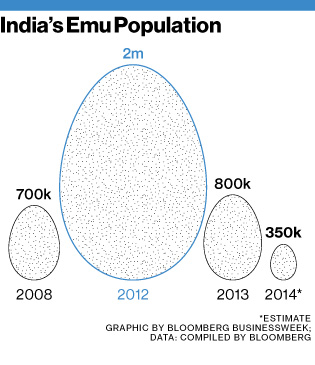
India’s Emu Ranching Bubble Bursts, With a Grim Aftermath; The collapse of India’s emu business has reduced the size of the country’s flock from 2 million to 800,000

India’s Emu Ranching Bubble Bursts, With a Grim Aftermath

By Bruce Einhorn and Ganesh Nagarajan September 26, 2013

econ_emu40chart_315

In India’s countryside, where poor farmers must cope with droughts, floods, and other disasters, there’s a new scourge: the collapse of emu ranching. Native to Australia, the emu is a large, flightless bird that somewhat resembles its African cousin, the ostrich, and tastes (fans say) like beef. Farmers in Australia, the U.S., and other countries raise emus for their meat, eggs, and oil (rendered from their fat). About five years ago, Indian farmers started seeing these Australian fowl as their ticket to riches. The fad quickly spread across the country, as farmers “just did whatever the neighbors said,” says Vinay Sharma, a former banker in New Jersey with Merrill Lynch who now raises emus in Gujarat. Overcapacity—the bird population peaked at about 2 million in 2012—has led some to abandon their emus in the wild. “People are feeling this business is not doing well,” he says. Read more of this post

India woos offshore currency players as rupee hits hard times

Updated: Thursday September 26, 2013 MYT 5:23:20 PM

India woos offshore currency players as rupee hits hard times

MUMBAI: Stung by the rupee’s recent collapse, India’s central bank is taking a carrot-and-stick approach to curb trade in the offshore forwards market that is seen as a key source of wrenching currency volatility. However, with no viable alternative to trading in non-deliverable forwards (NDF) involving the rupee, the strategy is likely to have only a limited impact. The Reserve Bank of India recently met with a handful of foreign banks and asked them to stop acting as market-makers for rupee NDFs, according to three bankers involved in the discussions. Read more of this post

Age Limits Among Car Ownership Limits Urged for Jakarta

Age Limits Among Car Ownership Limits Urged for Jakarta

By Hotman Siregar on 9:40 pm September 26, 2013.
A transportation analyst has urged the Jakarta authorities to impose a limit on the age of vehicles allowed on the streets, in a bid to both reduce exhaust emissions and cut back on car use. Yoga Adiwinarto, the director of the Institute for Transportation and Development Policy, said on Wednesday that the idea had long been discussed by city officials but never implemented. Read more of this post

South Korea’s financial regulator is seeking to lower the heavy corporate debtor threshold to include more firms on the watch list for default risks. If the threshold is lowered, Hyundai Group and Tong Yang Group will likely be added

More corporate debtors likely to be on watch list

2013.09.26 16:55:21

South Korea’s financial regulator is seeking to lower the heavy corporate debtor threshold to include more firms on the watch list for default risks.

According to sources on Thursday, the Financial Supervisory Service (FSS) recently drew up a measure that lowers the debt threshold of large companies so that more firms can be included in the FSS list of so-called primary corporate debtors, FSS officials with knowledge of the matter said.
More liabilities regarding financial improvement will be requested for large companies when signs of mismanagement are detected. A primary corporate debtor’s role will also be expanded.
Under the envisioned plan, the FSS will lower the 0.1 percent rule so that more smaller conglomerates with liquidity risks can be added.
The regulator has also proposed including their short-term borrowings like commercial papers or corporate bonds since a lot of big firms rely on such types of debt instruments to raise money.
If the threshold is lowered, Hyundai Group and Tong Yang Group will likely be added to the list.

Diageo Goes Gangnam With Johnnie Walker for Korea Whisky Revival

Diageo Goes Gangnam With Johnnie Walker for Korea Whisky Revival

Diageo Plc (DGE), the world’s biggest distiller, is trusting Gangnam to do the same for whisky as the song named after it did for dance moves. Seoul’s luxury retail district, known internationally for the music video that became a global phenomenon, is the location for today’s opening by Diageo of a Johnnie Walker House as the liquor maker goes after high-net worth consumers seeking a bespoke bottle of its biggest whisky brand to take home. Read more of this post

Debt owed by 41 major South Korean public organizations would snowball from 520 trillion won ($483.7 billion) this year to 600 trillion won in 2017

41 public agencies’ debt to balloon to $558bn in 2017

Lee Sang-duk

2013.09.27 15:52:37

Debt owed by 41 major South Korean public organizations would snowball from 520 trillion won ($483.7 billion) this year to 600 trillion won in 2017, according to a report. This estimate is based on the assumption that the public companies do not seek to cut back on debt, and suggests they will need to tighten the belt to pay back much of the debt.
As such, the government will set up an intra-governmental task force dedicated to tackling the public debt and undertake intensive restructuring, such as asset disposal, to bring down the public debt to around 573 trillion won by 2017.  Read more of this post

Nine Japanese automotive suppliers admit they fixed prices of car parts in United States and abroad; to pay more than $740 million in criminal fines

September 26, 2013

Companies Admit They Fixed Prices of Car Parts

By JACLYN TROP

In an expanding global antitrust investigation, nine Japanese automotive suppliers, along with two former executives, have agreed to plead guilty to conspiracy and pay more than $740 million in criminal fines for fixing the price of auto parts sold in the United States and abroad, the Justice Department said Thursday. The pleas were the latest in what the Justice Department said was its largest criminal antitrust investigation, one that has involved the authorities from Asia to North America to Europe and has now resulted in $1.6 billion in fines since 2011. Read more of this post

Corporate Japan strives to beat power crunch

Updated: Friday September 27, 2013 MYT 11:52:28 AM

Corporate Japan strives to beat power crunch

TOKYO: Automatic doors are blocked at offices, subway escalators are disabled and much of the headquarters of Japan’s biggest utility sits in semi-darkness – all evidence of how a 2½-year power crunch has forced companies to re-think energy use. As expensive imported fuel has sent corporate electricity prices surging by more than a third since the Fukushima nuclear disaster, firms have scrimped and employees have grown used to sweaters in the winter and open collars in the summer. Read more of this post

Indonesian Funds Dump Stocks Tumbling Most Amid Global Rally

Indonesian Funds Dump Stocks Tumbling Most Amid Global Rally

Indonesia’s biggest mutual funds are liquidating stocks traded in Jakarta as local interest rates rise and growth slows, sending the nation’s benchmark equity index to the biggest drop among major markets this quarter. Equity funds managed by local units of Schroders Plc (SDR), Manulife Asset Management and PT Bank Mandiri raised their average cash holdings to 12.8 percent at the end of August from 10.3 percent in June and 6.9 percent in March, data compiled by Bloomberg show. The Jakarta Composite Index’s (JCI) 8.6 percent drop this quarter left it valued at 18 times reported earnings, a 54 percent premium over the MSCI Emerging Markets Index. Read more of this post

Singapore Casinos Lose Luster Among Locals

September 26, 2013, 3:42 PM

Singapore Casinos Lose Luster Among Locals

CHUN HAN WONG

Three years after Singapore launched its bold bet on casinos, local residents have become less inclined to try their hands on the glitzy gambling floors in this Southeast Asian financial center. Daily average visits by Singaporean citizens and permanent residents to Singapore’s two casinos have fallen to about 17,000, compared to 20,000 in 2010 when the resorts opened, the city-state’s casino regulator said in its annual report published Wednesday. Read more of this post

Rising debt, overheated housing market threaten New Zealand’s economic stability

Rising debt, overheated housing market threaten New Zealand’s economic stability

English.news.cn   2013-09-27

WELLINGTON, Sept. 27 (Xinhua) — New Zealand’s overvalued housing market and high household debt levels risk derailing the country’s fragile economic recovery, two leading economic institutions warned Friday. Reserve Bank of New Zealand (RBNZ) governor Graeme Wheeler said in the RBNZ’s latest annual report that the two most significant challenges facing the bank were the overvalued New Zealand dollar and the overvalued housing market. Read more of this post

“We are already using 45% of Petronas money to pay for salaries and to take care of expenditure – there is only so much money Petronas can give without severely damaging its own viability”

Updated: Friday September 27, 2013 MYT 6:53:03 AM

When popularity is a bane

ALL KINDS OF EVERYTHING BY DATUK ZAID IBRAHIM

Sometimes tough measures must be taken, even if they prove unpopular.

A POLITICIAN needs to be popular at all times, for his “legitimacy” comes from being elected as president of the party that commands the largest number of seats in Parliament. There are other ways of being president of course – a former Umno president was in power for 22 years and in that time, only one election for president was ever held. He was able to convince Supreme Council members that an election for the top posts would destroy the party. Persuasion is an option for those who find democracy too difficult to manage. Read more of this post

New guidelines for Malaysia’s SPACs

Updated: Friday September 27, 2013 MYT 7:56:58 AM

New guidelines for Malaysia’s SPACs

BY RISEN JAYASEELAN
RISEN@THESTAR.COM.MY

PETALING JAYA: The Securities Commission (SC) will soon issue new guidance notes relating to the listing of special-purpose acquisition companies (SPACs), a move that is aimed at ensuring new submissions are of a certain high quality, sources said. “There have been some concerns about the quality of submissions. The SC feels that it needs to elaborate on the original spirit of the SPAC guidelines,” said the source. Read more of this post

It was another eye-opening day for Prime Minister Datuk Seri Najib Tun Razak in Silicon Valley with a meeting with Facebook CEO Mark Zuckerberg and a visit to Google.

Updated: Thursday September 26, 2013 MYT 8:25:13 AM

Innovation the keyword in trip to Silicon Valley

MERGAWATI ZULFAKAR IN SILICON VALLEY, USA

IT was another eye-opening day for Prime Minister Datuk Seri Najib Tun Razak in Silicon Valley with a meeting with Facebook CEO Mark Zuckerberg and a visit to Google. Najib, who is on a three-day working visit to Silicon Valley, was at Facebook’s head office in Menlo Park besides making a trip to Google’s headquarters in Mountain View. “The experience is very, very interesting, an eye-opener on not only products but also the lifestyle, especially the culture of innovation. Read more of this post

The Slow, Profitable Death of GM’s Big SUVs; GM has 61 percent of the market for large SUVs, which can be up to 10 times more profitable than a midsized car

The Slow, Profitable Death of GM’s Big SUVs

By Tim Higgins September 26, 2013

BW40_comp_SUV_630

In a time when gasoline is $4 a gallon and hybrid cars are all the rage, it would be easy to conclude that the large SUV has gone the way of your grandfather’s Oldsmobile. But reports of the death of the gas guzzlers that grew popular in the late 1990s are greatly exaggerated. Instead, huge SUVs have slipped into a slow-but-profitable decline—andGeneral Motors (GM) is thankful for their delayed interment. Read more of this post

The First Cracks Appear In The Insane LBO Craze

The First Cracks Appear In The Insane LBO Craze

WOLF RICHTERTESTOSTERONE PIT SEP. 26, 2013, 6:20 PM 2,381

It could be an aberration. Or it could be the first visible crack in the insane leveraged buyout craze that has spread across the country: JPMorgan, Bank of America, and Goldman Sachs could get hit with a combined loss of up to $156 million on the $780 million in junk debt they pledged to sell to fund the buyout of teen-fashion retailer rue21. With consequences for investors. Read more of this post

Swaps Rules Worry Industry; Coming Regulations Have Market Players Concerned About Possible Disruption

Updated September 26, 2013, 7:55 p.m. ET

Swaps Rules Worry Industry

Coming Regulations Have Market Players Concerned About Possible Disruption

KATY BURNE and GEOFFREY T. SMITH

MI-BY730A_SWAPS_NS_20130926184804

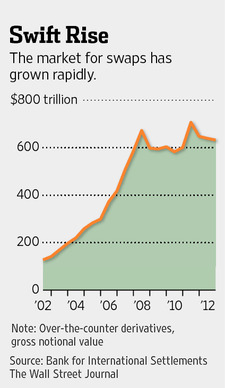
Banks, brokers and investors are warning of potential turmoil in a major part of the derivatives market on Oct. 2, when new U.S. rules kick in governing how instruments known as swaps are traded. Swaps are derivatives, traditionally not traded on exchanges, which corporations and financial institutions use to protect against or speculate on changes in everything from fuel costs to interest rates. The Bank for International Settlements estimates that there are $633 trillion of swaps outstanding. Read more of this post

SEC Aims to Get Tougher on Fraud; Chairman White, Fleshing Out Goals, Touts Settlements That ‘Have Teeth’ and Deter Wrongdoing

Updated September 26, 2013, 5:50 p.m. ET

SEC Aims to Get Tougher on Fraud

Chairman White, Fleshing Out Goals, Touts Settlements That ‘Have Teeth’ and Deter Wrongdoing

ANDREW ACKERMAN

CHICAGO—Wall Street’s main cop, under the new leadership of a former prosecutor, plans to ramp up its policing of financial fraud. Securities and Exchange Commission Chairman Mary Jo White, laying out a broad enforcement agenda for the first time since taking the helm at the agency five months ago, said the agency will seek charges against more individuals and pursue larger fines against companies that commit wrongdoing. Read more of this post

Is Nasdaq and NYSE Neglect Breaking the Humble Stock Ticker?

Is Nasdaq and NYSE Neglect Breaking the Humble Stock Ticker?

By Dave MichaelsSam Mamudi, and Matthew Philips September 26, 2013

On the morning of Sept. 12, executives of the nation’s major stock and options exchanges traveled to Washington to meet with Securities and Exchange Commission Chairman Mary Jo White. The summons was prompted by a rash of technical glitches on the exchanges, the most glaring of which hit on Aug. 22, when a software failure forced theNasdaq (NDAQ) to halt trading for three hours. White told the executives to come back in two months with a “comprehensive action plan” for making the markets more resilient. “Our homework assignments are clear,” NYSE Euronext (NYX) Chief Executive Officer Duncan Niederauer said to reporters afterward. “They require collaboration, and we’ve got 60 days.” Four days later, a glitch at an NYSE subsidiary helped bring the entire U.S. options market to a halt for 20 minutes. Read more of this post

Help a Ponzi Scheme? It’s No Big Deal for a Bank

Help a Ponzi Scheme? It’s No Big Deal for a Bank

Even by the lamentable standards of U.S. banking and securities regulators, the settlements unveiled this week with Toronto-Dominion Bank (TD) for its role in a $1.2 billion Florida Ponzi scheme were incredibly lacking. Three federal agencies on Sept. 23 said they had struck deals with TD Bank, the Toronto-based lender’s U.S. unit. The penalties amounted to $52.5 million: $37.5 million to settle allegations by the Office of the Comptroller of the Currency and $15 million to the Securities and Exchange Commission. Per the usual niceties, TD Bank neither admitted nor denied the agencies’ claims, which ranged from negligence to violations of anti-money-laundering laws. It also settled with the Financial Crimes Enforcement Network, a unit of the Treasury Department, but that won’t result in additional payments. Read more of this post

Global wealth management: banks’ panacea or failing dream?

Global wealth management: banks’ panacea or failing dream?

By Simone Foxman @simonefoxman September 26, 2013

If there’s one kind of banking that’s been repeatedly touted since the financial crisis, it has to be wealth management. Banking, we’re told, needs to become more boring. And in wealth management, the incentives of money managers are more directly aligned with those of their customers. But the wealth-management love story may be hitting a rough patch. Today, Barclays announced that it’s cutting its wealth management practice in 130 countries. On September 24, Credit Suisse said it too was scaling back on its emerging markets business (paywall), pulling out of approximately 50 countries, because it doesn’t have the scale to profit from customers there who are just moderately wealthy. HSBC, traditionally an emerging markets powerhouse, has also dialed back from practices in Latin America and Asia, though presumably to prevent itself from getting caught up in yet another damning and expensive money-laundering scandal. Read more of this post

Greece’s Financial Woes Are Far From Over; Public debt stands at 176 percent of GDP. No one knows how Greece will pay

Greece’s Financial Woes Are Far From Over

By Carol Matlack September 26, 2013

There were glimmers of hope in Athens in late September as international lenders arrived for a new round of talks on Greece’s debt crisis. The government said it would post a small budget surplus this year, with the economy set to contract a less-than-expected 3.8 percent. Tourism is up, Greeks are depositing money in banks again, and a poll released on Sept. 25 showed support for the governing coalition holding steady. Could this be the turning point? Six years of recession and the austerity measures demanded by Greece’s creditors have shrunk its economy by 25 percent and pushed unemployment to more than 27 percent. It seems the country has suffered enough. Read more of this post

Macroeconomic Mystery: U.S. Unemployment Subverts Okun’s Law

Macroeconomic Mystery: U.S. Unemployment Subverts Okun’s Law

By Evan Applegate  September 26, 2013

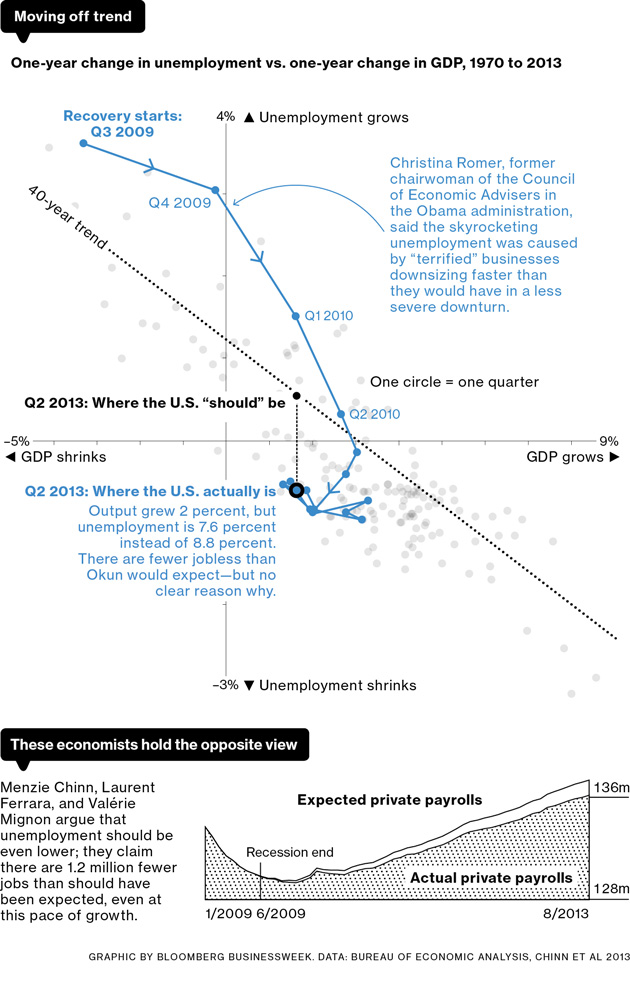
Okun’s law, posited by economist Arthur Okun, states that a 2 percent decline in output will be accompanied by a 1 percent rise in unemployment. That relationship, proven repeatedly over the past several decades, frayed during the recession and the plodding recovery that followed: Unemployment shot up faster than expected in the depths of the crisis, then fell more quickly than would be indicated by anemic U.S. growth.

econ_correlations40chart_630

The number of abandoned houses in Wenzhou, China’s “Entrepreneurs’ City”, may reach up to 15,000 after prices plunge and their owners are unable or are no longer willing to pay off their mortgages

Wenzhou homeowners abandon their properties as prices plunge

Staff Reporter

2013-09-26

The number of abandoned houses in Wenzhou in eastern China’s Zhejiang province may reach up to 15,000 after their owners are unable or are no longer willing to pay off their mortgages, reports Guangzhou’s 21st Century Business Herald. Wenzhou is the only city in China that has relaxed its restrictions on property purchases and allows some buyers to purchase a second house after the city’s property prices fell for 22 consecutive months. The average property price plunged 25.9% from 21,005 yuan (US$3,400) in January last year to 15,565 yuan (US$2,500) the following August, while properties previously driven up by speculation slumped by half their price. Many people now find their properties worth less than the mortgages they owe to the banks and are choosing to abandon them. Read more of this post

Ghostwriting a billion yuan industry in China

Ghostwriting a billion yuan industry in China

Staff Reporter

2013-09-26

To facilitate their career development, growing numbers of Chinese officials are publishing articles ghostwritten on their behalf. The face-boosting tactic has led to a covert industry with an annual output value that reached 1 billion yuan (US$163 million) in 2009. Liu Qiang, 33, a technician at a government agency in the capital of Inner Mongolia, is a typical example. In July, responding to an annual company evaluation requirement from his agency for at least one published article, Liu secured secured the services of local magazine Digitalized Subscriber to ghostwrite and publish an article with his byline. Many people have made a profession from writing papers and arranging their publication for others, the Party-run China Youth Daily said. Read more of this post

Financial consulting: The advisory industry has shown remarkable resilience since the crisis

Financial consulting: The advisory industry has shown remarkable resilience since the crisis

Sep 28th 2013 | New York |From the print edition

20130928_FND001_020130928_FNC481

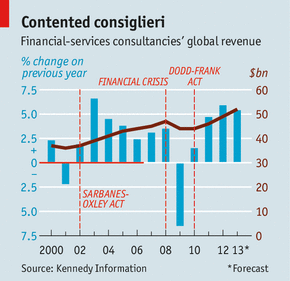
CONSULTANTS studiously avoid taking credit for their clients’ successes in order not to be blamed when things go awry. They have not been able to avoid the spotlight during the financial crisis. In a 2008 shareholder report explaining a huge write-down, UBS blamed “external consultants” for recommending that it go into areas like subprime mortgages. An ex-head of Citigroup’s investment bank told investigators he had relied on “a careful study from outside consultants” when moving into collateralised-debt obligations. Read more of this post

Swedish banks: Tips from an ageing model; Where banks are both safe and profitable

Swedish banks: Tips from an ageing model; Where banks are both safe and profitable

Sep 28th 2013 |From the print edition

ASK almost any banker in New York or London whether banks can have strong capital ratios and still generate mouthwatering returns for shareholders, and they will probably think you a fool. A doubling of the capital a bank has will, all else being equal, halve the bank’s return on equity (ROE). For most bankers there is an uneasy tension between making banks safer and making them attractive investments. Developments in Sweden, however, suggest it is possible to have both safety and profitability. Read more of this post

Mobile banking in Myanmar: Leapfrog spotting: Mobile phones may regenerate the country’s withered banking system

Mobile banking in Myanmar: Leapfrog spotting: Mobile phones may regenerate the country’s withered banking system

Sep 28th 2013 | Yangon |From the print edition

FOR a foreigner at least, it is still a bit of a thrill to use an ATM machine in downtown Yangon. After years of carting around wads of dog-eared dollars to exchange for even larger wads of ancient, crumbling kyat, the local currency, immaculate new machines now disgorge crisp new banknotes. It is a minor miracle. Linked to the international payment system only late last year, hundreds of ATMs around the country can now be used on Visa’s payments system. Read more of this post

America’s dominance of the global helium market is ending

America’s dominance of the global helium market is ending

Sep 28th 2013 |From the print edition

NOT every commodity contributes both to the gaiety of existence and life-saving technology. Helium does not just fill balloons and render voices squeaky. In gaseous form the inert, lighter-than-air gas is used in a range of applications from welding and fibre-optic technology to deep-sea diving. Super-cold liquid helium is essential to making and running the superconducting magnets for MRI scanners and to manufacturing electronic devices from TVs to phones. The world stands on the edge of a “helium cliff” precisely because the gas has always proved so useful. Read more of this post