Has Brazil blown it? A stagnant economy, a bloated state and mass protests mean Dilma Rousseff must change course

Has Brazil blown it? A stagnant economy, a bloated state and mass protests mean Dilma Rousseff must change course

Sep 28th 2013 |From the print edition

20130928_LDP002_0

FOUR years ago this newspaper put on its cover a picture of the statue of Christ the Redeemer ascending like a rocket from Rio de Janeiro’s Corcovado mountain, under the rubric “Brazil takes off”. The economy, having stabilised under Fernando Henrique Cardoso in the mid-1990s, accelerated under Luiz Inácio Lula da Silva in the early 2000s. It barely stumbled after the Lehman collapse in 2008 and in 2010 grew by 7.5%, its strongest performance in a quarter-century. To add to the magic, Brazil was awarded both next year’s football World Cup and the summer 2016 Olympics. On the strength of all that, Lula persuaded voters in the same year to choose as president his technocratic protégée, Dilma Rousseff. Read more of this post
Farmers in Kansas are starting to adapt to declining stocks of groundwater

Farmers in Kansas are starting to adapt to declining stocks of groundwater

Sep 28th 2013 | CHICAGO |From the print edition

MITCHELL BAALMAN’S well is drying up. This is bad news for a farmer of thirsty crops in parched north-western Kansas. Four years ago Mr Baalman and other local farmers realised that unless they started saving water there might not be enough left for their children and grandchildren to irrigate the soil. So they are trying something new: voluntarily cutting back on the amount they use, even though they will grow less. Read more of this post

Nonfinancial Commercial Paper Rises to Most Since 2001, Fed Says

Nonfinancial Commercial Paper Rises to Most Since 2001, Fed Says

The market for short-term IOUs by nonfinancial companies climbed to the highest mark in 12 years. The seasonally adjusted amount of commercial paper issued by the firms climbed $13 billion to $242.5 billion outstanding in the week ended yesterday, the highest level since June 2001, the Federal Reserve said today on its website. The central bank’s unprecedented economic stimulus measures pushed borrowing costs to record lows for debt issuers in May, spurring record offerings of dollar-denominated company bonds that have reached an all-time monthly high in September. Read more of this post

Bonds-for-Chickens Barter Feeds Debt Selloff in Venezuela

Bonds-for-Chickens Barter Feeds Debt Selloff in Venezuela

Venezuela will pay for $600 million of food imports including milk and live chicks from Colombia with dollar-denominated bonds, a sign the nation is running out of money to address the chronic shortages of basic goods fueling the world’s fastest inflation. Venezuela’s borrowing costs, which fell this month on speculation it would start a foreign-exchange system to boost the dollars needed to buy necessities from abroad and alleviate inflation of 45 percent, surged by the most in three weeks yesterday after El Nacional newspaper said China wouldn’t loan the cash intended to fund the change. Yields on the benchmark 2027 bonds rose 0.23 percentage point to 11.4 percent, almost four times the increase for junk-rated emerging market debt. Read more of this post

Norway Oil Fund Chief Warns on Bonds With Returns Close to Zero

Norway Oil Fund Chief Warns on Bonds With Returns Close to Zero

The head of Norway’s sovereign wealth fund, the world’s biggest, said the bond market will offer scant returns as the investor looks to expand into other asset classes to safeguard the nation’s wealth. “Returns in the bond markets are low and look to remain so for a good while ahead,” Yngve Slyngstad, chief executive officer of the $780 billion Government Pension Fund Global, said today in a speech in Bergen published on the central bank’s website. “The safest investment alternative gives today a return after inflation close to zero.” Read more of this post

Zoom, sputter, aagghhh!! The biggest loss-making cars in Europe

Zoom, sputter, aagghhh!! The biggest loss-making cars in Europe

Sep 25th 2013, 13:27 by S.W. and L.P.

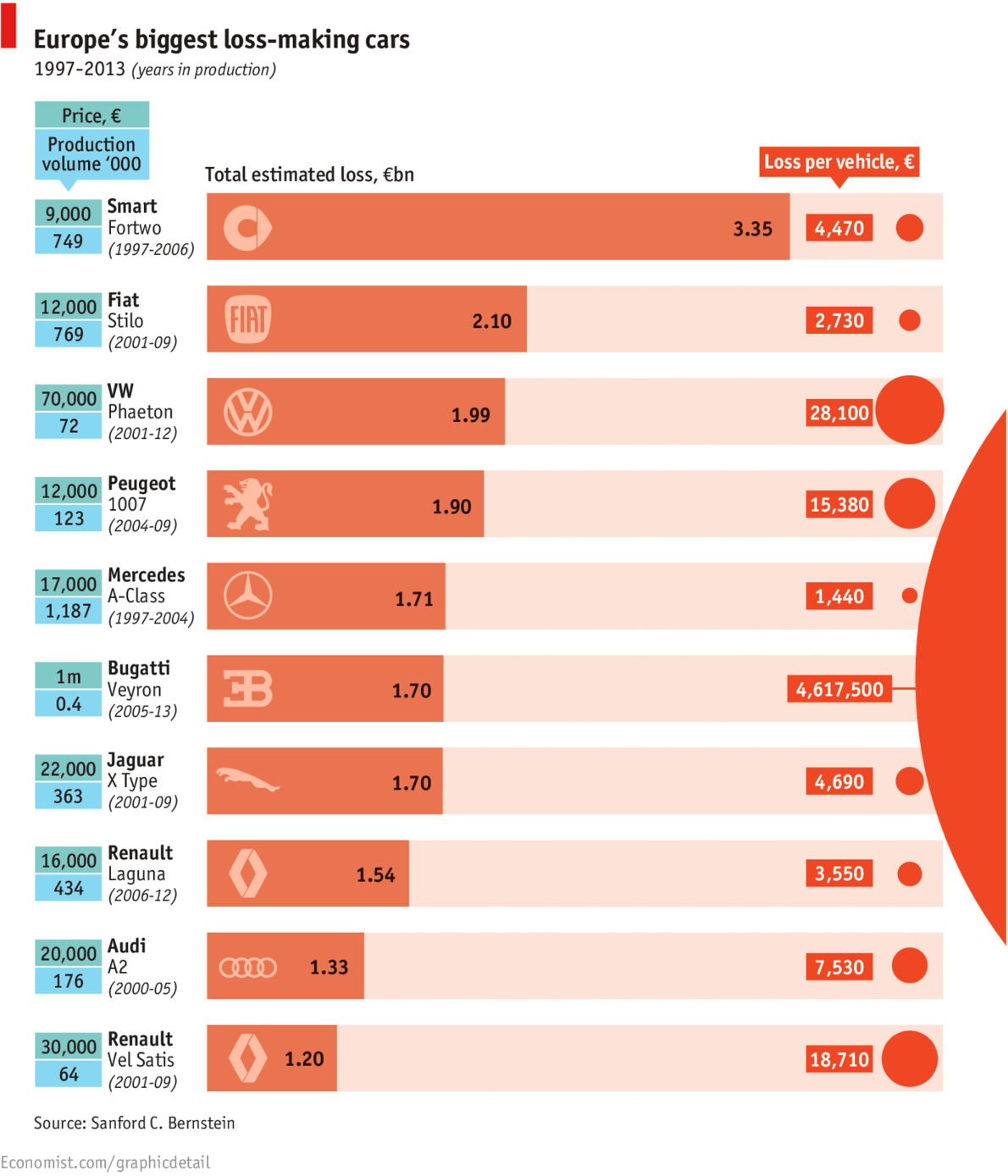
CARMAKERS in Europe are facing a rough ride, with sales at a 17-year low region-wide. So it seems cruel of Sanford C. Bernstein, a brokerage, to remind them of their biggest commercial wrecks. Most major makers suffered billions in losses. Yet not all cars failed by accidents of poor design, ill-judged technological leaps or wildly optimistic production forecasts. VW knew its Bugatti Veyron, a quick and complex supercar made in tiny numbers, would not make money but hoped it might burnish the brand. Daimler believed it could transfer know-how from its sleek executive saloons to small cars. It did—but it brought the same high costs too: its Smart Fortwo had the biggest loss. Renault produced reasonable cars but was overly optimistic about sales. Fiat failed to compete with the VW Golf. As for tomorrow’s pile-ups? Bernstein reckons that the latest bunch of electric cars could some day join the list.

20130928_gdc977_1190_6


The shadow of Fukushima, the world’s worst nuclear disaster after Chernobyl, hangs over Japan’s energy future

The shadow of Fukushima, the world’s worst nuclear disaster after Chernobyl, hangs over Japan’s energy future

Sep 21st 2013 | TOKYO |From the print edition

THIS week Japan’s last working nuclear reactor was switched off. At Oi, on the west coast of the country’s main island, the closure was supposedly for routine maintenance and safety checks. Yet no firm date is in sight for reopening Oi or any other of Japan’s 50 reactors, shut in the wake of the triple meltdown at the Fukushima Dai-ichi plant. Before the earthquake and tsunami of March 2011 turned so much of Japan’s world upside down, the country counted on nuclear power for 30% of its electricity—one of the highest proportions in the world. Now it is entirely without nuclear power for only the second time since 1970. Read more of this post

Flaws in the ASEAN “diamond decade”

Flaws in the diamond

In the different disputes in the East China Sea and South China Sea, China’s aims are the same

Sep 21st 2013 |From the print edition

LEE KUAN YEW, Singapore’s elder statesman, who turned 90 this week, offers some characteristically blunt analysis of China’s approach to territorial disputes in the East and South China Seas. In a new book (“One Man’s View of the World”), Mr Lee notes: “The Chinese know that they are the biggest boy in the neighbourhood and that, as they grow in power, they can expect more respect for their rights from their neighbours.” If the respect is lacking, China becomes menacing. Tensions with Japan over the Senkaku islands (known in China as the Diaoyu) have been mounting again. On September 11th China resentfully marked the first anniversary of the “nationalisation” of three of the five islands, which the Japanese government bought from their private owner. At the same time China’s dispute with the Philippines over islets in the South China Sea is deepening. Read more of this post

Barclays Plc will stop offering wealth management services in about 130 countries by 2016 and cut jobs in the unit

Updated: Thursday September 26, 2013 MYT 9:06:19 AM

Barclays too shut Wealth Management Services in 130 countries

LONDON: Barclays Plc will stop offering wealth management services in about 130 countries by 2016 and cut jobs in the unit as part of an effort to rein in costs and boost profit, the Financial Times reported on Wednesday, citing the British bank. Barclays announced plans in April to restructure its wealth business so it works more closely with retail and corporate banking divisions. Further details on the wealth strategy had been expected. The bank appointed Peter Horrell as the wealth and investment management unit’s chief executive on Monday. Horrell has held the position on an interim basis since May. – Reuters


Nomura Says China May Allow Defaults of Local Debt

Nomura Says China May Allow Defaults of Local Debt

(Corrects name in second paragraph.)

Policy makers in China may allow some local governments’ debt to default next year to improve market discipline as borrowings surge, according to Nomura Holdings Inc. Local government financing vehicles’ debt grew 39 percent from 2010 to 19 trillion yuan ($3.1 trillion) as of the end of 2012, Nomura economists led by Zhang Zhiwei wrote in a report released today. That’s 37 percent of gross domestic product, according to the investment bank. China will complete an audit of the debt this month to assess risks to its financial system, ahead of a Communist Party meeting in November to set economic policy. Non-performing local-government and corporate liabilities will probably have a “significant impact” on China’s credit and economic growth, according to half of the economists in a Bloomberg News survey conducted in July. Read more of this post

What Investors Should Know About Shanghai’s Free-Trade Zone

September 26, 2013, 10:05 a.m. ET

What Investors Should Know About Shanghai’s Free-Trade Zone

WEI GU

Shanghai’s free-trade zone is set to launch Sunday despite almost no clarity about what exactly will be freely tradable. Investors have bid up the shares of real-estate companies in the zone and pundits have made predictions ranging from currency convertibility to access to Facebook FB +1.86% . In the first case, investors are thinking too narrowly; in the second, the pundits aren’t thinking much at all. The Chinese government historically hasn’t made big, bold changes all at once, but has taken incremental approaches to new and risky ventures. The step-by-step internationalization of the yuan is a good example. Read more of this post

Maersk Line CEO: We Misjudged Container-Shipping Demand when we ordered billions of dollars’ worth of new vessels two years ago

September 26, 2013, 7:04 a.m. ET

Maersk Line CEO: We Misjudged Container-Shipping Demand

Shipper Now Counting on Cargo-Sharing Alliance to Cut Costs

COSTAS PARIS And CLEMENS BOMSDORF

Søren Skou, the chief executive of Maersk Line, said the Danish group misjudged the strength in demand for container shipping, which has proved far more sluggish than it expected when it ordered billions of dollars’ worth of new vessels two years ago. Photo: Bloomberg

COPENHAGEN—The chief executive of Danish shipping group Maersk Line said Thursday the company misjudged the strength in demand for container shipping, which has proved far more sluggish than it expected when it ordered billions of dollars’ worth of new vessels two years ago. The world’s biggest container shipper is now counting on the planned P3 cargo-sharing alliance with European rivals CMA CGM and Mediterranean Shipping Co. to cut costs and reduce the number of their ships plying major routes between Europe and Asia to 250 from 300, Soren Skou said in an interview with The Wall Street Journal. Read more of this post

Two thirds of Australian family businesses do not have a succession plan in place despite the majority of family chief executives being over the age of 50 and nearly 20% being over the age of 65

AUSTRALIAN FAMILY FIRMS FAILING TO PREPARE FOR SUCCESSION

ARTICLE | 23 SEPTEMBER, 2013 04:40 PM | BY JESSICA TASMAN-JONES

Two thirds of Australian family businesses do not have a succession plan in place despite the majority of family chief executives being over the age of 50 and nearly 20% being over the age of 65, according to a KPMG and Family Business Australia survey. Seventy-two per cent of family businesses listed balancing family and business issues as the primary challenge for their family firm, and 67% said maintaining family ownership was a primary concern. The biennial report, this year titled Performers: resilient, adaptable, sustainable and conducted in collaboration with the University of Adelaide’s Family Business Education and Research Group, found 71% of families intend to retain family ownership, but around half would consider a sale if approached. First generation firms were more likely to consider a sale than family firms in their second generation or beyond. Read more of this post

BlackBuried: Indonesia Failings Offer Lessons for Apple, Samsung

BlackBuried: Indonesia Failings Offer Lessons for Apple, Samsung

By Jeremy Wagstaff & Kanupriya Kapoor on 4:37 pm September 25, 2013.
Indonesia has long been a surprising jewel in the crown of BlackBerry Ltd, a rare market where its devices enjoyed mass appeal. But the country also highlights the struggling company’s failure to embrace the emerging economies that are leading smartphone sales growth across the globe. Indonesia is still one of BlackBerry’s biggest markets, accounting for about 15 percent of global users but its share of smartphone sales in Southeast Asia’s biggest economy has fallen fast to 21 percent in the second quarter from 39 percent a year earlier, according to data from telecoms consultancy IDC. Read more of this post

Abenomics Speeds Corporate Investment, But Not in Japan

Abenomics Speeds Corporate Investment, But Not in Japan

By Wayne Arnold & Orathai Sriring on 3:05 pm September 26, 2013.
Hong Kong/Bangkok. Japanese Prime Minister Shinzo Abe got an early sign of how his blueprint to revive Japan’s industrial vim and economic vigor was working when two of his country’s biggest car makers unveiled $900 million worth of investments to boost production. There was one drawback: the new assembly plants and expanded factories announced by Mazda Motor and Honda Motor are not in Japan, but more than 2,000 miles away, in Thailand. Read more of this post

Park’s Budget Scales Back Pledged Aid to South Korean Aged as the government forecast the first drop in revenue in four years

Park’s Budget Scales Back Pledged Aid to South Korean Aged

South Korea President Park Geun Hye was forced to scale back aid she pledged to pensioners in her 2014 budget and delayed plans to eliminate the deficit as the government forecast the first drop in revenue in four years. In her first budget draft since taking office in February, Park boosted welfare spending to a record while scaling back a plan to expand pension benefits as dwindling revenue restricts her ability to increase support for an aging population. The deficit is forecast to remain at 1.8 percent of gross domestic product, a seventh straight year of shortfalls in Asia’s fourth biggest economy, the finance ministry said in its proposal. Read more of this post

Fuss Trounces Bond Rivals by Thinking Like a Stock Picker

Fuss Trounces Bond Rivals by Thinking Like a Stock Picker

Loomis Sayles & Co.’s Dan Fuss left rival bond-fund managers including Bill Gross behind in his eighth decade, by using a style generally associated with bargain-hunting stockpickers. Fuss, who turns 80 tomorrow, managed the two best large U.S. bond funds over the past 10 years. His $15.1 billion Natixis Loomis Sayles Strategic Income Fund and the $21.7 billion Loomis Sayles Bond Fund both returned more than 125 percent over the period, ranking first and second among 65 bond funds with more than $5 billion in assets that have been in existence for at least 10 years, according to data compiled by Bloomberg. The flagship Loomis Sayles Bond Fund, started in 1991, was also the top fixed-income fund over the past 20 years. Read more of this post

Amid Probe, Chinese Moguls Vanish; Prominent Executives are Being Detained, Associates Say, in Sign of New Round of Political Infighting

Updated September 25, 2013, 8:41 p.m. ET

Amid Probe, Chinese Moguls Vanish

Prominent Executives are Being Detained, Associates Say, in Sign of New Round of Political Infighting

JAMES T. AREDDY

WO-AP580_CMISSI_DV_20130925202000AI-CD763_CMISSI_G_20130925200908

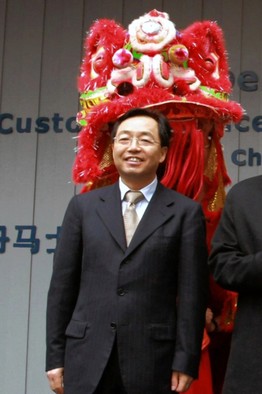
Li Chuncheng, ousted Sichuan deputy party chief, had ties to many of the business tycoons; At nearly three times the size of the Pentagon, the New Century Global Center in Chengdu, China, has claimed the title of world’s largest building. WSJ’s Deborah Kan and James T. Areddy discuss what makes the center more than just a building as well as the mysterious disappearance of its owner.

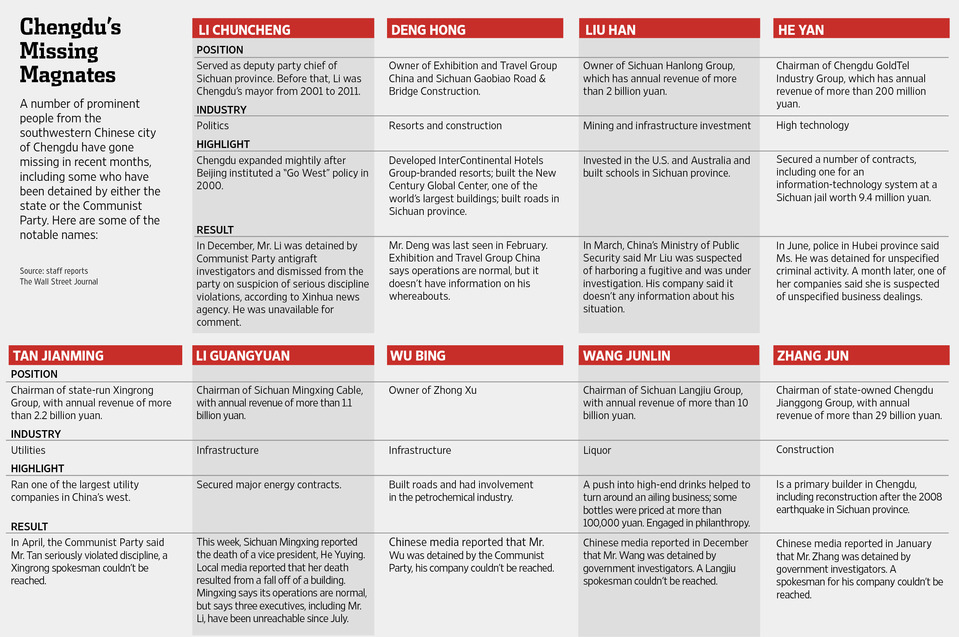
CHENGDU, China—When the government of this southwestern city needed a landmark for a new district, billionaire developer Deng Hong picked up the land cheap five years ago and erected a building almost three times the size of the Pentagon. Nearby, Wu Bing paved a motorway, while Liu Han put up schools. He Yan wired a jail with information technology and Wang Junlin’s winery funded government charities. Now, over the past several months, all of those tycoons have disappeared from view. Their absences come amid an alleged corruption scandal that may broadside the economic vitality of this gateway to China’s rugged west and indicate a fresh front in Chinese political infighting. Read more of this post

China Running Out of Room to Restructure Economy

China Running Out of Room to Restructure Economy

If we accept the argument that China must, and will, rebalance its economy by reducing its reliance on investment, what happens if it proves politically impossible to cut investment rates sharply? Gross domestic product growth rates would remain very high, but debt levels would also grow unsustainably. At some point, China will reach its debt capacity limits and no longer be able to fund investment. At this point, the country would fall into the self-reinforcing process of chaotic adjustment that characterized the U.S. in the early 1930s or Brazil in the mid-1980s. As investment falls and GDP growth grinds to a halt, rising financial distress causes businesses to fire workers. Unemployment causes consumption growth to drop, and GDP growth falls even further, resulting in more distress. Read more of this post

Shanghai’s Free-Trade Zone Is Destined to Disappoint; The new commercial oasis is an experiment in how little reform Beijing can get away with—not how much

September 25, 2013, 12:51 p.m. ET

Shanghai’s Free-Trade Zone Is Destined to Disappoint

The new commercial oasis is an experiment in how little reform Beijing can get away with—not how much.

JOSEPH STERNBERG

When it comes to the triumph of China hope over China experience, it’s hard to match the current wave of enthusiasm over the impending opening of the Shanghai Free Trade Zone. This project, first announced in August and still shrouded in mystery on the alleged eve of its launch, is supposed to herald a new era in the country’s economic evolution away from export manufacturing and toward service consumption. Authorities may even allow access to banned social-media websites such as Facebook and Twitter in the 29-square-kilometer zone. Read more of this post

Wenzhou woes are warning for all to see; even the loan shark market is stretched, and the nationwide liquidity shortage in June made the situation much worse

Wenzhou woes are warning for all to see
Thursday, September 26, 2013
Data show that among 70 major Chinese cities, 69 saw home prices rise in August year-on-year. In first-tier cities – Beijing, Shanghai, Guangzhou and Shenzhen – prices jumped 18 to 20 percent, and in second-tier cities, 7 to 10 percent. Where did prices fall? Wenzhou, Zhejiang province. Known as the birthplace of China’s private economy, Wenzhou boasts numerous entrepreneurs making electrical equipment, chemicals, medicine, building materials and textiles. With their wealth, some of the businessmen turned to speculation. Data show that home prices in Wenzhou peaked in early 2011, and since then, have plunged 26 percent. The city faces three major woes. Debts have soared at local firms amid the economic slowdown in America and Europe. Secondly, even the loan shark market is stretched, and the nationwide liquidity shortage in June made the situation much worse. Third, the property market bubble burst, and it is China’s only city permitted to float policies to boost home purchases. Even Wang Shi, chairman of the mainland’s largest developer, Vanke, has warned the nation’s property bubble is similar to that of Japan in the 1980s. Will anybody listen to him? Dr Check and/or The Standard bear no responsibility for any decision made based on this column.

Tibetan caterpillar fungus fortune nearing exhaustion

Tibetan caterpillar fungus fortune nearing exhaustion

Xinhua

2013-09-26

The caterpillar fungus, a cash cow for Tibetans, may die out in China in two decades, as a result of overexploitation on the Qinghai-Tibet Plateau, experts have warned. When the harvest season ended this summer, many unlucky diggers found their fungus incomes were not even enough to cover their costs — mainly a fee that varies from 5,000-50,000 yuan (US$820 – US$8,200) levied by local authorities according to the acreage where they were allowed to dig. Read more of this post

Pursuing Graft Cases at Higher Levels, Chinese Leader Risks Unsettling Elites; “Xi Jinping must do something to show that he has command over those interests — that they are not independent kingdoms. Otherwise, no one will follow him”

September 25, 2013

Pursuing Graft Cases at Higher Levels, Chinese Leader Risks Unsettling Elites

By CHRIS BUCKLEY

HONG KONG — Shortly before his retirement late last year, Zhou Yongkang, the longtime chief of China’s domestic security apparatus, visited an office of the state oil company where he had started his ascent in the Communist Party hierarchy. He spoke of his undimmed devotion to the company, China National Petroleum Corporation, and to his fellow oilmen. “Oil is a word that stays in an oilman’s heart for his whole life,” Mr. Zhou said in his valedictory. A year later, senior officials associated with the oil conglomerate, including longtime allies of Mr. Zhou’s, are enmeshed in spreading corruption inquiries, presenting China’s new leader, Xi Jinping, with one of his biggest tests so far: How far and high is he willing to go to clean up China’s political elite? Read more of this post

Fonterra to launch self-branded infant formula in China

Fonterra to launch self-branded infant formula in China

By Ding Yining | September 26, 2013, Thursday |  PRINT EDITION

The world’s largest dairy producer Fonterra will launch its self branded infant formula in China later this year, undeterred by a recent botulism scare, as it taps the huge demand for imported formula in the country. The launch would start around the end of this year, an official with Fonterra China confirmed with Shanghai Daily yesterday, although no other details were provided. Fonterra CEO Theo Spierings said its Anmum brand of infant milk formula will be available in 70 Chinese cities in two to three years, Reuters reported yesterday. Read more of this post

China’s top appliance maker Gree eyes banking business, the second Chinese home appliance player to eye a move into the financial industry after Suning

China’s top appliance maker Gree eyes banking business

1:31am EDT

HONG KONG (Reuters) – A unit of China’s Gree Electric Appliances Inc of Zhuhai (000651.SZ: QuoteProfile,ResearchStock Buzz) plans to set up a private bank, the second Chinese home appliance player to eye a move into the financial industry after Suning Commerce Group Co Ltd (002024.SZ: QuoteProfileResearchStock Buzz) announced its own plans last month. Gree, with a market value of $14 billion, said in a filing to the Shenzhen stock exchange late on Wednesday that Zhuhai Gree Group Finance Co Ltd is in initial talks with Zhuhai Hengqin Village Bank, but said no agreement has been reached. Read more of this post

China’s wealthiest families score $720 billion in undeclared “gray income”

China’s wealthiest families score $720 billion in undeclared “gray income”

By Lily Kuo @lilkuo September 25, 2013

The undeclared “gray” income earned by China’s richest families has reached staggering levels, and is contributing to massive income inequality that is far worse than official statistics, according to research by the state-backed China Society of Economic Reform. CSER researcher Wang Xiaolu, writing in Caixin magazine, said gray income reached 6.2 trillion renminbi (about $1 trillion) in 2011, or about 12% of GDP, based on a survey of 5,344 families in urban areas that was completed in 2012. Read more of this post

China to boost domestic formula brands

September 25, 2013 12:11 pm

China to boost domestic formula brands

By Lucy Hornby in Beijing

China is set to unveil subsidies and other support for five of its dairy companies to develop infant formula brands to compete against the foreign brands that currently dominate the premium end of Asia’s largest formula market. If successful, the policy, expected to be announced on Saturday, could create new competition for companies such as Nestlé,Danone and Abbott Laboratories. Read more of this post

China corruption trials risk erosion of party legitimacy

September 25, 2013 1:57 pm

China corruption trials risk erosion of party legitimacy

By Jamil Anderlini in Beijing

The criminal trials of two of China’s most notorious businesswomen have opened in Beijing and northern China just days after Bo Xilai, disgraced Communist party leader, was handed a life sentence for corruption and abuse of power. Gong Aiai, a former vice-president of a rural bank, is accused of buying fake identification to purchase dozens of properties in Beijing, while Ding Yuxin allegedly paid huge bribes to China’s former railway minister in exchange for billions of renminbi worth of contracts. Read more of this post

Break up of State oil monopoly? Industry experts suggested that China should establish a separate and independent company to operate the oil wholesale business and manage the supply to retailers, to break up the de facto monopoly of the three state-owned large oil companies

Break up of State oil monopoly?

2013-09-26 02:08:33 GMT2013-09-26 10:08:33(Beijing Time)  China Daily

As part of the efforts to dismantle the SOE’s monopoly in the petroleum sector, China should separate the oil wholesale business away from the three major State-owned industrial enterprises, experts suggested. Song Qiong / Xinhua

Industry experts suggested that China should establish a separate and independent company to operate the oil wholesale business and manage the supply to retailers, to break up the de facto monopoly of the three State-owned large oil companies, especially the two onshore oil giants. A major portion of China’s oil stations are run by Sinopec Ltd and PetroChina Co Ltd, and although oil stations owned by foreign companies and private investors do exist, they have a marginal significance in terms of market share. Read more of this post

The New Going Dutch: Why a U.S.-Japan merger is relocating to the Netherlands. Tokyo Electron takeover could be a mold-breaker for Japan. Applied Materials CEO Moving Family to Tokyo in Big Deal

September 25, 2013, 7:15 p.m. ET

The New Going Dutch

Why a U.S.-Japan merger is relocating to the Netherlands.

The $29 billion merger that America’s Applied Materials AMAT +2.26% and Japan’sTokyo Electron 8035.TO -2.19% announced on Tuesday is a rare trans-Pacific marriage in which a U.S. firm seems to be the dominant player. As eye-catching, the companies say that their merged entity will be incorporated not in Japan or in North America—but in the tax-friendly Netherlands. Among OECD countries, the U.S. ranks at the bottom with a combined statutory federal and state corporate income tax rate of 39.1%, and Japan is next on the dishonor roll at 37%. America is also, er, exceptional for taxing overseas profits, which dissuades companies from bringing back and reinvesting this capital at home. Read more of this post