Singapore Foreigner Curbs Target Professionals: Southeast Asia

Singapore Foreigner Curbs Target Professionals: Southeast Asia

Singapore will widen foreign-worker curbs to professional jobs as the government clamps down on companies that hire overseas talent at the expense of citizens, stepping up efforts to counter a backlash against immigration. The Southeast Asian nation said yesterday it will set up a job bank where companies are required to advertise positions to Singaporeans before applying for so-called employment passes for foreign professionals. The unprecedented policy will target jobs that pay at least S$3,000 ($2,400) a month. Read more of this post

US housing: Content to rent? Americans are increasingly abandoning property ownership as investment increases in the rental sector

September 23, 2013 7:17 pm

US housing: Content to rent?

By Anjli Raval

Americans are increasingly abandoning property ownership as investment increases in the rental sector

Sandie Crisman sees the headlines hailing the US housing rebound and wonders when she will get her share of it. The 60-year-old Florida resident is one of the tens of thousands of Americans burnt by the housing bust that wiped out $7tn in homeowner equity and is still suffering from its fallout. “If I could do it all over again, I wouldn’t be a homeowner,” she says. “What’s the point if you can’t guarantee your house will be worth what you paid for it in five or 10 years time?” Read more of this post

Maybe New Zealand Can Solve Housing Bubbles

Maybe New Zealand Can Solve Housing Bubbles

As the world’s biggest economies search for ways to let the air out of giant asset bubbles, they might find some answers in tiny New Zealand. (NZOCR)

Fittingly, the nation that begins the developed world’s day and the central bank that pioneered inflation targeting will probably be the first to raise short-term interest rates. The move could come next year as growth steadily returns to levels seen before the collapse of Lehman Brothers Holdings Inc. in 2008. But something far more interesting is afoot at the Reserve Bank of New Zealand’s headquarters in Wellington. Faced with a scary housing bubble not terribly unlike that in the U.S. five years back, Governor Graeme Wheeler should be tapping the brakes now, and hard, or so holds classical monetary theory. Doing so, however, would jeopardize the nation’s 2.5 percent growth amid general global uncertainty. Instead, Wheeler is conducting an experiment: limits on leveraged lending. Read more of this post

US convertible bond sales slow sharply

September 23, 2013 9:47 am

US convertible bond sales slow sharply

By Arash Massoudi in New York

The pace of convertible bond issuance in the US unexpectedly slowed through the summer, defying investor expectations that a rapid number of new deals would come to market as interest rates moved higher. Convertible bonds allow companies to issue debt at ultra-low yields but give investors the option to convert the securities into stock if the share price reaches a preset premium during the bond’s tenure. Read more of this post

Celebrating a Century of Indian Cinema

Celebrating a Century of Indian Cinema

By Gurjit Singh on 10:22 pm September 23, 2013.
This year marks the centenary of Indian cinema. It was in May 1913 that the first full-length feature film “Raja Harishchandra” was screened in Mumbai. That film brought traditional Indian legends to the silver screen and changed the nature of entertainment in India. The cinema movement in the country thereafter moved very quickly from Mumbai, to Chennai, to Hyderabad and to Bengal where the cinema industry and theater developed quickly. The low price of tickets brought a new awareness to the people of India and community viewing of cinema became an integral part of Indian social activity. Read more of this post

The Landesbanken: Inside Germany’s trillion euro banking blind spot

The Landesbanken: Inside Germany’s trillion euro banking blind spot

Tue, Sep 17 2013

By Laura Noonan

HAMBURG (Reuters) – Many Germans feel that whoever wins Sunday’s election, they should not fund any more bailouts of fellow European countries, whose errant banks are a particular bugbear for Berlin. But a cornerstone of Germany’s own banking system, which has already received state bailouts, is facing fresh challenges, increasing the need for reforms which will be very hard for any new government to deliver. Read more of this post

Should the U.S. Finance Alternative-Energy Startups? After some well-publicized failures, two experts debate whether the federal government should play this role

September 22, 2013, 5:17 p.m. ET

Should the U.S. Finance Alternative-Energy Startups?

After some well-publicized failures, two experts debate whether the federal government should play this role.

IV-AA462B_DEBAT_D_20130919170014

The federal government has long been a player in the energy industry. On top of its regulatory role, the U.S. government extends tax credits to companies in fossil fuels, renewables and nuclear energy alike. It also makes direct investments. The Tennessee Valley Authority, for instance, a supplier of power to seven states, was created by Congress and has been owned by the U.S. since 1933. Read more of this post

Phoenix Solar to build largest PV solar system in Singapore for supermarket giant Sheng Siong Group,

Sheng Siong’s distribution centre to house largest single solar panel installation

shengsiong_zb

Monday, September 23, 2013 – 16:16

Grace Chua

The Straits Times

SINGAPORE – The 11,000 square metre installation will supply up to 1.2 megawatts when running at peak, and will be built by major solar energy firm Phoenix Solar. The system is expected to start producing electricity by the end of this year, and supply at least 15 per cent of the centre’s consumption. 

Phoenix Solar to build largest PV system in Singapore

The Singapore-based firm will design and build Singapore’s largest photovoltaic system for supermarket giant Sheng Siong Group, which will reduce 730 tonnes of carbon dioxide emissions per year

Phoenix Solar on Monday announced that it will design and build the biggest photovoltaic (PV) system in Singapore for supermarket giant Sheng Siong Group. Read more of this post

Loans challenge big money’s leasing model for U.S. rooftop solar

Loans challenge big money’s leasing model for U.S. rooftop solar

1:04am EDT

By Nichola Groom

(Reuters) – Falling prices and growing acceptance of home solar power is sparking a challenge to major financiers who have anchored the U.S. industry using leases, as smaller banks and other lenders rush to offer homeowners loans to buy systems. Loans offer homeowners a path to solar system ownership and the opportunity to capture for themselves federal tax credits worth 30 percent of the value. Well over 60 percent of residential systems in top solar states like California and Arizona today are owned by investors or companies which lease systems to homeowners for a monthly fee. Read more of this post

Holcim Turns Toxic Toys Into Cement as Waste Helps Profit

Holcim Turns Toxic Toys Into Cement as Waste Helps Profit

Holcim Ltd. Chief Executive Officer Bernard Fontana is turning waste into profit at the world’s largest maker of cement by burning toxic baby dolls, contraband cigarettes and old sunglasses. Fontana, who last year became the first outsider to run Jona, Switzerland-based Holcim in its 101-year history, is ramping up the use of waste materials, instead of coal, to heat cement kilns from India to Vietnam and cut costs. The expansion into waste management is generating revenues as companies such as cigarette makers pay to burn copycat and expired goods, said Aidan Lynam, an area manager for Holcim in South Asia. “They watch to make sure every last cigarette goes into our kiln,” he said, referring to manufacturers in Vietnam that pay to cremate contraband at Holcim plants. “It disappears like a grain of sand in the Sahara,” he said, adding that at extreme temperatures, cigarettes become part of the cement. Following more than $10 billion of acquisitions in the decade through 2011, Fontana began a cost-cutting program last year to boost operating profit by 1.5 billion Swiss francs ($1.6 billion) and adjust for declining demand amid the European debt crisis. Burning waste may make some cement plants in Asia as energy efficient as in Europe, helping Holcim to free up cash and compete with rivals Lafarge SA and Cemex SAB. Read more of this post

Why $100,000 Salary May Yield Retirement Flipping Burgers

Why $100,000 Salary May Yield Retirement Flipping Burgers

It seems like another life. At the height of his corporate career, Tom Palome was pulling in a salary in the low six-figures and flying first class on business trips to Europe. Today, the 77-year-old former vice president of marketing for Oral-B juggles two part-time jobs: one as a $10-an-hour food demonstrator at Sam’s Club, the other flipping burgers and serving drinks at a golf club grill for slightly more than minimum wage. While Palome worked hard his entire career, paid off his mortgage and put his kids through college, like most Americans he didn’t save enough for retirement. Even many affluent baby boomers who are approaching the end of their careers haven’t come close to saving the 10 to 20 times their annual working income that investment experts say they’ll need to maintain their standard of living in old age. For middle class households, with incomes ranging from the mid five to low six figures, it’s especially grim. When the 2008 financial crisis hit, what little Palome had saved — $90,000 — took a beating and he suddenly found himself in need of cash to maintain his lifestyle. With years if not decades of life ahead of him, Palome took the jobs he could find. The youthful and perennially optimistic grandfather considers himself lucky. He’s blessed with good health, he said. He’s able to work, live independently and maintain his dignity, even if he has to mop the floors at the club grill before going home at 8 p.m. and finally getting off his feet. “That’s part of the job,” he said. “You have to respect the job you’re doing and not be negative — or don’t do it.” Read more of this post

Moncler, the purveyor of €1,000 down jackets, to list after sales climbed from less than €50m in 2003 to €489m in 2012; “China is very dangerous. I don’t trust that it will be like this for the next 20 years . . . there will be a crash.”

September 23, 2013 11:46 am

Moncler in second attempt to wrap up IPO

By Rachel Sanderson in Milan

Moncler Grenoble Fall 2013 Presentation

My dream is that you collect three, four, five of my jackets in your wardrobe and you choose one for different days, but they last for life – Remo Ruffini, chairman and creative director, Moncler

Moncler, the purveyor of €1,000 down jackets, has a stock market listing in its sights. Remo Ruffini, chairman and creative director of Moncler, said in an interview with the Financial Times that he and the brand’s private equity backers were looking at a winter listing of the Franco-Italian brand in Milan. A successful listing would be second time lucky for Moncler. Private equity group Carlyle pulled a stock market listing in Milan in June 2011. Jittery about volatile markets, Carlyle instead sold 45 per cent of Moncler to French private equity group Eurazeo for €418m. Read more of this post

Shadow Boxing With Risk at Chinese Banks

September 22, 2013, 2:51 p.m. ET

Heard on the Street: Shadow Boxing With Risk at Chinese Banks

AARON BACK

MI-BY611_CBANKH_NS_20130922165105

Chinese banks are bringing some holdings out of the shadows. But they might not be shining a harsh enough light on them. For some time, Chinese banks have used off-balance-sheet vehicles to lend to trusts, which are lightly regulated finance intermediaries. Now, new regulations are forcing them to take some of those instruments back onto their books as Chinese authorities look to rein in the “shadow-banking” sector. That led in the first half of this year to a surge on some bank balance sheets of credit extended to these trusts. Yet banks, especially smaller ones, may not be adequately reflecting, or preparing for, the risk that could be embedded in these holdings. The tangled web starts with wealth-management products, a kind of high-interest deposit banks offer clients. These were created to sidestep caps on rates for traditional deposits. Sometimes, banks guarantee the client’s principal in these products; when they don’t, the products don’t appear on bank balance sheets. Read more of this post

Wuhan has to repay about 100 million yuan every day in 2013 and 2014 as its debts soared on huge expenditures on infrastructure projects in the past years, the latest example showing the seriousness of China’s local government debt

Local debt levels raising alarm 
Monday, September 23, 2013
Wuhan has to repay about 100 million yuan (HK$126.7 million) every day in 2013 and 2014 as its debts soared on huge expenditures on infrastructure projects in the past years, the latest example showing the seriousness of China’s local government debt issue. Debts of the capital city of Hubei province reached 203.71 billion yuan as at June 30, 2012, China Business said, citing an investigation report by an official from the Ministry of Finance. Read more of this post

Hangzhou Bay Bridge provides lower returns than expected after five years; bridge’s operator is facing a huge capital shortfall of 850 million yuan (US$138.2 million)

Hangzhou Bay Bridge provides lower returns than expected

Staff Reporter

2013-09-23

C502X0020H_2008資料照片_N71_copy1

The opening ceremony of the Hangzhou Bay Bridge held on May 1, 2008. (Photo/Xinhua)

After putting the 36 km Hangzhou Bay Bridge in east China’s Zhejiang province into service in 2008, the bridge’s operator is facing a huge capital shortfall of 850 million yuan (US$138.2 million), given that only 643 million yuan (US$104.5 million) in tolls was collected during the first half of this year, Guangzhou’s 21st Century Economic Report reports. Read more of this post

Investors Vs. Asset Managers: A Dysfunction at the Heart of China Private Equity

Investors Vs. Asset Managers: A Dysfunction at the Heart of China Private Equity

2013-09-23 17:47:35

Peter Fuhrman, Chairman and CEO China First Capital

Assuming the same level of risk, would you rather make $100 from investing $10 or from investing $50? Easy, right? Who wouldn’t choose to make ten times your money, rather than just double it? There is one group I know. Private equity firms active in China. At least some of them. They care more about the amount they can invest in a deal than the profits they stand to make. The illogic at work here is the direct result of some particular, not very appealing characteristics, of the PE industry in China. PE firms lately have more confidence in their ability to raise money than to invest it profitably by achieving a timely exit. To raise money, though, a PE firm needs first to spend most of what it already has. Result: a rush to get money out the door and parked in deals. Read more of this post

Lotte heirs in ‘mini’ power struggle; Shin Kyuk-ho sent the elder Shin to Japan and the younger Shin to stay in Korea but the Korean ops have grown ten times bigger than the Jap ops in the past decades

2013-09-23 21:00

Lotte heirs in ‘mini’ power struggle

02-21

Shin Kyuk-ho                 Shin Dong-joo              Shin Dong-bin
Founder of             Japan Lotte Holdings             Lotte Group
Lotte Group                  vice chairman                     chairman

By Choi Kyong-ae
The brothers who run Lotte operations in Korea and Japan have been on a hunt for stakes in affiliates, triggering suspicion that they are competing for control of the Korean retail giant.  Their father is 91 but still engaged in managing the group. Last week, Japan Lotte Holdings Vice Chairman Shin Dong-joo acquired 1 billion won ($930,000) worth of stocks, representing a 0.05 percent stake, in Lotte Confectionery. Lotte Group Chairman Shin Dong-bin continued to buy stakes in Lotte Chemical, Lotte Confectionery, Lotte Chilsung and Lotte Insurance since May through Sept. 13. Read more of this post

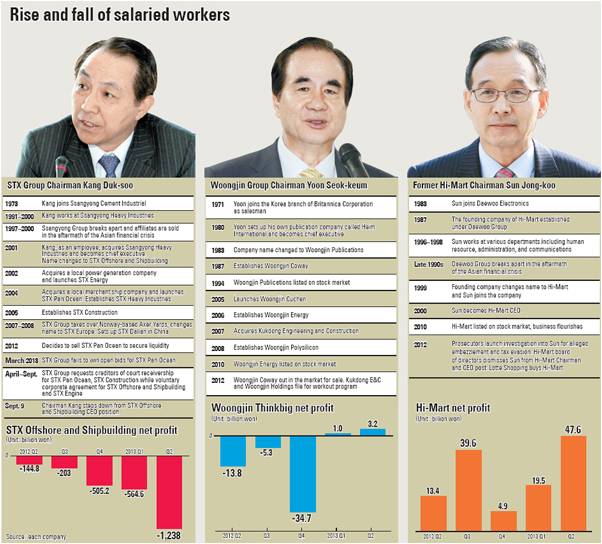
Reality check for ‘salaried man myth’: STX Group chairman’s troubles tarnish image of a business legend; In every country, there are legends in the business world who start their career from the bottom as salaried workers, and after decades of hard work become heads of conglomerate

Reality check for ‘salaried man myth’

STX Group chairman’s troubles tarnish image of a business legend

Sept 23,2013

Korea Salaried

In every country, there are legends in the business world who start their career from the bottom as salaried workers, and after decades of hard work become heads of conglomerates. Korea, too, has such legendary figures to share, although in most cases they don’t seem to have a happy ending. STX Group Chairman Kang Duk-soo, who has long been considered a successful entrepreneur who started out with nothing but achieved much, is about to lose his title as chief executive officer of the conglomerate’s flagship STX Offshore and Shipbuilding, which he has been steering for more than a decade.  Read more of this post

Tongyang Group is expected to face the biggest-ever liquidity crisis as Orion Group has refused to offer emergency liquidity to the cash-strapped group; Orion’s Tam and wife Lee Hwa-kyung and Hyun Jae-hyun reportedly paid visit to graveyard of Lee Yang-gu, late founder of Tongyang Group, on Sep 14, which had raised the expectation that Orion Group would assist Tongyang Group repay debt

2013-09-23 16:37

Tongyang may go under court control

By Kim Rahn

TYCement

Tongyang Group is expected to face the biggest-ever liquidity crisis as Orion Group has refused to offer emergency liquidity to the cash-strapped group. Following Orion’s decision, Tongyang’s creditors have expressed their reluctance to provide fresh funds, which many believe will likely drive the ill-fated group into court receivership. Orion Group officially said Monday that it and its major shareholders do not and will not want to help the Tongyang Group, saying foreign investors and the main shareholders of Orion have expressed concerns over Orion’s involvement in the financial mess. Read more of this post

Yang Hyun-suk, who heads South Korean talent agency YG Entertainment maintained his top stance on the list of stock-rich celebrities this month

2013-09-23 10:16

YG Entertainment head remains richest celebrity in stocks

Yang Hyun-suk, who heads South Korean talent agency YG Entertainment Inc., maintained his top stance on the list of stock-rich celebrities this month, data showed Monday.
According to the data compiled by market researcher Chaebul.com, Yang saw the value of his shares reach 197.3 billion won (US$182.1 million) as of Sept. 16, becoming the richest shareholder among local celebrities. YG Entertainment has South Korean rapper Psy under its wing, who released the global-hit “Gangnam Style,” which has been viewed more than 1.77 billion times since it was uploaded on YouTube on July 15, 2012. Lee Soo-man, the chairman of SM Entertainment Co., ranked second with the value of his shares reaching 157.6 billion won, trailed by Bae Yong-joon, an actor widely known from the popular drama “Winter Sonata,” with 30.6 billion won. JYP Entertainment chief Park Jin-young saw the value of his shares reach 7.2 billion won, followed by actor Jang Dong-gun with 3.7 billion won. YG Entertainment, meanwhile, saw its operating profit jump 56.8 percent in the first half of 2013 from a year earlier, while that of SM Entertainment plunged 62.9 percent over the cited period. KeyEast Co., an entertainment agency founded by Bae, switched to a shortfall of 2.6 billion won over the cited period, compared to an operating profit of 1.5 billion won a year earlier. (Yonhap)

What K-pop needs to go global

What K-pop needs to go global

Korean companies should have faith in their singers that their music can stand up in any locale.

Sept 24,2013

To call Korean K-pop “Hallyu” (or “the Korean Wave”) might be a misnomer. A wave comes and goes; it comes in and goes out. That might be a metaphor for the many Korean singers that have gone to the United States in search of global stardom (a little about Psy later), crashed on the shore and returned home to Korea, somewhat less but humbler for at least trying.  Read more of this post

Korea’s total debt to GDP ratio hit a record high to 289.2% in 2Q, with debt growing much faster than economic output

2013-09-23 16:11

Debt-to-GDP ratio hits record high

By Kim Rahn
The nation’s total debt to gross domestic product (GDP) ratio hit a record high in the second quarters of this year, with debt growing much faster than economic output.
Data from the Bank of Korea showed Sunday that combined debt held by households, companies and the government was 3.74 quadrillion won ($3.45 trillion) as of the end of June. This is 289.8 percent of GDP for the last one year, larger than the previous record during the height of the global financial crisis of 285.2 percent in the second quarter of 2009.
The debt to GDP ratio was around 220 percent in 2003. But it rose to 236.5 percent at the end of 2006, to 245.9 percent in 2007 and 273.7 percent in 2008. Read more of this post

Amid skepticism about “hallyu” or the Korean wave, a 2003 Korean drama “Jewel in the Palace” continues on the airwaves a decade after its first airing in 2003

013-09-23 20:34

Hallyu drama celebrates 10 years

By Kim Ji-soo

Amid skepticism about “hallyu” or the Korean wave, a 2003 Korean drama “Jewel in the Palace” continues on the airwaves a decade after its first airing in 2003.

The broadcaster MBC has announced that it will put out special programs to mark the 10th anniversary of the epic drama about a female royal chef of the Joseon Kingdom (1392-1910). Starring actors Lee Young-ae and Ji Jin-hee, the drama was produced for $15 million. Since its first airing, it has achieved 57 percent viewer ratings in Korea, and has pulled in $40 million worldwide, becoming the definitive K-drama that catapulted Lee and Ji into global hallyu stars. It has also been made into a musical. Read more of this post

AmorePacific, Korea’s leading cosmetics firm, aims to join the league of the world’s top 10 global cosmetics firms by 2020, CEO Suh Kyung-bae said

2013-09-23 19:06

Amore aims to join global top 10

By Park Ji-won

AmorePacific, the nation’s leading cosmetics firm, aims to join the league of the world’s top 10 global cosmetics firms by 2020, CEO Suh Kyung-bae said. To that end, Suh plans to expand overseas sales by competing with global brands and develop it into a “Great Global Brand Company,” he added. “We expect that more than half of our products will be sold overseas in the near future. Our products are growing in popularity among Asian customers,” Suh said on the 68th anniversary of the company on Sept. 5. “If we keep providing what our customers want in beauty products, we expect the company will earn more than half of our revenue from the overseas market,” Suh said. Read more of this post

Treasury Wine CEO to Leave After A$160 Million Inventory Writedown; The company “needs a leader with a stronger operational focus to deliver the company’s growth ambitions”

Treasury Wine CEO Quits After A$160 Million Writedown

Treasury Wine Estates Ltd. (TWE), the world’s second-largest publicly traded wine maker, said Chief Executive Officer David Dearie will leave the company immediately after writedowns to destroy out-of-date inventory. The company “needs a leader with a stronger operational focus to deliver the company’s growth ambitions,” Chairman Paul Rayner said in a regulatory statement today. Warwick Every-Burns, a director of Treasury Wine Estates, will become interim CEO. Dearie’s departure follows chief financial officer Mark Fleming, who quit about six weeks before the company announced the U.S. writedown. Treasury, whose brands include Penfolds and Beringer, said July 15 it would take A$160 million ($150 million) of writedowns to destroy stock, discount older bottles, and take charges for onerous grape-buying contracts. The company held an an excess of low-valued bulk wine, as a result of expected lower sales to the U.S., which will reduce earnings in the 2014 financial year by about A$30 million, it said previously.

To contact the reporter on this story: David Fickling in Sydney at dfickling@bloomberg.net

How IT creates a wealthy Australia

How IT creates a wealthy Australia

PUBLISHED: 23 SEP 2013 18:46:21 | UPDATED: 23 SEP 2013 20:12:34

HUGH DURRANT-WHYTE

Last week was a fairly typical week at National ICT Australia (NICTA). On Monday morning we hosted a parliamentary delegation on transport safety and in the afternoon welcomed a senior leadership group from the NSW Police. On Tuesday morning we scoped a data analytics project with a major telco and a large logistics company. That same afternoon we started an exciting new health informatics project with the Garvan Institute. On Wednesday we held an industry forum in Melbourne on environmental analytics. Read more of this post

Zong Qinghou should rethink Wahaha management style; Hangzhou Wahaha Group — China’s leading beverage maker — operates like a “one-person company” and has never had a deputy CEO, with Zong Qinghou, the company’s founder, chairman and CEO handling every decision

Zong Qinghou should rethink Wahaha management style: insider

Staff Reporter

2013-09-23

Hangzhou Wahaha Group — China’s leading beverage maker — operates like a “one-person company” and has never had a deputy CEO, with Zong Qinghou, the company’s founder, chairman and CEO handling every decision. However, following reports that Zong was a victim of a knife attack, observers have begun to question whether the group would be able to continue operating smoothly if Zong were to stepped down, reports the Guangzhou-based Southern Metropolis Daily. The Chinese tycoon — the country’s second-richest man — was attacked near his home in Hangzhou in eastern China’s Zhejiang province on Sept. 13, sustaining minor wounds to his left hands. Local police later confirmed that Zong was attacked by a migrant worker surnamed Yang who was angry when Zong declined to offer him a job at his company. Read more of this post

Non-residents face hard and costly road to get around the hukou barrier in China

Non-residents face hard and costly road to get around the hukou barrier

Monday, 23 September, 2013, 12:00am

Zhang Hong hong.zhang@scmp.com

After working in Beijing for 10 years, Gao Feng, 36, a senior manager at a private technology company, nearly has it all: three flats, two luxury cars, a good job and a happy family. What could be missing? A Beijing hukouHukou refers to permanent residency status, and an urban hukou often affords its bearers a slew of benefits. For instance, in an effort to control property prices, the Beijing municipal government has set a rule that allows only permanent Beijing residents to buy a second home. To buy a first home, those without ahukou would need to show tax documents going back five years and proof of social security payments. Read more of this post

Growing logistics market in China struggles to contend with smuggling

Growing logistics market in China struggles to contend with smuggling

Xinhua

2013-09-22

China is struggling to combat illegal imports which smugglers conceal in mass freight as the country’s logistics industry booms. On Tuesday, police dumped a large batch of smuggled goods in a landfill in Nanning, capital of south China’s Guangxi Zhuang autonomous region. Around 200 tonnes of items were destroyed, including frozen chicken and beef. In the third quarter of this year, Nanning police have cracked a number of smuggling cases, featuring 2,700 kg of pork of questionable quality and 970 tonnes of other frozen goods. In recent years, smugglers have turned to disguising banned goods in large cargoes, which have become much more common as the logistics industry expands. Read more of this post

Brazil risks lost decade as it bungles infrastructure boost; Transport investment still lags far behind other large economies

September 22, 2013 2:22 pm

Brazil risks lost decade as it bungles infrastructure boost

By Joe Leahy in São Paulo

Transport investment still lags far behind other large economies

Officiating at a railway project last week in Rondonópolis in the Brazilian soya bean state of Mato Grosso, President Dilma Rousseff said the country was “two centuries” behind when it comes to building its rail network. A similar point, although to a lesser degree, could be made for the rest of the country’s transport and logistics networks. Brazil’s highway system lags behind probably by 50 to 60 years, the same for ports, urban transport and airports. The government is trying to fix this. But as shown by two landmark tender processes last week – one for highways and the other for oil exploration blocks – it needs to get moving or risk condemning Brazil to a lost decade in terms of higher potential economic growth. Who is responsible for this mess? Most countries, developing or developed, struggle with infrastructure construction and Brazil is no exception. Read more of this post