Consumers from California to Switzerland are developing a taste for dark chocolate, taking a bite out of global cocoa supplies and driving up candy prices in both high-end boutiques and mass-market drugstores

September 22, 2013, 6:36 p.m. ET

Chocolate Prices Soar in Dark Turn

Consumer Shift to Dark Chocolate Further Squeezing Cocoa Supplies

LESLIE JOSEPHS And NEENA RAI

MI-BY613_COCOA_G_20130922180904

Consumers from California to Switzerland are developing a taste for dark chocolate, taking a bite out of global cocoa supplies and driving up candy prices in both high-end boutiques and mass-market drugstores. The cost of one kilogram of chocolate in the U.S. is expected to hit a record $12.25 this year, a 45% increase from 2007, according to market-research firm Euromonitor International. Prices are on the rise due to a shortage of cocoa beans, which are roasted and ground to make chocolate. Market experts estimate that supplies will fall short of demand this year for the first time since 2010 and dry weather is expected to hurt the next harvest in West Africa, where 70% of cocoa beans are produced. Read more of this post

Despite talk of farm bubble, Farmer Mac woos investors

Despite talk of farm bubble, Farmer Mac woos investors

1:27am EDT

By David Randall

NEW YORK (Reuters) – Farmer Mac – the farm loan equivalent of its cousins Freddie Mac and Fannie Mae – owes its existence to the last time a U.S. farm bubble burst. Now, the company is trying to convince investors it would survive another one. The market isn’t giving the company a vote of confidence yet. Just five years ago, Farmer Mac had to be rescued by its creditors after its large positions in Lehman Brothers and Fannie Mae went sour. Now, the revived company must prove to skeptical investors that it can withstand a sharp decline in the price of farmland that analysts expect to come in the next year. That open question – and the inability of Congress to pass an updated five-year farm bill, which provides crop insurance and other subsidies that farmers rely on – has been weighing on the company’s stock price. Read more of this post

India’s Rural Silent Revolution Spurs Spending in Boon for Singh

India’s Rural Silent Revolution Spurs Spending in Boon for Singh

Kamal Chand takes a break from watering his wheat field to sit under a banyan tree and flick through advertisements for motorbikes. Rising welfare payments have turned the Indian farmer’s dream of owning one into reality. “The government has really helped us,” said Chand, 35, eyeing a picture of a Hero Motocorp Ltd. bike. Higher guaranteed crop prices, wages from a government jobs program and grants have allowed him to renovate his home in the village of Challi in Rajasthan state, buy his wife gold ornaments and acquire his first Nokia Oyj mobile phone. He still has $600 for the bike. Read more of this post

Six Myths About Renewable Energy: So, you think renewables are a speck on the energy landscape? That they can create millions of green jobs? Think again.

September 22, 2013, 5:17 p.m. ET

Six Myths About Renewable Energy

The impact on jobs and other assumptions that don’t hold up anymore

KEITH JOHNSON

Old ideas die hard. The country has been debating renewable energy for decades—how much we should support it, what place it should have in our energy policy, how big an impact it actually has. Yet many of the things we think we know about renewable energy go back to the earliest arguments. Many of the debating points we hear today are based on outdated facts and assumptions that don’t hold up anymore. So, we set out to look at a few persistent myths or beliefs held by both supporters and critics of renewable energy. We’ve focused largely on wind and solar power, in part because they’ve shown explosive growth in recent years but also because they are at the center of political debates over energy. Read more of this post

Thai Farmers Hooked on Subsidies Test Yingluck: Southeast Asia

Thai Farmers Hooked on Subsidies Test Yingluck: Southeast Asia

Thailand’s decision to expand subsidies for rice and rubber farmers to quell protests is undermining efforts to control rising debt, even as governments in neighboring Malaysia and Indonesia cut back support programs. The government will pay 21.2 billion baht ($681 million) directly to rubber farmers’ bank accounts to offset falling prices, up from 10 billion baht agreed on earlier, after violent clashes between the police and growers demanding subsidies. The administration also promised to buy rice at above-market rates for another crop year, at a cost of 270 billion baht. Read more of this post

Hon Hai in final leg of negotiations to expand in Indonesia; Hon Hai is reportedly in advanced negotiations with Erajaya Swasembada, Indonesia’s leading mobile phone distributor, and Jakarta-based tech company A2Z Technology

Hon Hai in final leg of negotiations to expand in Indonesia

Staff Reporter

2013-09-23

Taiwan’s Hon Hai Precision Industry — the world’s largest electronics contract manufacturer, better known by its trading name Foxconn — is entering the final stages of solidifying new alliances in Indonesia, reports our sister paper Commercial Times. Hon Hai is reportedly in advanced negotiations with Erajaya Swasembada, Indonesia’s leading mobile phone distributor, and Jakarta-based tech company A2Z Technology. The company has been building an investment plan in Indonesia for more than a year, though it was not until a recent cross-strait summit that chairman Terry Gou announced that Indonesia will be Hon Hai’s next target for development opportunities in Asia. According to sources, Hon Hai is still undergoing negotiations with local enterprises in the hope that it can secure an industrial park of a specified minimum size to house Hon Hai factories and mobile phone production facilities in the country. In return, Hon Hai will reportedly provide its technical knowledge and innovation to offer a boost to the local economy and tech industries. Potential partner Erajaya Swasembada has nearly 400 retail outlets and 25,000 distributors in Indonesia, accounting for 30% of the domestic market. In addition to Erajaya and A2Z Technology, Hon Hai is also said to be in discussions with telecommunications providers and industrial park developer Jababeka.

Long hours and low pay to become the norm in Taiwan: observer

Long hours and low pay to become the norm in Taiwan: observer

Monday, Sep 23, 2013

The China Post/Asia News Network

TAIPEI – Long working hours and low pay will become the norm in Taiwan’s labour market as a result of the fast growth in atypical employment, an observer said Saturday. The number of atypical workers, including those who have only temporary employment or work on assignments by dispatch agencies, has risen to 740,000 so far this year, said Lin Yu-min, chief executive of the Chinese Personnel Executive Association (CPEA). Read more of this post

The Credit Bubble Is Not Only Back, It Is 94% Bigger Than In 2007

The Credit Bubble Is Not Only Back, It Is 94% Bigger Than In 2007

Tyler Durden on 09/23/2013 09:28 -0400

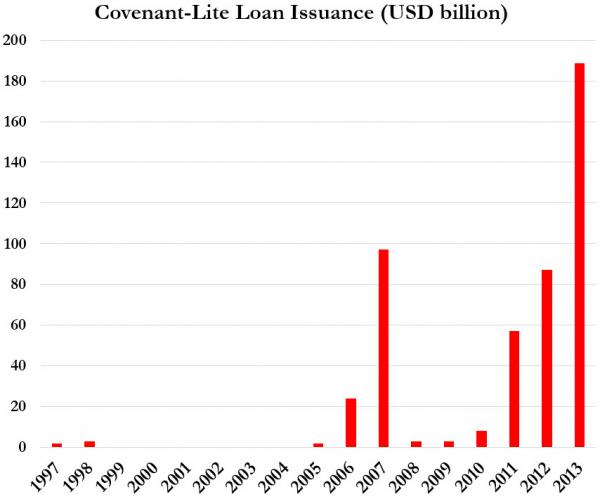
If the Fed was worried about ‘froth’ in the markets earlier in the year, then this chart should have them panicking. Of course, as Jim Bullard noted Friday, there is no bubble because everyone knows there is no bubble but judging by the massive surge in covenant-lite loan issuance, there is a bubble in forced demand for leveraged loans. At $188.7 billion, the 2013 issuance of these highly unsafe loans (which have seen huge inflows since the Fed started talking taper back in May) is almost double that of the peak of the last credit bubble in 2007 and is five times the size of 2012 YTD issuance at this time. As Reuters notes, Covenant-lite loans used to be reserved for stronger companies and credits, but are now so common in the U.S. leveraged loan market that investors are becoming wary of some credits with a full covenant package. With corporate leverage at all-time highs, what could go wrong? Demand for leveraged-loans is surging (as rate concerns rise)…

20130923_loans

And where there is demand, supply rises to meet it – as the least lender-protected notes surge in issuance…

20130923_loans1_0

(Data: Morgan Stanley S&P LCD) Read more of this post

Side-effects that should call time on the QE medicine

September 22, 2013 9:26 pm

Side-effects that should call time on the QE medicine

By John Authers

An incomplete list of how quantitative easing is damaging

Here is a Monday morning challenge. In how many ways is QE damaging? (For the uninitiated, QE stands for quantitative easing, the central bank policy of buying bonds in an attempt to stimulate the economy.) We now know, after last week’s surprise announcement from the Federal Reserve, that the US central bank has decided it must keep up with QE at full throttle. We also know, from its efforts to prepare the markets for a move away from QE, that it would like to end it if at all possible. Read more of this post

Relief to be temporary for EM investors in Asia; Corporate balance sheets in Asia are the most levered in the world.

September 23, 2013 9:21 am

Relief to be temporary for EM investors

By Henny Sender

After the Federal Reserve announced its decision not to begin selling securities, UBS sent a note to clients declaring “Hooray! Nothing Has Changed!”. Meanwhile, Deutsche Bank put out a piece of celebratory research citing the fact that “liquidity will be ample and cheap for longer”. Nowhere were the sighs of relief more audible than in the emerging markets of Asia. Indonesia, among the hardest hit by the prospect of less liquidity, rose 4.8 per cent, the Australian market over 1 per cent and the Philippine market over 3 per cent. Hong Kong, ever sensitive to developments across the border, has been up almost 20 per cent since the end of June when a combination of a sudden spike in Chinese rates and the Fed’s open mouth policy took their toll on confidence. But the sighs of relief will prove temporary for emerging market investors in Asia. Read more of this post

Shipping Lenders Toughen Oversight After Worst Rout in 23 Years

Shipping Lenders Toughen Oversight After Worst Rout in 23 Years

Shipping lenders are tightening rules on who their clients can trade with after the industry’s worst rout in at least 23 years. Banks are threatening to cancel loans if ship owners do business with customers they perceive to be at risk of failing to honor contracts, according to the Baltic and International Maritime Council, whose members control 65 percent of the global fleet. That means some shipping companies are being forced into shorter contracts from a smaller pool of clients, said Peter Sand, an analyst at the Bagsvaerd, Denmark-based group. Read more of this post

Railroads Look Past U.S. Oil-Move Costs Helping Pipelines

Railroads Look Past U.S. Oil-Move Costs Helping Pipelines

As 57,000 miles of U.S. crude pipelines threaten to lure business from railroads, Burlington Northern Santa Fe LLC and Union Pacific Corp. (UNP) are sticking to their bet on the nation’s energy boom. Domestic oil that was significantly cheaper than imported crude for the last two years allowed refiners to pay rail service’s higher transportation costs rather than use slower, less expensive pipelines. With the oil price difference now narrowing, the share of crude shipped by rail from Williston Basin region in and around North Dakota has decreased for three consecutive months, the longest string of declines since 2011. Read more of this post

Fed’s underlying message a bad signal for U.S. profit growth

Fed’s underlying message a bad signal for U.S. profit growth

1:10am EDT

By Caroline Valetkevitch

NEW YORK (Reuters) – The euphoria with which investors in the U.S. stock market greeted the Federal Reserve’s decision to stick with its easy-money policy has begun to evaporate, as the message the Fed was sending about a less-than-stellar economy sinks in. An economy still in need of a safety net may be too weak to produce robust earnings growth, meaning that the Standard & Poor’s 500 valuation, now at its most expensive on a price-to-earnings basis since 2010, becomes harder to justify. Read more of this post

Not All S&P 500 Index Funds Are Created Equal; An ETF’s structure is an oft-ignored data point that can affect performance

Not All S&P 500 Index Funds Are Created Equal

Superlatives surround the SPDR S&P 500 Trust (SPY). It is the oldest exchange-traded fund, launched in 1993. It is the largest, at $148 billion. And it is the most-traded ETF, with average volume of 100 million shares, or 20 times that of Wal-Mart Stores Inc. (WMT). What SPY is not: the best-performing ETF tracking the S&P 500. In fact, it’s the worst-performing of the three ETFs that track all 500 stocks and have 10-year records. Read more of this post

Europe’s banks slog to exit bailouts

September 20, 2013 10:44 pm

Europe’s banks slog to exit bailouts

By FT Reporters

In all the euphoria around the UK government’s first move this week to reprivatise Lloyds Banking Group, it is easy to forget just how long – and painful – the turnround in Britain’s banks has been, following the multiple collapses of 2007-8 and the subsequent bailouts, write Sharlene Goff and Patrick Jenkins.

The process of returning Lloyds and Royal Bank of Scotland to private ownership has been severely hampered by a deeper and more prolonged economic downturn than many envisaged five years ago. So it was unsurprising that George Osborne, chancellor, grasped the opportunity to hail the sale of £3.2bn of Lloyds shares as a clear sign that the UK banks – and with them the broader economy – were finally healing. Read more of this post

China milk makers including Yili, Mengniu to get state support: report

China milk makers including Yili, Mengniu to get state support: report

5:15am EDT

SHANGHAI (Reuters) – Chinese milk powder makers, including Inner Mongolia Yili Industrial Group Co Ltd (600887.SS: QuoteProfileResearchStock Buzz) and China Mengniu Dairy Co Ltd (2319.HK: QuoteProfile,ResearchStock Buzz), are set to get 30 billion yuan ($4.90 billion) in official funds to support sector consolidation, media said. As well as Yili and Mengniu, the first group of firms to benefit would include Feihe International Inc (ADY.BE:QuoteProfileResearchStock Buzz), Heilongjiang Wondersun Dairy Co Ltd and Treasure of Plateau, the official China Business Journal said in its Saturday edition, citing an unidentified source. Authorities have said they want to consolidate the domestic milk powder sector to increase the ability of companies to compete with international rivals who dominate the lucrative premium end of China’s $12.4 billion infant formula market. Read more of this post

China Development Bank Pulls Back From Commercial Push; Bank Keeps Low Profile After Financing Some of Asia’s Biggest Deals

September 21, 2013, 10:27 p.m. ET

China Development Bank Pulls Back From Commercial Push

Bank Keeps Low Profile After Financing Some of Asia’s Biggest Deals

PRUDENCE HO

HONG KONG—China Development Bank Corp, the government-owned policy bank, made waves last year lending billions of dollars to private companies ranging from Alibaba Group Holding Ltd. to Hong Kong Exchanges & Clearing Ltd. 0388.HK +0.69% But after a high profile blowup in January when it tried to fund the sale of a stake in insurer Ping An Insurance 601318.SH -0.24% (Group) Co. of China, the bank has been noticeably absent from big deals this year. If this year is any indication, CDB’s move into going commercial, along the way financing some of Asia’s biggest deals, is over. Last year, investment bankers around the region said they often lost out to CDB, which could either afford to charge lower interest rates or could lend a huge amount of money. This year, CDB has kept its profile low. Read more of this post

Farid: A guide to investing in developing economies around the world

http://www.paydayangels.co.uk/guide-investing-developing-economies-around-world/

A GUIDE TO INVESTING IN DEVELOPING ECONOMIES AROUND THE WORLD

Author: Muhammad Farid, Published: September 16, 2013

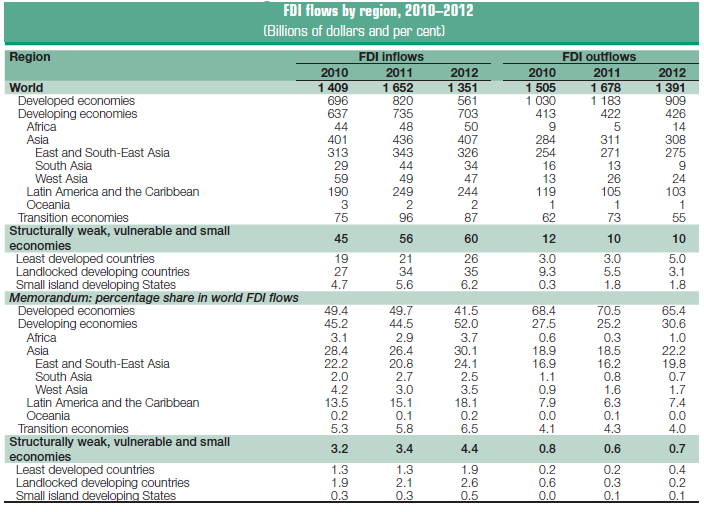
Ever since the financial crisis, developed economies have failed to recover as they would have liked to. Investors are reluctant to invest, consumers are wary of spending and macroeconomic indicators have not been very encouraging. In such times, an investor needs to be proactive rather than reactive, and find new places to invest in order to get enough returns to cover himself against financial fluctuations. This sounds like a good idea but it is very difficult to keep finding new territories to make good, high-returning investments. It may seem difficult, but it is certainly not impossible. All it needs is a bit of researching – finding out trends – and using common sense. Before the financial crisis hit the world, the developed economies were booming; investors were investing, consumers spending and economies growing. But after the crisis, the developed economies were no longer investors’ ‘safe havens’ that they once used to be. Investors needed to switch to better places.

farids-graph-1 Read more of this post

The economics of equity research: The old model of stockmarket research is changing

The economics of equity research: The old model of stockmarket research is changing

Sep 21st 2013 |From the print edition

EQUITY research is meant to benefit both providers and recipients. It ought to help investors to allocate money more profitably. And the banks that give their clients free access to research hope that it will help them generate revenues from equity trading. But neither party is much satisfied by the conventional model. Start with the banks. A fall in trading revenues makes the economics of providing research less attractive. Between 2009 and 2013, total equity-trading commissions paid to brokers fell from $13.9 billion to $9.3 billion in America, and from €4.2 billion ($5.6 billion) to €3 billion in Europe, according to Greenwich Associates, a consultancy. The rise of passive investing and the spread of algorithmic trading have both reduced margins and dampened demand for research produced by and for humans. Read more of this post

Fitch: China’s credit is not just big, it’s growing way too fast

Fitch: China’s credit is not just big, it’s growing way too fast

Sep 18, 2013 11:08am by Rob Minto

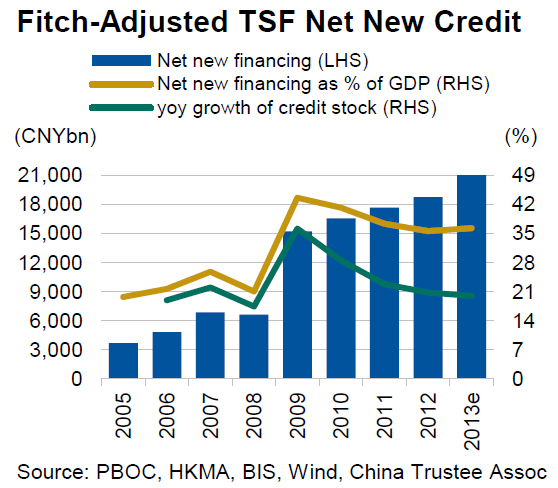
Some more fuel to the China-credit-is-out-of-control fire. Fitch Ratings (which, don’t forget, downgraded China’s debt rating last year) has published a report which argues that “talk of deleveraging, or contracting credit, is misplaced” and warns that “no financial system can sustain rising leverage indefinitely”. And Fitch has a few scary numbers and charts to show the extent of the problem. The report starts by looking at how debt is still climbing: Leverage continues to rise rapidly in China’s economy. The rolling 12- month sum of net new credit hit CNY 21trn in August 2013, based on Fitch Ratings’ measure of broad credit (2012: CNY19trn), marking the fifth year that net new credit will exceed a third of GDP. Certain forms of credit are shrinking, but overall extension remains high, a substantial portion of which is appearing in channels excluded from official data. Talk of deleveraging, or contracting credit, is misplaced, with the stock on pace to rise 20% in 2013. This chart illustrates that growth:

Fitch-China-TSF-Sep-2013 Read more of this post

China Inc’s balance sheet is flashing danger signals

China Inc’s balance sheet is flashing danger signals

Friday, 20 September, 2013, 12:00am

Tom Holland

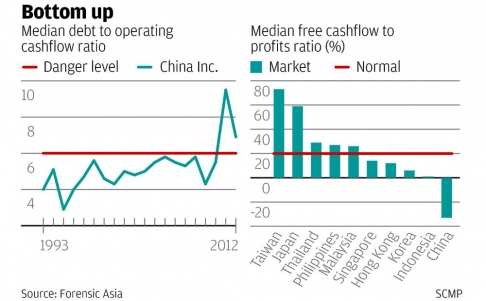
Mainland’s recent lending boom has pushed corporate leverage into a potentially perilous state in terms of ratio of operating cash flow to debt

be50c1e74187c7bfdf39a6b20437fac0

If you want to know whether a recession is coming, don’t look at the top-down macroeconomic numbers like gross domestic product. Instead, focus on the bottom-up analysis of consumer, corporate and government balance sheets. They make a far more reliable warning system. In emerging Asia, where consumer debt is generally modest and government finances relatively sound, it is corporate balance sheets that we should be looking at. Read more of this post

Singapore elites: “..class of people who do not understand the problems faced by ordinary Singaporeans, and are only interested to pursue their ‘elite’ interests”

Updated: Saturday September 21, 2013 MYT 8:28:50 AM

Singapore relooks elitist policy

BY SEAH CHIANG NEE

Recent measures show that the government is not aiming to eliminate, only to remake, elitism, which exists everywhere.

AS Lee Kuan Yew celebrated his 90th birthday last week, one of his legacies – an elitist leadership – was given a few hard jolts. Whether the founding leader had intentionally devised it or simply encouraged it through his scholars-as-leaders policy or eugenics theory, a form of elitist environment has taken a grip on Singapore. It created a new breed of highly-paid civil servants, some of whom became dominating and arrogant, who helped to govern a questioning middle-class population – not the best of combinations. A number of them are accused of having lost touch with the common folk because of their high salaries and lavish living. As a result, the class rift has worsened, aggravated by a widening gap between the rich and poor. It has also reduced support for the People’s Action Party (PAP). Read more of this post

Indonesia and India, the two emerging markets hardest hit in recent weeks by falling currencies and other financial troubles, took opposite tracks as both countries struggled to balance growth with the threat of inflation

September 20, 2013

Amid Economic Stress, Differing Strategies Emerge

By KEITH BRADSHER and JOE COCHRANE

JAKARTA — Indonesia and India, the two emerging markets hardest hit in recent weeks by falling currencies and other financial troubles, took opposite tracks on Friday as both countries struggled to balance growth with the threat of inflation. In an interview here, the vice president of Indonesia characterized higher interest rates and a weakened currency as the “new normal.” Boediono, the country’s vice president, who uses only one name, said that Indonesia would face a tougher international financial environment in the coming months and should give greater emphasis to a stable currency, stable prices and a stable trade balance and not just pursue economic growth. Read more of this post

The American Dream, RIP? An economist asks provocative questions about the future of social mobility

The American Dream, RIP? An economist asks provocative questions about the future of social mobility

Sep 21st 2013 |From the print edition

20130921_USD000_0

COULD America survive the end of the American Dream? The idea is unthinkable, say political leaders of right and left. Yet it is predicted in “Average is Over”, a bracing new book by Tyler Cowen, an economist. Mr Cowen is no stranger to controversy. In 2011 he galvanised Washington with “The Great Stagnation”, in which he argued that America has used up the low-hanging fruit of free land, abundant labour and new technologies. His new book suggests that the disruptive effects of automation and ever-cheaper computer power have only just begun to be felt. Read more of this post

The world’s biggest firms: American private enterprise dominates the corporate premier league again, thanks to waning valuations of state-backed firms

The world’s biggest firms: American private enterprise dominates the corporate premier league again, thanks to waning valuations of state-backed firms

Sep 21st 2013 |From the print edition

20130921_FBD001_020130921_FBC416 20130921_FBC376 20130921_FBC417

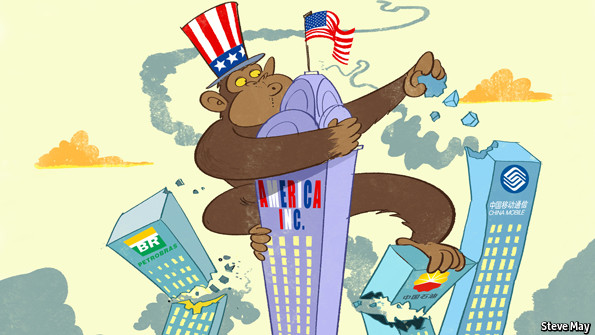
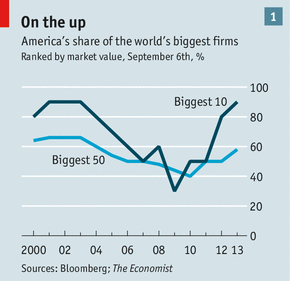
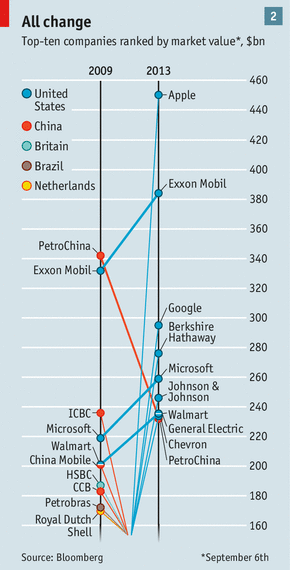
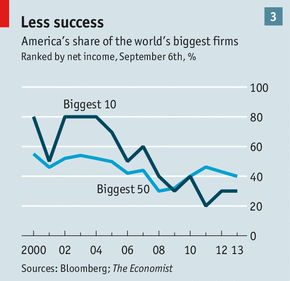
BACK in September 2009 it seemed that America Inc was being crushed. Of the world’s ten largest quoted firms by market value, only three were American—Exxon Mobil, Microsoft and Walmart. The list was dominated by state-controlled giants such as PetroChina, China Mobile and ICBC, a Chinese bank. Petrobras, an oil-and-gas firm run by the Brazilian government, had just made it into the ninth slot. It all fitted an easy story. America was in decline after the subprime crisis. The private firm was being displaced by state capitalism. There was an inexorable shift in power to the emerging world. Read more of this post

The indie bookstore resurgence: Amazon may have the bargains, but independent booksellers are trading in the importance of real-life community

The indie bookstore resurgence

September 20, 2013: 11:19 AM ET

Amazon may have the bargains, but independent booksellers are trading in the importance of real-life community — and are seeing an uptick in business.

By Verne Kopytoff

FORTUNE — John Evans, co-owner of Diesel, a small California bookstore chain, gives an emphatic “no” when asked if he’s crazy for opening a new store this summer near San Francisco. After all, bookstores are doomed, right? Amazon (AMZN) is shoving them into extinction. E-books are taking over. Well, not so fast. After years of steep decline, independent bookstores have turned the corner — to a point. Sales grew 8% in 2012 and are on track for similar gains this year, according to the American Booksellers Association. The uptick is welcome news for the industry, which has been in turmoil throughout recent memory. Read more of this post

Electric bicycles: Sales are booming, but large-scale urban hire schemes remain some way off

Electric bicycles: Sales are booming, but large-scale urban hire schemes remain some way off

Sep 21st 2013 | PARIS |From the print edition

BICYCLE fairs come thick and fast at the end of summer in Europe. Eurobike closed on August 31st in Friedrichshafen, Germany; the Salon du Cycle in Paris on September 16th. And how the market is changing: for all the hype over the latest rugged mountain bike, the whirr of electrically assisted wheels is clearly audible. Although electric cars have struggled to gain purchase (their sticker price is unalluring and they stop dead if not recharged), sales of cycles using batteries to augment a rider’s own efforts are growing quickly. Faster ones with more sophisticated electronic controls, a bit like those popular in China, may also be gaining ground. Read more of this post

Why Land Reform Efforts Remain on the Back Burner in China

09.19.2013 17:17

Why Land Reform Efforts Remain on the Back Burner

Despite recent optimism a breakthrough had been made on rural land, disagreements among policymakers continue to stall progress

By staff reporter Wang Su

(Beijing) – Lawmakers are deliberating reforms that could revolutionize China’s land system. On September 2, a news report regarding reforms to the land system sent waves through the nation. The report said that the government would allow the trading of rural cooperative land designated for construction purposes. Officials are planning to set up pilot areas in 18 provinces and municipalities and 28 lower-tier administrative regions in which citizens will be allowed to buy and sell property rights of collective construction land on open markets. The day after the news broke, stock markets reacted. Over ten stocks related to land concept hit upper trading limits that day. A Shenyin and Wanguo Securities report indicated that land prices will be reappraised across the nation following this major development in land reforms. Read more of this post

Wang Jianlin, China’s richest man and the chairman of property and entertainment conglomerate Wanda, is breaking ground on a 30 billion yuan, or $4.9 billion, film studio, which he promises will be the world’s largest

September 21, 2013, 9:32 p.m. ET

China’s Wanda Group Breaks Ground on $4.9 Billion Film Studio

Chairman Promises It Will Be World’s Largest

LAURIE BURKITT

QINGDAO, China—Wang Jianlin, China’s richest man and the chairman of property and entertainment conglomerate Dalian Wanda Group Corp., is breaking ground on a 30 billion yuan, or $4.9 billion, film studio, which he promises will be the world’s largest. The “Qingdao Oriental Movie Metropolis,” set to open in 2017 in the eastern Chinese port city of Qingdao, will include a 10,000 square-meter film studio and 19 smaller facilities, along with a theme park similar to Universal Studio’s in Miami, Wanda said in a statement Sunday. The project will also include a permanent auto show, a yacht center, an international hospital, as well as hotels and bars, the statement said. Read more of this post

Paris In China: Tianducheng Is An Eerie, Abandoned City Of Lights Clone

Paris In China: Tianducheng Is An Eerie, Abandoned City Of Lights Clone

The Huffington Post  |  By Lisa_Miller Posted: 08/07/2013 7:48 am EDT

o-TIANDUCHENG-570

Take a look at this picture for a second. You know where that is, right? That’s Paris, obviously. There’s the Eiffel Tower, and there are some of those quaint Parisian fountains and buildings. Yeah? Nope. In fact, that shot was taken nearly 6,000 miles from the City of Lights. So… what’s the deal? That’s actually Tianducheng, a luxury real estate development and Paris look-alike that’s located in Hangzhou, China. Tianducheng lacks much of what Paris has to offer though — including people. The development is now more or less abandoned, giving it an even eerier, ghost-town feel. Read more of this post