Researcher Puts China’s Local Government Debt at $3.3 Trillion

September 17, 2013, 6:46 a.m. ET

Researcher Puts China’s Local Government Debt at $3.3 Trillion

BEIJING—A Chinese government researcher estimates that China’s practices of borrowing heavily to fuel investment-driven growth have as much as doubled local government debt in just two years to around 20 trillion yuan ($3.3 trillion). The researcher, Liu Yuhui of the Chinese Academy of Social Sciences, said the current dependence on heavy borrowings to drive rapid economic growth is unsustainable. Read more of this post

Property Prices Keep the Locks on Myanmar; Office Space in Yangon the Most Expensive in Southeast Asian Region at $78 psm Vs Jakarta $24 psm Vs Manhattan $50 psm

Updated September 17, 2013, 7:57 p.m. ET

Property Prices Keep the Locks on Myanmar

Office Space in Yangon the Most Expensive in Region

SHIBANI MAHTANI

AM-BA293_MYANPR_G_20130917134807

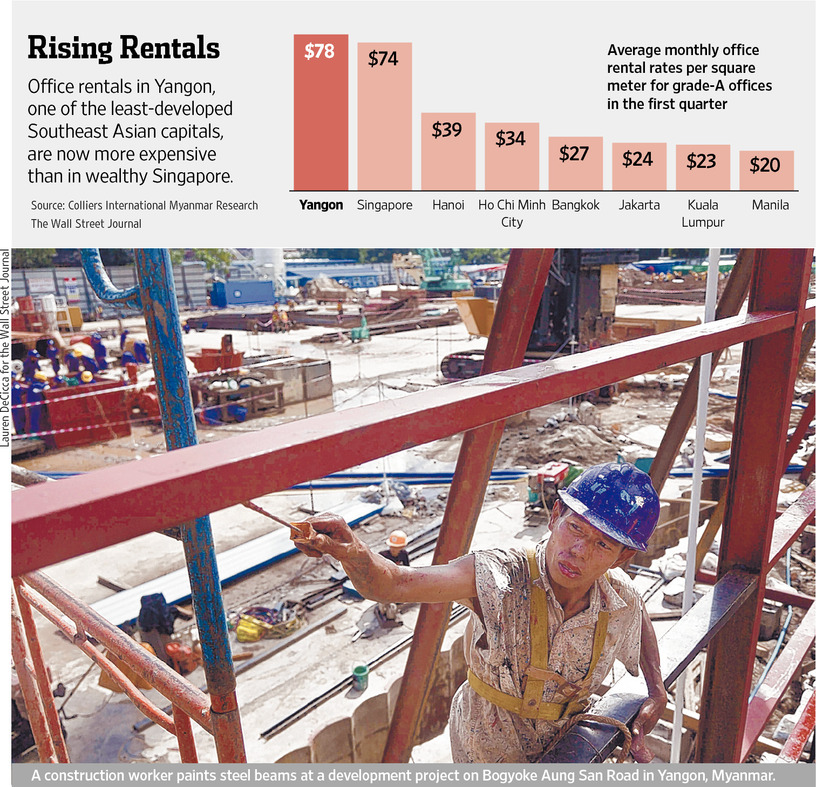
For years, international companies wanting to set up in Myanmar were stifled by Western sanctions or rebuffed by the country’s military government. Now, as the country opens up, global corporations are finding a new hurdle: real-estate prices. Top-quality office space in prime locations in Yangon, the commercial capital of the poorest country in Southeast Asia, is now the most expensive in the region at $78 a square meter ($7.33 a square foot) per month, according to research from real-estate firm Colliers International. By comparison, office rentals in a booming market like Jakarta are $24 a square meter. Even in Manhattan, the average asking rent is lower, at $49.95. Read more of this post

South American ‘soybean king’ says region feeds world; Los Grobo, the largest producer of wheat in Latin America, deals not only in soy, grains and oilseeds, but also provides agri-input and technical assistance to farmers. “I am a Marxist, you mig

South American ‘soybean king’ says region feeds world

soyking_afp2

Tuesday, September 17, 2013 – 10:41

AFP

BUENOS AIRES – Argentina’s Gustavo Grobocopatel, known as the “soybean king,” is head of one of the most powerful agroindustrial groups in South America, and quickly touts soy’s power in feeding people everywhere. “In South America we work to feed the world,” Grobocopatel, 51, said during an interview with AFP. “To criticise soy is to criticise the poor who have begun to eat,” he said. Read more of this post

Vending machine market in China poised for explosive growth

Vending machine market in China poised for explosive growth

Staff Reporter

2013-09-18

In early 2011, Huang Heng, a 24 year old from central China’s Hubei province, decided to leave his job as a migrant worker and profit from the summer heat by installing six automated vending machines inside the factory of Great Wall Motors in Baoding in northern Hebei province. The outcome of his venture far exceeded his wildest expectations as he sold 200 beverage cans on the first day, jumping to 300 the following day. Two and a half years later Huang now owns 120 vending machines, costing 30,000-35,000 yuan (US$4.900- US$5,700) each, while his total investment tops 4 million yuan (US$653,400). “I can recoup my investment for a machine in one and a half years on average,” Huang told the Chinese-language Global Entrepreneur magazine. Read more of this post

Shanghai Free Trade Zone details to be delayed

Shanghai Free Trade Zone details to be delayed

Updated: 2013-09-17 23:48

By WEI TIAN in Shanghai ( China Daily) Read more of this post

Preferred Shares for China Banks Supported, but Direction from Gov’t Lacking; There is divergence, for example, over whether preferred shares should be classified as equity or bond investment for accounting purposes

09.17.2013 18:06

Preferred Shares for Banks Supported, but Direction from Gov’t Lacking

Financial institutions already preparing for launch, sources say, but are waiting for regulators to clear up range of issues

By staff reporters Wen Xiu, Zhang Yuzhe and Zheng Fei

(Beijing) – Despite overwhelming support for preferred shares in the banking industry, there is no consensus yet over how the financing instrument should be designed and regulated. Many banks have been preparing to launch preferred shares, but they need regulators to clear away legal ambiguity, sources from banks said. Read more of this post

History and the rise of Shandong set challenge for Japan’s car makers in China

History and the rise of Shandong set challenge for Japan’s car makers in China

5:26pm EDT

By Norihiko Shirouzu and Kazunori Takada

BEIJING/SHANGHAI (Reuters) – A year after their China sales were battered by protests in a territorial dispute, Japan’s big automakers are finding it tough to bounce back in the world’s biggest market. Demand for cars is rising fastest in provinces where anti-Japan sentiment historically runs deepest – a legacy of Japanese occupation around World War Two. In relatively more Japan-friendly parts of southern China such as Guangdong, Toyota Motor Corp (7203.T: Quote,ProfileResearchStock Buzz), Nissan Motor Co (7201.T:QuoteProfileResearchStock Buzz) and Honda Motor Co (7267.T: QuoteProfileResearchStock Buzz) are returning to sales levels near those seen before a diplomatic row last September over a group of rocky, uninhabited islets in the East China Sea. Read more of this post

Chinese Internet Riled Up Over Detention of Corruption-Busting Microblogger

September 17, 2013, 9:40 PM

Chinese Internet Riled Up Over Detention of Corruption-Busting Microblogger

OB-UR401_crt_ya_DV_20120921123930

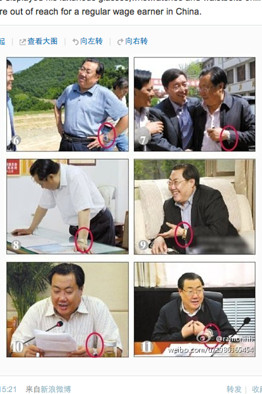
An image posted to Sina Weibo in Sept. 22 shows identified luxury watches worn by disgraced former Chinese official Yang Dacai. A number of Mr. Yang’s watches were identified with the help of microblogger Wu Dong, known online as Boss Hua.

China’s top social media site lit up Tuesday night following reports that one of its most celebrated corruption busters had been taken into police custody amid a renewed government effort to exert more control online. The official newspaper of China’s military, Liberation Daily, reported on its verified feed on Sina Corp.’s Weibo microblogging site that the microblogger known by the pen name “Boss Hua Has Lost His Golden Cudgel” was being interrogated by police in Beijing’s eastern Chaoyang district, though it did not say when or why he was taken away. A policeman answering phones in the Chaoyang district police station said he had no knowledge of the case. Calls to the station’s propaganda office rang unanswered Tuesday night. Read more of this post

China’s Bosses Size Up a Changing Labor Force

China’s Bosses Size Up a Changing Labor Force

By Christina Larson September 16, 2013

John Liu is the 31-year-old founder and owner of Harderson International, a small factory in southern China that applies paint and decals to ceramics and glass. His showroom includes samples of tinted perfume bottles made for Ralph Lauren and Kate Spade. A 2006 graduate of Wuhan University in central China, Liu is not much older than the 20-somethings and late teenagers who come to work on the assembly line. But generational cohorts in China are extremely compressed, and Liu sees a vast gap in expectations between himself and those a decade younger. “When I finished school, I felt I needed to find a good stable job quickly and earn money,” he says. “But living conditions in China have improved quickly. Young people now don’t have to work so hard to earn a living, and many have parents who will support them. … A lot of those born in the 1990s can’t stand this kind of repetitive work, so they choose to stay home or do very simple cashier work, even though it pays less.” The upshot is that, for a small factory, it’s “getting harder to find workers.” Read more of this post

China’s Shadow Bankers Seek Their Place in the Sun

September 17, 2013, 11:30 AM

China’s Shadow Bankers Seek Their Place in the Sun

China’s trust companies are feeling hurt and unloved. If you ask them, they’ll tell you their hard work has been a little misunderstood. “People say the trust firms are the ‘bad boys’ of the financial sector. I think it’s a misunderstanding,” said Li Zhenhua, secretary general of the China Wealth Management 50 Forum, a financial industry group. “There have been rarely any material defaults and we’ve been offering high returns with close-to-zero risk,” Mr. Li told a briefing on the trust sector’s track record this year. Read more of this post

‘Shanghai’ in Name Adds $45 Billion in Value Amid Bubble Concern

‘Shanghai’ in Name Adds $45 Billion in Value Amid Bubble Concern

Zhang Guangdi has watched the market value of his Shanghai International Port Group Co. (600018) shares jump 130 percent since Aug. 22, when China’s commerce ministry said the government approved a free-trade zone in Shanghai. The 67-year-old retiree says he’ll probably sell the 2,935 yuan ($480) stake when the zone, part of Premier Li Keqiang’s plan to liberalize yuan trading and relax government regulation, opens at the end of this month. The port operator is valued at 25 times profit, a 121 percent premium versus the Shanghai Composite Index (SHCOMP), according to data compiled by Bloomberg. Read more of this post

Bathed, not bred: Vendors warn of fake Yangcheng Lake crabs

Bathed, not bred: Vendors warn of fake Yangcheng Lake crabs

Staff Reporter 

2013-09-18

CFP443438175-123415_copy1

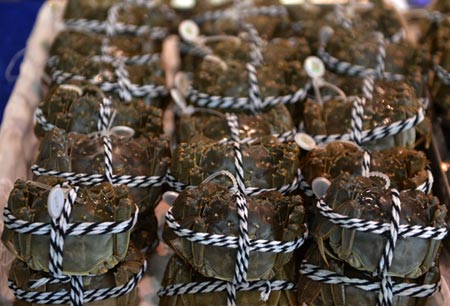
Mitten crabs — known locally as hairy crabs — are a seasonal delicacy in China especially around the time of the traditional Mid-Autumn Festival, which falls this year on Sept. 19. The area most famous for producing the crabs is Yangcheng Lake, to the northeast of Suzhou in eastern China’s Jiangsu province, and the name is sufficiently well known for some vendors to try to pass crabs bred elsewhere as genuine Yangcheng Lake produce, reports our Chinese-language sister paper Want Daily. More than 2,000 households are estimated to make a living selling Yangcheng Lake crabs, producing about 2,000 tonnes of the crustaceans a year. Genuine Yangcheng Lake crabs will go on sale from Sept. 17 this year, which means crabs which have gone on sale so far claiming to be from the area are not so, according to an association officially approved to oversee the trade in crabs from Suzhou. The crabs that have gone on sale so far are from outside the area, say Yangcheng Lake crab farmers, who say unscrupulous vendors raise their crabs elsewhere before taking them to the lake for a dip in the water before selling them at a higher price than they would otherwise fetch. This year’s harvest of Yangcheng Lake crabs is estimated to be down by about 20% this year due to hot weather, creating higher prices for a more limited supply. Customers who are buying their crabs at a cheaper price are likely to be buying specimens which have only “taken a bath” in the lake, local breeders said.
A Troubling Future for China’s Once-Raucous Internet

A Troubling Future for China’s Once-Raucous Internet

At some point after his Aug. 23 arrest for allegedly soliciting a prostitute, Chinese Internet celebrity Charles Xue began losing his 12 million followers on Sina Weibo, the country’s most popular microblogging site. The abandonment of Xue, a billionaire investor and online activist, has been subtle but unmistakable: At 12:36 p.m. on Monday in China, he had 12,054,441 followers; 10 seconds later, he had 12,054,435; after another 10 seconds, he was down to 12,054,430. In five minutes, 50 followers had cut their online ties. Read more of this post

China’s Choking Cities Means Job Cuts at Steel Town

China’s Choking Cities Means Job Cuts at Steel Town: Commodities

Zhang Fei sums up one of the headaches for China’s Premier Li Keqiang in his efforts to refocus the country’s economy. The 40 year-old contractor, who’d just earned 160 yuan ($26) for four hours work at a local steel mill, is leaning on his red motorcycle in grimy army fatigues and battered running shoes on Galaxy Street. That’s a 10-mile strip lined with forges, welders, tire repair and auto-painting shops, as well as restaurants, a school and a hospital. Read more of this post

China will strictly control the construction of new photovoltaic manufacturing projects to curb excess capacity in the world’s biggest maker of solar panels

China to Strictly Limit Building of More Photovoltaic Capacity

China will strictly control the construction of new photovoltaic manufacturing projects to curb excess capacity in the world’s biggest maker of solar panels. New solar manufacturing that “purely” expands capacity will be strictly banned, the Ministry of Industry and Information Technology said in a statement on its website today. Annual spending by companies for research and development and upgrading equipment combined must be no less than 3 percent of revenue and no less than 10 million yuan ($1.6 million), according to the statement. Chinese authorities have pledged to cut overcapacity in industries from steel to paper as policy makers seek to reduce the economy’s reliance on investments and exports. A global oversupply of solar panels led to a 20 percent plunge in average prices last year, according to data compiled by Bloomberg. The government’s previous backing for the solar industry has left at least one factory producing photovoltaic products in half of China’s 600 cities, according to the China Renewable Energy Society in Beijing. China’s solar industry now accounts for seven out of every 10 solar panels produced worldwide, according to data compiled by Bloomberg.

To contact Bloomberg News staff for this story: Sarah Chen in Beijing at schen514@bloomberg.net

Jade sales slump big time in Asia; “The bubble of low to middle end jade has burst first given the little fear of raw material shortage. By the end of the year, the prices will start to drop from the sky.”

Jade sales slump big time

Wednesday, Sep 18, 2013

The New Paper

Prized as a magical imperial stone, jade is a status symbol of the super rich in Asia. But rocketing prices in the top-end of the market have left traders in Hong Kong struggling to find buyers. The price of raw jade has risen over the past eight years. Driven up by the appetite of wealthy Chinese, the rising cost of jade is also being fuelled by fears of a shortage in supply from Myanmar, the key source. “Consumers cannot accept the current high prices, therefore, no deal is reached,” Hong Kong jade dealer Li Kwong-kei told AFP at the Hong Kong Jewellery and Gem Fair last Friday. Read more of this post

The US might be drowning in oil, but the world is still dependent on Saudi Arabia; Record Saudi Arabia oil output fills supply gap

September 16, 2013 5:45 pm

Record Saudi Arabia oil output fills supply gap

By Ajay Makan

The US might be drowning in oil, but the world is still dependent on Saudi Arabia. Indeed, Saudi Arabia is pumping out more crude than at any time since at least the 1970s. In neighbouring Kuwait and the United Arab Emirates meanwhile, oil production levels hit record highs. Read more of this post

Naptha Is The Key Ingredient For A Saudi Petrochemicals Boom

Naptha Is The Key Ingredient For A Saudi Petrochemicals Boom

THE ECONOMIST SEP. 17, 2013, 6:59 PM 661

Although plans are well advanced for constructing one of the world’s biggest combined cycle petrochemicals plants in the kingdom, being built by the Sadara Chemical Company (a joint venture between the state oil company, Saudi Aramco, and Dow Chemical of the US), in reality the petrochemicals sector has mostly taken a back seat in the country’s rapid industrialisation of recent years. This is primarily due to the shortage of ethane-rich associated gas and natural gas liquids (NGLs), which are both linked to crude oil production. However, this may well change if a new strategy planned by Saudi Aramco bears fruit. Read more of this post

Companies Unplug From the Grid, Delivering a Jolt to Utilities

September 17, 2013, 11:05 p.m. ET

Companies Unplug From the Grid, Delivering a Jolt to Utilities

REBECCA SMITH and CASSANDRA SWEET

P1-BN175_OWNGEN_G_20130917181504

On a hill overlooking the Susquehanna River, two big wind turbines crank out electricity for Kroger Co.’s KR +2.19% Turkey Hill Dairy in rural Lancaster County, Pa., allowing it to save 25% on its power bill for the past two years. Across the country, at a big food-distribution center Kroger also owns in Compton, Calif., a tank system installed this year uses bacteria to convert 150 tons a day of damaged produce, bread and other organic waste into a biogas that is burned on site to produce 20% of the electricity the facility uses. Read more of this post

From honey whiskey to pumpkin pie vodka, bold new flavors are the toast of the global drinks industry. At Diageo, drinks created in the past five years account for half of the beverage giant’s sales growth in that period

September 17, 2013, 4:33 p.m. ET

Spirits Soar on Flavored Liquors

Sales Growth Is Being Driven by Dessert-Inspired Vodkas and Other Innovations

SIMON ZEKARIA

BISHOP’S STORTFORD, ENGLAND—From honey whiskey to pumpkin pie vodka, bold new flavors are the toast of the global drinks industry. Diageo DGE.LN +0.62% PLC’s technical laboratory here, which makes drinks for Europe and Africa, is tucked away in a bland office block, but inside beverage scientists are playing with pipettes, spices and colored liquids. Drinks created in the past five years account for half of the beverage giant’s sales growth in that period. Some 80% of the company’s investment in innovation is directed to products launched within a three-year time frame. Read more of this post

After making billions in rough-and-tumble sectors, Suleiman Kerimov may have met his match in potash

September 17, 2013 7:06 pm

Mining: Gone to potash

By Courtney Weaver, Charles Clover Jan Cienski

After making billions in rough-and-tumble sectors, Suleiman Kerimov may have met his match

Hailing from a poor part of southern RussiaSuleiman Kerimov became a billionaire through iron determination and a gargantuan appetite for risks – some of which work out, some of which do not. He crashed a Ferrari Enzo on the French Riviera in 2006, sustaining burns for which he still wears oedema gloves. He poured $450m into Anzhi Makhachkala, a football club in Dagestan that so far has not lived up to his hopes. His highly leveraged investments in western banks almost cost him his fortune amid the collapse of financial markets in 2008, but he made it back. Some say he leads a charmed life while others attribute his good fortune to his solid political connections in the Kremlin. Whatever the case, Mr Kerimov may have gone too far when he – or more accurately his subordinates, according to people familiar with the matter – took onAlexander Lukashenko, the mustachioed president of neighbouring Belarus last July. Read more of this post

S Korea struggles to take in foreign workers

September 17, 2013 10:13 am

S Korea struggles to take in foreign workers

By Simon Mundy in Ansan, South Korea

As Sri Lankan music blares from an electronics shop across the road, Sherzod is struggling to count the nationalities of the customers at his café in Ansan, a town of 1m people in South Korea’s Gyeonggi province. “They come from Pakistan, Indonesia, Mongolia, Vietnam . . . there are more coming from Russia these days,” says the 39-year-old Uzbek, his country’s national dress proudly displayed on the wall behind him. Read more of this post

Drugstores in Korea are struggling to stay afloat as they are losing money due to cutthroat competition in the industry

2013-09-17 17:01

Drugstores struggle to beat competition

By Park Ji-won
Drugstores are struggling to stay afloat as they are losing money due to cutthroat competition in the industry. Recently, restrictions were placed on retail companies, making it difficult to open a new store. The regulations also limit operating hours. To avoid such restrictions, retail conglomerates CJ, GS and Kolon have invested in drugstores. As a result, the number of drugstores in Korea has exploded. Some market insiders expect the industry will reach 500 billion won this year and could reach 700 billion won by 2014.
While the estimates are encouraging, increasing competition is making it tough for some drugstores to stay afloat.  Read more of this post

Narendra Modi tempers Hindu nationalist message to woo India; Polarising figure has a sense of purpose and ‘rock star appeal’

September 17, 2013 3:19 pm

Narendra Modi tempers Hindu nationalist message to woo India

By Victor Mallet in New Delhi

Polarising figure has a sense of purpose and ‘rock star appeal’

The boast last month by Manmohan Singh, India’s 80-year-old prime minister, about how connected the country had become since he took office a decade ago may come back to haunt the ruling Congress party at the next general election – especially if the claim is true. “In 2004, only 7 per cent of the people had telephone connections,” Mr Singh intoned mechanically as he read out his independence day speech in Hindi from the ramparts of the Red Fort in Delhi. “Today 73 per cent enjoy this facility.” India also had more roads, airports, electricity, schools and – he might have added – televisions. Read more of this post

Leprosy Return Shows Neglect in India of Ancient Blight

Leprosy Return Shows Neglect in India of Ancient Blight

Sandeep Gupta fidgets nervously in a Mumbai clinic while waiting to learn if the white patches and boils that appeared on his elbow a month ago are signs of leprosy — the disease that disfigured his cousin and maimed millions of people in India and elsewhere for 8,000 years. The lesions on the 12-year-old’s arm are a sign of leprosy which, left untreated, can cause disfigurement and nerve damage. While leprosy, described in Indian texts from the 6th century BC, has been cleared from the developed world, it’s regaining ground in India, which has become the biggest source of cases imported into the U.K. and Australia. Read more of this post

India Escalates Gold Capital Controls, Hikes Duty On Gold Jewerly Imports To 15%

India Escalates Gold Capital Controls, Hikes Duty On Gold Jewerly Imports To 15%

Tyler Durden on 09/17/2013 13:59 -0400

Anyone following the Indian economy and capital markets has been witness to what is the worst case outcome for a modern-day central banker: on one hand forced to keep inflation down, on the other fighting a fierce capital outflow which recently shocked Rupee holders by send the currency to all time lows against the dollar and sending gold priced in INR to record highs. All of this is, of course, happening as India fights tooth and nail to keep its monthly trade deficit under control, not overpay for oil, and keep businesses running now that inflation expectations are becoming unanchored. And, as we have reported previously, the biggest scapegoat to the Indian central bank and government is, understandably, gold, which has been the source of much of the population’s “wealth preservation” currency outflow. Read more of this post

Li Ka-Shing: I’m staying in HK – but I’m worried

I’m staying – but I’m worried
Karen Chiu and Imogene Wong
Wednesday, September 18, 2013
Tycoon Li Ka-shing yesterday vowed to never leave Hong Kong. But the Cheung Kong Holdings chairman noted all his future investments in the SAR will depend on the prevailing political and economic situation. And he warned Hong Kong is getting less competitive. “I love Hong Kong and the country. Cheung Kong and Hutchison Whampoa won’t move away from Hong Kong after so many years of being here,” he said yesterday. Read more of this post

Li Ka-Shing Says Hong Kong May Lose Out to Shanghai; Hong Kong Most Costly City for Office, Home Rents, Savills Says

Li Ka-Shing Says Hong Kong May Lose Out to Shanghai: RTHK

Li Ka-shing, Asia’s richest man, said Hong Kong needs to raise its competitiveness if it wants to avoid losing out to Shanghai, where China is setting up a free trade zone, Radio Television Hong Kong reported. Li, the 85 year-old chairman of Hong Kong-based Cheung Kong Holdings Ltd. (1) and Hutchison Whampoa Ltd. (13), said the Shanghai free trade zone “will affect Hong Kong heavily,” RTHK reported on its website, citing Li’s comments at a briefing today. Read more of this post

MTR in Hong Kong is probably the best-run metro in the world and that brand is what they bring with them

Updated September 17, 2013, 1:00 p.m. ET

Hong Kong’s MTR Rides Toward Expansion

Company Makes Tracks Toward Becoming World’s Top Metro-Train Operator

JEFFREY NG

A subway system with a 99.9% on-time rate would be a source of pride in most cities. In famously efficient Hong Kong, it elicits an explanation from the director of operations: “Zero delay is difficult to achieve on any railway system,” he said in a recent service update. Hong Kong’s MTR Corp. 0066.HK +0.82% is taking its high standards abroad, bidding to run subways in Europe, Asia and Australia. If it wins just a few of the bids, it will become the biggest operator of metro systems in the world. Led by a New Yorker, it is also considering other projects, even in Germany, another place that places a high value on efficiency. “MTR in Hong Kong is probably the best-run metro in the world and that brand is what they bring with them,” says Nigel Harris, managing director at the Railway Consultancy Ltd., a U.K.-based firm. Read more of this post

Vacant Japan Homes Show Holes in Abe’s Push for Housing Growth; “It used to be common that parents find ways to increase the value of what they have and pass it down to their children. But now, one can no longer expect much.”

Vacant Japan Homes Show Holes in Abe’s Push for Housing Growth

Broken wood pieces dangle and sway like autumn leaves from the window frames of vacant homes in Inariyato, part of Yokosuka in the greater-Tokyo urban area, where taped-over mailbox slots tell a story of abandonment. More than 50 houses and apartments, almost 20 percent of the quaint residential neighborhood of narrow streets and stairway paths leading into green hills, are empty here, an hour’s train ride south of Tokyo and 1,000 yards (900 meters) from the Yokosuka naval base, home of the U.S. Seventh Fleet. That hasn’t stopped developers from building at least eight new apartment blocks in the same city in the past two years. Read more of this post