Weak Rupee, Economic Slowdown Hit India’s Ship Recyclers who pay in U.S. dollars for the ships they buy to break down. They often take bank credit, to be repaid in three to nine months. Most in this low-margin business don’t hedge

September 13, 2013, 4:45 a.m. ET

Weak Rupee, Economic Slowdown Hit India’s Ship Recyclers

Local Currency’s Steep Fall Drives Up Cost, Weak Economy Hurts Demand

BIMAN MUKHERJI

NEW DELHI—The world’s largest ship-breaking yard at Alang on India’s western shore is hit by a double whammy. The rupee currency’s deep dive has driven up their cost, while a slowdown in the local economy has sapped demand for scrap steel. “About 90% of the industry is in trouble because of the rupee’s slide,” said Nitin Kanakia, joint secretary of the Ship Recycling Industries Association of India. Read more of this post

Asia’s Second Biggest Slum Hurts Mumbai Airport Expansion

Asia’s Second Biggest Slum Hurts Mumbai Airport Expansion

India’s airlines are desperate to get space in Mumbai as travel demand surges. Standing between the carriers and their growth plans are a million people living in slums around the airport. Years of efforts to clear the tin-roofed shanties that surround the aerodrome in India’s financial capital hit a road block when a company tasked with the job had its project terminated, prompting a court battle. A more than decade-old plan to build a second airport in the city that’s home to billionaires such as Mukesh Ambani, has also gone nowhere. India ranked below Ethiopia and Namibia in the World Economic Forum’s 2012 score for quality of air transport infrastructure. Read more of this post

Craving for a chocolate fix? Prepare to pay more; cocoa butter prices nearly double to more than $7,000 a tonne from $4,000 a tonne six months ago

Craving for a chocolate fix? Prepare to pay more

9:46am BST

* Butter ratios at highest since 2008 in Asia, Europe, U.S.

* Global confectionary sales set to rise nearly 2 pct in 2013

* Chocolatiers scramble to stock up on butter

By Lewa Pardomuan and Marcy Nicholson

SINGAPORE/NEW YORK, Sept 13 (Reuters) – Chocoholics may have to dig deeper to pay for their favorite treat this festive season as sweet makers face sky-high prices for cocoa butter, the special ingredient that gives chocolate its melt-in-the-mouth texture. Increased demand from Asia’s expanding middle class and a turnaround in sales in big consuming countries have seen butter prices nearly double to more than $7,000 a tonne from $4,000 a tonne six months ago. Read more of this post

Thrifty spending habits seen dying hard even as economy lifts

Thrifty spending habits seen dying hard even as economy lifts

Thu, Sep 12 2013

* Price more important to Millennials – Wal-Mart’s Simon

* Consumers won’t loosen belts quickly – Sainsbury CFO

* Private label seen at 50 pct of food sales by 2025

* More products offered at 1 pound, 1 euro

* “Lipstick effect” helps demand for luxury, treats

* Value and premium products set to steal more share

By Emma Thomasson and Dhanya Skariachan

LONDON/NEW YORK, Sept 12 (Reuters) – Consumers are sticking to frugal shopping habits developed in the recession even as developed economies show signs of recovery, suggesting some behaviour changes could be permanent, industry executives say. With household budgets under pressure since the financial crisis of 2008, consumers have flocked to discount stores, shifted from branded goods to private-label alternatives and shopped more often at convenience stores or online rather than spending on expensive fuel to drive to out-of-town hypermarkets. Read more of this post

America Drinks So Much Soda, They Literally Had To Expand This Chart To Fit It In

America Drinks So Much Soda, They Literally Had To Expand This Chart To Fit It In

MATTHEW BOESLER SEP. 12, 2013, 4:17 PM 9,560 16

This chart – taken from a new study by Credit Suisse titled “Sugar consumption at a crossroads” – shows a general correlation between GDP per capita and soda consumption per capita. In other words, as countries get richer, they tend to increase their soda consumption. The U.S. is clearly the most extreme outlier. Soda consumption per capita in America is way more than the relationship to GDP per capita would suggest. Note that the U.S. is such an outlier that Credit Suisse literally had to expand this chart to include it. Without the U.S., the range of the y-axis wouldn’t even have to go up to 160.

screen shot 2013-09-12 at 4.09.32 pm-1

Zoellick: How Emerging Markets Can Get Their Mojo Back; Only productivity-boosting reforms, not short-term stimulus, will ensure sustained economic growth

September 12, 2013, 7:15 p.m. ET

How Emerging Markets Can Get Their Mojo Back

Only productivity-boosting reforms, not short-term stimulus, will ensure sustained economic growth.

ROBERT B. ZOELLICK

Over the past five years, developing economies have been responsible for over two-thirds of global economic growth. Over the past decade, the share of developed-country exports bought by their developing partners has increased to almost 50% from 25%. In recent years China alone has consumed about half the world’s cement, iron ore, steel, coal and lead, lifting commodity prices. Read more of this post

Fed Message Muddled as Misunderstood Taper Meets Slowing Growth

Fed Message Muddled as Misunderstood Taper Meets Slowing Growth

Federal Reserve Chairman Ben S. Bernanke and his colleagues meeting next week are poised to take two steps that appear inconsistent. They will probably lower their estimates for growth for this year and next for the third consecutive time. Simultaneously, they are forecast to start scaling back the $85 billion in monthly bond purchases they have been relying on to stoke the recovery. What’s more, annual inflation has been running at least a half percentage point below the Fed’s goal since December. And while the unemployment rate, at 7.3 percent in August, is falling, that’s mainly because some Americans are leaving the labor force. Read more of this post

At Wells Fargo, a Bear Among Bulls; Contrarian Analyst Sees S&P 500 Falling to Finish Year

September 12, 2013, 8:01 p.m. ET

At Wells Fargo, a Bear Among Bulls

Contrarian Analyst Sees S&P 500 Falling to Finish Year

ALEXANDRA SCAGGS

Gina Martin Adams is out on a limb. The strategist at Wells Fargo WFC -0.56%Securities is the only stock-market guru at a major Wall Street firm calling for U.S. shares to slump. She is sticking with a call made earlier this year that the S&P 500-stock index will end 2013 at 1440. That would mean a 14% decline over the next 31/2 months, all but wiping out this year’s gains. Ms. Adams reasons that once the Federal Reserve begins to pull back on its stimulus efforts, the stock market will lose a crucial source of support amid soft earnings growth. In contrast, most other analysts predict that for the year, the S&P 500 will keep or exceed the 18% gain it has posted in 2013 to date. Read more of this post

Brazil Index to Drop Penny Stocks; Plan to Remove Shares Trading for Less Than One Real Could Mean OGX Is Ejected From Ibovespa

Updated September 12, 2013, 4:56 p.m. ET

Brazil Index to Drop Penny Stocks

Plan to Remove Shares Trading for Less Than One Real Could Mean OGX Is Ejected From Ibovespa

ROGERIO JELMAYER

MI-BY450_IBOVES_NS_20130912180303

SÃO PAULO—Brazil’s stock-exchange operator said it planned to remove penny stocks from the Ibovespa index as part of a change in methodology, a move that could result in the exclusion of shares in troubled oil firm OGX Petróleo e Gás ParticipaçõesSA OGXP3.BR +2.63% from the country’s benchmark index. The rapid slide in shares of companies controlled by Brazilian businessman Eike Batista was a factor, but not the only reason behind the decision by South America’s largest stock-exchange operator to remove penny stocks from the index,BM&FBovespa SA’s BVMF3.BR -2.14% chief executive said Thursday. Read more of this post

Banks Allying With Hedge Funds as Capital Rules Bite

Banks Allying With Hedge Funds as Capital Rules Bite

Breezing into a sunlit conference room near London’s Hyde Park Corner wearing an open-collared white shirt that frames his square jaw, Loic Fery exudes the confidence of a soccer club owner who’s enjoyed success on the pitch and with the team’s account ledgers. FC Lorient, the French soccer club Fery and his family rescued from the brink of bankruptcy in 2009, has under his ownership had some of the best seasons in its 87-year history; for the past four years, it has been the only profitable team in Ligue 1, France’s top league. Read more of this post

A Toxic Subprime Mortgage Bond’s Legacy Lives On; The story of CWABS 2006-7—its borrowers, its investors and others touched by it—is the financial crisis seen from inside

Updated September 12, 2013, 9:07 p.m. ET

CRISIS PLUS FIVE

A Toxic Subprime Mortgage Bond’s Legacy Lives On

The story of CWABS 2006-7—its borrowers, its investors and others touched by it—is the financial crisis seen from inside

MICHAEL CORKERY and AL YOON

P1-BN103_DEALTR_NS_20130912182106 P1-BN106_DEALTR_G_20130912182706

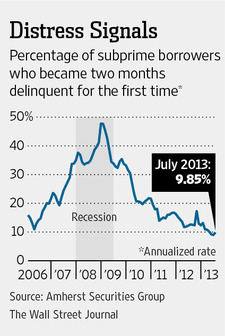
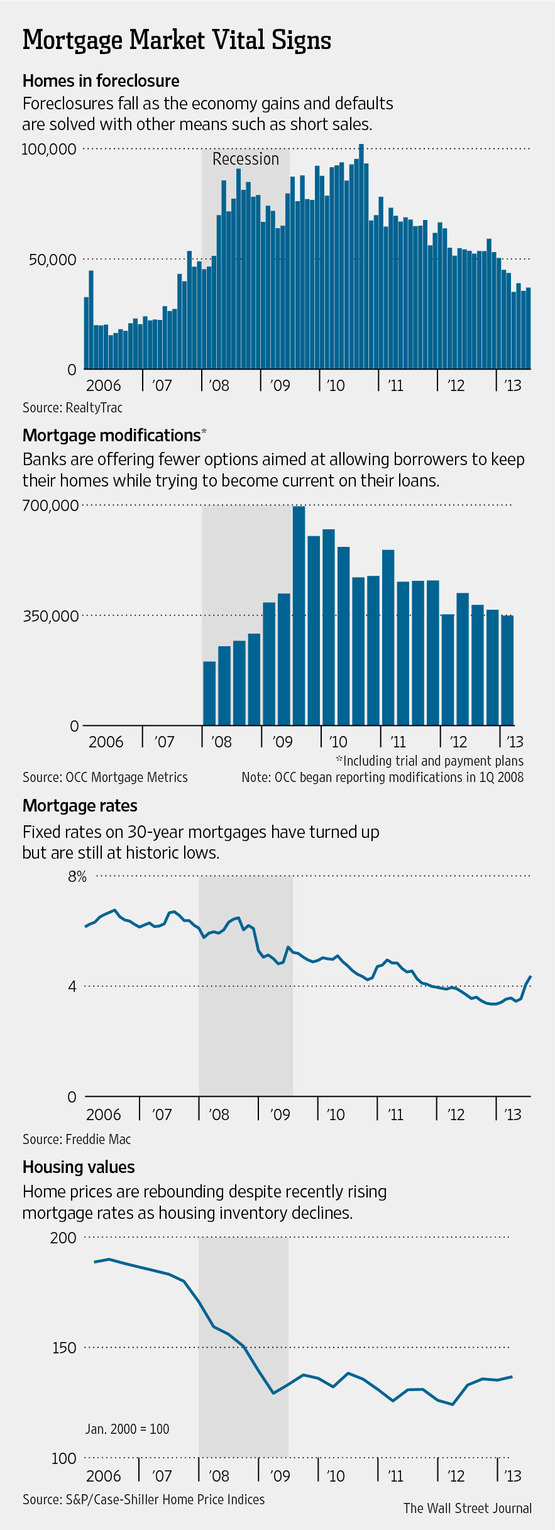
At the core of the financial crisis was a creature called a subprime mortgage bond, and among the more toxic was one with the bland name of CWABS 2006-7. Made entirely out of loans from Countrywide Financial Corp., the bond was so battered by delinquencies in 2009 it appeared that nearly all of the thousands of mortgages inside the bond could default. One might think that today, such a relic of misbegotten lending would be as dead as orbiting space junk. Instead, CWABS 2006-7 is alive and well, a sought-after asset that has made big profits for savvy investors. A senior slice of it now trades at 91 cents on the dollar, having come nearly all the way back. Read more of this post

US investors would have best slept through crash after Lehman; Rich Man’s Recovery; Insane financial system lives post-Lehman

September 12, 2013 6:56 pm

US investors would have best slept through crash after Lehman

By James Mackintosh

Recrimination and regret still haunt banks

Five years on from Lehman’s last day, recrimination and regret still haunt banks. But for investors in US equities, it is as though the crash never happened. It would have been best to ignore it all, sleeping through financial battles like a latter-day Rip van Winkle. Like the fictional character, the modern sleeper would be shocked by the changes of the past half-decade; the iPhone is now available in colour, for example. Today’s investor would have to look hard to spot the impact of the crisis on his portfolio, though. Read more of this post

The Slow Rise And Quick Fall Of The SEC’s Enforcements

Updated September 11, 2013, 8:46 p.m. ET

CRISIS PLUS FIVE

SEC Tries to Rebuild Its Reputation

JEAN EAGLESHAM

P1-BN088_NEWSEC_NS_20130911184507 P1-BN090_NEWSEC_G_20130911185112

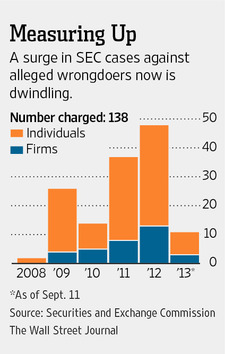
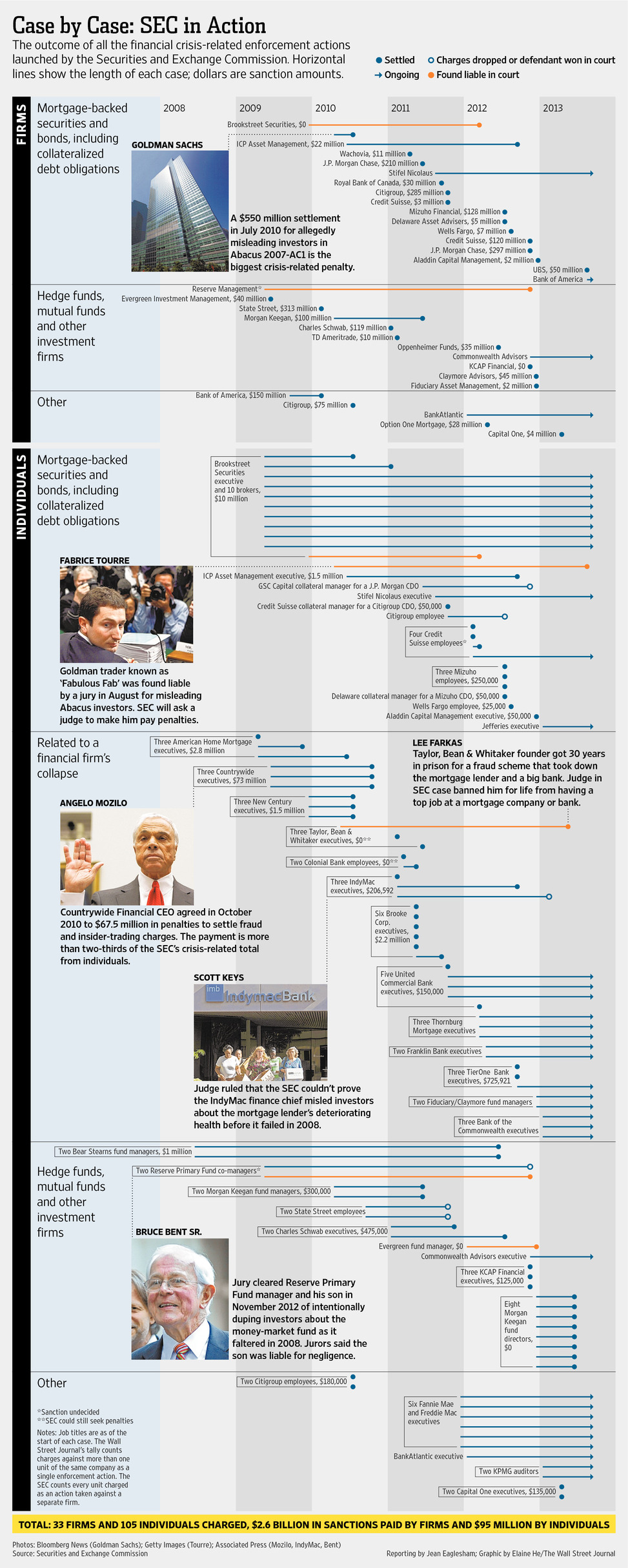
The Securities and Exchange Commission is ending its push to punish financial-crisis misconduct in the same way it started—with a new chairman vowing that Wall Street’s top cop will be tougher in the future. In 2009, at the depths of the recession,Mary Schapiro took the reins at the SEC promising to “move aggressively to reinvigorate enforcement” at the agency. She created teams to target various types of alleged misconduct, including one focused on the complicated mortgage bonds that helped set off a global financial panic. Read more of this post

The Next Top Model: Kiwis

The Next Top Model: Kiwis

11 SEP 2013 – ASHBY MONK

When governments set out to launch sovereign funds or public pension funds, they are often biased with an assumption that these funds will never be able to compete with the private sector. Over time, this assumption is given credibility by the fact that the sponsors of these funds under-resource the teams in charge, while over-paying external asset managers and service providers. This creates a vicious downward cycle whereby pensions become increasingly dependent on external managers (who increasingly over-charge them for services they claim are beyond their capabilities). As a result, an awful lot of people genuinely believe that investment management is something that only the private sector can do; that public sector organizations are inevitably dysfunctional and should be protected from themselves… And then this happens: A sovereign fund drops some science on the investment management industry with a 26% year and a 9% decennial IRR. That SWF is the New Zealand Superannuation Fund, and it is fundamentally challenging the notion that public funds can’t compete with the private sector. As such, I think it may be time that we coin a new “top model” of institutional investment. But before we get there, let’s review some of the existing models: Read more of this post

The “Real” America: Near Record 20% Struggle To Afford Food, Highest Since Crisis Began; Years after recession, many in U.S. still struggling

The “Real” America: Near Record 20% Struggle To Afford Food, Highest Since Crisis Began

Tyler Durden on 09/12/2013 10:00 -0400

With US equity markets on a 7-day roll and excited TV anchors proclaiming the worst over and new all-time highs must signal recovery as they ‘celebrate’ five years on from Lehman, the following two charts of the state of real America should open a few eyes to just how blinded American has become to the truth (unless you live it). A stunning 20.0% of Americans were found to have struggled to afford food in the last year – surging in recent months to its highest since the peak of the crisis in 2008 – as American’s ability to consistently afford food has notrecovered to pre-recession levels. Furthermore, Americans access to basic needs (13 factors including housing, healthcare, and food) hovers near record lows – dramatically lower than pre-recession levels. The Gallup polls point to a very different image of American than Dow 15,000 – and is set to get worse as the food stamp program is set to be cut in November. Read more of this post

BRIC Markets Sink to Worst Place for Investors in Global Poll

BRIC Markets Sink to Worst Place for Investors in Global Poll

The largest developing nations for the first time have the worst market opportunities as optimism for stronger growth shifts to the U.S. and Europe, according to a Bloomberg Global Poll. India fared the poorest, followed by Brazil, Russia and China, a worldwide poll of investors, analysts and traders who are Bloomberg subscribers showed this week. The number of respondents who see the European Union as one of the two best opportunities rose to 34 percent, its best showing in the poll dating to 2009, with the U.S. at 51 percent. Read more of this post

The Struggle for Work-Life Balance in China; Some Stressed-Out Chinese Are Re-Evaluating Their Priorities

September 12, 2013, 12:57 p.m. ET

The Struggle for Work-Life Balance in China

Some Stressed-Out Chinese Are Re-Evaluating Their Priorities

WEI GU

The public disclosure by one of China’s best-known technology entrepreneurs that he has cancer, and how that has changed his view of life, has caused some businesspeople to re-evaluate their aggressive pursuits of wealth and success. Kai-Fu Lee recently revealed his lymphoma diagnosis in a message to his 50 million followers on Sina Weibo. But what has resonated far wider is his repudiation of the work-comes-first mentality that drives so many Chinese businesspeople. “It’s only now, when I’m suddenly faced with possibly losing 30 years of life, that I’ve been able to calm down and reconsider,” wrote the 52-year-old founder and CEO of technology incubator Innovation Works and former president of Google China. He said macho efforts like seeing who could sleep less were “naive.” Read more of this post

China’s New Spin on a Turbo Tax; Its Consumers Must Contend With Steep Taxes on Everything From iPhones to SUVs, but Some Car Makers Are Turning This to Their Advantage

September 12, 2013, 12:21 p.m. ET

China’s New Spin on a Turbo Tax

Its Consumers Must Contend With Steep Taxes on Everything From iPhones to SUVs, but Some Car Makers Are Turning This to Their Advantage

ABHEEK BHATTACHARYA

Like iPhones, cars are pricier in China because of higher taxes. Chinese consumers are complaining that the new iPhone 5C costs at least $184 more than in the U.S. Most of that difference is due to taxes. Cars face a bevy of levies, too, such as customs duties, value-added taxes and purchase taxes. A big one is a consumption tax of up to 40% based on the size of the car engine, to encourage fuel efficiency. This tax is a big reason car makers are adopting “turbo” engines. Turbocharging technology helps deliver the same power with a smaller engine, by pumping more air into it. Such vehicles accounted for 13% of all cars sold in China last year, double the proportion of the year before, and that may rise to 35% by 2020, says LMC Automotive. Read more of this post

The Chinese Billionaires Who Got Poorer

September 11, 2013, 8:21 PM

The Chinese Billionaires Who Got Poorer

Being rich one year doesn’t guarantee the same fortune the next. An economic slowdown in China that has hit some industries and firms harder than others, along with personal misfortunes, have left a minority of the country’s richest people less well-off this year: According to data from Hurun Research Institute’s annual ranking of wealthy Chinese, some 252 on its richest 1,000 list saw their wealth shrink. Misfortunes amongst the rich shouldn’t come as a surprise after equity in general has had a bad year in China; the Shanghai Composite Index is down 1.2% since the start of the year. In fact, the majority of China’s 315 people who have north of $1 billion got poorer. Read more of this post

Bank Indonesia Surprises With Rate Increase to 7.25%

Updated September 12, 2013, 10:03 a.m. ET

Bank Indonesia Surprises With Rate Increase

Central Bank Raises Its Overnight Policy Rate to 7.25%

FARIDA HUSNA And ANDREAS ISMAR

AI-CD516_INDORA_NS_20130912055704

JAKARTA—Indonesia’s central bank on Thursday announced a surprise increase in its policy interest rate, reflecting its commitment to protect the country’s currency, as global sentiment remains fragile. Bank Indonesia raised its benchmark rate by a quarter percentage point to 7.25%, just two weeks after raising it by a half percentage point. It also raised a key money-market rate, known as the Fasbi rate, by a quarter percentage point to 5.50%. Read more of this post

Chipotle targets Big Food, skips big branding

Chipotle targets Big Food, skips big branding

Bruce Horovitz, USA TODAY8:21 a.m. EDT September 12, 2013

Chipotle hopes that its new, anti-Big-Food video and downloadable game go viral — even with little mention of the Chipotle brand name or logo.

Chipotle is about to turn the ad world on its head — even as it smacks Big Food in the chops. On Thursday, the Millennial-friendly Mexican food chain will post “The Scarecrow,” a Big-Food-mocking 3½-minute animated video ad — and make available a free downloadable, interactive game on the topic. The twist: Both have virtually no Chipotle branding. Chipotle’s name shows up — in small print — only in the game’s introduction, and its logo is displayed only after the video is over. Read more of this post

Billionaires Halt Mining Deals on Rupee Erosion

Billionaires Halt Mining Deals on Rupee Erosion: Corporate India

Indian billionaires led by Kumar Mangalam Birla are stalling purchases of mines overseas as the rupee’s 13 percent drop this year inflates the cost of deals. The Aditya Birla Group, which runs the nation’s second-biggest copper and aluminum maker, has put acquisition plans on hold, said a person with direct knowledge of the matter. JSW Steel Ltd. (JSTL), controlled by the billionaire Jindal family, would prefer to wait, Commercial Director Jayant Acharya said. Read more of this post

Sino Biopharm, Market Cap $3 Billion, Plunges After CCTV Bribery Report

Sino Biopharm Plunges After CCTV Bribery Report: Hong Kong Mover

Sino Biopharmaceutical Ltd. (1177) plunged the most in about 13 years before being suspended in Hong Kong trading, after a report by state-run Chinese Central Television alleged bribery at a unit of the medicine maker. Sino Biopharmaceutical fell 16 percent to HK$4.76, headed for the largest drop since October 2000, before being halted at 11:49 a.m. The stock has been suspended pending an announcement to clarify certain information in recent press reports, the drugmaker said today. Two groups of doctors attended 50-minute meetings organized by the company in China and then left on sponsored trips, according to the broadcast yesterday evening. Read more of this post

More Boom-and-Bust Seen in Dubai’s Cash-Driven Recovery

More Boom-and-Bust Seen in Dubai’s Cash-Driven Recovery

After five years living in Dubai, Akanksha Goel and her husband decided to buy a property instead of paying $68,000 a year to rent their three-bedroom house. It never happened. Though Goel, the owner of a small advertising agency, and her cameraman husband, were prepared to pay 50 percent upfront, the couple was classified as “high-risk” because she’s self-employed. They were offered a mortgage for 30 percent of the home’s value at double the rate given to buyers with the best credit. Read more of this post

Henkel to Expand Beauty Care Business in Smaller Chinese Cities

Henkel to Expand Beauty Care Business in Smaller Chinese Cities

Henkel AG, the German maker of adhesives and Soft Scrub cleaners, plans to step up expansion in China as the company pushes to sell hair and skin care products in smaller cities outside Beijing and Shanghai. The company will invest “heavily” to lift the proportion of China sales at its consumer business to 30 percent from the current 20 percent, Chief Executive Officer Kasper Rorsted said in an interview today. Adhesives account for 80 percent of the company’s China revenue, he said. Read more of this post

Tesla Challenges BMW on Home Turf as Germans Go Green

Tesla Challenges BMW on Home Turf as Germans Go Green

Tesla Motors Inc. (TSLA), the electric-vehicle maker led by billionaire Elon Musk, is pushing beyond the friendly confines of California to take on the world’s biggest luxury-car brands in their home market. Tesla will have six stores in Germany after adding locations in the coming months in Berlin and Stuttgart, home to Mercedes-Benz parent Daimler AG. The start-up already has sales centers in Frankfurt, Dusseldorf, Hamburg and Munich, Bayerische Motoren Werke AG (BMW)’s hometown. Read more of this post

Fashion designers look to patents to fight knockoffs

Fashion designers look to patents to fight knockoffs

5:02pm IST

By Erin Geiger Smith

NEW YORK (Reuters) – Design companies tending to the details of fashion shows have more to think about than skirt lengths and handbag clasps – they must decide whether to seek U.S. patent protection for their looks. Diane von Furstenberg, famous for her wrap dresses, has a design patent on a chain mail-style bag. The popular French line Celine has one on the envelope-style handbag sported by countless fashion experts at New York Fashion Week. Read more of this post

Asia’s Outlook Turns Murky After the 2008 Crisis

September 11, 2013, 2:51 p.m. ET

Asia’s Outlook Turns Murky After the 2008 Crisis

Region Roared Ahead of West, but Ground Has Shifted; Debt Levels Rise

ALEX FRANGOS

AM-BA228_ASIAPL_G_20130911133604

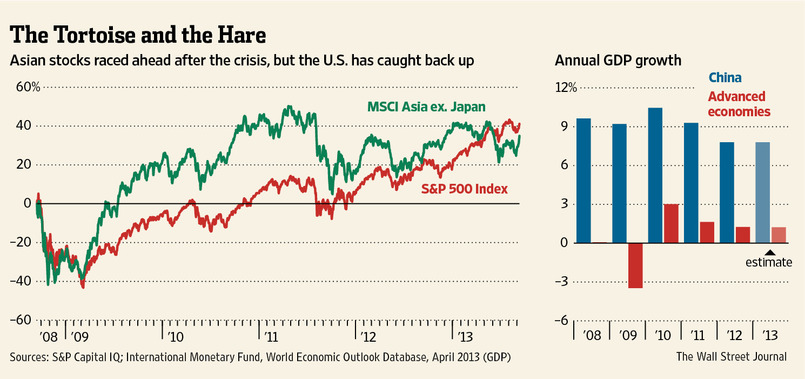
HONG KONG—The early verdict on the global financial crisis was that Asia came out on top. Strong banking systems and a government-directed lending spree in China quickly boosted the region’s economies back to growth. By 2010, investors were betting that there had been a permanent shift in the balance of economic power. They pushed Asian stock markets and currencies to record highs. Just over two years after the failure of Lehman Brothers, Asian stocks were up 40%, outperforming U.S. stocks by 42 percentage points. Read more of this post

Companies Act on Rising Interest Rates; Pension Contributions, Trade, Borrowing for Deals All Are Affected

September 11, 2013, 8:15 p.m. ET

Companies Act on Rising Interest Rates

Pension Contributions, Trade, Borrowing for Deals All Are Affected

NOELLE KNOX And VIPAL MONGA

MK-CG214_RISING_NS_20130911181509

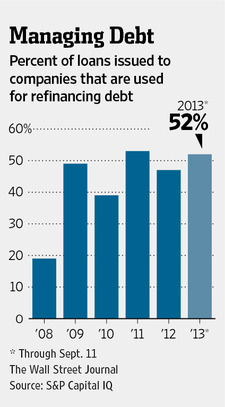
Interest rates for long-term business borrowing have shot up to the highest levels in two years. That’s pushing corporate executives to not only rethink their borrowing and refinancing strategies, but also to adjust pension contributions and overseas trade. Some may even accelerate plans for deals. While most experts say it is too early to see an increase in the number of mergers and acquisitions, which can take months to negotiate, rising rates were a driving factor in Verizon Communications Inc.’s VZ +0.11% recent agreement to buyVodafone Group VOD.LN +1.08% PLC’s stake in their joint U.S. wireless business. That is because fresh funds for acquisitions and other deals will only get more expensive as rates go higher. “Interest rates are presumably the real catalyst here,” said Craig Moffett, senior research analyst at Moffett Research, referring to Verizon. Read more of this post

ASX100 CEOs: Their path to the corner office

ASX100 CEOs: Their path to the corner office

24 September 2012 Myriam Robin

Want to be a CEO? Being an executive is a crucial first step, but not all leadership roles are likely to lead to the corner office. LeadingCompany analysed the backgrounds of the ASX100 CEOs, and discovered most were promoted after delivering results in their own little fiefdom. The rest of them were chief operating officers and chief financial officers, leaving other C-suite positions out in the cold. Australia’s top boards are opting for leaders who’ve either already demonstrated leadership success, or who bring operational mastery to the chief role. Read more of this post