It takes Swedes 140 years on average to repay their home loans. Only 40 percent of borrowers with mortgages smaller than 75 percent of their property’s value actually pay down their debt

Sweden’s Banks Face Extra Buffer as Private Debt Hits Record

Sweden’s financial watchdog said banks in the largest Nordic economy will probably need to hold extra capital to reflect households’ record debt burdens. That means a countercyclical buffer that’s yet to be calculated for Nordea Bank AB, Swedbank AB (SWEDA), SEB AB (SEBA) and Svenska Handelsbanken AB (SHBA) may stay above zero for “several years,” said Martin Andersson, director general of the Swedish Financial Supervisory Authority. “It has been seen as another fine-tuning instrument for the economic cycle, but that’s never been the intention and that wouldn’t be a good way to use it,” Andersson said yesterday in an interview in Stockholm. “It’s about dealing with a credit cycle that’s much longer.” The FSA isn’t planning to adjust the buffer “particularly often,” he said. Read more of this post
Five Years of Financial Non-Reform

Five Years of Financial Non-Reform

Anat Admati, Professor of Finance and Economics at the Stanford Graduate School of Business, is co-author (with Martin Hellwig) of The Bankers’ New Clothes: What’s Wrong with Banking and What to Do about It.

13 September 2013

ec49b9c045decc0cd683335a6a67f410.portrait

STANFORD – Five years after the collapse of Lehman Brothers triggered the largest global financial crisis since the Great Depression, outsize banking sectors have left economies shattered in Ireland, Iceland, and Cyprus. Banks in Italy, Spain, and elsewhere are not lending enough. China’s credit binge is turning into a bust. In short, the world’s financial system remains dangerous and dysfunctional. Worse, despite years of debate, no consensus about the nature of the financial system’s problems – much less how to fix them – has emerged. And that appears to reflect the banks’ political power. Read more of this post

Turning against the tycoons: Some of Israel’s leading businessmen are suffering a backlash

Turning against the tycoons: Some of Israel’s leading businessmen are suffering a backlash

Sep 14th 2013 | TEL AVIV |From the print edition

A CORPORATE saga has filled Israel’s newspapers for months: the struggle of Nochi Dankner, one of the country’s leading businessmen, to keep control of IDB Holding Corporation, a debt-laden conglomerate. Mr Dankner came to prominence when he bought IDB in 2003. If he fails to devise a viable rescue plan soon, the firm’s bondholders will gain control; Mr Dankner may lose much of his fortune. Read more of this post

The Lehman anniversary: Five years in charts

The Lehman anniversary: Five years in charts

Sep 14th 2013 |From the print edition

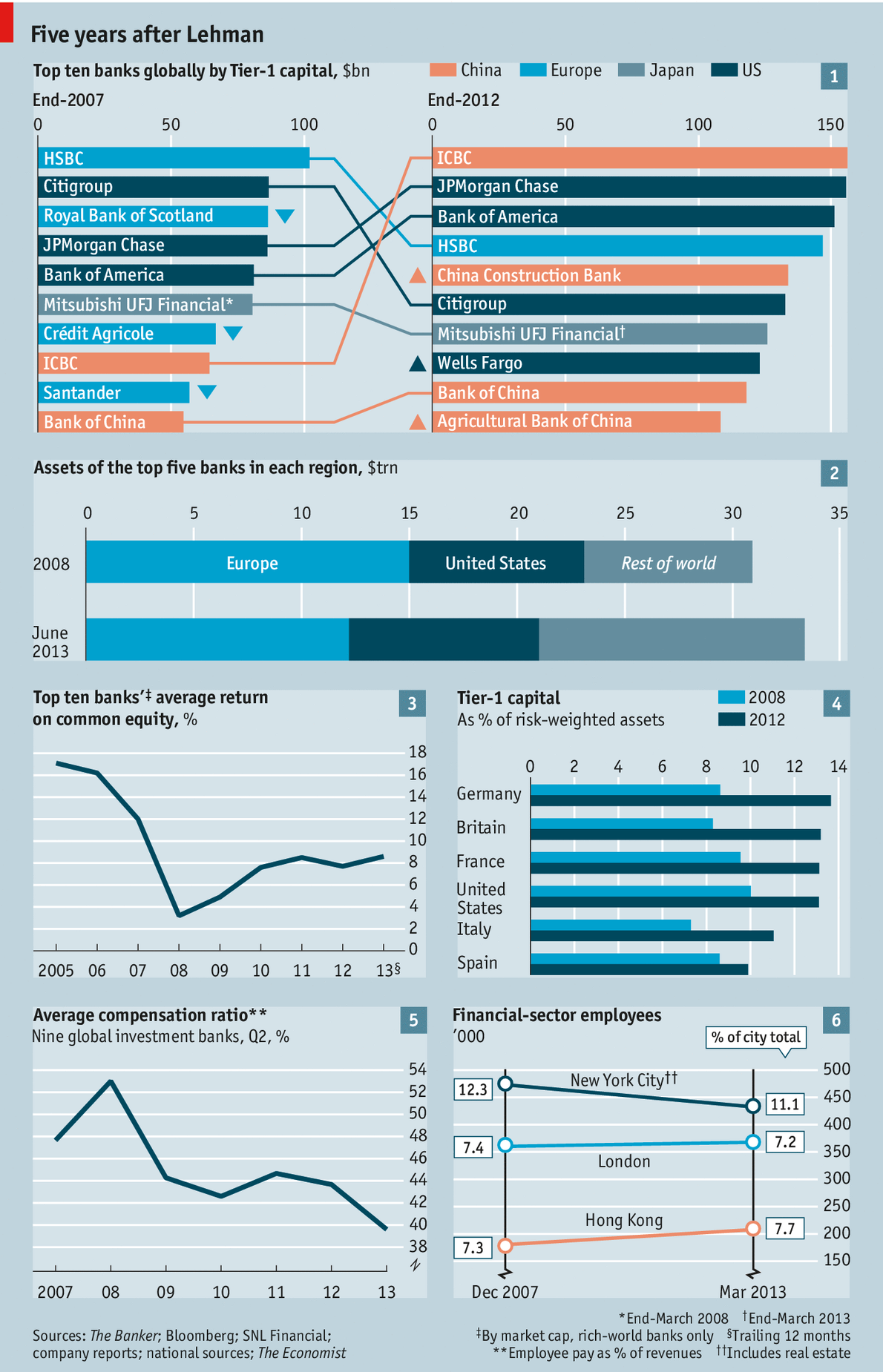
The world of banking has changed dramatically, if not radically, in the five years since September 15th 2008, the day Lehman Brothers went bust. American and European banks used to dominate the list of the world’s biggest banks (see chart 1); the Chinese have since scaled the charts. The balance-sheets of Europe’s behemoths have got quite a bit smaller (chart 2); consolidation has made America’s giants bigger than ever. Western banks are generating much lower returns on equity than they did in the years before the crisis (chart 3), in part because the industry is being forced to fund itself with higher levels of equity than in the past (chart 4). So cost-cutting is much more important than it was: compensation ratios at investment banks have fallen (chart 5). But those who want a complete reshaping of finance can still argue that change has not gone far enough: more people work in finance in London in 2013 than did in December 2007 (chart 6).

20130914_FNC384_1190


The ambitions of Western firms in emerging markets far exceed their efforts

The ambitions of Western firms in emerging markets far exceed their efforts

Sep 14th 2013 |From the print edition

20130914_WBD001_0

SPEAK to the boss of a big, rich-world multinational company and he will soon wax lyrical about the attractions of emerging markets. Even recent wobbles in some of these countries have not curbed vocal enthusiasm for the BRICS and other collections of high-growth markets, whose prospects have more than offset a gloomy prognosis for the maturing, growth-starved domestic markets of the developed economies. So, with the source of future profits so clearly identified, presumably such firms are doing everything possible to succeed in emerging markets? Read more of this post

Rich Bet on Farms to Rail Cars as Yield Hunt Brings Risks

Rich Bet on Farms to Rail Cars as Yield Hunt Brings Risks

Ken Slater says he was a novice at growing corn and soybeans when he asked Bank of America Corp.’s U.S. Trust unit to purchase the first of three farms for him in the past two years. A millionaire living in Palm Beach, Florida, Slater was looking for a place to put his money that would provide income, diversify risk and offer capital appreciation. He wasn’t thrilled with the returns of corporate and municipal bonds, so he put 5 percent of his portfolio in real assets such as farmland and timber. Read more of this post

Powder buyers have been holding back their purchases waiting for prices to fall further; “As long as they don’t sell the powder, pressers bring the butter price to a level whereby most of the processing cost is covered by butter sales”

Record Chocolate Sales Boosting Cocoa Demand to Leave Shortages

Record chocolate sales are boosting cocoa demand and prices as bean supplies lag behind demand for a second year.

Output will be 129,000 metric tons smaller than demand in the 12 months starting Oct. 1, Euan Mann, director at the London-based Complete Commodity Solutions Ltd., said at the European Cocoa Conference in Istanbul this week. That follows a shortage of 119,000 tons a year earlier. Chocolate sales volume will rise 6.2 percent to a record $117 billion next year, researcher Euromonitor International Ltd. in London estimates. Read more of this post

What We Learned From the Financial Crisis; From Timing Retirement Withdrawals to Avoiding Unnecessary Complexity, Some Hard Lessons on Managing Money

September 13, 2013, 4:41 p.m. ET

What We Learned From the Financial Crisis

From Timing Retirement Withdrawals to Avoiding Unnecessary Complexity, Some Hard Lessons on Managing Money

KELLY GREENE, LIAM PLEVEN, LAURA SAUNDERSDAWN WOTAPKA and JASON ZWEIG

There is nothing quite like living through a financial cataclysm to teach you what really is important when it comes to your finances. Or is there? It has been five years since the collapse of investment bank Lehman Brothers Holdings, a shock point in an era that saw the takeover or shutdown of many household-name financial institutions and the meltdown of the stock and housing markets. Despite a government bailout of financial firms costing hundreds of billions of dollars, 8.8 million jobs and $19.2 trillion in household wealth were lost, according to a U.S. Treasury report on the crisis. Read more of this post

Why the Dow — Quirks and All — Is Beating the S&P 500

Sep 13, 2013

Why the Dow — Quirks and All — Is Beating the S&P 500

JASON ZWEIG

This coming week, the dowager gets a makeover. The Dow Jones Industrial Average, which turned 117 years old this summer, will get three new members as Nike, Visa and Goldman Sachs Group replace AlcoaAA -0.98%Hewlett-PackardHPQ +0.50% and Bank of AmericaBAC +0.07%. Should you care? There will be no immediate impact on the level of the Dow, which finished this week at 15376; the three stocks getting the boot have barely budged in price. But the inner workings of the average, which have changed little since its inception, hold some important lessons for investors—most notably that things on Wall Street are seldom as simple as they seem. Read more of this post

Wanted: Jobs for the New ‘Lost’ Generation; Five years after the 2008 crisis, younger adults still struggle to find work

Updated September 13, 2013, 11:15 p.m. ET

Wanted: Jobs for the New ‘Lost’ Generation

Five years after the 2008 crisis, younger adults still struggle to find work

BEN CASSELMAN and MARCUS WALKER

P1-BN129_LOSTGE_NS_20130913145703 P1-BN130_LOSTGE_G_20130913155705

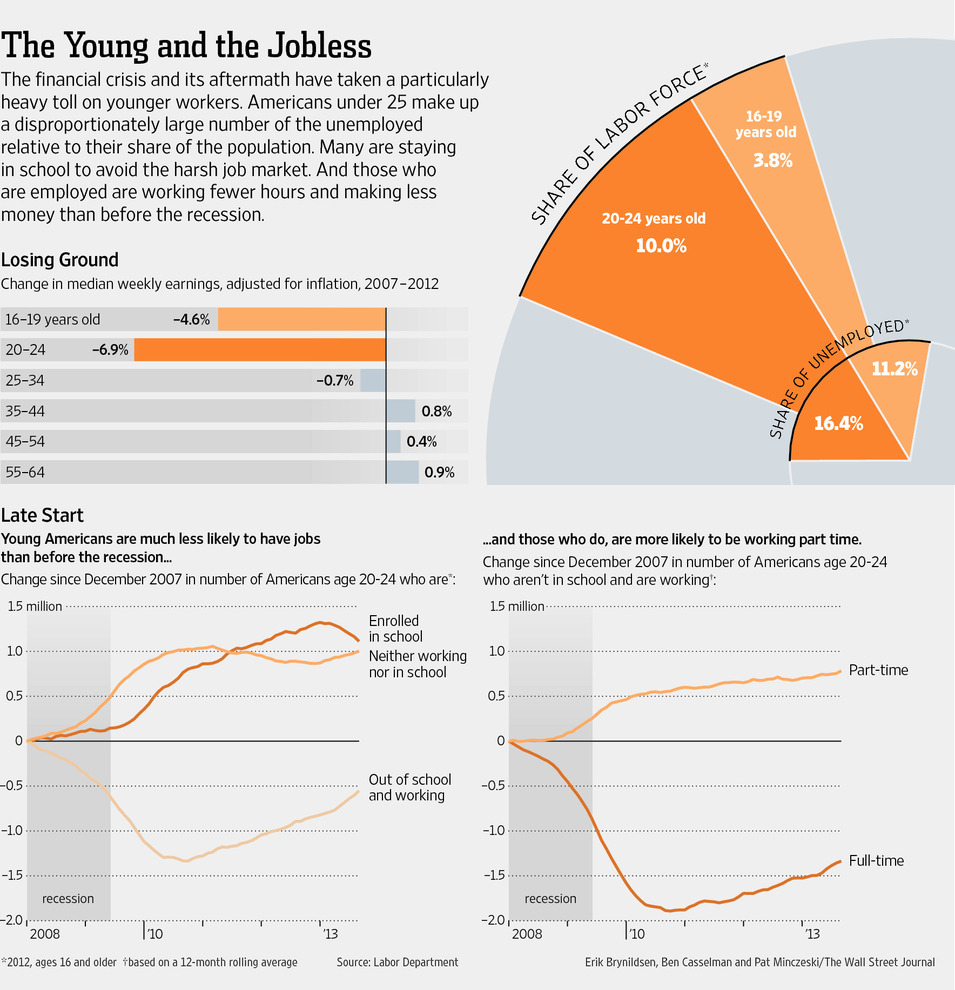
Like so many young Americans, Derek Wetherell is stuck. At 23 years old, he has a job, but not a career, and little prospect for advancement. He has tens of thousands of dollars in student debt, but no college degree. He says he is more likely to move back in with his parents than to buy a home, and he doesn’t know what he will do if his car—a 2001 Chrysler Sebring with well over 100,000 miles—breaks down. Read more of this post

Doubts Rise as China Touts Upturn; Beijing’s Reliance on Credit-Fueled Megaprojects, Exports Raises Questions About Rebound’s Length

Updated September 12, 2013, 7:08 p.m. ET

Doubts Rise as China Touts Upturn

Beijing’s Reliance on Credit-Fueled Megaprojects, Exports Raises Questions About Rebound’s Length

BOB DAVIS, TOM ORLIK and LAURIE BURKITT

WO-AP394_CREBOU_G_20130912181808

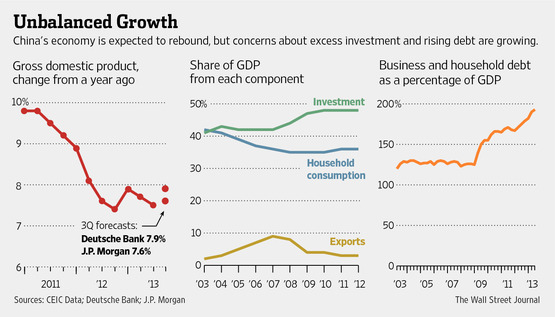
BEIJING—China’s leaders are trumpeting their commitment to overhauls, but there are signs a recent turnaround in the Chinese economy relies on old policies, raising doubts about how long the rebound can continue. Some economists and business leaders say Beijing is pulling the same levers it has used in the past to produce growth, leaving untouched a reliance on exports abroad and credit-fueled investment in large infrastructure projects at home—the very model China says it wants to scrap. Over the past two months, China’s industrial output, electricity production and exports have posted solid gains, buoying global markets and easing fears the country would join other emerging economies reeling in anticipation that the U.S. Federal Reserve will curb bond-buying. Read more of this post

It’s China, it’s bad loans, and it’s securitisation

It’s China, it’s bad loans, and it’s securitisation

David Keohane

| Sep 13 08:33 | 3 comments | Share

What could possibly go wrong? It looks increasingly likely that China is gearing up for another round of bad-loan cleansing with asset management companies seemingly being prepared for some more NPL absorption and a move towards what might be loosely termed market-based approaches to restructurings. It looks like this will include securitisation, which Chinese authorities have been dipping their toes back into since a Lehman-burning, according to SocGen’s Wei Yao (with our emphasis):

China’s credit asset securitisation (CAS) got off to a meaningful start in 2005 when the government accelerated policy initiatives to set up the regulatory framework. Domestic issuance of asset-backed securities (ABS) took off, rising from almost zero to nearly CNY70bn by 2008. However, as soon as the Lehman crisis hit, policymakers suspended the trial programme and only cautiously resumed it in 2011 with six deals totalling CNY22bn, which were subsequently followed in 2012 by a second trial of CNY50bn. Entering 2013, the reluctance has continued to thaw and interest has continued to rise.In August, the State Council announced to steadily push ahead with the pilot scheme for securitisation. A new round of CNY300bn is widely expected to kick off soon. Read more of this post

Banks ‘seeking to transfer non-performing loans’

Banks ‘seeking to transfer non-performing loans’

Updated: 2013-09-13 15:44

By Yang Ziman (chinadaily.com.cn)

A number of banks, including State-owned establishments, are transferring non-performing loans to asset management companies, the 21st Century Business Herald reported. The transfers will be completed by the end of the third quarter, an employee of an asset management company told the newspaper. A bank based in north China has launched a bid to offload its 747 million yuan ($122 million) bad loans to one of the top four AMCs in the country, the newspaper reported. Read more of this post

The Hidden Losses of China SOEs: While corruption cases grab headlines, it’s the SOE system that brings the greatest losses

The Hidden Losses of SOEs – Economic Observer Online

By the EO Editorial Board
Issue 636, Sept 9, 2013

The corruption scandal at China National Petroleum Corporation (CNPC) continues to unfold. Recently, Jiang Jiemin (蒋洁敏), the former director of The State-owned Assets Supervision and Administration Commission (SASAC) and former chairman of CNPC, was placed under investigation for corruption. He marks the fifth senior CNPC official to fall in the last few weeks. We still don’t know how much was lost because of these corruption cases, but CNPC is a central state-owned enterprise holding trillions of yuan in state-owned assets. After the corruption probe was revealed, the company’s market value fell by up to ten billion yuan. This case has once again underscored how state-owned assets can easily be stripped away through “transactional losses.”  This refers to when state assets are sold on the cheap rather than at a fair price, either through incompetence or corruption. Read more of this post

Shanghai Free-Trade Zone Sparked Excitement but Is Short on Specifics

September 13, 2013, 6:59 a.m. ET

Shanghai Free-Trade Zone Sparked Excitement but Is Short on Specifics

SHEN HONG

SHANGHAI—Enthusiasm over China’s plans for a free-trade zone in Shanghai has reached fever-pitch levels, with stocks connected to the project rallying heavily, but officials are staying mum on details, and major stumbling blocks remain. Analysts say while companies operating in the 29-square-kilometer zone may benefit from looser capital controls and fewer barriers to trade and investment, it will be years before the testing ground in Shanghai has a more meaningful impact on the world’s second-largest economy. Read more of this post

Multinationals Feel the Pressure in China; The extent to which Chinese authorities have recently focused on commercial corruption is unprecedented.

September 12, 2013, 1:34 p.m. ET

Multinationals Feel the Pressure in China

The extent to which Chinese authorities have recently focused on commercial corruption is unprecedented.

ANGELA MANCINI AND BLISS KHAW

China is in the middle of a major anticorruption drive and foreign companies risk finding themselves in the crosshairs soon—if they’re not there already. The clock is ticking for executives to make sure their firms won’t fall afoul of the crackdown. Although Beijing has talked tough on corruption in the past, this time all indications are that serious action will result. The rhetoric from the top, led by Chinese President Xi Jinping, is backed by an ongoing campaign against commercial corruption by the State Administration of Industry and Commerce (SAIC), an investigation of corporate criminal behavior by the Public Security Bureau (PSB), as well as a crackdown on inflated pricing and market dominance by the National Development and Reform Commission (NDRC). On Aug. 28, the Politburo launched a broad five-year anticorruption plan to extend from 2013-17. Read more of this post

Mr Clean catches China’s graft tigers by the tail; “I would say that Wang Qishan is the second most powerful person next only to Xi Jinping”

Mr Clean catches China’s graft tigers by the tail

Thu, Sep 12 2013

By John Ruwitch

SHANGHAI (Reuters) – Behind China’s aggressive drive to root out corruption is Wang Qishan, a historian-turned-economist who once felt so bad about getting free parking that he reportedly sent a colleague back to pay the fee. President Xi Jinping launched the anti-corruption campaign after becoming Communist Party chief in November. So far the party has announced the investigation or arrest of eight senior officials, including three from the 376-member elite Central Committee. Among them, former executives from oil giant PetroChina are being investigated in what appears to be the biggest graft probe into a state-run firm in years. Wang, 65, heads the Central Commission for Discipline Inspection and ranks sixth in the party hierarchy. His power far exceeds this, said Cheng Li, a fellow at the Brookings Institution in Washington and an expert on Chinese politics. Read more of this post

How China’s Homegrown Biz Is Threatening Hollywood’s Payday

How China’s Homegrown Biz Is Threatening Hollywood’s Payday

SEPTEMBER 12, 2013 | 04:20AM PT

Country’s evolving movie biz shows an increasing sophistication and diversity that challenges U.S. studios to rethink their approach

Patrick Frater

Asia Bureau Chief

In the past few years, Westerners have exulted in the country’s box office boom, which included hefty grosses for major-studio films such as “Iron Man 3,” “Pacific Rim” and “The Croods.” With the liberalization of access to the market and a greater share of distribution money, Hollywood began to seeChina as the land of opportunity after decades of feeling thwarted by tight quotas for imported movies. Read more of this post

‘Tiger hunts’ revisit a bloody era in China’s history

September 12, 2013 2:35 pm

‘Tiger hunts’ revisit a bloody era in China’s history

By Frank Dikotter

As in the 1950s, malicious ideas such as democracy must be erased, writes Frank Dikotter

On a wintry day in February 1952, two victims, their hands tied behind their backs, were marched off to the execution grounds of Baoding, the provincial capital of Hebei, just south of Beijing. They were shot in the heart rather than in the head. Hundreds of thousands of enemies of the regime had faced the firing squad since the red flag was hoist above Tiananmen Square in October 1949 but this case was different. Both victims were central actors in the local party hierarchy. It was the defining moment of a campaign against corruption Mao Zedong had unleashed against the party itself. There were mere “flies” who needed to be swatted, the chairman explained, and there were “tigers”. Everywhere tiger-hunting teams tried to outdo each other, encouraged from above by Mao. Read more of this post

DBS to Maybank Return Least on Expansion Spree: Southeast Asia; “If you can’t make money at home, why do you think you can make money in another market where you don’t have the brand name, you don’t have the local knowledge”

DBS to Maybank Return Least on Expansion Spree: Southeast Asia

Southeast Asia’s biggest lenders including DBS Group Holdings Ltd. (DBS) have performed the worst among the region’s bank stocks in the past five years on concern overseas expansion plans will fail to boost earnings. Singapore’s DBS and Malaysia’s Malayan Banking Bhd. (MAY), which get at least 30 percent of revenue outside their home markets, have given annualized returns including dividends of no more than 15 percent in the five years to Sept. 6, data on 15 banks compiled by Bloomberg show. Krung Thai Bank Pcl (KTB), which gets all its revenue in Thailand, returned the most with 28 percent. Read more of this post

S. Korea’s top 6 family-owned conglomerates enjoy high-flying growth amid fall of ‘legendary salary men’

S. Korea’s top 6 family-owned conglomerates enjoy high-flying growth amid fall of ‘legendary salary men’

2013.09.12 17:04:07

South Korea’s six largest family-owned conglomerates have witnessed accelerating growth even amid the fall of Woongjin Group chairman Yoon Seok-geum and STX’s former Chairman Kang Deok-soo, once dubbed as ‘legendary salarymen.’ Of the total assets held by 51 largest conglomerates with assets of five trillion won ($4.6 billion) or more, which are subject to limitations on total equity investment, Samsung Group, Hyundai Group, LG Group, SK Group, Lotte Group and Hyosung Group took up 67.7 percent late last year, up 8.2 percentage points in five years from 59.5 percent in late 2007. The nation’s 18 companies belonging to the six family-owned business groups doubled (100.8 percent) from 525 trillion won in 2007 to one quadrillion late last year. Over the corresponding period, the combined assets owned by the six large conglomerates grew merely 76.4 percent from 883 trillion won to 1.5 quadrillion. The combined assets of the remaining conglomerates went up 40.7 percent, accounting for less than half of the combined assets of the six conglomerates. 
The nation’s gross domestic production (GDP) grew 30.5 percent during the cited period. Net asset of the six largest family-run companies climbed sharper than their assets. 
Their net profit added 63.3 percent from 37 trillion won to 60 trillion won, the share also expanded a startling 25.4 percentage points from 65.6 percent to 91 percent. The six largest groups generated 60 trillion won profit, dwarfing other group’s six trillion won. 

Tong Yang asks for financial help from Orion

Tong Yang asks for financial help from Orion

Lee Jin-myung, Hong Jong-sung

2013.09.13 17:20:20

Hyun Jae-hyun, Chairman of Tong Yang Group, has asked for financial help from Dam Chul-gon, Chairman of Orion, in efforts to overcome a cash crunch. Tong Yang Group is the former parent company of Orion, South Korea’s major confectionery maker. According to Tong Yang Group on Thursday, the two businessmen, brother-in-laws to each other, met recently to discuss Tong Yang Group’s liquidity crisis. Hyun asked Dam to provide collateral to help the troubled Tong Yang to issue asset-backed securities worth up to 1 trillion won ($919.87 million). Tong Yang wants the money to repay debts that will mature late this year. But sources said Dam did not make his answer immediately. Tong Yang Group plans to issue ABSs based on assets of the group’s key subsidiaries – Tong Yang Cement and Tong Yang Power and Tong Yang Securities – and to liquidate them with Orion’s backing. This plan was recently discussed with the nation’s financial regulators.

South Korea grapples with fiscal deficit

Updated: Friday September 13, 2013 MYT 12:30:21 PM

South Korea grapples with fiscal deficit

SEOUL: South Korea says it faces a 2013 revenue shortfall of up to 8 trillion won (US$7.37bil), a challenge for President Park Geun-hye’s administration as it prepares to submit its first full-year budget to parliament next month. The previous South Korean government was unable to have a balanced budget in its last years, and a wider-than-expected deficit this year may signal that Park, who became president early this year, could struggle to achieve a goal of balancing the budget by the end of her five-year term. Read more of this post

Japan’s Companies Shun China for Southeast Asia; Trend Means Beijing May Miss Out on Fresh Wave of Overseas Japanese Expansion

September 12, 2013, 2:43 p.m. ET

Japan’s Companies Shun China for Southeast Asia

Trend Means Beijing May Miss Out on Fresh Wave of Overseas Japanese Expansion

YUKA HAYASHI And MAYUMI NEGISHI

MK-CG238_JASIA_G_20130912181204

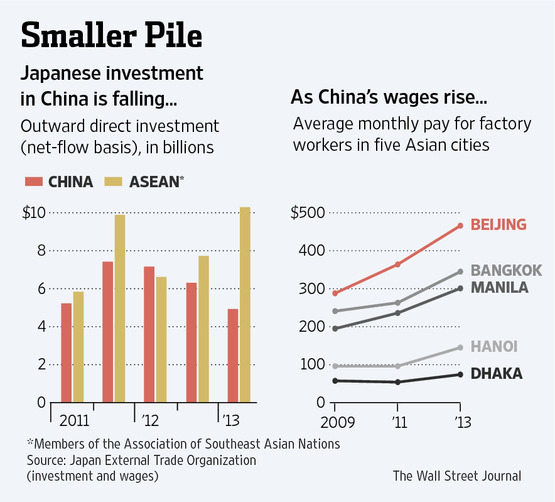
TOKYO—Japanese investment in China is falling amid political tensions between the nations, a trend that means Beijing could be missing out on a fresh wave of overseas expansion by Japanese companies. Japanese businesses are turning their attention instead to Southeast Asia, signing a number of deals in recent months to purchase insurance firms, banks and factories. In part, the shift reflects rising wage costs in China. Some Japanese firms say they also are concerned about anti-Japanese sentiment. They point to mob violence a year ago against Japanese businesses in China, as tensions rose over a group of uninhabited islands in the East China Sea. Read more of this post

Nuclear freeze chills Japan’s cash-strapped utilities

September 13, 2013 11:29 am

Nuclear freeze chills Japan’s cash-strapped utilities

By Ben McLannahan in Tokyo

Japan’s cash-strapped utilities are facing increased pressure to bring down the cost of replacement fossil fuels as the country shuts its last operating nuclear reactor. Kansai Electric’s 1,180-megawatt No 4 reactor at the Ohi plant in Osaka will be idled from Sunday for safety inspections. Before the Fukushima crisis of March 2011, nuclear power accounted for about 30 per cent of Japan’s electricity generation. Read more of this post

Japan Braces for Rise in Capital-Gains Tax; Investors Worry Over Impact on Stock Market; a Special Deal for Retail Investors

September 12, 2013, 1:07 p.m. ET

Japan Braces for Rise in Capital-Gains Tax

Investors Worry Over Impact on Stock Market; a Special Deal for Retail Investors

KANA INAGAKI

TOKYO—As it works its way back toward a five-and-a-half year high reached in May, Japan’s stock market faces a new headwind as the government moves forward with a planned doubling of tax rates on capital gains and dividends. Government officials and brokerages are betting that a new program will offset any negative impact from the higher rates, as well as aiding the economy by encouraging more people to invest in shares. The initiative—heavily marketed with images of cuddly dogs and the endorsement of baseball star Ichiro Suzuki—allows smaller retail investors to buy stocks tax-free, albeit with a number of strings attached. Read more of this post

Fukushima “not under control”, says TEPCO official

Fukushima “not under control”, says TEPCO official

POSTED: 13 Sep 2013 7:27 PM
The Japanese government and TEPCO were scrambling to reassure people on Friday that they have a lid on Fukushima after a senior utility executive said the nuclear plant was “not under control”. TOKYO: The Japanese government and TEPCO were scrambling to reassure people on Friday that they have a lid on Fukushima after a senior utility executive said the nuclear plant was “not under control”. Read more of this post

Abenomics hits Yakult, the lunchtime tipple of 3 million Japanese schoolchildren and salarymen

September 12, 2013 12:58 pm

Abenomics hits lunchtime tipple of schoolchildren and salarymen

By Jennifer Thompson in Tokyo

Inflation may be the holy grail of “Abenomics” but it has made an unwelcome appearance in lunch boxes and delivery trolleys across Japan: the popular Yakult milk drink is raising prices for the first time in more than two decades. Yakult, whose probiotic drink is doled out to schoolchildren and drunk by salarymen at their desks, follows McDonald’s burgers, soy sauce and mayonnaise among other foodstuffs and beverages that have upped their sticker prices.

Read more of this post

Jakarta will be underwater by 2030: National Council on Climate Change

Jakarta will be underwater by 2030: National Council on Climate Change

Friday, September 13, 2013 – 09:10

The Jakarta Post/Asia News Network

The National Council on Climate Change (DNPI) predicts that half of Jakarta will be under water by 2030 due to global warming. DNPI executive chairman Rachmat Witoelar said on Thursday that global warming could cause sea levels to increase significantly. “If we allow this situation to continue, then by around 2030, half of Jakarta, specifically areas such as Ancol, will be under water,” he said in Jakarta on Thursday, as quoted by Antara news agency. Read more of this post

Indonesia’s borrowing costs are surging toward those of Vietnam, rated five levels lower by Moody’s Investors Service, as a plunging rupiah spurs inflation

Indonesia Yield Nears Vietnam’s on Inflation Risk

By Bloomberg on 2:59 pm September 13, 2013.
Indonesia’s borrowing costs are surging toward those of Vietnam, rated five levels lower by Moody’s Investors Service, as a plunging rupiah spurs inflation. The extra yield investors demand to hold Vietnam’s 10-year local-currency government bonds over Indonesia’s narrowed five percentage points from this year’s high on Jan. 7 to a record low 12 basis points this week. The yield on the Indonesian notes has risen 3.3 percentage points to 8.49 percent in 2013 and Standard Chartered says it will reach 9.25 percent by Sept. 30. The rate on the Vietnamese paper dropped 110 to 9.1 percent. Read more of this post