Rise Is Seen in Students Who Use E-Cigarettes

September 5, 2013

Rise Is Seen in Students Who Use E-Cigarettes

By SABRINA TAVERNISE

06ecigs-articleLarge

E-cigarettes, battery-powered devices that deliver nicotine in an aerosol mist, are becoming increasingly popular among middle and high school students.

WASHINGTON — The share of middle and high school students who use e-cigarettes doubled in 2012 from the previous year, federal data show. The rise is prompting concerns among health officials that the new devices could be creating as many health problems as they are solving. One in 10 high school students said they had tried an e-cigarette last year, according to a national survey by the Centers for Disease Control and Prevention, up from one in 20 in 2011. About 3 percent said they had used one in the last 30 days. In total, 1.8 million middle and high school students said they had tried e-cigarettes in 2012. Read more of this post

Greek Yogurt Latecomer Danone Eats Chobani’s Lunch; Marketing muscle helps the French food giant cut into Chobani’s lead

Greek Yogurt Latecomer Danone Eats Chobani’s Lunch

By Julie Cruz September 05, 2013

Just two years after releasing its first product in 2007, Chobani became the biggest U.S. seller of Greek-style yogurt, which has more milk solids and a sharper taste than the conventional variety. This is not the kind of success that goes unnoticed by Danone (DANOY), the world’s largest yogurt maker. After being blindsided by the upstart, the French food giant has fought to take back the dairy section with Greek-style products from its own Dannon Oikos brand. A marketing blitz included a pricey Super Bowl ad, and it’s given out samples at store promotions. The success of Danone’s belated push to slow Chobani’s momentum and narrow its lead in Greek yogurt is a testament to how an established player’s marketing heft can trump a newcomer’s first-mover advantage. Read more of this post

The Plastic-Bag Paradox; Despite Cheap Natural Gas, Raw-Materials Prices Remain High

September 5, 2013, 8:15 p.m. ET

The Plastic-Bag Paradox

Despite Cheap Natural Gas, Raw-Materials Prices Remain High

JAMES R. HAGERTY

MK-CG068A_PLAST_G_20130905175712

LOGAN TOWNSHIP, N.J.—Heritage Bag Co., which makes plastic trash bags around the clock at a factory here, should be sitting pretty. Heritage’s main raw material, polyethylene, is derived from natural gas. As the U.S. ramps up production of gas released from underground shale formations, output of polyethylene is expected to soar too, creating the potential for lower prices. “I think it’s our duty to use this gift of shale gas to rebuild our industrial infrastructure,” says Jim Morris, a bluff Texan who serves as chief operating officer of privately owned Heritage. Read more of this post

Energy security: Strength in reserve; The shale boom will strengthen US diplomatic influence but will not allow it to disengage from the Middle East

September 5, 2013 7:19 pm

Energy security: Strength in reserve

By Ed Crooks and Geoff Dyer

The shale boom will strengthen US diplomatic influence but will not allow it to disengage from the Middle East

“When word of a crisis breaks out in Washington, it’s no accident that the first question that comes to everyone’s lips is: ‘Where’s the nearest carrier?’” President Bill Clinton, aboard the USS Theodore Roosevelt, 1993.

Twenty years after Mr Clinton’s tribute to the might of America’s fleet, the location of its carriers still reveals much about US foreign policy priorities. Of the US navy’s 10 operational aircraft carriers, three are in foreign waters: one in Japan and two with the Bahrain-based 5th Fleet in the Gulf. One of the two, the USS Nimitz, sailed into the Red Sea on Monday, moving into position for possible air strikes on Syria. The other, the USS Harry S Truman, remains in the Arabian Sea, launching missions to support US troops in Afghanistan. Both are also positioned to keep watch over the oil-producing countries of the Middle East, and in particular the Strait of Hormuz at the mouth of the Gulf, the conduit for a fifth of the world’s supply. Read more of this post

Protecting India’s Linguistic Riches

Protecting India’s Linguistic Riches

In New Delhi this week, the findings of an ambitious and methodologically inventive survey of Indian linguistic plenitude were made available to the public. The project, called the People’s Linguistic Survey of India, establishes the number of languages currently in circulation at an astonishing 780. The survey, headed by the scholar Ganesh Devy, and drawing on hundreds of scholars and research workers, is impressive not just for its findings but also for the principles it applied in thinking about India’s languages. They dramatically extend, for instance, the official view of India’s languages in the Constitution of 1950, which recognizes 22 official languages, or Scheduled Languages. All have their own script and print cultures, and are now sanctified as the “high languages” of modern India. Read more of this post

India’s Middle Class Hit Hard as Rupee Pushes Up Prices

India’s Middle Class Hit Hard as Rupee Pushes Up Prices

Mumbai taxi driver Saiyad Ahmed Ali has cut back on fruit and fish, from about twice weekly to once a month these days as prices surge. He’ll tell you the culprit: India’s weakening currency. “The rupee’s value has been falling, gas is getting more expensive and fewer people want to take cabs,” said Ali, who has seen his daily income fall by about a third, to less than 400 rupees ($6.05) after the costs of running his taxi. “Life here in the big city has become more difficult.” Read more of this post

Darkest before dawn: Why some foreign investors are buying India

Darkest before dawn: Why some foreign investors are buying India

5:07pm EDT

By Subhadip Sircar and Suvashree Dey Choudhury

MUMBAI (Reuters) – Newspaper headlines spew doom and gloom about India. Analysts are topping each other with ever-more-dire pronouncements on the country’s prospects. And yet some foreign investors are not only ignoring the warnings, they are buying more shares. It flies in the face of conventional wisdom to bet on a country with a currency tumbling to record lows and a government that is clutching at straws to deal with India’s worst economic turmoil since its balance of payment crisis in 1991. Read more of this post

Indonesia’s Grab for Tin Roils Market; World’s Top Supplier Forcing Export Customers to Buy on Local Exchange

Updated September 5, 2013, 3:47 p.m. ET

Indonesia’s Grab for Tin Roils Market

World’s Top Supplier Forcing Export Customers to Buy on Local Exchange

BEN OTTO, ANDREAS ISMAR and TATYANA SHUMSKY

Indonesia last week began requiring tin exporters to sell through local exchanges in an effort to gain more control over the price of the valuable commodity. But many buyers haven’t signed up to trade locally, raising concerns about supply and sending prices soaring.

MI-BY308A_INDOT_G_20130905193306

Indonesia’s efforts to control the tin trade reverberated through the market for the metal, sending prices soaring as mining companies halted shipments and some investors bet on a global supply shortfall. Indonesia, which produces more than one-third of the world’s tin, on Friday began requiring exporters to sell through local exchanges. By steering trading away from London, the center of the global tin trade for almost 140 years, Indonesia hopes to gain more control over the price of one of its most valuable commodities. Read more of this post

Jakarta Workers Rally for 50% Minimum Wage Increase; Employers Say No

Jakarta Workers Rally for 50% Minimum Wage Increase; Employers Say No

By SP/Edi Hardum, SP/Hotman Siregar, SP/Mikael Niman & Bayu Marhaenjati on 9:00 pm September 5, 2013.
Some 20,000 Greater Jakarta workers rallied on Thursday to demand a 50 percent increase in regional minimum wage for 2014. “We refuse the Presidential instruction that increasing the 2014 minimum wage would violate the 2003 law on manpower,” said Teguh Maianto of the All-Indonesian Workers Trade Union. The protestors, drawn from several union and labor groups, gathered at the Hotel Indonesia traffic circle, the State Palace, the Ministry of Manpower  and the Ministry of Health. The wage increase was necessary, Teguh said, because of increases in commodity and subsidized-fuel prices. Read more of this post

Jakarta Governor Joko Widodo may have stolen the spotlight from senior politicians eyeing the presidency in 2014, but his deputy, Basuki Tjahaja Purnama, has proven to be a more popular figure in addressing Jakarta’s chronic woes

Basuki More Popular Than Joko, Poll Finds

By SP/Yeremia Sukoyo on 9:25 am September 6, 2013.

IMAL9034_preview-1024x674

Jakarta Deputy Governor Basuki Tjahaja Purnama speaking to reporters. (JG Photo/Afriadi Hikmal)

Jakarta Governor Joko Widodo may have stolen the spotlight from senior politicians eyeing the presidency in 2014, but his deputy, Basuki Tjahaja Purnama, has proven to be a more popular figure in addressing Jakarta’s chronic woes, according to the results of a survey released on Thursday. Basuki rated favorably with 98.3 percent of the 8,280 respondents polled by the Indonesia Network Election Survey, slightly ahead of Joko, who got 96.9 percent.

Read more of this post

Japan’s shrinking shinkin: Small banks left behind by Abenomics

Japan’s shrinking shinkin: Small banks left behind by Abenomics

5:05pm EDT

By Taiga Uranaka

WAKKANAI, Japan (Reuters) – First the commercial fisheries began shutting down in this hardscrabble corner of Japan’s northern coast. Then tourism fizzled. Now, the small-town bank that serves Wakkanai, at the tip of Hokkaido, is grappling with a problem common throughout Japan’s financial system: to survive years of deflation it has had to stray far from its core mission of making loans, and the easy investment income it has come to rely on is looking shaky. “There’s no demand for productive loans,” says Masatoshi Masuda, president of the town’s Wakkanai Shinkin bank. Read more of this post

Korea’s Instructive Non-Crisis; Reforms and free trade help Seoul avoid capital flight

Updated September 5, 2013, 4:26 p.m. ET

Korea’s Instructive Non-Crisis

Reforms and free trade help Seoul avoid capital flight.

Seoul’s markets used to be highly sensitive to contagion from other markets. The country was among the hardest hit by the 1997 Asian Financial Crisis, and when Lehman Brothers went bankrupt in 2008 it was the first place fearful investors looked for signs of impending Asian doom (which fortunately never came). So it’s worth asking why Korea has been a haven for growth and stability as former star Asian performers such as India and Indonesia suffer from capital flight and currency depreciation. In July, as the broader departure of capital from Asia was gathering pace on speculation about U.S. Federal Reserve tapering, Korea saw inflows into its bond market, while flows out of equity markets slowed. Growth was 2.3% year-on-year in the second quarter, a two-year high. Manufacturing and exports are both picking up again. Read more of this post

Korean Pension Stealth Rule Clears Path to Buy 60 Stocks

Pension Stealth Rule Clears Path to Buy 60 Stocks: Korea Markets

South Korea is putting as many as 60 companies from Cheil Industries Inc. (001300) to Samsung C&T Corp. (000830) on the National Pension Service’s buying list after clearing the way for the $367 billion fund to boost holdings of local stocks. Relaxed disclosure requirements that took effect on Aug. 29 will help NPS increase stakes in some local companies above the 10 percent threshold, the nation’s biggest investor said in an e-mailed response to questions on Aug. 21. The rules lengthen the timing of public filings for transactions above that level to once a quarter from within five days. The fund said it had positions of 9 percent to 10 percent in 60 stocks as of June. Read more of this post

Seoul No Singapore as Korea Housing Bears Raise Rents; “[By renting], at least, I can avoid a nightmare of losing money from the house financed with debt.”

Seoul No Singapore as Korea Housing Bears Raise Rents

Kim Joon Hyung met more than 20 realtors and searched for months to find a place to rent in Seoul. In July, he finally signed a two-year contract on a two-bedroom apartment that requires him to make monthly payments, a rarity in South Korea where landlords and tenants have favored a century-old method of lump-sum deposits to lease homes. “I finally gave up,” said 34-year-old Kim, a marketer at a home-appliance company who’s getting married this month. “This monthly charge rent home was the only thing available.” Read more of this post

Singapore Overtakes Japan as Asia’s Biggest Foreign-Exchange Hub

Singapore Overtakes Japan as Asia’s Biggest Foreign-Exchange Hub

Singapore overtook Japan as Asia’s biggest foreign-exchange center for the first time as trading surged in the past three years, the city’s central bank said, citing a survey by the Bank for International Settlements. The city-state’s average daily foreign-exchange volume increased 44 percent to $383 billion as of April from $266 billion in the same month in 2010, the Monetary Authority of Singapore said in a statement. The average interest-rate derivatives volume climbed 6 percent to $37 billion over the same period, the highest in the region after Japan, it said. Read more of this post

In the new Myanmar, an old junta’s laws survive and adapt

In the new Myanmar, an old junta’s laws survive and adapt

6:42pm EDT

By Jared Ferrie and Aung Hla Tun

YANGON (Reuters) – It was once the feared weapon of a military junta, ruthlessly deployed to restrict Myanmar’s nascent Internet and throw journalists, students, monks and other political opponents behind bars. The junta is gone, but the Electronic Transactions Law and other draconian legislation remain on Myanmar’s books. Attempts to revamp them are stirring debate over the reformist credentials of the semi-civilian government that took power in 2011 and how far it will loosen tough state controls. Read more of this post

Legoland Malaysia, which is celebrating its first anniversary on Sept 15, has exceeded its expectations of gettting one million visitors in the past 12 months

Legoland doing better than expected

Friday, September 6, 2013 – 09:27

The Star/Asia News Network

JOHOR BARU – Legoland Malaysia, which is celebrating its first anniversary on Sept 15, has exceeded its expectations of gettting one million visitors in the past 12 months. General manager Seigfried Boerst said the theme park in Nusajaya, surpassed its target by 70 per cent some months ago. Read more of this post

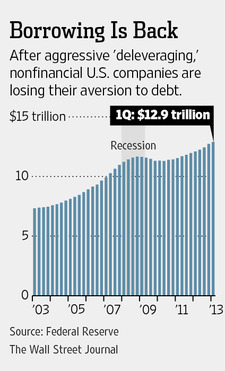
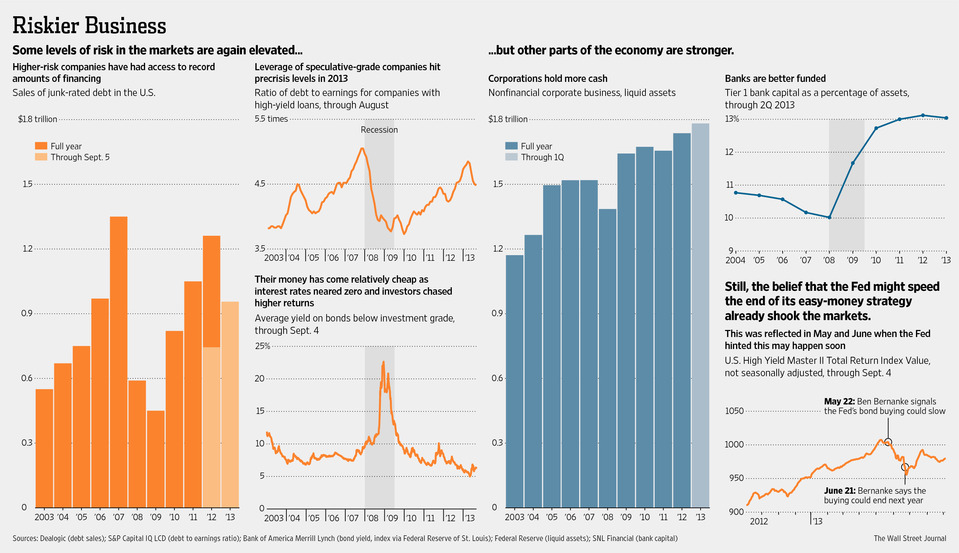
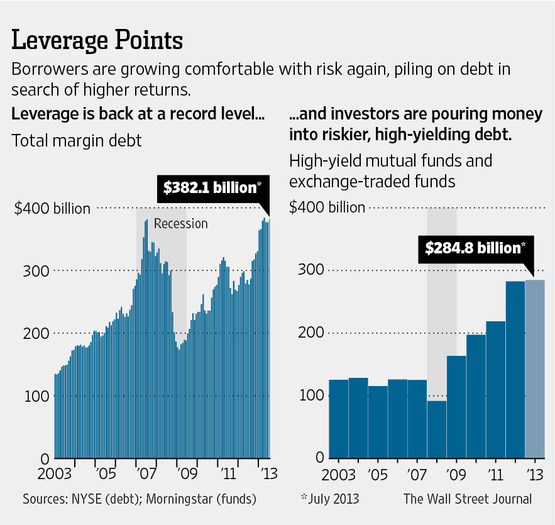
Financial Crisis Anniversary: For Corporations and Investors, Debt Makes a Comeback

Updated September 5, 2013, 9:38 p.m. ET

Financial Crisis Anniversary: For Corporations and Investors, Debt Makes a Comeback

JAMES STERNGOLD and MATT WIRZ

P1-BM982_LEVERA_NS_20130905190010 P1-BM983A_LEVER_G_20130905184209 P1-BM991_LEVERA_G_20130905183304 P1-BM985B_STAND_G_20130905202119

Oil worker Jeremy Barnett positions a pipe Wednesday at a well site near Hennessey, Okla., that belongs to Gastar Exploration, which financed the site’s purchase with junk bonds. Looking back, J. Russell Porter said his company was “almost at death’s door” when the U.S. economy hit bottom. With credit markets near frozen, he said, Gastar Exploration in 2009 couldn’t find banks or investors willing to provide the $35 million the oil-and-gas producer needed to refinance its crushing debt. Read more of this post

The Next Emerging Market Crisis

SEPTEMBER 5, 2013, 12:01 AM

The Next Emerging Market Crisis

By SIMON JOHNSON

Simon Johnson, former chief economist of the International Monetary Fund, is the Ronald A. Kurtz Professor of Entrepreneurship at the M.I.T. Sloan School of Management and co-author of “White House Burning: The Founding Fathers, Our National Debt, and Why It Matters to You.”

Do the world’s middle-income countries – known in the investment business as “emerging markets” – face a serious risk of crisis? If such a crisis unfolds in one country, could there be contagion, with panic spreading around the world? My answer is a cautious “no” on both questions. But it would be a mistake to dismiss or ignore these questions, in part because they are being asked by smart people in financial markets and in part because sometime in the not-too-distant future the answer could be a decisive “yes” – with disastrous consequences. There are three main sources of concern. Read more of this post

Shiller Warns of Housing Bubble in Brazil After 225% Surge

Shiller Warns of Housing Bubble After 225% Surge: Brazil Credit

Robert Shiller, who predicted the collapse of the U.S. housing market, is warning that a bubble is emerging in Brazil at a time when a sluggish economy and persistent inflation are eroding investor confidence. Since January 2008, home prices in Sao Paulo have soared 181 percent and jumped 225 percent in Rio de Janeiro, according to the FIPE Zap index. That’s as much as twice the increase in rent prices, signaling that the housing market has become overheated, according to Shiller, a Yale University professor who helped create the S&P/Case-Shiller Index (SPCS20) of U.S. home prices, which has dropped 13.7 percent since 2007. Read more of this post

London’s extraordinary lead in FX; London accounted for almost 41 per cent of global FX turnover vs 19% for US, 5.7% for Singapore

London’s extraordinary lead in FX

Paul Murphy

| Sep 05 14:43 | 4 comments | Share

The triennial central bank survey of foreign exchange and derivatives market activity from the BIS is out. FX details are here and OTC IR derivatives are here. Oh, and the Bank of England’s parochial summary is here. But if you are interested in how financial centres stack up against each other you’ll need to consult this table: London accounted for almost 41 per cent of global FX turnover at the survey point (April this year). That compares with 19 per cent for the US and 5.7 per cent for Singapore, the third largest financial centre as far as FX goes. London’s dominance is even more extreme when it comes to IR derivatives.

Screen-shot-2013-09-05-at-2.24.32-PM Read more of this post

Latest bond market rout unhinges U.S. short-term yields

Latest bond market rout unhinges U.S. short-term yields

8:08pm EDT

By Richard Leong

NEW YORK (Reuters) – The punishing sell off in the U.S. Treasury market has taken a surprising turn, with yields on shorter maturities getting swept higher at a startling pace. The rise defies a widely held view that they would remain anchored at historic lows by the Federal Reserve’s pledge to keep a lid on short-term rates. In what some see as investors second-guessing the Fed’s resolve, the 2-year Treasury note yield on Thursday jumped above 0.50 percent for the first time since June 2011. Read more of this post

JPMorgan to stop making student loans: company memo

JPMorgan to stop making student loans: company memo

7:05pm EDT

By David Henry

NEW YORK (Reuters) – JPMorgan Chase & Co (JPM.N:QuoteProfileResearchStock Buzz) has decided to get out of the student loan business, after the biggest U.S. bank concluded that competition from federal government programs and increased scrutiny from regulators had limited its ability to expand the business. Read more of this post

China Cash Crunch 2: Just When You Thought It Was Safe to Go Back in the Markets

September 5, 2013, 2:15 PM

China Cash Crunch 2: Just When You Thought It Was Safe to Go Back in the Markets

Could June jitters in China’s money market be followed by a September shudder? The causes of the June cash crunch that pushed short-term borrowing rates close to 30%, triggering a sell-off in the mainland’s equity and bond markets, were complex. But analysts break it down into five main factors. Some of them look set to return.

OB-YU154_ccrunc_P_20130905020908

Read more of this post

Bill Gross latest monthly: “Why invest in financial or real assets if bond prices could only go down, and/or stock prices could no longer be pumped up via the artificial steroids of QE?”

September 2013

Seventh Inning Stretch

William H. Gross

They say that reality is whatever you wish it to be and I suppose that could be true. Just wish it, as Jiminy Cricket used to say, and it will come true. Reality’s relativity came to mind the other day as I was opening a box of Cracker Jacks for an afternoon snack. That’s right – I said Cracker Jacks! I can’t count the number of people who have told me during the seventh inning stretch at a baseball game to make sure I sing Cracker Jack (without the S) because that’s what the song says. I care not. No one ever says buy me some “potato chip” or some “peanut.” How about a burger and some “french fry?” In all cases, the “s” just makes it flow better. My reality is a box of Cracker Jacks, and I think little sailor Jack on the outside of the box would be nodding his approval if he could ever come to life, which maybe he can if the stars are aligned and reality is whatever we wish it to be. Read more of this post

Cheap Diving Lures Singaporeans as Ringgit Falls: Southeast Asia

Cheap Diving Lures Singaporeans as Ringgit Falls: Southeast Asia

The ringgit’s descent to a 15-year low against the Singapore dollar is luring tourists and property-buyers from the city-state, providing relief as Malaysia’s economic growth slows.

In the past three months, the ringgit has lost 5.8 percent against the greenback and 4.1 percent versus the currency of Singapore, which accounted for 52 percent of overseas visitors last year. Malaysia’s current-account surplus shrank 70 percent in the second quarter, while Singapore’s widened 28 percent, helping fuel a selloff in the nation’s assets by overseas investors preparing for the Federal Reserve to reduce stimulus. Read more of this post

Money Fund Lehman Moment Lurks as New Protections Stall

Money Fund Lehman Moment Lurks as New Protections Stall

A year ago, when opposition from the asset-management industry killed her plan to make money-market mutual funds safer, U.S. Securities and Exchange Commission Chairman Mary Schapiro looked to Timothy Geithner, then the Treasury Secretary, to tackle “one of the pieces of unfinished business from the financial crisis.” It remains unfinished.

As Schapiro and Geithner prepared to leave government toward the end of 2012, the effort started anew to make the $2.6 trillion money-fund industry less likely to disrupt global financial markets. Norm Champ, a Harvard University-trained lawyer and the SEC’s top regulator of mutual funds, canvassed the remaining four commissioners, seeking to find common ground on which new rules could be built after Schapiro failed to corral enough votes to push her plan forward. Read more of this post

Australia Gold Coast Homes at 50% Below 2010 Lure Buyers

Australia Gold Coast Homes at 50% Below 2010 Lure Buyers

After sitting on the sidelines for two years watching home prices plummet, Rina Poke bought her ninth investment property in Australia’s Gold Coast for A$121,000 ($110,388), beating another buyer after a frantic round of bidding. “This is definitely the time to buy,” Poke, a 44-year-old sales manager at World Gym in the Gold Coast suburb of Ashmore, said after the auction on Aug. 8 at which 16 properties were offered. “Interest rates are at an all-time low, it’s the bottom of the market and prices are on their way up.” Read more of this post

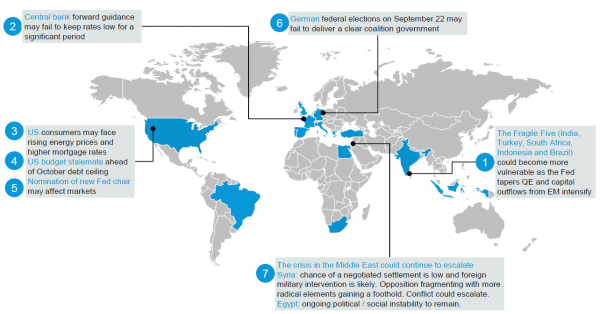
Mapping The 7 “Risk” Horsemen Of The Sept-ocalypse

Mapping The 7 “Risk” Horsemen Of The Sept-ocalypse

Tyler Durden on 09/04/2013 21:50 -0400

Ahead of September, historically the worst month for stocks, Deutsche Bank notes that volatility has picked up and corporate bond issuance has slowed. There are several possible risks over the next few weeks that could trigger a further escalation in market volatility

20130903_DB7_1_0

Via Deutsche Bank,

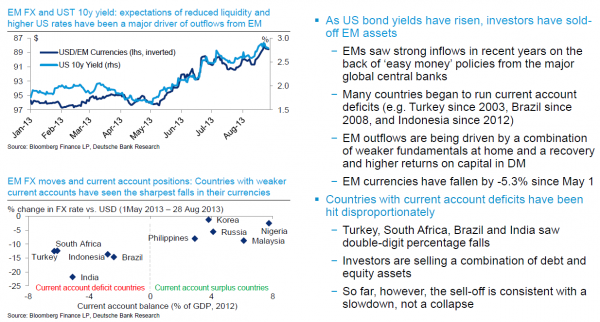
1. Emerging markets could become more vulnerable as the Fed tapers QE and capital outflows from EM intensify

20130903_DB7_2_0 Read more of this post

Green Mountain is betting consumers want to get soup from the same machine that brews their morning joe

Updated September 4, 2013, 7:14 p.m. ET

Maker of Coffee Pods Adds New Flavor: Soup

Green Mountain, Campbell to Introduce Packets for Broth

ANNIE GASPARRO

Green Mountain Coffee Roasters Inc. GMCR +1.34% is betting consumers want to get soup from the same machine that brews their morning joe. The company on Wednesday announced a deal with Campbell Soup Co.CPB +0.40% to sell K-Cups for Green Mountain’s Keurig machines that will brew a cup of chicken broth. The K-cups will come with packets of dried noodles and vegetables to mix in. The deal marks Green Mountain’s first attempt to expand its single-serve coffee brewers beyond beverages. Read more of this post