Japan Fishermen Reject Release of Fukushima Water to Ocean

Tepco Irradiated Water Find May Signal Problem for Bypass Plan

Tokyo Electric Power Co. (9501) found irradiated water near a storage tank that leaked last month at the Fukushima plant, complicating its plan for a pipeline to cut the volume of radioactive water it’s forced to manage. Inspectors found 650 becquerels per liter of beta radiation, which includes the contaminant strontium-90, Mayumi Yoshida, a spokeswoman for the utility known as Tepco, said today by phone. That’s more than 21 times government safety guidelines covering sea water near the plant for strontium-90, which has been linked to bone cancer. Read more of this post

Announcing this year’s traditional autumn crisis

September 6, 2013 8:32 pm

Announcing this year’s traditional autumn crisis

By John Dizard

Emerging market worries replace the time-honoured eurozone crackup farce, finds John Dizard

So, summer is over and everyone in the money world is getting ready for the traditional autumn crisis. Of course we will have the, now time-honoured, eurozone crackup farce. Show times will be set and the cast members announced after the German election in two weeks, ready for the IMF-World Bank meetings in mid-October. There may, though, be something Different This Time. You will notice that after the spring and summer market hiccups and corrections, a couple of asset classes are not only coughing, but coughing up some blood. Emerging market-traded debt and equities, even after last week’s little rally, have continued to lose international investors’ cash and confidence. Read more of this post

Bogged-Down Banking Fight Leaves EU Vulnerable to Relapse

Bogged-Down Banking Fight Leaves EU Vulnerable to Relapse

Europe’s march toward a banking union began in the early morning hours of June 29, 2012, during an overnight summit that pitted Germany against Spain and Italy over their plea for more help against the raging debt crisis. The 13 1/2-hour meeting resulted in a deal that introduced the possibility of aid to banks from the euro firewall fund. In return, leaders said the European Central Bank should take over financial supervision in the 17-nation currency bloc. Read more of this post

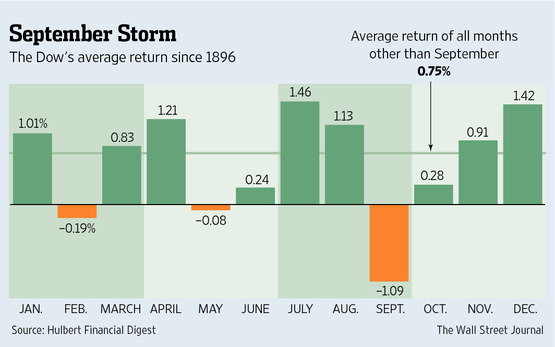
It’s well known that September has been the worst month, on average, for stocks. But no one has come up with a plausible explanation for why that is.

Updated September 6, 2013, 6:25 p.m. ET

How to Play the September Effect

It’s well known that September has been the worst month, on average, for stocks. But no one has come up with a plausible explanation for why that is.

MARK HULBERT

BF-AF719_HULBER_G_20130906153603

Stock-market aficionados know that the average September over the past 100 years has been terrible for stocks. But this record, in and of itself, isn’t a good reason to sell all your stocks and leave the money in cash this month. That is because there appears to be no convincing explanation for why equities have performed poorly in September. So there is a good chance September’s dismal historical record is just a random fluke that won’t persist. Read more of this post

Mafia hurt by asset seizures but still too strong to beat

Mafia hurt by asset seizures but still too strong to beat

11:47am EDT

By Barry Moody

NAPLES, Italy (Reuters) – Syringes litter the floor of an abandoned school in the crime-plagued Scampia district of northern Naples, alongside tin foil used for crack cocaine, a filthy mattress and piles of clothing. What was once a classroom is smeared with human waste and Coca Cola bottles filled with urine are stacked in one corner, alongside an abandoned children’s toy. For years desperate addicts lived in the school, where the local mafia or Camorra sold hard drugs from a counter. Now the building is part of a nationwide campaign to use confiscated gang assets to persuade youths from sink estates like Scampia that there is an alternative to drugs and working for the mob. Read more of this post

Malaysia Risk Tops Philippines on Najib Budget Gap

Malaysia Risk Tops Philippines on Najib Budget Gap

Malaysia’s default risk climbed above that of the Philippines for the first time as Prime Minister Najib Razak seeks to avoid a debt-rating cut, while his counterpart pitches for upgrades. Contracts insuring Malaysian bonds against non-payment rose 63 basis points this year to 141, compared with an advance of 33 to 139 for its lower-rated neighbor, according to data provider CMA. Malaysia’s 10-year ringgit yield jumped 44 basis points to 3.92 percent, 16 basis points higher than the rate on similar-maturity Philippine notes, data compiled by Bloomberg show. Read more of this post

M’sia debt ratio nears ‘worrying levels’ and near the country’s mandated debt ceiling of 55 per cent of GDP: BOA; In the 1960s, the limit was made law by then-finance minister Tan Siew Sin to ensure fiscal prudence

PUBLISHED SEPTEMBER 07, 2013

M’sia debt ratio nears ‘worrying levels’: BOA

S JAYASANKARAN BTWORLD@SPH.COM.SG

A US bank has warned that Malaysia’s ratio of public debt to gross domestic product (GDP) “is approaching worrying levels”. In a report yesterday, Bank of America Merrill Lynch (BOAML) said that the country’s debt-to-GDP ratio had risen to 54.6 per cent at the end of the second quarter, from 53.8 per cent in the first quarter. If BOAML’s estimate is right, the figure is just shy of the country’s mandated debt ceiling of 55 per cent of GDP. In the 1960s, the limit was made law by then-finance minister Tan Siew Sin to ensure fiscal prudence. Read more of this post

To Reform or Not Reform?—Echoes of the Late Qing Dynasty

To Reform or Not Reform?—Echoes of the Late Qing Dynasty

A ChinaFile Conversation

ORVILLE SCHELL, JOHN DELURY, JEFFREY WASSERSTROM, PETER C. PERDUE, JOSEPH W. ESHERICK, ROBERT KAPP

Orville Schell:

It is true that China is no longer beset by threats of foreign incursion nor is it a laggard in the world of economic development and trade. But being there and being steeped in an atmosphere of seemingly endless political and economic tension where questions of how far the leadership is willing (able?) to go in making reforms does make one think back to the end of the Qing, China’s last dynasty, during its waning years at the end of the 19th century. While the analogy is not perfect, one is left to ponder whether Party General Secretary Xi Jinping might end up being the Empress Dowager Cixi of the Communist era, a victim of the same wager: Fail to reform rapidly enough and risk stasis. Reform too rapidly and risk instability and even upheaval. Read more of this post

‘Most Expensive Bed in the World’ Now Sold in Beijing; You’re bound to get a good night’s sleep on this 1.2 million RMB bed, unless you’re footing the bill

‘Most Expensive Bed in the World’ Now Sold in Beijing

09-05 16:27 Caijing

You’re bound to get a good night’s sleep on this 1.2 million RMB bed, unless you’re footing the bill

113264211

Ever heard the saying ‘you’re better off putting your money under your mattress’? Well, this probably isn’t exactly what they meant. Still, with China’s luxury product market booming – and, if this launch is anything to go by, bigger than ever – who needs to be frugal? The headline-grabbing ‘Royal State Bed’, priced at 125,000 GBP (1,186,600 RMB), is the latest in a series of models being introduced to the Chinese market by esteemed British brand Savoir Beds. Originally exclusive bed makers for London’s prestigious Savoy Hotel, Savoir has over a century of experience giving its customers a sound night’s sleep. Read more of this post

The capital-freeze index: Which emerging markets are most vulnerable to a freeze in capital inflows?

The capital-freeze index: Which emerging markets are most vulnerable to a freeze in capital inflows?

Sep 7th 2013 |From the print edition

20130907_overall2

*Based on current-account balance, credit growth, short-term gross external debt and external debt payments as % of reserves, and financial openness

THE risk of an abrupt end to capital inflows is now a worry for much of the emerging world. Some places are more vulnerable than others. A large current-account gap implies lots of net borrowing from abroad, which could presage a credit crunch if funding dries up. A high level of short-term external debt relative to a government’s stock of reserves means an economy lacks the means to tide borrowers through temporary difficulties. Rapid credit growth often signals overstretched firms and overvalued asset prices. A more open financial system may boost growth in the long run, but it also makes it easy for capital to flood out fast. Read more of this post

Farming as rocket science: Why American agriculture is different from the European variety

Farming as rocket science: Why American agriculture is different from the European variety

Sep 7th 2013 |From the print edition

20130907_USD000_0

BEFORE growing up to become farmers, a startling number of America’s rural kids are taught how to build rockets. Every year rural skies fill with mini-missiles built by children. The largest fly hundreds of feet, carrying altimeters, parachutes and payloads of eggs. Baseball diamonds are popular launch sites, as are alfalfa fields: the latter tend to be large and, compared with other crops, alfalfa tolerates a fair bit of trampling. All this tinkering and swooshing explains a lot about American farms. Read more of this post

What happened to biofuels? Energy technology: Making large amounts of fuel from organic matter has proved to be more difficult and costly than expected

What happened to biofuels? Energy technology: Making large amounts of fuel from organic matter has proved to be more difficult and costly than expected

Sep 7th 2013 |From the print edition

SCIENTISTS have long known how to convert various kinds of organic material into liquid fuel. Trees, shrubs, grasses, seeds, fungi, seaweed, algae and animal fats have all been turned into biofuels to power cars, ships and even planes. As well as being available to countries without tar sands, shale fields or gushers, biofuels can help reduce greenhouse-gas emissions by providing an alternative to releasing fossil-fuel carbon into the atmosphere. Frustratingly, however, making biofuels in large quantities has always been more expensive and less convenient than simply drilling a little deeper for oil. Read more of this post

The hopes, fears and worries of Europe’s quest for renewable energy

The hopes, fears and worries of Europe’s quest for renewable energy

Sep 7th 2013 |From the print edition

20130907_EUD000_0

SUNDAY June 16th this year was a Goldilocks sort of day across Germany, not too hot but not too cool, with bright sunshine and a reasonable offshore breeze. Just right for Germany’s solar panels and wind turbines to produce, at their peak, a record 60% of Germany’s electricity on a slow weekend. But France and Belgium also had lots of nuclear power that could not easily be cranked down. So for several hours, generating companies had to pay customers to take their surplus power. Read more of this post

This land is whose land? A new law may do little to break India’s land-acquisition logjam

This land is whose land? A new law may do little to break India’s land-acquisition logjam

Sep 7th 2013 |From the print edition

UNDER a bodhi tree, their brightly coloured saris draped over their heads, some 500 women brave the midday heat just outside the pretty and rather prosperous village of Dhinkia. Just a few hundred metres of rolling sand dunes from the sea, Dhinkia, in the eastern Indian state of Odisha (formerly Orissa) is a hub of protest. The women, one from every village family, are staging the village’s daily dharna, a sit-in. Sisir Mohapatra, a former sarpanch or village head, makes a rousing speech. He seems respected, though his police record would suggest he is a mafia don: he says he faces 35 criminal charges, and of his 60-strong extended family in Dhinkia, 40 are also wanted by the law. They claim that the charges are all trumped up. Their real crime is to oppose the biggest single foreign-investment project India has ever attracted. Read more of this post

China’s banks are hogging the country’s market earnings, and that spells trouble; A stronger service sector is crucial to “rebalancing” the economy away from investment-fueled growth, but not if it’s driven by bad lending.

China’s banks are hogging the country’s market earnings, and that spells trouble

By Gwynn Guilford @sinoceros September 5, 2013

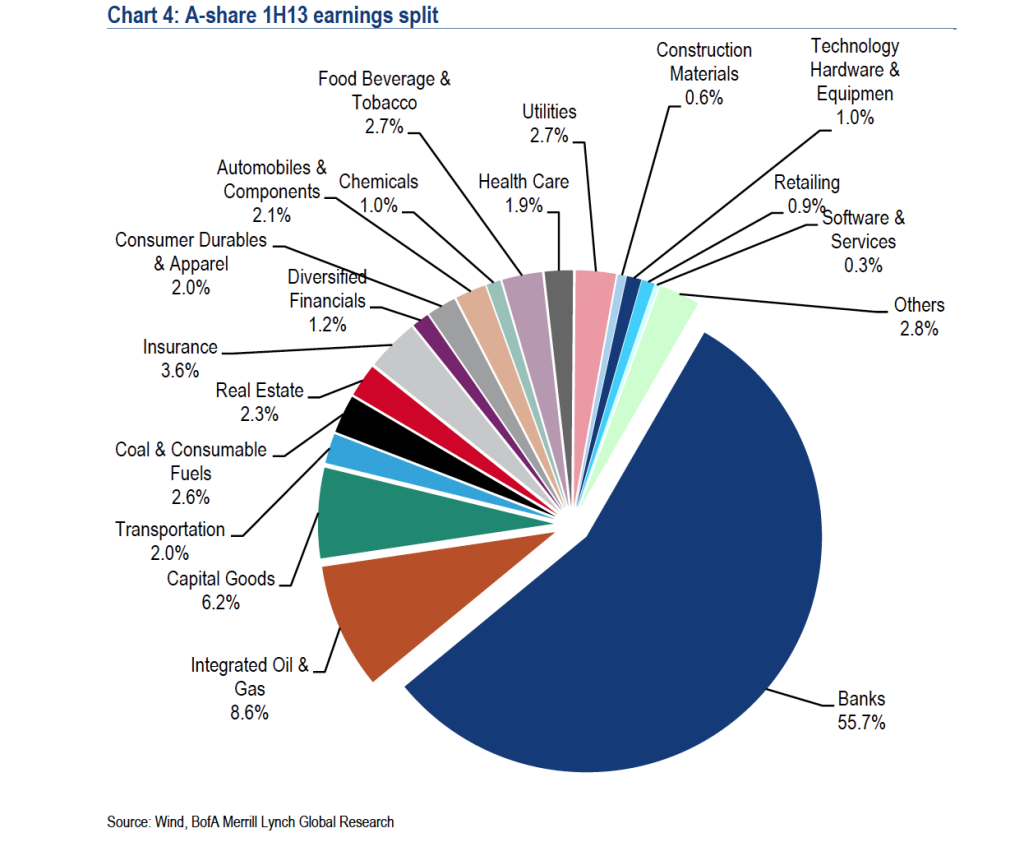
Considering China’s massive debt problem, investors might be wary of the country’s banking sector. But relax: Chinese banks are doing just peachy. In fact, as David Cui, China strategist at BofA Merrill Lynch, flags in a note today, “banks alone accounted for 56% of total market earnings” of mainland-listed companies. Here’s a look at that:

bofa-merrill-lynch-banks-a-shares-sep-4

​Cui doesn’t necessarily think this is a good thing. “This large and rising share is unhealthy,” he and the BofA Merrill Lynch China strategy team wrote in a related note. More evidence of China’s engorged banking sector came out a few days ago, when the China Enterprise Confederation, an advocacy group for Chinese enterprises, reported that, of China’s top 500 service-sector companies, the country’s 39 leading banks generated 68% of profits so far in 2013. The surge in banking profits helped China’s service sector eclipse that of the top 500 manufacturers for the first time in the history of CEC’s analysis. The profits of the 268 manufacturing companies among China’s top 500 companies fell nearly 18% in 2013, hitting 438 billion yuan ($71 billion) (link in Chinese) in H1 2013. That compares with the 39 top banks’ 1.04 trillion yuan in profits. A stronger service sector is crucial to “rebalancing” the economy away from investment-fueled growth, but not if it’s driven by bad lending. The CEC’s vice president, Li Jianming, considers the trend a bad omen. He compares China’s ballooning banking sector to that of the US; America’s financial industry accounts for something like 30% of operating profits. Read more of this post

China’s Yunnan Province ‘Busted’ For Fake Data; Exaggerated 2013 Output By Over 150%

Chinese Province ‘Busted’ For Fake Data; Exaggerated 2013 Output By Over 150%

Tyler Durden on 09/05/2013 09:39 -0400

Still believe that China’s PMI is above 50 and suggesting a global growth expansion? Still believe in Santa and the Tooth Fairy? Well, none other than China’s own National Bureau of Statistics has been forced to admit that at least one of its major provinces has dramatically overstated industrial output. As Sina reports, according to a NBS report, the government in China’s Yunnan province had coerced local companies to report inflated industrial output value, resulting in artificially high economic figures. With government leadership promotions driven by the performance of economic numbers in each province, it should hardly be surprising but the scale of the fraud is remarkable. In 2012, one county in Yunnan province reported CNY6.34 billion in output while audits showed only CNY 2.82 billion and in the first half of 2013, Yunnan published CNY 2.75 billion in output while audits showed a mere CNY1.06 billion! The province was also found to have faked investment data.

Chinese county’s fake economic data exposed

2013-09-05 11:54:36 GMT2013-09-05 19:54:36(Beijing Time)  Xinhua English

BEIJING, Sept. 5 (Xinhua) — China’s National Bureau of Statistics (NBS) on Thursday announced it had uncovered a serious case involving the faking of economic data by a county government in southwest China’s Yunnan Province. According to the NBS’s publicized report, the government of Luliang had coerced local companies to report inflated industrial output value, resulting in artificially high economic figures. Twenty-eight sampled local companies reported a total of 6.34 billion yuan (1.03 billion U.S. dollars) in industrial output value in 2012; however, the actual value was only 2.82 billion yuan, based on initial calculation, according to the report. Similarly, 25 sampled local companies reported 2.74 billion yuan of industrial output value in the first half of 2013, but the NBS initially verified the actual value to be only 1.06 billion yuan. Meanwhile, the county was also found to have faked investment data. Companies complained that if they did not fraudulently report higher data, their reports would be returned by local government departments. They also said that fake reports would ensure they would enjoy favorable policies such as securing bank loans. The NBS said that the misconduct has seriously affected the authenticity and independence of company data. The NBS did not specify the reasons behind the county’s faking of data but it is a well-known fact that local government leaders are assessed for their performances based on economic data. Nice-looking data sheets mean promotion opportunities. In February 2012, the NBS launched a unified data collection system through which companies can send their data directly to the government’s statistics center or authorized provincial branches, in an effort to ensure the authenticity of official economic data and dispel discrepancies in this field. The scheme covers a total of 700,000 major enterprises, which contribute about 80 percent of the country’s GDP. However, many other small and medium-sized companies as well as individual businesses are not included.

China’s Regulators Wary of Interbank Lending to transfer loans off their balance sheet

Updated September 5, 2013, 8:07 a.m. ET

China’s Regulators Wary of Interbank Lending

RICHARD SILK

China’s regulators are on the lookout for risks posed by the rapid growth of interbank lending, a vice governor of the central bank said Thursday. The interbank market all but seized up and interest rates rose to almost 30% in late June, after capital outflows exacerbated a seasonal spike in liquidity demand. The People’s Bank of China proved reluctant to supply cash to the market, surprising an industry that had gotten used to regular liquidity support. “The rapidly expanding interbank market has brought new challenges for implementing monetary policy and avoiding financial risks,” said Hu Xiaolian at a conference in Beijing. “For example, some banks have been using the interbank market to transfer loans off their balance sheet.” Read more of this post

Cheung Kong Group Denies Li Ka-shing Pulling back from China and HK

Cheung Kong Group Denies Li Ka-shing Pulling back from China

09-06 10:34 Caijing

Guo Ziwei, a Cheung Kong director, called the shift a cautious investment decision by “putting eggs in more than one basket.”

Board of director of Cheung Kong Group, the leading HK-based multi-national conglomerate, has denied its chairman Li Ka-shing is giving up on investments in China following reports of his groups selling Chinese assets while shopping in Europe. Li’s conglomerate, Hutchison Whampoa, has put the supermarket chain ParknShop in HK up for sale while the Cheung Kong is selling an office building in Shanghai for at least 6 billion yuan, triggering speculations that the Asia’s richest man is withdrawing investments in China, both the mainland and HK. Read more of this post

The Winners and Losers of China’s Anticorruoption Drive

September 6, 2013, 12:43 a.m. ET

The Winners and Losers of China’s Anticorruoption Drive

Probes Hurt Small, Private Companies More Than State-Owned Enterprises

WEI GU

AM-BA144_WEICOL_G_20130905061807

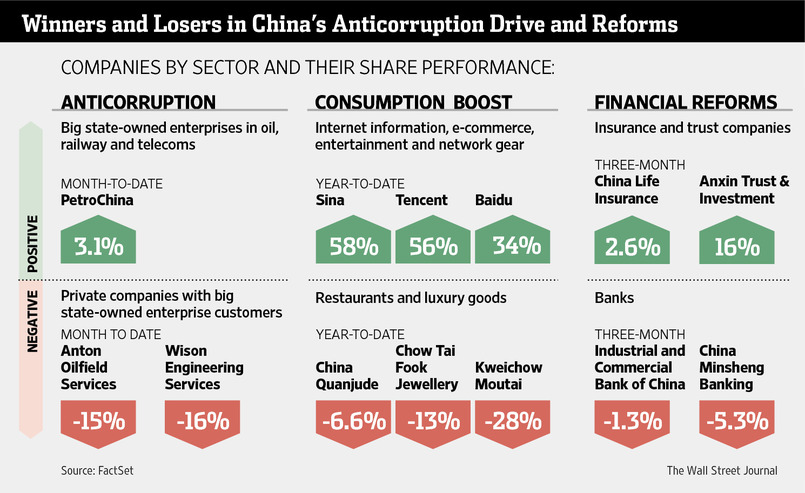
China’s anticorruption drive and the country’s economic overhaul expected this fall are likely to guide stock-market performance this year. But the winners and losers might surprise you. The investigation into high-ranking officials at China National Petroleum Corp. and its listed unit, PetroChina601857.SH -0.25% is likely to hurt small private companies that have tight business relationships with the state-owned enterprise more than it hurts Petrochina, some analysts say. PetroChina’s shares in Shanghai have hardly budged since news of the investigation broke last week. The same was true in past corruption probes into the banking and railway industries. The state-owned enterprises are powerful machines, and their favored position in China’s economy counts for more than whoever happens to be at the top. Read more of this post

Say what? China says 400 million can’t speak national language

Say what? China says 400 million can’t speak national language

6:49am EDT

BEIJING (Reuters) – More than 400 million Chinese are unable to speak the national language Mandarin, and large numbers in the rest of the country speak it badly, state media said on Thursday as the government launched another push for linguistic unity. China’s ruling Communist Party has promoted Mandarin for decades to unite a nation with thousands of often mutually unintelligible dialects and numerous minority languages, but has been hampered by the country’s size and lack of investment in education, especially in poor rural areas. Read more of this post

Powerful Oil Clique at Center of Chinese Probes; Some See Party Struggle Behind Investigations Targeting Central Pillar of State Sector

September 5, 2013, 7:50 p.m. ET

Powerful Oil Clique at Center of Chinese Probes

Some See Party Struggle Behind Investigations Targeting Central Pillar of State Sector

JEREMY PAGE, BRIAN SPEGELE and WAYNE MA

WO-AP304_COIL_G_20130905182708

BEIJING—In November of 2009, China’s internal security chief visited the Khartoum Refinery, a joint venture between the state-run Chinese oil company he used to run and the Sudanese government. By his side was one of his protégés, the then-head of China National Petroleum Corp., Jiang Jiemin. At the time, the visit by Zhou Yongkang—then one of China’s top nine leaders—seemed to encapsulate the international ambitions of China’s oil industry. It also was an illustration of the political clout Mr. Zhou wielded as patron of a powerful network of current and former oilmen in the Communist Party’s top ranks. Read more of this post

No Swift China Breakthrough Seen by Mao-to-Xi Scholar of Economy

No Swift China Breakthrough Seen by Mao-to-Xi Scholar of Economy

Zhang Shuguang, who’s studied China’s economy for more than 50 years, is skeptical that Communist Party leaders will unveil significant breakthroughs in an economic plan due in November. “It will mention rural reform, it will mention fiscal reform, it will mention financial reform — but obstacles hindering these reforms are still there,” Zhang, 73, an economist and senior fellow with the Chinese Academy of Social Sciences, said in an interview in Beijing last week. “Hopes for breakthroughs shouldn’t be too high.” Read more of this post

Mixed blessings for investors as China lets some firms recapitalize

Mixed blessings for investors as China lets some firms recapitalize

5:02pm EDT

By Lu Jianxin and Pete Sweeney

SHANGHAI (Reuters) – China’s shakey economic growth over recent months has helped persuade regulators to let select listed companies top up balance sheets through rights issues and private placements. The relaxation will ease the pain for some cash-strapped firms but equity analysts worry that the recapitalizations will draw money away from other scrips in an already wobbly stock market. Read more of this post

China for the first time joined the ranks of the most-traded international currencies, underscoring the rise of the world’s second-largest economy and the growth of the global foreign-exchange market.

Updated September 5, 2013, 7:53 p.m. ET

Milestone for Yuan Marks Rise of China

Yuan Rises to Ninth-Most-Actively-Traded Currency Globally

NICOLE HONG, CLARE CONNAGHAN and TOM ORLIK

EM-AX011A_YUAN_G_20130905090008

China for the first time joined the ranks of the most-traded international currencies, underscoring the rise of the world’s second-largest economy and the growth of the global foreign-exchange market. The Chinese yuan vaulted to ninth in the Bank for International Settlements’ latest report on foreign-exchange turnover, surpassing the Swedish krona and New Zealand dollar, among other widely used currencies. Trading in the Chinese currency, also known as the renminbi, has more than tripled over the past three years, to $120 billion a day in 2013, the BIS said, referencing survey data from April. Daily U.S. dollar trading in 2013 has averaged $4.65 trillion. Read more of this post

Bitcoin Mania Grips China; There are about 11.6 million Bitcoins in circulation and the total number that can be mined is capped at about 21 million; 10 million Bitcoins yet to be mined have a value of $1.44 billion

Bitcoin Mania Grips China

By Lulu Yilun Chen September 05, 2013

Sun Minjie, a 28-year-old Internet worker who lives in Beijing, has invested more than $3,000 in 796 Xchange, a website where people buy and sell shares of companies that deal in Bitcoins, the digital currency. The stock of 796 Xchange, which also deals in Bitcoin futures, returned about 57 percent from Aug. 1, when it started trading on the company’s website, through Sept. 3. The benchmark Shanghai Composite Index gained about 4.6 percent during the same period. “In China, the stock market, property, and bond market are all not so good, so people get really excited when they hear of a new investment that generates high returns,” says Peter Pak, head of trading at BOCI Securities in Hong Kong. Read more of this post

Scientists around the world are racing to find a solution to a deadly disease that is spreading through shrimp farms in South-east Asia, killing shrimp en masse and causing annual losses of more than US$1 billion

Race on to fight deadly shrimp disease

Friday, September 6, 2013 – 03:00

Nirmal Ghosh

The Straits Times

ASIA – -Scientists around the world are racing to find a solution to a deadly disease that is spreading through shrimp farms in South-east Asia, killing shrimp en masse. Earlier this year, the Global Aquaculture Alliance estimated that Early Mortality Syndrome (EMS), which emerged in China in 2009 and reached Thailand this year, is causing annual losses of more than US$1 billion (S$1.3 billion) across China, Vietnam, Malaysia and Thailand. Thailand, the largest shrimp exporter in the world with last year’s exports worth 95.3 million baht (S$3.8 million), is being increasingly hit by a virus-triggered toxin which kills the shrimp. Read more of this post

Asean economies facing sharp slowdown

Asean economies facing sharp slowdown

Paolo G. Montecillo, Philippine Daily Inquirer/ANN, Manila | Business | Fri, September 06 2013, 7:59 AM

Southeast Asian economies like the Philippines face a sharp deceleration in growth as a result of a credit crunch brought on by a shift in the monetary policy of the US Federal Reserve. The Institute of Chartered Accountants in England and Wales (Icaew) also warned that, although Southeast Asian economies have more stable economic foundations, the countries might also have to deal with the slowdown in China—Southeast Asia’s largest trading partner. Read more of this post

Coca-Cola, Kirin eye hot fizzy drinks; Kirin also intends to sell Kirin no Awa, a hot fruit-flavored drink, exclusively at convenience stores, targeting mainly women in their 20s and 30s

Coca-Cola, Kirin eye hot fizzy drinks

KYODO

SEP 5, 2013

COCA-COLA – Co. will release the U.S. beverage giant’s first hot carbonated drink Oct. 21, making Japan the first country to taste it. Kirin Beverage Co. is set to follow suit Nov. 5. Canada Dry Hot Ginger Ale took four years to develop, Tim Brett, president of Coca-Cola’s Japan unit, said at a press conference Wednesday. The product came about after Coca-Cola came up with a technique for containing bubbles when the drink is heated. The company is hoping the new drink will shore up sales in winter, when demand for cold sodas typically fizzles. The suggested retail price for a 180-milliliter can is ¥120. Kirin Beverage meanwhile intends to sell Kirin no Awa, a hot fruit-flavored drink, exclusively at convenience stores, targeting mainly women in their 20s and 30s, the company said. A 275-milliliter can will cost ¥130.


Lego Sales Rise on Asia Growth, Now 2nd Biggest Toymaker

Lego Sales Rise on Asia Growth, Now 2nd Biggest Toymaker

By Agence France-Presse on 6:19 pm September 5, 2013.
Danish toy maker Lego on Thursday reported an 18 percent rise in first-half net profit as revenue grew 13 percent, fuelled by growth in Asia as developed markets stalled. Lego, now the world’s second-biggest toy manufacturer behind Mattel of the US, said its largest markets North America, Europe and Japan had experienced a slow start to the year. “Despite this tough dynamic, our data indicates that consumer sales of Lego products for the first half of 2013 grew nine percent globally,” chief executive Joergen Vig Knudstorp said in a statement. Revenue of 10.3 billion kroner ($1.83 billion) was also boosted by low stocks of Lego products in many stores due to a strong holiday season last year. Read more of this post

Japan’s Suntory closing in on deal to buy GSK drinks brands Lucozade and Ribena for more than $1.6 billion

Suntory closing in on deal to buy GSK drinks brands: sources

8:58am EDT

By Anjuli Davies and Ben Hirschler

LONDON (Reuters) – Japan’s Suntory Beverage & Food (2587.T: QuoteProfileResearchStock Buzz) is in advanced talks to buy GlaxoSmithKline’s (GSK.L: Quote,ProfileResearchStock Buzz) Lucozade and Ribena drinks for more than 1 billion pounds ($1.6 billion), in a deal that would pre-empt an auction of the brands, two people close to the process said. A deal could be announced in the next few days, one of the sources said on Thursday. GlaxoSmithKline (GSK) – Britain’s biggest drugmaker – announced plans in April to sell Lucozade and Ribena, which are big sellers in Britain but lack global reach, as the company seeks to make its consumer health business more focused. Read more of this post