Abe Adviser Hamada Doubts Japan Economy Showing Real Improvement

Abe Adviser Hamada Doubts Japan Economy Showing Real Improvement

By Keiko Ujikane and Takashi Hirokawa  Sep 4, 2013

Koichi Hamada, an adviser to Prime Minister Shinzo Abe, said it was too early to know whether Japan’s economy has turned the corner under the economic policies known as Abenomics. “Various economic indicators, including investment data, are picking up, but I’m not sure if they show a meaningful improvement,” Hamada said at an event today at Bloomberg’s Tokyo office. Read more of this post

Nepal’s smugglers cash in on India’s love of gold

Updated: Wednesday September 4, 2013 MYT 1:41:07 PM

Nepal’s smugglers cash in on India’s love of gold

KATHMANDU: After a long drive from across the border in China, the white truck arrived in Nepal’s capital at dawn with a seemingly innocuous cargo of Chinese-made clothes. But hidden in a cylinder inside the vehicle’s front bumper was the latest haul of gold smuggled from Tibet – bars weighing some 35kg and worth several million dollars on the black market. Nepal’s police were waiting for the truck and its 24-year-old driver just inside the city, after tracking them for several days along the highway that connects Nepal with China. “We had been informed from our reliable source that a consignment of gold was on its way from Khasa (a border town in Tibet),” Uttam Kumar Karkee, a senior superintendent, who led the operation in July told AFP. Read more of this post

Bollywood Cuts Costs as Rupee Crisis Bites

Bollywood Cuts Costs as Rupee Crisis Bites

By Agence France-Presse on 6:01 pm September 3, 2013.
Mumbai. Bollywood producers have long been fond of filming in exotic foreign locations, but the spiralling Indian currency has seen spending on movie sets abroad drop by one third, according to a study released Monday. The Associated Chamber of Commerce and Industry of India (ASSOCHAM) said that the amount spent on Bollywood movies outside of India in the past four months has declined by 30 to 35 percent compared with the previous four-month period. Read more of this post

Hong Kong’s Needy Children Wait for Homes

Hong Kong’s Needy Children Wait for Homes

By Agence France-Presse on 5:40 pm September 4, 2013.
Hong Kong. Life could have turned out very differently for Mary, who like many other 12-year-old girls in Hong Kong enjoys shopping, music and going out with friends, while she dreams of one day travelling the world as a flight attendant. Mary was taken into foster care when she was three years old, her biological parents addicted to drugs and unable to look after her as they drifted in and out of prison. But she is one of the luckier ones in a city where a growing number of children are waiting for care as the number of couples who can afford to provide it is falling, social workers say, due to high property costs, a lack of space in the city and the fact that both partners often have to work to support a family. Read more of this post

Indonesia Faces Price Rise as Currency Weakens; At malls across Jakarta, a small Caffè Americano at Starbucks is up 9% since early August; taxi has raised minimum fares by more than 16%

Updated September 3, 2013, 7:41 p.m. ET

Indonesia Faces Price Rise as Currency Weakens

Weakening Currency After Fund Exodus Compounds the Problem

BEN OTTO

WO-AP261_INDOPR_NS_20130903175103

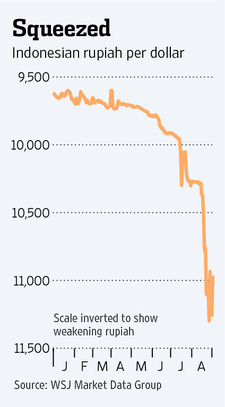
JAKARTA—Indonesia’s currency weakened to its lowest level in more than four years against the dollar Tuesday, underscoring the reality that consumers in Southeast Asia’s largest economy are facing after a harrowing summer slide: Inflation is taking hold and prices are rising. The rupiah has been in decline since last year, but an exodus of cash in the recent emerging-markets selloff led to a 6% slide in August alone. Meanwhile, prices were already beginning to increase after the government raised the cost of fuel this year, and a weaker rupiah has compounded the trend by making the country’s many imports more expensive. Recently, the government has tightened monetary policy, making concessions on growth in order to contain inflation. Read more of this post

Singapore’s Volatile Data Stump Professionals

September 4, 2013, 5:32 AM

Singapore’s Volatile Data Stump Professionals

By Gaurav Raghuvanshi

Last month, Singapore’s government announced the economy grew 3.8% on-year in the second quarter. But as late as June, economists polled by the city-state’s central bank were predicting growth of just 1.5%. Economists got it wrong on exports too: They predicted a nearly flat print in the second quarter, when exports actually fell 5.0%. The difference was even starker in the first quarter: Economists in March predicted exports would fall 0.5%, but in fact they shrank a whopping 12.5%. The Monetary Authority of Singapore polls economists at banks and research firms every quarter on key local data such as gross domestic product, exports, currency, inflation and employment. The results are released at the start of every quarter, with the second-quarter survey landing Wednesday. It turns out that the 20 or so economists who respond to the survey get it quite wrong, quite often. Read more of this post

Previous limited U.S. strikes were followed by unforeseen consequences

Previous limited U.S. strikes were followed by unforeseen consequences

6:01am BST

(Reuters) – President Barack Obama’s national security team is trying to make the case to sceptical U.S. lawmakers for a limited strike against the Syrian government over its alleged use of chemical weapons on August 21. Following are details of missile strikes and other limited military action taken by the United States over the past 30 years and what transpired afterwards: Read more of this post

IMF sees emerging economies vulnerable to U.S. tapering

Exclusive: IMF sees emerging economies vulnerable to U.S. tapering

11:14am EDT

By Gernot Heller

BERLIN (Reuters) – Advanced economies led by the United States will increasingly drive global growth while emerging countries are at risk of slowing due to tighter U.S. monetary policy, the International Monetary Fund said in a note obtained by Reuters on Wednesday. In the surveillance note, prepared for the Group of 20 meeting in St. Petersburg, the IMF urged strengthened global action to revitalize growth and better manage risks, warning that some downside risks have become more prominent. Read more of this post

Europe’s Auto Makers Poised to Lose $6.6 Billion in 2013 With Demand at 20-Year Low

September 4, 2013, 4:23 a.m. ET

Europe’s Auto Makers Poised to Lose $6.6 Billion in 2013 — Moody’s

Demand at 20-Year Low

GILLES CASTONGUAY

MILAN—Moody’s Investors Service Inc. expects four of Europe’s volume car manufacturers including Fiat SpA F.MI +9.06% and PSA Peugeot-Citroën SAUG.FR +0.42% to lose a combined €5 billion ($6.6 billion) in the region this year as demand falls to its lowest level in two decades. It would be the second year in a row that these manufacturers—Ford Motor Co.F +3.24% and General Motors Co.GM +2.69% being the other two—suffer such a loss at the operational level. Read more of this post

Singapore: Just sell. That was what an owner of an HDB executive mansionette in the north-east told his property agent last Thursday with new three-year wait for PRs to buy property

Sell at all cost

Wednesday, Sep 04, 2013

Ronald loh

The New Paper

SINGAPORE – Just sell. That was what an owner of an HDB executive mansionette in the north-east told his property agent last Thursday. In a bid to stabilise the property market here, the Government announced several major changes last Tuesday. The new measures were so significant that sellers are reducing their asking cash over valuation (COV) – the cash premium buyers pay for resale Housing Board flats. One of the measures was a three-year wait for newly-converted permanent residents (PRs) before they are allowed to buy resale HDB flats. Some sellers are panicking, five property agents told The New Paper on Sunday. Agents specialising in HDB flats said they have seen COVs plummet by up to $60,000 over the past few months and they expect the numbers to dip some more. Read more of this post

Are we ready for the next meltdown?

Are we ready for the next meltdown?

By Allan Sloan, senior editor-at-large   @FortuneMagazine August 30, 2013: 1:30 PM ET

Okay, folks. It’s been five years since Lehman Brothers failed, setting off a chain of unanticipated consequences that came within inches of melting down the world’s financial system. Had the Federal Reserve, other central banks, and the U.S. government not intervened and thrown trillions of dollars at the crisis to keep financial markets afloat, we would be talking about Great Depression II.

But rather than offering the conventional wisdom about what’s happened since Lehman filed for bankruptcy on Sept. 15, 2008, which is readily accessible in a zillion places, I’d like to offer some unconventional wisdom — at least I hope it’s wisdom — based on my 40-plus years of writing about business. My specialty is fiascoes and failures, which is why there’s a toy vulture hanging from my office ceiling, a mid-1980s Father’s Day present from my children. Read more of this post

Asia Services Set to Exceed Manufacturing as GDP Share

Asia Services Set to Exceed Manufacturing as GDP Share

Dinh Tu quit being a monk three years ago and worked in a yoga studio in Ho Chi Minh City to cater to a growing Vietnamese middle class who are finding new outlets for their money. These days, he’s selling insurance, too. “People in Vietnam have more to spend now,” said the 40-year-old agent for Tokyo-based Dai-ichi Life Insurance Co. “Because I’m no longer a monk, I have to worry about financial pressures, too. I can see that insurance is a good business.” As Tu and millions of other Asians switch from traditional occupations, farms and factories, the contribution of service industries to the region’s emerging economies is poised to exceed 50 percent for the first time, according to data compiled by Bloomberg from government statistics. The watershed marks Asia’s shift from its role as the world’s workshop with countries led by China concentrating on building domestic economies. Read more of this post

The prospect of the Pratt family taking part of their Visy packaging empire public has always tantalised the business community

James Thomson Editor

A very private family goes public: Pratt family’s investment guru Alex Waislitz to run listed group

Published 04 September 2013 11:04, Updated 04 September 2013 13:59

The prospect of the Pratt family taking part of their Visy empire public has always tantalised the business community, particularly the nation’s investment bankers. A few years ago, we got close when packaging group Pact, owned by Richard Pratt ’s daughter Fiona and her husband Raphael Germinder, looked at an IPO. But on Tuesday, it finally happened. Well, sort of. Alex Waislitz is set to become the non-executive chairman of listed cashbox Wentworth Holdings after his investment group Thorney struck a deal on a $50 million recapitalisation of the company. The business will be renamed Thorney Opportunities Ltd. The deal means Waislitz will manage the money of ordinary punters for the first time. Read more of this post

The Greek Yogurt Culture War; It’s Crowding Out Classic Flavors and Others in the Dairy Case; Bye Bye, Margarine

September 3, 2013, 7:22 p.m. ET

The Greek Yogurt Culture War

It’s Crowding Out Classic Flavors and Others in the Dairy Case; Bye Bye, Margarine

SARAH NASSAUER

PJ-BQ312_NOGREE_G_20130903195412

Culture wars are being waged at a supermarket near you, as traditional yogurt is getting the squeeze from upstart Greek-style brands. WSJ’s Sarah Nassauer joins Lunch Break. Photo: F. Martin Ramin for The Wall Street Journal. These are dark days for fans of regular yogurt. The creamy snack is being edged out on grocery store shelves by its thicker, tarter, higher-protein sibling, Greek yogurt. Over a third of the yogurt in a typical grocery store is now Greek, in varieties from low-fat to fruit-on-the-bottom to tubes for kids. Because shelf space is limited, the Greek squeeze means consumers have had to say goodbye to some varieties of traditional-style yogurt and more obscure flavors. (R.I.P. Stonyfield Farm’s Whole Milk White Chocolate Raspberry and Strawberry Acai flavors.) Pudding cups, margarine and other products with the misfortune of usually sitting near yogurt also are harder to find. Read more of this post

Texas Wines Take the Heat in $1.8 Billion Business; With 275 bonded wineries producing 3 billion gallons annually and $1.8 billion in sales, both climate and sales marketing have made it a struggle to compete with California, Oregon

Texas Wines Take the Heat in $1.8 Billion Business

Being the fifth largest wine grape and wine producing state in the U.S. might be worth boasting about, but Texas is not a state that takes fifth place lightly. With 275 bonded wineries producing 3 billion gallons annually and $1.8 billion in sales, Texas’s wine industry is still expanding. But both climate and sales marketing have made it a struggle to compete with California, Oregon, and other states for bragging rights. “Our state’s top vignerons are among the bravest, most intrepid and most tortured farmers on the planet,” Houston Chronicle wine columnist Dale Robertson wrote last month. “Late freezes, hailstorms and drought wreak constant havoc.” Read more of this post

Procter & Gamble is talking to retailers about plans for a new bargain version of its flagship Tide laundry detergent. Three years ago P&G scrapped a lower-priced Tide Basic, fearing cannibalization

Updated September 3, 2013, 7:12 p.m. ET

P&G to Test Waters Again on a Bargain Tide

Cheaper Liquid Detergents Are Growing; Company Scrapped Earlier Effort

PAUL ZIOBRO

Procter & Gamble Co. PG -0.18% is trying again with a lower-priced Tide. In a move that could set off price battles in the laundry aisle, Procter & Gamble is talking to retailers about plans for a new bargain version of its flagship Tide laundry detergent, people in the industry said. One person said the product may be a liquid detergent called Tide Simple, a name P&G considered when it tried a low-price Tide several years ago. It would be priced just above rival bargain brands, such as Church & Dwight Co.’s CHD -0.30% Arm & Hammer. P&G declined to comment. A decision to offer a lower-priced version of the premium brand carries the risk that buyers of regular Tide could trade down and stay there. Read more of this post

Dollar General Is Paying Its Way; Shareholders Should Be Concerned About Its Dwindling Edge Over Larger-Format Competitors

September 3, 2013, 5:45 p.m. ET

Dollar General Is Paying Its Way

Shareholders Should Be Concerned About Its Dwindling Edge Over Larger-Format Competitors

SPENCER JAKAB

MI-BY226_AOT_NS_20130903165408

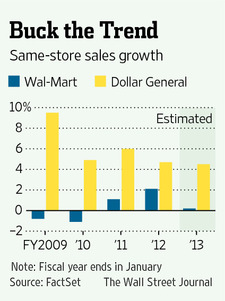
For retailers who obsess about a few cents here or there, there is nothing more painful than seeing an item walk out the door at a margin of negative-100%. Discussing a tepid fiscal first quarter, management at Dollar General Corp.DG -0.17% cited such “shrinkage” as a factor behind weaker margins. A euphemism for loss of inventory, mainly due to theft, it is a cost of doing business for a retailer found largely in low-income neighborhoods.  Read more of this post

Why Are Items Pricier in China? From iPads to Starbucks to ice cream and cars, the price of many goods is far higher in China than in many other countries. But consumers there are wising up

September 3, 2013, 7:43 p.m. ET

In China, Veil Begins to Lift on High Consumer Prices

Resistance to Prices Grows Amid New Ways to Comparison Shop

LAURIE BURKITT

BEIJING—In China, consumers pay nearly $1 more for a latte at StarbucksSBUX +1.53% than their U.S. counterparts. A Cadillac Escalade Hybrid Base 6.0 costs $229,000 in China, compared to just over $73,000 in the U.S. Welcome to China’s modern retail world, where the price of many goods is far higher than in many other countries, a disparity that is all the more stark considering the income differences. A basic iPad 2 is priced at $488 in China, where average per capita income is around $7,500. The same tablet is $399 in the U.S., where average per capita personal income totals $42,693. Clothing and other apparel is on average 70% more expensive for consumers in China than in the U.S., according to data from SmithStreet, which compared the prices of 500 items of 50 brands in both countries. Read more of this post

When a Beijinger Owns 1,000 License Plate Numbers to rent out for profit; Flawed public policy can only be avoided through transparent decision-making and the use of judicial review

09.03.2013 12:40

When a Beijinger Owns 1,000 License Plate Numbers

Flawed public policy can only be avoided through transparent decision-making and the use of judicial review

By Wang Yong

Beijinger Wang Xiuxia should be in the Guinness World Records book for holding 1,000 license plate numbers, equivalent to 5 percent of new Beijing numbers issued monthly. She rented them out for profit. The case, exposed in late August, involves a number of legal and public policy questions worth analyzing. Wang’s rental business had two models of operation. Before a purchase limit was enacted by the Beijing city government in 2011, she rented identity cards to people from outside Beijing so they could register license plates. After the purchase limit came into effect – a limit that requires locals to enter a lottery system to get a plate – she rented out plates under her own name. Read more of this post

State Council Counselor Xia Bin noted that results of the ongoing nationwide auditing of local government debt could be quite “striking”, with substantial part of debts having gone sour, proposes “bailout” package to deal with the problems

State Council Counselor Suggest Tough Ways Against Local Debt

09-04 15:33 Caijing

Xia Bin says Beijing should punish those who spends recklessly and lavishly on offical buildings.

A counselor of the State Council in China suggested tough ways in reining in local government’s addition to debt, including sales of government’s assets like the usually fancy office buildings. “Local governments who spend recklessly and extravagantly in office building, while shouldering high debt burden, should be ordered to move out from their luxurious offices….and sell them along with other good assets to repay debts,” Xia Bin, who is also honorary director of the Finance Institute of the State Council Development Research Center, told media on Tuesday. Read more of this post

New Chinese Luxury: Pairing Wine With Duck, Not Sprite

New Chinese Luxury: Pairing Wine With Duck, Not Sprite

By Bloomberg News  Sep 3, 2013

Can’t tell a Monet from a Van Gogh? Christie’s International’s China staff can help. Mixing a pricey Chateau Petrus or Chardonnay with Sprite? Sommeliers at Shanghai wine retailer Sarment will explain why not. As growth in China’s luxury industry slows and consumers turn more selective, high-end brands are boosting efforts to educate consumers on the finer points of haute couture and vintage wines to persuade them to pay up. Read more of this post

Don’t Trust a Chicken Nugget That’s Visited China; Would you willingly eat a chicken nuggets processed in a country that has no intention of meeting U.S. food-safety standards? Most Americans likely wouldn’t

Don’t Trust a Chicken Nugget That’s Visited China

Would you willingly eat a chicken nuggets processed in a country that has no intention of meeting U.S. food-safety standards? Most Americans likely wouldn’t.

That may explain why the U.S. Department of Agriculture waited until Friday — the day before a long holiday weekend — to announce that it had ended a ban on Chinese chicken imports by approving four Chinese poultry processors to ship processed (“heat-treated/cooked”) chicken to the U.S. The report on the approved poultry plants noted that the audit set out to “to determine whether the People’s Republic of China’s (PRC) food safety system governing poultry processing remains equivalent to that of the United States (U.S.), with the ability to produce products that are safe, wholesome, unadulterated, and properly labeled.” Needless to say, the Chinese plants passed. Read more of this post

Chinese local governments need cash so badly they’re beating, kidnapping and killing to get it

Chinese local governments need cash so badly they’re beating, kidnapping and killing to get it

By Gwynn Guilford @sinoceros 11 hours ago

Chinese local governments have taken on scary levels of debt—12.1 trillion yuan ($1.9 trillion), by some estimates. That’s scary for the central government, which will be on the hook to bail out any Chinese Detroits. But it’s scary for residents, too. Take, for example, Hong Xiaorou, a four-year-old girl bulldozed to death in Fujian province on August 29. Or Xu Haifeng, whose family members have been kidnapped on 18 separate occasions, as Reuters reports. Read more of this post

China PMI may not signal rising commodity demand: Clyde Russell

China PMI may not signal rising commodity demand: Clyde Russell

Tue, Sep 3 2013

(The author is a Reuters columnist. The opinions expressed are his own.)

By Clyde Russell

LAUNCESTON, Australia, Sept 3 (Reuters) – Commodity producers and traders have no doubt been cheered by the recent recovery in China’s key manufacturing sector, but the boost may be more to sentiment than actual demand. This is because there is a fairly weak correlation between movements in China’s official Purchasing Managers’ Index (PMI) and imports of key commodities such as crude oil, iron ore and copper. Read more of this post

China has a choice – short-term growth or sustainability; The elimination of a subsidy that encourages feckless borrowing is overdue

September 2, 2013 4:23 pm

China has a choice – short-term growth or sustainability

By Michael Pettis

The elimination of a subsidy that encourages feckless borrowing is overdue, says Michael Pettis

Years of artificially low interest rates have been key both to China’s rapid growth and to its notorious domestic imbalances. The role of financial repression – manipulating the financial system to divert money from savers to producers – in the Chinese growth model is widely recognised. But the improvement in the country’s interest rate structure is not. As a rule when nominal lending rates are broadly in line with nominal gross domestic product growth rates, the rewards of expansion are efficiently distributed between savers and users of capital. When they are substantially lower, however, as they have been in China for the past 30 years, net lenders – mainly household depositors – in effect pay a hidden subsidy to net borrowers. In China these include state entities, manufacturers, state-owned enterprises and real estate developers. Read more of this post

China ‘Catastrophe’ Hits 114 Million as Diabetes Spreads; China’s diabetes epidemic is worse than previously estimated – much worse

China ‘Catastrophe’ Hits 114 Million as Diabetes Spreads

By Bloomberg News  Sep 3, 2013

China’s diabetes epidemic is worse than previously estimated — much worse. The most comprehensive nationwide survey for diabetes ever conducted in China shows 11.6 percent of adults, or 114 million, has the disease. The finding, published yesterday in the Journal of the American Medical Association, adds 22 million diabetics, or the population of Australia, to a 2007 estimate and means almost one in three diabetes sufferers globally is in China. Read more of this post

As Return of Chinese Gov’t Bond Futures Nears, Experts Pore over Details; Nearly two decades after market was suspended because of short sellers’ scam, traders and analysts wonder if new approach will protect investors

09.03.2013 17:09

As Return of Gov’t Bond Futures Nears, Experts Pore over Details

Nearly two decades after market was suspended because of short sellers’ scam, traders and analysts wonder if new approach will protect investors

By staff reporters Fan Junli, Zheng Fei and Cao Wenjiao

(Beijing) – Securities traders and analysts are going over the details of the new government bond futures that will hit the market soon – after a hiatus of nearly two decades – to see if they can better protect investors against fraud and other risks. The first batch of three contracts, all based on five-year government bonds, will be opened for trading from September 6 on the China Financial Futures Exchange (CFFEX), the securities regulator said last month. Read more of this post

“Tiny Times 2,” a popular film about four Shanghai students who celebrate the luxe life, is causing consternation in China

September 3, 2013

A Film-Fueled Culture Clash Over Values in China

By SHEILA MELVIN

TINY1-articleLarge-v2

“Tiny Times 2,” a film about four Shanghai students who celebrate the luxe life, is causing consternation in China

BEIJING — Amid the usual crop of Western-imported blockbuster fare (see “Jurassic Park 3D,” “Monsters University,” “Pacific Rim”), two homegrown movies about four fashion-obsessed girlfriends at a Shanghai university have unexpectedly made their way to the top of China’s box office here this summer. The first, “Tiny Times 1,” beat Hollywood’s “Man of Steel” when it opened here in late June, grossing more than $43 million its first week, according to Entgroup, a film industry research company. The sequel, “Tiny Times 2,” which opened on Aug. 8, grossed more than $47 million in its first three weeks. (“Tiny Times 1” opened in select North American markets in July, and its sequel opened in New York on Friday.) Ticket sales for both movies qualified them as major hits in China. Read more of this post

Tongyang Group is facing deeper financial trouble as it will have difficulty in rolling over maturing debts worth 200 billion won due in the coming months

2013-09-03 17:49

Tongyang burrows deeper into trouble

By Kim Tae-jong
Tongyang Group is facing deeper financial trouble as it will have difficulty in rolling over maturing debts worth 200 billion won due in the coming months. The situation became worse after two credit ratings agencies recently lowered their ratings on affiliates of the mid-tier conglomerate, following the issuance of corporate bonds worth 75 billion won by Tongyang Inc., the holding company of the group, on Aug. 29. With restructuring efforts delayed, the group’s affiliates have issued corporate bonds worth 576 billion won this year ― 426 billion won for Tongyang Inc. and 150 billion won for Tongyang Cement & Energy ― to secure liquidity for business operations and repayment of maturing corporate bills and bonds. Read more of this post

Subaru’s Anti-Crash Feature Lures Japanese Seeking Safety

Subaru’s Anti-Crash Feature Lures Japanese Seeking Safety

Inching forward in heavy traffic toward the ski slopes of Niigata, Japan, Tomohiro Azuma cursed as the car in front stopped suddenly, forcing him to slam on the brakes of his Subaru Legacy. “There was a voice in my head saying, ‘Damn, too late!’” Azuma, 46, said of the near-collision in February. “Then my car stopped with a jerk and for a moment I didn’t know what had happened.” The information technology manager from Tokyo had averted a pileup thanks to a feature called EyeSight, which stopped his car when the gap with the vehicle ahead became perilously small. The technology has helped Subaru build a reputation as a leader in safety — typically the domain of high-end brands like Mercedes-Benz and Volvo (VOLVB) — and buck falling sales in its home market. Read more of this post