Overseas Equity Investors Head to Japan for ‘Abenomics’ Clues

September 4, 2013, 12:31 PM

Overseas Equity Investors Head to Japan for ‘Abenomics’ Clues

By Kana Inagaki

Following a sleepy August, a record number of foreign investors are now flocking to Japan in search of fresh clues to whether “Abenomics” is still a good reason to buy Japanese stocks. While the stock-market rally from mid-November has recently flagged, with trading volumes low, foreign investors remain focused on whether Prime Minister Shinzo Abe’s economic policies can really lift the economy out of deflation. Both Japanese and foreign brokers are tailoring their investor conferences to address this increasing demand for a better understanding of Japanese politics by inviting members of Mr. Abe’s Cabinet and his close advisers as keynote speakers. Read more of this post

Kao’s Kanebo continued shipping skin-whitening cosmetics even after its top managers endorsed a decision to recall the products following consumer complaints of white blotches

Kanebo shipped cosmetics after recall decision

KYODO

SEP 3, 2013

Kanebo Cosmetics Inc. continued shipping skin-whitening cosmetics even after its top managers endorsed a decision to recall the products following consumer complaints of white blotches, sources said. The subsidiary of Kao Corp. delayed halting shipments for almost a week through July 4, when the company announced the recall, a delay that increased the number of people affected, the sources said Monday. Cosmetics retailers were alerted to the recall only on the day of its announcement. Read more of this post

Almost half of Japanese charitable foundations, some of which have sizable assets, think Abe will need to increase his economic stimulus measures to get the country onto a sustainable recovery path

Japan foundations see limited economic boost from Abenomics: survey

2:10am EDT

TOKYO (Reuters) – Almost half of Japanese charitable foundations, some of which have sizable assets, think Prime Minister Shinzo Abe will need to increase his economic stimulus measures to get the country onto a sustainable recovery path, according to a survey. A survey by Mizuho Securities of more than 400 such non-profit foundations, a relatively little known group of investors, also showed they were eager to boost foreign stocks while planning to cut holdings in structured notes and Japanese investment trusts called toshins. Read more of this post

Abe Seen Facing Stock Rout in Case of Suspending Japan Tax Rise

Abe Seen Facing Stock Rout in Case of Suspending Japan Tax Rise

Japanese shares could plunge 10 percent or more if Prime Minister Shinzo Abe fails to carry through on a plan to raise a sales tax in April. Postponing an increase would have a large and negative impact on Japan’s financial markets, said 22 of 32 economists in a Bloomberg News survey. JPMorgan Chase & Co. Senior Economist Masamichi Adachi said a delay could push stocks down 10 percent, wiping out $418 billion in market capitalization, while UBS AG Economist Daiju Aoki predicted a sell-off as steep as 12 percent in the Nikkei 225 Stock Average. Read more of this post

Once-Hot Indonesia Loses Allure as Prices Chill Buyouts

Once-Hot Indonesia Loses Allure as Prices Chill Buyouts (1)

By Klaus Wille September 04, 2013

Indonesia has lost much of its allure for private equity as steep valuations restrain buyouts in a country that two years ago was, in the words of one investor, “probably the sexiest destination in the emerging markets.” International private-equity firms have acquired stakes in four Indonesian companies this year, down from 10 in 2011 and seven last year, according to data compiled by Bloomberg and the Asian Venture Capital Journal. Total transaction values fell from $649 million for the nine deals in 2011 where terms were disclosed to $324 million for the six deals last year for which prices were available, the data show. Read more of this post

Low Cash, Slowing Sales: Double Whammy for Indonesia’s Retailers

Low Cash, Slowing Sales: Double Whammy for Indonesia’s Retailers

By Janeman Latul & Andjarsari Paramaditha on 1:01 pm September 4, 2013.
As Indonesia’s economy boomed in recent years, its retailers had a simple formula: open more stores. And more. And more. Minnows became leviathans. That strategy is now haunting them as the rupiah currency tumbles, inflation accelerates, interest rates rise and growth slows. The country’s three biggest retailers are in their weakest cash position since the 2008 global financial crisis, just as consumers are tightening their wallets. Strains on cash flow at Indonesia’s biggest high-end retailer Mitra Adiperkasa, its largest low-end department store group Ramayana Lestari Sentosa and top mid-tier retailer Matahari Department Store, along with interviews with shoppers and store managers, suggest a significant slowdown in consumer spending, the main engine of Southeast Asia’s biggest economy. Read more of this post

KPK Delves Into Public Servants’ Wealth, Begins Demanding Proof; Indonesia has about five million civil servants, some of whom live in conspicuous luxury way above that which could be afforded on their official incomes

KPK Delves Into Public Servants’ Wealth, Begins Demanding Proof

By Novianti Setuningsih & Carla Isati Octama on 11:05 am September 3, 2013.

By making proactive use of money laundering and anti-corruption laws, Indonesia’s graftbusters are managing to snare a greater number of corrupt officials, and just as importantly, return to the public purse a fortune in stolen funds. Prosecutors in corruption cases are comparing officials’ compulsory personal wealth reports (LHKPN) and personal bank account data collected by the Financial Transaction Reports and Analysis Center (PPATK) with official wage income, often finding wild discrepancies. Read more of this post

India’s scientists return as opportunities beckon

India’s scientists return as opportunities beckon

Wednesday, September 4, 2013 – 03:00

Krittivas Mukherjee

The Straits Times

INDIA – In returning to India to work as a scientist two years ago, Dr Praveen Kumar Vemula achieved two things in one stroke: one, to work in the virtually virgin market for biomedics and the other, to repay a debt to his motherland. “I came back with a scientific vision,” says the 39-year-old former Harvard Medical School-Massachusetts Institute of Technology fellow, who left India in 2006 to research biomedical technologies. Read more of this post

India Moves Bill Favoring FDI in Pension Funds for First Time

India Moves Bill Favoring FDI in Pension Funds for First Time

India’s Finance Minister Palaniappan Chidambaram moved a bill allowing overseas investment in the country’s pension funds for the first time, as the government tries to revive economic growth and stem the rupee’s slide. He introduced an amendment in parliament today recommending 26 percent ownership by foreign companies in local businesses selling pensions. The threshold for foreign direct investment in pensions will be kept in line with the cap for insurance, which was opened to overseas companies in 2000. The legislation needs the approval of the lower and upper houses. Read more of this post

A Kinder, Gentler South China Morning Post

A Kinder, Gentler South China Morning Post

Written by Our Correspondent

TUESDAY, 03 SEPTEMBER 2013

New Chinese language Web site won’t make any waves

William Zheng Wei, a former Singapore Press Holdings business editor, has been named the chief editor of the South China Morning Post’s new Chinese-language Web site. His mandate? Don’t carry anything controversial.
Zheng’s appointment was announced Monday in an internal company release by Robin Hu, the 55-year-old chief executive officer of the SCMP Group, himself a former Singapore Press Holdings executive. Hu replaced Kuok Hui Kwong last July after serving for six years as regional director in China for the Singapore Economic Development Board, a government agency, and as a senior vice president for an Internet startup. Read more of this post

Germans Hide Cash in Diapers as Swiss Secrecy Crumbles

Germans Hide Cash in Diapers as Swiss Secrecy Crumbles

Germans who avoided taxes by keeping money in Switzerland are bringing wads of cash home and hiding it in odd places. With Swiss banks the target of an international crackdown against tax evasion, the government wants the industry to stop managing undeclared funds. This requirement, combined with high-profile cases such as Bayern Munich President Uli Hoeness, who is charged with using a Swiss account to evade paying taxes, and the purchase of client data by German officials, has frightened tax cheats into action, according to customs agents. Read more of this post

Emerging Nations Save $2.9 Trillion Reserves in Rout

Emerging Nations Save $2.9 Trillion Reserves in Rout: Currencies

Developing nations from Brazil to India are preserving a record $2.9 trillion of foreign reserves and opting instead to raise interest rates and restrict imports to stem the worst rout in their currencies in five years. Foreign reserves of the 12 biggest emerging markets, excluding China and countries with pegged currencies, fell 1.6 percent this year compared with an 11 percent slump after the collapse of Lehman Brothers Holdings Inc. in 2008, data compiled by Bloomberg show. The 20 most-traded emerging-market currencies have weakened 8 percent in 2013 as the Federal Reserve’s potential paring of stimulus lures away capital. Read more of this post

Myanmar’s 2015 Stock Exchange Deadline at Risk: Southeast Asia

Myanmar’s 2015 Stock Exchange Deadline at Risk: Southeast Asia

Myanmar is running behind schedule for starting a stock exchange by 2015 after delays in getting the legal framework in place, said an executive at Japan Exchange Group Inc. (8697), which is assisting on the project. “We’re pressed for time,” Koichiro Miyahara, senior executive officer at Japan Exchange, said in an interview in Tokyo on Aug. 27. He said the late approval of a capital markets bill has delayed the project, and it’s up to the Myanmar government as to how fast it can set up related organizations such as a securities regulator. Read more of this post

Thousands of Thai rubber farmers, reeling from steep price declines of 50% since Feb 2011, vowed to continue protests now in their second week after the government’s latest financial aid measures fell short of their demands

September 3, 2013, 2:38 p.m. ET

Rubber Farmers in Thailand to Continue Protests

Thai Exporters Report Cargo Delays

NOPPARAT CHAICHALEARMMONGKOL and HUILENG TAN

int_rubber_0904

BANGKOK—Thousands of rubber farmers, reeling from steep price declines, vowed to continue protests now in their second week after the government’s latest financial aid measures fell short of their demands. Slowing growth in China and other major economies has sapped demand for rubber, resulting in a 50% price decline since February 2011 that has stirred unrest in major commodity exporters. Read more of this post

Vietnam’s power grid is under strain. All kinds of fuses may blow

Vietnam’s power grid is under strain. All kinds of fuses may blow

Aug 31st 2013 | HANOI |From the print edition

IN 1894 Prince Henri d’Orléans published a book of his journey through France’s then-sprawling empire. His florid account was largely upbeat. Yet it soured along the northern coastline of Vietnam, where he lamented the “dilatory attitude of a red-tape administration” when it came to exploiting the area’s coal reserves. Now red tape is again impeding foreign investment in Vietnam’s energy sector. The country’s electricity supply is fairly reliable—if compared with Myanmar and Pakistan. But daily life is punctuated by brownouts which analysts say will intensify unless officials reform a state-dominated power market and entice foreign companies to build more power plants. That also has sobering implications for the ruling Communist Party, which is trying to revive a slow economy and boost its sagging legitimacy. Read more of this post

Bank Leverage Tax? Bank Leverage Is the Defining Debate of Our Time

Bank Leverage Is the Defining Debate of Our Time

Every age has great debates on its defining questions. Sometimes these disputes are on a grand scale: capitalism versus communism. Sometimes they concern details that puzzle later generations: Summarize the main points of contention in the Thirty Years’ War, without consulting Google.

The defining conflict of our time is over what might seem to be a relatively arcane and technical detail: leverage, meaning the extent to which financial institutions should be allowed to borrow relative to their total balance sheets. The question won’t be decided on the battlefield, in the courts or by the public. The Board of Governors of the Federal Reserve System will make the call. Read more of this post

The big trade switch is on as emerging markets export less; global expansion will slow until emerging countries develop stable sources of internal demand to replace their sales abroad

The big trade switch is on as emerging markets export less

By Tim Fernholz @timfernholz September 3, 2013

trade-trends-highlight-global-growth-worries-world-trade-volume-advanced-economies-emerging-economies_chartbuilder

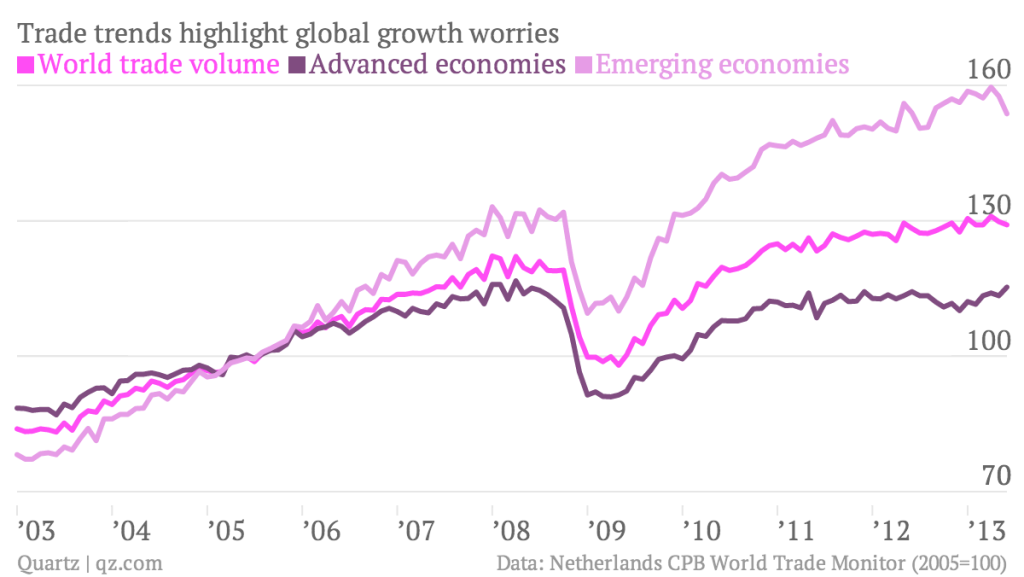
This chart shows a trend that has economists worried about the pace of economic recovery: the slowing growth of overall worldwide trade, and the drop in exports from emerging markets even as the advanced economies sell more goods abroad. The OECD released an interim forecast of global growth today, showing a continued slow recovery in the US, Japan and Germany that is being undermined by slowing growth in emerging markets, including China, Brazil and India. This is a reversal from recent years, when emerging markets drove global growth as Europe stumbled through a double-dip recession and the US slowly emerged from the wreckage of its housing bubble. But in 2013, industrial production has slowed in emerging economies even as manufacturing grows in wealthier Western nations. Another data point out today that reflects this trend: US factories reported the largest increase in orders in the last two years. This is all part of the great rebalancing, as wealthier citizens in emerging marketsseek access to more imported Western goods, while Western economies re-tool tocompete with cheaper workforces abroad. That’s all well and good, but because emerging markets make up such a huge share of worldwide economic activity, global expansion will slow until these countries develop stable sources of internal demand to replace their sales abroad.


How 37-Year-Old Teacher Imperils Pimco’s Bond Bet: Mexico Credit

How 37-Year-Old Teacher Imperils Pimco’s Bond Bet: Mexico Credit

For Pedro Hernandez, a striking elementary-school teacher from the southern state of Oaxaca, his union’s protests disrupting Mexico’s capital aren’t just about education. They’re about stopping President Enrique Pena Nieto. “We’re against all the structural reforms,” the 37-year-old said last week as he walked down Mexico City’s central boulevard as part of an organized march of 15,000. Hernandez held a sign that read, “Mexico has no president.” Read more of this post

Factoring Draws Attention of China’s Bank Regulator

September 3, 2013, 6:43 a.m. ET

Factoring Draws Attention of Bank Regulator

Regulator Seeks Better Monitoring of Innovative Lending

BEIJING—China’s banking regulator has instructed banks to better monitor a type of lending particularly popular with small firms as demand burgeons and banks relax their oversight standards. According to a document from the China Banking Regulatory Commission seen by The Wall Street Journal, loans made against companies’ accounts receivable—those sales for which a company has yet to receive payment—must be recorded as nonperforming loans if they turn bad. Banks also need to be sure that such loans are in fact backed by receivables. Read more of this post

China Arrests Bosera’s Ex-Fund Manager Ma Le on Suspected Insider Trading in front-running of fund clients

September 3, 2013, 7:04 a.m. ET

China Arrests Ex-Fund Manager on Suspected Insider Trading

Bosera Fund Management: Activities Were Ma Le’s ‘Personal Actions’

BEIJING—China has arrested a former manager with a major securities fund-management company on suspicion of insider trading, the nation’s legal supervisory body said Tuesday. Ma Le, a former fund manager at Bosera Fund Management, has been arrested on suspected front-running of fund clients, the Shenzhen People’s Procuratorate said in a statement on its website. Front-running, a form of trading on privileged information, entails purchases of securities by a broker or fund manager for resale to clients—or the fund itself—at a profit. The procuratorate is responsible for criminal investigations and prosecutions. Read more of this post

China bans officials from buying mooncakes with public funds

China bans officials from buying mooncakes with public funds

8:30am EDT

BEIJING (Reuters) – China is banning officials from using public funds to buy mooncakes, pastries offered as gifts during the Mid-Autumn Festival, as part of President Xi Jinping’s fight against corruption, the government said on Tuesday. Officials cannot use public money to send mooncakes as gifts or to arrange banquets that are not related to official duties during the festival, which falls on September 19 this year, the ruling Communist Party’s Central Commission for Discipline Inspection said on its website. Read more of this post

For Rich Mainlanders, Hong Kong Loses Luxury Luster

September 3, 2013, 6:22 PM

For Rich Mainlanders, Hong Kong Loses Luxury Luster

By Jason Chow and Chester Yung

Has Hong Kong lost its perch as China’s preferred luxury hub? Mainland Chinese passport holders account for 78% of all visitors to Hong Kong, and they have an outsize presence on the city’s shopping scene. The sheer number of Chinese visitors is huge: Last year saw 34.9 million arrivals from China, equal to about five times’ Hong Kong’s population. But while mainlanders continue to arrive in the city in droves – more than 3.7 million entered the territory in July, up 15.7% from a year before – they seem to be spending less than they used to, and veering away from big-ticket items in particular, according to Hong Kong government figures released on Monday. Read more of this post

Citigroup has shed more than $6 billion in private-equity and hedge-fund assets in the past month in order to comply with new regulations limiting banks’ holdings of “alternative” investments

Updated September 2, 2013, 9:28 p.m. ET

Citigroup Dialing Back Its ‘Alternative’ Holdings

SHAYNDI RAICE

Citigroup Inc. C +2.13% has shed more than $6 billion in private-equity and hedge-fund assets in the past month, according to people familiar with the transactions, in order to comply with new regulations limiting banks’ holdings of “alternative” investments. The nation’s third-largest bank by assets last week sold a $4.3 billion private-equity fund called Citi Venture Capital International for an undisclosed price to Rohatyn Group, a private-equity fund run by Nick Rohatyn, son of financier Felix Rohatyn, said people familiar with the matter. It couldn’t be determined what price the fund fetched. On Aug. 9, Citigroup sold a $1.9 billion emerging-markets hedge fund to the fund’s managers, the people said. Read more of this post

China’s Struggle Sessions; A messy leadership transition suggests the return of ideology

September 3, 2013, 1:10 p.m. ET

China’s Struggle Sessions

A messy leadership transition suggests the return of ideology.

When the trial of Bo Xilai, the former Communist Party boss of Chongqing, ended last week, most observers assumed that Chinese politics would settle into its usual monotonous patterns. But the power plays continue. On Tuesday, Jiang Jiemin was removed as head of the State-Owned Assets Supervision and Administration Commission (SASAC), a post he had held for only a few months. Read more of this post

Buying a Frontier Market Fund? This Theater’s Got a Teeny, Tiny Exit

September 3, 2013, 10:26 A.M. ET

Buying a Frontier Market Fund? This Theater’s Got a Teeny, Tiny Exit

By Brendan Conway

It’s been a rotten year for one of yesteryear’s favorite investing categories: iShares MSCI Emerging Markets ETF (EEM) is down 13% on the year. But iShares MSCI Frontier 100 ETF(FM), which tracks stocks from tiny, less trodden markets that are too underdeveloped for EEM, is up more than 10%. If you guessed frontier markets are even less liquid than emerging markets and, thus, harder to exit in a panic, Joe Light of the Wall Street Journal has some data you should see. Namely, Vanguard Group estimates the one hour it takes to liquidate $100 million in emerging-markets expands to more than 10 days when you’re on the frontier. Being so small can have bad consequences, says Chris Philips, senior analyst at Vanguard Group, which doesn’t offer a frontier-market fund. For one thing, it can take funds a long time to move into and out of stocks. Mr. Philips calculated that a frontier-market fund would need more than 10 days to liquidate a $100 million position. Read more of this post

Europe’s Workers Flock to Norway for Better-Paying Jobs

Europe’s Workers Flock to Norway for Better-Paying Jobs

Pedro Dias cut his workday almost in half and tripled his pay after leaving his native Portugal for a job as a software developer in Oslo. The 27-year-old, who escaped 15-hour days as a researcher at New University of Lisbon and now rarely works past 5 p.m., landed his job at Metafocus AS, a producer of web-based software, at a career fair in the Portuguese capital in February. “In Portugal, with an average salary you will struggle and have to work longer hours,” he said as he looked at the waters of the Oslo Fjord from a patio outside his office in the capital. Dias says he enjoys his new job and his free time, during which he is preparing for his first half-marathon run. Read more of this post

Dealers in Debt Pare Commitments Raising Risk as New Rules Bite

Dealers in Debt Pare Commitments Raising Risk as New Rules Bite

The worst losses in U.S. debt in at least 37 years are being magnified by investors exiting the market at the same time new regulations prompt Wall Street firms to cut back on trading corporate bonds. Bank of America Merrill Lynch’s U.S. Broad Market Index is on pace to drop 4.41 percent, the biggest annual loss since at least 1976. Investors pulled $123 billion from bond funds since May, according to TrimTabs Investment Research. Read more of this post

North Korea Can Launch Nuclear-Tipped Missiles, South Korea Says, contradicting the U.S. position that the country is years away from developing the technology

North Korea Can Launch Nuclear-Tipped Missiles, South Korea Says

North Korea can now deliver a nuclear warhead on a missile, the South Korean Defense Ministry said in a report, contradicting the U.S. position that the country is years away from developing the technology. “The security situation on the Korean Peninsula has now worsened as the North’s threat of nuclear missiles has become real,” according to the report, which was presented to a parliamentary committee on national security today and released by the office of lawmaker Kim Kwang Jin. The new capability may embolden North Korea toward military provocation once the U.S. relinquishes its wartime command of South Korean troops in 2015, the report said. That command was given to the U.S. during the 1950-53 Korean War. North Korea threatened first strikes against South Korea and the U.S. in March after a February nuclear test prompted tightened sanctions against the Kim Jong Un regime. The Obama administration, which has called on North Korea to renounce its nuclear program, has said the country didn’t have the ability to launch an atomic weapon on a missile. Until 2010, the North was in an experimental stage with its nuclear missiles, and the country has now come to a point where it can actually use them, the report said. The Defense Ministry didn’t explain how it reached its conclusion, and the study didn’t mention the ranges of the missiles that the North had the capability to mount weapons on.

To contact the reporter on this story: Sam Kim in Seoul at skim609@bloomberg.net

China Solar Defaults Shock Holders as $8.4 Billion Due

China Solar Defaults Shock Holders as $8.4 Billion Due

LDK Solar Co.’s delay in paying debt and Suntech Power Holdings Co.’s attempts to renegotiate obligations are prompting investors to gird for losses as $8.4 billion in renewable energy comes due by the end of next year. The 2014 securities of LDK slid to a record low of 25.6 yuan per 100 yuan face value last week after the manufacturer said a payment due Aug. 28 on the notes would be delayed. That compares with the 30 euros per 99.861 euro issue price on Bonn-based Solarworld AG. (SWV) Suntech, once the world’s biggest panel maker, said former chairwoman Susan Wang and two other directors quit amid negotiations with holders of its defaulted debt. Read more of this post

Rupiah Weakens Beyond 11,000 a Dollar for First Time Since 2009

Rupiah Weakens Beyond 11,000 a Dollar for First Time Since 2009

The rupiah weakened beyond 11,000 per dollar for the first time since April 2009 on concern Indonesia will struggle to rein in a record current-account gap. The nation’s trade shortfall was $2.3 billion in July, compared with the $393 million median estimate in a Bloomberg survey of economists. The current-account deficit will be about 4 percent of gross domestic product or more this quarter, from 4.4 percent in the previous period, Bank of America Merrill Lynch economist Hak Bin Chua wrote in a note yesterday. This is higher than the government’s target of 3 percent this quarter. Read more of this post