Insolvent town exposes gulf between EU dreams and reality

Insolvent town exposes gulf between EU dreams and reality

Sun, Sep 1 2013

By Luiza Ilie

ANINOASA, Romania (Reuters) – On an abandoned storefront, an old poster advertises one of the few career opportunities available in this Romanian town: naked webcam models wanted for Internet chatrooms. If joining the European Union was supposed to lift Romania out of poverty, it has yet to work in Aninoasa, a town of 4,800 people in the mountainous central region of Jiu Valley. Six years after Romania’s accession to the EU, not only is Aninoasa still poor – it has also become the first town in Romania to file for insolvency. Read more of this post
Asian Bonds Tumble Below Par in Capital Flight

Asian Bonds Tumble Below Par in Capital Flight: Credit Markets

Asia dollar-denominated bonds have dropped below par for the first time since 2011 as investors pull money out of the region amid concerns that growth is slowing and as currencies from the rupee to rupiah plunge. Average prices of company debentures in the region fell to 98.61 cents on the dollar on Aug. 22, the least since October 2011, Bank of America Merrill Lynch indexes show. Dollar bonds globally have held above 100 cents since September 2009. Both investment- and non-investment-grade debt in Asia were below par on Aug. 22. The last time that happened was in September 2008, when Lehman Brothers Holdings Inc. collapsed. Read more of this post

Plunging Currencies Plague Asian Firms; Weak Currencies Make it More Costly to Pay Foreign Debt

September 2, 2013, 12:15 a.m. ET

Plunging Currencies Plague Asian Firms

Weak Currencies Make it More Costly to Pay Foreign Debt

SEAN MCLAIN IN NEW DELHI And I MADE SENTANA IN JAKARTA

Companies across Asia are facing a debt-repayment crunch as plunging local currencies make it more costly to repay foreign loans, a situation that is exacerbating stresses on the region’s economies. Asian companies took out sizable foreign loans in recent years as the U.S. Federal Reserve kept interest rates low and printed money. For firms in nations like India and Indonesia, rates on U.S.-denominated debt were more attractive than local borrowing costs. Read more of this post

Ditch the stats: China retailers don’t buy signs of recovery

Ditch the stats: China retailers don’t buy signs of recovery

6:05pm EDT

By Anne Marie Roantree and Donny Kwok

HONG KONG (Reuters) – If things are really starting to look up for China’s economy, as a recent spate of better-than-expected government data seems to suggest, nobody appears to have told its biggest retailers. A Reuters review of first-half earnings showed that more than 20 Chinese companies selling everything from footwear to food were not convinced the economic slowdown had bottomed out, and neither were their traditionally thrifty customers. Read more of this post

‘Creative destruction inevitable for Thai growth’

‘Creative destruction inevitable for Thai growth’

THE NATION September 2, 2013 1:00 am

THAILAND HAS to face another era of creative destruction if has to maintain its competitiveness, Bank of Thailand economists said last week. Creative destruction – the shift of labour to high-growth industries and the death of some non-competitive businesses – is going on, but not at the same level in each industry and not in all industries. Their paper entitled “Thailand’s Quest for Economic Growth: From Factor Accumulation to Creative Destruction”, aims to show the economic environments that are supportive of the change or hinder the process. Read more of this post

TV confessions in China an unsettling new trend for executives

TV confessions in China an unsettling new trend for executives

Megha Rajagopalan 5 hours ago

By Megha Rajagopalan

BEIJING (Reuters) – A series of confessions by foreign and local executives on China’s state-controlled television has spurred anxiety among the business community about a trend that some lawyers say makes a mockery of due process. Confessions have long been part of China’s legal landscape, with petty criminals routinely admitting their guilt on television. But rarely have senior business figures been put on television in orange prison jumpsuits to confess. Read more of this post

Silver Lining in China’s Smog as It Puts Focus on Emissions?

August 31, 2013

Silver Lining in China’s Smog as It Puts Focus on Emissions

By CHRIS BUCKLEY

HONG KONG — Jiang Kejun may be one of the few Beijing residents who see a ray of hope in the smog engulfing the city. A researcher in a state energy institute, he is an outspoken advocate of swiftly cutting China’s greenhouse gas output, and he sayspublic anger about noxious air has jolted the government, which long dismissed pollution as the necessary price of prosperity. Read more of this post

Shark Fin Decline Linked to China Corruption Crackdown

Shark Fin Decline Linked to China Corruption Crackdown

By Agence France-Presse on 3:25 pm September 1, 2013.
Conservationists have attributed a dwindling demand for shark fins to China’s crackdown on corruption which has forced a decline in lavish banquets. “We are seeing a reduction in demand from China. Hong Kong is also showing a significant decline in consumption,” Angelo Villagomez, a shark specialist with US-based conservation group the Pew Charitable Trusts, said Sunday. Villagomez was in the Marshall Islands to discuss shark sanctuaries with leaders at the Pacific Islands Forum, the annual summit of Pacific heads of state. However, he said the decline in shark fin demand over the past year was not directly linked to increasing shark protection by Pacific island governments. Instead, it was related to the Chinese leadership’s crackdown on graft and opposition to extravagance. Read more of this post

China’s mooncake sales fall over 20% due to anti-corruption policy

China’s mooncake sales fall over 20% due to anti-corruption policy

Staff Reporter

2013-09-02

China’s mooncake sales this year are expected to fall at least 20% in the wake of the government’s anti-corruption policies, with some producers shutting down while others have switching to targeting foreign companies or individuals, the Shanghai-based First Financial Daily reports. “I have worked for a supermarket for more than 10 years, and every year around this period, promotions for mooncakes have been seen everywhere, but in recent days, in my supermarket there is not any such promotion at all,” said Mr. Yin, a marketing executive of an unidentified large-sized supermarket. Read more of this post

China’s Bright Food in talks to buy control Israel’s biggest food maker Tnuva for $1.7B

Chinese company in talks to buy control of Tnuva

Tnuva is Israel’s biggest food maker, and deal could exceed NIS 6 billion.

By Yoram Gabison | Sep. 2, 2013 | 4:11 AM

China-based Bright Food Group, which has been a global acquisition binge over the past three years, is putting out feelers to buy Tnuva, Israel’s biggest food maker, in a deal that could exceed NIS 6 billion. The Chinese company is in talks with Apax Partners, the British private equity fund that owns a 56% stake in Tnuva, the maker of such iconic products as Israel’s best-selling cottage cheese, through foreign investment banks, TheMarker has learned. Read more of this post

China moves to chill interest in independent films; “They don’t like people with interesting ideas gathering together”; “They don’t want people to think, they don’t want people to have independent and free ideas”

China moves to chill interest in independent films

By AP News Aug 30, 2013 4:53PM UTC

BEIJING (AP) — Chinese authorities have disrupted an independent film school, shut down two film festivals and harassed organizers of a third in recent months, say independent filmmakers, who see the actions as part of a general clampdown on freedom of expression. Filmmakers whose edgy themes contrast with the rosier images of the country’s mainstream industry are accustomed to censorship of content deemed to show China in a negative light. But independent filmmakers say authorities now appear to be trying to chill the sharing and discussion of their films, amid a broader clampdown under Chinese leader Xi Jinping on public discourse that could potentially undermine the country’s one-party rule, including the arrests of bloggers who post sensitive material and activists who have accused officials of corruption. Read more of this post

Asia turns bullish on convertible bonds

September 1, 2013 1:23 pm

Asia turns bullish on convertible bonds

By Paul J Davies in Hong Kong

Stock market jitters and rising costs of credit do not sound like good news for companies’ funding needs. But convertible bonds are an exception that prosper in such volatile times – and Asian groups are rushing to take advantage. Qihoo 360 Technology, a US-listed Chinese security software firm, saw very strong demand for one of the year’s biggest issues last week. That $600m deal took total issuance for the year so far in Asia excluding Japan above $10bn, according to Dealogic. Read more of this post

Philippines’ Jollibee aims to become Asia’s largest homegrown chain

Jollibee aims to become Asia’s largest homegrown chain

By Neil Jerome C. Morales (The Philippine Star) | Updated September 2, 2013 – 12:00am

MANILA, Philippines – Fastfood giant Jollibee Foods Corp. (JFC) aims to be the largest homegrown quick service restaurant chain in Asia by 2020. The long-term goal will be supported by continuous store expansions and acquisitions of several more brands abroad, an executive said. “We hope in the next seven years to achieve being the largest,” JFC chief financial officer Ysmael V. Baysa said in an interview. So far, JFC is the largest homegrown fastfood chain in Southeast Asia and the second biggest in the entire Asian continent in terms of sales, Baysa said. “For Asian companies, excluding US (fastfood) franchises, I think we’re second next only to Japan’s Yoshinoya,” Baysa said, adding that the long-term plan was crafted in 2004 when JFC was the top four in Asia. Read more of this post

More than one in eight UK high street shops could go out of business in the next three years; many of these “zombie” companies are only able to stay trading due to very low interest rates, and are not paying down the capital on loans

September 1, 2013 11:55 am

More than 1 in 8 UK shops face closure, says study

By Duncan Robinson

More than one in eight shops could go out of business in the next three years, according to an in-depth review of the UK’s struggling high street by former Iceland and Wickes chief executive Bill Grimsey. The retail veteran has claimed that nearly half of the UK’s retailers are under extreme financial pressure, as the high street struggles to deal with a slump in consumer spending. This figure rises to two-thirds among small retailers, according to an analysis by Company Watch, a financial risk management group which Mr Grimsey commissioned to carry out research. Read more of this post

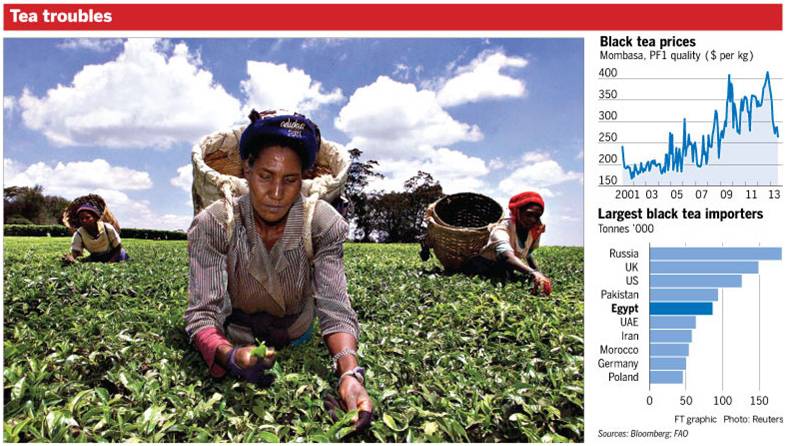
Tea prices have plunged more than a third over the past year as the crisis in Egypt, the world’s fifth largest importer, has cut demand

September 1, 2013 9:29 pm

Trouble brews for tea growers in wake of Egypt crisis

By Javier Blas in Nairobi

BlackTea

Tea prices have plunged more than a third over the past year as the crisis in Egypt, the world’s fifth largest importer, has cut demand just as global production has rebounded after several years of bad crops. The commodity, which is critical to several east African economies, is now selling at its lowest price in more than three years. Kenya is the world’s largest exporter of black tea, followed by Sri Lanka and India. The wholesale cost of Kenyan medium-quality tea, known as best Pekoe Fanning 1, last week fell to $2.64 a kilogramme, down roughly 34 per cent from a year ago and the lowest since mid-2010. Traders said prices could fall further if the crisis in the north African nation of tea drinkers results in lower sales. “We see absolutely no reason to be bullish,” Van Rees, the Netherland-based tea traders, said in a report. Read more of this post

Tyrant or Hero? Plan to Name Jakarta Road After Suharto Stirs Controversy

Tyrant or Hero? Plan to Name Jakarta Road After Suharto Stirs Controversy

By Markus Junianto Sihaloho on 9:31 am August 31, 2013.
A plan to name a main thoroughfare in the heart of Jakarta after former President Suharto has drawn both support and muted criticism, with Jakarta Governor Joko Widodo conceding it could be a hard sell. The plan, conceived by a group calling itself the Council of 17 and led by Jimly Asshidiqie, a former chief justice of the Constitutional Court, would see the four roads encircling the National Monument (Monas) park renamed in honor of former leaders, as part of what Jimly called a push to boost the public’s sense of nationalism. Joko, who met with the Council of 17 on Friday, said he foresaw no problems in renaming Jalan Medan Merdeka Selatan, on the southern edge of the Monas square, to Jalan Sukarno, in honor of Indonesia’s founding president. Read more of this post

Lack of reform-oriented leaders may hurt business environment in Indonesia

Lack of reform-oriented leaders may hurt business environment

Published: 2013/09/02

JAKARTA: Indonesia’s rapidly growing economy offers opportunities for entrepreneurs, but the lack of a strong reformist candidate for the upcoming presidential elections may hurt the business environment, according to a report by Ernst & Young. The global company, whose services include financial and tax auditing as well as various advisory services, recently released the outcome of its study on entrepreneurship in each of the world’s top 20 economies. Indonesia, the world’s 16th largest economy, was part of the “EY G-20 Entrepreneurship Barometer 2013.” Analysing Indonesia’s strengths, weaknesses, opportunities and threats, the study said: “A strong reformist candidate has yet to emer-ge for elections in 2014, raising the possibility of backsliding on earlier improvements to the business environment thereafter.” Read more of this post

India’s Holy Mary: Converting Sacred Temple Gold Into Dollars; RBI plans to request Tirupati, Shirdi shrines to sell their gold pile to rescue Rupee fall

India’s Holy Mary: Converting Sacred Temple Gold Into Dollars

Tyler Durden on 09/01/2013 17:39 -0400

Ten days ago, it was a tongue in cheek suggestion that the Royal Bank of India should lease their gold in a last ditch effort to procure much needed USD and keep the economic engine going. Then it was an offer so good, the citizens could simply refuse (or maybe not if it was enforced) that the millions of ounces of local wealth preserving gold be converted into Rupees in a wholesale gold purchasing campaign by the domestic banks. Now, the India Times, reports that as the dollar-starved desperation deepens, the local central bank is “discussing with banks on how to convince temple trusts to deposit their hoard of idle jewellery that could be converted into bullion.” In other words, the government is going for the sacred gold which will be sold to keep the petrodollar economy functioning for another several months. Surely, yet another “transitory” measure. Read more of this post

India’s crisis within a crisis; finance minister fights on two fronts

India’s crisis within a crisis; finance minister fights on two fronts

5:21pm EDT

By Sanjeev Miglani

NEW DELHI (Reuters) – Late last month, with their doors shut to the mounting market panic outside as investors fled the country, India’s cabinet ministers gathered to give final approval to a cheap food scheme for the poor. It was hardly a difficult decision for a government that needs to shore up its sagging popularity before elections due by next May. But officials familiar with the discussion say there was one dissenting voice over what is now destined to become one of the world’s largest welfare programs. Read more of this post

Panasonic churns out 100 millionth washing machine

Panasonic churns out 100 millionth washing machine

KYODO

AUG 30, 2013

OSAKA – Panasonic Corp. has built its 100 millionth washing machine since starting production in 1951 under the leadership of founder Konosuke Matsushita. Its output of washing machines has accelerated since Panasonic started production in China in 1992, with the last 50 million being manufactured since 1998. Panasonic said Thursday that its washing machines are popular in numerous areas because they are designed specifically for each region, taking into consideration size and washing method. Read more of this post

Japan government abandons hands-off approach to Fukushima clean-up

Japan government abandons hands-off approach to Fukushima clean-up

5:12pm EDT

By Linda Sieg and Mari Saito

TOKYO (Reuters) – Japan’s government is moving to take a more direct role in the clean-up of the wrecked Fukushima nuclear plant, as concerns grow over the ability of embattled operator Tokyo Electric to handle the legacy of the worst atomic disaster in a quarter century. The concerns have also revived debate about the future of Tokyo Electric Power Co (Tepco) itself, including early-stage proposals to put its toxic nuclear assets under government control and leave the rest of the company as a provider of power to the nation’s biggest economic region. Read more of this post

Korea’s Tongyang Group’s financial woes to deepen from Oct

Tongyang Group’s financial woes to deepen from Oct

2013.09.02

Concerns are mounting in the corporate bond market over Tongyang Group’s fundraising capacity. This is because the Group is expected to face setbacks in financing as Tongyang Group’s major affiliated companies have suffered from a series of credit rating downgrades ahead of the implementation of financial investment regulation amendments in October. The issuance of debt securities by Tongyang-affiliated companies has totaled 576 billion won ($520 million) this year, according to financial investment sources Monday.  Read more of this post

Korea Inc. grapples with aging workforce

Korea Inc. grapples with aging workforce
Militant labor unions blamed for high wage and low productivity

2013-09-01

By Lee Hyo-sik

130901_a02_koreainc1130901_a02_koreainc2

Korea has emerged as a global manufacturing powerhouse since the Korean War. Over the past six decades, automakers, shipbuilders, steelmakers and other manufacturers have become leaders in the industry. Companies like Samsung Electronics and Hyundai Motor are selling Korean-made products that are in demand across the world. While demand is high, local manufacturers are facing a ticking time bomb: a rapidly aging workforce. As a result, Asia’s fourth-largest economy is facing higher wages and falling labor productivity, which is chipping away at Korea’s ability to compete. Read more of this post

Singapore Stocks Worst in Developed World: Southeast Asia

Singapore Stocks Worst in Developed World: Southeast Asia

Singapore stocks tumbled by the most among developed markets last month as investors pulled cash from Southeast Asia on concern about the future of global stimulus.

Singapore’s Straits Times Index, the benchmark gauge for the region’s biggest market, dropped 7.5 percent in the 10 days through Aug. 28, its longest losing streak since 2002. The gauge slumped 6 percent in August, the worst performance among the world’s developed equity markets. Jardine Cycle & Carriage Ltd., the largest shareholder of Indonesia’s PT Astra International (ASII), and commodities trader Olam International Ltd. led declines. Read more of this post

New Zealand Ends Patents for Basic Software

Sep 1, 2013

New Zealand Ends Patents for Basic Software

By Lucy Craymer

International technology giants won’t be able to get patents for basic software under a law passed by the New Zealand government, although protection for significant innovations and programs will remain under the country’s copyright law. The New Zealand government updated its 60-year-old patent bill with a new law that acknowledges overseas influences in New Zealand but perhaps more controversially prevents both local and international companies receiving patents for their software. Local patent experts say the move brings the country in line with the U.K. and Europe, which already prevent the patenting of software. Under the U.K. law, a number of smartphone patents that Apple Inc. wanted such as a patent on unlocking a phone by performing a gesture were rejected. Read more of this post

Investment scams on the rise in recent years: Consumers Association of Singapore (Case)

PUBLISHED SEPTEMBER 02, 2013

Investment scams on the rise in recent years: Case

Whole of 2012 had 27 cases, complaints in Jan-July this year already hit 37

ANNABETH LEOW LEOWHMA@SPH.COM.SG

DISPUTES over dodgy investment schemes have been on the increase in recent years. The number of investment-related complaints lodged with the Consumers Association of Singapore (Case) stood at an estimated 37 in just the first seven months of this year, compared with 27 for the whole of last year and 12 for 2011. Out of the 37 complaints, close to half concerned gold investment schemes. Four more pertained to wine investments. Both these types of investments have attracted negative publicity of late.

Malaysian shrimp industry will lose RM511million if US anti-dumping duty is imposed

Updated: Monday September 2, 2013 MYT 6:56:47 AM

M’sian shrimp industry will lose RM511mil if US anti-dumping duty is imposed

BY DAVID TAN
DAVIDTAN@THESTAR.COM.MY

The next concern for the local shrimp industr y is the European Union’s preferen tial tariff of about 4% enjoyed by Malaysian shrimp producers

GEORGE TOWN: The local shrimp industry stands to lose over US$155mil (RM511mil) in revenue per annum should the United States’ proposal to impose a 54.5% anti-dumping duty on Malaysian shrimps take effect on Oct 1, 2013. Malaysia Shrimp Industry Association president Syed Omar Syed Jaafar told StarBizthat shrimp exports to the United States comprised 43.84% of Malaysian shrimp sold overseas, indicating that the United States is a major market. Read more of this post

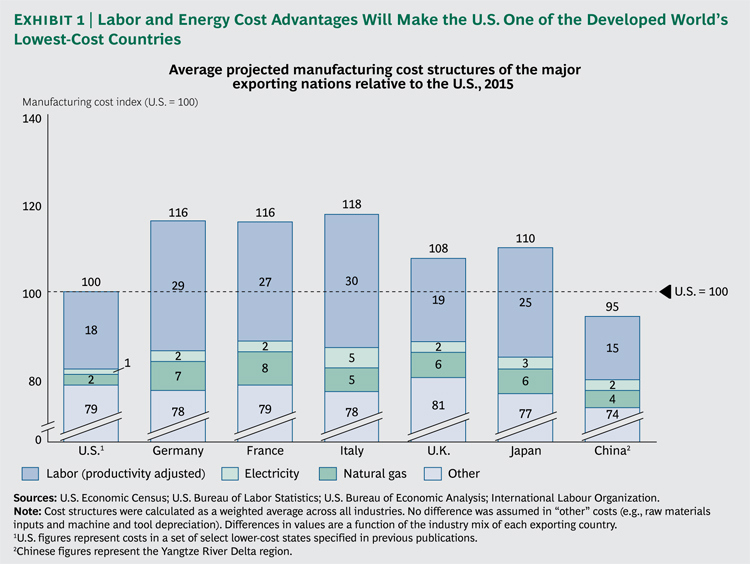
Overall, in 2015, manufacturing in the US will cost only about 5% more than in China

What gives American factories their competitive edge: They’re easy to close

By Tim Fernholz @timfernholz August 30, 2013

american_export_surge_ex1_lg_tcm80-141741

Yesterday’s pleasant surprise: The US economy grew much faster than we thought in the previous quarter: 2.5% on the year, thanks to robust exports. Another pleasant surprise: That might continue. America’s great manufacturing renaissance continues to attract converts. Companies including Toyota, Honda, Siemens and Rolls Royce have all shifted production to the US in recent years. Boston Consulting Group, which advises companies on their supply chains, recently made an extended case that the United States is like the China of wealthy countries (awesome analogy!) because of how cheap it is to make stuff there. Here’s BCG’s chart. What it shows is that labor and energy costs are a lot lower in the US than in Europe and Japan, and are no higher, combined, than in China. Overall, in 2015, manufacturing in the US will cost only about 5% more than in China. Read more of this post

Measuring the gauges of US stock valuations

September 1, 2013 3:00 pm

Measuring the gauges of US stock valuations

By John Authers

The key metrics are coming in for re-examination

Cue q. For weeks, an academic debate has spilled into dealing rooms over the merits of cyclically adjusted price/earnings ratios, known as Capes, one of academics’ favoured metrics for gauging whether stock markets are cheap or expensive. But another key gauge is also now coming in for re-examination: Tobin’s q. Before anyone stops reading, this matters, a lot, to those hoping to make money in stock markets. Cape and q both tell the same story, that the US stock market is significantly overvalued and this contradicts much hopeful analysis from Wall Street and the City. As so many people have an interest in selling stocks, it is inevitable that these metrics will be re-examined; and it is vital to understand why academics find them so useful. Read more of this post

Italy will become the first country to introduce a tax on high-frequency trading in a move that has become a test case for potential further crackdowns on the controversial practice

September 1, 2013 4:35 pm

Italy introduces tax on high-speed trade and equity derivatives

By Philip Stafford

Italy will on Monday become the first country to introduce a tax on high-frequency trading in a move that has become a test case for potential further crackdowns on the controversial practice. The country will introduce levies against high-speed trading and equity derivatives in the final part of a two-stage process established this year to tax equity-related transactions. Read more of this post