How much Europe is too much Europe?

How much Europe is too much Europe?

Luke Baker 8 hours ago

By Luke Baker

BRUSSELS (Reuters) – In the dark days of Europe’s debt crisis in 2012, when it seemed Greece might be forced out of the euro and the single currency could implode, leaders believed “more Europe” was the only answer. Only deeper integration can bolster the region to withstand future crises, they said. A more united Europe will punch its weight in the world, not collapse on the ropes. Read more of this post

Does renewed acronym anxiety spell crisis? First it was Piigs, now Fragile Five Biits, as EM scare unsettles

August 30, 2013 6:50 pm

Does renewed acronym anxiety spell crisis?

John Authers

First it was Piigs, now Fragile Five Biits, as EM scare unsettles

Acronym anxiety is here. It is a clear sign of worry when brokers start to produce acronyms to encapsulate negativity. The emergence of “Piigs” (Portugal, Ireland, Italy Greece and Spain) was one of the first symptoms of the budding crisis on the periphery of the eurozone. In the last week, my email inbox has brought me the Fragile Five Biits (Brazil, Indonesia, India, Turkey and South Africa) from Deutsche Bank, and Crash (Conflict, Rates, Asia, Speculation and Housing) from BofA Merrill Lynch. So we have a state of high acronym anxiety. Read more of this post

New Radiation Hotspots Found at Fukushima Daiichi; Operator’s Struggle to Control Highly Radioactive Water Suffers New Setbacks

Updated September 1, 2013, 11:35 a.m. ET

New Radiation Hotspots Found at Fukushima Daiichi

Operator’s Struggle to Control Highly Radioactive Water Suffers New Setbacks

KANA INAGAKI

TOKYO—The operator of the troubled Fukushima Daiichi nuclear complex said over the weekend that its struggles to control highly radioactive water had suffered new setbacks. The company announced the discovery of contaminated spots in new parts of the compound where the water is stored, while radiation levels jumped to highly dangerous levels in another part of that area where readings were previously lower. Read more of this post

Most Brazil IPOs have lost money since 2005: Credit Suisse

Most Brazil IPOs have lost money since 2005: Credit Suisse

Fri, Aug 30 2013

By Guillermo Parra-Bernal

CAMPOS DO JORDÃO, Brazil (Reuters) – Many initial public offerings in Brazil have led to investor losses over the past eight years, a senior Credit Suisse Group fund manager said on Friday, with the worst results coming from oil and gas – a sector that for years was seen as the nation’s most promising. Only 37 of the 117 IPOs since the start of 2005 have yielded returns above the benchmark CDI interbank lending rate, with remainder losing as much as half of the amount initially invested, according to a presentation by Luiz Stuhlberger, who as chief investment officer oversees 43 billion reais ($18 billion) in assets for Credit Suisse Hedging Griffo. Read more of this post

Rupee slump a hard lesson for Indian students overseas

Rupee slump a hard lesson for Indian students overseas

12:49am EDT

By Anurag Kotoky

NEW DELHI (Reuters) – Student Mikael Haris is wrestling with the sort of question confronting others across India, including companies, investors and banks, following the 18 percent slump in the rupee this year. With plans to study for a masters degree in marketing in London from this month, he is trying to decide whether to pay his course fees up front and secure a discount, or to spread them out in the hope that a rebound in the rupee will ultimately reduce his costs. Read more of this post

Asia sees widespread McDonald’s refugee phenomenon

Asia sees widespread McDonald’s refugee phenomenon

Staff Reporter

2013-09-01

McDonald’s introduced 24-hour operations in its chains in Japan in 2006, and since then a number of homeless people have chosen to stay in its stores for a long-term stay due to its cheap costs, earning them the name McDonald’s refugees. Media outlets in mainland China, Hong Kong and South Korea have also done their own reports on the phenomenon which has been widely seen across the region, NetEase’s online news unit reports. These homeless or jobless people, who cannot afford to pay normal rentals due to low income, have chosen to stay in 24 hour restaurants like McDonald’s. Always-open restaurants started in China in 2006, with the media reporting the refugee phenomenon at a Beijing location in December 2006. In 2007, Hong Kong and South Korea media began similar reports, finding more and more low-income people choosing to stay at McDonald’s for the long-term. Read more of this post

Laos Bourse to Open Bond Trading, Triple New Stocks after posting a loss every year since it opened in 2011

Laos Bourse to Open Bond Trading, Triple New Stocks to Halt Loss

Lao Securities Exchange will start trading bonds and triple the number of listed companies next year to raise revenue after posting a loss every year since it opened in 2011.

The exchange, the second-smallest by market capitalization among 84 global bourses tracked by Bloomberg, after Swaziland, plans to begin government bond trading for the first time early next year, according to Chief Executive Officer Dethphouvang Moularat. It will also expand the number of listed stocks to six, from two, he said. Laos World Co. Ltd., a trade exhibition operator, and a state-controlled cement maker are among companies to join the Laos Composite Index. (LSXC) Read more of this post

What’s the Difference Between U.S., Chinese Corruption?

What’s the Difference Between U.S., Chinese Corruption?

Forming opinions in the absence of facts is a dangerous business, which is why it’s premature to draw conclusions about whether the government is on the right track with its investigation of JPMorgan Chase & Co.’s hiring practices in China. That said, if the feds are going to make a case, they will need a lot more evidence on the bank than what the New York Times offered today in its latest article on the subject. Maybe they will find it. The article relies on information from people whom the Times didn’t identify. So it’s sometimes hard to tell whose version of events we’re getting — the government’s or JPMorgan’s. The article does refer to a “confidential government document” as a key source, although it obviously isn’t very confidential because the Times said the document was sent to JPMorgan. Read more of this post

Wahaha needs a new business model, says Kelly Zong

Wahaha needs a new business model, says Kelly Zong

Staff Reporter

2013-08-31

Kelly Zong, the daughter of Hangzhou Wahaha chairman Zong Qinghou, has said the beverage empire that has made her father one of China’s richest men is gradually losing its advantage in terms of business model and product lines. Her father’s anointed successor, Zong has rarely discussed in the past the management issues and future development concerns of the company, worth an estimated 32 billion yuan (US$5.2 billion). She revealed her apprehensions about the company’s business model recently however in an interview with ifeng.com, the news website run by Hong Kong’s Phoenix TV network. Read more of this post

Too big to hail: China’s banking behemoths are too beholden to the state. It is time to set finance free

Too big to hail: China’s banking behemoths are too beholden to the state. It is time to set finance free

Aug 31st 2013 |From the print edition

20130831_LDC291

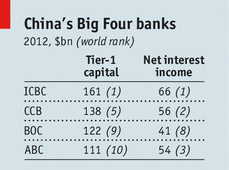
AT FIRST sight, China seems to have a superb banking system. Its state-controlled banks, among the biggest and most profitable in the world, have negligible levels of non-performing loans and are well capitalised. That appears to suggest that the country’s approach should be applauded. Not so. For one thing, though China’s banking system is stable, its banks are not as healthy as they seem. The credit binge of recent years has left them with far higher levels of risky loans than they acknowledge. And a profit squeeze is coming. The banks are having to work harder to keep both their biggest depositors, who are tempted by alternative investment products, and their biggest borrowers, who are turning to the bond market instead. As a consequence, the country’s Big Four banks—Industrial and Commercial Bank of China, Bank of China, Agricultural Bank of China and China Construction Bank—will no longer make easy money by merely issuing soft loans to state-owned enterprises, or SOEs (see article). Read more of this post

China’s War On Online Gossip Is Starting To Get Scary

China’s War On Online Gossip Is Starting To Get Scary

ADAM TAYLOR AUG. 31, 2013, 11:49 AM 1,730 2

china-rumors

An image featured on China’s gossip-reporting website

These days its rare to read a story about the gritty side of Chinese life without a mention of an overseas gossip website, or an angry reaction from Weibo’s online mob, the so-called “human flesh search engine.” Authorities aren’t too pleased with the gossipy world online — perhaps understanding that frequently this gossip is designed to undermine politicians and officials. A state-directed campaign to clamp down on rumors dates back at least a few years, with state-run newspapers comparing gossip to heroin and cocaine in 2011. However, in the last month there appears to have been a notable uptick in the war on rumors with arrests and people detained: It’s starting to get some people worried. Read more of this post

SEC Is Shocked, Shocked by Business as Usual in China

SEC Is Shocked, Shocked by Business as Usual in China

According to a Bloomberg News report, the Securities and Exchange Commission is on the verge of figuring out how business is actually done in China. The key to this discovery is a spreadsheet that the SEC obtained from JPMorgan Chase & Co.. It includes two key sets of data: the names of the offspring of some of China’s most prominent families, and a list of “specific deals pursued by the bank.” According to the Bloomberg report, combining these two data sets has provided investigators with a Rosetta Stone-like insight into how the bank just might make money in the Middle Kingdom: The spreadsheet, which links some hiring decisions to specific transactions pursued by the bank, may be viewed by regulators as evidence that JPMorgan added people in exchange for business, according to one person with knowledge of the review. Read more of this post

Foreclosures rising in China’s “entrepreneur city” Wenzhou as properties drop below mortgage values

Foreclosures rising in Wenzhou as properties drop below mortgage values

Staff Reporter

2013-09-01

C324X0227H_2013資料照片_N71_copy1

Many upscale housing units in Wenzhou are reportedly half empty amid a bout of foreclosures. (Photo/Xinhua)

Foreclosures are spiking in the city of Wenzhou in east China’s Zhejiang province as shrinking property prices have turned properties into negative equity, reports the Shenzhen-based Security Times. Since hitting a peak around two years ago, property prices in Wenzhou have declined sharply, so much so that the market value of many properties has fallen below the amount of their corresponding loans, turning them into negative-value assets. Read more of this post

Corrupt, anonymous and in thrall to the party – China is not the new Japan; However big the statistics say the Chinese economy is, it will never reach its full potential until the state relinquishes its grip

Corrupt, anonymous and in thrall to the party – China is not the new Japan

However big the statistics say the Chinese economy is, it will never reach its full potential until the state relinquishes its grip

Will Hutton

The Observer, Sunday 1 September 2013

It is a paradox. China is the world’s leading exporter ahead of both the US and Germany. If you trust its figures, it is the second biggest economy. Yet it succeeds in making only 9.5% of internationally applicable, so-called “triadic”, patents. This is a country whose growth has not been propelled by innovation. The failure is matched by a parallel failure of Chinese firms to develop as multinationals. When Japan was rising to global economic prominence in the 60s and 70s, its car and electronics companies became household names. No such claim can be made for China. Its big companies, still either state-owned or heavily state-influenced, are largely anonymous. There are certainly no Chinese multinationals of the standing of, say, Toyota, Sony or Hitachi.

Read more of this post

China’s largest village corruption case explodes in Zhejiang

China’s largest village corruption case explodes in Zhejiang

Staff Reporter 

2013-08-29

Ten officials in Xinqiao, a small village in easterns China’s Zhejiang province, have whipped up what has been deemed the nation’s biggest collective corruption case on record for village-level governance in the history of the People’s Republic of China. The alleged crimes involve the illicit seizure of 316 resettlement houses, worth 1.8 billion yuan (US$294 million), reports the Beijing-based Economic Observer. Read more of this post

China’s top anti-corruption agency is investigating Jiang Jiemin, head of the commission overseeing the country’s biggest state-owned enterprises

China State Assets Head Jiang Under Investigation

By Nerys Avery  Sep 1, 2013

(Corrects month of Jiang’s appointment in third paragraph.)

China’s top anti-corruption agency is investigating Jiang Jiemin, head of the commission overseeing the country’s biggest state-owned enterprises, the official Xinhua News Agency reported today. Jiang, 57, head of the State-Owned Assets Supervision and Administration Commission, is being probed by the Communist Party’s Central Commission for Discipline Inspection over “suspected serious disciplinary violations,” Xinhua said in a one-paragraph report today. No further details were given. Jiang, who was appointed to the commission in March, is the latest senior official to come under investigation after Xi Jinping pledged to root out corruption when he took over as head of the party in November. Liu Tienan, vice chairman of the country’s planning agency, was expelled from the party in August after being fired in May after a probe began and Li Chuncheng, a deputy party secretary of Sichuan province was put under investigation in December, Xinhua reported at the time. The South China Morning Post said Aug. 30 that party leaders have agreed to investigate retired Politburo Standing Committee member Zhou Yongkang on corruption allegations, citing people it didn’t identify. Leaders made the decision because of rising anger inside the party at the scale of corruption and the vast fortune amassed by his family, it said. News of Jiang’s investigation comes a week after the trial of ousted Politburo member Bo Xilai, who was charged with bribery, embezzlement and abuse of power.

To contact the reporter on this story: Nerys Avery in Beijing at navery2@bloomberg.net
 

Billions wiped from blue-chips as carbon tax hits Australia’s top companies

Billions wiped from blue-chips as carbon tax hits Australia’s top companies

STEVE LEWIS AND STEPHEN MCMAHON

NEWS LIMITED NETWORK

AUGUST 30, 2013 1:07PM

Virgin Australia CEO John Borghetti said the carbon tax had added nearly $50 million to the company’s 2012/13 expenses. Source: News Limited

VIRGIN Airlines has blamed the carbon tax for contributing to a $98 million full-year loss, adding to corporate concerns that Labor’s climate change scheme is wiping billions of dollars off blue-chip profits. Australia’s second biggest airline on Friday morning announced the carbon tax had added nearly $50 million to its 2012/13 expenses – around half the amount booked by Qantas, which said the green impost added $106 million. Read more of this post

Japan’s Public Pension Fund Suffers Biggest-Ever Bond Losses

Japan’s Public Pension Fund Suffers Biggest-Ever Bond Losses

Japan’s Government Pension Investment Fund, the world’s largest manager of retirement savings, posted its smallest gain in three quarters in the period ended June on record domestic bond losses. GPIF, which has 121 trillion yen ($1.24 trillion) in assets, earned a 1.9 percent return last quarter compared with a 6.9 percent gain in the prior three months, according to a statement on its website today. Market investments in Japanese bonds fell 1.5 percent while domestic stocks jumped 9.7 percent, the fund said. Losses on local bonds were wider than the previous record quarterly decline in 2008, said Tokihiko Shimizu, director general of the research department at GPIF. Read more of this post

Wal-Mart Prepares New India Venture

August 30, 2013, 11:23 a.m. ET

Wal-Mart Prepares New India Venture

Retailer Expected to Formally Request Approval to Operate Supermarkets

RAJESH ROY

NEW DELHI—U.S. retail giant Wal-Mart Stores Inc. WMT +0.76% is expected to submit soon a formal proposal to the Indian Trade Ministry to operate supermarkets in the country, a senior government official said on Friday. ‎ Scott Price, Wal-Mart’s Asia chief executive officer, met with officials at the Department of Industrial Policy and Promotion, said an official familiar with the matter. Read more of this post

S Chand: India’s Fastest-Growing Educational Publisher; A strategy to acquire and grow is set to elevate the 76-year-old educational publishing veteran to domestic market leader

S Chand: India’s Fastest-Growing Educational Publisher

by Udit Misra | Aug 29, 2013

topimg_22363_himanshu_gupta_600x400 S Chand-FINAL.indd

A strategy to acquire and grow is set to elevate the 76-year-old educational publishing veteran to domestic market leader

The beginnings of the S Chand Group were steeped in nationalism. Started by Shyam Lal Gupta in 1937, its mission was to publish Indian authors unable to find a voice in colonial times. S Chand has evolved into one of the biggest domestic publishers and exporters of textbooks. It publishes all types of educational books: Higher education, technical and management education, school books (they account for 60 percent of its revenues). Read more of this post

E-Cigarette Makers’ Ads Echo Tobacco’s Heyday

August 29, 2013

E-Cigarette Makers’ Ads Echo Tobacco’s Heyday

By STUART ELLIOTT

Adco2-popup (1)

Electronic cigarettes may be a creation of the early 21st century, but critics of the devices say manufacturers are increasingly borrowing marketing tactics that are more reminiscent of the heady days of tobacco in the mid-1900s. With American smokers buying e-cigarettes at a record pace — annual sales are expected to reach $1.7 billion by year’s end — e-cigarette makers are opening their wallets wide, spending growing sums on television commercials with celebrities, catchy slogans and sports sponsorships. Those tactics can no longer be used to sell tobacco cigarettes, but are readily available to the industry because it is not covered by the laws or regulations that affect the tobacco cigarette industry. The e-cigarette industry is also spending lavishly on marketing methods that are also still available to their tobacco brethren, including promotions, events, sample giveaways and print ads. Read more of this post

Aluminum Industry Seen by JPMorgan Unprofitable on LME Rule

Aluminum Industry Seen by JPMorgan Unprofitable on LME Rule

Two-thirds of aluminum producers would be losing money because of lower premiums paid on top of exchange benchmarks if the world’s biggest metals bourse approves rules to cut waiting times at its warehouses, according to JPMorgan Chase & Co. Premiums to obtain the metal will drop 60 percent to about $100 a metric ton as a result of the new rules the London Metal Exchange is expected to approve in October, Benjamin Defay, an analyst at the bank in London, wrote in a report e-mailed today. The LME proposed to oblige warehouses where waits extend for 100 days or more to let more metal out than they take in. Read more of this post

Jitters over high public debt in Malaysia

Jitters over high public debt in Malaysia

Saturday, Aug 31, 2013

Yong Yen Nie

The Straits Times

MALAYSIA – With the Indonesian rupiah and Indian rupee plunging and economies in turmoil as foreign funds flee, economists are wondering if Malaysia is next. Malaysia, whose bond market now has a record level of foreign holdings, has not been spared as foreign funds return to dollar-denominated assets. As it is, the ringgit has already depreciated 7 per cent against the US dollar this year, to RM3.33 to the greenback. Read more of this post

Quant pioneer Clifford Asness thinks bonds are expensive but don’t constitute a bubble, and stocks are a little pricey, too. So what’s the best course?

SATURDAY, AUGUST 31, 2013

The Big Danger: Overreliance on Stocks

By LAWRENCE C. STRAUSS | MORE ARTICLES BY AUTHOR

BA-BC762A_qap_p_G_20130831015222

Quant pioneer Clifford Asness thinks bonds are expensive but don’t constitute a bubble, and stocks are a little pricey, too. So what’s the best course?

Armed with an M.B.A. and a doctorate in finance from the University of Chicago, Clifford S. Asness can talk about the arcane workings of the markets with the best of them. One of his key points, however, is very simple: Many investors place too big a bet on stocks and lack sufficient diversification in their portfolios. Asness, who co-founded AQR Capital Management (the name stands for applied quantitative research) in 1998 after working at Goldman Sachs in quantitative research, is a big believer in variations of four of his firm’s key strategies: value, momentum, defensive, and “carry” (which includes shorting lower-yielding assets and investing in higher-yielding ones). He calls these the “big four” and argues that, because they have low or negative correlations with one another, they provide protection in all markets. Read more of this post

With Huge War Chests, Activist Investors Tackle Big Companies

AUGUST 30, 2013, 9:01 PM

With Huge War Chests, Activist Investors Tackle Big Companies

By MICHAEL J. DE LA MERCED and JULIE CRESWELL

Microsoft executives faced an unusual challenge in April when a $12 billion hedge fund, ValueAct, announced that it had bought a nearly $2 billion stake in the company with the intention of shaking things up. To many analysts, the possibility that ValueAct, with less than 1 percent of Microsoft’s stock, could succeed seemed improbable at best. The firm buys shares in companies, hoping to fight for board seats and change the targets’ corporate strategies. Read more of this post

The End of the Emerging-Market Party; in Atlas of Economic Complexity, when economies began producing more complex products, a harbinger of sustainable growth followed

The End of the Emerging-Market Party

Ricardo Hausmann, a former minister of planning of Venezuela and former Chief Economist of the Inter-American Development Bank, is a professor of economics at Harvard University, where he is also Director of the Center for International Development.

30 August 2013

CAMBRIDGE – Enthusiasm for emerging markets has been evaporating this year, and not just because of the US Federal Reserve’s planned cuts in its large-scale asset purchases. Emerging-market stocks and bonds are down for the year and their economic growth is slowing. To see why, it is useful to understand how we got here. Between 2003 and 2011, GDP in current prices grew by a cumulative 35% in the United States, and by 32%, 36%, and 49% in Great Britain, Japan, and Germany, respectively, all measured in US dollars. In the same period, nominal GDP soared by 348% in Brazil, 346% in China, 331% in Russia, and 203% in India, also in US dollars. Read more of this post

Losses Stalk Bond Investors in August as Europe’s Economy Grows

Losses Stalk Bond Investors in August as Europe’s Economy Grows

Corporate bondholders in Europe forfeited 0.2 percent in August, the fourth month of losses in a year that’s poised to generate the worst returns since 2008. Investment-grade debt in euros is returning 0.8 percent so far this year compared with 9 percent in the same period of 2012, Bank of America Merrill Lynch index data show. Average yields on the securities jumped nine basis points this month to 2.04 percent, near the highest in seven weeks, while yields on junk-rated bonds climbed 14 basis points to 4.9 percent, according to Bloomberg index data. Read more of this post

Goldman Sachs bought gold from clients after issuing a SELL call

Guess Which “Bearish” Bank Bought A Record Amount Of GLD In Q2

Tyler Durden on 08/30/2013 21:32 -0400

In early April, the status quo was exuberant when none other than Goldman Sachs issued a “sell” on the barbarous relic that has become so indicative of the exuberance of central planning. At the time, we were skeptical (to say the least) and, just for extra Muppetting, the bank also suggested its clients buy Treasuries. Well, now that the full details of holdings changes have been released for Q2, it is perhaps clearer than ever before that as the bank was telling its clients to “sell, sell, sell” it was itself “buy, buy, buy”-ing the Gold ETF (GLD) with both arms and feet. In Q2, Goldman Sachs added a stunning (and record) 3.7 million ‘shares’ of GLDAs Paulson dumped his GLD, Goldman lapped it up to become the ETF’s 7th largest holder. Goldman was the largest adding holder for GLD… buying what its clients were selling in size…

20130830_GLD1_0


Fed ‘taper’ is dicey game of dominoes

August 30, 2013 4:51 pm

Fed ‘taper’ is dicey game of dominoes

By Ralph Atkins in London

Lining up dominoes is a hazardous game, as any child knows. A small slip can result in the whole lot falling prematurely and chaotically. Investors may wonder whether Ben Bernanke, the US Federal Reserve chairman, is attempting a similar feat. Talk about Fed “tapering” – the central bank’s plans to scale back asset purchases, or “quantitative easing” – has driven US Treasury yields sharply higher since May. In response, investors have pulled out of riskier assets in emerging markets, sending share and bond prices spiralling downwards in countries such as India. Read more of this post

As a credit crisis hangover ebbs, company debt costs to rise

As a credit crisis hangover ebbs, company debt costs to rise

11:13am EDT

By Richard Leong

NEW YORK (Reuters) – It’s taken nearly five-years, but one of the most persistent bond market dislocations left behind by the financial crisis has finally dissipated, likely signaling that the days of super-cheap corporate borrowing costs are numbered. In the latest signal of the slow normalization process playing out in U.S. financial system, the 30-year swap spread closed above zero earlier this week for the first time since January 2009. Read more of this post