Cotton Glut Expands to Record as Hanes Profit Gains

Cotton Glut Expands to Record as Hanes Profit Gains: Commodities

The fourth straight year of surplus cotton output and the biggest drop in Chinese imports since 2000 are creating record global inventories, signaling higher profits for the makers of Hanes underwear.

Stockpiles will jump 8.6 percent to 93.765 million bales in the 12 months ending in July, the U.S. Department of Agriculture said in an Aug. 12 report. There are enough inventories to make three pairs of jeans for every person in the world and reserves doubled since reaching a 13-year low in 2010. Prices may fall 8.5 percent to 76.6 cents a pound by the end of 2013, according to the average of 16 analyst estimates compiled by Bloomberg. Read more of this post


E-Cigarettes Just Passed The $1 Billion Sales Mark

E-Cigarettes Just Passed The $1 Billion Sales Mark

ROB WILE AUG. 28, 2013, 1:31 PM 1,369 1

A shop owner, who gave his name as Yohan, uses an electronic cigarette near a poster which reads “electronic cigarette, free trial” in his shop in Nice June 7, 2013. France intends to ban electronic cigarette smoking in public places by imposing the same curbs enforced since 2007 to combat tobacco smoking. E-cigarettes is officially a $1 billion per year business. This is according to Wells Fargo data cited by V2 Cigarettes, a major online electronic cigarette retailer. Sales in brick and mortar stores are now at $700 million annualized, while online transactions are expected to tick at least $500 million.  “When combined with online sales, the industry has now exceeded $1 billion for the first-time ever, with the consumption of e-cigs likely surpassing that of traditional cigarettes in the next decade,” Wells Fargo’s Bonnie Herzog said.  Read more of this post

Rubber farmers in Thailand have blockaded roads and train tracks over the past week to pressure the government to guarantee a rubber price to bolster their incomes, as it has done for rice growers.

August 28, 2013, 11:13 a.m. ET

Thai Rubber Farmers Protest Over Prices

Roads and Rail Blockaded as Demonstrators Want Government Action to Buttress Their Incomes

WARANGKANA CHOMCHUEN

BANGKOK—Rubber farmers in Thailand have blockaded roads and train tracks over the past week to pressure the government to guarantee a rubber price to bolster their incomes, as it has done for rice growers. Hundreds of rubber farmers began gathering last weekend in the Cha-uat district of Nakhon Si Thammarat province, about 480 miles south of Bangkok, complaining the government has neglected the 60% drop in rubber prices since a record high in February 2011. Read more of this post

The Park Geun-hye government is backpedaling on her much-touted hard-line stance against large conglomerates as it appears that her administration will ease regulations in their favor

2013-08-28 18:11

Park backpedals on chaebol policy

By Choi Kyong-ae
The Park Geun-hye government is backpedaling on her much-touted hard-line stance against large conglomerates as it appears that her administration will ease regulations in their favor, political analysts said Wednesday. “President Park is definitely backpedaling on her trademark policy of ‘economic democratization’ after she called in chaebol leaders (to Cheong Wa Dae) to ask them to make investments to stimulate the economy,” Lee Phil-sang, invited professor of the department of economics at Seoul National University, said in a telephone interview with The Korea Times. Read more of this post

Among Korean companies, Lotte Chemical is the most vulnerable to the economic turmoil in emerging Asian markets; Lotte Chemical acquired Malaysia’s petrochemical company Titan Chemicals in 2010

2013-08-28 17:38

Lotte Chemical exposed to Asian turmoil

By Kim Rahn
Among Korean companies, Lotte Chemical is the most vulnerable to the economic turmoil in emerging Asian markets, according to market data, Wednesday.
Petrochemical or energy-related companies are generally more exposed to market fluctuations in India, Indonesia and other neighboring Asian countries, as their sales in the countries take up larger portions of their total sales than firms in other industries. Read more of this post

Paying the Price for a Slack Civil Service in Indonesia; Experts say the high price of seeking public office fuels corruption and inefficiency among bureaucrats

Paying the Price for a Slack Civil Service

Experts say the high price of seeking public office fuels corruption and inefficiency among bureaucrats

By Yuli Krisna, Novy Lumanauw & Robertus Wardi on 8:18 am August 29, 2013.
Sumedang, West Java/Jakarta. Need a land or birth certificate? Or a driver’s license or car registration? Or a place at a public school or medication at a public hospital? You’ll stand little chance of success without paying a bribe or procuring the services of an intermediary, such as is the state of the Indonesian civil service. “It’s a fact of life here in Indonesia. The civil servants are actually trying to make things difficult so that people give them money to get things done. In many cases, civil servants work together with middlemen and get a cut,” Dadang Trisasongko, a representative of integrity activist group Transparency International Indonesia, told a forum in Jakarta on Monday. Read more of this post

Foreign workers in Indonesia must comply with local regulations and follow cultural norms based on Pancasila, the philosophical foundation of the Indonesian state

Pancasila Plan to Affect Foreigners

By Edi Hardum on 8:35 am August 29, 2013.

belajar-sejarah_005_preview-1024x682

Students visit the Pancasila Monument in East Jakarta on April 3, 2013. Foreign workers in Indonesia must comply with local regulations and follow cultural norms based on Pancasila, the philosophical foundation of the Indonesian state, Irianto Simbolon, the director general in charge of industrial relations and workers’ social security at the Manpower and Transmigration Ministry, said on Wednesday. (JG Photo/Safir Makki)

Foreign workers in Indonesia must comply with local regulations and follow cultural norms based on Pancasila, the philosophical foundation of the Indonesian state, a government official said on Wednesday. Irianto Simbolon, the director general in charge of industrial relations and workers’ social security at the Manpower and Transmigration Ministry said the department was rolling out socialization training necessary to help foreigners adapt to Indonesia and to prevent intercultural conflict that could hurt foreign investment. Read more of this post
A team of officials from several government agencies are teaming up to bring back to Indonesia fugitives involved in the Bank Century bailout corruption case who fled overseas

Bank Century Extraditions Loom

By Markus Junianto Sihaloho on 8:28 am August 29, 2013.
A team of officials from several government agencies are teaming up to bring back to Indonesia fugitives involved in the Bank Century bailout corruption case who fled oversees. Attorney General Basrief Arief said his office was extraditing two former Bank Century bosses: Hesham Al Warraq, who is now living in Saudi Arabia, and Rafat Ali Rizvi, who is in the United Kingdom. Basrief said the extraction effort was being facilitated by a team led by the Coordinating Ministry for Legal, Political and Security Affairs that also included the Attorney General’s Office, Ministry of Foreign Affairs, National Police and Financial Transaction Reports and Analysis Center (PPATK). Read more of this post

This Story Of A Government Worker Writing Letters To Himself May Be The Craziest-Ever Example Of Bureaucratic Waste

This Story Of A Government Worker Writing Letters To Himself May Be The Craziest-Ever Example Of Bureaucratic Waste

MAMTA BADKAR AUG. 28, 2013, 1:52 PM 6,189 14

IGP_0_0

Indian bureaucracy is famously the worst in Asia, and one of the worst in the world.  Businessmen will often complain about how long it takes to get things done in India. And how it typically involves greasing someone’s palm.  An incident involving Bhaskar Rao, the Inspector General of Police for Internal Security, is a truly epic case of bureaucratic waste. The Deccan Chronicle reports that in addition to being the Inspector General of Police, for Internal Security on August 1 the government made him the Inspector General in charge of training. Since then, Rao has been writing letters to himself. From the Deccan Chronicle:

“As the Inspector General of Police, Internal Security Division, Bhaskar Rao has to write to IGP, Training, Bhaskar Rao that his men from the Karnataka State Industrial Security Force need to be sent for training for which the date should be fixed at the earliest.

“He then goes back to the office of IGP, Training in Carlton House and replies to the letter that he had sent to himself a day before from his office as IGP, ISD on Richmond Road with the training schedule for the KSISF.

“In a letter addressed to IGP, ISD, Bhaskar Rao states that in response to “your letter seeking dates for training of your men we are sending you the following schedule as under. This cannot be changed…” s/d IGP, Training, Bhaskar Rao.” Read more of this post

Skidding Rupee Endangers India’s Slowing Economy; Indian Currency’s Fresh Lows Fuel Inflation, Threaten Public Finances

August 28, 2013, 2:30 p.m. ET

Skidding Rupee Endangers India’s Slowing Economy

Indian Currency’s Fresh Lows Fuel Inflation, Threaten Public Finances

BIMAN MUKHERJI, SUDEEP JAIN and SAPTARISHI DUTTA

WO-AP194_IECON_G_20130828181505

NEW DELHI—India’s currency experienced its worst one-day drop in years Wednesday, skidding to a new low more than 8% below where it started the week and sharply ratcheting up pressure on the country’s already fragile economy. Currencies in other emerging markets—from South Africa and Turkey to Indonesia and Malaysia—also have been battered amid a general pullback by investors betting that the U.S. Federal Reserve’s easy-money stance is ending. But India, the world’s second-most populous country and Asia’s third-biggest economy, has been among the most vulnerable to this summer’s shift in sentiment because of its reliance on foreign money to fund its wide trade deficit. Read more of this post

Shake-up looms in Singapore banking, wealth managers warn

August 28, 2013 3:54 pm

Shake-up looms in Singapore banking, wealth managers warn

By Jeremy Grant in Singapore

Intense competition, a tendency for wealthy Asians to use multiple private bankers and high staff costs are likely to force consolidation in the wealth management business in Singapore and could push operators out of business, top private bankers have warned. Signs of competitive strain in one of Asia’s biggest wealth management hubs stand in contrast to an image of rising wealth as the number of multimillionaires grows faster in the region than anywhere else. Read more of this post

Corruption in the Philippines; Benigno Aquino pledges to end a crooked disbursement system in the Philippines

Corruption in the Philippines

Scratching pork

Aug 29th 2013, 6:20 by J.McL. | MANILA

porkphilippines_595

“PEOPLE Power”, which toppled the corrupt regime of Ferdinand Marcos in 1986, was in the minds of protestors massed in Manila’s main park on August 26th. From families and schoolchildren to nuns, the tens of thousands of Filipinos were demanding an end to pork-barrel politics, after a government audit earlier this month revealed that politicians had funnelled over 6 billion pesos ($135m) into 82 dodgy NGOs. Many demonstrating saw themselves as the heirs of ’86. Read more of this post

Johor to review property ownership policy for foreigners

Johor to review property ownership policy for foreigners
Price hike not due to rise in number of buyers from Singapore, it says
PUBLISHED AUGUST 29, 2013
[NUSAJAYA] The Johor government is looking to review the policy on foreign ownership of real estate to keep the escalating property prices in the state under control, said Johor Housing and Local Government Committee chairman Abdul Latiff Bandi. Mr Latiff was responding to a question by Mohd Ismail Roslan (Barisan Nasional MP from Semerah) on the state government’s efforts to control the escalating property prices in Johor during the state assembly meeting recently. Read more of this post

Why Emerging Market FX Has Further To Fall

Why Emerging Market FX Has Further To Fall

Tyler Durden on 08/28/2013 20:14 -0400

20130828_EM320130828_EM120130828_EM2

The current external environment and consequence of past policies are limiting options for EM nations (most specifically Indonesia and India). Citi believes the best they can do now is to smooth the (inevitable) macro adjustment (weaker FX, higher risk premiums, slower growth) through improved policy credibility (to curb volatility and overshooting) and find offsets to portfolio flows to ease the pressure. The 4 choices of various rocks and hard places do not hold much hope for anything but further FX devaluation. As Citi’s Matt King points out, what goes up (in terms of Emerging Market central bank FX reserves) risks coming back down with a thud… and in case you were wondering why India, Turkey, and Indonesia were the most-hammered… It’s all about the carry… Read more of this post

The Emerging Market Profit Collapse

The Emerging Market Profit Collapse

ED YARDENI, DR. ED’S BLOG AUG. 28, 2013, 10:57 AM 1,911

screen shot 2013-08-28 at 10.17.23 amscreen shot 2013-08-28 at 10.17.29 am

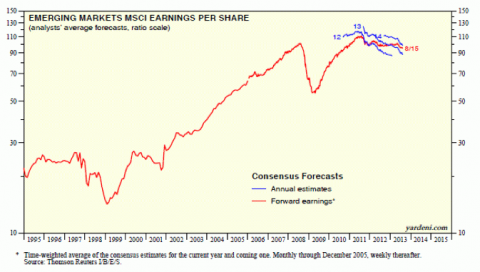
I don’t expect that yesterday’s anxiety attack over the deteriorating Middle East situation will turn into another panic attack for the US stock market. On the other hand, while US stock prices have been quite resilient this summer, the currencies, bonds, and stocks of emerging market (EM) economies have been getting clobbered. This has happened because global investors fear that the consequences of prospective Fed QE tapering will be more severe for the EMs than for developed economies. That’s only part of the story. The fact is that the forward earnings of the MSCI Emerging Markets composite peaked at a record high during the week of August 4, 2011 and has been trending lower since then. Analysts’ consensus estimates for both 2013 and 2014 also are falling, and at a faster pace in recent weeks. Net earnings revisions have been negative for the past 30 months. Read more of this post

The Day Everbright Had to Pull Power Plugs to Stop Erroneous Trading

08.28.2013 17:09

The Day Everbright Had to Pull Power Plugs to Stop Erroneous Trading

Securities firm made a bundle by skipping a crucial risk control step so it could deal fast, but when things soured, traders literally resorted to yanking cables out of sockets

By staff reporters Yang Lu, Fan Junli, Fu Yanyan and Zhou Qun

(Beijing) – How did a simple system glitch slip past layers of supposedly strong fail-safe mechanisms and rock the country’s entire securities market? This is the question that many people have been asking since a trading error by Everbright Securities directly led to erroneous transactions worth billions of yuan on August 16. The A-share index surged as a result, then fell the same day when the firm admitted its mistake. Read more of this post

Strike on Syria could trigger retaliatory attacks, cyberwar

Strike on Syria could trigger retaliatory attacks, cyberwar

1:09am EDT

By Warren Strobel and David Alexander

WASHINGTON (Reuters) – It’s a truism often repeated in the Pentagon and across the U.S. security establishment: In war, the enemy gets a vote. A U.S.-led cruise missile attack on Syria in response to its alleged use of chemical weapons, which seems increasingly likely in the coming days, could provoke reprisals from Damascus and its backers, ranging from retaliatory missile strikes to terrorist attacks and cyberwar, according to government officials and private analysts. Read more of this post

Rolling returns to assess fund performance

portfolio manager patterns

Tom Brakke

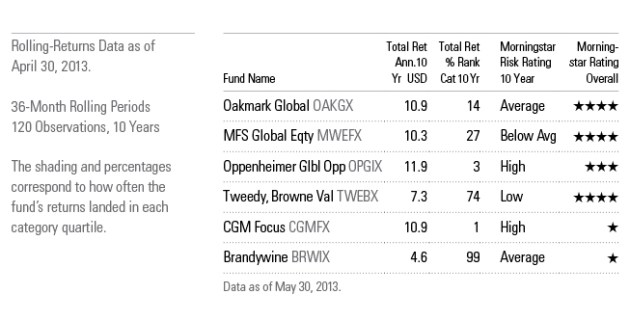
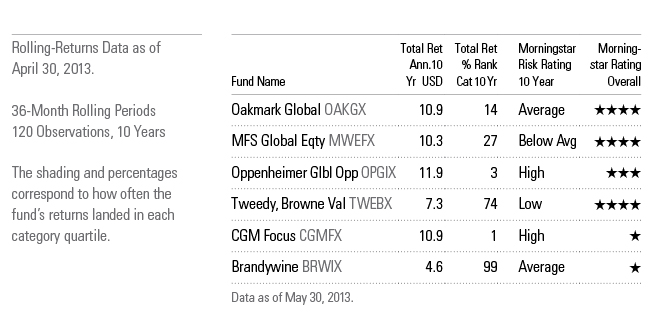
Morningstar published an article on rolling returns that included this graphic:

18101809

It shows the percentage of time the three-year trailing returns for six funds spent in each quartile of their respective categories.  (This is monthly for ten years, so 120 observations.) By chance, I had just read this from Howard Marks, I believe from 1990:  “I feel strongly that attempting to achieve a superior long term record by stringing together a run of top-decile years is unlikely to succeed.  Rather, striving to do a little better than average every year — and through discipline to have highly superior relative results in bad times — is:  less likely to produce extreme volatility, less likely to produce huge losses which can’t be recouped and, most importantly, more likely to work (given the fact that all of us are only human).” Read more of this post

Markets must force banks, like petulant toddlers, to grow up

August 28, 2013 5:56 pm

Markets must force banks, like petulant toddlers, to grow up

By Tim Harford

Even with a large equity cushion, the perverse incentives of ‘too big to fail’ will assert themselves

Like monstrous toddlers, the world’s banks have stumbled from manic exuberance, destroying all they touch with clumsy glee, to petulant refusal to get off the floor. As any parent will tell you, round-the-clock supervision of toddlers is impossible and clearing up the mess is no fun. How can we force banking to grow up? The problem is that governments – rightly, given the present set-up – regard certain banks as too big or too interconnected to fail. Read more of this post

Making law school cheaper; For many, two years is plenty

Making law school cheaper; For many, two years is plenty

Aug 28th 2013, 18:36 by The Economist | NEW YORK

20130831_USC290

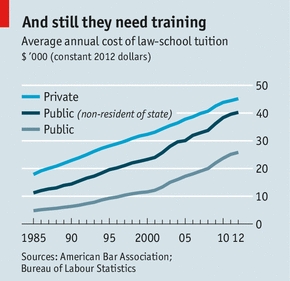
“THIS is probably controversial to say, but what the heck,” said Barack Obama on August 23rd. “[L]aw schools would probably be wise to think about being two years instead of three.” Mr Obama once taught constitutional law; his proposal could put many of his former colleagues out of work. Yet he has a point. For most of the 1800s, would-be lawyers (such as Abraham Lincoln) learned the trade as apprentices. Law schools sprouted up late in the century, in two main flavours. Elite universities set up legal departments for posh students; night schools catered to the sons of immigrants. Read more of this post

Have you fed your Cash-Eating Organism today? Fraud, failure and bankruptcy pay well for CEOs

Aug. 28, 2013, 6:15 a.m. EDT

Fraud, failure and bankruptcy pay well for CEOs

MW-BH494_ceos_h_20130827154355_MN

Commentary: Have you fed your Cash-Eating Organism today?

By Al Lewis

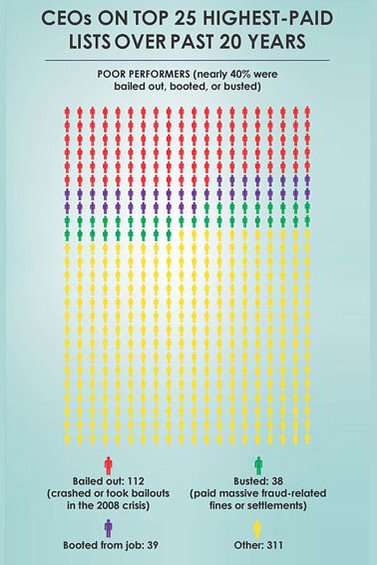
Richard Fuld had a $66 million payday in 2000 because, well, he was a great chief executive officer, now wasn’t he?

Though the Internet bubble popped and the Nasdaq peaked in 2001, he made another $105.2 million. In 2002, he bagged yet another $28.7 million; 2003, $52.9 million; 2004, $41.8 million; 2005, $104.4 million; 2006, $27.3 million; 2007, $40 million. His tab for eight years of CEO work came to $466.3 million. You may still remember the name of his company. It was called Lehman Brothers. In 2008, it set a record as history’s largest bankruptcy, setting off the nuclear reaction we now call the financial crisis and cementing America’s future as a socialist state for giant banks and corporations. Read more of this post

Hank Paulson: Why Fannie and Freddie remain a big threat

Hank Paulson: Why Fannie and Freddie remain a big threat

By Katie Benner August 28, 2013: 10:45 AM ET

No one had a better view of the chaos of the financial crisis five years ago than former Treasury Secretary Hank Paulson. In this expansive Q&A, he tells Fortune where the trigger points for the next meltdown may be.

FORTUNE — To commemorate the five-year anniversary of the financial crisis, former Treasury Secretary Hank Paulson has written a new prologue to his memoir On the Brink, which chronicles the dark days of 2008. As head of the Treasury, Paulson, now 67, had the herculean task of saving the global banking system when problems in the subprime mortgage market sent waves of losses to the furthest reaches of the financial markets. Read more of this post

For the first time, the combined GDP of poor nations is greater than the rich ones

For the first time, the combined GDP of poor nations is greater than the rich ones

By David Yanofsky @YAN0 August 28, 2013

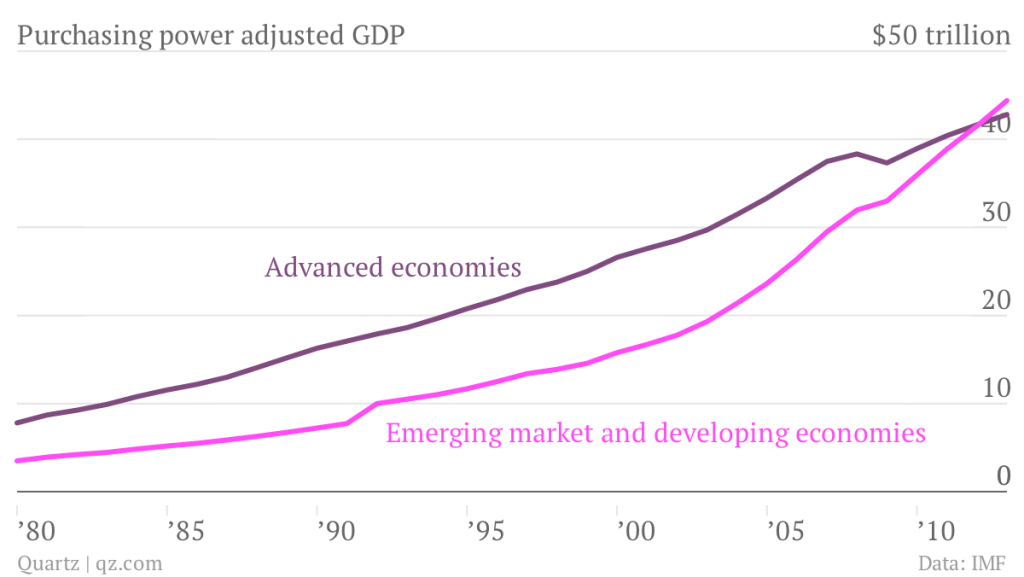
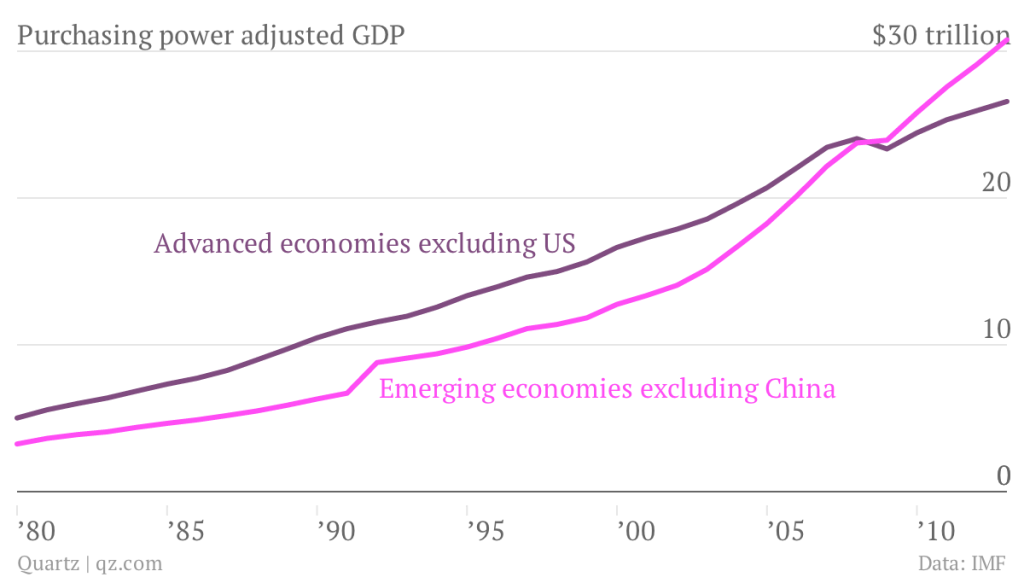
For the first time ever, the combined gross domestic product of emerging and developing markets, adjusted for purchasing price parity, has eclipsed the combined measure of advanced economies. Purchasing price parity—or PPP for short—adjusts for the relative cost of comparable goods in different economic markets. According to the International Monetary Fund—the supplier of this data—emerging and developing economies will have a purchasing price parity-adjusted GDP of $42.8 trillion in 2013, while that of emerging economies will be $44.4 trillion. In other words, emerging markets will create $1.6 trillion more value in goods and services than advanced markets this year. Advanced economies are, according to the IMF, the 34 nations that result from combining the members of the G7, euro area countries, and the 4 “newly industrialized Asian economies”—Taiwan, Hong Kong, Singapore, and South Korea. The world’s 150 other nations are considered emerging or developing. Excluding the largest advanced economy, the United Sates, and the largest emerging economy, China, which both account from more than 30% of their respective group’s total GDP, the data show that the PPP-adjusted GDP of poorer nations surpassed that of richer ones in 2009. It’s worth keeping in mind that the emerging economies have strength in numbers. Not only are there more emerging and developing nations; those nations also boast a larger combined population. As such, emerging and developing economies trail far behind advanced economies in per-capita terms. Their aggregate per-capita PPP-adjusted GDP is $7,415, while the same measure for advanced nations totals $41,369.

purchasing-power-adjusted-gdp-advanced-economies-emerging-market-and-developing-economies_chartbuilder purchasing-power-adjusted-gdp-advanced-economies-excluding-us-emerging-economies-excluding-china_chartbuilder gdp-ppp-per-capita-advanced-economies-emerging-market-and-developing-economies_chartbuilder-2

Brazil Raises Rate to 9% as Real Undercuts Inflation Fight

Brazil Raises Rate to 9% as Real Undercuts Inflation Fight

Brazil’s central bank raised the key rate by half a percentage point for a third straight meeting, as a plunge in the currency undermines efforts to slow inflation in the world’s second-largest emerging market. The bank’s board, led by President Alexandre Tombini, today unanimously voted to raise the benchmark Selic rate to 9 percent from 8.5 percent, as forecast by 50 of 52 economists surveyed by Bloomberg. One economist expected a 75 basis-point increase, while one forecast a 25 basis-point boost.

Read more of this post

Bond Binge Expands Leverage Toward Financial Crisis Peak

Bond Binge Expands Leverage Toward Financial Crisis Peak

Company debt loads in the U.S. are approaching the highest level since the aftermath of the financial crisis as borrowing to finance mergers and shareholder payouts exceeds earnings growth.

Debt levels have increased faster than cash flow for six straight quarters, boosting the obligations of investment-grade companies in the second quarter to 2.09 times earnings before interest, taxes, depreciation and amortization, according to JPMorgan Chase & Co. That’s up from 2.07 times in the first three months of 2013 and compares with 2.13 in the third quarter of 2009, when it peaked after the deepest recession since the Great Depression. Read more of this post

Why $3.4tn in foreign reserves is not China’s escape hatch

Why $3.4tn in foreign reserves is not China’s escape hatch

Guest writer | Aug 28 08:40 | 5 comments | Share

By Paul J. Davies, the FT’s Asia financial correspondent.

After trying to work out how big China’s bad debt problem might be, many people still turn round and point to the country’s mammoth foreign exchange reserves as its great get-out clause. The idea is seductive. On a deliberately gross calculation using the 20 per cent non-performing loan rate found at China’s big banks in the late 1990s, total bad debts would amount to Rmb21tn. A more sensible stab might put the level at roughly half that, or Rmb10tn. These are painfully large numbers – but hang on, China’s central bank has foreign exchange assets of $3.4tn, or Rmb20tn. Perfect – what’s the problem? Read more of this post

Beijing land values surpass US annual GDP

Beijing land values surpass US annual GDP

Staff Reporter

2013-08-28

Transaction prices in China’s urban housing market have touched new highs in 2013, such as Beijing, Shanghai, Guangzhou and Hangzhou. In Sunhe, located in the Zhaoyang district in Beijing, Cofco Property, spent 2.36 billion yuan (US$385 million) on July 23 this year to buy an HIJ plot, measuring 33,000 square meters. The floor area was priced at 44,000 yuan (US$7000) per square meter, making it the most expensive plot of land in the capital. On Aug 16, China Resources won the bid for a plot of land in Qianhai, Shenzhen for 10.9 billion yuan (US$1.7 billion), which broke the record for the highest price quoted for a single land transaction. Read more of this post

“China has made too many mistakes, and urbanization in several places is not even real”

Urbanization in parts of China slower than Vietnam

Staff Reporter

2013-08-28

C812X0702H_2010資料照片_N71_copy1

Ren Zhiqiang, right, attends a meeting in Hainan. (Photo/Xinhua)

Until China solves its problems of household registration and land issues, urbanization in certain parts of the country will still be slower than those found in Vietnam, said a Beijing party official. “China has made too many mistakes, and urbanization in several places is not even real,” said Ren Zhiqiang, who also doubles as the chairman of Huayuan, a real estate company based in Beijing. Ren suggested that China allows people to have access to all the resources related to urbanization. “First, the industry has to become a free market. Second, the government should give people the right to change their residence,” he said. “Many in China blame real estate companies for resources being unequally allocated. But the government is actually the one to be blamed, because it caused the country’s urbanization to be slower than other Asian countries, Vietnam for example,” he said.


China’s Transparency Standards, U.S. Investor Expectations Collide; Government Policy Curtails Scrutiny of Links Between Officialdom and Business

Updated August 27, 2013, 1:44 p.m. ET

China’s Transparency Standards, U.S. Investor Expectations Collide

Government Policy Curtails Scrutiny of Links Between Officialdom and Business

JAMES T. AREDDY

SHENZHEN, China—In the almost six years since VisionChina Media Inc.VISN -4.15% raised $115 million in a U.S. initial public offering, the Chinese broadcasting company hasn’t told U.S. investors its co-founder is the daughter-in-law of a senior figure in the Chinese Communist Party. Should it have? The omission is legal. But it illustrates wide differences between China’s transparency standards and U.S. investors’ expectations. The issue of Chinese political interests overlapping with business comes as inconsistencies pile up over how the U.S. and China treat information. Over the past year, Beijing and Washington have butted heads over jurisdiction to regulate auditors and enforce legal rulings. Accusations by U.S. hedge funds that several China-based, U.S.-traded companies engaged in fraudulent accounting have erased billions of dollars in market value, also hitting shares of companies not accused of wrongdoing. More recently in China, one scandal after another has highlighted ties between business and the relatives of politicians. Read more of this post

CBRC Tells Banks to Limit Investment in Local Government Bonds

CBRC Tells Banks to Limit Investment in Local Government Bonds

China’s banking regulator told lenders to be “cautious” when investing in bonds issued by local government financing vehicles as policy makers seek to rein in local borrowing. The China Banking Regulatory Commission has capped at end-2012 levels LGFV loans by banks, which are banned from providing guarantees to the entities’ bonds, Cao Guoqiang, Vice President of China Citic Bank Corp. (998), said at a teleconference. Read more of this post