NY property agents, brokers stripped of corporate titles; The use of corporate honorifics like “senior vice president” among brokers and agents without any actual corporate duties turns out to be illegal.

August 19, 2013

NY property agents, brokers stripped of corporate titles

By ELIZABETH A. HARRIS

Alex Dietrich, a real estate agent with Nest Seekers International, has recently found himself fielding an unwelcome question from some clients. “They ask, ‘Have you been demoted?’” said Mr. Dietrich, who was a vice president and managing director until earlier this year. “It is not ideal.” Mr. Dietrich has not been demoted, nor is he alone in his tumble from grace. Tens of thousands of real estate agents and brokers around New York were stripped of their corporate titles this year — senior vice president, managing director and the like — after the New York Department of State, which issues real estate licenses, said the use of corporate honorifics without any actual corporate duties was, in fact, illegal. Read more of this post
Mutual Funds Try Hard To Hide One Statistic: Maximum drawdowns or the worst-ever losing period for any given investment

Mutual Funds Try Hard To Hide One Statistic

MAMTA BADKAR AUG. 21, 2013, 5:51 PM 4,609

Mutual Fund Companies Are Keeping A Big Secret (Advisor Perspectives)

Gary Halbert of Halbert Wealth Management shared a FINRA quiz on economic and investment basics with his readers and one of the questions many of them missed was on drawdowns. “Maximum (or max) drawdown refers to the worst-ever losing period for any given investment,” he writes. Mutual funds according to Halbert try hard to hide this statistic because “it doesn’t fit into their “relative return” view of the world.” “Mutual funds like to compare their performance to stock and bond market indexes. Think how often you hear commercials for mutual funds bragging that they beat this or that market index. Sounds impressive, doesn’t it? Read more of this post

Mom-and-Pop Investors Bolt Emerging Markets; Since Start of June, $18.1 Billion Pulled From Emerging-Market Bond Funds

Updated August 21, 2013, 7:30 p.m. ET

Mom-and-Pop Investors Bolt Emerging Markets

Since Start of June, $18.1 Billion Pulled From Emerging-Market Bond Funds

ERIN MCCARTHY

MI-BY030_EMFLOW_G_20130821182703

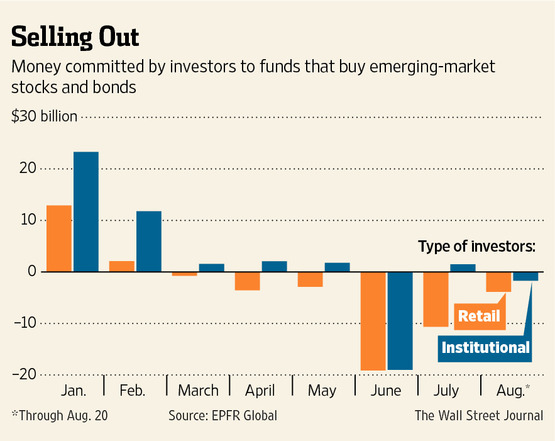
Retail investors have led the summer stampede out of emerging-market stocks, bonds and currencies, pulling almost twice as much money as institutional investors such as insurance companies and pension funds. The action highlights the outsize impact mom-and-pop investors can have on global markets at a time of low interest rates, disappointing investment returns and volatile market reactions to perceived shifts in central-bank policy. Since the start of June, retail investors have pulled $18.1 billion from emerging-market bond funds, about one-third of the amount they had put in since the financial crisis, according to fund tracker EPFR Global. By comparison, institutional investors have pulled $9.3 billion, or about 10% of their postcrisis inflows. The same pattern can be seen in the stock market, where retail outflows continue even as institutional investors have largely stopped selling. Read more of this post

Long-term mutual funds fell $879 million in the latest week as investors pulled money from domestic stock funds and bonds; Equity mutual funds have recorded weekly gains for most of 2013, after investors had avoided them in the wake of the 2008 financial crisis

August 21, 2013, 8:50 p.m. ET

Long-Term Funds Drop

NATHALIE TADENA

Long-term mutual funds fell $879 million in the latest week as investors pulled money from domestic stock funds and bonds, according to the Investment Company Institute. Equity mutual funds have recorded weekly gains for most of 2013, after investors had avoided them in the wake of the 2008 financial crisis. Meanwhile, bond funds have recorded outflows in recent weeks amid a recent run-up in interest rates. For the week ended Aug. 14, equity funds had inflows of $1.49 billion, down from prior-week inflows of $3.41 billion. Domestic equity funds declined by $764 million, while foreign equity funds gained $2.26 billion. Read more of this post

Junk bonds and the rate cycle

August 21, 2013 10:16 pm

Junk bonds and the rate cycle

By James Mackintosh

Betting now offers much smaller margin of safety

So much for risk-free. Not only have US 10-year Treasury bonds lost almost 10 per cent since taper talk started in May, they have also been beaten by US investment grade corporate bonds (down 6 per cent) and by junk bonds (down 2.5). Look in more detail, and the inversion is even clearer: the higher the credit rating of a bond, the bigger the loss – with the lowest-rated junk only just losing money, according to Barclays’ indices. Read more of this post

Investors have yanked $30.3 billion from U.S.-listed bond mutual funds and exchange-traded funds this month, marking the third-largest monthly outflow in records going back to 1984

August 21, 2013, 5:24 p.m. ET

Investors Yank Money From Bond Funds

August Outflows Are Third-Largest Monthly Figures on Record

KATY BURNE

Investors have yanked $30.3 billion from U.S.-listed bond mutual funds and exchange-traded funds this month, marking the third-largest monthly outflow in records going back to 1984, according to estimates by TrimTabs Investment Research. The redemptions, which are through Aug. 19, come amid fears the Federal Reserve will begin winding down its bond-buying stimulus program as soon as September, the data company said, causing interest rates to rise following a postcrisis boom for bonds. When yields rise, the price of existing bonds falls, exposing investors to losses. Read more of this post

Hedge Funds Severely Underperforming This Year

Aug 21, 2013

Hedge Funds Severely Underperforming This Year

By Steven Russolillo, Reuters

OB-YP696_goldma_G_20130821110110

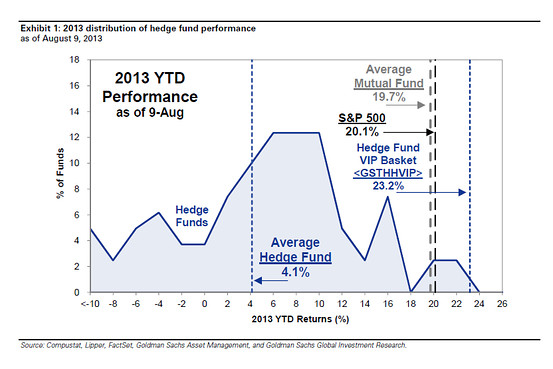
It’s been a great year for the stock market. It’s been a tough year for a hedge-fund manager. A typical hedge fund has risen 4%, on average, this year through Aug. 9, according to an analysis conducted by Goldman SachsGS -1.54%. That performance compares to a 20% total return (including dividends) for the S&P 500 over the same time frame, meaning the market has outperformed an average hedge fund by five times this year. Read more of this post

Financial Crisis-Era Derivatives Are Making A Comeback

Financial Crisis-Era Derivatives Are Making A Comeback

VERONIQUE DUPONT, AGENCE FRANCE-PRESSE AUG. 21, 2013, 8:16 AM 2,066 11

Collateralized debt obligations, the complex financial instruments that cratered disastrously in the financial crisis, are back.

The market for the instruments, which were based on subprime mortgages, shrank from $520 billion in 2006 to just $4.3 billion in 2009 after the housing bust. Warren Buffett once called CDOs “financial weapons of mass destruction” because of their riskiness. Read more of this post

Bad Trades’ Ripple Effect; Most of Goldman’s Erroneous Orders to Be Canceled; Counterparties Face a Hit

Updated August 21, 2013, 7:56 p.m. ET

Bad Trades’ Ripple Effect

Most of Goldman’s Erroneous Orders to Be Canceled; Counterparties Face a Hit

JACOB BUNGE, KAITLYN KIERNAN  and JUSTIN BAER

MI-BY024_TRADEM_G_20130821183908

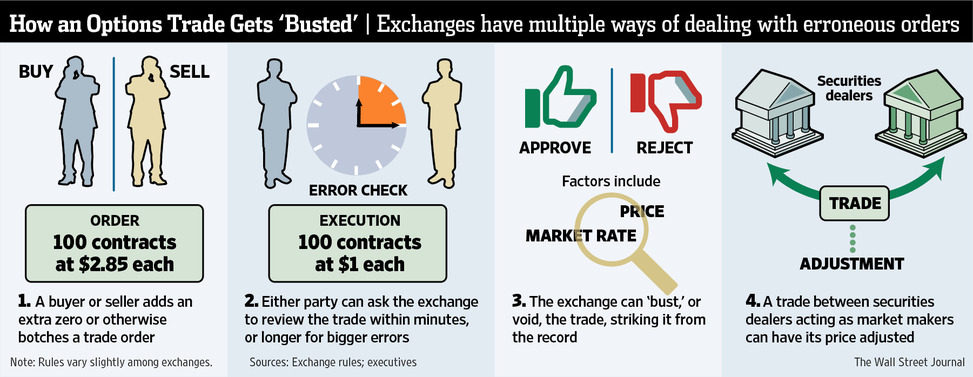
Goldman Sachs Group Inc. GS -1.54% won a preliminary victory to limit losses from a wave of erroneous trades that roiled U.S. options markets on Tuesday. After hours spent reviewing thousands of transactions, U.S. options-exchange officials on Wednesday decided to cancel most of the trades caused by a technical glitch in a Goldman trading system, people close to the matter said.

Read more of this post

An important reason for Bangladesh’s remarkable progress in recent years has been investment in education of health and education, especially for women

Women and property rights

Who owns Bangladesh?

Aug 20th 2013, 17:11 by The Economist | DHAKA and DELHI

AN IMPORTANT reason for Bangladesh’s remarkable progress in recent years has been investment in education of health and education, especially for women. Pick any of the standard measures of development—maternal health, female literacy and life expectancy—and you find that Bangladesh is beating India.

It is young women who stitch garments worth $20 billion in exports, women who own Grameen Bank, an embattled but Nobel-winning micro-lender, and women who have ruled the country as prime ministers since 1991—longer than men have managed, which might make Bangladesh unique in the history of the world’s republics. Read more of this post

Bond Trading Hampered as Buyers Retreat to Crowded Exits

Bond Trading Hampered as Buyers Retreat to Crowded Exits

The lowest volumes for U.S. corporate-bond trading since 2008 are underscoring the potential for market disruptions as regulations prompt dealers to retreat.

August trading volumes have plummeted to a daily average of $14.1 billion, down 9 percent from the corresponding period last year, even as the amount of company debt outstanding has soared by 12 percent. Bonds have lost 5 percent since the end of April on the Bank of America Merrill Lynch U.S. Corporate Index, the worst stretch since the credit crisis as the Federal Reserve considers curtailing its record stimulus. Read more of this post

Leveraged ETFs, the Flash Crash, and 1987

Aug 20, 2013

Leveraged ETFs, the Flash Crash, and 1987

By Paul Vigna

OB-UZ996_blackm_E_20121018101126

Okay, this is going to be a wonky post. But it brings together a high-risk investing strategy, the flash crash, and the Crash of 1987, and shows how little-known corners of the investing world can still have a big market impact.

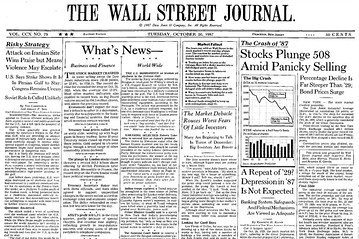
You could be forgiven if you’ve never heard of leveraged ETFs. But this smallish corner of the investing universe could, under the right circumstances, do to the market what portfolio insurance did to the market in 1987: that is, force a liquidation that sparks a big selloff. Read more of this post

Currency Volatility in Emerging Market Is Unnerving Investors

AUGUST 20, 2013, 9:02 PM

Currency Volatility Is Unnerving Investors

By NATHANIEL POPPER

Lawmakers and central bankers in India, Indonesia, Turkey and several emerging-market economies are scrambling to contain the damage from falling currencies and to keep foreign investors from heading for the exits. Money has poured out of those economies over the last few weeks, pushing down the prices of a wide array of assets, including stocks, bonds and currencies. On Tuesday, the Indian rupee fell to a record low against the dollar, while the Indonesian rupiah dropped to its lowest level against the dollar since 2009. Read more of this post

Japan’s nuclear crisis deepens, China expresses ‘shock’

Japan’s nuclear crisis deepens, China expresses ‘shock’

6:25am EDT

By Kiyoshi Takenaka and James Topham

TOKYO (Reuters) – Japan’s nuclear crisis escalated to its worst level since a massive earthquake and tsunami crippled the Fukushima plant more than two years ago, with the country’s nuclear watchdog saying it feared more storage tanks were leaking contaminated water.

The U.N.’s International Atomic Energy Agency (IAEA) said on Wednesday it viewed the situation at Fukushima “seriously” and was ready to help if called upon, while nearby China said it was “shocked” to hear contaminated water was still leaking from the plant, and urged Japan to provide information “in a timely, thorough and accurate way”. Read more of this post

A U.S. manufacturing comeback won’t rebuild the middle class

A U.S. manufacturing comeback won’t rebuild the middle class

By Nin-Hai Tseng, Writer August 21, 2013: 5:00 AM ET

Cheaper labor may bring about more jobs, but workers have less spending power.

FORTUNE — There’s been some good news lately about U.S. manufacturing — that sector of American industry once considered vital to the growth of the nation’s middle class. It’s well known manufacturing has been declining for decades, but experts, and some across corporate America, have been saying that many factors signal that factory jobs that have gone to China and other parts of the world are returning. Read more of this post

Should India be “investment grade?”

Should India be “investment grade?”

By Heather Timmons 2 hours ago

For more than a year, India has been teetering on the edge of a credit rating agency cliff: The country’s sovereign credit rating, a measure of its overall political and economic stability, is rated just one notch above “junk” by Fitch, Standard & Poor’s and Moody’s.

Surprisingly, the country has not yet fallen over that edge. Rating agencies are notoriously unreliable when it comes to judging the actual worthiness of a company, country or financial asset, and their performance in the run up to the subprime mortgage crisis (and subsequent testimony in the lawsuits afterward) has seriously undercut their reputations as objective advisors. Read more of this post

India Borrowing Costs at 2001 High Threaten Singh Goal

India Borrowing Costs at 2001 High Threaten Singh Goal

A surge in Indian sovereign debt costs to a 12-year high this week is threatening Prime Minister Manmohan Singh’s plan to cut the budget deficit and fueling the fastest surge in credit risk since 2008.

Ten-year (GIND10YR) yields rose 72 basis points this month through yesterday to 8.92 percent, the most among 14 regional markets tracked by Bloomberg, touched the highest level since 2001 of 9.48 percent. They plunged 57 basis points today after the Reserve Bank of India said late yesterday it will buy long-dated notes via open-market auctions. Government debt in Indonesia added 68 basis points to 8.39 percent. Read more of this post

Plunging Rupiah Spurs Yudhoyono Into Action With Policy Plans

Plunging Rupiah Spurs Yudhoyono Into Action With Policy Plans

Indonesian President Susilo Bambang Yudhoyono will announce measures on Friday to deal with a slowing economy and a currency that’s fallen to a four-year low. The government will draft a package of policies, and the rupiah’s plunge is the main problem to be tackled, Yudhoyono told reporters in Jakarta today. It will be difficult to reach a target of 6.3 percent expansion by relying on investment as exports decline, he said.

The move comes after Yudhoyono, due to hand over power in elections next year, gave a favorable assessment of his economic record in two speeches on Aug. 16. Since then, central bank data showed the current-account deficit widened to a record in the second quarter, the rupiah fell 3.6 percent and the Jakarta Composite index of shares slid 7.7 percent this week. Growth has slowed for the last four quarters, dipping below 6 percent in the three months through June for the first time since 2010. Read more of this post

Thailand Holds Rate as Rising Debt Curbs Room to Aid Economy

Thailand Holds Rate as Rising Debt Curbs Room to Aid Economy

Thailand kept its benchmark interest rate unchanged for a second straight meeting as rising household debt and capital outflows reduce scope for monetary easing to revive an economy in recession.

The Bank of Thailand held its one-day bond repurchase rate at 2.5 percent, with policy committee members voting six to one for the decision, it said in Bangkok today. Nineteen of 20 economists in a Bloomberg News survey predicted the outcome, while one saw a reduction to 2.25 percent as an economic contraction last quarter added to signs of a regional weakening. Read more of this post

Malaysia’s Central Bank Trims 2013 Forecast; Data From Malaysia Underscores Fragile Growth Prospects in Southeast Asia

Updated August 21, 2013, 10:29 a.m. ET

Malaysia’s Central Bank Trims 2013 Forecast

Data From Malaysia Underscores Fragile Growth Prospects in Southeast Asia

ABHRAJIT GANGOPADHYAY

KUALA LUMPUR—Slowing growth and a dwindling current-account surplus are adding to market concerns about Malaysia when capital is flowing quickly out of the region. The central bank on Wednesday cut Malaysia’s full-year growth outlook, citing weak external demand as gross domestic product grew 4.3% in the second quarter from a year earlier, short of market expectations for a 4.7% rise. Bank Negara Malaysia projected the economy would grow 4.5%-5.0% in 2013, down from 5.0%-6.0% previously. GDP grew 4.1% in the first quarter on a seasonally adjusted basis. The cut to the central bank’s forecast “is perhaps a pre-emptive step to tamp down market expectation,” said Rahul Bajoria, an economist at Barclay’s Capital. Read more of this post

We’re not a start-up nation, Or even a nation at all, as the envy and spite aroused by the IBM-Trusteer deal reveal

We’re not a start-up nation

The Trusteer deal exposes Israel of 2013 as a collection of cultures, countries, world views, and tribes.

20 August 13 12:57, Yanki Margalit

Congratulations to Shlomo Kramer and Mickey Boodaei, the investors, and the hundreds of employees of Trusteer Ltd. An impressive business success. You established and built a real, global information security company with a reputation. Congratulations to IBM (NYSE: IBM) on its 14th acquisition in Israel and on the establishment of an information security center in the country. Read more of this post

Happy Meal Convertible Offerings Make People Angry

20 Aug 2013 at 11:40 AM

Happy Meal Convertible Offerings Make People Angry

By Matt Levine

It is not every day that the Wall Street Journal has afront-page article about “happy meal” convertible offerings with registered stock borrow facilities so I’m going to tell you about them. Here is what they are:1 A company sells a convertible bond to convertible arbitrageurs. At the same time, it lends shares of its own stock to the arbs so they can establish their hedge for the convertible. As the Journal points out, these deals go pear-shaped with horrific frequency – a third of them go bankrupt within five years, versus 7% of all convertible issuers.2And now people are all mad and suing and stuff, and there are insinuations that evil hedge funds made lots of evil money on these evil deals. All of this is very confused so let’s talk about it in excruciating detail shall we? Read more of this post

Asia’s debt conundrum reawakens ghosts of 1990s crisis

August 20, 2013 1:21 pm

Asia’s debt conundrum reawakens ghosts of 1990s crisis

By Josh Noble in Hong Kong

When China unleashed the largest stimulus package in its history in response to the2008 crisis and slowing export markets in the west, it came at a price. Today China is grappling with a bill that some economists say has driven total debt to gross domestic product past 200 per cent. While China offers the most extreme example of using debt to fund growth, it is a pattern that has been repeated across Asia. Without exports, central banks turned on the taps, leading to a jump in household and corporate borrowing. Read more of this post

As investors mull QE finale, Asia’s miracle shows signs of wear

As investors mull QE finale, Asia’s miracle shows signs of wear

5:04pm EDT

By Wayne Arnold and Tomasz Janowski

HONG KONG/TOKYO (Reuters) – Asia’s economic miracle looks increasingly vulnerable to the end of a decidedly earthly phenomenon – five years of ultra-cheap financing sparked by the U.S. monetary policy dubbed “quantitative easing”. The notion that a region associated with thrift, low debt and high savings is vulnerable to an ebbing tide of global credit is controversial. But the sell-off gripping emerging foreign exchange and equity markets this week has exposed an Asia that, despite amassing huge currency reserves and devising policies to insulate it from the kind of fund flight that triggered the Asian financial crisis in 1997 and 1998, has once again become susceptible to the rapid reversal of capital inflows. Read more of this post

Heavy debt weighs on Southeast Asian consumers; Betting on Asean growth may have become questionable

August 20, 2013 3:20 pm

Heavy debt weighs on Southeast Asian consumers

By Jeremy Grant

Betting on Asean growth may have become questionable

When Dhanin Chearavanont, Thailand’s richest man, committed this year to buying back a domestic discount store chain he once owned, it was clear he wanted it very badly. Mr Dhanin’s offer represented a whopping 44 times expected 2013 profits at Siam Makro, which is now a unit of Charoen Pokphand, Thailand’s largest agribusiness and food company of which he is chairman. The big idea was to expand the Makro concept of membership-only, cash-and-carry stores out of Thailand, where it has 57 stores, and across Southeast Asia, to take advantage of the region’s rising middle class. We hear a lot about the middle class in the countries of the Association of Southeast Asian Nations these days. As a way of describing how people are being lifted from rural poverty by moving to higher-paying jobs in cities, where they buy microwaves and kitchen utensils, it points to a trend. But betting too heavily on it may have become a questionable exercise, for two reasons. Read more of this post

King of Knives collapse: administrators to cut stores and staff

Ben Hurley Reporter

King of Knives collapse: administrators to cut stores and staff

Published 20 August 2013 12:02, Updated 20 August 2013 13:08

The King of Knives chain will continue to trade as administrators assess the state of the business.Photo: Kitty Hill

The creditors of national homewares franchise King of Knives will meet this Friday to determine the future of the company after it went into voluntary administration last week. The 25-year-old business, which has 60 stores in Australia and New Zealand, has been struggling through a difficult retail climate in recent years. But it was a decision from its bankers to withdraw finance that pushed it over the edge. “That put them in a cash crunch position which the directors had to fund personally, and they did,” says Antony Resnick, partner at appointed voluntary administrator BRI Ferrier. “We’re currently meeting with the key landlords to try to keep the group alive. We’re trading all stores at the moment. Read more of this post

Protege-Backed Expedition Shuts Asia Volatility Fund After Loss

Protege-Backed Expedition Shuts Asia Volatility Fund After Loss

Expedition Advisors Ltd., backed by New York-based Protege Partners LP, is returning investor capital in its Asia volatility hedge fund after losses. Expedition’s hedge fund, which sought to profit from stock swings in Asia outside of Japan, lost 14 percent since its May 2012 inception, according to its March newsletter, the last one sent out to investors and non-investors in the fund and obtained by Bloomberg News. “A prolonged period of suppressed volatility combined with a low ’vol of vol’ environment created a very difficult backdrop for our core strategy,” Craig James, Hong Kong-based chief investment officer of Expedition, said in an e-mailed statement. “Given the current climate, it was decided that money would be returned to our strategic investor.” Read more of this post

Super funds head Australia’s top 500 private companies

Super funds head Australia’s top 500 private companies

PUBLISHED: 1 HOUR 43 MINUTES AGO | UPDATE: 1 HOUR 17 MINUTES AGO

BEN WOODHEAD

Superannuation funds have again dominated the pointy end of Australia’s top 500 private companies, with Anthony Pratt-helmed Visy Industries the only non-super fund to squeeze into the top 10. Measured by total revenue, BRW’s annual list of the top 500 companies found AustralianSuper was once again the biggest private business in Australia, with total annual revenue of $24.9 billion in the 2012-2013 financial year. First State Super Fund was a distant second with $11 billion in revenue, while UniSuper moved up one rung on the ladder to come in at number three among the biggest private companies with revenue of $8.5 billion. Read more of this post

Wine exchange market booming in China with many winemakers able to borrow significant finances from the capital market

Wine exchange market booming in China

Staff Reporter

2013-08-21

The wine exchange market is booming in China, with many winemakers able to borrow significant finances from the capital market, reports the Guangzhou-based Southern Metropolis Daily. Between 2011 and 2012, investors channeled funds into sought-after wine brands, pushing up their prices to record highs. The price of a special 2012 edition of crystal white wine touched 1,200 yuan (US$196) a bottle in March and closed at 979 yuan (US$159) a bottle during its first trading day. This was a 25.5% jump from the wine’s original price. Some 14,079 bottles of the special edition wine were traded that day, with an exchange rate of 14.08%. Read more of this post

Tough-talking China pricing regulator sought confessions from foreign firms

Tough-talking China pricing regulator sought confessions from foreign firms

12:49am EDT

By Michael Martina

BEIJING (Reuters) – A senior Chinese official put pressure on around 30 foreign firms including General Electric and Siemens at a recent meeting to confess to any antitrust violations and warned them against using external lawyers to fight accusations from regulators, sources said. The meeting is evidence of what many antitrust lawyers in China see as increasingly aggressive tactics to enforce a 2008 anti-monopoly law and highlight a worsening relationship between foreign companies and China’s array of regulators. Two sources who were at the July 24-25 closed-door meeting said the senior official showed in-house lawyers how to write what they called “self-criticisms” and displayed copies of letters from companies admitting guilt in past antitrust cases. Lawyers employed by some of those firms were in the room. Read more of this post