Many Wall St. Banks Woo Children of Chinese Leaders

AUGUST 20, 2013, 8:46 PM

Many Wall St. Banks Woo Children of Chinese Leaders

By DAVID BARBOZA

For more than a decade, Wall Street’s biggest banks have hired the sons and daughters of senior Chinese government officials in the hopes that they can open doors and secure deals in the world’s fastest-growing major economy. The hirings were not well publicized, but they were no secret. The grandson of former Chinese President Jiang Zemin once worked for Goldman Sachs; the daughter of former Prime Minister Wen Jiabao used to work forCredit Suisse; and in 2006, the son-in-law of Wu Bangguo, then a member of the Politburo of the Communist Party, helped Merrill Lynch win a deal to arrange a $22 billion listing of the state-owned banking giant I.C.B.C. Read more of this post

Inner Mongolia: Where Bankers Sold Bunk; Shady banking practices have come to light at the fraud trial of a wealthy woman, and the regulator says insider crimes are a nationwide concern

08.21.2013 12:03

Inner Mongolia: Where Bankers Sold Bunk

Shady banking practices have come to light at the fraud trial of a wealthy woman, and the regulator says insider crimes are a nationwide concern

By staff reporters Wen Xiu and Wang Heyan

(Hohhot) – Underlying the trial of a woman authorities say drained bank accounts and kidnapped a banker’s wife are vexing questions about account security and teller supervision at China’s state-run bank branches in Inner Mongolia. Hundreds of millions of yuan were stolen from customer accounts at the Bank of China’s (BOC) branch and the Agricultural Bank of China’s (ABC) branch in the city of Bayan Nur between 2007 and 2011, say prosecutors who have charged Tu Ya and 23 alleged accomplices. These include Tu’s husband Jin Junping, a boyfriend named Li Shengrong and 11 former BOC employees. Read more of this post

Fraud Inquiry into Shanghai Insurance Firm Rattles Industry; Regulator takes closer look at companies after head of one dealer bolted to Fiji with a reported 500 million yuan

08.20.2013 19:00

Fraud Inquiry into Shanghai Insurance Firm Rattles Industry

Regulator takes closer look at companies after head of one dealer bolted to Fiji with a reported 500 million yuan

By staff reporter Wang Shenlu

Beijing – A fraud investigation into Shanghai’s largest insurance dealer has roiled the country’s insurance industry, prompting the regulator to meet and order closer scrutiny of such firms. Chen Yi, the general manger of Fanxin Insurance Agency Co., was escorted from Fiji back to China by Chinese police on August 19, Xinhua reported. On August 15, the Shanghai branch of the China Insurance Regulatory Commission (CIRC) said the company was selling unauthorized fixed-income financial agreements. A source close to the company said Fanxin engaged in sales fraud to get high commission fees from insurance companies. Public security officials in Shanghai said they received reports on August 12 that Chen had left the country with 500 million yuan. They have not been able to confirm that figure.

Read more of this post

China’s Corporate Crackdown

China’s Corporate Crackdown

20 August 2013

Simon Zadek

BEIJING – Multinational corporations are under siege in China. In recent months, the government has leveled a series of allegations of corporate misconduct – ranging from food-product contamination to price rigging, bribery, and environmental shortfalls – against foreign-owned companies, with important implications for the development of China’s business environment. Does the government’s recent behavior reflect a commitment to strengthening business ethics, marking the start of a long-overdue regulatory catch-up process? Or is it intended merely to create a convenient populist distraction from China’s current economic woes? Or are these revelations of often long-known corporate misdemeanors part of a complex power play involving competing Chinese interests? Read more of this post

Bitcoin Spawns China Virtual IPOs as U.S. Scrutiny Grows

Bitcoin Spawns China Virtual IPOs as U.S. Scrutiny Grows

The Bitcoin craze is catching on in China.

Sun Minjie is a 28-year-old Internet worker who lives in Beijing. Eager to profit from growing demand for the digital currency, Sun has invested more than $3,000 in a company called 796 Xchange Ltd., an online exchange for trading stocks and other financial instruments related to Bitcoin, where initial public offerings are also being held.

He’s part of a small but growing group of investors in China who have put the country into contention with the U.S. as the biggest downloader of the virtual money that’s being used to buy a growing range of goods and services online. While intensified scrutiny by U.S. regulators casts doubt on the currency’s future there, China’s Bitcoin industry is expanding. Read more of this post

Eat, drink, man, woman, meatballs; Ikea has figured out ‘glocal’ in a way that has eluded foreign retailers

August 20, 2013 5:30 pm

Eat, drink, man, woman, meatballs

By Patti Waldmeir in Shanghai

Ikea has figured out ‘glocal’ in a way that has eluded foreign retailers, writes Patti Waldmeir

What modern institution in China provides food, housing, love and babysitting, all under one roof? The Communist party may have dashed the Maoist “ iron rice bowl” to the ground, but Ikea is stepping in to take up the slack. The world’s largest furniture retailer not only invites Chinese consumers to nap on its beds and snack on its dinnerware; it lets pensioners hold matchmaking sessions over free coffee in its canteens, and even provides day care for the only grandchild, to make the whole Eat Drink Man Womanthing go that much more smoothly. Read more of this post

On Wall Street, a Reversal of Fortune; Slump in Aluminum Deliveries Marks Unraveling of Profitable Business

August 20, 2013, 5:12 p.m. ET

On Wall Street, a Reversal of Fortune

Slump in Aluminum Deliveries Marks Unraveling of Profitable Business

CHRISTIAN BERTHELSEN And TATYANA SHUMSKY

MI-BX983A_BANKT_G_20130820180027

Aluminum deliveries into warehouses run by big banks and trading firms have plunged this summer, highlighting Wall Street’s retreat from the once-lucrative commodities business amid stagnant markets, new rules and regulatory scrutiny. The slump marks the unraveling of a practice that boosted profits for several years at warehouse operators including Goldman Sachs Group Inc. GS +0.59% and Glencore Xstrata PLC. GLNCY -1.88% Bank warehousing practices now are the subject of investigations by several U.S. authorities, including a Senate panel. Read more of this post

As India’s Rupee Drops, Foreign Firms Reel; Fear of Fed Retreat Roils India; Economic Weakness in Developing Nations Is Laid Bare as Easy Money Dries Up; Rupee exposes India’s corporate debt stack

August 20, 2013, 1:59 p.m. ET

As India’s Rupee Drops, Foreign Firms Reel

SEAN MCLAIN

MK-CF705_INDOCO_NS_20130820173903 MK-CF706_INDOCO_NS_20130820171503

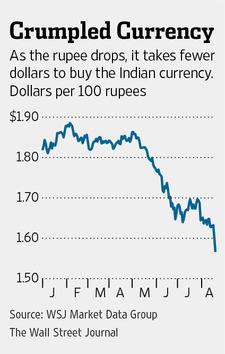
NEW DELHI—As India’s economy shifted into low gear earlier this year, sales at the country’s largest car manufacturer also lost steam, falling nearly 7% in the second quarter from a year earlier. Now the auto maker, Maruti Suzuki India Ltd., 532500.BY -0.81% faces trouble on a new front: the rapid drop in the Indian currency. The rupee has slumped nearly 3% against the dollar since last Wednesday and roughly 15% since May. “If the rupee remains where it is, it is going to hurt everybody across sectors,” Maruti Suzuki Chief Financial Officer Ajay Seth said Tuesday. “All the fundamentals have become very difficult right now.” Read more of this post

Japan to issue gravest Fukushima nuclear warning in two years; Fukushima Springs Another Leak in Battle With Radiated Water

Japan to issue gravest Fukushima nuclear warning in two years: agency

Tue, Aug 20 2013

By Kentaro Hamada and James Topham

TOKYO (Reuters) – Japan will dramatically raise its warning about the severity of a toxic water leak at the Fukushima nuclear plant, its nuclear watchdog said on Wednesday, its most serious action since the plant was destroyed by an earthquake and tsunami in 2011. The deepening crisis at the Fukushima plant will be upgraded from a level 1 “anomaly” to a level three “serious incident” on an international scale for radiological releases, a spokesman for Japan’s Nuclear Regulation Authority (NRA) said. That will mark the first time Japan has issued a warning on the International Nuclear Event Scale (INES) since three reactor meltdowns after the massive quake in March 2011. Read more of this post

Reversal of Fortune for Bangkok; Southeast Asia gets whipsawed by global money flows

August 20, 2013, 12:36 p.m. ET

Reversal of Fortune for Bangkok

Southeast Asia gets whipsawed by global money flows.

The land of smiles is not in a cheerful mood. Second quarter data out of Thailand on Monday showed that the economy contracted for a second time on a quarter-on-quarter basis, which was worse than expected and puts it technically in recession. The government has cut its growth forecast for the year to a range of 3.8% to 4.3% from its previous estimate of 4.2% to 5.2%. The main stock index dropped 3.3% on Monday and 2% on Tuesday. Read more of this post

Is Russia Already in Recession?

Is Russia Already in Recession?

(Corrects date of end of Putin’s term in final paragraph.)

Russia’s economy, long one of the drivers of growth in the developing world, might already be in recession. Worse, the country’s leaders are offering no indication that they’re prepared to combat it. Identifying recessions can be difficult in Russia. The typical definition is two quarters of declining gross domestic product, adjusted for inflation, but government statistics agency Rosstat provides only year-over-year data for international comparison. Read more of this post

The economic footprint of BPO industry; BPO industry in Philippines currently employs 770,000 people with total revenue expected to reach $6 billion

The economic footprint of BPO industry

FILIPINO WORLDVIEW By Roberto R. Romulo (The Philippine Star) | Updated August 21, 2013 – 12:00am

The Business Process Outsourcing Industry has come a long way since I first espoused the merits of this global business phenomenon in 2001, helping position the country, in collaboration with the early movers of BPO, by setting up Outsource Philippines and doing road shows all over the US and the UK. It was a big bet for investors to come to the Philippines back in those days. Read more of this post

New Zealand Targets Mortgage Lending to Avert Bubble; Restrictions to Be Placed on Bank Lending to Home Buyers Able to Make Only Small Downpayments

August 20, 2013, 5:05 a.m. ET

New Zealand Targets Mortgage Lending to Avert Bubble

Restrictions to Be Placed on Bank Lending to Home Buyers Able to Make Only Small Downpayments

LUCY CRAYMER And REBECCA HOWARD

WELLINGTON, New Zealand—New Zealand’s central bank imposed new curbs on mortgage lending aimed at heading off a nascent housing bubble that in the past has contributed to a recession. Reserve Bank of New Zealand Gov. Graeme Wheeler said in a speech that from Oct. 1, restrictions would be placed on bank lending to home buyers able to make only small downpayments. Under the plan, no more than 10% of new mortgage lending by registered banks may be to borrowers that put down less than 20% of the cost of the property as a deposit. Read more of this post

Why has the Fed given up on America’s unemployed? The costs of unemployment persisting are vast; the costs of pushing too far to cut it are small, says Adam Posen

August 20, 2013 4:48 pm

Why has the Fed given up on America’s unemployed?

By Adam Posen

The costs of unemployment persisting are vast; the costs of pushing too far to cut it are small, says Adam Posen

Complaints about public officials’ short time horizons are well rehearsed: the gripe is usually that too many activist policies result from pandering to voters and special interests. But the reality is that measures are often discarded before they have a chance to work. Then, having not really tried, policy makers claim that the target was unattainable. In macroeconomics, it is the unemployed who suffer most from this repeated failure to follow through. Read more of this post

U.S. program to curb stock price swings triggered frequently; The roll-out of a new program to limit wild price swings in publicly traded securities triggered dozens of trading halts as highly illiquid names were phased into the program

U.S. program to curb stock price swings triggered frequently

Mon, Aug 19 2013

NEW YORK (Reuters) – The roll-out of a new program to limit wild price swings in publicly traded securities triggered dozens of trading halts on Monday as highly illiquid names were phased into the program. By the session’s end, 48 exchange-traded products (ETPs) had been halted or paused on NYSE Arca, a unit of exchange operator NYSE Euronext, according to trading information provided by exchange operator Nasdaq OMX Group Inc. Seven other securities were halted on Nasdaq. Read more of this post

The Proxy Advisory Racket: Life’s easier when the feds encourage people to buy your product.

August 20, 2013, 7:12 p.m. ET

Review & Outlook: The Proxy Advisory Racket

Life’s easier when the feds encourage people to buy your product.

Federal regulators helped create the financial crisis by requiring banks to follow the advice of private credit-rating agencies. When these private firms like Standard & Poor’s and Moody’s guessed wrong about the mortgage market, the error was repeated across the financial system. Now one Washington regulator is warning that the government is making a similar mistake about another category of private firms. Read more of this post

Sovereign funds’ fortunes turn as emerging assets sour; “In private deals, agency issues become of the first order. Information is very poor. You can get screwed everywhere.”

Sovereign funds’ fortunes turn as emerging assets sour

2:01am EDT

By Natsuko Waki

LONDON (Reuters) – The world’s biggest sovereign wealth funds may see their bumper profits of 2012 diminish this year as recent diversification into high-growth emerging markets starts to produce disappointing returns. Their long-term horizon may allow many sovereign funds, which globally control $5 trillion of oil and other windfall assets, to weather losses. But the sheer size of these funds may increasingly limit the window of opportunities even when emerging markets recover. Read more of this post

Rising Markets Batter Short Sellers; Investors Betting Stocks Will Fall See Worst Losses in Decade

August 20, 2013, 9:24 p.m. ET

Rising Markets Batter Short Sellers

Investors Betting Stocks Will Fall See Worst Losses in Decade

JULIET CHUNG and  ROB BARRY

P1-BM802_SHORT_NS_20130820191204P1-BM803_SHORTj_G_20130820191504

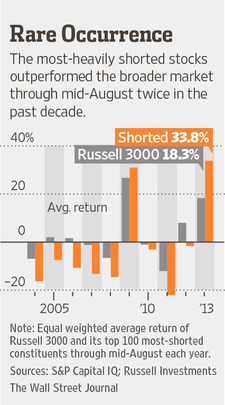
Short sellers are facing their worst losses in at least a decade, a Wall Street Journal analysis has found, as many of the rising stocks they bet against have only continued to soar. That has stung several high-profile hedge-fund managers, including William Ackman and David Einhorn, who have placed prominent short bets. In the Russell 3000 index, the 100 most heavily shorted stocks are sharply outperforming the average returns of stocks in the index, according to a Journal analysis of data provided by S&P Capital IQ. The shorted stocks are up by an average of 33.8% through Aug. 16, versus 18.3% for all stocks in the index. Read more of this post

Ripping Off Young America: The College-Loan Scandal

Ripping Off Young America: The College-Loan Scandal

The federal government has made it easier than ever to borrow money for higher education – saddling a generation with crushing debts and inflating a bubble that could bring down the economy

by MATT TAIBBI

AUGUST 15, 2013

20130814-nat-aff-306x-1376517780

On May 31st, president Barack Obama strolled into the bright sunlight of the Rose Garden, covered from head to toe in the slime and ooze of the Benghazi and IRS scandals. In a Karl Rove-ian masterstroke, he simply pretended they weren’t there and changed the subject. The topic? Student loans. Unless Congress took action soon, he warned, the relatively low 3.4 percent interest rates on key federal student loans would double. Obama knew the Republicans would make a scene over extending the subsidized loan program, and that he could corner them into looking like obstructionist meanies out to snatch the lollipop of higher education from America’s youth. “We cannot price the middle class or folks who are willing to work hard to get into the middle class,” he said sternly, “out of a college education.” Read more of this post

Medical Marijuana Spawning Pump-and-Dump Scams: Finra

Medical Marijuana Spawning Pump-and-Dump Scams: Finra

Con artists are taking advantage of the legalization of medical marijuana to lure investors into buying stock in weed-related companies, regulators said.

The scammers may be promoting the shares, then selling them to gullible investors in what’s called a “pump-and-dump” scheme, the Financial Industry Regulatory Authority said today in an e-mailed statement. The companies are touting their growth potential as more states allow pot for medical or recreational use, Wall Street’s self-funded regulator said.

“We’ve seen a rise over the last couple of months in marijuana-related potential stock scams,” Gerri Walsh, Finra’s senior vice president for investor education, said in a phone interview. “We often see with these stock-fraud scams that the next big thing, the cons tend to circle around.” Read more of this post

Italian business: No way back; Time is being called on the cross-shareholdings that have bound the top companies together

August 20, 2013 7:06 pm

Italian business: No way back

By Rachel Sanderson

Time is being called on the cross-shareholdings that have bound the top companies together

Cuccia

A finger in every pie: Enrico Cuccia, the founder of Mediobanca, who built the cross-holdings that linked Italian business

Over six decades, Cesare Geronzi ascended to the summit of Italian finance. Every step of the way, he took three scarlet chairs with him. They were in his antechamber when he was chairman of Capitalia, the Roman bank. They graced his waiting room at Mediobanca, the Milanese investment bank where, despite two fraud convictions, he became president. When he manoeuvred his way to the presidency of Generali, Italy’s largest financial group, the chairs sat in an office where Mr Geronzi’s windows opened on to a much-envied view of the Colosseum. Read more of this post

‘Work until I die’: Why older Americans are refusing to retire and how it’s changing the face of labour

‘Work until I die’: Why older Americans are refusing to retire and how it’s changing the face of labour

Tom Moroney, Bloomberg News | 13/08/20 | Last Updated: 13/08/20 2:44 PM ET
He’s on County Road 1680 moving like a black-tailed jackrabbit under the big-bowl Oklahoma sky, a tiny dot in his Ford Ranger out on the edge of the world when the flying red stinger ants show up.

One, two, now three, they invade. Jim Ed Bull swats with a big hand. “They can hurt ya bad,” he says. Read more of this post

BRIC: Is the fastest period of emerging-market growth behind us? Emerging Markets: A Contrarian Special?

BRIC: Is the fastest period of emerging-market growth behind us?

Defending the motion

Ruchir Sharma, Head of emerging markets and global macro at Morgan Stanley Investment Management

It is rare for emerging nations to sustain growth faster than 5% for even one decade, much less two or three, and only six countries have grown that fast for as long as four decades in a row.

Against the motion

Kishore Mahbubani, Dean and Professor, Lee Kuan Yew School of Public Policy, National University of Singapore

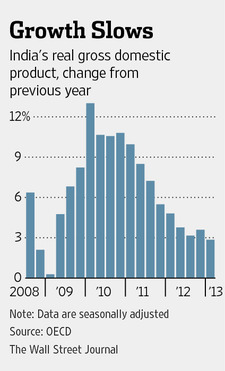
In 2013, China’s economy will grow by 7.8%, India’s by 5.6% and Brazil’s by 2.5%. In response, Western media headlines have begun screaming that the emerging-market story is over. Oh dear, here comes Western wishful thinking again.

The moderator’s opening remarks

Aug 20th 2013 | Ryan Avent

Since the early 2000s emerging markets have powered global economic growth. Emerging economies grew faster than the rich world, and from 2003 to 2011 they raised their share of global output by a percentage point each year. As a result, emerging markets now account for more of the world’s GDP than advanced economies. Yet as The Economist recently noted, a “great deceleration” seems to be under way. The Chinese and Indian economies have slowed dramatically from double-digit growth rates prior to the financial crisis; the IMF expects China to grow by just 7.8% this year and India by 5.6%. Most other large emerging economies are also slowing sharply. Read more of this post

CREDIT SUISSE: The End Of Zero Interest Rates May Create A ‘Huge Financial Disruption Akin To The End Of A War’

CREDIT SUISSE: The End Of Zero Interest Rates May Create A ‘Huge Financial Disruption Akin To The End Of A War’

ASHLEY KINDERGAN, THE FINANCIALIST AUG. 19, 2013, 5:56 PM 8,665 8

It wasn’t so long ago that the challenge of making money with interest rates stuck around zero was investors’ top concern. Those days are gone. Today, they’re worried about the opposite: the threat that now-rising rates pose for fixed income investments. That, and the downturn in emerging markets that many only recently embraced in the hunt for yield caused by those near-zero rates.

It’s easy to identify the date that things changed: May 22, the day that the Federal Reserve first alerted markets that it might soon start “tapering” the $85 billion in monthly asset purchases it has been making since December to juice the economy. And soon looks to be getting even sooner. A steady improvement in U.S. employment figures—unemployment fell from 7.6 percent in June to 7.4 percent in July—has brought into focus the 6.5 percent unemployment target the Fed set as a prerequisite for raising short-term interest rates. On Thursday, the U.S. Bureau of Labor Statistics released yet another piece of good news on the employment front: New applications for unemployment benefits sank to their lowest levels in six years in July. Read more of this post

EM storms could spread to Europe; Periphery eurozone bond markets could be next in line for sell-off

August 20, 2013 2:17 pm

EM storms could spread to Europe

By Ralph Atkins in London

Periphery eurozone bond markets could be next in line for sell-off

At the start of this year, emerging market turmoil was on few investors’ worry lists. Top preoccupations were US fiscal woes, the rumbling eurozone debt crisis and a possible “hard” landing for China’s economy. Nobody really considered what would happen if all those threats did not materialise. The financial storms hitting India and other developing economies this week are the answer. Read more of this post

What indebted politically-connected business elites have so far ignored is that their obligations carry with them a significant and pressing danger: currency risk

August 20, 2013

A Global Boom Is Facing the End of Easy Lending

By LANDON THOMAS Jr.

In a city where skyscrapers sprout like weeds, none grew as high as the Sapphire tower in Istanbul.

Today, it stands as a symbol of how far the mighty may fall. Like a vast majority of new buildings that have blanketed the Istanbul hills in recent years, the Sapphire — at 856 feet it is the tallest in Turkey and among the loftiest in Europe — was built on the back of cheap loans, in dollars, that have flooded Turkey and other fast-growing markets like Brazil, India and South Korea. The money began to flow when the Federal Reserve and other major central banks cut interest rates to the bone in 2009 and cranked up the printing presses in a bid to spur recovery in the United States and other advanced industrial nations. But now, with expectations mounting that the Federal Reserve, led by its departing chairman Ben S. Bernanke, may soon begin to tighten its monetary spigot, Istanbul’s skyline could well be a harbinger of an emerging-market bust brought on by unpaid loans, weakening currencies, and, eventually, the possible failure of developers and banks.

Read more of this post

Erdogan’s Witch Hunt Endangers Turkish Economy

08/20/2013 06:10 PM

Erdogan’s Witch Hunt Endangers Economy

By Özlem Gezer and Maximilian Popp

Turkish Prime Minister Recep Erdogan has begun scouring the financial industry for scapegoats to blame for the political unrest in his country. Banks and industrialists are being controlled and intimidated, and foreign investors are being scared off.

Long after sunset, the day’s heat lingers in the urban canyons of Istanbul’s Levent financial district. Beneath billboards depicting lingerie models, black sedans crawl, bumper-to-bumper, along Büyükdere Caddesi, a four-lane highway. In a café some distance from the office towers, Umut Keles, a Turkish analyst with an American investment bank, removes the battery from his mobile phone, afraid of being wiretapped by the Turkish government. He is speaking with us under two conditions: That we not use his real name or that of his employer. The investment banker believes that the government would take action against him if it knew his identity. “There’s a witch hunt underway here at the moment,” he says. Read more of this post

Banks Work Around China’s Lending Limits; Latest Tactic in Cat-and-Mouse Game With Regulators Hides Risks, Analysts Say

August 19, 2013, 12:38 p.m. ET

Banks Work Around China’s Lending Limits

Latest Tactic in Cat-and-Mouse Game With Regulators Hides Risks, Analysts Say

CYNTHIA KOONS and DINNY MCMAHON

MI-BX958_CTRUST_G_20130819181205

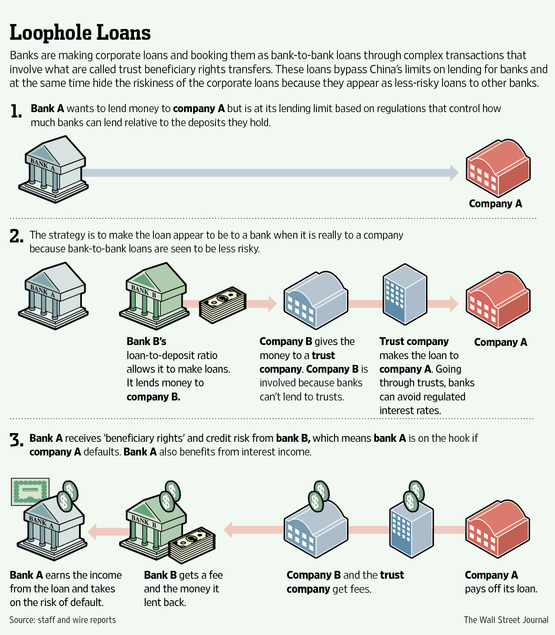
Chinese regulators have tried for months to rein in lending by the country’s banks, most recently by instigating a cash squeeze that left some scrambling for funds. But the banks have stayed one step ahead, keeping the lending spigots open largely through increasingly complicated transactions. The banks’ latest effort in their cat-and-mouse game with regulators involves making corporate loans appear on their balance sheets as less risky loans to banks. This allows banks to skirt limits on lending to customers but hides risks that they will be hit by big losses. Read more of this post

China’s insolvent toxic-waste dump Cinda for sale; investors would be wise to think carefully before buying in to the IPOs of China’s asset management firms

China’s insolvent toxic-waste dump Cinda for sale

Monday, 19 August, 2013, 12:00am

Tom Holland

Let’s wait and see the prospectuses, but investors would be wise to think carefully before buying in to the IPOs of China’s asset management firms

At some point in the next few months, China Cinda Asset Management is likely to list on the Hong Kong stock exchange, in a mega deal that could raise HK$20 billion or more. Meanwhile, Cinda’s counterpart, Huarong Asset Management, is busy lining up strategic investors ahead of an offering some time next year. The two companies will be sold to investors as universal financial services giants, with businesses on the mainland that range from banking and insurance, through asset management and leasing, to securities broking and commodity trading. In reality, they are toxic waste dumps. Worse: by any sensible standards they are insolvent. Both Cinda and Huarong, along with potential listing candidates Great Wall Asset Management and Orient Asset Management, were set up in 1999 to shift bad loans off the balance sheets of China’s Big Four state-owned banks. Read more of this post

It Looks Like 1998 Again in China

It Looks Like 1998 Again in China

Of all the reporting trips I made in my Washington days, flying with Lawrence Summers to Beijing so he could kiss Zhu Rongji’s ring ranks among the most fascinating.

Anyone who has spent inside of five minutes with Summers knows he’s not the groveling type. But this was in January 1998, when Summers was deputy secretary of the U.S. Treasury, and Bill Clinton’s White House feared China would devalue the yuan and toss more fuel onto Asia’s already blazing crisis. As we landed in Beijing, Zhu, China’s reformist premier-in-waiting, was the man to see first. Summers won pledges from Zhu not to weaken China’s currency and to keep Hong Kong’s dollar pegged to the U.S.’s. Read more of this post