Easy Cash Ebbs for $300 Billion Asean Port-to-Rail Cost

Easy Cash Ebbs for $300 Billion Asean Port-to-Rail Cost: Freight

Emerging Southeast Asian nations need to pour $300 billion into transport links to help ease freight bottlenecks. That just got harder as the prospect of reduced Federal Reserve monetary stimulus pushes up borrowing costs. Indonesia, Thailand, Malaysia and the Philippines require $128 billion of investment in roads, $119 billion for rail, $33 billion in ports and $16 billion for airports through 2020, Goldman Sachs Group Inc. estimates. At the same time, their government bond yields have surged since May as concern the Fed could taper cash injections sparked outflows of foreign capital. The four nations plan about $1 trillion in development spending, partly to improve goods transport performance that declined in all except the Philippines since 2007, based on World Bank rankings. The expenditure is needed to keep up a pace of expansion that averaged more than 6 percent in 2012, closing in on China and beating India for the first time in a decade. Read more of this post
Investors Grow Wary of Indonesia; Protectionism, Slowing Growth Are Worries as Election Approaches

Updated August 6, 2013, 7:14 p.m. ET

Investors Grow Wary of Indonesia

Protectionism, Slowing Growth Are Worries as Election Approaches

BEN OTTO and LAUREN DAVIDSON.

MI-BX696_INDOMK_G_20130806184513

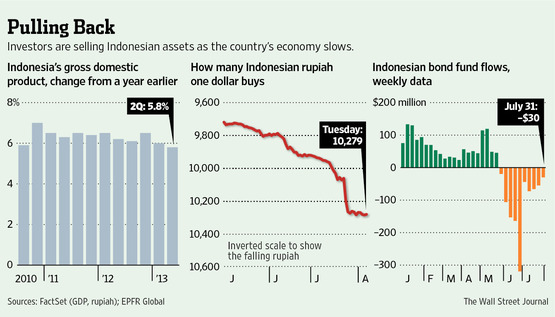
JAKARTA, Indonesia—Investors are souring on Indonesia as growth slows and a contentious election approaches. Indonesia’s economy expanded by just 5.9% in the second quarter, its worst showing since 2010. Prices for commodities exports such as palm oil and coffee are down, driving the trade balance deeper into the red. Inflation hit a 4½-year high in July after the government raised fuel prices. The country’s stocks, bonds and currency, the rupiah, all have sold off this summer as investors pulled cash out of emerging markets amid speculation the Federal Reserve was preparing to wind down its bond buying. The rupiah is down 6% against the dollar since the start of May. Over the same period, yields on 10-year government debt denominated in rupiah jumped to 7.63%, from 5.5%. Yields rise when prices fall. Read more of this post

Earnings disappointment may stall chase for outperforming China stocks

Earnings disappointment may stall chase for outperforming China stocks

12:44am EDT

By Clement Tan

HONG KONG (Reuters) – Chinese companies still able to report healthy profits could see their shares trim sharp gains if earnings disappoint, narrowing a yawning gap with firms struggling to cope with Beijing’s drive to consolidate industries plagued by overcapacity. The signs are starker in onshore markets where sectors such as technology and pharmaceuticals, which are still generating healthy profits, have significantly outperformed the lumbering industrials and materials firms plagued by inefficiency. Slowing growth in China is now a top concern for global investors, who have steadily cut exposure to emerging markets and braced for the risk of a possible hard landing in the world’s second-largest economy. Read more of this post

McDonald’s Franchisees Rebel as Chain Raises Store Fees; ‘‘It is not as profitable a business as it used to be”

McDonald’s Franchisees Rebel as Chain Raises Store Fees

By Leslie Patton – Aug 6, 2013

McDonald’s Corp. (MCD), already struggling to sell burgers in the U.S., now must contend with a brewing franchisee revolt. Store operators say the company, looking to improve its bottom line, is increasingly charging them too much to operate their restaurants — including rent, remodeling and fees for training and software. The rising costs are making franchisees, who operate almost 90 percent of the chain’s more than 14,100 U.S. locations, less likely to open new restaurants and refurbish them, potentially constraining sales.

McDonald’s is “doing everything they can to shift costs to operators,” said Kathryn Slater-Carter, who in June joined other franchisees in Stockton, California, to brainstorm ways of getting the chain to lessen the cost burden. “Putting too much focus on Wall Street is not a good thing in the long run. ‘‘It is not as profitable a business as it used to be,’’ said Slater-Carter, who owns two McDonald’s stores and backs California legislation that would require good faith and fair dealing between parties in a franchise contract. It would also allow franchisees to associate freely with fellow store owners. Read more of this post

Suicidal to buy land at current high prices: Singapore CDL Property Billionaire Chairman Kwek Leng Beng

Suicidal to buy land at current high prices: CDL Chairman

SINGAPORE — Buying land at the prevailing high prices would be “suicidal”, City Developments (CDL) Executive Chairman Kwek Leng Beng said yesterday, as he forecast private home prices to decline 5 per cent over the next year, with the Government’s cooling measures working their way through the market.

BY LEE YEN NEE –

5 HOURS 40 MIN AGO

SINGAPORE — Buying land at the prevailing high prices would be “suicidal”, City Developments (CDL) Executive Chairman Kwek Leng Beng said yesterday, as he forecast private home prices to decline 5 per cent over the next year, with the Government’s cooling measures working their way through the market. Under the law, developers with any foreign ownership — including most of the publicly-listed ones — are subject to Qualifying Certificate (QC) conditions, one of which is that all units must be sold within two years of completion. Developers can apply for an extension for a fee. Read more of this post

Better ways to play the merger mania; Big takeovers get all the attention, but demergers have a far better record of releasing value

August 2, 2013 6:28 pm

Better ways to play the merger mania

By Jonathan Eley

Big takeovers are back in the news, but what is the best way to profit from them? Mega mergers are back. This week, advertising groups Omnicom and Publicis announced a $35bn tie-up. Just a day or two earlier, Irish pharmaceuticals group Elan ended a long courtship by recommending a takeover by Perrigo. Closer to home, engineering group Invensys has recommended an offer from France’s Schneider Electric. The re-emergence of M&A has been long predicted, and there have been several false starts. Companies are sitting on big cash piles, having restructured and refinanced in the wake of the credit crunch, and that money is earning only nugatory returns in cash and other short-term instruments. The global economic recovery might still be slow and uneven, but there are now at least some tangible signs that it is heading in the right direction, giving chief executives the confidence to deploy some of that cash. Valuations in the US might be looking a bit stretched, but elsewhere in the world – especially in many parts of Europe – they are broadly reasonable. Read more of this post

First U.S.-Listed Chinese Firm Plans Switch to China; The curious case of a backdoor listing in Shanghai; Reverse A-share mergers

August 6, 2013, 7:56 AM

First U.S.-Listed Chinese Firm Plans Switch to China

A wave of Chinese companies have left the Nasdaq and NYSE in recent years, with their founders vowing to relist somewhere they’re more appreciated. Finally one company has announced plans to relist – but using the same reverse merger technique that got U.S. investors riled up when the same firms went to trade in the U.S. in the first place. China Security & Surveillance Technology, Inc., a Shenzhen-based firm that delisted from the NYSE in 2011, wants to list one of its subsidiaries, China Security & Fire, on the Shanghai stock exchange. According to a public filing, it plans to list part of itself via a sale to Shanghai Feilo Co.600654.SH -0.25% Ltd., a manufacturer of electronic parts for cars already trading on the Shanghai market. Read more of this post

Spotlight on solar panel maker Suntech in test for China

August 6, 2013 6:06 pm

Spotlight on solar panel maker in test for China

By Henny Sender

Close watch on case amid competing priorities

Suntech Power Holdings was once the biggest solar panel maker in the world by production volume, its founder Shi Zhengrong was the richest man in China and the offshore parent company was listed in New York with a market capitalisation of $16bn. Then in March, Wuxi Suntech, its principal subsidiary, filed for bankruptcy under China’s new revitalisation law. Chinese banks are owed about $2.3bn by the mainland entity according to filings as of year-end 2011. Creditors to the offshore parent, a group with claims of almost $600m that includes several hedge funds as well as the IFC arm of the World Bank, are also attempting to recover their loans. The offshore parent has not filed for bankruptcy and is still operating. Read more of this post

India’s Indigenous Languages Drive Wikipedia’s Growth

India’s Indigenous Languages Drive Wikipedia’s Growth

MAHESH SHARMA

posted 16 hours ago

Despite accommodating the world’s second largest English-speaking population behind the United States, it is India’s indigenous language speakers that are creating and consuming the content that is driving Wikipedia’s growth on the subcontinent. The Wikimedia Foundation last year issued a  $440,000 grant to the Bangalore-based Centre for Internet and Society (CIS), which, along with the local Wikimedia chapter, has trained almost 2,500 Indians how to edit and create content in their local languages. While the country’s official languages are Hindi and English (when the country earned its independence in 1947, the states couldn’t agree to be represented by a single local tongue) there are over a thousand recognised dialects, and 22 official languages spoken by over a million people. Read more of this post

Australia and the curious case of the highly politicised interest rates

Australia and the curious case of the highly politicised interest rates

Kate Mackenzie

| Aug 06 08:59 | 11 comments | Share

Politics has definitely been an element in the discussions around who will replace Ben Bernanke at the Fed. That’s probably putting it mildly. But we suspect even the US doesn’t have quite the partisan obsession Australia boasts. Australia’s central bank cut its cash interest rate to 2.5 per cent today, a record low. Australians being a rather highly leveraged bunch, the RBA’s interest rate decisions are almost always reported with focus on the implications for mortgagees. And this cut happened to be made a few days after an election was called which, surprise surprise, is set to be tightly contested… Read more of this post

Bank commodity hoarding to end?

Bank commodity hoarding to end?

Posted by Houses and Holes in Commoditieson August 6, 2013 | 16 comments

Find below an excerpt from a fascinating Morgan Stanley study of the global supply of commodities by investment banks. Nice job if you can get it. Trade the commodity and control the supply. Rent-seeker 101. The long-awaited unwinding of inventory financing and trading deals in LME metals appears to have begun, in our view. Ultimately, we expect a number of wash-back effects, the most important of which are likely to be renewed price pressure on aluminium and zinc, as well as second-order effects on some feedstock prices such as alumina. We think copper prices should escape any significant near-term pressure, but more ready access to metal over time could be negative as supply increases. Read more of this post

Church of England Wages War on Loan Sharks

08/06/2013 02:01 PM

God’s Bankers

Church of England Wages War on Loan Sharks

By Hans Hoyng

The UK’s thriving payday loan sector is in hot holy water. The new head of the Church of England, an 11-year oil-industry veteran, is hoping to undercut the business by forging ties with credit unions to offer better interest rates to the poor.

The Church of England has made a former oil industry executive its new leader. He now aims to defuse the conflicts between religion and the financial world. The working meal in mid-July wasn’t exactly exemplary for a “church for the poor.” The menu consisted of swordfish carpaccio, pasta with prawns, tuna steak, semifreddo, fresh fruit and coffee. Nevertheless, the two church leaders, who had taken office within only two days of each other, quickly came to an agreement. Anglicans and Catholics alike, said Pope Francis, should give “a voice to the cry of the poor, so that they are not abandoned to the laws of an economy that seems at times to treat people as mere consumers.” Read more of this post

NYC’s Good Times May Sour Like Detroit’s, Bloomberg Warns

NYC’s Good Times May Sour Like Detroit’s, Bloomberg Warns

New York Mayor Michael Bloomberg invoked Detroit’s bankruptcy to recall the most populous U.S. city’s own brush with insolvency and warn its residents that they shouldn’t take the current fiscal well-being for granted.

Bloomberg, 71, said his 12 years in office helped generate a “virtuous circle” in which spending on schools, public safety and cultural amenities led to population growth, business investment, job creation and tax revenue gains. It can easily be undone, he said in prepared remarks for a speech today in Brooklyn. Read more of this post

The IPO Market’s Baby Boomlet

SATURDAY, AUGUST 3, 2013

The IPO Market’s Baby Boomlet

By JACK WILLOUGHBY | MORE ARTICLES BY AUTHOR

IPO activity is heating up, as the Facebook disaster fades into memory. On the horizon are Twitter, Dropbox, and Spotify, among others.

BA-BC578F_IPO_T_G_20130803023905

This is a golden era for initial public offerings. More of them priced in the second quarter of 2013, 44 in all, than in any period since the final quarter of 2006. A strong small-cap market has helped push these fledgling-company shares to new heights: The average first-half deal jumped 16.97% on its first day, gaining a total of 39.16% by the end of July. “I’d characterize the IPO market as white hot,” says Tim Keating, CEO of the Denver area’s Keating Capital, which invests in private offerings of companies on track to become public. If you remember, there was nothing white hot about last spring’s IPO market. Facebook(ticker: FB) had just raised $16 billion in May, the biggest Internet IPO of all time. The deal was overpriced, a technology glitch at Nasdaq caused shares to be misallocated, and a number of buyers accused the company and its bankers of selectively disseminating earnings revisions to bigger investors. Very few IPOs of any sort got done for awhile afterward. It’s fitting, then, that last week Facebook’s share price, in this year’s stronger market, got back to its original offering price of $38, after falling as low as $17.55. Read more of this post

Power and money draw gov’t subsidy for China’s LED industry; 20% of the domestic LED lighting companies might file for bankruptcy by the end of this year

Power and money draw gov’t subsidy for China’s LED industry

Staff Reporter

2013-08-07

Private companies have to maintain a good relationship with government officials and do everything possible in order to acquire government subsidies, the owner of a private company said. Li Xinghua, head of the Guangdong Provincial Department of Science and Technology, is currently being investigated for having close relations with the LED industry. Based on statistics compiled by the National Audit Office, an LED company in Anhui had cheated the government by filing fake documents to get 9.9 million yuan (US$1.6 million) allocated as investment for construction. Read more of this post

Americans are drinking less orange juice than they used to, particularly the frozen variety traded in the futures market

August 6, 2013, 5:34 p.m. ET

OJ Market Shrivels as Demand Sours

Orange-Juice Market Is Getting Squeezed by Changing Consumer Tastes

LESLIE JOSEPHS and ALEXANDRA WEXLER

MI-BX685A_OJ_G_20130806193905

The orange-juice market is getting squeezed by consumers like Susan Zenick. The 45-year-old elementary-school librarian and mother of three from Simsbury, Conn., serves orange juice to her three children “as a treat,” she says. Her pediatrician had warned her about the juice’s sugar content. It is “the dessert in our family,” she adds. Changing consumer tastes are being felt far beyond the breakfast tables and supermarket aisles. In the market for orange-juice futures, traders held just $440.8 million as of Monday, down 60% from $1.1 billion in August 2011. So far this year, average daily trading volume is 2,233 contracts, a 15% decline in the past decade. Read more of this post

At Fukushima, Fear of a Losing Battle; Tepco Builds Sunken Barrier to Ring-Fence Site, but Water May Have Already Overtopped Wall

Updated August 6, 2013, 12:37 p.m. ET

At Fukushima, Fear of a Losing Battle

Tepco Builds Sunken Barrier to Ring-Fence Site, but Water May Have Already Overtopped Wall

MARI IWATA and PHRED DVORAK

WO-AO889_JNUKE_G_20130806183607

To stem the advance of radioactive water to the sea, the operator of the stricken Fukushima Daiichi nuclear power plant has tried plugs, walls, pumps and chemicals that harden the ground into a solid barrier. But as Tokyo Electric Power Co.9501.TO +3.16% prepares this week to start work on a new set of measures that would ring off and cap the area where the most highly contaminated water has been found, some experts and regulators are saying that the battle to completely contain radioactivity to the site of one of the world’s worst nuclear accidents may be a losing one. Read more of this post

India’s largest spot commodity exchange was shut down as regulators investigate possible trading violations

August 6, 2013, 2:19 p.m. ET

India Halts Spot-Metals Trade

Commodities Exchange Shut Down in Trading-Violations Probe

DEBIPRASAD NAYAK And BIMAN MUKHERJI

MUMBAI—India’s largest spot commodity exchange was shut down on Tuesday as regulators investigate possible trading violations. The government banned trading in all contracts operated by the National Spot Exchange, including gold, silver and base metals, Ramesh Abhishek, chairman of the Forward Markets Commission, told The Wall Street Journal. Mr. Abhishek didn’t say how long the suspension would remain in place. Tuesday’s ban was the final blow for the National Spot Exchange, which was forced to suspend trading in sugar, rice and other commodities last week after regulators alleged that the exchange allowed trades to be settled more than a month after they were made. Under India’s regulations, spot exchanges must settle trades within 11 days. Read more of this post

Investors Lose Appetite for High-End Restaurants in China

Aug 6, 2013

Investors Lose Appetite for High-End Restaurants in China

By Chao Deng

Private-equity firms are looking to satisfy the appetites of China’s growing middle class as the economy slows and high-end restaurants lose favor following recent government curbs on lavish spending by officials. Five years ago these firms were piling into China’s luxury retail sectors, including dining. But more recently they have begun to shun high-end restaurants in favor of such names as Dairy Queen and Chinese hot-pot chain Xiabu Xiabu, reflecting a desire to offer Chinese consumers more affordable menus and capture strong growth in fast-food sales. Read more of this post

China Faces Setback in Bid to Challenge Boeing, Airbus woth delivery of China’s first locally produced commercial jetliner delayed to 2017 at the earliest

August 6, 2013, 7:33 a.m. ET

China Faces Setback in Bid to Challenge Boeing, Airbus

State-Owned Comac to Delay Delivery of C919 Jet

JOANNE CHIU

HONG KONG—Delivery of China’s first locally produced commercial jetliner will likely be delayed to 2017 at the earliest, a setback in the country’s bid to become a global force in the aerospace industry. The C919 jet, under development by state-owned Commercial Aircraft Corp. of China Ltd., or Comac, is the nation’s multibillion-dollar gamble against Airbus and BoeingCo.’s BA -0.43% aviation duopoly. But early-stage design difficulties have forced Comac to consider revising the production schedule for the plane, people familiar with the situation said. Read more of this post

China fines milk powder makers $110 million for price fixing

China fines milk powder makers $110 million for price fixing

By Kazunori Takada and Anne Marie Roantree

SHANGHAI/HONG KONG (Reuters) – China fined six companies including Mead Johnson Nutrition Co, Danone and New Zealand dairy giant Fonterra a total of $110 million following an investigation into price fixing and anti-competitive practices by foreign baby formula makers. The other three penalized were Abbott Laboratories, Dutch dairy cooperative FrieslandCampina and Hong Kong-listed Biostime International Holdings, the National Development and Reform Commission (NDRC) said on Wednesday. The fines, announced just over a month after the NDRC said it was conducting the antitrust review, coincide with separate pricing investigations into foreign and local pharmaceutical firms as well as companies involved in gold trading. Those probes have yet to conclude. Read more of this post

China Uses Dairy Scare to Help Domestic Firms

Updated August 6, 2013, 9:47 p.m. ET

China Uses Dairy Scare to Help Domestic Firms

Chinese State-Run Media Criticize Foreign Baby Formula

MK-CF339_CFORMU_G_20130806180042

BEIJING—China is taking aim at foreign dairy brands amid rising worries over tainted supplies from New Zealand. But to boost its own tarnished industry, it has to win over customers like Wang Suhong. Ms. Wang, who said she is expecting her first grandchild, was checking out brands of baby formula on Tuesday at a supermarket in Beijing’s Dongcheng district. Her decision was between the U.S. brand Mead Johnson and Dutch brand Royal FrieslandCampina, bypassing well-known Chinese brands. “I’m going to the U.S. in September and plan to bring some formula back from there,” she said. Read more of this post

Diamond Jeweler Turns Alleged Smuggler as India Gold Prices Rise

Diamond Jeweler Turns Alleged Smuggler as India Gold Prices Rise

In January, jeweler Vihari Sheth was publicizing a ritzy new line of diamond-encrusted designs. Last week, she was arrested at Mumbai airport with nearly $400,000 of gold jewelry in her underwear and on her person.

The 27-year-old has a store in Singapore and is married to a director of Mumbai-based Siyaram Silk Mills Ltd (SIYA), a suit maker that is a household name in the country. She is suspected of smuggling to supply a relative’s stores in Mumbai, according to court documents examined by Bloomberg. Read more of this post

Australians paid a record $18.6 billion in fees to their superannuation funds over the year to June, about four times the amount households pay in bank fees

Super funds net $18b in fee grab

August 7, 2013

Madeleine Heffernan

Australians paid a record $18.6 billion in fees to their superannuation funds over the year to June, about four times the amount households pay in bank fees. With retail funds charging about 2 per cent in fees, and industry funds about 1 per cent, this means the average Australian paid about $2300 in super fees in the 2013 financial year, according to a report by super fund research body Rainmaker. Rainmaker’s report has found there was no relationship between fees and investment returns, and warned as members’ account balances get larger, the impact of fees becomes more significant. Read more of this post

Korea’s household debt problem is going from bad to worse after a brief period of relief. What’s ironical this time is that the government’s measures to revitalize the sagging property market are aggravating the problem

2013-08-06 17:03

Household debt blues

The nation’s household debt problem is going from bad to worse after a brief period of relief. What’s ironical this time is that the government’s measures to revitalize the sagging property market are aggravating the problem. Household debt contracted slightly to 961.6 trillion won at the end of March this year, but the figure began to rise again in April, raising the possibility that household lending may top 1,000 trillion won by the end of the year. What’s disturbing is that household debt rebounded in the second quarter because more people rushed to borrow money to buy houses before the government’s temporary tax break for home purchases expired. This must be a dilemma to the government, given that household debt could swell at a faster pace if the government takes fresh measures to boost housing transactions. Read more of this post

Ottawa’s latest housing crackdown has some wondering — why now?

Ottawa’s latest housing crackdown has some wondering — why now?

Garry Marr | 13/08/06 | Last Updated: 13/08/06 11:16 PM ET
The latest tightening of mortgage rules might come down to a couple of thousand dollars for the average Canadian consumer but that still has many wondering why Ottawa is cracking down once again on housing.

OTTAWA — The housing market may be recovering just a little too fast for CMHC, the federal Crown corporation that has a key role in shaping the market. Don Lawby, chief executive of Century 21 Canada, said if the latest changes raise borrowing costs, housing is going to get more expensive. “In the eyes of the government, housing must be out of control again, but I don’t see it,” he said, adding the warning, “if you push hard enough, there will be a correction.” Read more of this post

A growing mountain of debt owed by Thailand’s households has sparked a rate tussle between the country’s central bank and finance minister

Rising Thai household debt spurs rate tussle

Wednesday, Aug 07, 2013

Reuters

BANGKOK – A growing mountain of debt owed by Thailand’s households has sparked a tussle between the country’s central bank and finance minister on the best way to steer Southeast Asia’s second-largest economy through a period of slowing growth. The central bank is warning about a possible credit bubble, implying higher interest rates are coming. But the finance minister, who lobbied hard for a recent rate cut, demands another one to counter the slowdown. Faced with risks to both financial stability and growth, the central bank will probably opt to leave its policy rate where it is for many months, tackling the credit problem with targeted measures designed to avoid hurting the whole economy, economists say. Read more of this post

Australia Rate Policy Risks Home Bubble

August 6, 2013, 6:33 AM

Australia Policy Risks Home Bubble

By James Glynn

Australia’s interest rate cut Tuesday is an attempt to boost a sagging economy. But it comes with a risk: boosting already high home prices. The country avoided the kind of housing crash that consumed the U.S. after 2008. But a period of easy money–Tuesday’s cut to a record 2.5% low was the eighth since November 2011–has some observers worried. Loose monetary policy has failed to lift consumer spending, as Australia exits a decade-long commodities boom. Read more of this post

Clive Palmer’s ‘Mad’ Mine Costs China on Learning Curve

Palmer’s ‘Mad’ Mine Costs China on Learning Curve: Commodities

Clive Palmer, the mining magnate planning a Titanic replica, once said rivals called him “mad” to consider mining low-grade iron ore in Australia’s outback. Then China agreed to build the project for $2.5 billion.

Seven years later, the world’s biggest magnetite iron ore mine has yet to start shipments. Its estimated cost has jumped to $8 billion, and the first two production lines are mired in repair work. Owner Citic Pacific Ltd. (267), the Hong Kong-traded unit of China’s biggest state-owned investment vehicle, may have to sell more debt to fund some $2 billion in extra costs to complete the project, Standard Chartered Plc said in May. Read more of this post

New Zealand’s World Dairy Dominance Becomes Achilles Heel

New Zealand’s World Dairy Dominance Becomes Achilles Heel

New Zealand is finding that its greatest strength is also its Achilles heel. A contamination scare at milk-producer Fonterra Cooperative Group Ltd. is jeopardizing export ties with China, which this year overtook Australia as its biggest trading partner. Dairy is the largest foreign exchange earner, accounting for 28 percent of overseas sales in an economy where exports make up about a third of output. “The events of the past few days are a stark reminder of New Zealand’s increasing vulnerability to a single product and to a single export destination,” said Doug Steel, an economist at Bank of New Zealand Ltd. in Wellington. “Any lingering major concern about the quality of New Zealand’s food production could have far-reaching economic implications.” Read more of this post