Fed Belongs to Everybody as Public Says It’s Our Money in Crisis

Fed Belongs to Everybody as Public Says It’s Our Money in Crisis

The unprecedented frenzy surrounding Federal Reserve Chairman Ben S. Bernanke’s potential successor shows that Americans won’t let the central bank go back to its opaque and secretive ways.

The backlash that resulted from Bernanke’s bailouts during the financial crisis and his record expansion of the Fed’s balance sheet has pushed the central bank toward openness at the fastest pace in its 100-year history. His introduction of regular press conferences in 2011 is just one of his recent initiatives. Read more of this post

Rupee over 60: Why Indian currency weakness may be here to stay

Rupee over 60: Why Indian currency weakness may be here to stay

2:49am EDT

By Rafael Nam

MUMBAI (Reuters) – Welcome to the swinging 60s. As India’s rupee hits record lows, some investors see it headed towards the mid-60s against the dollar, a reflection of weak economic fundamentals and expectations the government will struggle to implement meaningful measures to reverse capital outflows. Domestic forwards markets, which reflect market expectations, see the rupee trading at around 65 to the dollar in a year, while offshore forward markets see it at 66. Pessimism remains even as the government is widely expected to announce steps soon to encourage more foreign inflows, including potentially raising debt abroad, after the Reserve Bank of India’s steps to drain cash from the financial system failed to prop up the currency.

Read more of this post

We Are All Going to Pension Hell

We Are All Going to Pension Hell

One of the most startling moments of the Detroit bankruptcy was when a judge stepped in to stay the bankruptcy at the behest of the city’s public sector unions…and then said that she was going to tell the president about this.

“It’s cheating, sir, and it’s cheating good people who work,” the judge told assistant Attorney General Brian Devlin. “It’s also not honoring the (United States) president, who took (Detroit’s auto companies) out of bankruptcy.”

Aquilina said she would make sure President Obama got a copy of her order.

“I know he’s watching this,” she said, predicting the president ultimately will have to take action to make sure existing pension commitments are honored.

Aside from turning President Obama into a quasi-mystical entity who is apparently sacred party to all transactions involving any government, anywhere, this was a veiled confession that she did not have the power to order what she was ordering. She could issue a piece of paper telling Detroit to protect its pensions, but that piece of paper would not give the city any more resources to pay them. It was a quixotic attempt to stop the unstoppable, to fix the unfixable. The only way her order made sense was if some outside force stepped in to provide the cash. Read more of this post

Malaysia Violent Crime Wave Escalates With Shootings, Car Blast

Malaysia Violent Crime Wave Escalates With Shootings, Car Blast

One man was executed at a traffic light, another shot four times by motorcycle assassins and a third had explosives detonated in his Jaguar car in separate incidents around Malaysia, the Star newspaper reported today. While gun ownership is restricted, public shootings have surged to almost one a day since July 26, according to data compiled by police. Prime Minister Najib Razak pledged to boost resources for fighting violent crime and introduce additional legislation in parliament after AMMB Holdings Bhd. founder Hussain Ahmad Najadi was shot dead in a car park last week. Read more of this post

Cities in China brace for financial drought

Cities in China brace for financial drought

Staff Reporter

2013-08-08

Many municipalities in China are feeling the squeeze on their finances, and it is not just because of the economic slowdown. A decrease in disposable funds, administrative approvals leading to lower fee income, transferred payments by the central government, as well as the maturity of municipal bonds has gotten their buttons close to popping. According to the country’s Ministry of Finance, in the first half this year the financial income of the central government inched up 1.5% year-on-year to 3.2 trillion yuan (US$523 billion). That of municipal governments reached 3.6 trillion yuan (US$588 billion), up 13.5%, but down by 0.9 percentage points from the growth rate during the same period last year. The central and western provinces fare worse than other municipalities. In the first half this year, the financial incomes of Guizhou, Hunan, and Jiangxi, for instance, advanced 18.5%, 16.2%, and 19% year-on-year, respectively, much lower than the growth rates of 36.36%, 29.1%, and 32.3% in the same period last year. Read more of this post

Asian Slowdown Hits Standard Chartered, HSBC; Weak Emerging-Market Growth Threatens to Bring Two of Europe’s Highest-Flying Banks Back Down to Earth

Updated August 6, 2013, 1:11 p.m. ET

Asian Slowdown Hits Standard Chartered, HSBC

Weak Emerging-Market Growth Threatens to Bring Two of Europe’s Highest-Flying Banks Back Down to Earth

MAX COLCHESTER

MI-BX677_UKBANK_NS_20130806182704

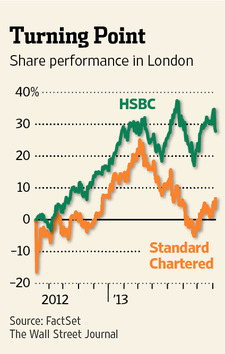
LONDON—Asia’s economic slowdown is threatening to bring two of Europe’s highest-flying banks back down to earth. Standard Chartered PLC said Tuesday that net profit fell 24% in the first half of the year, as weakening growth in Asian markets and a $1 billion write-down at its South Korean business put a brake on earnings. The announcement came one day after HSBC HoldingsHSBA.LN -2.23% PLC said underlying profit before tax stagnated at its Asian-Pacific unit, which excludes Hong Kong, and warned it was bracing for slower growth in China. The jittery results underscore a nascent problem for the two U.K.-based banks, which both lean heavily on Asian economic growth to bolster their results and tout their substantial emerging-market presence to differentiate themselves from Europe’s crisis-hit banks. Read more of this post

Buffett’s Wells Fargo is trying to grow its relatively small credit-card business with an unusual strategy: appealing to its customers’ distaste for debt

Wells Fargo to offer credit cards that help cut consumer debt

By Peter Rudegeair

Filed Aug 5th, 2013

Wells Fargo & Co, the fourth-largest U.S. bank, is trying to grow its relatively small credit-card business with an unusual strategy: appealing to its customers’ distaste for debt. In 2007, Wells Fargo debuted the Home Rebate Card, which offers a 1 percent rebate that automatically goes toward paying down principal on a Wells Fargo home loan. In the coming months, the bank has plans to roll out cards that provide similar benefits to customers who have taken out student loans, auto loans and other types of consumer debt from the bank. “The real thing customers wanted was to pay down their mortgage,” Tom Wolfe, Wells Fargo’s executive vice president for consumer credit solutions, said in a recent interview. “That created a thought process where we asked, ‘Why don’t we offer that service for all our products?'” Read more of this post

How promoters of Dabur, Marico and Jyothy Laboratories forged long lasting bonds with key professionals

How promoters of Dabur, Marico and Jyothy Laboratories forged long lasting bonds with key professionals

Kala Vijayraghavan, ET Bureau Jul 19, 2013, 03.46AM IST

A popular story on the empowerment of professionals at Dabur is to do with Hajmola candy. A manager offered the yet-to-be launched, mint-flavoured Hajmola to Anand Burman, who promptly spat it out and said consumers will never eat it. Unfazed by the promoter’s view, CEO Sunil Duggal launched it because the market research was favourable. He was right — Hajmola has been one of Dabur’s most successful new brands. There are promoters who like to hold on but there are also promoters like the Burmans who let go, letting professionals run the show, stepping in only when they need to or when they want to. “After a period of time, the relationship between promoters and professionals tend to become like spouses.” says K Sudarshan, managing partner with EMA Partners International, a consultancy. “They fight, argue and yet stay together.” Read more of this post

Marico learns to juggle old and new businesses after acquiring Paras’s personal care brands

Marico’s Unique Paras Strategy

by Samar Srivastava | Aug 7, 2013

Marico learns to juggle old and new businesses after acquiring Paras’s personal care brands

Paras-FINAL.indd

When Marico decided to try on a new hat, it also committed itself to a different, more vibrant, personality. Juggling personas was never going to be easy but here’s proof that the company known for its steadiness, manifested in brands like Saffola and Parachute, is ready to step away from its long-standing staid avatar.  Consider this advertisement. Its narrative goes like this: Two young television jockeys are shown complaining about the quality of participants at a talent hunt. “Pata nahi kahaan se aa jaate hain. Unko maloom nahi, yeh talent hunt hai, unki gaon ki nautanki nahi [Don’t know where they land up from. They don’t know, this is a talent hunt, not a village nautanki],” says one dismissively. On cue, the maligned participant pulls out a can of Zatak deodorant; the cap flies across the room and lodges itself in the jockey’s mouth rendering him unable to speak while the participant sprays himself. ‘Who’s the cool one now?’ the advertisement seems to ask. The jockeys are humbled and the underdog prevails. Read more of this post

Korean chaebol Woongjin chief, executives indicted for embezzlement by fraudulently issuing commercial papers (CPs) and illegally providing financial support to its units

2013-08-07 16:08

Woongjin chief, executives indicted for embezzlement

By Kang Hyun-kyung

The prosecution indicted Woongjin Group Chairman Yoon Seok-keum and six other executives for inflicting losses to the company by fraudulently issuing commercial papers (CPs) and illegally providing financial support to its units. The Seoul Central District Prosecutors’ Office said Wednesday that they issued 100 billion won worth of CPs in July and August of 2012, although they knew that the company was unable to pay back the debt due to its junk-level credit ratings. It said the company issued the securities under the name of Woongjin Holdings without disclosing that the group’s decision to file for court protection after giving up its plan to sell another key unit Woongjin Coway. In September last year, the company also sold CPs worth 19.8 billion won. Chairman Yoon and the other executives are also accused of embezzlement and breach of trust. In March 2009, they withdrew 1.25 billion won of corporate funds from Rexfield Country Club, a Woongjin Group’s affiliate firm, on the presumption of using it as consulting fees to buy real estate, but gave it to founding members of the group in severance payments. The prosecution also said that the executives committed breach of trust by directing other units to provide 96.8 billion won in illegal financial support to Woongjin Capital, owned by group Chairman Yoon.

Hedge funds profit from return of M&A

August 7, 2013 5:17 pm

Hedge funds profit from return of M&A

By Sam Jones

As developed world stock markets have surged this year, the corporate world has likewise seen a revival of deal-making, capital raisings and restructurings. And hedge funds – in particular, so-called event arbitrageurs – are looking for rich pickings from that trend. Event arbitrage is a catch-all term for the strategies by which hedge funds look to capitalise on corporate announcements. In a merger, a simplistic event arbitrageur bet would entail wagering on the price of the acquisition target rising, while shorting the acquirer in expectation of its price falling. Such strategies have outperformed all other hedge fund trading styles so far this year. Proof positive, say event arb traders, that their strategy is bearing fruit. According to HFR, the average event arbitrageur is up 5.7 per cent, compared with an industry-wide average of 3.6 per cent. Many individual managers have fared better. Read more of this post

Chic and cheap: China takes shine to South Korean cosmetics

Chic and cheap: China takes shine to South Korean cosmetics

5:06pm EDT

By Hyunjoo Jin

SEOUL (Reuters) – Cosmetics brand Laneige has a French name and luxurious blue-and-white packaging but its legions of fans in China, the world’s third-largest beauty products market, love it because it is South Korean and affordable. Laneige, or “the snow”, is one of about two dozen brands made by South Korea’s biggest cosmetics company Amorepacific Corp which is using its Asian cachet and pocket-friendly prices to give global firms like L’Oreal SA, and Procter & Gamble Co a run for their money. Other South Korea cosmetics manufacturers like LG Household & Healthcare and Able C&C are also using similar strategies to expand in China’s beauty and personal care market, which is estimated to be worth $34 billion this year. Read more of this post

Green Mountain’s Buzz Poised to Wear Off; The Coffee Company’s Shares Have Had an Epic Comeback, but the Question Is How Much That Reflects Fundamentals

August 6, 2013, 7:26 p.m. ET

Green Mountain’s Buzz Poised to Wear Off

The Coffee Company’s Shares Have Had an Epic Comeback, but the Question Is How Much That Reflects Fundamentals

SPENCER JAKAB

MI-BX667A_AOT_NS_20130806184502

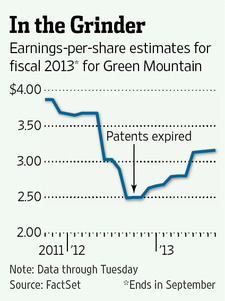
High praise has a way of preceding big stumbles. In earlier, headier times, Green Mountain Coffee Roasters Inc.’s GMCR -2.53%machines were occasionally referred to as the iPods of coffee. Then, in the fall of 2011, questions about its growth prospects sent its shares tumbling from nearly $116 to less than $18 by the next summer. Like Apple Inc.’s music players, competition and the onward march of technology was to blame.

Read more of this post

Small Businesses in Jiangsu Singing the Bank Loan Blues; Lenders burned by bad loans to giants in solar and shipbuilding industries are reluctant to extend loans to family businesses as ordered, forcing some to close

08.07.2013 19:38

Small Businesses in Jiangsu Singing the Bank Loan Blues

Lenders burned by bad loans to giants in solar and shipbuilding industries are reluctant to extend loans to family businesses as ordered, forcing some to close

By intern reporter Wu Hongyuran

Several textile company owners in southern Jiangsu gathered for a meeting on July 25 to figure out how to save their businesses. One of them said local banks had been unwilling to lend since April, making life extremely hard for her and others who also run a family business in Shengze, a silk town in Suzhou, the capital of the eastern province of Jiangsu. Shengze hosts more than 6,000 small and medium-sized textile companies and a great number of spinning mills in its 118 square kilometers. Having run a business there smoothly for five years, the businesswoman at the meeting said it had become very difficult to raise funds in the past few months. These sentiments were expressed by the other businesspeople who attended the meeting. Read more of this post

Japan’s Giant New Destroyer Sends A Clear Message To China, The World; Alarming signs of Japan’s rearmament

Japan’s Giant New Destroyer Sends A Clear Message To China, The World

GEOFFREY INGERSOLL AUG. 6, 2013, 4:04 PM 22,957 76

japan-new-carrier

The Izumo has been in construction since 2009. Sixty-eight years to the day of the Hiroshima bombing, Japan unveiled its new naval “destroyer” that happens to have a flat-top — dubbed “Izumo” — capable of carrying various rotary-wing aviation units, reports Eric Talmadge of ABC. Consequently, it’s also the biggest since WWII … and since Japan’s official army was disbanded. The new boat comes as Chinese officials say the country is in “no rush” to sign a code of conduct guiding military behavior in the contested South China Sea. Read more of this post

Nearly One-Third Of America’s Massive Federal Student Loan Debt Is Either Late Or In Default

Nearly One-Third Of America’s Massive Federal Student Loan Debt Is Either Late Or In Default

MANDI WOODRUFF AUG. 7, 2013, 11:49 AM 2,062 24

Student loan debt continues to swell, with more than $1.2 trillion worth of loans issued so far in the U.S.  The Consumer Financial Protection Bureau recently took a look at our student debt addiction to figure out exactly how well consumers are working at paying it down. It isn’t looking too good. Out of $1 trillion in federal loans, $214 billion are in deferment or forebearance and $89 billion are in default. It’s the 7 million borrowers in default that really have the CFPB worried.  “Defaulting on a federal student loan has serious consequences,” Rohit Chopra, the bureau’s student loan ombudsman, says. “Unlike other consumer credit, borrowers in default on a federal student loan might see their tax refund taken and their wages garnished without a court order.” Read more of this post

Why the luck is running out for Australia’s next leader; After two decades of growth, politicians should be prepared for changing fortunes

August 7, 2013 7:23 pm

Why the luck is running out for Australia’s next leader

By David Pilling

After two decades of growth, politicians should be prepared for changing fortunes

For two decades, Australia has deserved its reputation as a “lucky country”. Alone in the developed world, since 1991 it has been recession-free. It admirably weathered the global financial crisis thanks to a sound financial system and a made-in-China mining boom that has turbocharged the economy. As well as massive coal and iron ore deposits, it has huge reserves of natural gas ready to liquefy and ship to energy-starved Japan and South Korea. It continues to enjoy low public debt, low inflation and, for now, relatively low unemployment.

Read more of this post

Lobster industry squeezed by oversupply as demand for what has long been considered a luxury dish has not kept pace, especially since the global recession hit in 2008

Last updated: August 7, 2013 7:30 pm

Lobster industry squeezed by oversupply

By Neil Munshi in Chicago

The Maine lobster industry is being crippled by a glut of supply that many attribute to climate change, sending the price per pound plummeting and turning the crustacean into something it has rarely been before: affordable. According to figures from the Maine Department of Marine Resources, the volume of the state’s lobster harvests has skyrocketed from about 28m pounds in 1990 to 126m pounds last year as oceans have warmed, helping the shellfish and their larvae to grow faster. But demand for what has long been considered a luxury dish has not kept pace, especially since the global recession hit in 2008, even as fuel and equipment costs rise. Read more of this post

Rare questions are being asked about the power of China’s state-owned corporations as details emerge about the purchase of three mines in Shanxi Province

August 7, 2013

Silence Underground

By KEITH BRADSHER and CHRIS BUCKLEY

ZHONGSHE, China — A moribund coal mine here descends deeply, more than 3,800 feet underground. But the deal in which a Chinese state-owned conglomerate bought it may be even darker and more labyrinthine. The Zhongshe mine and two others, in Shanxi Province in northern China, are at the center of unusually public accusations of mismanagement and corruption afflicting one of the nation’s flagship state conglomerates, China Resources. Critics say that the $1.6 billion purchase was vastly overpriced and illegal and that large sums may have been squandered or, as some are claiming, improperly diverted. Read more of this post

How Siemens Lost Its Way; Every success already contains the seed of failure

08/07/2013 07:06 PM

Peter and the Wolves

How Siemens Lost Its Way

By Dinah Deckstein, Martin Hesse and Thomas Tuma

Siemens is a massive global conglomerate, building everything from trains to power plants. In-fighting and last week’s ouster of CEO Peter Löscher are just a few indications of a German giant’s decline. The company must find new markets to regain success.

A few days before all hell breaks loose around him, Joe Kaeser is sitting in his Munich office, relating anecdotes about the big, wide world of Siemens. At the time, he’s still the company’s chief financial officer. A large, black-and-white photo of the striking cliffs of Big Sur, on the California coast, one of the 56-year-old executive’s dream destinations, is hanging on the wall behind his desk. Kaeser, with surprising openness, describes how almost everyone in the company “has recently come a little unhinged.” At some point, he says, even he began to feel like a rock in the surf. Read more of this post

One day you are hot, the next day you are not – and so it is with Mongolian Genghis bonds which have suffered a sharp market correction in the wake of June’s market rout

August 6, 2013 5:56 pm

Mongolian bonds suffer amid frontier correction

By Pan Kwan Yuk

One day you are hot, the next day you are not – and so it is with Genghis bonds which have suffered a sharp market correction in the wake of June’s market rout. Back in November, eyebrows were raised in the emerging markets debt investment community when Mongolia – a country that has been rescued five times in the past 22 years by the International Monetary Fund – managed to raise $1.5bn at a price below Spain’s borrowing costs. At the time, many took the sale, which was 10 times subscribed and attracted $15bn in bids – as yet another sign that investors who were flushed with cash and desperate for yields were jumping into markets that they did not fully understand. Read more of this post

Dairy Auction Shows Fonterra’s Premium Over Rivals Narrowing After Latest Scare

Updated August 7, 2013, 3:52 a.m. ET

Dairy Auction Shows Fonterra’s Premium Over Rivals Narrowing After Latest Scare

Sale Was Seen as First Big Test After Dairy Giant’s Bacteria Warning

REBECCA HOWARD

AI-CC735_FONTER_NS_20130807034505

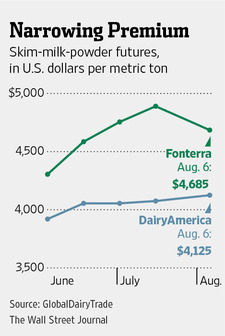
WELLINGTON, New Zealand—The dairy industry’s biggest auction signaled thatFonterra Cooperative Group Ltd.’s FCG.NZ +1.14% tainted-milk scare has eroded its ability to charge premium prices and led to a shift in consumer sentiment toward rival suppliers. New Zealand officials saw the overnight GlobalDairyTrade auction as the first big test of the country’s ability to weather food-safety concerns after Fonterra warned days earlier that three batches of one of its dairy products may contain harmful bacteria. Dairy accounts for about a quarter of New Zealand’s exports and Fonterra is its largest supplier. Lawmakers feared the company’s latest quality issue is hurting consumer confidence, especially after countries such as China and Russia banned imports of some Fonterra products. Read more of this post

Distressed-Debt Investors Look Toward Asia; Corporate debt in Asia now exceeds 2008 levels

Aug 7, 2013

Distressed-Debt Investors Look Toward Asia

By Isabella Steger

AM-AZ763_AMONEY_G_20130807040005

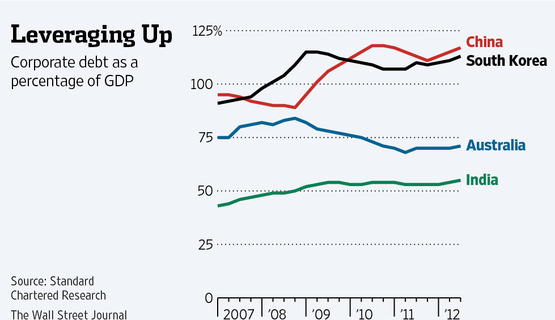
As Asia’s economic growth sputters and banks face the prospect of rising bad debts, credit-focused hedge funds and private-equity firms are seeking opportunities to buy distressed debt. While investors in distressed credit in the region have been most active in Australia, they are starting to spot signs of trouble in other markets such as China, South Korea and India, particularly after a recent boom in corporate-bond sales sent debt levels higher. Many of those bonds will be up for refinancing in a few years, said Michel Löwy, chief executive of Hong Kong-based hedge fund SC Lowy, which invests in distressed debt. Read more of this post

In China, Air Pollution Rules Spur Big Car Purchases; Buyers Trade Up Fearing They May Get Just One Shot at a Purchase

August 7, 2013, 4:13 p.m. ET

In China, Air Pollution Rules Spur Big Car Purchases

Buyers Trade Up Fearing They May Get Just One Shot at a Purchase

SHANGHAI—As more Chinese cities propose license-plate lotteries and other ways of limiting the number of cars on the road, consumers are responding by buying more expensive automobiles with bigger engines. In Shanghai, one of four major Chinese cities with policies designed to reduce car purchases to ease pollution and traffic congestion, between 9,000 and 10,000 plates are auctioned monthly, fetching an average of 82,000 yuan ($13,400) so far this year. That steep fee helped convince David Fu, a 26-year-old bank corporate finance manager, to buy an Audi NSU.XE +0.16% A4 in June for 300,000 yuan after looking at a dozen lower-cost models including those made by Volkswagen AGVOW3.XE -0.77% and China’s home grown car makers. Read more of this post

Foods that are decades past their expiry dates are too common in Asia

Foods that are decades past their expiry dates are too common

Nury Vittachi, Bangkok | Opinion | Sun, July 14 2013, 11:05 AM

When I heard last week that inspectors had found a shop selling food that was 43 years past its expiry date, I thought, wow, they go to the same supermarket I do.
I’ve seen food items there that aren’t just dried out, but are actually fossilizing. I sometimes visit just to show my children how mineralization works: “See how microstructural features are retained, so that people in 10 million years can trace the early evolution of the MSG pie?” Anyway, in my experience you’re fine as long as you stick to foods from the Holocene and Pleistocene eras: Avoid anything pre-Mesozoic. Later, I found the actual Xinhua report about the expired food. The shop was in the Guangxi region of China. But this problem happens all over Asia. A reader once sent me a package of food he bought from the most expensive delicatessen in Hong Kong. Under the expiry date sticker was another one. And another one beneath that. And another one beneath that, etc.  Read more of this post

In American Greetings Deal, Echoes of Larger Buyout for Dell

AUGUST 6, 2013, 6:34 PM

In American Greetings Deal, Echoes of Larger Buyout for Dell

By STEVEN DAVIDOFF

This is a tale of two management-led buyouts. The first is the headline-grabbing $24.4 billion bid by Michael S. Dell and the private equity firm Silver Lake Partners to buy the personal computer maker that Mr. Dell founded. The second is the lesser-known $612 million buyout by the Weiss family of the American Greetings Corporation, the greeting card company they control. Both deals illustrate the rising tide of shareholder power, as well as the devilish issues that emerge when management tries to buy a public company. And even though Dell’s board has changed the voting rules, both companies are being tested by shareholders who view the buyouts as undervaluing their companies. Read more of this post

A misleading model: Low bond yields have in the past been bad, not good, for equity returns

A misleading model: Low bond yields have in the past been bad, not good, for equity returns

Aug 3rd 2013 |From the print edition

20130803_FNC157

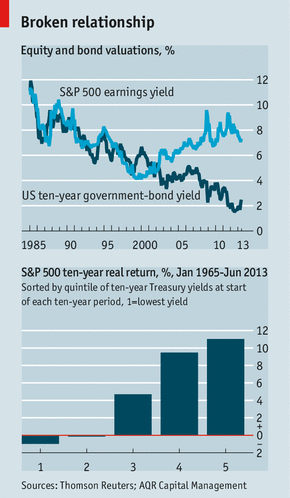
BULLS tend to find all sorts of reasons for forecasting a higher stockmarket. This is especially true of investment-bank strategists, whose bonuses are likely to get bigger when share prices are rising. Low bond yields are often seized on by equity bulls. A recent research note from Deutsche Bank, for example, suggested there was a straight trade-off between changes in bond yields and the valuation of shares, in the form of the price-earnings ratio or “multiple”. Lower bond yields mean a higher multiple; based on current yields, shares are cheap. It is all remarkably reminiscent of the so-called “Fed model”, much loved by bulls in the 1990s. The model was based on a reference in Alan Greenspan’s 1997 congressional testimony to the close relationship between the ten-year bond yield and the earnings yield (the inverse of the price-earnings ratio) on the S&P 500 index. If the earnings yield was higher than the bond yield, then equities were cheap. Bond yields and earnings yields did indeed seem to move in tandem for about 15 years, and then the relationship broke down completely at around the turn of the century (see top chart). Read more of this post

Thrice-bailed-out Dexia suffers fresh loss

August 7, 2013 10:38 am

Bailed-out Dexia suffers fresh loss

By James Fontanella-Khan in Brussels

Dexia, the Franco-Belgian bank that was one of the biggest victims of the financial crisis, suffered further losses in the first half of 2013, raising fears in Paris and Brussels that the troubled lender could further impact their recession-hit economies. The thrice bailed-out bank on Wednesday reported a net loss of €905m in the first half of 2013, despite enjoying lower funding costs. In the same period a year ago it lost €1.17bn. The performance of Dexia is being closely watched by French and Belgian authorities as their governments own most of the residual bank. They two countries were forced to inject €11bn in fresh capital and provide €90bn in state guarantees to save the bank in the aftermath of the 2008 crisis. Luxembourg also participated in the bailouts but to a lesser degree. Further losses at Dexia – once the world’s biggest lender to municipalities – raises the prospect of fresh capital injections or state guarantees from France and Belgium. Read more of this post

India to milk advantage from curbs on New Zealand dairy products; Nearly 90% of China’s $1.9 billion in milk powder imports last year originated in New Zealand

India to milk advantage from curbs on New Zealand dairy products

5:39am EDT

By Rajendra Jadhav

MUMBAI (Reuters) – India, the world’s biggest milk producer, hopes to seize on a New Zealand dairy product contamination scare to increase its exports and add market share in China and other emerging Asian countries. India’s milk production is likely to rise almost 5 percent in the year to next March to 133 million tons, said R G Chandramogan, managing director of Hatsun Agro Products Ltd, one of the country’s leading milk powder exporters. Traditionally, most of that production stays at home as a protein staple for a population of 1.2 billion, but with domestic demand pegged at around 128 million tons, there should be more milk available to make skimmed milk powder (SMP) for export. The Indian government also usually restricts overseas sales to keep a lid on local prices. Read more of this post

Build it and they might come: A planned Thai mega-project in Myanmar runs into difficulty

Build it and they might come

A planned Thai mega-project in Myanmar runs into difficulty

Aug 3rd 2013 | BANGKOK AND DAWEI |From the print edition

20130803_ASM931

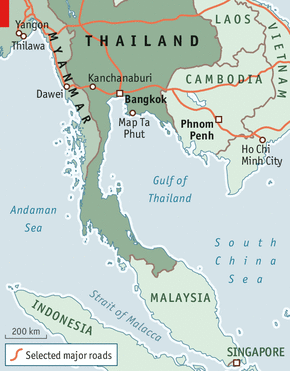
THE Burmese city of Dawei lies 350 kilometres (220 miles) west of the Thai capital, Bangkok. The two are separated by a stretch of mountainous jungle and have never been connected. But over the past five years, Thailand’s biggest construction company, ItalianThai, has cut a swathe through the jungle which, once paved, will cost roughly $1m per kilometre of road. The plan is that it will connect Bangkok with a $50 billion industrial hub and deep-sea port at Dawei on the Andaman Sea.

The project was set in motion by Thaksin Shinawatra, a former Thai prime minister, who was overthrown in a military coup in 2006. When he proposed it he was still in power and it was seen by many as a vanity project that would never get off the ground. After the Burmese government started to open up two years ago, some concluded that Mr Thaksin was in fact a visionary. But although Yingluck Shinawatra, Mr Thaksin’s sister and Thailand’s current prime minister, is soon due to inaugurate the border checkpoint on the road, financial difficulties are once more calling the project into question. Read more of this post