Young, Rich Real-Estate Dummies

Young, Rich Real-Estate Dummies

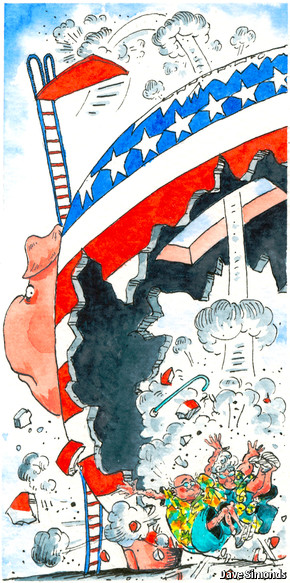
The Wall Street Journal reports that well-to-do young Americans prefer to put their savings into “safe” luxury real estate rather than “risky” equities. Some are wealthy heirs and heiresses who have nothing better to do with their money. Others are members of the nouveau riche, cashing out their Facebook shares for houses in San Francisco. Yet most people described in the article are simply young, rich and dumb.

Matt Winter, a 28-year-old interior designer in L.A. says that he “always felt that having your money in property is the safest and best thing to do if you want to grow your personal wealth.” That was why he spent $1.7 million on his new home, after having spent about $1 million on his first home two years ago. Winter goes on to say that he owns no stocks because equities “spook him.” Read more of this post


Wall Street’s Biggest Job Cuts Yet to Come, Whitney Says

Wall Street’s Biggest Job Cuts Yet to Come, Whitney Says

Wall Street firms must cut more jobs to boost their return on equity and satisfy shareholders, said Meredith Whitney, a banking analyst and founder of Meredith Whitney Advisory Group LLC.

“The biggest layoffs are ahead of us,” Whitney said in a Bloomberg Television interview today with Tom Keene, Sara Eisen and Scarlet Fu. “It’s no fun, it’s painful but you have to downsize dramatically, get more efficient on every single line of business.” Read more of this post

The poison pill in India’s search for cheap food

The poison pill in India’s search for cheap food

1:35am EDT

By Rajendra Jadhav and Jo Winterbottom

MUMBAI/NEW DELHI (Reuters) – Nearly a decade ago, the Indian government ruled out a ban on the production and use of monocrotophos, the highly toxic pesticide that killed 23 children this month in a village school providing free lunches under a government-sponsored program. Despite being labeled highly hazardous by the World Health Organization (WHO), a panel of government experts was persuaded by manufacturers that monocrotophos was cheaper than alternatives and more effective in controlling pests that decimate crop output. Read more of this post

A Race to Save the Orange by Altering Its DNA

July 27, 2013

A Race to Save the Orange by Altering Its DNA

By AMY HARMON

CLEWISTON, Fla. — The call Ricke Kress and every other citrus grower in Florida dreaded came while he was driving. “It’s here” was all his grove manager needed to say to force him over to the side of the road. The disease that sours oranges and leaves them half green, already ravaging citrus crops across the world, had reached the state’s storied groves. Mr. Kress, the president of Southern Gardens Citrus, in charge of two and a half million orange trees and a factory that squeezes juice for Tropicana and Florida’s Natural, sat in silence for several long moments. “O.K.,” he said finally on that fall day in 2005, “let’s make a plan.” In the years that followed, he and the 8,000 other Florida growers who supply most of the nation’s orange juice poured everything they had into fighting the disease they call citrus greening. To slow the spread of the bacterium that causes the scourge, they chopped down hundreds of thousands of infected trees and sprayed an expanding array of pesticides on the winged insect that carries it. But the contagion could not be contained. Read more of this post

ETF Wolves in Sheep’s Clothing: Financial advisors are increasingly using passive, index-tracking ETFs to implement strategies that are just as active as what you’d find in the most aggressive mutual funds

SATURDAY, JULY 27, 2013

Wolf in Sheep’s Clothing

By CORRIE DRIEBUSCH | MORE ARTICLES BY AUTHOR

Financial advisors are increasingly using passive, index-tracking ETFs to implement strategies that are just as active as what you’d find in the most aggressive mutual funds.

BA-BC478_ETF_MY_G_20130727011118

Some pairings just make sense — Scarlett and Rhett, peanut butter and jelly, exchange-traded funds and index investing. But when the pairing is put into a different context — a campy musical version of Gone with the Wind, or a PB&J-filled breakfast cereal — it becomes a distinctly different thing. And that “different thing” is happening in the world of ETFs. Financial advisors are increasingly using passive, index-tracking ETFs to implement strategies that are just as active as what you’d find in the most aggressive mutual funds. For some investors, it’s a natural fit. But for others, particularly those drawn in by the allure of passive ETFs, it’s going to be stomach-churning. Read more of this post

Volatility Hits Hong Kong Exchange Fund with $3.25 billion investment losses in the second quarter; De facto central bank sees “immense shocks” ahead

July 26, 2013, 8:40 a.m. ET

Volatility Hits Hong Kong Exchange Fund

De facto central bank sees “immense shocks” ahead

CHESTER YUNG

HONG KONG—Hong Kong’s de facto central bank suffered an investment loss of 25.2 billion Hong Kong dollars (US$3.25 billion) in the second quarter, due to declines in the value of its bond holdings and foreign-exchange losses during a period of heightened market volatility. The Hong Kong Monetary Authority’s Exchange Fund lost 19.6 billion Hong Kong dollars on its bond holdings during the quarter, reversing a gain of 2.8 billion Hong Kong dollars in the first quarter. It also lost 6.1 billion Hong Kong dollars on local equities as the benchmark Hang Seng Index fell 6.7%, while losses from foreign-exchange movements totaled 5.9 billion Hong Kong dollars. The HKMA uses the fund to manage its assets and maintain the Hong Kong dollar’s peg to the U.S. dollar, as well as to ensure the territory’s financial stability. Read more of this post

Foreign banks in China dropping out of retail banking

Foreign banks in China dropping out of retail banking

Staff Reporter

2013-07-28

Due to adjustment in business structure and continuing deficits, a number of foreign banks have started closing their retail banking branches in China. In mid-July, Deutsche Bank China folded its last retail banking branch in Huamao, Beijing. According to the Beijing Business Today, the the bank closed the branch, opened on Nov 29, 2007, after deciding to focus on corporate banking, forgoing its original ambition to diversify its services. Deutsche Bank is not the first foreign bank exiting the retail banking market in China. Previously, the Royal Bank of Scotland left the retail banking sector in order to concentrate its resources on corporate and wholesale banking. The Bank of East Asia (China) has also pulled out of the retail banking business for some of its smaller branches, according to Beijing Business Today. Read more of this post

Blown it: China’s offshore wind farms suffer repeated setbacks

Blown it: China’s offshore wind farms suffer repeated setbacks

Staff Reporter

2013-07-28

In 2010, the Chinese government successfully held public bids for the nation’s first four offshore wind farm projects, all off the coast of Jiangsu province, but three years on,the four projects have yet to break ground due to a number of factors, including difficulties in the coordination for the use of the sea area, an unclear power-rate policy, the immaturity of peripheral industrial chain and a protracted approval process. “The progress of the project is slower and the time for approval longer than expected,” an executive of one of the bid-winning enterprises has admitted. Read more of this post

What would a world without banks look like? Converts to peer-to-peer websites such as Zopa and RateSetter believe we’re already there; Risk and reward in the p2p revolution

July 26, 2013 6:01 pm

Risk and reward in the p2p revolution

By Elaine Moore

What would a world without banks look like? Converts to peer-to-peer websites such as Zopa and RateSetter believe we’re already there – and it’s a utopia of 5 per cent returns, affordable loans to trustworthy borrowers and no hard selling of extra products. The UK government, Google and hard-nosed former Morgan Stanley chairman John Mack appear convinced, putting money behind the sector, and high street bank Santander is now considering a partnership with a peer-to-peer lender. But with interest rates almost double the equivalent offered by banks, what exactly are investors accepting in exchange for a lift in returns? Read more of this post

Why China pays too much for medicines

Why China pays too much for medicines

Fri, Jul 26 2013

By Ben Hirschler, Ransdell Pierson and Kazunori Takada

(Reuters) – China has a drug problem. While most Western countries spend 10-12 percent of their healthcare budget on medicines, in China it is well over 40 percent, a disparity that goes to the heart of Beijing’s crackdown on the industry. A promise this week by GlaxoSmithKline to make its drugs more affordable in China in the wake of a bribery scandal is an important lever Chinese authorities may now use to start redressing the balance. Britain’s biggest drugmaker has given no details on the size of the price cuts it will consider, but an examination of its discounts in other emerging markets suggests there may be scope for reductions for some medicines of a third or more. Other pharmaceutical firms might have to follow suit. Read more of this post

Online Start-Up LearnVest Aims to Bring Financial Planning to the Masses; “Financial advice shouldn’t be a luxury. We want to disrupt the industry.”

July 26, 2013

A Start-Up Aims to Bring Financial Planning to the Masses

By TARA SIEGEL BERNARD

27money-articleLarge

It’s an unfortunate fact: the people who are most in need of honest financial advice often cannot afford it, or they don’t realize that their so-called adviser isn’t an adviser at all, but a salesman. If Alexa von Tobel has her way, however, financial advice will be as widely available — and affordable — as any other mass-produced consumer product or service. Think gym memberships. It will become the perfect wedding gift for your best friend, or for adult children after they have their first baby. As the founder of LearnVest, an online financial advisory that she started four years ago, Ms. von Tobel, 29, repeats these themes several times over the course of a recent meeting to underscore what she has set out to do: deliver comprehensive and conflict-free financial advice to the middle class. “Financial advice shouldn’t be a luxury,” said Ms. von Tobel, a petite blonde with a big personality, in the company’s loftlike offices in New York. “We want to disrupt the industry.” Read more of this post
As a revitalised Coles goes from strength to strength, Woolworths has foundered amid missed opportunities and a lack of innovation. “It takes a long time to slow down the Queen Mary but once she is dead in the water she is awfully hard to restart”

Choosing the right hardware for growth

July 27, 2013

Katherine Jimenez

supermarket-620x3492707woolworths_timeline353px-300x0

As a revitalised Coles goes from strength to strength, Woolworths has foundered amid missed opportunities, a lack of innovation and a misstep into the big-box hardware sector.

From the first day of Greg Foran’s appointment as Woolworths supermarket chief, one thought consumed his mind. He wanted to break Coles. The opportunity was there. Foran saw Wesfarmers’ $20 billion takeover of Coles in late 2007 as a perfect opportunity for the $40 billion supermarket juggernaut – once dubbed the ”Queen Mary” of grocery chains – to put its ”foot on the throat” of its arch-rival. Not long after his promotion in October 2008, Foran approached the then Woolworths chief Michael Luscombe and chief financial officer Tom Pockett with his grand plan. Having cut his teeth under highly regarded chief Roger Corbett during Woolworths’ golden years, Foran had pinched a leaf out of his book and believed the best weapon was to aggressively cut prices. Read more of this post
Fibra Macquarie CEO sees ‘danger’ of price bubble for Mexico’s REITs

Fibra Macquarie CEO sees ‘danger’ of price bubble for Mexico’s REITs

Fri, Jul 26 2013

By Gabriel Stargardter

MEXICO CITY (Reuters) – There is a danger that the growing value of Mexico’s real estate investment trusts could form a property price bubble, the head of Macquarie’s Mexican REIT said on Friday. The trusts, known locally as fibras, issue certificates that function much like shares on the stock exchange, and allow investors to participate in Mexico’s property market without owning buildings. But the extra liquidity generated by the funds, which have posted dizzying gains on the local bourse in recent months, has led some to suggest an inflated price bubble is around the corner, possibly resulting in painful price adjustments. Read more of this post

Bloomberg has quietly pulled the plug on its new wealth management business BloombergBlack just months after the financial data company began offering investment advice for individuals.

Last updated: July 26, 2013 2:39 pm

Bloomberg pulls plug on wealth management business

By Tracy Alloway in New York

Bloomberg has quietly pulled the plug on its new wealth management business just months after the financial data company began offering investment advice for individuals. “We weighed the future prospects of the business against the ongoing resource investment and concluded that it wasn’t in our best interest to continue moving forward,” a Bloomberg spokesman said. “We remain optimistic about the idea and open to the possibility of pursuing a similar business in the future.” Discussions about shutting the web-based service, which took more than three years to develop, were already in advanced stages as early as June, according to people familiar with the business. Read more of this post
Taiwan yachtmakers face struggle to stay afloat

July 26, 2013 12:28 pm

Taiwan yachtmakers face struggle to stay afloat

By Sarah Mishkin

Truckers at Bluewater Yacht Builder struggle to load a megayacht on to a truck that will help the 30-tonne luxury boat begin its journey to its new owner in California. While the task may be tricky, at least this Taiwanese company has a buyer. Taiwan recently overtook Germany to become the world’s sixth-largest yachtmaker, with 43 boats under construction. Yet despite this, sales are much lower than before the 2008 financial crisis. Production at yards across the country hit $148m last year, down from $357m in 2008. Read more of this post

China sovereign wealth fund downgrades commodities

July 26, 2013 1:31 pm

China wealth fund downgrades commodities

By Simon Rabinovitch

China’s sovereign wealth fund has switched emphasis away from commodities to financial stocks in its overseas equity holdings over the past year. The investment shift by China Investment Corp is notable because the fund is uniquely placed to make a call about the global commodities market, with Chinese demand one of the biggest drivers of prices. Since its establishment in 2007 CIC had focused most heavily on commodities. But the fund, which had $575bn of assets under management at the end of last year, changed tack as Chinese growth slowed. Less than 17 per cent of CIC’s overseas equity holdings were in the energy and materials sectors, according to its annual report published on Friday. That was down from 23 per cent at the end of 2011. Read more of this post

Darwin, Japan and the origin of outperformance

July 26, 2013 6:02 pm

Darwin, Japan and the origin of outperformance

By Merryn Somerset Webb

Things that there are too many of. It’s a long list. But if you turn your thoughts to the financial industry you will see that the standout is investment funds. I have no idea how many funds there actually are available to chip away at your savings in the UK, but you can choose between over 2,000 at the top fund supermarkets alone. On that basis I would guess at 7,000-10,000 in total.

Most of those will be rubbish one way or another, which of course is why the average active fund regularly underperforms any given index. So here’s an interesting thing to wonder about at the beach this year: what if a 20-year bear market meant none of the big houses bothered to market funds in one particular sector any more? Read more of this post

The cult of home ownership is dangerous and damaging; The US and UK should ditch their obsessions with residential property, writes Adam Posen

July 26, 2013 7:28 pm

The cult of home ownership is dangerous and damaging

By Adam Posen

The US and UK should ditch their obsessions with residential property, writes Adam Posen

You would think that the residential property bubble and subsequent crisis of the past decade would make people leery of widespread home ownership, and governments reluctant to pump it up. Yet, here we are again. Despite the continuing fiscal tightening, the UK coalition government is pressing on with its “Help to Buy” scheme and the US Congress continues its unquestioning protection of the home mortgage interest tax deduction. This is the economic policy equivalent of incurring the individual and social costs of an obesity epidemic while still subsidising maize and beef production – but maybe more fixable. Read more of this post

Emerging market growth story dies

Last updated: July 26, 2013 11:44 am

Emerging market growth story dies

By Jonathan Wheatley

An uncomfortable truth is making itself felt around the world of emerging market investors: the emerging market growth story is dead. This is not to say that emerging economies will no longer grow. Nor even that emerging market assets will no longer deliver attractive returns. But the days are long gone when “emerging markets” could be seen as a single asset class. More than that: as David Lubin, head of emerging market economics at Citigroup puts it, the very “foundation myth” of the emerging markets no longer holds true. “The EM story is based on rapid growth, led by exports, which delivers large current account surpluses, which leads to the accumulation of foreign exchange reserves and the expansion of domestic credit,” he says. “Every single element of that story is no longer true.” Read more of this post

‘King of Beers,’ Fizzling in U.S., Sets Goal of World Domination; Anheuser-Busch InBev is making a bold move into China, the largest and most elusive prize

Updated July 27, 2013, 12:00 a.m. ET

‘King of Beers,’ Fizzling in U.S., Sets Goal of World Domination

Anheuser-Busch InBev is making a bold move into China, the largest and most elusive prize

MIKE ESTERL

P1-BM478A_BUD_f_NS_20130726175104

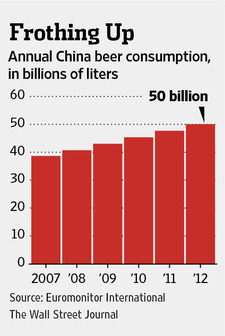
Budweiser ads drape the windows of banquet halls and karaoke bars in China. It’s all part of Anheuser-Busch InBev’s effort to transform America’s King of Beers into a truly global brand. WSJ’s Mike Esterl reports. ZIYANG, China—Little of the Western world has infiltrated this dusty city in China’s rural hinterland, where red lanterns hang from lampposts and restaurants serve pig tail and duck neck. But Americans would recognize a beer increasingly making the rounds here: Budweiser, which flows from a state-of-the-art brewery built below a hilltop pagoda. Advertisements for the 137-year-old brand from St. Louis, Mo., drape the windows of a banquet hall, trumpeting the year of the snake. The walls, floors and stairs of a karaoke bar are blanketed with Budweiser’s red bow tie and gold crown symbols. On a narrow back street, three hot pot restaurants serve the beer. “It’s brewed in Ziyang. I’m very proud of that,” says Li Mei, manager at the “Very Hot Hot Pot.” Read more of this post

Industrialization has turned much of the Chinese countryside into an environmental disaster zone, threatening not only the food supply but the legitimacy of the regime itself

July 26, 2013, 6:33 p.m. ET

China’s Bad Earth

Industrialization has turned much of the Chinese countryside into an environmental disaster zone, threatening not only the food supply but the legitimacy of the regime itself.

JOSH CHIN and BRIAN SPEGELE

In Dapu, a rain-drenched rural outpost in the heart of China’s grain basket, a farmer grows crops that she wouldn’t dare to eat. A state-backed chemicals factory next to her farm dumps wastewater directly into the local irrigation pond, she says, and turns it a florescent blue reminiscent of antifreeze. After walking around in the rice paddies, some farmers here have developed unexplained blisters on their feet. “Nothing comes from these plants,” says the farmer, pointing past the irrigation pond to a handful of stunted rice shoots. She grows the rice, which can’t be sold because of its low quality, only in order to qualify for payments made by the factory owners to compensate for polluting the area. But the amount is only a fraction of what she used to earn when the land was healthy, she says. The plants look alive, “but they’re actually dead inside.” Read more of this post

J.P. Morgan to Sell Commodities Business

Updated July 26, 2013, 7:54 p.m. ET

J.P. Morgan to Sell Commodities Business

Move Comes Amid Regulatory Scrutiny of Wall Street

DAN FITZPATRICK and CHRISTIAN BERTHELSEN

P1-BM480A_jpm_NS_20130726182709

NEW YORK—The largest U.S. bank is getting out of the power-plant and warehouse business, amid heightened regulatory scrutiny of Wall Street’s ownership of such assets. J.P. Morgan Chase JPM -0.80% & Co. said Friday it is putting its physical commodities operation up for sale, a major retreat for a company that last decade made a costly and bold effort to become No. 1 in the commodities field. J.P. Morgan joins rivals Goldman Sachs Group Inc. GS -0.39% and Morgan Stanley,MS -0.22%  which also are seeking buyers for such holdings. Regulators in recent months have ratcheted up scrutiny of banks’ power-market operations. The Federal Energy Regulatory Commission’s enforcement staff in March accused J.P. Morgan of manipulating energy markets in California and the Midwest. J.P. Morgan denied the accusations in a written response to FERC. The company is negotiating a $410 million settlement that would resolve those allegations. The Federal Reserve, meanwhile, is reviewing a decade-old policy allowing banks to hold physical commodity assets. Read more of this post

Moody’s Sees Local Chinese Debt Default as $21 Billion Matures

Moody’s Sees Local Default as $21 Billion Matures: China Credit

Local-government financing vehicles need to repay a record amount of debt this year, prompting Moody’s Investors Service to warn Premier Li Keqiang may set an example by allowing China’s first onshore bond default.

Some 127 billion yuan ($21 billion) of so-called LGFV notes expire in the second half, according to Everbright Securities Co., the most in its data going back to 2000 and more than double the 62.7 billion yuan that matured in the first six months. The yield premium over top-rated notes for one-year AA debt, the most common rating for LGFVs, widened to 67 basis points yesterday, the highest level since Jan. 16, Chinabond data show. The comparable gap in India is 47. Read more of this post

Boy Selling Candles Becomes Polish Billionaire Unhappy With Debt

Boy Selling Candles Becomes Polish Billionaire Unhappy With Debt

iKH9XcOc3agU

In Radom, a blue-collar Polish city better known for producing guns than entrepreneurs, Feliksa Pietruszka remembers the young boy from the neighboring apartment who sold candles at the cemetery opposite. “These were good kids,” said Pietruszka, 85, who still lives in the same building with outside toilets and coal-fired stoves for heating, as she sat in a kitchen barely big enough for two chairs and a table. “This was just a normal family.”

More than four decades and three changes of name later, that boy, Zygmunt Solorz-Zak, has turned his first zloty into a fortune exceeding $3 billion and a business spanning television, mobile phones, a bank and a power utility. Along the way, it also made him Poland’s biggest borrower as he expanded to compete with rivals funded by foreign investors and create the fastest mobile Internet service in the country. Read more of this post

Fed may decide that owning warehouses, pipelines and tankers does not fit with banks’ missions – meaning they could be ordered, or pressured, to divest those infrastructure assets

On U.S. banks and commodity trade, Fed unlikely to say no

12:03am EDT

By Jonathan Leff

NEW YORK (Reuters) – When it comes to commodity trading, the U.S. Federal Reserve has a habit of lengthy deliberation, deep enquiry and saying yes. The Fed granted its first authorization to trade physical commodities to Citigroup Inc (C.N: Quote, Profile, Research,Stock Buzz) in 2003 after nearly five years of study; the letter allowing it to keep its Phibro unit arrived just six days before a grace period ended. It spent another nine months scrutinizing one of its last such permits, given to the Royal Bank of Scotland (RBS.L:Quote, Profile, Research, Stock Buzz) in 2008 when it bought half of Sempra Commodities; the Fed’s deliberations delayed plans to close the deal by months, but it ultimately approved a vastly expanded array of activities. So even after a week of unprecedented public and political scrutiny on the multibillion-dollar commodity trading desks at Goldman Sachs Group Inc (GS.N: Quote, Profile, Research, Stock Buzz), Morgan Stanley (MS.N: Quote, Profile, Research, Stock Buzz) and JPMorgan Chase & Co (JPM.N: Quote, Profile, Research,Stock Buzz), a dozen legal experts and industry sources say the Fed is unlikely to turn back the clock to an era when banks were barred from touching gasoline cargoes or aluminum coils. Read more of this post

The Great Deceleration: The most dramatic, and disruptive, period of emerging-market growth the world has ever seen is coming to its close

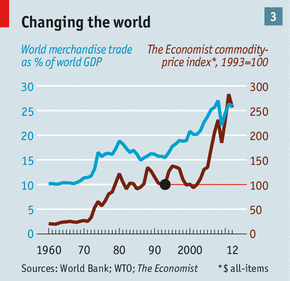
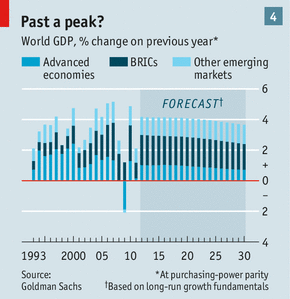
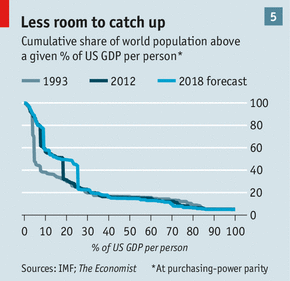
The Great Deceleration

The emerging-market slowdown is not the beginning of a bust. But it is a turning-point for the world economy

Jul 27th 2013 |From the print edition

20130727_LDP001_020130727_FBC127 20130727_FBC130 20130727_FBC131 20130727_FBC128 20130727_FBC129

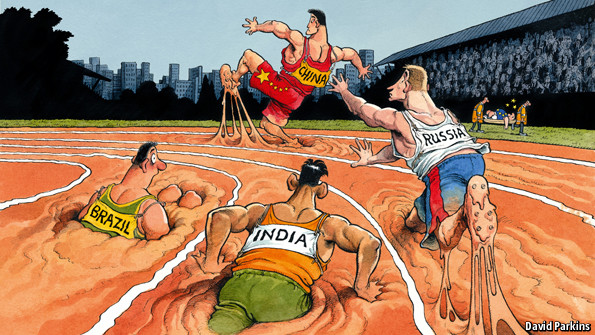
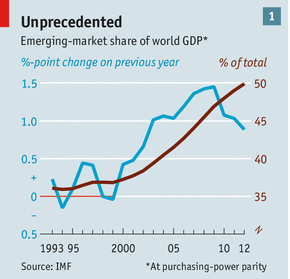
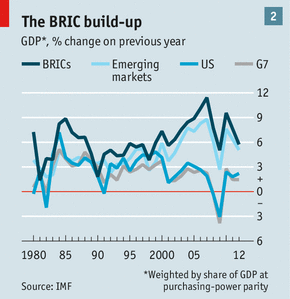
WHEN a champion sprinter falls short of his best speeds, it takes a while to determine whether he is temporarily on poor form or has permanently lost his edge. The same is true with emerging markets, the world economy’s 21st-century sprinters. After a decade of surging growth, in which they led a global boom and then helped pull the world economy forwards in the face of the financial crisis, the emerging giants have slowed sharply. Read more of this post

Tower Crane Industry Awaits a Big Lift; Five Years After Commercial Construction Market’s Collapse, Utilization Rates and Sales Remain Soft

Updated July 25, 2013, 8:13 p.m. ET

Crane Industry Awaits a Big Lift

Five Years After Commercial Construction Market’s Collapse, Utilization Rates and Sales Remain Soft

BOB TITA

MK-CF043_CRANE_G_20130725180307

For a glimpse of how the U.S. commercial construction market is faring, Morrow Equipment Co. is worth a good look. Five years after the construction market collapsed, about 250 cranes—or half of Morrow’s fleet—remain idle. The market “is improving this year, but is still at a very low rate compared with where it used to be in the boom time,” said Christian Chalupny, president of Morrow, which is the nation’s largest supplier of rented tower cranes based on fleet size. Read more of this post

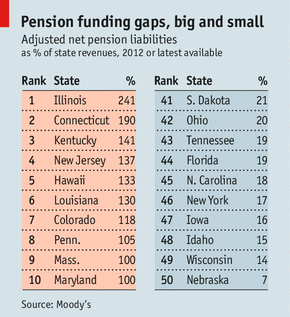
Retirement benefits: Who pays the bill? Pensioners are pushing many cities and states towards financial crisis

Retirement benefits: Who pays the bill? Pensioners are pushing many cities and states towards financial crisis

Jul 27th 2013 | CHICAGO AND LOS ANGELES |From the print edition

20130727_USD001_0 20130727_USC119 20130727_USD002_0

DETROIT may be an extreme case of fiscal incontinence. But its bankruptcy highlights a long-term problem faced by many American cities and states; how to fund generous pension and health-care promises that are no longer affordable. The problem has been decades in the making. It has always been easier for politicians to promise generous retirement benefits to public servants than to raise their wages. The bill for jam today falls due immediately; the bill for jam tomorrow can be delayed for decades. Read more of this post

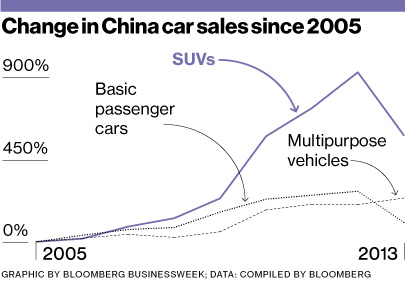
Great Wall Motor, China’s No. 1 SUV maker, has operating margins of 16 percent. That’s the highest of any carmaker

China’s Great Wall Motor Is Built on SUVs

By Tian Ying on July 25, 2013

comp_greatwall31__01__202 comp_greatwall31_405

Wang Jiangwei spent last summer sweating through a month of military drills—everything from marathon runs to rigorous calisthenics—conducted by Chinese People’s Liberation Army instructors. But Wang isn’t a soldier; he’s a researcher at Great Wall Motor (2333:HK). The training program is a creation of Great Wall’s quirky founder, Chairman Wei Jianjun, who has built China’s biggest maker of SUVs with a leadership style that stands out for its emphasis on discipline and frugality usually more common to the military. Read more of this post

Chemical Companies Rush to the U.S. Thanks to Cheap Natural Gas, powering a $100 billion investment boom in the U.S. chemical industry

Chemical Companies Rush to the U.S. Thanks to Cheap Natural Gas

By Jack Kaskey on July 25, 2013

Ships sailing north from Chile are bringing an unusual cargo to the U.S.: chemical factories. Methanex (MEOH), the Canadian company that’s the world’s largest producer of methanol, is spending $1.1 billion to disassemble two of its Chilean factories and rebuild them in Geismar, La. The first plant is scheduled to open next year. A second will be relocated by early 2016.

Scores of other companies including ExxonMobil (XOM), Chevron (CVX), and Sasol (SSL) plan to spend about $100 billion to build or expand chemical plants in the U.S., according to a tally kept by Dow Chemical (DOW), the biggest U.S. chemical maker by sales. Dow is spending $4 billion to build factories in Freeport, Tex., and reopen a plant in Hahnville, La., creating 500 manufacturing and 5,000 construction jobs. Five years ago the company was closing U.S. plants and moving production to the Middle East to gain access to cheaper raw materials and be closer to Asian markets. Read more of this post