China Cash Crunch Spreads; Businesses Turn to Alternatives Such as Bankers’ Acceptances to Pay Their Bills

June 26, 2013, 8:19 p.m. ET

China Cash Crunch Spreads

Businesses Turn to Alternatives Such as Bankers’ Acceptances to Pay Their Bills

DINNY MCMAHON

BEIJING—Even as Chinese officials indicate a softening of their tight grip on cash, some businesses are reporting liquidity is increasingly hard to find in some places and that customers are turning to alternatives.

It isn’t clear how deep the liquidity issues have trickled down from the financial sector, which has been gripped this month by a cash crunch widely believed to be aimed at deflating ballooning credit in the Chinese economy. But it suggests the pain could spread to other areas if cash borrowing rates for banks remain stubbornly high. Read more of this post

Exit Signs Blurry for Private Equity

Updated June 26, 2013, 10:09 p.m. ET

Exit Signs Blurry for Private Equity

MIKE SPECTOR and TELIS DEMOS

It all was going so well. For the first 5½ months of the year, private-equity firms took advantage of soaring markets and eager investors to raise about $35 billion by selling stakes in their companies, not to mention billions of dollars more through initial public offerings.

The rush for cash prompted some buyout executives and bankers to view 2013 as the year of the exit, a moment to reap what they sowed, including on some highly indebted, controversial deals just before the eruption of the financial crisis. Leon Black, Apollo Global Management LLC APO +1.79% co-founder, in April called the market’s receptiveness to such sell-downs “biblical.” Read more of this post

Hong Kong Stocks Show Property Collapse to BNP

Hong Kong Stocks Show Property Collapse to BNP

imOjuIdKbD2c

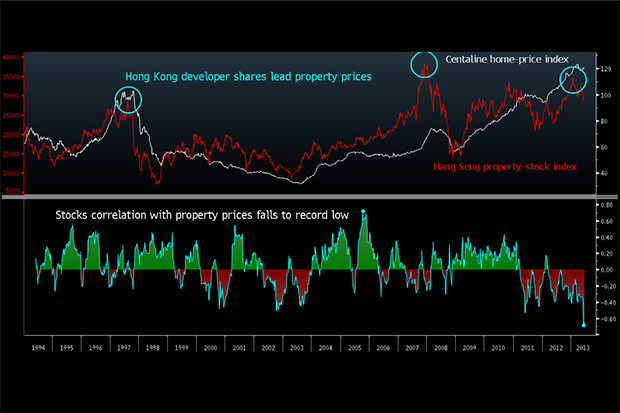
Hong Kong real estate has become more unhinged from the city’s stock market than ever before as shares of developers tumble while property prices stay near record highs.

The CHART OF THE DAY’s lower panel shows the 20-week correlation between Centaline Property Agency Ltd.’s housing-price gauge and the Hang Seng Property Index has dropped to minus 0.68 this month, the lowest level since Bloomberg began compiling the data in 1994. The Centaline index slipped 3 percent from its peak in March through its most recent report on June 16, while the stock index, which includes Sun Hung Kai Properties Ltd. (16) and Cheung Kong Holdings Ltd. (1), declined 19 percent from this year’s high on Jan. 28 through yesterday. Read more of this post

Li’s Shock Treatment to China Lenders Evokes Ex-Reformer

Li’s Shock Treatment to China Lenders Evokes Ex-Reformer

The jolt Premier Li Keqiang delivered to China’s financial system emulates a playbook crafted by predecessor Zhu Rongji in the 1990s, inflicting short-term pain in the anticipation of long-term gain.

Li, who took office in March, sent the clearest message yet the past week that China’s new leadership team wants lenders to rein in credit expansion, depriving money markets of liquidity in the biggest squeeze in at least a decade. Next steps may include tightening that sends some smaller financial institutions into bankruptcy, according to analysts at Nomura Holdings Inc.

Zhu’s strategy of cutting the size of state enterprises with millions on the payrolls helped set the stage for years of growth in excess of 10 percent. With a focus now on a slower expansion pace that avoids asset bubbles or bad-loan crises, Li and his team face a possible backlash from indebted local governments and state banks that are among the world’s largest by market value.

“You’ve got to use a hammer to change this system,” said James McGregor, a Beijing-based former chairman of the American Chamber of Commerce in China and author of the 2012 book “No Ancient Wisdom, No Followers: The Challenges of Chinese Authoritarian Capitalism.” “There’s no rule of law here, so you’ve got to use blunt instruments to get party members out there in the financial system to pay attention. This got their attention.”

Liquidity Support

The central bank signaled this week that while it won’t let the cash squeeze further roil money markets, any liquidity support will be focused on banks that are lending to help the economy, after credit expansion outpaced economic growth this year. Li’s State Council, or Cabinet, said last week that the financial system must better support the economy, and yesterday said China will keep consistency and stability in its policies to stabilize market expectations.

“It takes pains to get through the liquidity crunch, but it also paves way for future gains,” the official Xinhua News Agency said in a commentary last night. “For the blessing of a more sustainable economy, banks are the first, but certainly not the last to suffer the hardship.”

China’s overnight repurchase rate, a gauge of interbank funding, yesterday fell 40 basis points to 5.6 percent after the central bank said June 25 it would use tools to safeguard stability and that tight liquidity would ease. The rate, which touched a record 12.85 percent on June 20, is still more than double the 2.51 percent average during the six months through May.

Open Economy

Li, 57, has pledged to open the economy to more market forces and strip power from the government. This “self-imposed revolution” would “even feel like cutting one’s own wrist,” Li said at a March 17 press conference.

“Both premiers are reformers and investors are trying to find out if Li, like Zhu, has the courage and will to push for wrenching changes,” said Fred Hu, the Beijing-based founder of private-equity firm Primavera Capital Group and former Greater China chairman at Goldman Sachs Group Inc. “Zhu’s reforms, while unpopular and painful at the time, ultimately delivered tremendous benefits to the Chinese economy.”

Li’s economic team includes leaders who worked under Zhu in the 1990s such as People’s Bank of China Governor Zhou Xiaochuan, who was a deputy governor from 1996 to 1998, and Finance Minister Lou Jiwei, a vice minister from 1998 to 2007. Both played roles in economic restructuring that led to China joining the World Trade Organization in 2001.

Zhou’s Position

While the PBOC’s actions this month have been “extraordinarily reckless,” Zhou is in a “very difficult position” given that he doesn’t have authority to make key decisions, said Mark Williams, a former U.K. Treasury adviser on China who is now an economist at Capital Economics Ltd. in London. “There will be a lot of angry bankers out there and a lot of state-owned industry will be questioning what went on.”

Jiang Jianqing, chairman of Industrial & Commercial Bank of China Ltd., the nation’s biggest bank, said there was no clear direction from policy makers on their goals during the money-market turmoil, Reuters reported, citing a June 25 interview. “Those few days, even for us, we were genuinely a bit tense,” Jiang said, according to Reuters.

As the economy’s steward from the early 1990s through 2003, during which he served as vice premier, central bank governor and then premier, Zhu helped slash inflation to 2.8 percent in 1997 from more than 24 percent in 1994 while slowing growth in fixed-asset investment. More than 50 million workers were laid off at state-owned enterprises under Zhu’s watch, according to Standard Chartered Plc.

World Bank

Li, China’s first premier with an economics doctorate, gave his “unwavering commitment” to the 400-plus-page “China 2030” report published last year by the World Bank and the Development Research Center of China’s State Council, then-World Bank President Robert Zoellick said in February 2012.

The report lays out a framework to restructure China’s economy through market mechanisms. It recommends loosening controls over interest rates, boosting consumption, rolling back state enterprises and speeding a shift to market-set prices for everything from loans to raw materials.

Such initiatives may face opposition from entities including local governments that rely on debt to finance their budgets and state-owned enterprises in industries from banking to telecommunications that resist increased competition.

“Everybody who needs credit will be pushing back,” said Steve Tsang, director of the China Policy Institute at the University of Nottingham in England. “How are local governments going to service their huge debt?”

‘Complete Alignment’

The initiative to squeeze credit required the premier and President Xi Jinping “to be in complete alignment,” said McGregor, now chairman for Greater China at public-relations company APCO Worldwide Inc.

Li inherited combined government, corporate and consumer debt at about 206 percent of gross domestic product, up from 150 percent a decade earlier, Standard Chartered estimates.

With May M2 money supply expanding 15.8 percent from a year earlier, above the year’s 13 percent target, policy will remain tight in the second half, said Zhang Zhiwei, Nomura’s chief China economist in Hong Kong.

The sudden action by Li’s government contrasts with a decade of incremental policy change under former President Hu Jintao and Premier Wen Jiabao.

“What you are seeing is a re-connection with the economic management and reform mindset of the period of former President Jiang Zemin and Zhu Rongji,” said Kenneth Courtis, founder of Tokyo-based advisory company Next Capital Partners and former Asia vice chairman at Goldman Sachs. “People are starting to understand more fully that the new leadership is working to move China beyond the Hu-Wen period, when change was modest and based largely on vast reforms that had gone before.”

–Kevin Hamlin. With assistance from Emma Bi in Hong Kong. Editors: Scott Lanman, Stephanie Phang

To contact Bloomberg News staff for this story: Kevin Hamlin in Beijing at khamlin@bloomberg.net;
China guideline for industries, plans targeting industrial overcapacity could be announced soon

Thursday June 27, 2013

China guideline for industries, plans targeting industrial overcapacity could be announced soon

BEIJING: China is set to release new plans soon to slim down bloated industries from steel to shipbuilding, but applying measures on the ground will be tough after years of lax oversight during a stimulus-fuelled rush to expand in Asia’s biggest economy.

The new rules, which will also target aluminium, cement and glass-making, could be announced within weeks. Despite fairly resilient demand, all these sectors have been hit by overcapacity and failure to rein in production gluts could put more pressure on already weak markets. Read more of this post

Scalpel in hand, Chinese Premier Li stirs reform hopes

Scalpel in hand, Chinese Premier Li stirs reform hopes

Wed, Jun 26 2013

By Koh Gui Qing

BEIJING (Reuters) – Investors getting stung by China’s worst financial market rout in years should find solace in the fact that the government, in particular Premier Li Keqiang, is willing to play hardball to force through much-needed policy change.

The central bank’s refusal to intervene last week to ease an unprecedented cash crunch, where interest rates in the interbank market shot as high as 30 percent, was the clearest sign yet that China’s new leaders are willing to stomach economic pain for the long-term good. Read more of this post

Arrest warrant sought for Korean CJ Group chairman

2013-06-26 16:46

Warrant sought for CJ Group chairman

By Kim Jae-wo

The prosecution said Wednesday that it has applied for an arrest warrant for CJ Group Chairman Lee Jay-hyun on charges of tax evasion, corporate fund embezzlement and stock manipulation. The Seoul Central District Prosecutors’ Office said that it asked the Seoul Central District Court to issue the warrant, saying the charges are serious enough for him to be taken into custody and the amount of illegal gains was huge.  The court said that senior Judge Kim Woo-soo will review the application. Prosecutors quizzed the 53-year-old tycoon Tuesday for 17 hours over allegations that he amassed a secret fund worth between 400 billion won ($347 million) and 500 billion won both at home and abroad through various illegal methods, and evaded taxes in the process. Sources say Lee admitted to instructing the group’s executives to manage the secret fund, but said it was not for personal use and that there was no intentional criminal acts. Lee is under suspicion of evading 51 billion won in taxes in creating the fund and misappropriating 60 billion won of company money. The country’s 10th richest man is additionally accused of inflicting financial losses worth 35 billion won on the group by fraudulently purchasing two buildings in Tokyo.

Debt crisis blows South Korea’s STX on to the rocks

June 26, 2013 2:22 pm

Debt crisis blows South Korea’s STX on to the rocks

By Simon Mundy in Seoul

Kang Duk-Soo was sanguine when asked three years ago whether choppy industry conditions could spell trouble for STX Group, which he had built into one of the world’s leading shipping and shipbuilding groups in less than a decade.

“We have no liquidity problems because we never seek excessive expansion. We will make efforts not to follow in the footsteps of Daewoo,” the chairman told the Financial Times, referring to the defunct South Korean conglomerate wound up in 1999 after years of debt-fuelled international growth. Read more of this post

China Out of 10 Biggest Stocks as PetroChina Ousted

China Out of 10 Biggest Stocks as PetroChina Ousted

Chinese companies have dropped out of the ranks of the world’s 10 biggest stocks by market value for the first time since 2006 amid a cash crunch, slower growth and the biggest U.S. stock rally in a decade.

PetroChina Co., (PTR) the state oil producer that was the world’s sixth-biggest company in May, lost $35 billion in market value this month to $214 billion, dropping to 12th, according to data compiled by Bloomberg based on closing prices yesterday. Industrial & Commercial Bank of China Ltd. fell four places to 13th after losing $28 billion. All of the 10 largest stocks are from the U.S. after Johnson & Johnson (JNJ), the top maker of health-care products, and Wells Fargo & Co. (WFC) overtook the Chinese firms. Read more of this post

Nobel Laureate Robert Engle on an increasingly risky China economy

Nobel Laureate Robert Engle on an increasingly risky economy

Tuesday, June 25, 2013

China edged its way toward a credit crunch last week, spooking investors, businesses, analysts – and perhaps more than anyone – the banks themselves.

Liquidity in the country’s money market appeared to suddenly dry up after a long holiday in early June. Interbank lending rates then shot from around 3% to 28% at one point. Exchanges in Hong Kong and Shanghai slid at the thought of highly leveraged firms losing access to credit. Read more of this post

Business Feels Pinch of Swift Rate Rise

June 26, 2013, 8:00 p.m. ET

Business Feels Pinch of Swift Rate Rise

JON HILSENRATH and VICTORIA MCGRANE

P1-BM082_FedEco_G_20130626185705

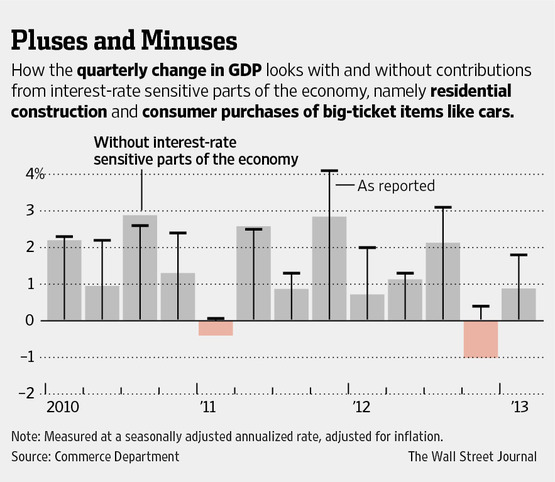
Sharp increases in long-term interest rates, triggered by Federal Reserve statements last week, threaten sales of homes, cars and other big-ticket items that have helped drive the U.S. economic recovery.

Rate increases on interest-sensitive sectors likely aren’t severe enough to derail the recovery, say economists. But they arrived just as the economy’s lagging growth had showed welcome signs of improvement, raising worries among consumers and company executives. Read more of this post

The Middling Kingdom: By 2030, China will have more people over 65 than the U.S. has people. It stands to be the first global power to get old before getting rich

June 26, 2013, 4:27 p.m. ET

The Middling Kingdom

By 2030, China will have more people over 65 than the U.S. has people. It stands to be the first global power to get old before getting rich.

HOWARD FRENCH

Outside of world wars and market cataclysms, the relative trajectories of major powers usually trace gradual curves rather than abruptly rising or falling. After the 2008 financial crisis, however, commentators in China and to a lesser extent in the West suggested that the U.S. had hit an inflection point. China, they said, was zooming toward parity as a world power, and perhaps more.

In recent months, for somewhat less obvious reasons including Beijing’s increasing pushiness in East Asia and the country’s just-completed once-a-decade leadership transition, this conversation has been shifting again, at least in the West. America’s relative decline is anything but assured, many analysts have begun to proclaim, with some adding that China’s rise to global pre-eminence any time soon is highly unlikely. Read more of this post

Why Legal Secretaries Can’t Find Jobs; Legal secretaries are increasingly being displaced, as law firms cut back and usher in a new generation of lawyers who conduct business by email and type their own briefs

June 26, 2013, 7:31 p.m. ET

Why Legal Secretaries Can’t Find Jobs

Positions Dwindle as Firms Cut Back; Younger Lawyers Type Their Own Briefs

JENNIFER SMITH and JOE PALAZZOLO

Steve Bryant is still hunting for permanent work more than four years after he was laid off from his legal secretary job at the New York office of Latham & Watkins LLP, which slashed more than 250 staffers at the height of the recession.

Mr. Bryant has tried to burnish his résumé, obtaining a college degree and a paralegal certificate from Hunter College in New York. Despite roughly 20 job interviews, and a slew of job applications, he has landed only lower-paying work as a temp. He and his wife were leaning on credit cards until her work as an architect picked up in recent years. Read more of this post

Since the crunch began in early June, many Chinese savers have received messages from banks and their wealth managers, urging them to buy new WMPs, which are are subject to fewer official controls and pay hugher interest rates

China: savers flock to shadow-bank deposits in response to higher rates

Jun 26, 2013 1:37pm by Lydia Guo

China’s recent cash squeeze is having the perverse effect of attracting more savers into the controversial wealth management products (WMPs) that the authorities want to bring under greater scrutiny. The hike in market interest rates that has accompanied the crunch has boosted the returns many banks need to offer on these off-balance-sheet-funds so they can lend the money on to borrowers hit by the squeeze. Since the crunch began in early June, many savers have received messages from banks and their so-called wealth managers, urging them to buy new WMPs, which are similar to time deposits but are subject to fewer official controls and pay higher interest rates.

Read more of this post

Bond rout threatens to hit bank funding

June 26, 2013 6:00 pm

Bond rout threatens to hit bank funding

By Christopher Thompson in London and Jason Abbruzzese in New York

Will banks be among the biggest casualties of the global bond market sell off through rising funding costs?

Like Odysseus’s boat passing between Scylla and Charybdis, banks must navigate an increase in their funding costs from higher market interest rates on one side and regulators’ demands on the other. Read more of this post

Economists Tackle Puzzle of Libor Losses for Investors

Economists Tackle Puzzle of Libor Losses for Investors

Paula Ramada, who has a doctorate in economics from the Massachusetts Institute of Technology, says she can calculate how much investors lost from banks’ alleged rigging of benchmark interest rates. Now all she needs is funding, a team of analysts and weeks to run the numbers.

Ramada is among a growing number of mathematicians, analysts and researchers trying to tackle one of the toughest questions to emerge from the Libor scandal: If banks manipulated rates tied to $300 trillion in instruments such as mortgages and student loans, how much did it cost investors? Read more of this post

Cost of Public Projects Is Rising, and Pain Will Be Felt for Years; The recent sell-off in bonds has hit hard in the municipal market, forcing governments to pay higher interest rates for crucial infrastructure projects

JUNE 26, 2013, 8:28 PM

Cost of Public Projects Is Rising, and Pain Will Be Felt for Years

By MARY WILLIAMS WALSH

States and cities across the nation are starting to learn what Wall Street already knows: the days of easy money are coming to an end.

Interest rates have been inching up everywhere, sending America’s vast market for municipal bonds, a crucial source of financing for roads, bridges, schools and more, into its steepest decline since the dark days of the financial crisis in 2008.

For one state, Illinois, the higher interest rates will add up to $130 million over the next 25 years — and that is for just one new borrowing. All told, the interest burden of states and localities is likely to grow by many billions, sapping tax dollars that otherwise might have been spent on public services. Read more of this post

Norway’s economic star begins to lose its shine

Norway’s economic star begins to lose its shine

1:00am EDT

* Number of unemployed at an 8-year high

* Bankruptcies rise rapidly

* Oil sector at risk from crude prices

* Growth rate still the envy of Europe

By Balazs Koranyi and Terje Solsvik

TOFTE, Norway, June 27 (Reuters) – A boiler towers over a fjord on Norway’s south coast from a 116-year-old pulp mill, the largest employer in the town of Tofte.

The 300 jobs may be gone by September, the deadline set by the loss-making plant’s Swedish owner to find a buyer or close, victim of high wage costs, the strong Norwegian currency and the debt crisis that has hurt its local European markets. Read more of this post

Counterfeit Food More Widespread Than Suspected; “Around the world, food fraud is an epidemic”

June 26, 2013

Counterfeit Food More Widespread Than Suspected

By STEPHEN CASTLE and DOREEN CARVAJAL

GREAT DALBY, England — Invisible from the roadway, hidden deep in the lush English countryside, Moscow Farm is an unlikely base for an international organized crime gang churning out a dangerous brew of fake vodka.

But a quarter of a mile off a one-lane road here, tens of thousands of liters of counterfeit spirits were distilled, pumped into genuine vodka bottles, with near-perfect counterfeit labels and duty stamps, and sold in corner shops across Britain. The fake Glen’s vodka looked real. But analysis revealed that it was spiked with bleach to lighten its color, and contained high levels of methanol, which in large doses can cause blindness. Read more of this post

Commodities traders call end of ‘supercycle’

June 26, 2013 5:29 pm

Commodities traders call end of ‘supercycle’

By Jack Farchy and Javier Blas

The commodities “supercycle” is dead. If anyone was still in doubt about whether the era of ever-rising prices driven by rapid Chinese growth was over, events of the past week have surely dispelled it.

The dollar rally after the Federal Reserve’s hints about tapering its “quantitative easing” programme, together with fears about a liquidity crunch in China, have sent a ripple of fear through the commodities industry. Read more of this post

Mr. Abe’s Missing Arrow; The absence of immigration reform from Abenomics bespeaks a deeper problem.

June 26, 2013, 12:54 p.m. ET

Mr. Abe’s Missing Arrow

The absence of immigration reform from Abenomics bespeaks a deeper problem.

JOSEPH STERNBERG

If there’s one reform that’s symbolic of Prime Minister Shinzo Abe’s eponymous program to rejuvenate the Japanese economy, it’s immigration.

By importing new consumers and workers, immigration is crucial to stimulating domestic capital investment by companies. By expanding the taxpaying population base, it improves the government’s fiscal position. Immigration will facilitate foreign direct investment, boosting productivity. Read more of this post

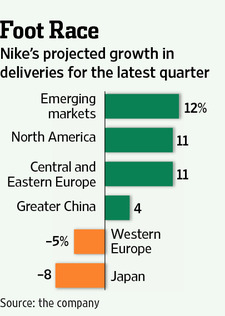
Nike Earnings May Be Tripped Up by China

Updated June 26, 2013, 7:57 p.m. ET

Nike Earnings May Be Tripped Up by China

SPENCER JAKAB

MI-BW798_AOT_NS_20130626174803

With LeBron, Tiger and Federer on the payroll, clutch performances should be business as usual for Nike Inc.

Looking back at a decade of quarterly earnings reports, that has been the case with 36 “beats” of the analyst consensus out of 40 opportunities. The company’s performance against the point spread was less impressive, with the stock rising on just 27 occasions.

Read more of this post

Foreign firms will struggle to hand out credit cards in China

Foreign firms will struggle to hand out credit cards in China

Thursday, June 27, 2013

MasterCard didn’t make a peep earlier this month when word leaked that Beijing had halted the company’s transactions in renminbi.

Leaked documents didn’t show when the payments were terminated, but the central bank effectively stopped the Chinese online payment platform EpayLinks from issuing yuan-denominated credit cards in partnership with the US firm. MasterCard declined to comment on the issue.

It’s quite the issue to keep mum on. After all, the WTO has already ruled that by blocking payment services and giving free range to its homegrown payment service UnionPay, China had not lived up to the commitments it made more than 12 years ago when it joined the organization. MasterCard would have found solid support in raising a loud complaint. Read more of this post

Institutional Imperative and Differentiating Between the Tech Innovators, the Imitators and the Swarming Incompetents in Asia. Bamboo Innovator is featured in BeyondProxy.com, where value investing lives

Bamboo Innovator is featured in BeyondProxy.com, where value investing lives:

  • Institutional Imperative and Differentiating Between the Tech Innovators, the Imitators and the Swarming Incompetents in Asia, June 27, 2013 (BeyondProxy)

Institutional Imperative

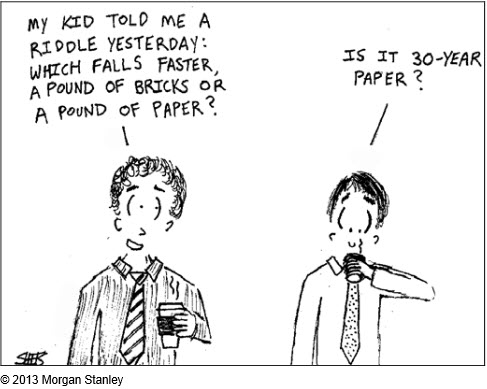
Humor of the day: Bonds

20130626_humor

Barron’s Midyear Roundtable 2013: Shifting Winds

MONDAY, JUNE 17, 2013

Shifting Winds

By LAUREN R. RUBLIN | MORE ARTICLES BY AUTHOR

A change appears to be under way in the markets. Our experts explain the risks, and highlight the opportunities.

Back in the day, a taper was only a candle. Just ask Lady Macbeth. Now, suddenly, it is cause for convulsions across the financial system. Just whisper the word — as in, the Federal Reserve might taper its monthly purchase of fixed-income assets — and voilà! billions of dollars of wealth vaporize in stock and bond markets around the world. After months of investment Nirvana, all bets are off for the rest of this roiled year. How best to navigate the new and more dangerous landscape? Luckily, we have just the guides: the intrepid members of the Barron’s Roundtable. In our midyear telephone check-ins with these illustrious investment experts, who last met as a group on Jan. 14 in Manhattan, we sought both insights into the current market turmoil and specific ways to profit as the second half unfolds. Our go-to pros didn’t disappoint. They also didn’t agree. As a result, you’ll find a wealth of contradictory opinion in the pages ahead, just as you will in the market, ranging from harsh assessments of the Fed’s experiment with too-easy money to applause for the central bank’s steps to end the financial crisis and prevent a successor. You’ll also find a broadly diverse selection of investment picks and pans, ranging from undervalued equities to overvalued currencies. The general consensus of the Roundtable crowd is that overseas markets can’t hold a candle — er, taper — to the U.S. these days. Why, then, are our experts recommending so many European shares? That’s just another of the contradictions that will keep you thinking and hopefully make you money in the back half of 2013. Read more of this post

Gold Drops Below Its Average Cash Cost

Gold Drops Below Its Average Cash Cost

Tyler Durden on 06/26/2013 13:05 -0400

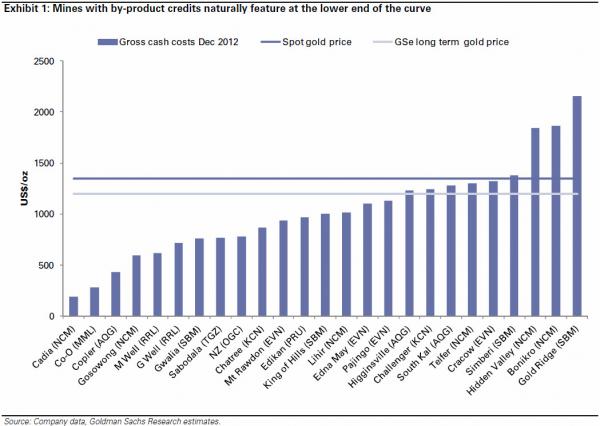
As shown two months ago, the marginal cost of production of gold (90% percentile) in 2013 was estimated at $1300 including capex. Which means that as of a few days ago, gold is now trading well below not only the cash cost, but is rapidly approaching the marginal cash cost of $1104… Which means that of the following mines (as we showed here) which make up the gold cost curve, one by one, starting on the right and going left, production is going to go dark, even without the recent demand by South African gold miner labor unions to have their wages doubled. Until eventually virtually no gold will be produced. It is at that point where one must apply the New Normal supply and demand curve, when one can predict a $0 per ounce price for gold, as physical demand continues unabated, while actual physical, not paper, production has now started going offline. Joking aside, not even Bernanke and all the paper Gold ETFs in the world will be able to do much to suppress gold prices from reaching their fair value when gold production hits a standstill, and when demands, especially by China, is still in the hundreds of tons each year.

20130416_gold1 20130417_cost1_0

Educated with a dead-beat job – the unseen legacy of Europe’s crisis

Educated with a dead-beat job – the unseen legacy of Europe’s crisis

June 26, 2013 – 4:23PM

Anders Melin

As the first anniversary of her graduation in eco-tourism and cultural history approaches, Linnea Borjars remains jobless and frustrated. After finishing her studies at Sweden’s Linkoping University, the 25-year-old accepted an unpaid, part-time position at Fair Travel, a non-profit group focused on human rights and tourism, hoping it would lead to a full-time job and a salary. But no such luck. Read more of this post

China said it will start an investigation to ensure the accuracy of data filed by companies as part of efforts to improve the reliability of statistics in the world’s second-largest economy

China Starts Probe to Ensure Accuracy of Economic Data

China said it will start an investigation to ensure the accuracy of data filed by companies as part of efforts to improve the reliability of statistics in the world’s second-largest economy.

There is an urgent need to prevent fraud in data submission, National Bureau of Statistics head Ma Jiantang was cited by China Information News today as having said on June 24. Those found submitting inaccurate information for major statistics may be “severely punished,” the newspaper, published by the bureau, reported without citing anyone. Read more of this post

Why Are So Many College Graduates Driving Taxis?

Why Are So Many College Graduates Driving Taxis?

It’s a parent’s nightmare: shelling out big money for college, then seeing the graduate unable to land a job that requires high-level skills. This situation may be growing more common, unfortunately, because the demand for cognitive skills associated with higher education, after rising sharply until 2000, has since been in decline.

So concludes new research by economists Paul Beaudry and David Green of the University of British Columbia and Benjamin Sand of York University in Toronto. This reversal in demand has caused high-skilled workers to accept lower-level jobs, pushing lower-skilled people even further down the occupational ladder or out of work altogether. If the researchers are right (which is not yet clear), the consequences are huge and troubling — and not just for college grads and their parents. Read more of this post