Ratings Ratio Worst Since 2009 as Profits Slow: Credit Markets

Ratings Ratio Worst Since 2009 as Profits Slow: Credit Markets

Corporate creditworthiness in the U.S. is deteriorating at the fastest pace since 2009 with earnings growth slowing as yields rise from record lows.

The ratio of upgrades to downgrades fell to 0.89 times in the first five months of the year after reaching a post-crisis high of 1.55 times in 2010, according to data from Moody’s Capital Markets Group. At Standard & Poor’s, the proportion has declined to 0.83 as of last week from 1 a year earlier.

The Federal Reserve has pumped more than $2.5 trillion into the financial system since markets froze in 2008, helping companies improve profitability by lowering their borrowing costs. Policy makers are considering curtailing $85 billion in monthly bond buying intended to prop up the economy as analysts surveyed by Bloomberg forecast earnings growth of 2.5 percent in the current quarter, the least in a year. Read more of this post

Brazil Burns With Bus Fares Double NYC: Chart of the Day

Brazil Burns With Bus Fares Double NYC: Chart of the Day

Brazil Bus

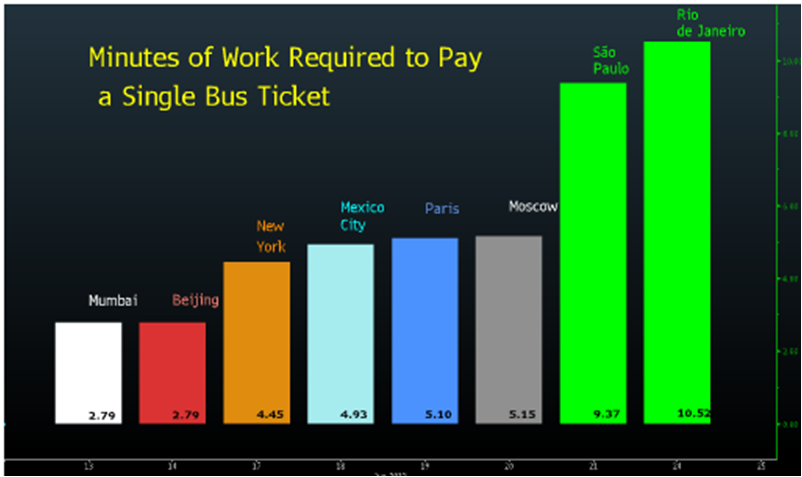
Residents of Sao Paulo and Rio de Janeiro devote a bigger share of their paychecks to mass transit than counterparts around the world even after winning a fight to revoke a 9-cent increase in bus fares.

The CHART OF THE DAY shows residents of Brazil’s two biggest cities must work an average 10 minutes to pay for a bus ticket, more than twice the time needed in Paris or New York. The comparison is based on the latest report by UBS AG on purchasing power in 72 cities. In Beijing and Mumbai, less than four minutes of work buys a ticket. Read more of this post

Chinese Banks Stop Lending Due To Liquidity Freeze

Chinese Banks Stop Lending Due To Liquidity Freeze

Tyler Durden on 06/26/2013 08:16 -0400

If one thought the schizophrenic lies out of Europe between 2010 and 2013 were bad enough (the bulk of which it now appears were orchestrated by Mario Draghi), here comes China, a country which already has a “credibility” issue so to say, which has no choice but to lie as blatantly as possible in order to preserve some semblance of stability. The reason: as first forecast here months ago, and as has subsequently materialized, the credit/liquidity collapse in the country that lives and breathes on credit creation (the bulk of which is created in the shadow banking system) is rippling through the banking sector and causing unprecedented fallout for a financial industry that is already starved for every marginal yuan (and in a Keynesian “credit=growth” world, the economic crush is just waiting beyond the next corner). Not unexpectedly following news that various retail and online banking services had been impaired in the early part of the week at China’s biggest banks, now Caixin reports that banks are simply shutting lending to both businesses and individuals.

Read more of this post

World’s Most Indebted Households Face Rate Pain: Nordic Credit

World’s Most Indebted Households Face Rate Pain: Nordic Credit

By Frances Schwartzkopff – Jun 26, 2013

Danish consumers, who owe banks more than three times their disposable incomes, are about to find out how sustainable that debt load is as interest rates rise.

Signals from the U.S. Federal Reserve that it’s preparing to scale back monetary stimulus have already sent mortgage costs higher as yields rise across global bond markets. The Nykredit Index of Denmark’s most traded mortgage bonds sank this week to its lowest in more than four months after investors sold assets once coveted for their haven status. Read more of this post

Quarterly fund statements could trigger another bond market sell-off; Lousy performance could mean more volatility, observers say; ‘that’s how these things get legs’

Quarterly fund statements could trigger another bond market sell-off

Lousy performance could mean more volatility, observers say; ‘that’s how these things get legs’

By Jeff Benjamin

Jun 25, 2013 @ 12:22 pm (Updated 4:11 pm) EST

Even if the recent volatility in the financial markets starts to calm down, the bond market could experience a second stage of selling as mutual fund investors start receiving their quarter-end statements and react with even more selling.

“What is scary here is the forces of mutual fund investors’ seeing their net asset values drop, and they are going to start dropping significantly,” said Dan Toboja, senior vice president of fixed income at Ziegler Capital Markets. Read more of this post

Why Did Chinese ATMs Stop Working?

Why Did Chinese ATMs Stop Working?

On Sunday morning, while China was taking a weekend breather from the financial fireworks caused by the government’s weeklong self-inflicted cash and credit crunch, customers of the Industrial and Commercial Bank of China, the world’s largest bank, woke to an unpleasant surprise: Their deposits were not available for withdrawal by ATM or teller (online or in-person).

The social-media reaction was swift, filled with exclamation points and lacking in confidence for ICBC, or the Chinese banking system as a whole. “I was just at ICBC to make a withdrawal and was told the system was undergoing an upgrade and withdrawals are temporarily unavailable,” tweeted a user in Shenyang on Sina Weibo, China’s leading social-media platform. “I called the service hot line, finally someone answered and said they don’t know the answer!!!!!!! ICBC: When can we withdraw money? Who can give a clear answer??????????????” Read more of this post

China steel firm goes bust as slowdown, supply glut bite; chairman of Jiangxi Steel sought to abscond with 200 million yuan after the company’s credit lines were suddenly cut off and the plant shut down

China steel firm goes bust as slowdown, supply glut bite

Wednesday, Jun 26, 2013

Reuters

BEIJING – A steel firm in the eastern Chinese province of Jiangxi has been declared insolvent and shut down after failing to pay its debts, adding to jitters in a sector struggling with overcapacity and weak prices, the China Business News reported on Wednesday.

China’s steel mills have been producing at near record rates in recent months despite a downturn in demand and a long decline in prices due to a massive supply glut. Industry experts have warned that closures are inevitable. Read more of this post

Leadership vacuum hits Korean chaebol CJ stocks

2013-06-25 17:27

Leadership vacuum hits CJ stocks

By Kim Tae-jong
CJ Group and its affiliates face a leadership vacuum because Chairman Lee Jay-hyun is under investigation for allegedly creating massive secret funds and evading payment of taxes.
CJ Cheiljedang’s stocks fell by 3.89 percent to close at 247,000 won, while CJ E&M plunged by 6.41 percent to end at 32,850 won. In comparison, the benchmark KOSPI fell by 1.02 percent to close at 1,780.63 that day. Read more of this post

Devendra Shah turned Parag Milk Foods into one of the most profitable dairy businesses. His secret: High-value milk products, especially cheese

How Parag Milk Foods Got it Right with Cheese

by Samar Srivastava | Jun 26, 2013

topimg_21881_devendra_shah_vk_600x400

Devendra Shah’s call to go for milk products has paid off for the company—75% of revenues come from cheese, flavoured yoghurt and ghee

Devendra Shah turned Parag Milk Foods into one of the most profitable dairy businesses. His secret: High-value milk products, especially cheese

In early 2008, a few months before the global economy went into a tailspin, Devendra Shah, the pudgy boss of Parag Milk Foods, took his boldest bet ever. In those days, India, which produces 127 million litres of milk a day, converted just 40 tonnes of that yearly flood into cheese, according to industry estimates. Most of this was made by Amul and sold to retail consumers.

Shah, who had set up his dairy 16 years ago in 1992 in Manchar, an hour’s drive from Pune, believed that India was on the cusp of a huge jump in cheese consumption. Now, this was before Indians had begun devouring pizzas faster than companies could serve them. Dominos had only 62 stores across India, a fraction of the 576 it has today. Other pizza chains, where they existed, were relatively smaller. Read more of this post

Post-90s Chinese Grads Confront Nepotism

Post-90s Grads Confront Nepotism – Economic Observer Online

By Li Yu (李谕) and Wu Weiting (吴娓婷)
Issue 625, June 24, 2013
The majority of university students graduating this year were born in 1990 and 1991, meaning the “Post-90s Generation” is entering the real world. But this entrance hasn’t been a very welcoming one.

A record 6.99 million-strong graduating class paired with an economic slump has resulted in what’s been deemed the worst job-hunting season in history. As of the beginning of June, only 33 percent of these graduating seniors had signed employment contracts. Read more of this post

The China Dream a far cry from the American Dream – it’s Meng

The China Dream a far cry from the American Dream – it’s Meng

Created: 2013-6-20 0:16:59, Updated: 2013-6-21 12:41:38

Author:Thorsten Pattberg

001ec949c22b132cbe930c

Many Western commentators translate Zhongguo Meng as “Chinese Dream,” thereby patronizing China’s socio-cultural originality and marketing it as a franchise of the “American Dream.”
But are the two civilizations really sleeping on the same pillow?
What is that – a “China Dream”- if not first a Western translation? Read more of this post

Li Zuojun, China’s most successful economics doomsayer

Li Zuojun, China’s most successful economics doomsayer

Staff Reporter

2013-06-26

Chinese investors are holding their collective breaths to see if the banking crisis predicted two years ago by renowned Chinese economist Li Zuojun will come to fruition in the next couple of months.

Li, the deputy director at the Development Research Center of China’s State Council, penned an article in Sept 2011 predicting that there will be a major banking crisis in July or August this year caused by excessive local government debt or a housing bubble. Read more of this post

PBoC hints at new status quo for China’s banks; credit crunch’s fallout may be felt for months to come around the world in the form of slower Chinese growth and weaker appetite for commodities from copper to oil

June 26, 2013 12:56 pm

PBoC hints at new status quo for China’s banks

By Simon Rabinovitch in Shanghai

The acute phase of China’s cash squeeze appears to have ended, with no major casualties to mention.

But analysts say the crunch’s fallout may be felt for months to come around the world in the form of slower Chinese growth and weaker appetite for commodities from copper to oil. Read more of this post

Kevin Rudd returned as Australia’s prime minister, defeating Julia Gillardin a leadership vote that marks a stunning turnaround for a figure whom she toppled three years ago but has remained popular among voters

Updated June 26, 2013, 6:20 a.m. ET

Rudd Beats Gillard in Leadership Vote

ENDA CURRAN

SYDNEY— Kevin Rudd returned as Australia’s prime minister, defeating Julia Gillardin a leadership vote that marks a stunning turnaround for a figure whom she toppled three years ago but has remained popular among voters.

Mr. Rudd’s decisive victory in a leadership ballot among ruling Labor party members on Wednesday caps a bitter tussle for the premiership that has been likened to a classical drama ever since Ms. Gillard led the party revolt that ousted Mr. Rudd in 2010. Read more of this post

ETF Tracking Errors in Rout Shows Access Comes With Risks

ETF Tracking Errors in Rout Shows Access Comes With Risks

By Christopher Condon and Michelle Kaske – Jun 23, 2013

Investors lured to exotic assets by the convenient access that exchange-traded funds provide were reminded last week that they can’t dodge the volatility or illiquidity of those markets.

Dozens of ETFs, mainly those tracking emerging-market stocks, sold at big discounts to their underlying holdings as investors fled developing nations. The $468 million iShares MSCI Indonesia Investable Market Index Fund, run by New York-based BlackRock Inc. (BLK), traded 7 percent below the value of its holdings on June 20, the largest discount among U.S.-traded ETFs with at least $100 million in assets, according to data compiled by Bloomberg. Read more of this post

Four Reasons Non-GAAP Metrics Are Exploding

June 25, 2013, 4:36 PM ET

Four Reasons Non-GAAP Metrics Are Exploding

Emily Chasan

U.S. companies are relying more and more on non-traditional financial reporting metrics to run their companies and communicate with investors.

Since U.S. securities regulators relaxed their stance on the use of non-GAAP measures in 2010, many companies have begun to report metrics like customer churn rates and average revenue per user. Companies can include such metrics in financial reports as long as they aren’t misleading. Read more of this post

Getting the price of assets right is a delicate balance

Getting the price of assets right is a delicate balance

Wednesday, June 26, 2013

Andrew Sheng, President of the Fung Global Institute, is a former chairman of the Hong Kong Securities and Futures Commission, and is currently an adjunct professor at Tsinghua University in Beijing. Xiao Geng is Director of Research at the Fung Global Institute

Building and maintaining the infrastructure of property rights – the rules, laws, registers, and administrative and judicial structures that define, protect, and enforce such rights and regulate economic transactions – has traditionally been the responsibility of national governments. But, as the world economy has become increasingly interconnected, a global property-rights infrastructure (PRI) has emerged – further raising the stakes of developing effective national PRIs and accurate price-discovery mechanisms. Read more of this post

Italy faces restructured derivatives hit; Audit finds potential loss of billions and reveals euro-entry tactics

June 26, 2013 1:04 am

Italy faces restructured derivatives hit

By Guy Dinmore in Rome

Italy risks potential losses of billions of euros on derivatives contracts it restructured at the height of the eurozone crisis, according to a confidential report by the Rome Treasury that sheds more light on the financial tactics that enabled the debt-laden country to enter the euro in 1999.

A 29-page report by the Treasury, obtained by the Financial Times, details Italy’s debt transactions and exposure in the first half of 2012, including the restructuring of eight derivatives contracts with foreign banks with a total notional value of €31.7bn. Read more of this post

Bond yields threaten recovery in global banks’ balance sheets

June 25, 2013 7:04 pm

Bond yields threaten recovery in global banks’ balance sheets

By Tom Braithwaite in New York and Patrick Jenkins in London

The recovery in global banks’ balance sheets is under threat from a surge in bond yields, according to senior bank executives and analysts preparing for the quarterly earnings season.

Banks have built giant portfolios of liquid securities, partly at the behest of regulators and also because they have not found better opportunities to lend a flood of deposits.Under new capital rules, unrealised losses in these “available for sale” portfolios hit banks’ equity capital. Read more of this post

Brazil’s love of the car begins to backfire for political leaders; Anger over poor investment in public transport

Last updated: June 25, 2013 4:26 pm

Brazil’s love of the car begins to backfire for political leaders

By Joe Leahy in São Paulo

In Entreatos, a documentary film about his election in 2002, Luiz Inácio Lula da Silva, former Brazilian president, describes his “middle-class” pride when he bought a car in the 1970s.

“I felt like a king,” said the man who started out as a metal worker in what was then Brazil’s equivalent of Detroit, the car-manufacturing hub of São Paulo known as “ABC Paulista”. Read more of this post

The dangers of courting Asean consumers; Much of the growth in southeast Asia has been credit-fuelled

June 25, 2013 7:39 pm

Inside Business: Credit dependency looms over Asia’s middle classes

By Jeremy Grant

For furniture shoppers on the high streets of Britain, the name Courts will probably forever be associated with furious customers who attacked the company’s staff and threw bricks through shop windows as it sank into administration eight years ago.

But in southeast Asia, the name is rapidly becoming emblematic of the big trend sweeping the region: the rise of a middle class of consumers, and of companies chasing their wallets. Read more of this post

Golden ratings era ending for emerging markets

Golden ratings era ending for emerging markets

Fri, Jun 21 2013

By Sujata Rao

LONDON, June 21 (Reuters) – A decade of improvement in emerging market credit ratings is coming to an end as higher borrowing costs and commodity price falls threaten to lay bare many countries’ failure to reform during the good times. Between 2007 and 2012 emerging economies earned almost 200 rating upgrades from the three main agencies, nearly half of them promotions to the top ‘investment grade’ category. Given the weight investors still assign to credit ratings, that was a huge driver for much of the $8 trillion or so that has flowed to emerging stock and bond markets since 2004. Read more of this post

Bond king Bill Gross and his protégé Mark Kiesel are among the hardest hit from bonds’ recent declines, a sign the selloff has caught some of the most trusted hands in the investing community

Updated June 25, 2013, 8:15 p.m. ET

Bond Selloff Creates Fits for the ‘King’

MIN ZENG and KIRSTEN GRIND

MI-BW787A_PIMCO_G_20130625180907

Bond king Bill Gross is one of the hardest hit from the broad credit market selloff.

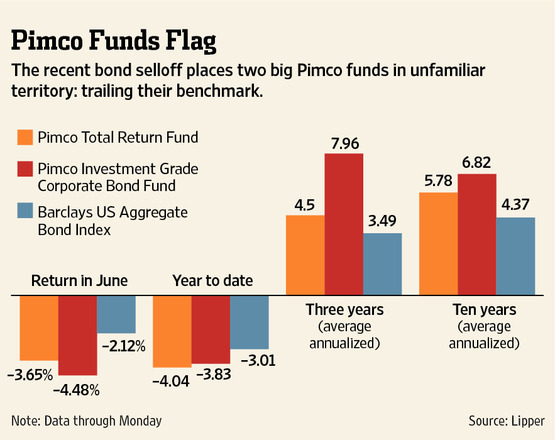
Pacific Investment Management Co.’s $285.2 billion Total Return Bond Fund has lost 3.65% in June alone, making it the 12th-worst performer among 177 similar bond funds tracked by data firm Lipper. Read more of this post

Ruchir Sharma: How Emerging Markets Lost Their Mojo; Investors have once again come to see state companies as slow-witted giants, prone to overinvest and overbuild

June 25, 2013, 7:08 p.m. ET

Ruchir Sharma: How Emerging Markets Lost Their Mojo

Investors have once again come to see state companies as slow-witted giants, prone to overinvest and overbuild.

RUCHIR SHARMA

ED-AQ937_sharma_G_20130625190135

Emerging economies have lost nearly $2 trillion in stock-market value since the global financial crisis hit in late 2007. The full blame for this meltdown, and then some, can be placed at the door of their state-owned companies, which account for a third of these economies’ roughly $9 trillion market capitalization.

Over the past five years, the value of private companies in emerging economies—including Brazil, Russia, India and China, as well as Mexico, Indonesia and Turkey—has remained broadly stable. Meanwhile, the value of state-owned companies (defined here as companies with a government ownership stake of at least 30%) dropped by more than 40%. Today there is only one state company (PetroChina) among the 10 most valuable companies in the world, down from five in 2008. Read more of this post

Weak Links Mar Investing in China; Stocks Trail the Rest of the Economy as State-Owned Companies Get Preferential Treatment for IPOs

June 25, 2013, 8:13 p.m. ET

Weak Links Mar Investing in China

Stocks Trail the Rest of the Economy as State-Owned Companies Get Preferential Treatment for IPOs

SHEN HONG

MI-BW788_MKTLED_G_20130625180917

The selloff in China’s stock market abated on Tuesday, but a key issue for investors remains: The country’s financial system puts state-owned companies ahead of private businesses.

The Shanghai Composite Index fell 0.2% on Tuesday after tumbling 5.3% on Monday, its biggest one-day percentage decline since August 2009, on worries about a credit crunch. Chinese shares initially began trading on Tuesday with another sharp drop, but recovered after Chinese central-bank officials sought to soothe investors. Read more of this post

Brazil riots raise questions over sporting mega-events

Brazil riots raise questions over sporting mega-events

Tue, Jun 25 2013

By Brian Homewood

BERNE (Reuters) – Brazilian anger against the cost of staging the World Cup could undermine the argument that host countries benefit from sporting mega-events as they become too big for most countries to handle.

UEFA’s idea of splitting the Euro 2020 championship into mini-tournaments hosted in 13 different countries could be one of the alternatives which organizers could follow in the future, analysts say. Read more of this post

Cisco China Sales Vulnerable as Media Urge Domestic Shift

Cisco China Sales Vulnerable as Media Urge Domestic Shift

Cisco Systems Inc. (CSCO) faces a backlash in China, where it generates about $2 billion in annual sales, after state-run media said the company poses a security threat and urged a shift toward domestic suppliers.

While Cisco has said it didn’t participate in U.S. surveillance programs revealed earlier this month by former government contractor Edward Snowden, state-owned Chinese media outlets are calling for the company to face restrictions there. Read more of this post

Wall Street’s $8 Billion CMBS in Limbo as Bulls Retreat

Wall Street’s $8 Billion CMBS in Limbo as Bulls Retreat

Wall Street firms spent the past six months increasing commercial mortgage origination as investors bought the most debt in six years. That’s now backfiring as banks prepare to market $7.5 billion of loans earmarked to be sold as bonds before credit markets took a dive this month.

Investors are demanding 1.2 percentage points more than the benchmark swap rate to buy new commercial mortgage backed securities tied to shopping malls, skyscrapers, hotels and apartment buildings, according to data compiled by Bloomberg. That’s up from 72 basis points in February, the narrowest spread since sales revived in 2009, the data show. Lenders’ profits are eroded when values of the securities fall. Read more of this post

Americans Exit Harrods Top 10 as Chinese Flock to Store

Americans Exit Harrods Top 10 as Chinese Flock to Store

The days of Americans being the biggest overseas shoppers at London’s Harrods store are over.

While seven years ago U.S. visitors were the top foreign spenders at the purveyor of luxury fashions and specialty teas, they are now outnumbered by wealthy customers from China and the Middle East, according to Managing Director Michael Ward. Read more of this post

While Toyota generated the highest return last year among the world’s five biggest automakers by sales, Akio Toyoda, 57, is the lowest-paid chief of the group, earning less than one tenth as much as his best-compensated counterpart

Toyota President Delivers Highest Returns for Lowest Pay

Toyota Motor Corp. (7203) made its name on the value and efficiency of its cars. Its chief executive is earning a similar reputation for his compensation.

While the company generated the highest return last year among the world’s five biggest automakers by sales, President Akio Toyoda, 57, is the lowest-paid chief of the group, earning less than one tenth as much as his best-compensated counterpart. Read more of this post