IKEA’s planned entry into Korea in 2014 is feared to deal a decisive blow to already-struggling furniture makers

2013-06-23 14:59

IKEA faces hurdle in opening store in Korea

Lee Hyo-sik

130623_a01_Furniture2130623_a01_Furniture1

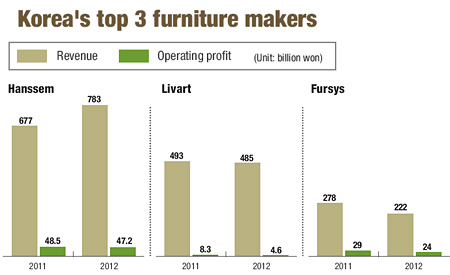
IKEA’s planned entry into Korea in 2014 is feared to deal a decisive blow to already-struggling furniture makers here. Since December 2011 when the Swedish home furnishing giant announced its plan to establish a presence in the country, it has drawn protests from concerned local furniture firms. Read more of this post

North Korea anxiety sparks South Korean global property binge

North Korea anxiety sparks South Korean global property binge

LONDON – A jump in tensions with North Korea has fed a tenfold surge in overseas commercial property spending by investors south of one of the world’s most heavily armed borders, making South Korea the largest property investor so far in 2013.

23 MIN 4 SEC AGO

LONDON – A jump in tensions with North Korea has fed a tenfold surge in overseas commercial property spending by investors south of one of the world’s most heavily armed borders, making South Korea the largest property investor so far in 2013.

South Korean investors bought about US$5 billion (S$6.4 billion) in the first five months, a huge increase on the first half of 2012, real estate consultant Jones Lang LaSalle said. Read more of this post

The vacancy rate in office buildings in major business districts in Seoul has reached a five-year high due to a toxic cocktail of an oversupply and a prolonged property market slump

2013-06-24 18:05

Landmark buildings stand empty

Office vacancy rate at highest level since 2008 crisis
By Yi Whan-woo
The vacancy rate in office buildings in major business districts in Seoul has reached a five-year high due to a toxic cocktail of an oversupply and a prolonged property market slump. Read more of this post

Korea’s CJ boss Lee Jae-Hyun face arrest for buying, selling artworks through third persons to evade taxes

2013-06-23 16:45

CJ boss face arrest for buying, selling artworks through third persons to evade taxes Read more of this post

Public companies are taking advantage of record U.S. equity prices to sell the most stock in 17 years, even as initial offerings slow

Stock Sales Climbing to $78 Billion Highest Since 1996

Public companies are taking advantage of record U.S. equity prices to sell the most stock in 17 years, even as initial offerings slow.

Thermo Fisher Scientific Inc., Dollar General Corp. and HCA Holdings Inc. are among U.S. corporations that offered $78 billion in shares during 2013, according to data compiled by Bloomberg. They’ve completed 334 secondary offerings, the most since 1996. IPOs are down 31 percent to $19.9 billion, the lowest since 2010, the data show. Read more of this post

Eurobonds as Refugees From Tax Men Turn 50 in $4 Trillion Market

Eurobonds as Refugees From Tax Men Turn 50 in $4 Trillion Market

Half a century ago, a London bond deal for an Italian highway operator, denominated in U.S. dollars and arranged by a U.K. bank founded by a Jew fleeing Germany spawned a $4 trillion-a-year global market.

Autostrade SpA, the manager of Italy’s freeway network, borrowed $15 million on July 1, 1963, through a new kind of international debt security, dubbed a Eurobond. Financiers led by Siegmund Warburg, founder of S.G. Warburg & Co., created the debenture so its interest payments were untaxed and in so doing gained access to pools of stagnant American dollars in Europe. Read more of this post

BIS: ‘Window-Dressing’ Undermines Bank Risk-Weight Trust; Global banks have improved their capital ratios in part by understating the riskiness of their assets, not by raising their ability to stem losses

‘Window-Dressing’ Undermines Bank Risk-Weight Trust: BIS

Global banks have improved their capital ratios in part by understating the riskiness of their assets, not by raising their ability to stem losses, the Bank for International Settlements said.

Regulators need to monitor the use of internal risk models in determining the capital lenders hold against losses and complement them with gauges that don’t use risk weightings, the BIS said in its annual report released today. The BIS, based in Basel, Switzerland and owned by 60 central banks, hosts the Basel Committee on Banking Supervision, a group of regulators and central bankers that sets global capital standards. Read more of this post

Million Indian Engineers Struggling to Find a Job

Million Engineers Struggling to Find a Job

Posted: 22 Jun 2013 12:43 PM PDT

Mike “Mish” Shedlock

It’s tough to find a job everywhere: in the US, in China, in Europe, and in India. Think education is the answer? I don’t. Economic Times reports a million engineers in India struggling to get placed in an extremely challenging market

Somewhere between a fifth to a third of the million students graduating out of India’s engineering colleges run the risk of being unemployed. Others will take jobs well below their technical qualifications in a market where there are few jobs for India’s overflowing technical talent pool. Beset by a flood of institutes (offering a varying degree of education) and a shrinking market for their skills, India’s engineers are struggling to subsist in an extremely challenging market. According to multiple estimates, India trains around 1.5 million engineers, which is more than the US and China combined. However, two key industries hiring these engineers — information technology and manufacturing — are actually hiring fewer people than before. Read more of this post

Clayton, Dubilier & Rice: Engineers of a different kind; A buy-out firm that really does focus on operational improvements

Clayton, Dubilier & Rice: Engineers of a different kind; A buy-out firm that really does focus on operational improvements

Jun 22nd 2013 |From the print edition

20130622_FND002_020130622_FNC837

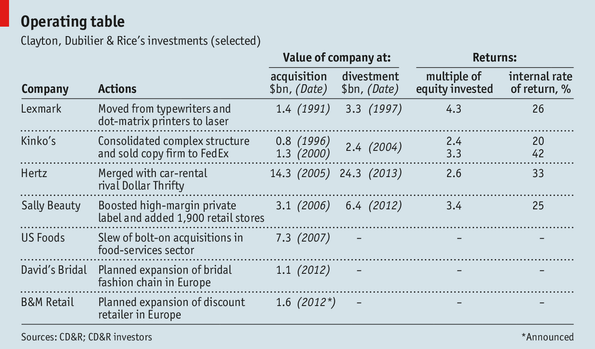
PRIVATE-EQUITY nabobs bristle at being dubbed mere financiers. Piling debt onto companies’ balance-sheets is only a small part of what leveraged buy-outs are about, they insist. Improving the workings of the businesses they take over is just as core to their calling, if not more so. Much of their pleading is public-relations bluster. Clever financial ploys are what have made billionaires of the industry’s veterans. “Operational improvement” in a portfolio company has often meant little more than promising colossal bonuses to sitting chief executives if they meet ambitious growth targets. That model is still prevalent today. Read more of this post

The fate of large firms helps explain economic volatility

The fate of large firms helps explain economic volatility

Jun 22nd 2013 |From the print edition

IN DECEMBER 2004 Microsoft paid a massive $33 billion dividend to its shareholders. The largest payment of its kind, it made up 6% of the increase in Americans’ personal income that year. Examples of how big firms can have a big impact do not come much starker. These kinds of firm-specific shocks are typically excluded from economists’ models, which assume that individual businesses’ ups and downs tend to cancel each other out. Yet to understand how things like trade and GDP evolve, tracking the biggest companies is essential. Read more of this post

The emerging-brand battle: Western brands are coming under siege from developing-country ones

The emerging-brand battle: Western brands are coming under siege from developing-country ones

Jun 22nd 2013 |From the print edition

20130622_WBD000_0

THE past 20 years have seen a massive redistribution of economic power to the emerging world. But so far there has been no comparable redistribution of brand power. Fortune magazine’s 2012 list of the largest 500 companies by sales revenue included 73 Chinese firms, more than from any other country except the United States, with 132. Yet Interbrand’s 2012 list of the 100 “best global brands” included not one Chinese firm. Read more of this post

Diageo to foray into China’s female alcohol market with Baileys liquor

Diageo to foray into China’s female alcohol market with Baileys liquor

Staff Reporter

2013-06-23

baileys-cream-with-spirit-113631_copy1

Diageo, a alcoholic beverage company headquartered in London, intends to dominate China’s female market by continuing to promote its liquor brand Baileys, the Global Entrepreneur magazine reports.

The creamy sweet liquor is a popular drink among female consumers around the world, with women reportedly consuming 2,365 glasses of the drink every minute. Baileys was first introduced globally in 1974, while its annual sales have touched 8.3 million cartons, making it the best seller among sweet liquor brands. Similar brands, such as Malibu, Dita and Kahlua affiliated with the French drinks conglomerate Pernod Ricard are its strongest competitive rivals in the market. Read more of this post

China cash squeeze exposes risks from short-term funding; more than 1.5 trillion yuan in wealth management products will mature in the last 10 days of June, explaining the scramble by some banks to secure short-term funds

China cash squeeze exposes risks from short-term funding

Fri, Jun 21 2013

By Gabriel Wildau

SHANGHAI (Reuters) – The mirror that China’s central bank is holding up in front of the country’s banks is providing uncomfortable viewing. Too many banks are reliant on short-term funding markets to survive, and a shake up in the sector is needed.

The central bank has engineered the current cash crunch as a warning to overextended banks but a growing concern, analysts say, is of a miscalculation that sets off a full-blown crisis. Read more of this post

Could Fee Hurdles Come Down Everywhere? Commissions on popular investments like mutual funds will be banned in Australia, Netherlands, following UK

Jun 21, 2013

The Intelligent Investor: Going Dutch — Could Fee Hurdles Come Down Everywhere?

By Jason Zweig

BF-AF198_INVEST_G_20130621173910

With markets in turmoil, investors need good advice even more than usual. But investing advice remains confusing, costly and opaque—and that needs to change.

New rules in the U.K., the Netherlands and Australia show one drastic way to tackle the problem. Starting this coming week, commissions on popular investments like mutual funds will be banned in Australia. Later this year, the Dutch government will finalize a law that will ban commissions as of Jan. 1, 2014. A similar prohibition already went into force in Britain as of Dec. 31, 2012. Read more of this post

Our great, global cities are turning into vast gated citadels where the elite reproduces itself; The elite talks about its cities in ostensibly innocent language. But the truth is exclusion.

June 14, 2013 6:49 pm

Priced out of Paris

By Simon Kuper

Our great, global cities are turning into vast gated citadels where the elite reproduces itself

Two mournful friends dropped by our flat in Paris last Sunday. They are a well-paid couple from the caste known in Paris as “bobos”: people with bourgeois incomes and bohemian tastes. In the popular narrative, bobos have invaded Paris, driving out pure bohemians and the working class. But my bobo friends had a new story: they themselves were being driven out of Paris. To get enough space for their kids, they were leaving for the suburbs. When they’d told the headmaster at the children’s school, he had looked sad and said: “Everyone is leaving.” Paris is pricing out even the upper middle-class. Read more of this post

Kayum Dhanani’s Barbeque Nation grew from a single outlet in 2006 to 35 with revenue $60m and 19% profit margin; the chain found a way to scale and replicate stds across 14 cities by offering customers an ‘independent’ dining experience

Rapid Expansion the Way Forward for Barbeque Nation

by Shravan Bhat | Jun 21, 2013

topimg_21877_kayum_dhanani_barbeque_600x400

Kayum Dhanani’s Barbeque Nation has grown from a tier 2 city restaurant to a tier 1 chain. And it is scaling fast

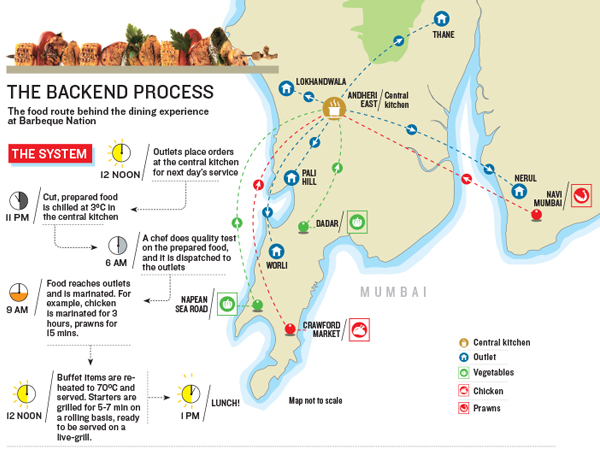
In Indore, it can get quite chilly in November. The temperature by the poolside at Sayaji Hotel was hovering around 7ºC, and restaurant manager Prosenjit Choudhury was getting complaints that kebabs served to the guests were going cold. One evening at home, Choudhury saw a television programme about nomads facing a similar problem while camping on riverbanks. They erected a grill using stacked armour, and roasted meat on it. Choudhury began serving kebabs, which were 90 percent cooked, on mini-grills at the tables. It was a hit. After a successful stint in Sayaji Hotel’s banquets division—he had started with parent company Sayaji Hotels as a management trainee in 1995—Choudhury got the go-ahead from Sajid Dhanani, then MD of Sayaji Hotels, to enter food retail. As CEO of Barbeque Nation, Choudhury brought the idea from Indore to Mumbai in 2006, with the city’s first Barbeque Nation at Pali Hill, in Bandra. Between 2006 and 2008, Barbeque Nation grew from a single outlet to 13. Today, it has 35 outlets, 18 of them opening in the last year alone. With a revenue of Rs 200 crore last year (it is expected to touch Rs 350 crore this fiscal), the chain brings in roughly Rs 9 crore per store, one of the highest for restaurant chains in India. Profit margins are 19 percent, which, for a buffet service serving unlimited meat and seafood, is remarkable.
img_70423_barbeque_nation Read more of this post
China’s Economic Policy Factory: The NDRC; With vast powers over the economy, the NDRC is drawing the scrutiny and anger of academics and ordinary Chinese

China’s Economic Policy Factory: The NDRC

By Dexter Roberts on June 20, 2013

http://www.businessweek.com/articles/2013-06-20/chinas-economic-policy-factory-the-ndrc

Who decides the size of Shanghai Disneyland (116 hectares, now under construction), how thin plastic bags should be (no less than 0.025 millimeters), sets gasoline prices and taxi fares, and recently used its sweeping power to fine China’s two best-known liquor companies 449 million yuan ($73.25 million)? It’s the National Development and Reform Commission, the biggest, most powerful Chinese bureaucracy, with responsibility over broad swathes of China’s $8.5 trillion economy, and day-to-day authority that sometimes rivals that of Premier Li Keqiang’s State Council, its putative boss. Read more of this post

China’s credit growth to back lavish construction and infrastructure projects is similar to that of the U.S. and Japan before they faced financial calamities

SATURDAY, JUNE 22, 2013

Where Will It End?

By JONATHAN R. LAING | MORE ARTICLES BY AUTHOR

BA-BC241F_china_G_20130622021505

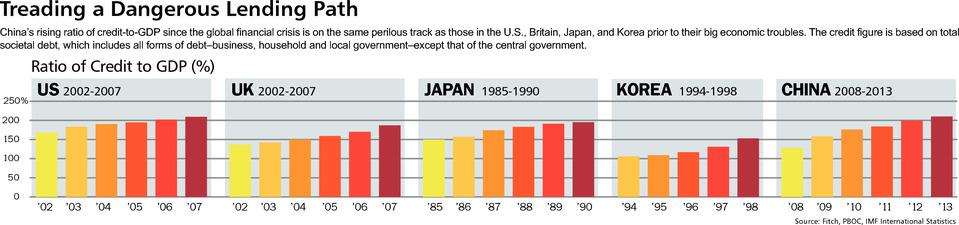
China’s credit growth to back lavish construction and infrastructure projects is similar to that of the U.S. and Japan before they faced financial calamities.

Of all the global economic powers, China would seem the most immune to the threat of a financial crisis.

It sailed through the post-2008 global credit implosion largely unscathed, by pumping up housing construction and infrastructure spending to compensate for slackening exports. First-quarter 2013 growth in gross domestic product, although the weakest in more than two years, rose at a rate the rest of the world would envy, 7.7%. Bad debts inside the Chinese banking system stand at a negligible 1%, compared with 3.4% in the U.S. and double-digit figures in much of the euro zone. Read more of this post

Korean banks, builders suffer from soaring lawsuits; Samsung Group’s financial affiliates ― Samsung Life, Samsung Card and Samsung Fire & Marine ― are involved in over 2,000 lawsuits, more than any other financial institutes

2013-06-20 18:56

Banks, builders suffer from soaring lawsuits

By Kim Tae-jong
Eighty percent of big firms surveyed are involved in legal disputes, recent data showed Tuesday.
According to the data compiled by business monitoring firm CEO Score, 182 firms that are under a “disclosure’ requirement by stock-related regulations are mired in 26,640 lawsuits. Read more of this post

In Brazil, Road Bandits Force Switch to Sea Shipping; Trucks transport 60 percent of Brazil’s cargo, about $470 million of which was stolen last year on the country’s roads

In Brazil, Road Bandits Force Switch to Sea Shipping

By Juan Pablo Spinetto and Christiana Sciaudone on June 20, 2013

comp_copper26__01inline__405

Most companies decide how to ship their goods by determining the fastest route between point A and point B. ButParanapanema (PMAM3), Brazil’s biggest refined copper producer, is switching its domestic shipments to slow-moving ocean freighters from swifter trucks. Although the shift almost triples transport times, it cuts costs by 21 percent by eliminating a threat peculiar to Brazilian roads: thieves. Read more of this post

Turkey’s Liquor Market at Risk; The latest ad for Turkey’s Efes beer features an unmarked brown bottle and this cryptic message: “Even if we don’t see each other, we’ll know.”

Turkey’s Liquor Market at Risk

By Kristen Schweizer and Selcan Hacaoglu on June 20, 2013

The latest ad for Turkey’s Efes beer features an unmarked brown bottle and this cryptic message: “Even if we don’t see each other, we’ll know.” The slogan refers to a new law that not only bans alcohol ads but would also stop TV viewers from watching Homer Simpson enjoy a Duff beer in Moe’s Tavern, as depictions of drinking on television programs are to be blurred out. Read more of this post

Unable to Reach Deal, Europe Plans New Talks on Bank Rescues

June 21, 2013

Unable to Reach Deal, Europe Plans New Talks on Bank Rescues

By JAMES KANTER

LUXEMBOURG — European Union finance ministers haggled early into Saturday morning over rules to lessen the chances that taxpayers will bear the burden if banks collapse, but they failed to reach a deal.

“We ran out of time,” Michael Noonan, the Irish finance minister, told reporters as he left the meeting here. “There are still core issues outstanding, so we’ll need a full meeting next week, and there’s no guarantee it will reach conclusion.” Read more of this post

China’s WMP whack, revisited; Wealth management products will borrow money from the banks at quarter-end to repay investors just prior to the quarter-end.

The WMP whack, revisited

Joseph Cotterill | Jun 19 17:56 | 18 comments | Share

AllianceB_Chinesebanks

It’s getting (a bit) clearer of late that China’s interbank crunch is deliberate policy. Still, although of course “We cannot use as fast money supply growth as in the past, or even faster, to promote economic growth” sounds very serious, it’s a bit woolly. Why so keen to withhold official liquidity from Chinese banks, and continue withholding it, right now? Read more of this post

An unwind in the great Chinese over-invoicing carry-trade?

An unwind in the great Chinese over-invoicing carry-trade?

Izabella Kaminska

| Jun 20 16:16 | 8 comments | Share

Screen-Shot-2013-06-20-at-15.44.18-590x409 Screen-Shot-2013-06-20-at-15.47.47 Screen-Shot-2013-06-20-at-16.05.28 Screen-Shot-2013-06-20-at-16.06.38 Screen-Shot-2013-06-20-at-16.23.36 Screen-Shot-2013-06-20-at-16.19.04-590x260 Screen-Shot-2013-06-20-at-16.20.51

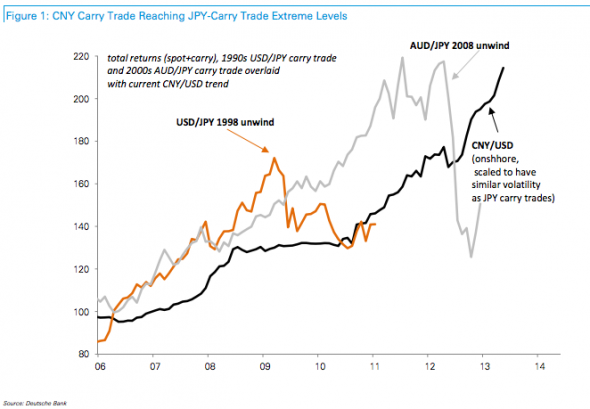
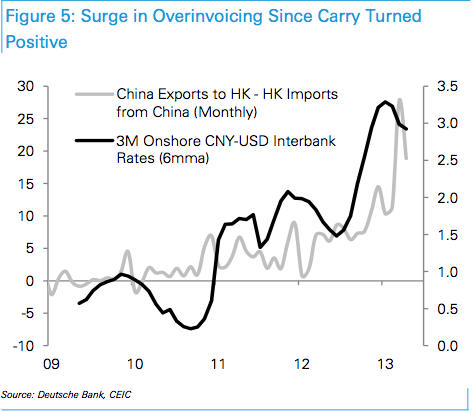
The popular explanation for the rise in Chinese repo rates is being linked to the government’s desire to rein in the shadow banking sector. That is to say the tightness is intentional. But what if it isn’t. What if it has more to do with the unwind of yet another carry trade? Deutsche Bank’s Bilal Hafeez made a strong case for this interpretation last week. We think it’s worth revisiting the argument. There are three main factors that need to be considered, he argued:

Adjusted for volatility China now offers the highest FX carry in the world. This, he says, has led to a surge in flows into the CNY (and CNH) by both onshore and offshore entities over the last few years. The performance of the carry was reaching breaking point last week. Any combination of higher US yields, regulatory clampdown or higher FX volatility or CNY appreciation could trigger an unwind. And as he warned, the demise of the carry trade would then remove an important channel of cheap funding for the Chinese economy. Read more of this post

Even Starbucks gets the China real estate blues; “If even Starbucks cannot afford it, how on earth could normal people pay for property in China?”

Even Starbucks gets the China real estate blues

Jun 21, 2013 5:46pm by beyondbrics

By Gu Yu and Kathrin Hille

China’s soaring property prices have been a problem for a long time. But this week, it was not the country’s nascent middle class complaining about rising rents. It was Starbucks. On Friday afternoon, the US coffee chain closed the coffee shop that had been its first in China. And if its staff is to be trusted, the reason was skyrocketing rent prices.

Read more of this post

Who’s Manipulating Derivative Indexes and Why; How to think about the Libor scandal and its astonishingly proliferating offspring

June 21, 2013, 6:31 p.m. ET

Who’s Manipulating Derivative Indexes and Why

How to think about the Libor scandal and its astonishingly proliferating offspring.

By HOLMAN W. JENKINS, JR.

Is Ewan McGregor, who played Nick Leeson in the movie about the Barings bank bust, available for a sequel? He would find an oddly similar character in Tom Hayes, the former UBS UBSN.VX -1.93% and Citibank employee charged in this week’s latest financial scandal of the century. Read more of this post

Unwinding the world’s biggest economic experiment; When the Fed does change direction, tightening often comes in a rapid series of interest rate rises

June 21, 2013 5:51 pm

Unwinding the world’s biggest economic experiment

By Gavyn Davies

When the Fed does change direction, tightening often comes in a rapid series of interest rate rises

On Wednesday, the chairman of the Federal Reserve announced that the greatest experiment in the history of central banking might be nearing its end. Ben Bernanke’s announcement included many caveats, but the financial markets did not miss the message. Since 2009, the central bank has been buying financial assets – US Treasury bonds and some types of corporate debt – paid for by an expansion of the monetary base (so-called “printing money”). This kept interest rates low, which damaged savers but helped indebted businesses and households. It has also been the major prop for financial markets. Within about a year, if the Fed’s plans come to fruition, the US government deficit will need to be financed from private sector savings – not by the central bank. Asset markets will be left to fend for themselves as the biggest buyer withdraws from the arena. Read more of this post

The world is still being held hostage by its rotten banks

June 21, 2013 7:29 pm

The world is still being held hostage by its rotten banks

By John Plender

Another financial crisis is probable and it would be much more damaging to the global economy

In the midst of this turbulent summer in the markets, the revolving door at the top of British banking has been spinning unexpectedly fast. At the Bank of England,Sir Mervyn King, the governor, is shortly to be replaced by the governor of the Canadian central bank, Mark Carney. The abrupt recent announcement of the impending departure of deputy governor Paul Tucker preceded the appointment ofCharlotte Hogg, head of retail banking at Santander, as the Bank’s first chief operating officer. In the private sector, Stephen Hester recently found himself brutally ejected from his role as chief executive of Royal Bank of Scotland. Many in the City of London were disconcerted by the timing of the Tucker announcement and the Hester defenestration. Read more of this post

Japan Rocked By The Biggest Wagyu Beef Ponzi Scheme Ever; $4.34 billion ponzi scheme defrauded 73,000 investors

Japan Rocked By The Biggest Wagyu Beef Ponzi Scheme Ever

STEVEN PERLBERG JUN. 21, 2013, 9:37 AM 5,840 6

Wikimedia Commons

Three former managers of a Japanese wagyu farm were arrested Tuesday on suspicion that they lead a beefy, $4.34 billion ponzi scheme that defrauded 73,000 investors, the Wall Street Journal reports. Wagyu — the “caviar of beef” — retails for hundreds of dollars a pound. Farmers add beer or sake to the coddled cows’ food and massage them to prevent muscle cramps. The managers of the Agura farm offered investors a “wagyu beef ownership system” with promised annual returns of 8%. They claimed the investors would profit from the calves born to purchased cows. From the Journal:

In reality, there weren’t as many cows as the number sold. According to the former managers, the farm had to file for bankruptcy after being hit by the double whammy of falling beef prices and lower sales following the 2011 Fukushima nuclear accident. (The farm is located less than 100 kilometers from the Fukushima plant.) That left 73,000 investors with losses totaling around ¥420 billion ($4.34 billion), according to lawyers for the plaintiffs.

Agura had reported to investors that they kept 90,000 to 100,000 breeding cows. Investigators found the number wasn’t quite as meaty — at 60,000. The case may be one of the biggest consumer fraud episodes in recent Japanese history. Read more of this post

How lipstick maker Revlon turned around its business with I.T.

How Revlon turned around its business with I.T.

By Ki Mae Heussner | GigaOM.com, Published: June 21

Lipstick maker Revlon isn’t likely the first company you’d think of when you think high tech. But part of what helps the global brand push more cosmetics to consumers is an IT infrastructure based on a private cloud.

Since 2007, the company has implemented a common cloud strategy that puts all of its data in one place and better enables it to align its business goals with its technology, said David Giambruno, Revlon’s SVP and CIO, at GigaOM’s Structure 2013 conference in San Francisco. The company “literally normalized all the data at Revlon,” he said, adding that their internal cloud runs more than 500 applications run on its internal cloud and averages 14,000 transactions a second. Read more of this post