Junk bond investors burnt in Fed retreat

June 24, 2013 5:25 pm

Junk bond investors burnt in Fed retreat

By Michael Stothard, Vivianne Rodrigues and Josh Noble

Those who followed the “close your eyes and buy” strategy that swept through junk bond markets since the start of the year have just had their fingers burnt.

The hardest hit casualties of a rout in high yielding debt over the past few weeks have been the more esoteric or lowly rated instruments, the very credits into which investors had been pouring money due to the slight pick-up in yield on offer. Read more of this post

EU Leaders to Stave Off Market Turmoil After Bank Talks Fail

EU Leaders to Stave Off Market Turmoil After Bank Talks Fail

European Union leaders will this week attempt to stave off a resurgence of market tremors after talks on setting up unified banking rules broke down.

Negotiations among the 27-member bloc’s finance ministers stalled over the weekend in Luxembourg after they tried to reach agreement on assigning losses at failing banks as part of proposed rules on bank resolution and recovery. They will regroup June 26, before EU leaders gather the next day for a summit meeting in Brussels.

“We shouldn’t be lulled by the current calm in the markets,” German Finance Minister Wolfgang Schaeuble said in a statement after the meeting. “Rather we should quickly ensure that we’re prepared for every eventuality.” Read more of this post

Cash hard to raise as Fed jars credit markets

Cash hard to raise as Fed jars credit markets

7:52pm EDT

(Reuters) – Prospective borrowers ranging from U.S. companies to county governments on Monday shelved a raft of deals to raise new capital or refinance debt as a suddenly uncertain interest rate environment dented demand.

In the municipal bond market, half a dozen deals aimed at raising collectively more than $300 million were postponed, while several companies pulled plans to refinance syndicated bank loans. Corporate bonds, meanwhile, passed a fourth day with no deals brought to market, either in the risky high-yield sector or the safer investment-grade sphere. Read more of this post

Mass Layoffs at Top-Flight Law Firm Weil, Gotshal & Manges, among the nation’s most prestigious and profitable law firms

JUNE 24, 2013, 9:39 AM

Mass Layoffs at a Top-Flight Law Firm

By PETER LATTMAN

Layoffs are a brutal reality of corporate America. During fallow periods, publicly traded companies, including the big banks, routinely cull their ranks. The country’s largest law firms, by contrast, have historically taken a kinder, gentler approach, rarely firing employees en masse.

The news on Monday that Weil, Gotshal & Manges, among the nation’s most prestigious and profitable law firms, was laying off a large number of lawyers and support staff while also reducing the pay of some of its partners, sent shock waves through the industry and underscored the financial difficulties facing the legal profession. Read more of this post

Student-Aid Scams Targeted by Schools, Government; a growing number of recipients—acting alone or as part of organized crime rings—are pocketing federal loans and grants without any intent of going to school

Updated June 23, 2013, 9:25 p.m. ET

Student-Aid Scams Targeted by Schools, Government

By JOSH MITCHELL

Federal officials are cracking down on fraud in student-aid programs, responding to evidence that a growing number of recipients—acting alone or as part of organized crime rings—are pocketing federal loans and grants without any intent of going to school.

The Education Department in January began using a database to flag applicants for federal Pell grants who have an “unusual enrollment history”—having received aid for three or more schools within a year, primarily. The department sends the names to colleges and universities, which then ask applicants to provide prior transcripts and other documents. A school can deny a grant or loan if it deems the applicant’s responses to be unsatisfactory. Read more of this post

The Dark Side Of Soaring Rates: A Housing Market That Lost 16% Of Its Value In Under Two Months

The Dark Side Of Soaring Rates: A Housing Market That Lost 16% Of Its Value In Under Two Months

Tyler Durden on 06/24/2013 14:32 -0400

A week ago, we provided a simple, irrefutable analysis of “What The Recent Surge In Rates Means For Your Home Purchasing Power” in which we demonstrated how the average home affordability goes down (due to the declining marginal purchasing power in a rising rate environment) as interest rates (for mortgages and all rate-sensitive products) go up. What this means is that all else equal, absent a massive increase in disposable income (especially when the opposite is happening to disposable income), the average home affordability plunges as rates go up. So here is the benchmark price-rate curve updated for a reality, in which the national average 30 Year fixed has exploded from 3.40% on May 1 to a whopping (for the New Normal) 4.875% as of today for Wells Fargo customers. The matching affordability collapse: from $450K to $378K, or a stunning 16% equilibrium price drop in under two months! So much for that wealth effect…

20130624_loan1_0

Southeast Asia: The Next Crisis? The region’s overheated economy faces a period of adjustment – and for some countries the correction could prove very painful

Southeast Asia: The Next Crisis?

June 24, 2013

Trefor Moss

The region’s overheated economy faces a period of adjustment – and for some countries the correction could prove very painful.

Southeast Asia, so long a byway of the world economy, has become a well-worn path for foreign investors seeking refuge from the continuing after-effects of the global financial crisis. They have come because the region has been surging ahead over the last few years, even as the West slumped, China readjusted and India stuttered. As confidence grew in Southeast Asia’s newfound ability to realize its potential, success followed success: Indonesia is on the cusp of becoming the region’s first trillion-dollar economy, and achieved an investment-grade credit rating for the first time in 14 years in late 2011, something the Philippines alsoattained for the first time ever earlier this year; manufacturing has been booming in Malaysia and Thailand; and the Philippines began to challenge India as the top destination for offshore services, while posting first-quarter GDP growth of 7.8%, Asia’s best performance. However, just when everything seemed to be going so well, cracks have begun to emerge in the foundations of the Southeast Asian boom. A bust is still avoidable, economists believe, but the fate of the regional economy over the next couple of years probably depends more on events in Europe and other turbulent sectors of the global system than on the decisions of local governments and central banks. Read more of this post

Regulatory threat hangs over long-term auditing links

June 24, 2013 12:06 am

Regulatory threat hangs over long-term auditing links

By Alison Smith and Adam Jones

When the accountancy firm that is now KPMG was first appointed as auditor to Cookson, sterling was still on the gold standard and the Empire State Building was being built.

The appointment that began in 1930 – and has survived last year’s demerger of the engineering group so that KPMG audits both the successor companies – is one of the most striking examples of the longstanding relationships that regulators worry makes auditors too cosy with those they are supposed to be vetting. Read more of this post

When the Ben and Beijing party comes to an end

When the Ben and Beijing party comes to an end

12:11am EDT

By Jonathan Spicer

(Reuters) – Through the dark days of the financial crisis, and the grey days of the halting recovery that have followed, investors have always been able to count on backing from two sources – Ben Bernanke and Beijing.

They have provided stimulus, mainly by pumping funds into the U.S. and Chinese economies in various ways, when other pillars of support had become unreliable.

That helps to explain why global financial markets took such a beating last week when both signaled that they are getting tired of being leant on so heavily. Read more of this post

Billionaire Daughter Leads Birla Into Microloans

Billionaire Daughter Leads Birla Into Microloans

Ananyashree Birla, the teenage daughter of Indian billionaire Kumar Mangalam Birla, is lending to the poor. Her experience may help her father’s quest for a banking permit.

The 18 year-old Birla scion’s Svatantra Microfin Pvt. is offering credit to women in villages in Maharashtra state to buy sewing machines and start businesses to make papadums, she said in an interview. The company, which charges 20 percent interest on the loans, plans to expand into neighboring Gujarat soon, said Birla, who enters undergraduate college this year. Read more of this post

Campari Blitzes Europe with Aperol Spritz to Boost Stock

Campari Blitzes Europe with Aperol Spritz to Boost Stock

Italy’s Davide-Campari Milano SpA (CPR) is trying to put some fizz back in its shares by getting people like Gillian Cowan to try a glass of bubbly orange tipple.

Cowan, a 30-year-old Londoner who works in retail marketing, had her first Aperol Spritz last month when friends ordered the drink on a night out in Soho, one of the trendy areas Campari has targeted. Despite its cachet, the bitter concoction — a mélange of Campari’s herbal Aperol, sparkling prosecco, and soda — wasn’t to her taste.

“Maybe it’s a drink I would like if I was more sophisticated, or had a yacht on the Amalfi coast,” she said. Read more of this post

Soda sold in glass bottles, a package generally phased out decades ago, is providing a rare spot of growth in a declining soft-drink industry

June 23, 2013, 9:06 p.m. ET

Glass Bottles Lend Pop to Soda Makers

By PAUL ZIOBRO

MK-CE224_BOTTLE_NS_20130623182712

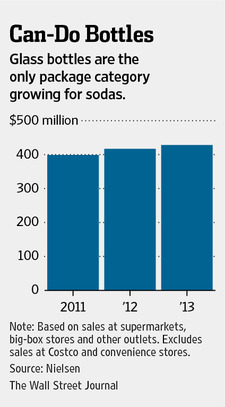
The clink of soda in bottles is helping to offset soft drink sales declines in the U.S. Soda sold in glass bottles, a package generally phased out decades ago, is providing a rare spot of growth in a declining soft-drink industry. Over the past two years, sales growth of soda in glass bottles has outpaced that of soda in the much-more-common plastic bottles and aluminum cans, according to Nielsen, whose data include supermarkets, big-box stores and other outlets, but excludes sales from other sources, like Costco Wholesale Corp. and convenience stores.

Read more of this post

Worries about Federal Reserve policy have hit a favorite destination for mom-and-pop investors: closed-end bond funds. Leverage Juiced Returns When Rates Were Moored; Now It Is Magnifying Losses

June 23, 2013, 4:52 p.m. ET

Closed-End Funds Bite Back

Leverage Juiced Returns When Rates Were Moored; Now It Is Magnifying Losses

By TOM LAURICELLA

MI-BW717_ABREAS_G_20130623175404

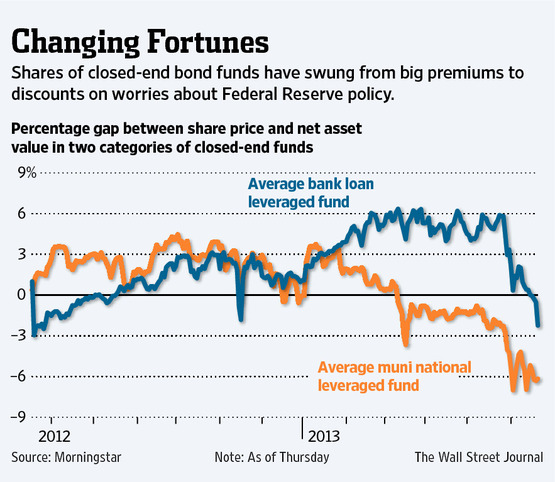
Worries about Federal Reserve policy have hit a favorite destination for mom-and-pop investors: closed-end bond funds.

These mutual funds have suffered outsize losses during a rough month for bond funds overall. The average high-yield closed-end bond fund is down 10.7% in the past month through Thursday, according to Morningstar Inc. MORN +0.89% That compares with a 3.4% decline for its open-end counterpart. Read more of this post

Emerging Markets Are on Their Own; Things are looking ugly for countries that have delivered about 75% of global growth over the past decade.

June 23, 2013, 8:28 p.m. ET

Emerging Markets Are on Their Own

By ANDREW PEAPLE

It is high time investors demerged emerging markets.

Protests on the streets of Brazil and Turkey, a cash crunch in China’s financial system, strikes in South Africa: These all indicate rising stress in developing economies. Add in signals the Federal Reserve may soon scale back its bond-purchasing program, and things are looking ugly for countries that have delivered about 75% of global growth over the past decade.

After a decade or so in which emerging markets reliably juiced the global economy, this is a wake-up call for investors. Read more of this post

Europe is ignoring the scale of bank losses

June 23, 2013 2:41 pm

Europe is ignoring the scale of bank losses

By Wolfgang Münchau

Consider the sheer number of crises in which lenders have lost money

It was another of those late-night agreements, which are as legally sophisticated as they are financially innumerate. Eurozone finance ministers agreed last week that the European Stability Mechanism could devote €60bn of its €500bn total lending ceiling to the recapitalisation of eurozone banks. If that is not enough, the rest of the money for the recapitalisation of the eurozone’s banks will have to come from national governments, or through bail-ins of investors and depositors. Read more of this post

The Mortgage Refinancing Gravy Train Just Ended

The Mortgage Refinancing Gravy Train Just Ended

WALTER KURTZ, SOBER LOOK JUN. 23, 2013, 6:45 AM 3,136 3

US 30yr mortgage rates spiked to a 2-year high on Friday (4.49%). In the near term this spike may actually push some potential buyers who have been on the sidelines into purchasing a home. People are concerned that rates will rise even further, which may have the effect of increasing June/July sales (see this story). The longer term effect however is less clear. While 4.5% is low by historical standards, it certainly takes a portion of the population out of the housing market. Also the speed of the rate spike may have a negative impact on consumer sentiment. Monthly payments on a new mortgage have increased by 10% from just a month ago (roughly $100/month for a median house price). One thing we can be confident of is that the wave of mortgage refinancing is over. Consumers have been putting extra cash into their pockets by refinancing multiple times in recent years. That gravy train just ended.

30y mortgage rate

Geeks oust miners among Australia’s new rich as boom fades

Published: Monday June 24, 2013 MYT 8:13:00 AM

Geeks oust miners among Australia’s new rich as boom fades

SYDNEY: In a country synonymous with larger-than-life mining tycoons and Outback heroes, the geeks are quietly inheriting the earth.

As coal magnate Nathan Tinkler, the poster boy for Australia’s fading 10-year minerals boom, publicly battles against bankruptcy, software entrepreneurs Mike Cannon-Brookes and Scott Farquhar are riding high.

The former college buddies behind fast-growing software firm Atlassian unceremoniously bumped Tinkler off the top of Australia’s “young rich list”, leading a charge in the country’s blooming technology industries. Read more of this post

As Asia embraces casinos, India hedges it bets

As Asia embraces casinos, India hedges it bets

Sun, Jun 23 2013

By Tony Munroe

PANAJI, India (Reuters) – Like many visitors to the Casino Royale Goa on a rainy Saturday night on India’s western coast, Salim Budhwani said he does not gamble but also had no objection to the betting at the busy tables downstairs.

Despite socially conservative India’s ambivalence about gambling, consultancy firm KPMG estimated that $60 billion was wagered in the country in 2010. Much of the gambling is illegal, but attitudes are slowly changing as more Asian countries embrace gaming as a revenue generator and tourist draw. Read more of this post

Best Emerging-Market Stock Pickers Buy Drugmakers to Retail

Best Emerging-Market Stock Pickers Buy Drugmakers to Retail

The only three emerging-market stock pickers who avoided losing money for clients in the worst first-half rout since 1998 say now’s the time to buy Philippine retailers, Chinese Internet companies and Indian drugmakers.

Lewis Kaufman, whose Thornburg Developing World Fund (THDAX) rose 3.2 percent, the most among U.S.-domiciled emerging-market mutual funds overseeing at least $100 million, says Manila-based Puregold Price Club Inc. (PGOLD) will benefit from 20 percent sales growth. CNI Charter Emerging Markets Fund (RIMIX)’s Anindya Chatterjee boosted his position in Shenzhen, China-based Tencent Holdings Ltd. (700) as first-quarter profit rose 37 percent. David Semple has been buying Indian pharmaceutical shares for the Van Eck Emerging Markets Fund as the rupee’s tumble boosts exports. Read more of this post

Gold Miner Writedowns at $17 Billion After Newcrest Fallout

Gold Miner Writedowns at $17 Billion After Newcrest Fallout

Newcrest Mining Ltd. (NCM)’s decision to write down the value of its mines by as much as A$6 billion ($5.5 billion) will lead to the biggest one-time charge in gold mining history. It also heralds pain for competitors.

Barrick Gold Corp. (ABX), the world’s biggest producer, Newmont Mining Corp. (NEM) and Gold Fields Ltd. (GFI) may be next, according to Jefferies International Ltd. Nouriel Roubini, professor of economics and international business at New York University and known as Dr. Doom for predicting turmoil before the global financial crisis began in 2008, says gold may drop to $1,000 an ounce by 2015, from $1,298.05 now. Read more of this post

World’s top gold producer Barrick Gold will lay off up to a third of its corporate staff at its headquarters in Toronto and other offices

Barrick Gold Corp to lay off up to a third of corporate staff as gold slump bites

Euan Rocha, Reuters | 13/06/24 7:55 AM ET
TORONTO — Barrick Gold Corp will lay off up to a third of its corporate staff at its headquarters in Toronto and other offices, sources said, as the world’s top bullion producer intensifies a downsizing plan amid a slump in the price of gold.

Barrick and miners such as Newmont Mining and Newcrest Mining are shaking up operations and taking measures like shutting down development projects, slashing exploration spending and cutting jobs due to the sliding gold price. Read more of this post

Rio Tinto abandoned plans to sell or list its diamond portfolio after failing to attract investors for a business some analysts estimated could be worth more than $2 billion

Updated June 24, 2013, 3:27 a.m. ET

Rio Tinto Drops Sale of Diamond Business

By ROBB M. STEWART

MELBOURNE—Rio Tinto RIO.LN -1.69% PLC abandoned plans to sell or seek a listing of its diamond portfolio after failing to attract potential new investors for a business some analysts estimated could be worth more than $2 billion.

Major miners like Rio Tinto RIO.AU -2.13% face a challenge as they look to bolster their balance sheets by offloading smaller assets: The prices of many commodities are in the doldrums. Gemstone prices have been held back by sluggish demand for luxury goods in developed markets, although producers hope for stronger sales as disposable incomes rise in populous nations like China and India. Read more of this post

Once worth $34.5 billion, Eike Batista’s holdings are now estimated at $4.8 billion and falling. With Brazil’s streets churning in protest, the markets — and Mr. Batista’s fortune — are on uncertain terrain

June 23, 2013

Brazil, Fortune and Fate Turn on Billionaire

By PETER LATTMAN and SIMON ROMERO

When the Brazilian billionaire Eike Batista appeared on the Charlie Rose show in 2010, he and his country were on a roll.

Brazil’s economy, driven by a worldwide commodity boom, grew a blistering 7.5 percent that year. And Mr. Batista’s prodigious holdings — spanning oil, mining, shipping and real estate — were soaring in value. In the interview, Mr. Batista was asked how rich he would become over the next decade.

“A hundred billion dollars,” he said, an amount that would most likely have made him the wealthiest person in the world. Read more of this post

Make or break moment for Myanmar reforms in opaque telecoms sector

Make or break moment for Myanmar reforms in opaque telecoms sector

Sun, Jun 23 2013

By Jared Ferrie

YANGON (Reuters) – Companies awarded telecommunications licenses in Myanmar this week will need to spend billions of dollars rolling out networks across a country that has yet to pass a law to govern the sector and where opaque, state-owned enterprises will remain players.

The process is being watched closely as a test case for reform in Myanmar, although the risks did not stop 90 international firms and groups from joining the initial phase.

Faced with big investments and uncertain returns however, Vodafone Group Plc and China Mobile Ltd dropped their joint bid for a license, saying it did not meet their “internal investment criteria.” The remaining 11 short-listed contenders include Singapore Telecommunications Ltd, KDDI Corp and Telenor ASA. Read more of this post

China’s liquidity crunch, and what it means for everyone; The Chinese central bank has finally broken its silence over the country’s cash crunch, telling banks the onus is on them to better manage their own balance sheets.

China’s liquidity crunch, and what it means for everyone

Kate Mackenzie

| Jun 24 10:43 | 3 comments | Share

Should you panic?

It’s hard to know exactly what degree of control the PBoC has over the events unfolding in China’s interbank markets.

On the one hand, making the smaller banks and shadow finance entities sweat fits with the central bank’s new high-priority goal, introduced late last year, of containing ‘financial risks’, and also with a broader government theme of clamping down on excess. Read more of this post

Big state companies in industries struggling with over-capacity but with easy access to credit are borrowing funds, not to invest in their business but to lend to smaller firms sometimes at several times the official interest rate

Analysis: Another China central bank worry; companies push into lending

Sun, Jun 23 2013

BEIJING/SHANGHAI (Reuters) – Chinese companies are getting more creative in the business of money lending as they struggle to keep profits ticking over in a cooling economy, raising concerns they are adding to the mountain of debt risks building in the world’s No.2 economy.

Big state companies in industries struggling with over-capacity but with easy access to credit are borrowing funds, not to invest in their business but to lend to smaller firms sometimes at several times the official interest rate, part of an informal lending market in China that authorities are taking aim at. Read more of this post

China’s builders have been the world’s worst-performing real-estate bonds this quarter as Premier Li Keqiang allowed a record cash crunch to rebalance the economy away from property investment

World’s Worst Real Estate Bonds Targeted in Crunch

China’s builders have been the world’s worst-performing real-estate bonds this quarter as Premier Li Keqiang allowed a record cash crunch to rebalance the economy away from property investment.

Dollar-denominated notes sold by Chinese developers have lost 4.1 percent this quarter, the most since the three months ended Sept. 30, 2011 and the worst among peers in major economies in Bank of America Corp.’s Global Corporates Real Estate Index. That marks a reversal after the debt topped 2012 rankings with a 22 percent return. Australian builders lost 0.8 percent since March 31, while Japan’s shed 1.7 percent. Read more of this post

Chinese Industrial Subsidies Grow; Chinese publicly traded companies received $13.83 billion in government subsidies last year, up 23% from a year earlier

June 23, 2013, 7:49 p.m. ET

Chinese Industrial Subsidies Grow 23%

By DINNY MCMAHON

MK-CE209_CSUBSI_G_20130623183304

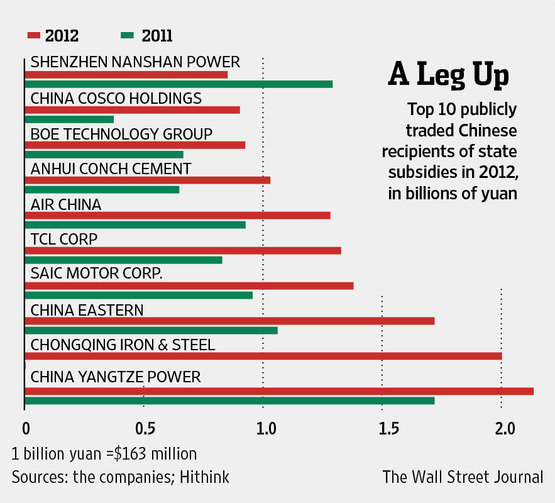
BEIJING—Chinese companies are under growing financial pressure as the country’s economic growth slows. So industries ranging from airlines to steel to consumer appliances increasingly are leaning on the Chinese government.

Companies listed on China’s stock exchanges received 85.68 billion yuan ($13.83 billion) in government subsidies last year, up 23% from a year earlier, while corporate profits rose less than 1%, according to a Chinese data provider. The subsidies were equivalent to more than 4% of the companies’ total profits last year, up from around 3% between 2009 and 2011. Read more of this post

Riot after Chinese teachers try to stop pupils cheating; “We want fairness. There is no fairness if you do not let us cheat.”

Riot after Chinese teachers try to stop pupils cheating

What should have been a hushed scene of 800 Chinese students diligently sitting their university entrance exams erupted into siege warfare after invigilators tried to stop them from cheating.

Riot after Chinese teachers try to stop pupils cheating

By Malcolm Moore, Beijing

3:25PM BST 20 Jun 2013

riot_2595770b

The relatively small city of Zhongxiang in Hubei province has always performed suspiciously well in China’s notoriously tough “gaokao” exams, each year winning a disproportionate number of places at the country’s elite universities.

Last year, the city received a slap on the wrist from the province’s Education department after it discovered 99 identical papers in one subject. Forty five examiners were “harshly criticised” for allowing cheats to prosper. Read more of this post

As Beijing air pollution worsens, some American expats clear out; “I want them to leave before they hate this place”

As Beijing air pollution worsens, some American expats clear out

MARK RALSTON, AFP/GETTY IMAGES

“I want them to leave before they hate this place,” one American executive said of his family’s decision to leave pollution-choked Beijing.

BY DON LEE,Los Angeles Times

June 21, 2013, 9:19 a.m.

BEIJING — After nearly two decades in Beijing, David Wolf knew it was time for a change when his 11-year-old son, Aaron, somberly asked him, “Dad, when you were growing up, did you ever have PE outdoors?”

Wolf had grown up in smog-choked Los Angeles in the 1970s, but even that wasn’t nearly as bad as Beijing today. His son, like many young students in the city, has been kept inside for months, with the luckier children getting the chance to exercise under huge air-filtered domes that their international schools have built. Read more of this post