Korean Tiger Moms Scrimp for Tutors in Blow to Consumer Spending

Korean Tiger Moms Scrimp for Tutors in Blow to Consumer Spending

Housewife Ahn Jee Eun began looking for a job to supplement her husband’s income after the cost of sending her twin three-year-old daughters to pre-school pushed the family’s bank account into the red.

“My husband and I are spending about half of our income on education,” said Ahn, 34, who pays more than 1.7 million won ($1,500) a month on private tuition fees. “I’ve been cutting down on grocery shopping to make sure my kids socialize in good places and learn stuff they’re supposed to learn.”

Education expenses have helped push the nation’s household debt toward record levels, sapping households’ ability to spend money on other goods — private consumption fell the most last quarter since the 2009 global recession. President Park Geun Hye this week set up a task force to scale back excess high-school testing in a nation where four out of five elementary school pupils get additional private tuition. Read more of this post

Yen Slump Failing to Stem Japan’s Exodus of Factories Overseas

Yen Slump Failing to Stem Japan’s Exodus of Factories Overseas

Japanese Prime Minister Shinzo Abe promises that Abenomics will revive the nation’s industrial might. For Takumi Tanaka at auto-parts maker Uchida Co., times are worse than after the 2011 earthquake.

Tanaka, managing director of a company founded in 1955, whose 94 employees supply Honda Motor Co. (7267) with parts molds, is contending with higher costs after an 18 percent drop in the yen in the past nine months pushed up the price of imported energy and metals. At the same time, he’s under pressure from clients to build factories near their overseas plants.

“We see very little benefit” from Abenomics, Tanaka said in an interview in Miyagi Prefecture, where two of the company’s three factories are located, close to the center of the earthquake that caused Japan’s worst nuclear disaster. “Even today, we are being asked to build plants in Vietnam, Thailand and Indonesia. There is little relief that manufacturing can stay in Japan.” Read more of this post

Who wants to the last person carrying the broken record and be blamed by investors? “There is now anecdotal evidence that long-term investors have started selling.” Investors lose bet on EM local currency debt

June 13, 2013 5:10 pm

Investors lose bet on EM local currency debt

By Pan Kwan Yuk

Investors in emerging market local currency bonds are among the biggest losers from the recent sell-off in emerging market assets. The average EM local currency fund has lost 7.8 per cent since the beginning of May, according to data from Lipper. This compares with a loss of 6.1 per cent on average for EM hard currency funds and 6.7 per cent for EM equity funds. The sharp reversal in performance comes as investors have substantially increased their bets on the locally denominated EM debt this year. As the chase for yield intensified, investors have piled into the asset class – drawn by the higher yields offered by the bonds and the prospect of an added sweetener in the form of foreign exchange gains. Investors have funnelled $20.4bn into EM local debt in the year to date, compared with just $2.5bn for hard currency bonds, according to data from EPFR. The flows into EM local debt this year have already surpassed the $16.7bn the asset class attracted for the whole of 2012. But the twin attractions of local currency debt – higher bond yields and foreign exchange appreciation – have also made it more vulnerable to the recent rise in US Treasury yields. Yields on JPMorgan’s GBI-EM index, which tracks local currency debt, have risen 82 basis points, or 15.34 per cent, since May 22, when the US Federal Reserve hinted that it may start winding down its $85bn-a-month bond buying programme. Meanwhile EM currencies have suffered a sharp correction. The South African rand, Brazilian real, Philippine peso, Indian rupee, and Mexican peso are among the world’s 10 worst performing currencies since May 22 – with losses ranging from 4.3 per cent to 3.2 per cent against the dollar. Sara Zervos, head of the global debt team at Oppenheimer Funds, attributes the sharp sell-off in recent weeks to crossover money from hedge funds pulling out. “Interest rate swaps yields have been going up higher and faster than [EM local currency] bond yields,” she said. “Real money accounts tend to hold bonds. Fast money tends to hold swaps. So my sense is that the sell-off has been initiated by leveraged buyers unwinding their positions rather than real money dumping bonds.” Others think it is only a matter of time before real-money investors pull back. “In retrospect, it is quite clear that positioning in local bond markets has been excessive,” said Benoît Anne, head of EM strategy at Société Générale, in a note to clients last week. “There is now anecdotal evidence that long-term investors have started selling. That may suggest that more pain is on the way. I see little reason to be bullish on EM fixed income against this backdrop.”
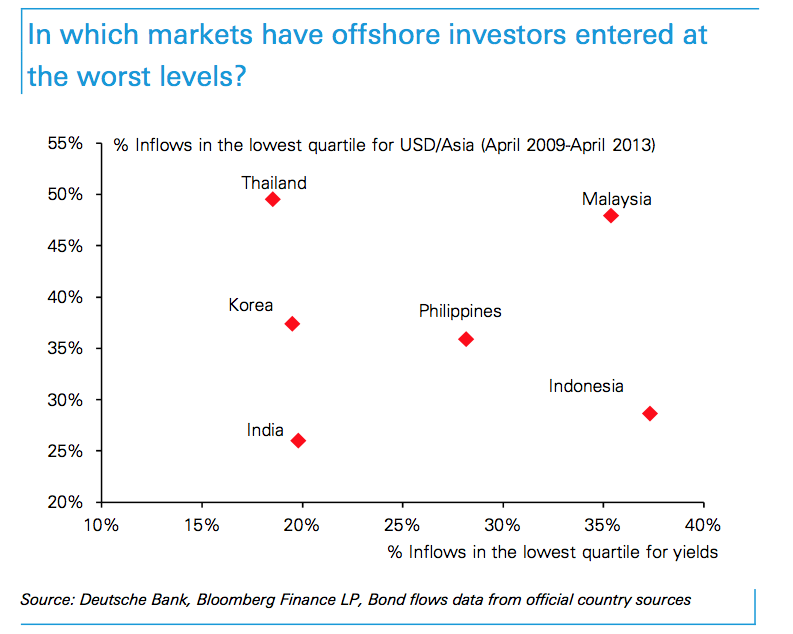
“Size of the exit”: Emerging markets are often easy to get into, but if history is any guide, when the elevator starts to go down and everyone is trying to get out, some people are going to get stuck

Still got your money in emerging markets? Here’s what to worry about—and where

By Matt Phillips @MatthewPhillips June 13, 2013

screen-shot-2013-06-12-at-2-24-23-pmscreen-shot-2013-06-12-at-3-18-32-pm

Global riptides of investment cash are a well-established threat for developing economies. On its way in, a surge in foreign investment pushes up prices of stocks, bonds and other assets. It drives down borrowing costs. It supercharges growth. But if the wave suddenly starts to recede, countries can face nasty combinations of currency collapse, banking crises and government default. This script has repeatedly played out. There was Mexico’s “tequila crisis” in 1994. The Asian crisis in 1997. The Russian devaluation of 1998. Which brings us to the current sharp selloff in a range of emerging markets. Among the countries that have been darlings of global investors in recent years, which ones are the most vulnerable to a reversal of fortunes? Here are a few ways to think about the risks. Read more of this post

Refinancings Plunge as Bond Yields Rise

June 13, 2013, 11:25 p.m. ET

Refinancings Plunge as Bond Yields Rise

By NICK TIMIRAOS and ANDREW R. JOHNSON

P1-BL891_REFI_G_20130613190606

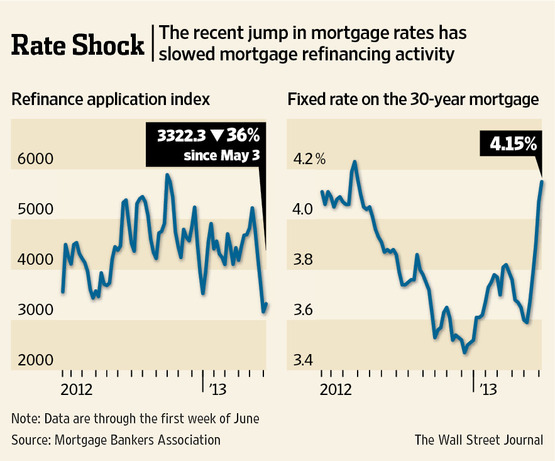
A surprise spike in mortgage rates threatens to halt a refinancing boom that has delivered strong profits for U.S. banks over the past two years.

The average rate on a 30-year mortgage rose to 4.15% last week, a 14-month high and up sharply from 3.59% in early May, according to the Mortgage Bankers Association. A separate survey released Thursday by Freddie Mac FMCC -5.56%said the rate this week was at 3.98%, up from 3.35% last month.

Refinancing applications last week were down 36% from the first week of May, before rates began climbing, according to the bankers association. Read more of this post

Watch out for the rate hike hit to banks

June 13, 2013 4:03 pm

Watch out for the rate hike hit to banks

By Gillian Tett

Regulators and bankers are assessing how damaging a US rate increase might be

Earlier this year, officials at America’s mighty Federal Deposit Insurance Corporation engaged in a bout of brainstorming with bank leaders about interest rate risk. The message was sobering.

Back then, in April, the FDIC did not seriously expect US rates to jump soon. Little wonder: at that stage, the 10-year yield was still below 2 per cent – and sinking – while Ben Bernanke, the US Federal Reserve chairman, seemed committed toquantitative easing. Read more of this post

US Bonds In “Panic” Mode

US Bonds In “Panic” Mode

Tyler Durden on 06/13/2013 21:40 -0400

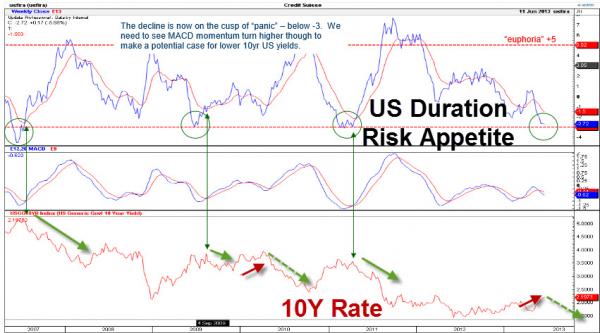
Based on Credit-Suisse’s Panic-Euphoria model of risk appetite, US bond markets are on the verge of the short-term capitulative “Panic” mode.Each time we have reached this level of ‘selling’ in the last 6 years, Treasury yields have compressed significantly. At the same time, equity risk appetite remains bearish and US credit risk appetite has resumed its decline (but relative to Treasuries they are significantly over-sold). Not a pretty picture… Bonds hit “Panic” levels of risk appetite…

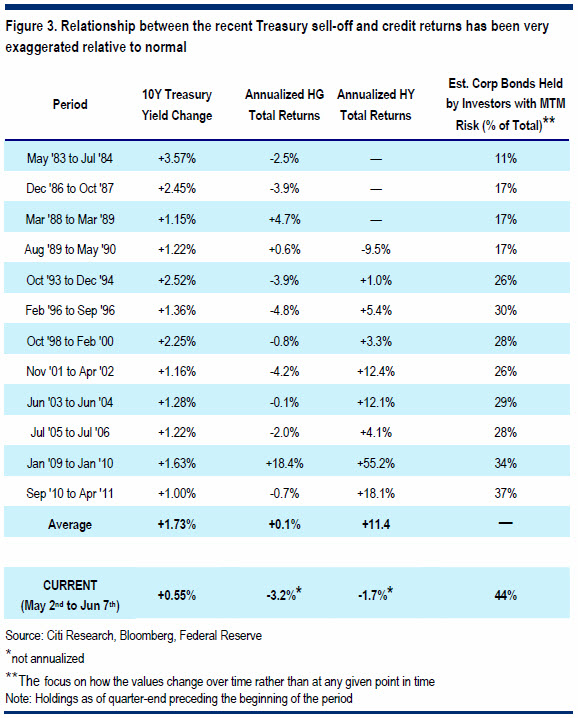
As Citi notes, Investors fear the 1994 redux trade, are looking at ways to short markets that may be vulnerable to rising rates, including credit. But in total return terms the credit space has already suffered quite dramatically. The chart below shows that the high-grade and high-yield markets are down 3.2% and 1.7%, respectively, since the Treasury backup began in early May, which is far more severe than what normally occurs when rates rise (annualized long-term average of +0.1% and +11.4%, respectively).

20130613_Panic_020130613_Panic3


The number of companies tapping the bond market has collapsed as a result of rising interest rates, threatening to halt a global refinancing wave that helped companies boost earnings and strengthen balance sheets

June 13, 2013 6:26 pm

Bond sales dry up as interest rates rise

By Vivianne Rodrigues and Stephen Foley in New York

The number of companies tapping the bond market has collapsed as a result of rising interest rates, threatening to halt a global refinancing wave that helped companies boost earnings and strengthen balance sheets.

Bond investors have retrenched in the face of increasing market volatility since Fed chairman Ben Bernanke hinted on May 22 at a possible “tapering” of US quantitative easing. This has left companies unable to raise financing on previously beneficial terms. Read more of this post

Hair-Loss Drugs’ Big Growth in China; Sales of hair-loss drugs in China, where a full head of hair is linked to virility, have soared 90 percent since 2007. BaWang, Chinese maker of herbal shampoos, posted three straight years of loss

Hair-Loss Drugs’ Big Growth in China

By Daryl Loo and Lisa Pham on June 13, 2013

When Shi Yang was studying and working in France several years ago, most of his colleagues were bald—which made his own thinning pate more tolerable. But since Shi’s return to China in 2011, the 26-year-old Shanghai engineer’s hair loss has become an issue. “You will definitely stick out more back in China,” explains the bespectacled engineer, who says he has a better chance of landing a girlfriend if he has a thick thatch of hair. That’s why after raw-ginger scalp rubs and walnut snacks failed to counter his receding hairline, Shi says he’s ready to give Western drugs a try. Read more of this post

Banks face derivatives shake-up in Asia

June 13, 2013 12:40 pm

Banks face derivatives shake-up in Asia

By Jeremy Grant in Singapore

Global banks trading over-the-counter (OTC) derivatives with some Asian counterparties risk being in breach of US regulations or falling foul of Asian countries’ data secrecy laws as sweeping US rules on such markets take effect.

This latest hurdle to the smooth implementation of the US Dodd-Frank Act is another blow to the growth of Asian OTC markets, which could be derailed if participation becomes too difficult. Read more of this post

US Coal Exports Plunge Due to Tremendous Asian Oversupply

June 13, 2013, 6:18 p.m. ET

Coal Exports Plunge

Asian Oversupply Leads to 31% Drop in April and Fears of Lower U.S. Profits

By KRIS MAHER

MK-CD997_COAL_NS_20130613181814

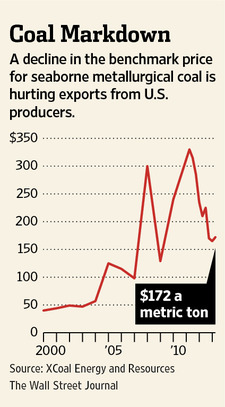
The export spigot for coal is beginning to close.

In a troubling sign for U.S. coal producers, shipments fell 31% in April from the prior month, driven largely by an oversupply in Asia for metallurgical coal used in steelmaking. U.S. producers are now at a further disadvantage to overseas competitors because weakening metallurgical-coal prices are making high-cost U.S. production less profitable for export.

“The industry has found itself in a position where there’s a tremendous oversupply,” said Ernie Thrasher, chief executive of XCoal, a U.S. coal trader that works on behalf of U.S. producers who want to sell coal in Asia. Read more of this post

Del Monte is exploring a sale of the canned-food business that made it a household name as the company increasingly focuses on products for dogs and cats.

Updated June 13, 2013, 5:39 p.m. ET

Del Monte Canned-Food Business Is Up for Sale

By DANA MATTIOLI and MIKE SPECTOR

Del Monte Corp. is exploring a sale of the canned-food business that made it a household name, said people familiar with the matter, as the company increasingly focuses on products for dogs and cats.

The San Francisco-based canned-food and pet-food company is gauging interest from potential buyers of the division, the people said, adding that the process is in the early stages. The canned-food business generates about $1.8 billion in sales annually, or about half of the company’s revenue. Read more of this post

Companies listed on the FTSE Bursa Malaysia KLCI Index now generate 45% of their revenue from overseas; the top 10% of firms in the Malaysian equity market capturing an average of 82% of the capital raised over the last five years

Friday June 14, 2013

PM urges EPF, other GLCs to step up involvement in smaller companies

By RAZAK AHMAD
razak@thestar.com.my

KUALA LUMPUR: The Employees Provident Fund (EPF) and other Government-linked investment companies should step up their involvement particularly in high quality mid-cap stocks, said Datuk Seri Najib Tun Razak.

The Prime Minister said the fund management industry, including public sector funds, should set specific objectives to increase the velocity of trades in the shares of such companies. Read more of this post

Goldman offers top clients automated block trading; “Everyone brings a different twist to the way they’re trying to solve a common problem, which is: How do you continue to bring high-touch service in an industry that’s facing downward commissions revenue?”

Updated: Friday June 14, 2013 MYT 9:01:24 AM

Goldman offers top clients automated block trading

NEW YORK: Goldman Sachs Group Inc has quietly offered some top clients a tool that allows them to plug into its trading system and buy or sell large blocks of stock electronically.

The technology is part of a broader platform called Marquee, details of which not been previously reported, but were confirmed to Reuters by Goldman executives. It is the latest attempt by a Wall Street bank to automate block trading, a small sliver of the equities business that is still handled mostly by humans rather than specialized computer programs. Read more of this post

China Local Debt Audit ‘Credit Negative,’ Moody’s Says

China Local Debt Audit ‘Credit Negative,’ Moody’s Says

By Bloomberg News on June 13, 2013

China’s government risks being forced to bail out some local authorities and take over their liabilities after a report from the nation’s audit office showed a jump in borrowings, Moody’s Investors Service said.

The National Audit Office review indicates that total local government direct and guaranteed debt may have risen 13 percent to 12.1 trillion yuan ($2 trillion) by end-2012 from end-2010, Moody’s said, citing its own calculations based on data in the report which showed a 13 percent increase in the debts of a sample 36 local authorities. Read more of this post

Chinese corporate and household debt interest payments as a share of GDP has doubled since 2002 to 12%

June 12, 2013, 11:11 p.m. ET

The Next Move for Beijing

By TOM ORLIK

AM-AY973_CHINAH_NS_20130613045403

A prolonged slowdown in China’s growth sharpens the need for an innovative policy response. Fortunately for Beijing, it has more-creative options than another government spending spree.

The latest indications from the world’s second-largest economy are worrying. Industrial output and investment are decelerating. After stripping out the effect of over-invoicing, export growth is flat lining. It’s all enough to have Goldman Sachs strategist Jiming Ha wondering whether China is on the way to 6% annual growth, well below the first quarter’s 7.7%. Read more of this post

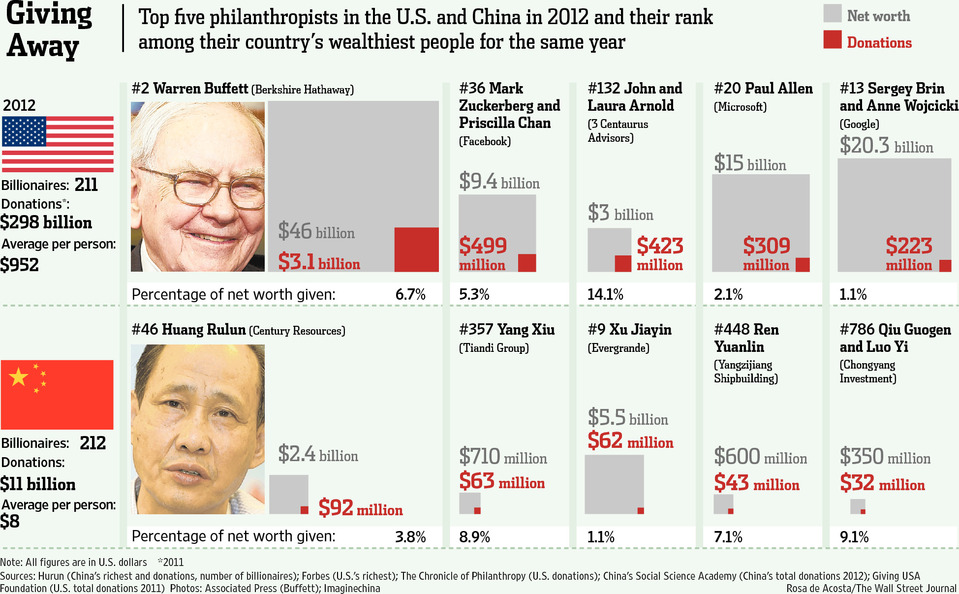
In China, Philanthropy Gains Cachet; people are now eager to show off pictures they took at an earthquake-stricken zone or on visits to rural schools

June 13, 2013, 2:06 p.m. ET

In China, Philanthropy Gains Cachet

By WEI GU

AM-AY971_WEICOL_G_20130613131807

When Warren Buffett and Bill Gates asked 50 of China’s richest people to a philanthropy dinner in Beijing in 2010, a third turned down the invitations, fearing they would be pressed to donate money.

Three years later, rich Chinese are starting to get more comfortable with giving.

Social media are abuzz with pictures of charity dinners and celebrities promoting causes. Displays of wealth are calming down, and people are now eager to show off pictures they took at an earthquake-stricken zone or on visits to rural schools. Read more of this post

Fed Could Drain the Oil Market’s Tank; At around 394 million barrels, U.S. commercial stocks of crude oil, excluding the strategic petroleum reserve, are hovering around their highest levels since the early 1980s

June 12, 2013, 2:56 p.m. ET

Fed Could Drain the Oil Market’s Tank

By LIAM DENNING

There is a shadow looming over oil prices in the shape of a big tank—and a big central bank.

The U.S. last year posted the biggest increase in oil production in the world and largest increase in U.S. history. But is there a shadow in the form of a central bank looming oil prices? Heard on the Street editor Liam Denning reports.

At around 394 million barrels, U.S. commercial stocks of crude oil, excluding the strategic petroleum reserve, are hovering around their highest levels since the early 1980s. Read more of this post

Shocking is the word that describes a report by Korea’s government auditors on the debt of major state-owned companies; During five years under the former Lee Myung-bak administration, the combined debt of nine public enterprises more than doubled, from 128 trillion won ($113 billion) to 284 billion won

2013-06-13 17:32

Public enterprises’ debt

Shocking is the word that describes a report by government auditors on major state-owned companies released Wednesday. During five years under the former Lee Myung-bak administration, the combined debt of nine public enterprises more than doubled, from 128 trillion won ($113 billion) to 284 billion won.

The biggest reason was the “ostrich” fiscal operation of the previous government. While pushing ahead with massive public works, including the controversial four-river refurbishment project, it passed the burden from snowballing budget deficits to state-owned enterprises (SOEs).

That was a most glaring example of irresponsible fiscal management, which does not stop at aggravating the bottom lines of these state firms but puts strict restraints on the succeeding government’s economic operation and eventually leads to heavier burdens on taxpayers. Major, if not the only beneficiaries were large construction firms and officials who received kickbacks from them.  Read more of this post

AustralianSuper, the nation’s biggest industry fund, has tipped a spate of mergers through the $1.6 trillion retirement savings sector as funds seek to take on the wealth arms of the major banks

$62b AusSuper eyes mergers

June 14, 2013

Madeleine Heffernan

AustralianSuper, the nation’s biggest industry fund, has tipped a spate of mergers through the $1.6 trillion retirement savings sector as funds seek to take on the wealth arms of the major banks. Ian Silk, the chief executive of the $62 billion AustralianSuper, has foreshadowed further deals by the fund, following mergers in recent years with the multibillion-dollar funds Westscheme and AGEST. ”It’s pretty clear that the regulators and public policy is pushing in the direction of a smaller number of large funds rather than a large number of smaller funds,” Mr Silk told BusinessDay.

Read more of this post

‘Missing’ superannuation funds reach $18b; For NSW and Victoria, the average estimated lost amount per person with super is about $2500

‘Missing’ super funds reach $18b

June 14, 2013

John Collett

The pile of ”lost” superannuation has risen to $18.1 billion, up from $17.4 billion a year ago.

The latest Westpac Lost Super Report, researched by Core Data, estimates half the population with superannuation funds is likely to have lost some super.

”We are all planning to retire, so why don’t more of us spend just a few minutes to find any lost super?” Westpac head of superannuation Deanne Stewart said.

For NSW and Victoria, the average estimated lost amount per person with super is about $2500. Read more of this post

Private equity firms are sitting on $116 billion of assets trapped in so-called zombie funds that lie dormant but still rake in fees from investors

More than $100 billion trapped in ‘zombie funds:’ industry data

1:00pm EDT

LONDON (Reuters) – Private equity firms are sitting on $116 billion of assets trapped in so-called zombie funds that lie dormant but still rake in fees from investors, research showed on Thursday.

Almost 1,200 private equity funds can be classed as “zombie” – poor-performing funds that have been retained beyond their planned life span and whose managers have little hope of raising more money – according to data from industry tracker Preqin. Read more of this post

Agriculture Prices Slump After Emerging Market Currency Weakness

Agriculture Prices Slump After Emerging Market Currency Weakness

Agricultural commodities fell to the lowest in almost one year as weakening currencies in emerging markets heightened speculation that farmers from Brazil to Indonesia will boost exports, adding to supplies.

The Standard & Poor’s GSCI Agricultural gauge of eight farm commodities including sugar, coffee and soybeans fell 2.3 percent by 5:10 p.m. in London, heading the lowest close since June 19, 2012. Nineteen of 24 emerging market currencies tracked by Bloomberg sild against the dollar by an average 3.2 percent in the past month.

Supplies of everything from soybeans to wheat are set to increase this year as planting rebounded following droughts in the U.S. and Russia in 2012. The global sugar surplus will be a record in the 12 months ending in September, the International Sugar Organization in London estimates. Weaker currencies make overseas sales prices in dollars more attractive. Read more of this post

Silver Faithful Taking $5 Billion Hit in Crossfire: Commodities

Silver Faithful Taking $5 Billion Hit in Crossfire: Commodities

Silver is punishing investors amid diminishing trust in precious metals as a store of wealth and concern that growth is weakening, with $5.2 billion erased from the value of their near-record holdings this year.

Investors expected silver to be one of the biggest gainers in 2013, with a 33 percent return, a Bloomberg survey in December showed. Instead it’s leading a retreat in commodities with a 28 percent plunge to $21.79 an ounce, on track for its worst performance since 1984. While the median prediction from 14 estimates compiled last week is for a rally to $23.50 by Dec. 31, that would still mean a 23 percent drop for the year. Read more of this post

Gold Bears Return as ETP Rout Extends to 17th Week and India, the biggest buyer, announced curbs on imports

Gold Bears Return as ETP Rout Extends to 17th Week: Commodities

Gold traders turned bearish for the first time in a month as investors reduced holdings in exchange-traded products for an unprecedented 17th consecutive week and India, the biggest buyer, announced curbs on imports.

Eighteen analysts surveyed by Bloomberg expect prices to fall next week, with 14 bullish and four neutral, the largest proportion of bears since May 17. Investors sold 490.4 metric tons valued at $21.8 billion through ETPs since Feb. 8 and the 2,124.7 tons left is the least they have held since April 2011, data compiled by Bloomberg show.

Bullion is on track for the first annual drop since 2000 as some investors lose faith in it as a store of value. While the slump into a bear market in April hurt billionaire hedge fund manager John Paulson and producer Newcrest Mining Ltd. (NCM), it spurred purchases of coins and jewelry worldwide. That demand may be threatened in India after the nation raised gold import taxes to contain a record current-account deficit. Read more of this post

Gold Imports by India Seen Tumbling as Curbs Boost Titan’s Costs; “These regulations will affect cash margins of jewelers due to higher cost of funding as equity or unsecured domestic loans will be used to fund purchases and inventory will have to be fully paid for in cash compared with gold on lease earlier”

Gold Imports by India Tumbling as Curbs Boost Titan’s Costs

Gold imports by India, the world’s largest consumer, are plunging as an increase in tax and restrictions on financing shipments boost costs for jewelers, helping the nation contain a record current-account deficit.

Shipments in June will decline as only orders placed before the curbs are being imported now, said Rajesh Mehta, chairman of Rajesh Exports Ltd. (RJEX) Overseas purchases tumbled to an average $36 million a day in the 14 business days through June 7, compared with an average $135 million a day through 13 days until May 20, Raghuram Rajan, chief economic adviser in the Finance Ministry, said in a statement on June 11. Read more of this post

High-end seafood businesses flounder amid spending cut and crackdown on graft and extravagance; “It has been the worst time for seafood-related industries in a decade”

Seafood businesses flounder amid spending cut

Updated: 2013-06-14 02:10

By WANG ZHUOQIONG ( China Daily) Read more of this post

Mollusk-Eating Chinese Fuel Junk-Loan Trawl at Clearwater

Mollusk-Eating Chinese Fuel Junk-Loan Trawl at Clearwater

Clearwater Seafoods Inc. (CLR) plans to join Canadian peers borrowing more in the U.S. leveraged-loan market to finance a 200-foot vessel to harvest clams for China’s mollusk-loving middle class.

The Bedford, Nova Scotia-based company which has doubled sales to Asia since 2008 is planning to issue about $335 million of term loans by early July, said Tyrone Cotie, Clearwater’s treasurer. While some of the money will be used to repay and refinance debt, Clearwater plans to use the rest to build a ship equipped with automated shucking machines to prepare the bivalves for export, he said. Read more of this post

Asahi to Ajinomoto CEOs Betting Abenomics Won’t Spur Inflation

Asahi to Ajinomoto CEOs Betting Abenomics Won’t Spur Inflation

Japan’s consumer goods makers and retailers aren’t buying Abenomics (JNMBMOBE).

Sixth months into an economic program that sparked faster growth and the world’s biggest stocks rally this year, consumer goods companies are still planning for deflation.

“We aren’t thinking about raising prices,” said Akiyoshi Koji, president of Asahi Breweries Ltd. (2502), which makes the country’s best-selling Super Dry beer.

Koji’s closest rival, Kirin Holdings Co. President Senji Miyake, said the signs of an improving economy aren’t enough to prompt a shift from a strategy to expand outside Japan. Their outlook is another hurdle for Prime Minister Shinzo Abe’s campaign to reflate the world’s third-largest economy and end 15 years of deflation. Read more of this post

Dollar Correlates to Stocks in Economy Obama Desires: Currencies

Dollar Correlates to Stocks in Economy Obama Desires: Currencies

The dollar is moving more in tandem with stocks than any time since 2008 in a sign that traders are gaining confidence in the sustainability of the U.S. recovery.

The U.S. Dollar Index and the Standard & Poor’s 500 Index are the most closely correlated since the start of the global financial crisis, according to data compiled by Bloomberg. The gauges started moving more in lockstep last month as the greenback jumped to an almost three-year high and U.S. equities surged to a record.

Traders retreating from emerging markets are seeking America’s currency as everything from jobs to consumer confidence and housing fuel the economy while the euro zone struggles with recession, Japan debases its currency and the U.K. stagnates. Rising U.S. bond yields as the Federal Reserve debates whether to slow bond purchases are adding to the dollar’s allure. Read more of this post